Blog
/
/
May 14, 2019

[Part 1] 10 Cyber Hygiene Issues Leading to a Security Breach

Spotting cyber hygiene issues caused by a lapse of attention requires AI tools that alert critical changes to network activity. Read part one here!
Inside the SOC
Darktrace cyber analysts are world-class experts in threat intelligence, threat hunting and incident response, and provide 24/7 SOC support to thousands of Darktrace customers around the globe. Inside the SOC is exclusively authored by these experts, providing analysis of cyber incidents and threat trends, based on real-world experience in the field.
Written by
Max Heinemeyer
Global Field CISO
Default blog imageDefault blog imageDefault blog imageDefault blog imageDefault blog imageDefault blog image
14
May 2019

For as long as people have sought to protect their assets from intrusion, they have safeguarded those assets behind ever more formidable walls, from castle walls made of stone to firewalls comprised of code. Yet no matter how impenetrable such fortifications appear, motivated attackers will inevitably find a way to bypass them. Build a 50-foot fence, and the enemy will bring a 50-foot ladder. Install state-of-the-art endpoint security on every employee’s computer, and cyber-criminals will infiltrate via the smart refrigerator in the office kitchen.

Needless to say, reinforcing the perimeter is still a good idea. Just as a castle in ruins makes a poor home for a king, so too do weak endpoint defenses put intellectual property and sensitive data at risk. The reality, however, is that digital environments are exponentially more difficult to wall off than physical ones, given the sheer number of applications and users that can compromise an entire network with just a single vulnerability or oversight. Improving a company’s cyber hygiene is therefore a continual responsibility, the nature of which perpetually changes as the business evolves.

Because even flawless cyber hygiene isn’t guaranteed to keep external attackers — let alone malicious insiders — from breaching the perimeter, leading companies and governments have turned to cyber AI technologies. Cyber AI works by learning the particular behaviors of a network and its users, allowing it to pick up on the subtly anomalous activity associated with an already infected device. Such technologies have shined a light on ten of the most commonly exploited cyber hygiene issues, five of which are examined below. And whereas there is no silver bullet when it comes to securing the enterprise online, patching these holes in the perimeter is nevertheless a critical first step.

Issue #1: Using SMBv1 — for anything

Server Message Block (SMB) is a very common application layer protocol that provides shared access to files, printers, and serial ports to devices in a network. The latest version, SMBv3, was developed with security in mind, whereas the original version, SMBv1, is more than three decades old and — in Microsoft’s own words — “was designed for a world that no longer exists[;] a world without malicious actors.” As a result, Microsoft has long implored users to stop using it in the strongest possible terms.

However, many of these users still have not disabled the protocol on operating systems older than Windows 8.1 and Windows Server 2012 R2, which do not allow SMB1 to be removed. The 2017 WannaCry ransomware attack abused the famous exploit EternalBlue in SMBv1 to infect Windows machines and move laterally in Windows environments, precipitating billions of dollars in global losses. Furthermore, SMBv1 allows NTLM logins using the anonymous credential by default, while successful anonymous logins can allow attackers to enumerate the target device for more information.

In light of the serious security risks that SMBv1 introduces, Darktrace flags its usage as threatening with the following models:

  • Anomalous Connection / Unusual SMB Version 1 Connectivity
  • Compliance / SMB Version 1 Usage

Issue #2: SMB services exposed to the internet

As mentioned above, SMB allows devices in a network to communicate with one another for a variety of purposes — functionalities that render it a complex protocol with many known vulnerabilities. Users are consequently highly discouraged from allowing connections from the internet to internal devices via any version of SMB — not just SMBv1.

Darktrace detected this poor hygiene practice in early 2019, when it observed the use of SMB from external IP addresses connecting to an internal device. The device happened to be a Domain Controller (DC), a server which manages network security and is responsible for user authentication. Due to the critical network function performed by this server, it is a high value target for cyber-criminals, meaning that any external connections should be limited to only essential administrative activity. In this incident, the external device was seen accessing the DC via SMBv1 and performing anonymous login. Fortunately, Darktrace AI detected the potential compromise with the model Compliance / External Windows Communications.

Issue #3: RDP services exposed to the internet

Microsoft’s proprietary Remote Desktop Protocol (RDP) provides a remote connection to a network-connected computer, affording users significant control over another device and its resources. Such extensive capabilities represent the holy grail for attackers, whether they seek to gain an initial foothold in the network, access restricted content, or directly drop malware on the controlled computer. Exposing devices with RDP services to the internet therefore creates a significant vulnerability in the network perimeter, as passwords and user credentials are liable to be brute-forced by those with malign intent.

Last month, Darktrace’s cyber AI detected a large number of incoming connections over the RDP protocol to a customer’s internet-facing device — possible indicators of a brute-force attack. While this activity might have been benign under different circumstances, the AI’s understanding of ‘self’ versus ‘not self’ for the particular device in question enabled it to flag the connections as anomalous, since they breached its Compliance / Incoming RDP from Rare Endpoints model.

By investigating further with Darktrace’s device tracking capability, we can see that the computer also breached several other AI models, including Compliance / Crypto Currency Mining Activity, Compliance / Outbound RDP, and Compromise / Beaconing Activity to External Rare. These breaches suggest that the attackers might have sought to use the computer to plant crypto-mining modules on other network-connected devices.
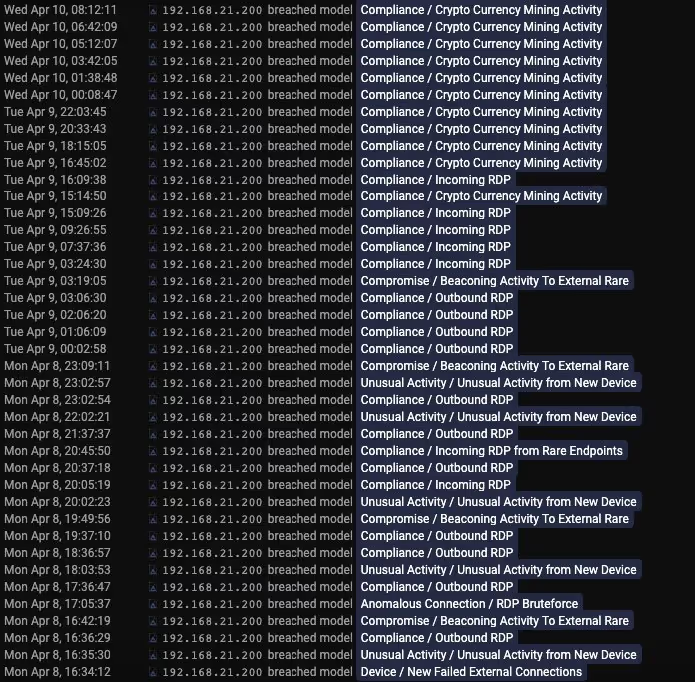
Models that the device breached within three days

Issue #4: Data uploads to unapproved cloud services

No innovation has antiquated the perimeter-only approach to cyber security more than cloud computing, since cloud and hybrid infrastructures have nebulous borders at best. Nevertheless, there are a number of bad cyber hygiene habits that make bypassing perimeter defenses much easier, including employees who upload data to close storage providers that are not on an organization’s approved list. Whether done maliciously or inadvertently, this decision prevents organizations from gaining any visibility over that data being transferred across the globe.

Darktrace cyber AI detects such unauthorized data movements with the following models:

  • Anomalous Connection / Data Sent To New External Device
  • Unusual Activity / Unusual External Data Transfer

Issue #5: Weak password usage and storage

Among the most common and most avoidable cyber-attacks are those that exploit systems with weak passwords, which can be breached by brute-force or dictionary attacks. Yet stronger, more complex passwords introduce a separate problem: because they are harder to be remember, users tend to store these passwords in sometimes unsafe locations. Whereas passwords housed in encrypted mediums such as password managers are relatively secure, many users instead save them in cleartext. Several modern strains of malware possess the ability to comb through the network in search of possible files which contains passwords, rendering this a critical vulnerability.

Darktrace has a set of models to spot such attempts at password guessing:

  • Device / SMB Session Bruteforce
  • Unusual Activity / Large Volume of Kerberos Failures
  • User / Kerberos Password Bruteforce
  • SaaS / Login Bruteforce Attempt

Darktrace also has a set of models that flag anomalous password storage or access:

  • Compliance / Sensitive Terms in Unusual SMB Connection
  • Compliance / Possible Unencrypted Password Storage
  • SaaS / Unusual SaaS Sensitive File Access

Read the second part: Part two — The perils of convenience

Inside the SOC
Darktrace cyber analysts are world-class experts in threat intelligence, threat hunting and incident response, and provide 24/7 SOC support to thousands of Darktrace customers around the globe. Inside the SOC is exclusively authored by these experts, providing analysis of cyber incidents and threat trends, based on real-world experience in the field.
Written by
Max Heinemeyer
Global Field CISO

More in this series

No items found.

Blog

/

Email

/

December 3, 2025

Darktrace Named as a Leader in 2025 Gartner® Magic Quadrant™ for Email Security Platforms

Default blog imageDefault blog image

Darktrace is proud to be named as a Leader in the Gartner® Magic Quadrant™ for Email Security Platforms (ESP). We believe this recognition reflects what our customers already know: our product is exceptional – and so is the way we deliver it.

In July 2025, Darktrace was named a Customers’ Choice in the Gartner® Peer Insights™ Voice of the Customer for Email Security, a distinction given to vendors who have scores that meet or exceed the market average for both axes (User Interest and Adoption, and Overall Experience). To us, both achievements are testament to the customer-first approach that has fueled our rapid growth. We feel this new distinction from Gartner validates the innovation, efficacy, and customer-centric delivery that set Darktrace apart.

A Gartner Magic Quadrant is a culmination of research in a specific market, giving you a wide-angle view of the relative positions of the market’s competitors. CIOs and CISOs can use this research to make informed decisions about which email security platform can best accomplish their goals. We encourage our customers to read the full report to get the complete picture.

This acknowledgement follows the recent recognition of Darktrace / NETWORK, also designated a Leader in the Gartner Magic Quadrant for Network Detection & Response and named the only Customers’ Choice in its category.

Why do we believe Darktrace is leading in the email security market?

Our relentless innovation which drives proven results  

At Darktrace we continue to push the frontier of email security, with industry-first AI-native detection and response capabilities that go beyond traditional SEG approaches. How do we do it?

  • With a proven approach that gets results. Darktrace’s unique business-centric anomaly detection catches advanced phishing, supply chain compromises, and BEC attacks – detecting them on average 13 days earlier than attack-centric solutions. That’s why 75% of our customers have removed their SEG and now rely on their native email security provider combined with Darktrace.
  • By offering comprehensive protection beyond the inbox. Darktrace / EMAIL goes further than traditional inbound filtering, delivering account and messaging protection, DLP, and DMARC capabilities, ensuring best-in-class security across inbound, outbound, and domain protection scenarios.  
  • Continuous innovation. We are ranked second highest in the Gartner Critical Capabilities research for core email security function, likely thanks to our product strategy and rapid pace of innovation. We’ve release major capabilities twice a year for nearly five years, including advanced AI models and expanded coverage for collaboration platforms.

We deliver exceptional customer experiences worldwide

Darktrace’s leadership isn’t just about excelling in technology, it’s about delivering an outstanding experience that customers value. Let’s dig into what makes our customers tick.

  • Proven loyalty from our base. Recognition from Gartner Peer Insights as a Customers’ Choice, combined with a 4.8-star rating (based on 340 reviews as of November 2025), demonstrates for us the trust of thousands of organizations worldwide, not just the analysts.  
  • Customer-first support. Darktrace goes beyond ticket-only models with dedicated account teams and award-winning service, backed by significant headcount growth in technical support and analytics roles over the past year.
  • Local expertise. With offices spanning continents, Darktrace is able to provide regional language support and tailored engagement from teams on the ground, ensuring personalized service and a human-first experience.

Darktrace enhances security stacks with a partner-first architecture

There are plenty of tools out there than encourage a siloed approach. Darktrace / EMAIL plays well with others, enhancing your native security provider and allowing you to slim down your stack. It’s designed to set you up for future growth, with:

  • A best-in-breed platform approach. Natively built on Self-Learning AI, Darktrace / EMAIL delivers deep integration with our / NETWORK, / IDENTITY, and / CLOUD products as part of a unified platforms – that enables and enhances comprehensive enterprise-wise security.
  • Optimized workflows. Darktrace integrates tightly with an extended ecosystem of security tools – including a strategic partnership with Microsoft enabling unified threat response and quarantine capabilities – bringing constant innovation to all of your SOC workflows.  
  • A channel-first strategy. Darktrace is making significant investments in partner-driven architectures, enabling integrated ecosystems that deliver maximum value and future-ready security for our customers.

Analyst recognized. Customer approved.  

Darktrace / EMAIL is not just another inbound email security tool; it’s an advanced email security platform trusted by thousands of users to protect them against advanced phishing, messaging, and account-level attacks.  

As a Leader, we believe we owe our positioning to our customers and partners for supporting our growth. In the upcoming years we will continue to innovate to serve the organizations who depend on Darktrace for threat protection.  

To learn more about Darktrace’s position as a Leader, view a complimentary copy of the Magic Quadrant report, register for the Darktrace Innovation Webinar on 9 December, 2025, or simply request a demo.

Gartner, Gartner® Magic Quadrant™ for Email Security Platforms, Max Taggett, Nikul Patel, 3 December 2025

GARTNER is a registered trademark and service mark of Gartner, Inc. and/or its affiliates in the U.S. and internationally and is used herein with permission. All rights reserved. Magic Quadrant is a registered trademark of Gartner, Inc. and/or its affiliates and is used herein with permission. All rights reserved.

Gartner does not endorse any vendor, product or service depicted in its research publications, and does not advise technology users to select only those vendors with the highest ratings or other designation. Gartner research publications consist of the opinions of Gartner’s research organization and should not be construed as statements of fact. Gartner disclaims all warranties, expressed or implied, with respect to this research, including any warranties of merchantability or fitness for a particular purpose.

This graphic was published by Gartner, Inc. as part of a larger research document and should be evaluated in the context of the entire document. The Gartner document is available upon request from Darktrace.

[related-resource]

Continue reading
About the author
Carlos Gray
Senior Product Marketing Manager, Email

Blog

/

/

December 2, 2025

Protecting the Experience: How a global hospitality brand stays resilient with Darktrace

Default blog imageDefault blog image

For the Global Chief Technology Officer (CTO) of a leading experiential leisure provider, security is mission critical to protecting a business built on reputation, digital innovation, and guest experience. The company operates large-scale immersive venues across the UK and US, blending activity-driven hospitality with premium dining and vibrant spaces designed for hundreds of guests. With a lean, centrally managed IT team responsible for securing locations worldwide, the challenge is balancing robust cybersecurity with operational efficiency and customer experience.

Brand buzz attracts attention – and attacks

Mid-sized, fast-growing hospitality organizations face a unique risk profile. When systems go down in a venue, the impact is immediate: hundreds of disrupted guest experiences, lost revenue during peak hours, and potential long-term reputation damage. Each time the organization opened a new venue, the surge of marketing buzz attracted attention in local markets and waves of sophisticated cyberattacks, including:

Phishing campaigns leveraging brand momentum to lure employees into clicking on malicious links.

AI-enhanced impersonation using advanced techniques to create AI-generated video calls and deep-researched, contextualized emails  

Fake domains targeting leadership with AI-generated messages that contained insider context gleaned from public information.

“Our endpoint security and antivirus tools were powerless against these sophisticated AI-powered campaigns. We didn’t want to manage incidents anymore. We wanted to prevent them from ever happening.”  - Global CTO

Proactive, preventative security with Darktrace AI

The company’s cybersecurity vision was clear: “Proactive, preventative – that was our mandate,” said the CTO. With a lean and busy IT group, the business evaluated several security solutions using deep-dive workshops. Darktrace proved the best fit for supporting the organization’s proactive mindset, offering:

  • Autonomy without added headcount: Darktrace provided powerful AI-driven detection and autonomous response functions with minimal manual oversight required.
  • Modular adoption: The company could start with core email and network protection and expand into cloud and endpoint coverage, aligning spend with growth.
  • Partnership and responsiveness: “We wanted people we trust, respect, and know will show up when we need them. Darktrace did just that,” said the CTO.
  • Affordability at scale: Darktrace offered reasonable upfront costs plus predictable, sustainable economics as the company and IT infrastructure expanded.  

“The combination of AI capabilities, a scalable model, and a strong engagement team tipped the balance in Darktrace’s favor, and we have not been disappointed,” said the CTO.

Phased deployment builds trust

To minimize disruption to critical hospitality systems like global Point of Sales (POS) terminals and Audio-Visual (AV) infrastructure, deployment was phased:

  1. Observation and human-led response: Initially, Darktrace was deployed in detection-only mode. Alerts were manually reviewed.
  2. Incremental autonomous response: Darktrace Autonomous Response was enabled on select models, taking action on low-risk scenarios. Higher-risk subnets and devices remained under human control.
  3. Full autonomous coverage: With tuning and reinforcement, autonomous response was expanded across domains, trusted to take decisive action in real time. Analysts retained the ability to review and contextualize incidents.

“Darktrace managed the rollout through detailed, professional, and responsive project management – ensuring a smooth, successful adoption and creating a standardized cybersecurity playbook for future venue launches,” said the CTO.  

AI delivers the outcomes that matter  

Measurable efficiency replaces endless alerts

Darktrace autonomous response significantly decreased false alerts and noise. “If it’s quiet, we’re confident there isn’t a problem,” said the CTO. Within six months, Darktrace conducted 3,599 total investigations, detected and contained 320 incidents indicative of an attack, resolved 91% of those events autonomously, and escalated only 9% to human analysts. The efficiency gains were enormous, saving analysts 740 hours on investigations within a single month.  

Precision AI turns inbox chaos into calm

Darktrace Self-Learning AI modeled sender/recipient norms, content/linguistic baselines, and communication patterns unique to the organization’s launch cadence, resulting in:

  • Automated holds and neutralizations of anomalous executive-style messages
  • Rapid detection of novel templates and tone shifts that deviated from the organization’s lived email graph, even when indicators were not yet on any feed
  • Downstream reduction in help-desk escalations tied to suspicious email

Full visibility fuels real-time response

Darktrace gives IT direct visibility without extra licensing, and it surfaces ground truth across every venue, including:

  • Device geolocation and placement drift: Darktrace exposed devices and users operating outside approved zones, prompting new segmentation and access-control policies.
  • Guest Wi-Fi realities: Darktrace AI uncovered high-risk activity on guest networks, like crypto-mining and dark-web traffic, driving stricter VLAN separation and access hygiene.
  • Lateral-movement containment: Autonomous response fenced suspicious activity in real time, buying time for human investigation while keeping POS and AV systems unaffected.

Smarter endpoints for a smarter network

Endpoints once relied on static agents effective only against known signatures. Darktrace’s behavioral models now detect subtle anomalies at the endpoint process level that EDRs often miss, such as misuse of legitimate applications (commonly used in living-off-the-land attacks), unapproved application usage and policy violations. This increases the accuracy and fidelity of network-based investigations by adding endpoint process context alongside existing EDR alerts.

Autonomous response for continuous compliance

Across PCI, GDPR, and cross-border privacy obligations, Darktrace’s native evidencing is helping the team demonstrate control rather than merely assert it:

  • Asset and flow awareness: Knowing “what is where” and “who talks to what” underpins PCI scoping and data-flow diagrams.
  • Layered safeguards: Showing autonomous prevention, network segmentation, and rapid containment supports risk registers and control attestations.
  • Audit-ready artifacts: Investigations and autonomous actions produce artifacts that “tick the box” without additional tooling.  

Defining the next era of resilience with AI

With rapid global expansion underway, the company is using its cybersecurity playbook to streamline and secure future venue launches. In the near term, IT is focused on strengthening prevention, using Darktrace insights to guide new policy updates and infrastructure changes like imposing stricter guest-network posture and refining venue device baselines.

For tech leaders charting their path to proactive cyber defense, the CTO stresses success won’t come from sidestepping AI, but from turning it into a core capability.

“AI isn’t optional – it’s operational. The real risk to your business is trying to out-scale automated adversaries with human speed alone. When applied to the right use case, AI becomes a catalyst for efficiency, resilience, and business growth.” - Global CTO
Continue reading
About the author
The Darktrace Community
Your data. Our AI.
Elevate your network security with Darktrace AI