ブログ
/
/
May 14, 2019

[Part 1] 10 Cyber Hygiene Issues Leading to a Security Breach

Spotting cyber hygiene issues caused by a lapse of attention requires AI tools that alert critical changes to network activity. Read part one here!
Inside the SOC
Darktrace cyber analysts are world-class experts in threat intelligence, threat hunting and incident response, and provide 24/7 SOC support to thousands of Darktrace customers around the globe. Inside the SOC is exclusively authored by these experts, providing analysis of cyber incidents and threat trends, based on real-world experience in the field.
Written by
Max Heinemeyer
Global Field CISO
Default blog imageDefault blog imageDefault blog imageDefault blog imageDefault blog imageDefault blog image
14
May 2019

For as long as people have sought to protect their assets from intrusion, they have safeguarded those assets behind ever more formidable walls, from castle walls made of stone to firewalls comprised of code. Yet no matter how impenetrable such fortifications appear, motivated attackers will inevitably find a way to bypass them. Build a 50-foot fence, and the enemy will bring a 50-foot ladder. Install state-of-the-art endpoint security on every employee’s computer, and cyber-criminals will infiltrate via the smart refrigerator in the office kitchen.

Needless to say, reinforcing the perimeter is still a good idea. Just as a castle in ruins makes a poor home for a king, so too do weak endpoint defenses put intellectual property and sensitive data at risk. The reality, however, is that digital environments are exponentially more difficult to wall off than physical ones, given the sheer number of applications and users that can compromise an entire network with just a single vulnerability or oversight. Improving a company’s cyber hygiene is therefore a continual responsibility, the nature of which perpetually changes as the business evolves.

Because even flawless cyber hygiene isn’t guaranteed to keep external attackers — let alone malicious insiders — from breaching the perimeter, leading companies and governments have turned to cyber AI technologies. Cyber AI works by learning the particular behaviors of a network and its users, allowing it to pick up on the subtly anomalous activity associated with an already infected device. Such technologies have shined a light on ten of the most commonly exploited cyber hygiene issues, five of which are examined below. And whereas there is no silver bullet when it comes to securing the enterprise online, patching these holes in the perimeter is nevertheless a critical first step.

Issue #1: Using SMBv1 — for anything

Server Message Block (SMB) is a very common application layer protocol that provides shared access to files, printers, and serial ports to devices in a network. The latest version, SMBv3, was developed with security in mind, whereas the original version, SMBv1, is more than three decades old and — in Microsoft’s own words — “was designed for a world that no longer exists[;] a world without malicious actors.” As a result, Microsoft has long implored users to stop using it in the strongest possible terms.

However, many of these users still have not disabled the protocol on operating systems older than Windows 8.1 and Windows Server 2012 R2, which do not allow SMB1 to be removed. The 2017 WannaCry ransomware attack abused the famous exploit EternalBlue in SMBv1 to infect Windows machines and move laterally in Windows environments, precipitating billions of dollars in global losses. Furthermore, SMBv1 allows NTLM logins using the anonymous credential by default, while successful anonymous logins can allow attackers to enumerate the target device for more information.

In light of the serious security risks that SMBv1 introduces, Darktrace flags its usage as threatening with the following models:

  • Anomalous Connection / Unusual SMB Version 1 Connectivity
  • Compliance / SMB Version 1 Usage

Issue #2: SMB services exposed to the internet

As mentioned above, SMB allows devices in a network to communicate with one another for a variety of purposes — functionalities that render it a complex protocol with many known vulnerabilities. Users are consequently highly discouraged from allowing connections from the internet to internal devices via any version of SMB — not just SMBv1.

Darktrace detected this poor hygiene practice in early 2019, when it observed the use of SMB from external IP addresses connecting to an internal device. The device happened to be a Domain Controller (DC), a server which manages network security and is responsible for user authentication. Due to the critical network function performed by this server, it is a high value target for cyber-criminals, meaning that any external connections should be limited to only essential administrative activity. In this incident, the external device was seen accessing the DC via SMBv1 and performing anonymous login. Fortunately, Darktrace AI detected the potential compromise with the model Compliance / External Windows Communications.

Issue #3: RDP services exposed to the internet

Microsoft’s proprietary Remote Desktop Protocol (RDP) provides a remote connection to a network-connected computer, affording users significant control over another device and its resources. Such extensive capabilities represent the holy grail for attackers, whether they seek to gain an initial foothold in the network, access restricted content, or directly drop malware on the controlled computer. Exposing devices with RDP services to the internet therefore creates a significant vulnerability in the network perimeter, as passwords and user credentials are liable to be brute-forced by those with malign intent.

Last month, Darktrace’s cyber AI detected a large number of incoming connections over the RDP protocol to a customer’s internet-facing device — possible indicators of a brute-force attack. While this activity might have been benign under different circumstances, the AI’s understanding of ‘self’ versus ‘not self’ for the particular device in question enabled it to flag the connections as anomalous, since they breached its Compliance / Incoming RDP from Rare Endpoints model.

By investigating further with Darktrace’s device tracking capability, we can see that the computer also breached several other AI models, including Compliance / Crypto Currency Mining Activity, Compliance / Outbound RDP, and Compromise / Beaconing Activity to External Rare. These breaches suggest that the attackers might have sought to use the computer to plant crypto-mining modules on other network-connected devices.
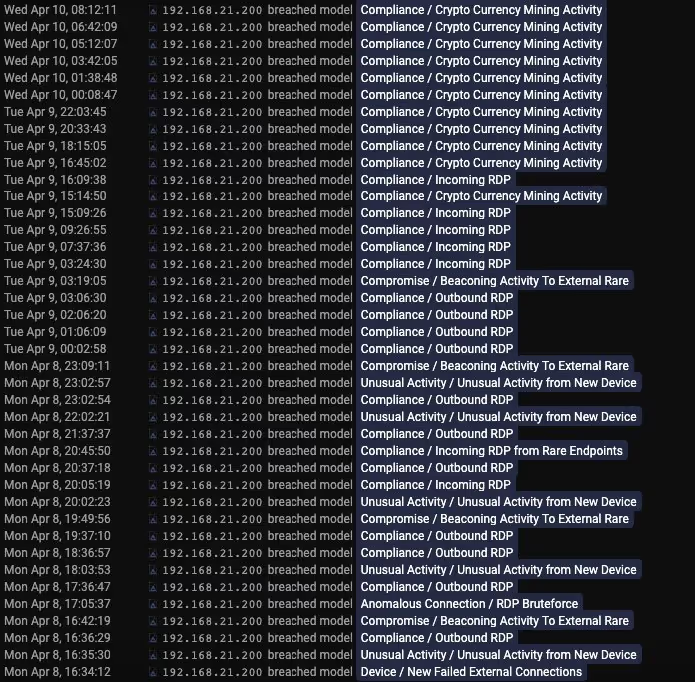
Models that the device breached within three days

Issue #4: Data uploads to unapproved cloud services

No innovation has antiquated the perimeter-only approach to cyber security more than cloud computing, since cloud and hybrid infrastructures have nebulous borders at best. Nevertheless, there are a number of bad cyber hygiene habits that make bypassing perimeter defenses much easier, including employees who upload data to close storage providers that are not on an organization’s approved list. Whether done maliciously or inadvertently, this decision prevents organizations from gaining any visibility over that data being transferred across the globe.

Darktrace cyber AI detects such unauthorized data movements with the following models:

  • Anomalous Connection / Data Sent To New External Device
  • Unusual Activity / Unusual External Data Transfer

Issue #5: Weak password usage and storage

Among the most common and most avoidable cyber-attacks are those that exploit systems with weak passwords, which can be breached by brute-force or dictionary attacks. Yet stronger, more complex passwords introduce a separate problem: because they are harder to be remember, users tend to store these passwords in sometimes unsafe locations. Whereas passwords housed in encrypted mediums such as password managers are relatively secure, many users instead save them in cleartext. Several modern strains of malware possess the ability to comb through the network in search of possible files which contains passwords, rendering this a critical vulnerability.

Darktrace has a set of models to spot such attempts at password guessing:

  • Device / SMB Session Bruteforce
  • Unusual Activity / Large Volume of Kerberos Failures
  • User / Kerberos Password Bruteforce
  • SaaS / Login Bruteforce Attempt

Darktrace also has a set of models that flag anomalous password storage or access:

  • Compliance / Sensitive Terms in Unusual SMB Connection
  • Compliance / Possible Unencrypted Password Storage
  • SaaS / Unusual SaaS Sensitive File Access

Read the second part: Part two — The perils of convenience

Inside the SOC
Darktrace cyber analysts are world-class experts in threat intelligence, threat hunting and incident response, and provide 24/7 SOC support to thousands of Darktrace customers around the globe. Inside the SOC is exclusively authored by these experts, providing analysis of cyber incidents and threat trends, based on real-world experience in the field.
Written by
Max Heinemeyer
Global Field CISO

More in this series

No items found.

Blog

/

Cloud

/

March 5, 2026

Inside Cloud Compromise: Investigating Attacker Activity with Darktrace / Forensic Acquisition & Investigation

Default blog imageDefault blog image

Investigating Cloud Attacks with Forensic Acquisition & Investigation

Darktrace / Forensic Acquisition & Investigation™ is the industry’s first truly automated forensic solution purpose-built for the cloud. This blog will demonstrate how an investigation can be carried out against a compromised cloud server in minutes, rather than hours or days.

The compromised server investigated in this case originates from Darktrace’s Cloudypots system, a global honeypot network designed to observe adversary activity in real time across a wide range of cloud services. Whenever an attacker successfully compromises one of these honeypots, a forensic copy of the virtual server's disk is preserved for later analysis. Using Forensic Acquisition & Investigation, analysts can then investigate further and obtain detailed insights into the compromise including complete attacker timelines and root cause analysis.

Forensic Acquisition & Investigation supports importing artifacts from a variety of sources, including EC2 instances, ECS, S3 buckets, and more. The Cloudypots system produces a raw disk image whenever an attack is detected and stores it in an S3 bucket. This allows the image to be directly imported into Forensic Acquisition & Investigation using the S3 bucket import option.

As Forensic Acquisition & Investigation runs cloud-natively, no additional configuration is required to add a specific S3 bucket. Analysts can browse and acquire forensic assets from any bucket that the configured IAM role is permitted to access. Operators can also add additional IAM credentials, including those from other cloud providers, to extend access across multiple cloud accounts and environments.

Figure 1: Forensic Acquisition & Investigation import screen.

Forensic Acquisition & Investigation then retrieves a copy of the file and automatically begins running the analysis pipeline on the artifact. This pipeline performs a full forensic analysis of the disk and builds a timeline of the activity that took place on the compromised asset. By leveraging Forensic Acquisition & Investigation’s cloud-native analysis system, this process condenses hour of manual work into just minutes.

Successful import of a forensic artifact and initiation of the analysis pipeline.
Figure 2: Successful import of a forensic artifact and initiation of the analysis pipeline.

Once processing is complete, the preserved artifact is visible in the Evidence tab, along with a summary of key information obtained during analysis, such as the compromised asset’s hostname, operating system, cloud provider, and key event count.

The Evidence overview showing the acquired disk image.
Figure 3: The Evidence overview showing the acquired disk image.

Clicking on the “Key events” field in the listing opens the timeline view, automatically filtered to show system- generated alarms.

The timeline provides a chronological record of every event that occurred on the system, derived from multiple sources, including:

  • Parsed log files such as the systemd journal, audit logs, application specific logs, and others.
  • Parsed history files such as .bash_history, allowing executed commands to be shown on the timeline.
  • File-specific events, such as files being created, accessed, modified, or executables being run, etc.

This approach allows timestamped information and events from multiple sources to be aggregated and parsed into a single, concise view, greatly simplifying the data review process.

Alarms are created for specific timeline events that match either a built-in system rule, curated by Darktrace’s Threat Research team or an operator-defined created at the project level. These alarms help quickly filter out noise and highlight on events of interest, such as the creation of a file containing known malware, access to sensitive files like Amazon Web Service (AWS) credentials, suspicious arguments or commands, and more.

 The timeline view filtered to alarm_severity: “1” OR alarm_severity: “3”, showing only events that matched an alarm rule.
Figure 4: The timeline view filtered to alarm_severity: “1” OR alarm_severity: “3”, showing only events that matched an alarm rule.

In this case, several alarms were generated for suspicious Base64 arguments being passed to Selenium. Examining the event data, it appears the attacker spawned a Selenium Grid session with the following payload:

"request.payload": "[Capabilities {browserName: chrome, goog:chromeOptions: {args: [-cimport base64;exec(base64...], binary: /usr/bin/python3, extensions: []}, pageLoadStrategy: normal}]"

This is a common attack vector for Selenium Grid. The chromeOptions object is intended to specify arguments for how Google Chrome should be launched; however, in this case the attacker has abused the binary field to execute the Python3 binary instead of Chrome. Combined with the option to specify command-line arguments, the attacker can use Python3’s -c option to execute arbitrary Python code, in this instance, decoding and executing a Base64 payload.

Selenium’s logs truncate the Arguments field automatically, so an alternate method is required to retrieve the full payload. To do this, the search bar can be used to find all events that occurred around the same time as this flagged event.

Pivoting off the previous event by filtering the timeline to events within the same window using timestamp: [“2026-02-18T09:09:00Z” TO “2026-02-18T09:12:00Z”].
Figure 5: Pivoting off the previous event by filtering the timeline to events within the same window using timestamp: [“2026-02-18T09:09:00Z” TO “2026-02-18T09:12:00Z”].

Scrolling through the search results, an entry from Java’s systemd journal can be identified. This log contains the full, unaltered payload. GCHQ’s CyberChef can then be used to decode the Base64 data into the attacker’s script, which will ultimately be executed.[NJ9]

Continue reading
About the author
Nathaniel Bill
Malware Research Engineer

Blog

/

Network

/

February 19, 2026

CVE-2026-1731: How Darktrace Sees the BeyondTrust Exploitation Wave Unfolding

Default blog imageDefault blog image

Note: Darktrace's Threat Research team is publishing now to help defenders. We will continue updating this blog as our investigations unfold.

Background

On February 6, 2026, the Identity & Access Management solution BeyondTrust announced patches for a vulnerability, CVE-2026-1731, which enables unauthenticated remote code execution using specially crafted requests.  This vulnerability affects BeyondTrust Remote Support (RS) and particular older versions of Privileged Remote Access (PRA) [1].

A Proof of Concept (PoC) exploit for this vulnerability was released publicly on February 10, and open-source intelligence (OSINT) reported exploitation attempts within 24 hours [2].

Previous intrusions against Beyond Trust technology have been cited as being affiliated with nation-state attacks, including a 2024 breach targeting the U.S. Treasury Department. This incident led to subsequent emergency directives from  the Cybersecurity and Infrastructure Security Agency (CISA) and later showed attackers had chained previously unknown vulnerabilities to achieve their goals [3].

Additionally, there appears to be infrastructure overlap with React2Shell mass exploitation previously observed by Darktrace, with command-and-control (C2) domain  avg.domaininfo[.]top seen in potential post-exploitation activity for BeyondTrust, as well as in a React2Shell exploitation case involving possible EtherRAT deployment.

Darktrace Detections

Darktrace’s Threat Research team has identified highly anomalous activity across several customers that may relate to exploitation of BeyondTrust since February 10, 2026. Observed activities include:

Outbound connections and DNS requests for endpoints associated with Out-of-Band Application Security Testing; these services are commonly abused by threat actors for exploit validation.  Associated Darktrace models include:

  • Compromise / Possible Tunnelling to Bin Services

Suspicious executable file downloads. Associated Darktrace models include:

  • Anomalous File / EXE from Rare External Location

Outbound beaconing to rare domains. Associated Darktrace models include:

  • Compromise / Agent Beacon (Medium Period)
  • Compromise / Agent Beacon (Long Period)
  • Compromise / Sustained TCP Beaconing Activity To Rare Endpoint
  • Compromise / Beacon to Young Endpoint
  • Anomalous Server Activity / Rare External from Server
  • Compromise / SSL Beaconing to Rare Destination

Unusual cryptocurrency mining activity. Associated Darktrace models include:

  • Compromise / Monero Mining
  • Compromise / High Priority Crypto Currency Mining

And model alerts for:

  • Compromise / Rare Domain Pointing to Internal IP

IT Defenders: As part of best practices, we highly recommend employing an automated containment solution in your environment. For Darktrace customers, please ensure that Autonomous Response is configured correctly. More guidance regarding this activity and suggested actions can be found in the Darktrace Customer Portal.  

Appendices

Potential indicators of post-exploitation behavior:

·      217.76.57[.]78 – IP address - Likely C2 server

·      hXXp://217.76.57[.]78:8009/index.js - URL -  Likely payload

·      b6a15e1f2f3e1f651a5ad4a18ce39d411d385ac7  - SHA1 - Likely payload

·      195.154.119[.]194 – IP address – Likely C2 server

·      hXXp://195.154.119[.]194/index.js - URL – Likely payload

·      avg.domaininfo[.]top – Hostname – Likely C2 server

·      104.234.174[.]5 – IP address - Possible C2 server

·      35da45aeca4701764eb49185b11ef23432f7162a – SHA1 – Possible payload

·      hXXp://134.122.13[.]34:8979/c - URL – Possible payload

·      134.122.13[.]34 – IP address – Possible C2 server

·      28df16894a6732919c650cc5a3de94e434a81d80 - SHA1 - Possible payload

References:

1.        https://nvd.nist.gov/vuln/detail/CVE-2026-1731

2.        https://www.securityweek.com/beyondtrust-vulnerability-targeted-by-hackers-within-24-hours-of-poc-release/

3.        https://www.rapid7.com/blog/post/etr-cve-2026-1731-critical-unauthenticated-remote-code-execution-rce-beyondtrust-remote-support-rs-privileged-remote-access-pra/

Continue reading
About the author
Emma Foulger
Global Threat Research Operations Lead
あなたのデータ × DarktraceのAI
唯一無二のDarktrace AIで、ネットワークセキュリティを次の次元へ