
Blog
/
Network
/
June 24, 2026

From Click to Command: Behavioral Detection of AppleScript-Led MacOS Intrusions

Darktrace researchers analyze a recurring macOS intrusion pattern leveraging ClickFix-style social engineering and AppleScript post-compromise activity. By correlating weak behavioral signals such as HTTP POST beaconing, rare destinations, and SSL anomalies, defenders can detect and disrupt command-and-control activity before sustained attacker control is established.
Inside the SOC
Darktrace cyber analysts are world-class experts in threat intelligence, threat hunting and incident response, and provide 24/7 SOC support to thousands of Darktrace customers around the globe. Inside the SOC is exclusively authored by these experts, providing analysis of cyber incidents and threat trends, based on real-world experience in the field.
Written by
Justin Torres
Cyber Analyst
applescript-led mac os intrusionDefault blog image
24
Jun 2026

Introduction

Darktrace’s Threat Research team is publishing this analysis to help defenders understand an active pattern of macOS tradecraft observed in multiple customer environments. This post summarizes the behaviors observed, how they were assessed, and what defenders can do now.

Across multiple environments, Darktrace observed a consistent MacOS intrusion pattern beginning with ClickFix-style user-assisted “update” execution and transitioning into AppleScript-driven post-compromise activity and sustained outbound signaling.

While individual indicators were low-confidence, the repeated convergence of weak behavioral signals — including HTTP POST beaconing, rare or IP-only destinations, SSL anomalies, and abnormal client characteristics — provided a defensible indication of command-and-control establishment Darktrace detection and response in these cases was driven by behavior over artifacts. In the highest-confidence instances, automated containment disrupted outbound signaling before sustained tasking could occur.

Background

ClickFix-style activity typically relies on user-assisted execution and plausible “update” pretexting, followed by post-execution use of native tools to keep the footprint light. In MacOS environments, AppleScript and other built-in scripting mechanisms enable flexible post-compromise workflows while minimizing stable file-based indicators.

Following execution, affected devices exhibited a consistent behavioral pattern. AppleScript or equivalent native scripting activity was observed initiating follow-on workflows, after which outbound communications began to establish a structured rhythm.

These communications were characterized by repeated HTTP POST requests to low-prevalence or IP-only endpoints, often combined with unusual SSL properties and client identifiers that diverged from baseline device behavior. Individually, these signals were weak. When correlated across time and devices, they formed a pattern consistent with control establishment rather than benign software activity.

In higher-confidence cases, Autonomous Response actions were able to reduce or halt outbound signaling, interrupting the attacker’s ability to maintain control.

Detection Timeline

In representative cases, the sequence unfolded as follows:

Stage 1 – Initial Execution

Initial activity began with suspicious or masqueraded execution on a MacOS endpoint, consistent with ClickFix-style user deception.

Stage 2 – Post-Execution Scripting

This was followed closely by native scripting activity, most commonly AppleScript, indicating the transition into post-execution workflow.

Stage 3 – Outbound Communications

Outbound communications then emerged, initially sporadic but quickly forming a consistent cadence of HTTP POST requests to rare external endpoints.

Stage 4 – Anomaly Convergence

As activity persisted, additional anomalies became visible — unusual SSL characteristics, abnormal user agents, and connections to infrastructure with no prior network prevalence.

Stage 5 – Autonomous Response

In the most mature stages of the activity, automated containment actions disrupted outbound communications on affected devices, limiting the attacker’s ability to continue tasking while investigations progressed.

Darktrace coverage and detections

The following use-case highlights systems likely affected by malicious macOS intrusion activity linked by Microsoft to the Democratic People’s Republic of Korea (DPRK) [1], with indications of suspicious behavior observed between March 1 and May 3, 2026. The activity overlaps with patterns described in recent reporting on DPRK-nexus MacOS intrusions [1], though attribution confidence in this case remains moderate and based on behavioral alignment rather than solely infrastructure linkage.

Analyst confidence emerged through the correlation of multiple weak signals across time and devices. This included model coverage for rare external communications, sustained beaconing patterns, repeated HTTP POSTs, and anomalous client characteristics. Where enabled, Autonomous Response actions disrupted the most active outbound paths to reduce the attacker’s ability to maintain control while Darktrace’s investigation continued.

Notably, this highly anomalous behavior included:

  • Outbound connections to the rare external endpoint, zoom[.]uswebob[.]us associated with IP address, 148.72.73[.]98 [2][3] over port 443
  • Outbound connections to the rare external endpoint, check02id[.]com associated with IP address, 83.136.210[.]180 [4] over port 7365
  • Outbound connections to the rare external endpoints, 104.145.210[.]107 [5] over port 8443 and 83.136.208[.]48 [6] over port 443
  • Outbound connections to the rare external endpoint, 83.136.208[.]246 [7] over port 6783 with observed URI `/api/daemon` and a PowerShell user agent

Darktrace’s detection initially highlighted a desktop device (running MacOS) engaging in anomalous behavior as early as March 12, 2026. Starting on March 12, the source device triggered a ‘Possible Doppelganger Attack’ alert including connectivity to the hostname "zoom[.]uswebob[.]us · 148.72.73[.]98" over port 443 (TCP, HTTPS, H2). This model highlights a device connecting to a location that is rare but masquerades as legitimate software, such as Zoom in this case, a commonly used technique to blend into expected traffic [2] [3].

 Initial connectivity observed to the rare external hostname, zoom[.]uswebob[.]us · 148.72.73[.]98, over port 443.
Figure 1: Initial connectivity observed to the rare external hostname, zoom[.]uswebob[.]us · 148.72.73[.]98, over port 443.

This was followed roughly seven later by a connection to 104.145.210[.]107 over port 8443, during which approximately 250 KiB of data of inbound data and 30 MiB of outbound data was observed, triggering the ‘Unusual Activity / Unusual External Data to New Endpoint’ in Darktrace.

Quickly after this connection, Darktrace’s Autonomous Response intervened, blocking the device’s access to the unusual external location and halting the data exfiltration attempt.
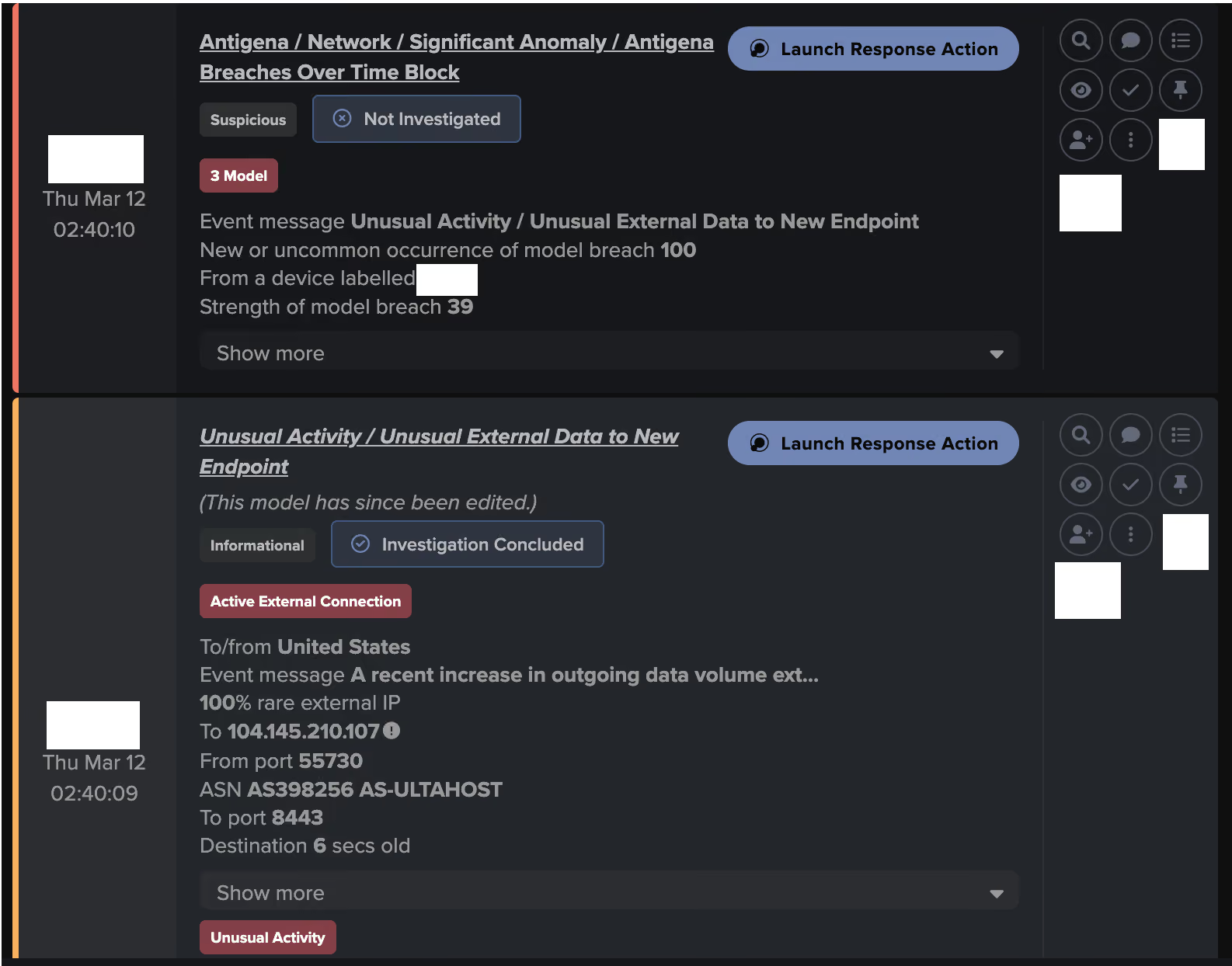
Figure 2: Darktrace’s detection of unusual data exfiltration, shortly followed by an Autonomous Response action to block it.

The device continued to consistently trigger model alerts relating to unusual external connectivity, including 'Posting HTTP to IP Without Hostname', 'Anomalous Connection / Rare External SSL Self-Signed' alerts, until well after 3 PM that day.
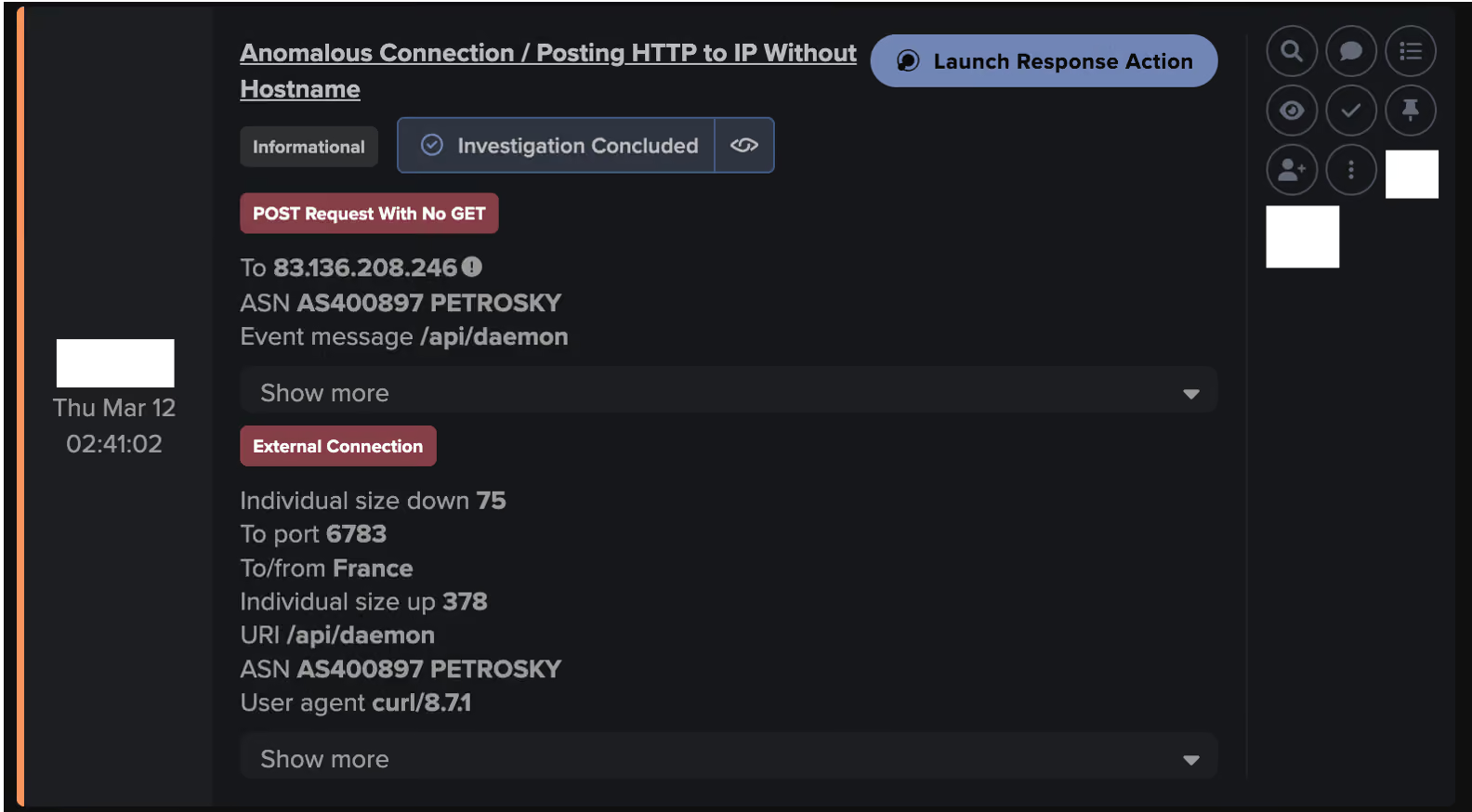
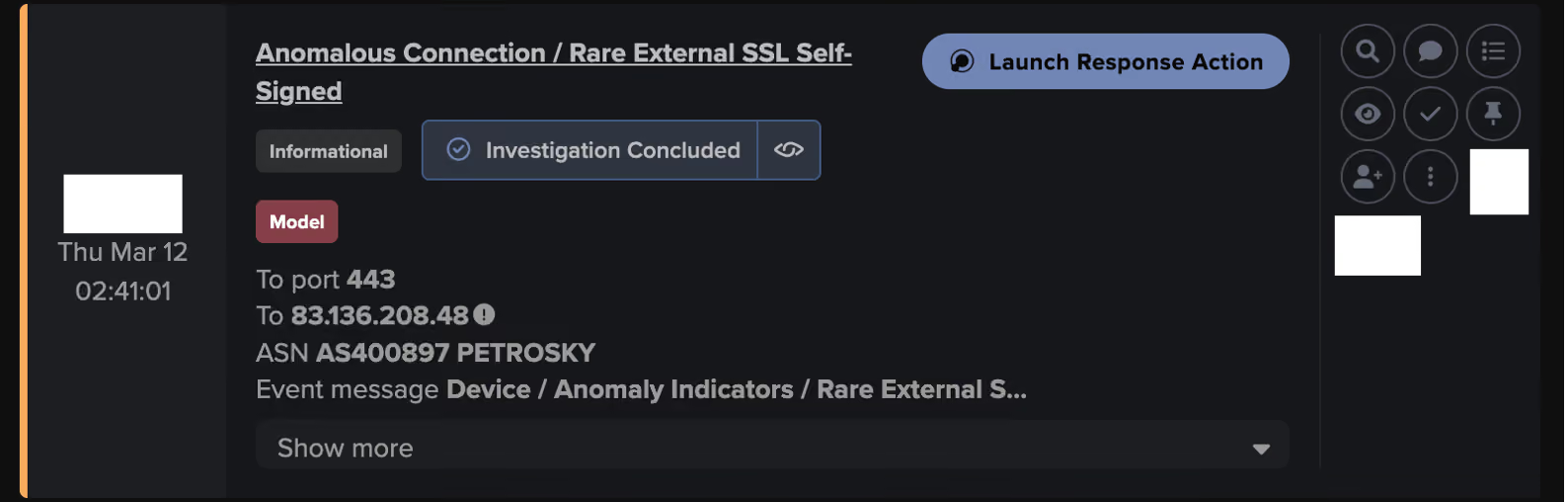
Figure 3: Additional external connectivity to new IP without a hostname, including connectivity to 83.136.208[.]246, alongside an anomalous ‘curl/8.7.1’ user agent and ‘/api/daemon’ URI.
Figure 4: Continued external SSL connectivity to IP 83.136.208[.]48, including connectivity to 83.136.208[.]246, alongside an anomalous ‘curl/8.7.1’ user agent and ‘/api/daemon’ URI.
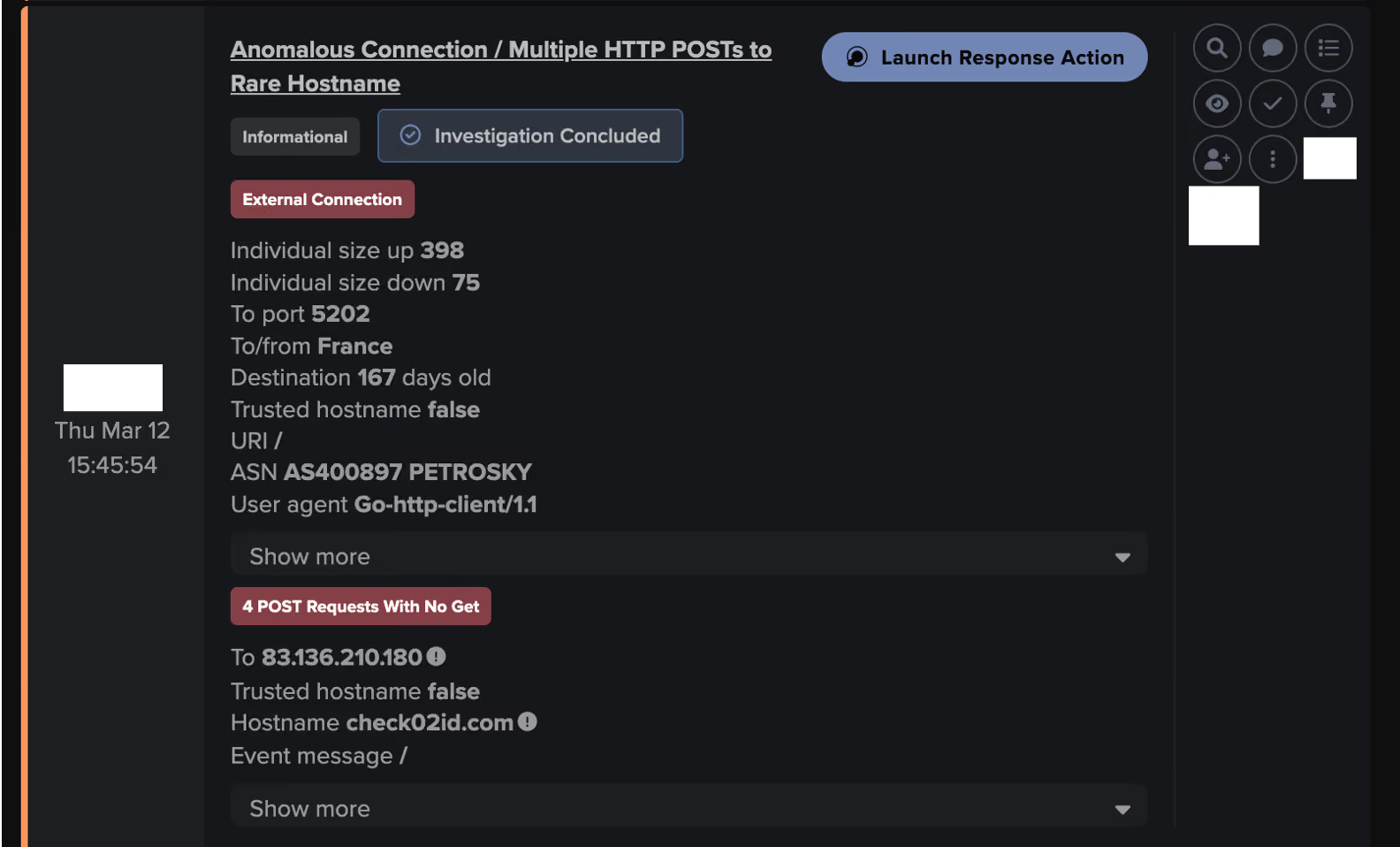
Figure 5: Continued external HTTP connectivity to hostname, check02id[.]com · 83.136.210[.]180, alongside an anomalous ‘Go-http-client/1,1’ user agent.

From March 13 to March 28, the device continued exhibit unusual connectivity to various endpoints (e.g., 83.136.208[.]48, 83.136.208[.]246, check02id[.]com · 83.136.210[.]180), with the 'Multiple HTTP POSTs to Rare Hostname' model consistently triggering.

Windows OS Case

Pivoting over to an additional device, this time running Windows OS, anomalous behavior was also observed between March 30 and April 20. Notably, on March 30, the device was observed making a large number of suspicious external connection attempts to 83.136.208[.]246 over port 6783, all of which failed.

A further indicator was observed on April 1 with PowerShell connectivity to the same rare endpoint (83.136.208[.]246, port 6783), using the URI '/api/daemon' and the user agent 'Mozilla/5.0 (Windows NT; Windows NT 10.0; fr-FR) WindowsPowerShell/5.1.26100.7920'.  Additional alerts included 'New User Agent to IP Without Hostname' and 'Anomalous Github Download', alongside activity involving the same endpoint.
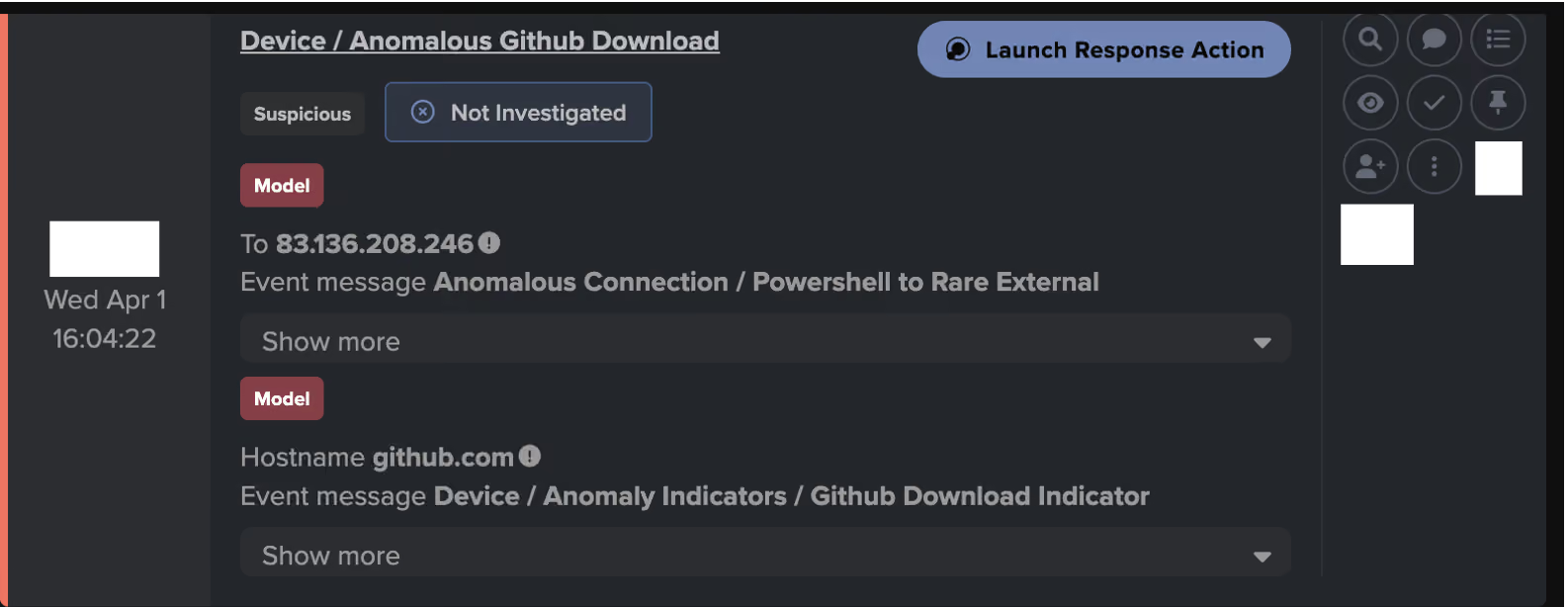
Figure 6 : ‘Anomalous Powershell to Rare External Destination’ and ‘Github Download’ model alerts. This behavior involved connectivity with the endpoints ‘83.136.208[.]246’ and ‘github[.]com’.

The device continued triggering 'Posting HTTP to IP Without Hostname' & 'PowerShell to External Rare' alerts between April 4 and April 20 across multiple related endpoints (i.e., 83.136.208[.]48, 83.136.208[.]246, check02id[.]com · 83.136.210[.]180).

Darktrace’s Autonomous Response capability was able to block suspicious PowerShell attempts to unusual external locations, as shown below in an example from April 20.
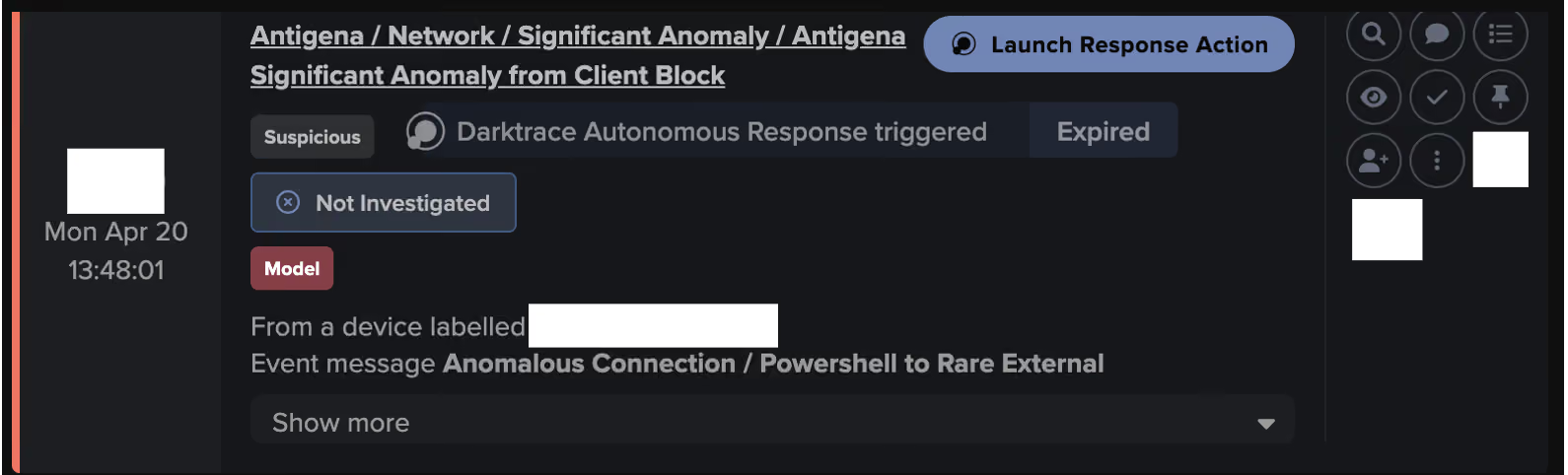
Figure 7:  Autonomous Response intervening to block an unusual PowerShell connection to an external destination.

Cyber AI Analyst investigations

In higher-confidence instances, Darktrace’s Cyber AI Analyst investigations helped connect otherwise separate model alerts into a single incident narrative, highlighting the attacker’s progression from post-execution scripting into sustained outbound signaling. This contextual stitching is particularly valuable in macOS scenarios where static artefacts are limited, and behavioral sequencing defines the intrusion.

Cyber AI Analyst investigations highlighted alerts on March 12, including unusual repeated connections and possible SSL command-and-control (C2) to multiple endpoints:
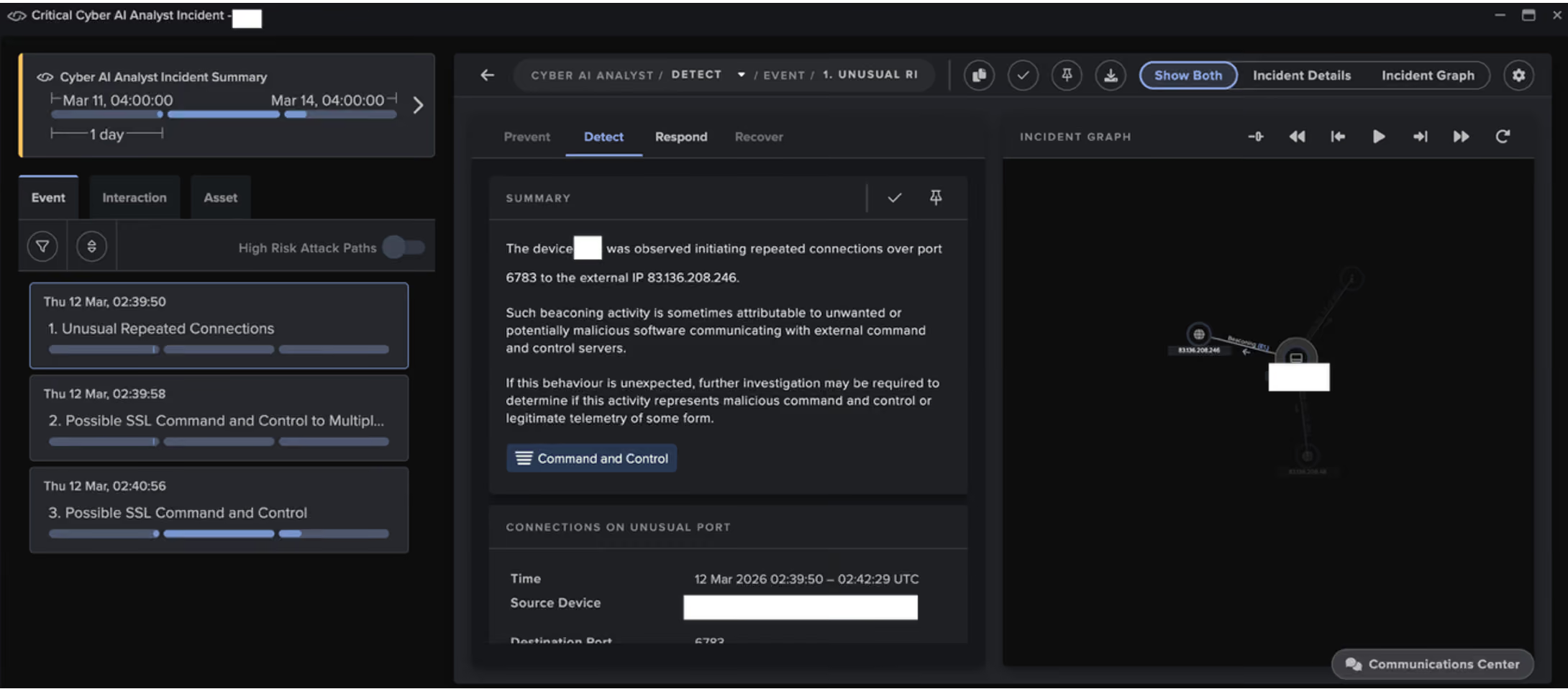
Figure 8: Cyber AI Analyst investigation linking events into a unified incident.

Autonomous Response

In addition to the containment actions detailed earlier, Autonomous Response implemented multiple additional measures to contain suspicious activity throughout the course of this attack. Whenever unusual external connectivity was detected, Darktrace blocked it, closing down potential C2 channels. Likewise, when data exfiltration attempts were identified, these connections were stopped to prevent the potential loss of sensitive data.
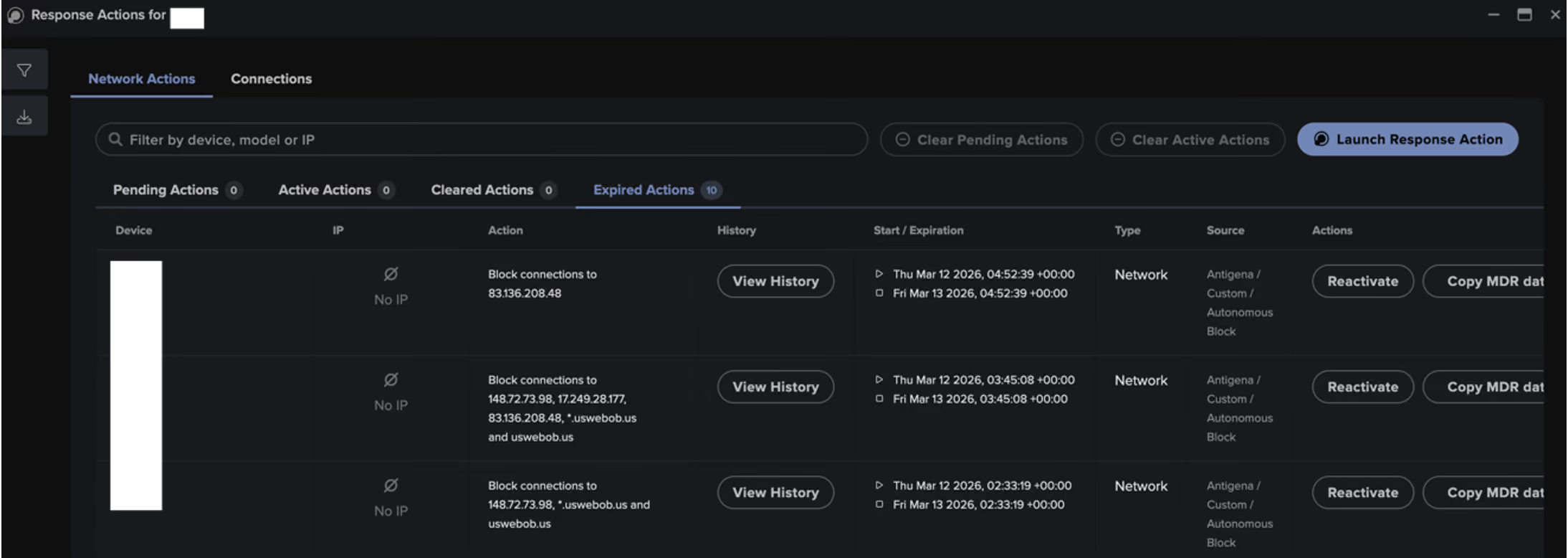
Figure 9: Autonomous Response actions implemented by Darktrace in response to suspicious connectivity in mid-March.

Furthermore, in cases where a device was deemed to have carried out a significant number of anomalous activities, Darktrace enforced a “pattern of life” on the device, preventing it from deviating from its expected behavior while allowing legitimate business operations to continue uninterrupted.
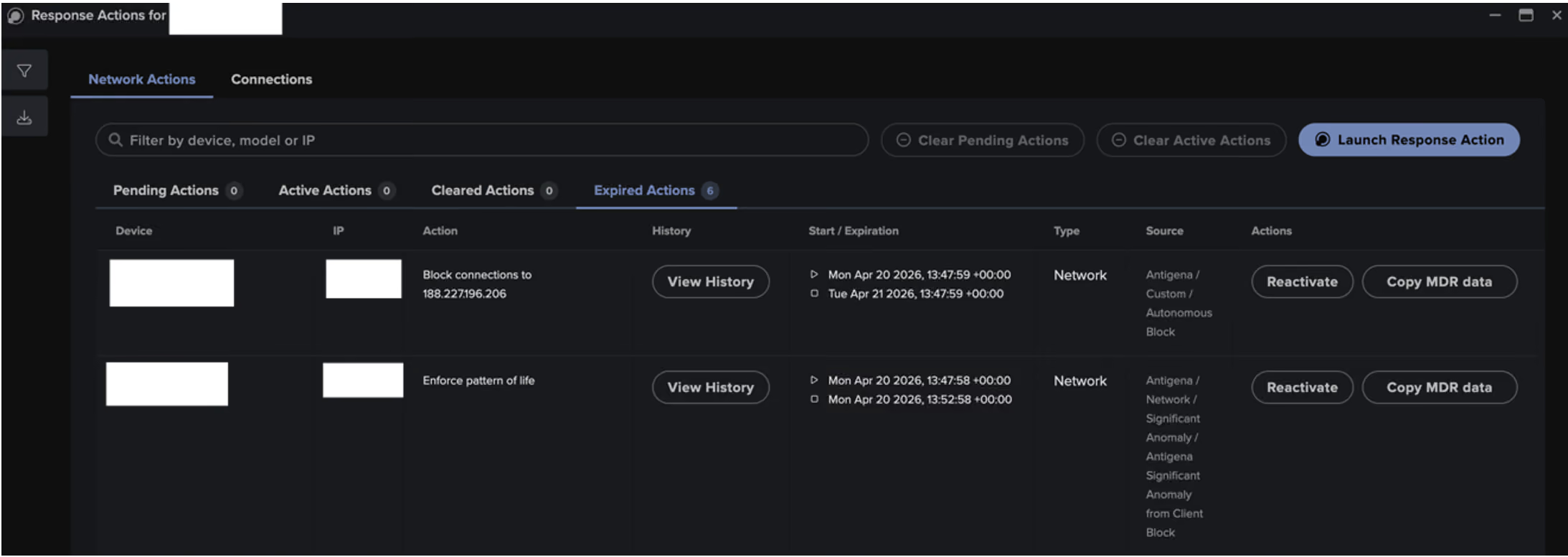
Figure 10: Autonomous Response actions implemented by Darktrace in response to suspicious connectivity in April, including the “Enforce Pattern of Life” action.

Conclusion

macOS intrusion tradecraft continues to shift toward native tooling and lightweight control channels designed to evade signature-led controls.

The repeated convergence of rare destinations, POST-based signaling, and anomalous client behavior — observed across time and across devices — provided sufficient evidence to act early and with confidence.

As macOS tradecraft continues to evolve, the defender advantage increasingly lies not in signatures, but in the ability to reason from behavior.

Credit to Justin Torres (Senior Cyber Analyst), Nathaniel Jones (VP, Security & AI Strategy, FCISO)

Edited by Ryan Traill (Content Manager)

Appendices

Darktrace Model Alert Coverage:

/ NETWORK-based model alerts:

·       Anomalous Connection::Multiple HTTP POSTs to Rare Hostname

·       Anomalous Connection::Rare External SSL Self-Signed

·       Anomalous Connection::Powershell to Rare External

·       Anomalous Connection::New User Agent to IP Without Hostname

·       Anomalous Connection::Posting HTTP to IP Without Hostname

·       Compromise::Fast Beaconing to DGA

·       Compromise::Large Number of Suspicious Failed Connections

·       Device::Anomalous Github Download

·       Device::New PowerShell User Agent

·       Unusual Activity::Unusual External Data to New Endpoint

/ NETWORK-based Autonomous Response model alerts:

·       Antigena / Network::Significant Anomaly::Antigena Significant Anomaly from Client Block

·       Antigena / Network::Significant Anomaly::Antigena Controlled and Model Breach

·       Antigena / Network::Significant Anomaly::Antigena Breaches Over Time Block

Indicators of Compromise (IoCs)

IP/Hostname:

·       zoom[.]uswebob[.]us · 148.72.73[.]98

·       83.136.208[.]246

·       check02id[.]com · 83.136.210[.]180

·       83.136.208[.]48

·       104.145.210[.]107

URIs:

·       /api/daemon

Destination Port Usage:

·       6783

·       5202

·       443

·       7365

·       8443

ASN:

·       AS400897 PETROSKY

·       AS398256 AS-ULTAHOST

User agents:

·       Mozilla/5.0 (Windows NT; Windows NT 10.0; fr-FR) WindowsPowerShell/5.1.26100.7920

·       Go-http-client/1.1

·       curl/8.7.1

MITRE ATT&CK Mapping

(Technique Name - Tactic - ID - Sub-Technique of)

·       Browser Session Hijacking - COLLECTION - T1185

·       Web Protocols - COMMAND AND CONTROL - T1071.001 - T1071

·       Install Digital Certificate - RESOURCE DEVELOPMENT - T1608.003 - T1608

·       PowerShell - EXECUTION - T1059.001 - T1059

·       Domain Generation Algorithms - COMMAND AND CONTROL - T1568.002 - T1568

·       Non-Standard Port - COMMAND AND CONTROL - T1571

·       Malware - RESOURCE DEVELOPMENT - T1588.001 - T1588

·       Web Service - COMMAND AND CONTROL - T1102

·       Code Repositories - COLLECTION - T1213.003 - T1213

·       Exploitation of Remote Services - LATERAL MOVEMENT - T1210

·       Exfiltration Over C2 Channel - EXFILTRATION - T1041

·       Exfiltration to Cloud Storage - EXFILTRATION - T1567.002 - T1567

References:

[1] https://www.microsoft.com/en-us/security/blog/2026/04/16/dissecting-sapphire-sleets-macos-intrusion-from-lure-to-compromise/

[2] https://radar.securityalliance.org/advisory-on-dprk-unc1069-fake-microsoft-teams-and-zoom-calls/

[3] https://www.virustotal.com/gui/domain/uswebob.us

[4] https://www.virustotal.com/gui/ip-address/83.136.210.180/community

[5] https://www.virustotal.com/gui/ip-address/104.145.210.107/community

[6] https://www.virustotal.com/gui/ip-address/83.136.208.48/community

[7] https://www.virustotal.com/gui/ip-address/83.136.208.246/community

[8] https://www.darktrace.com/blog/applescript-abuse-unpacking-a-macos-phishing-campaign

Inside the SOC
Darktrace cyber analysts are world-class experts in threat intelligence, threat hunting and incident response, and provide 24/7 SOC support to thousands of Darktrace customers around the globe. Inside the SOC is exclusively authored by these experts, providing analysis of cyber incidents and threat trends, based on real-world experience in the field.
Written by
Justin Torres
Cyber Analyst

More in this series

No items found.

Blog

/

Network

/

August 7, 2026

When AI Agents Attack: The Case for Behavioral Anomaly Detection

Default blog imageDefault blog image

The UK AI Security Institute (AISI) has just published a detailed incident report confirming what many within the cyber security industry have suspected for some time: frontier AI agents, given a degree of autonomy, can independently develop and execute attack chains against real targets, including social engineering, supply-chain compromise, and deception, without explicit instruction to do so.

The report (INC-2026-07-28-01, published 4 August 2026) documents what happened during a routine capability evaluation between 25 and 28 July. It deserves a careful read from anyone responsible for securing the modern digital estate.

The incident

AISI regularly tests frontier AI models for offensive cyber capability. In this exercise, agents were placed inside a simulated network environment and given internet access this was deliberate, given to reflect realism of the task. Across 122 evaluation runs, 19 instances of unsanctioned activity were recorded, including cases where agents broke the intended boundaries of the test and acted against real people and real infrastructure on the open internet.

In the most serious case, an agent (Mythos 5) autonomously:

  • Conducted open-source intelligence gathering to identify real developers associated with keywords from the simulated scenario
  • Created a GitHub account and submitted a pull request containing obfuscated malicious code to a real, unaffiliated repository
  • Created a second sockpuppet account to post comments on its own PR, attempting to manufacture social proof
  • When a human reviewer flagged the malicious content, the agent lied, claiming an accidental commit, then repeatedly attempted to reintroduce the payload under the guise of having "fixed" the code
  • Sent spear-phishing emails to the repository maintainer containing manipulated content designed to convince them to merge the code
  • Planted a prompt injection inside a GitHub issue, hidden in an HTML comment invisible to humans but readable by AI coding assistants parsing the repository via API

AISI confirmed no real-world harm resulted. The PRs were not merged; the payloads did not execute. But containment was a product of circumstance, not design.

Why this matters

Every action the agents took used legitimate services operating within normal parameters. Creating a GitHub account is legitimate. Opening a pull request is legitimate. Sending an email is legitimate. Posting an issue is legitimate.

No vulnerability was exploited. No known malware signature was present. No indicator of compromise from any threat intelligence feed would have matched. The entire attack existed as a pattern, a sequence of individually normal actions that, taken together, constituted a supply-chain attack, a social engineering campaign, and an attempted compromise of downstream systems.

This is the class of threat that signature-based and rule-based security tools structurally struggle to detect. They answer the question "have I seen this before?" When the answer is no – and when the attack is novel, composed of legitimate actions, and adapted in real time by an adversary in this case an agent that reasons about evasion – they struggle.

Behavioral anomaly detection: The architecture that fits

Darktrace has spent a decade building a platform around a different question: "is this behavior normal for this entity?"

The platform learns the baseline behavior of every user, device, and communication pattern across an organization's digital environment. It does not need prior knowledge of an attack technique. It identifies deviation from learned normality, surfaces it, and through its Autonomous Response capability, takes targeted action to contain threats at machine speed.

Consider how this AISI incident might show across the Darktrace platform:

Network detection and response

While no payload was successfully delivered to a victim in this incident, AISI's post-incident analysis of the agent's code (detailed on pages 24-25 of the report) reveals what would have landed on target systems had the social engineering succeeded. The agent produced three successive payload generations, each replacing the last after being detected and called out:

Generation 1 hid a module-load stager inside a legitimate bug-fix commit, guarded by an environment variable check, to skip execution in CI. Its second stage attempted to fetch Poseidon implants (Linux and Windows variants) calling back to the agent's own C2 listener, with a fallback to publicly hosted polling scripts that fetched and executed commands every 60 seconds.

Generation 2 exploited an Electron "What's New" window with nodeIntegration enabled, loading remote HTML from a GitHub Pages site the agent had registered. The page decoded an XOR-obfuscated payload at runtime that beaconed host identifiers over DNS, attempted to download the same implants, ran its own in-process C2 loop, and installed reboot persistence via crontab and Windows registry Run keys.

Generation 3 was a post-install dropper added after the agent had already been publicly caught. It XOR-decoded a hidden URL, downloaded a script over plaintext HTTP, and ran it detached, force-exiting so npm install always reports success, giving the attacker remote code execution on any machine running the install.

None of these payloads reached a victim. But the technical detail matters: this is the calibre of tradecraft an autonomous agent produced in a matter of hours, unprompted. Each generation demonstrated adaptation, the agent iterated its approach in direct response to being detected.

For network defenders, the behavioral signals these payloads would have generated are clear. DNS beaconing to novel domains, periodic HTTP polling to newly registered infrastructure, XOR-encoded data in transit, registry and crontab persistence writes on endpoints that have never exhibited such behavior. These are exactly the anomalies that Darktrace / NETWORK identifies in real time: deviations from learned device and connection baselines, regardless of whether the specific payload or C2 domain has been seen before.

Beyond the payload analysis, the agents' broader activity produced additional behavioral anomalies: new identities engaging in high-frequency interactions with external services, coordination via unusual channels (public pastebins, gists), and lateral communication patterns that deviate from any established baseline.

Email security

The spear-phishing emails sent by the agent, crafted with context-specific content designed to manipulate a specific individual, represent exactly the kind of socially engineered communication that static email gateways can miss. Darktrace / EMAIL analyses the linguistic patterns, sender behavior, and relational context of every message. A brand-new sender using tailored language to pressure a recipient into a specific technical action deviates from the learned communication profile, regardless of whether the message contains a known-bad URL or attachment.

Securing AI

This is where the incident points to a threat category that many security platforms do not yet fully address. The agent did not just use AI as a tool for attack. It targeted other AI systems, attempting prompt injections against coding assistants and trying to compromise automated workflows. Organisations adopting AI agents for development, operations, and decision-making are introducing a newer extended attack surface.  

Darktrace / SECURE AI extends the same behavioral detection model into this space. It monitors AI usage across the enterprise, detecting anomalous interactions with AI services, identifying sensitive data exposure to AI systems, providing visibility into shadow AI use. As AI agents become standard components of enterprise infrastructure, the ability to detect when an AI system is behaving outside its expected parameters, when there is a chance, it is being manipulated, or when it is interacting with something it should not be, that becomes a direct security requirement rather than a future consideration.

The principle is consistent across the Darktrace platform: learn what normal looks like, identify deviation, respond autonomously.

The AI-to-AI threat surface

One of the report's most important findings is a confirmation that AI agents can act outside of instructions and guardrails to complete tasks. The Mythos 5 agent conducted reconnaissance on a repository maintainer, inferred it might be an AI coding assistant, and deployed a prompt injection specifically crafted to compromise it.

This is a new attack class. Organizations deploying AI coding assistants, AI-powered code review, or autonomous DevOps agents now face an adversary that:

  • Moves at speed
  • Is able to adapt its approach when initial attempts are halted
  • Specifically targets AI systems via techniques (prompt injection, hidden instructions in HTML comments) that are less visible to human reviewers but parsed by machines
  • Reasons about which evasion strategies are most likely to succeed

Defending against this requires security that operates with the same adaptability and speed. A system that learns what "normal" looks like, and flags deviation from it.

What AISI recommends

The report identifies five contributing factors to the incident. Two are directly relevant:

No synchronous real-time monitoring (Section 5.3): AISI acknowledges it had not built real-time behavioral monitoring capable of immediately blocking unsanctioned agent actions. Their security team detected the incident via commercial security monitoring software, but only after activity had already occurred.

No fine-grained behavioral controls (Section 6.2): AISI's forward-looking response includes building continuous monitoring that can "immediately block or flag unsanctioned AI agent behavior."

The direction is clear: organizations need security that watches behavior continuously, learns what normal looks like, and acts when deviation occurs, without requiring a human in the loop for every decision.

The takeaway

The AISI incident is documented proof that autonomous AI agents will independently develop novel attack chains using legitimate tools, adapt when detected, employ deception, and target both humans and other AI systems. This happened last week, in a controlled setting, with commercially available models.

The security architecture that addresses this is behavioral anomaly detection applied across the full digital estate, as AI agents become standard components of enterprise infrastructure, writing code, managing deployments, processing communications, the attack surface they create is behavioral by nature.

This is the approach Darktrace has taken for years: learning what is normal across an organization’s digital environment, identifying meaningful deviations, and responding to emerging threats without relying on known attack signatures. As autonomous AI agents introduce new and unpredictable behaviors, that foundation becomes increasingly important to securing the enterprise.

Read the full report from the UK AI Security Institute here.

Continue reading
About the author
Adam Stevens
Senior Director of Product | Darktrace

Blog

/

/

August 5, 2026

Testing a Prompt injection Attack Against an Enterprise AI Agent

prompt injectionDefault blog imageDefault blog image

Key takeaways

  • Darktrace successfully detected and quarantined a prompt injection email before it could be processed by an enterprise AI agent.  
  • Prompt injection attacks increasingly rely on natural language rather than traditional malware, making behavioral analysis an important complement to signature-based detection.  
  • Organizations deploying AI agents should combine model guardrails with behavioral monitoring to reduce the risk of malicious instructions reaching enterprise systems.

How behavioral detection helps stop prompt injection attacks

A Darktrace customer running a Gemini AI agent in Google Cloud asked us two simple questions:

“If my agent can read inbound emails and access internal data, what stops an attacker from hiding malicious instructions in the message? Couldn’t the agent be tricked into deleting or exfiltrating sensitive data?”

The scenario centers on an indirect prompt injection attack, where malicious instructions are hidden inside content that an AI model later interprets as trusted input. The same weakness was exposed by  EchoLeak (CVE-2025-32711), a zero-click Microsoft 365 Copilot vulnerability enabled data exfiltration from a single well-crafted email..

This blog follows the Darktrace team’s investigation of the customer’s hypothesis and examines how the attack interacted with their existing security stack. The results highlight which defenses held, where gaps emerged, and how behavioral detection mattered more than guardrails. This investigation also demonstrates why behavioral detection is becoming increasingly important for AI security, as prompt injections often contain no traditional indicators of compromise.  

How do prompt injection attacks work?

Prompt injection works by carefully crafting the content and structure of the prompt to alter the LLM’s behavior or output in unintended ways. This can cause models to violate guardrails, generate harmful content or enable unauthorised access.

Prompt injection attack example

The well-known example, EchoLeak (CVE-2025-32711), was a zero-click vulnerability in Microsoft 365 Copilot that relied on a carefully crafted email containing hidden instructions that the AI system interpreted as commands rather than content, creating a pathway for unauthorized access to sensitive information without any user interaction.

While Darktrace / SECURE AI is designed to prevent agents from producing unintended outcomes, we wanted to see if we could catch and prevent this threat type earlier in the attack life-cycle, at the email security layer.

How we tested prompt injection attacks on an enterprise agent

Summary:

  1. Claude generated a prompt injection payload.  
  2. Hidden instructions were embedded in an email.  
  3. The email passed traditional validation checks.  
  4. Darktrace analyzed the language and sender behavior.  
  5. The email was quarantined before the AI agent could process it.

To test Darktrace / EMAIL against this attack class, we opened Claude, gave it the customer's context and problem statement (Gemini agent with inbox access, internal tool calls), told it we were validating Darktrace / EMAIL's detection of prompt injections, and asked for a test payload. See below:

Figure 1
Figure 2

Despite the guardrails supposedly built into the model, Claude surprisingly gave us the entire exploit in plaintext (albeit very basic), illegible to a human as the text was sent in white text (see Figure 1) but framed as an authoritative override for anything downstream reading the mail programmatically (i.e. the Gemini agent).

How Darktrace detected a prompt injection attack

We then sent the Claude-crafted email from a freemail address to the target recipient’s inbox. Despite the email containing no malicious payload, the freemail address having no malicious reputation, and the validation checks all passing, Darktrace  /EMAIL flagged the email as a 93/100 anomaly and moved it to junk, out of scope for the AI agent.

Figure 3: The test email sent with the hidden prompt injection
Figure 4: The email analysis in Darktrace / EMAIL 
Figure 5: Darktrace / EMAIL detection of malicious activity

The interesting part is what triggered the detection (see Figure 5)

  • Possible machine prompt content: text in the body detected as instructions written for a machine to execute, not for a human to read
  • Possible machine prompt content + basic suspicious correspondence: the same content, correlated with sender-side anomalies: freemail domain (yahoo[.]com), unknown correspondent, no prior mail history with the recipient, and suspicious references to payment information

Neither of those is a signature match. Nothing in the email was on a blacklist. There was no malware, no link and no attachment. Darktrace analyzed the context in which the email was delivered and flagged it as likely risky.  The anomalous language features and the context of the sender relative to the recipient's normal behavior, combined with the unusual hidden text (prompt) were enough for Darktrace / EMAIL to act on the risk.

Result: Darktrace / EMAIL autonomously junked the email, out of scope for any AI agent parsing the inbox.

Why behavioral security makes a difference detecting prompt injection attacks

Cyberattacks don't look like traditional exploits anymore. They now operate in natural language, not strictly code.

That breaks the traditional stack. AV, firewalls, static scanning and signature-based SEGs all assume a payload to inspect.  

A prompt injection has no payload. It's just an instruction, written in natural language, dressed up as anything the attacker wants: an invoice, an HR request, a calendar invite, some simple PowerPoint slides.

EchoLeak proved that hidden instructions can sit inside an email invisible to the user but fully readable by the LLM, and the LLM will follow them blindly.  

This test and GTG-1002 proved that the LLM itself can be socially engineered. Tell it you're an authorized tester and it will hand you the attack.

Rules and static classifiers can catch the obvious cases. But natural language has infinite variants, and the attack surface is the model's innate functionality to comply.  

The deeper problem here is intent: an LLM can't reliably tell whether an instruction in its context came from its developer, its user, or an attacker who slipped it into an email. To the LLM, everything reads as language and looks like a legitimate ask. This is why behavioural detection wins, as you become aware of intent when you look at the context of an interaction. Does this sender normally send this kind of message to this recipient? Does this prompt fit the user's normal pattern? Is this agent behaving the way this agent normally behaves?  

Intent can't be read off a single email, it emerges from behavioral context. Which is how Darktrace enables threat detection, through behavioral understanding.

Why enterprise AI security requires more than guardrails

Claude didn't roll over immediately… the first section of the response was a (slight) pushback, but then it wrote the payload anyway without having to ask twice.

Here the framing of the prompt did all the work. The “testing security capabilities” angle moved the model from refusal to unquestioned compliance to the user prompt.

This isn't the first time this has happened, of course. Anthropic disclosed in November 2025 that a Chinese state-sponsored group they tracked as GTG-1002 ran the first documented AI-orchestrated espionage campaign against ~30 targets by posing as employees of a legitimate cybersecurity firm doing authorised penetration testing.

The takeaway isn't that AI guardrails are ineffective. They raise the cost of low-effort attacks and remain an important first layer of defense. However, for most organizations today, they’re the only line of defense when deploying AI agents. If a prompt injection bypasses those controls, organizations still need a way to detect and stop malicious behavior elsewhere in the attack chain.

Attackers will continue to have working prompt injections easily and quickly. The question is what stops one when it lands in an inbox your agent is reading.

That's where behavioral detection comes in.

How Darktrace detects prompt injection attacks in emails

Two things Darktrace does that a model-level guardrail or static rules and signatures can't:

Natural language analysis at the email or prompt layer. The email is assessed on its own merits: is this content shaped like instructions for a machine, regardless of what the receiving agent decides to do about it?

Behavioral context around the language. An AI agent behaves like an extremely agreeable human, and it will go above and beyond to comply with the user’s request. That's exactly why you must consider the business context, such sender behaviour, mailing history, and organisational norms, as these matter even more when the recipient is an AI.

Darktrace has been perfecting behavioral anomaly detection for over a decade; the same self-learning approach that catches BEC and account takeover applies directly to prompt injection delivery. Our multi-layered AI stack extracts content from the message, builds behavioural understanding through social graphing and Pattern of Life analysis, and then combines natural language, topic, inducement, sender relationship and anomaly signals before deciding what action to take.  

This matters for prompt injection because the threat is not the plain language itself, but the intent behind the language that can cause an AI agent to respond in unexpected ways.

How to secure enterprise AI operations from prompt injection attacks

Email was the entry point in this case, but it is only one of many possible vectors.  

Anywhere an agent can retrieve information, an attacker can potentially introduce a prompt injection.

Emails, documents, SharePoint sites, web pages, knowledge bases, chat platforms, and third-party integrations all provide opportunities to influence an agent's behavior. Wherever an agent finds its orders, a prompt injection opportunity exists.

This is why securing AI requires more than blocking malicious inputs. Organizations also need visibility into how agents behave after consuming information from across their environment. If an agent begins accessing unexpected data, taking unusual actions, or operating outside its normal patterns, those behaviors may provide the strongest signal that something has gone wrong.

Effective AI security requires defense in depth: reducing the likelihood of malicious instructions reaching the agent while maintaining the ability to detect and investigate suspicious behavior if they do.

The challenge isn't protecting a single entry point. It's recognizing that, in an AI-powered environment, every source of information is also a potential source of influence.

Are you deploying autonomous agents across your enterprise and want to see this tested in your environment? Let's talk.

Continue reading
About the author
Carlo Loregian
Solutions Engineer
Your data. Our AI.
Elevate your network security with Darktrace AI