Blog
/
/
January 9, 2019

Insider Analysis of Emotet Malware

Uncover the secrets of Emotet with our latest Darktrace expert analysis. Learn how to identify and understand trojan horse attacks.
Inside the SOC
Darktrace cyber analysts are world-class experts in threat intelligence, threat hunting and incident response, and provide 24/7 SOC support to thousands of Darktrace customers around the globe. Inside the SOC is exclusively authored by these experts, providing analysis of cyber incidents and threat trends, based on real-world experience in the field.
Written by
Max Heinemeyer
Global Field CISO
Default blog image
09
Jan 2019

While both traditional security tools and the attacks against them continue to improve, advanced cyber-criminals are increasingly exploiting the weakness inherent to any organization’s security posture: its employees. Designed to mislead such employees into compromising their devices, computer trojans are now rapidly on the rise. In 2018, Darktrace detected a 239% year-on-year uptick in incidents related specifically to banking trojans, which use deception to harvest the credentials of online banking customers from infected machines. And one banking trojan in particular, Emotet, is among the costliest and most destructive malware variants currently imperilling governments and companies worldwide.

Emotet is a highly sophisticated malware with a modular architecture, installing its main component first before delivering additional payloads. Further increasing its subtlety is the fact that Emotet is considered to be ‘polymorphic malware’, since it constantly changes its identifiable features to evade detection by antivirus products. And, as will be subsequently discussed in greater detail, Emotet has advanced persistence techniques and worm-like self-propagation abilities, which render it uniquely resilient and dangerous.

Since its launch in 2014, Emotet has been adapted and repurposed on numerous occasions as its targets have diversified. Initially, Emotet’s primary victims were German banks, from which the malware was designed to steal financial information by intercepting network traffic. By this past year’s end, Emotet had spread far and wide while shifting focus to U.S. targets, resulting in permanently lost files, costly business interruptions, and serious reputational harm.

How Emotet works
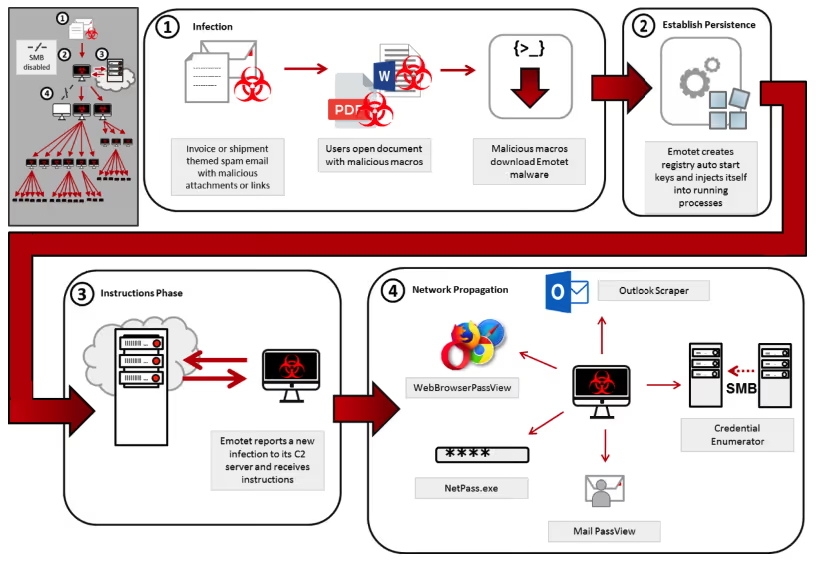
(Image courtesy of US-CERT)

Emotet is spread by targeting Windows-based systems via sophisticated phishing campaigns, employing social engineering techniques to fool users into believing that the malware-laden emails are legitimate. For instance, the latest versions of Emotet were delivered by way of Thanksgiving-related emails, which invited their American recipients to open an apparently innocuous Thanksgiving card:

These emails contain Microsoft Word documents that are either linked or attached directly. The Word files, in turn, act as vectors for malicious macros, which must be explicitly enabled by the user to be executed. For security reasons, running macros by default is disabled in most of the latest Microsoft application versions, meaning that the cyber-criminals responsible must resort to tricking users in order to enable them — in this case, by enticing them with the Thanksgiving card.

Once the macros are enabled, the Word file is executed and a PowerShell command is activated to retrieve the main Emotet component from compromised servers. The trojan payload is then downloaded and executed into the victim’s system. As mentioned above, Emotet payloads are polymorphic, often allowing them to slip past conventional security tools undetected.

How Emotet persists and propagates

Once Emotet has been executed on the victim’s device, it begins deploying itself with two main objectives: (1) achieving persistence and (2) spreading to more machines. To achieve the first aim, which involves resisting a reboot and various attempts at removal, Emotet does the following:

  • Creates scheduled tasks and registry key entries, ensuring its automatic execution during every system start-up.
  • Registers itself by creating files that have randomly generated names in system root directories, which are run as Windows services.
  • Typically stores payloads in paths located off AppData\Local and AppData\Roaming directories that it masks with names that appear legitimate, such as ‘flashplayer.exe’.

Emotet’s second key goal is that of spreading across local networks and beyond in order to infect as many machines as possible. To this end, Emotet first gathers information on both the victim’s system itself and the operating system it uses. Following this reconnaissance stage, it establishes encrypted command and control communications (C2) with its parent infrastructure before determining which payloads it will deliver. After reporting a new infection, Emotet downloads modules from the C2 servers, including:

  • WebBrowserPassView: A tool that steals passwords from most common web browsers like Chrome, Safari, Firefox and Internet Explorer.
  • NetPass.exe: A legitimate tool that recovers all the network passwords stored on the system for the current logged-on user.
  • MailPassView: A tool that reveals passwords and account details for popular email clients, such as Hotmail, Gmail, Microsoft Outlook, and Yahoo! Mail.
  • Outlook PST scraper: A module that searches Outlook’s messages to obtain names and email addresses from the victim’s Outlook account.
  • Credential enumerator: A module that enumerates network resources and attempts to gain access to other machines via SMB enumeration and brute-forcing connections.
  • Banking trojans: These include Dridex, IceID, Zeus Panda, Trickbot and Qakbot, all of which harvest banking account information via browser monitoring routines.

Whilst the WebBrowserPassView, NetPass.exe and MailPassView modules are able to steal the compromised user’s credentials, the PST scraper module can ransack the user’s contact list of friends, family members, colleagues and clients, enabling Emotet to self-propagate by sending phishing emails to those contacts. And because such emails are sent from the hijacked accounts of known acquaintances and loved ones, their recipients are more likely to open their infected attachments and links.

Emotet’s other self-propagation method is via brute-forcing credentials using various password lists, with the intent of gaining access to other machines within the network. When unsuccessful, the malware’s repeated failed login attempts can cause users to become locked out of their accounts, and when successful, the victims may become infected without even clicking on a malicious link or attachment. These tactics have collectively made Emotet remarkably durable and widespread. Indeed, in line with Darktrace’s discovery that incidents related to banking trojans have increased by 239% from 2017 to 2018, Emotet alone recorded a 39% increase, and the worst may be yet to come.

How AI fights back

Emotet presents significant challenges for traditional security tools, both because it exploits the ubiquitous vulnerability of human error, and because it is designed specifically to bypass endpoint solutions. Yet unlike such traditional tools, Darktrace leverages unsupervised machine learning algorithms to detect cyber-threats that have already infiltrated the network. Modelled after the human immune system, Darktrace AI works by learning the individual ‘pattern of life’ of every user, device, and network that it safeguards. From this ever-evolving sense of ‘self,’ Darktrace can differentiate between normal and anomalous behavior, allowing it to identify cyber-attacks in much the same way that our immune system spots harmful germs.

Recently, Darktrace’s AI models managed to detect a machine on a clients’ network that was experiencing active signs of an Emotet infection. The device was observed downloading a suspicious file and, shortly thereafter, began beaconing to a rare external destination, likely reporting the infection to a C2 server.

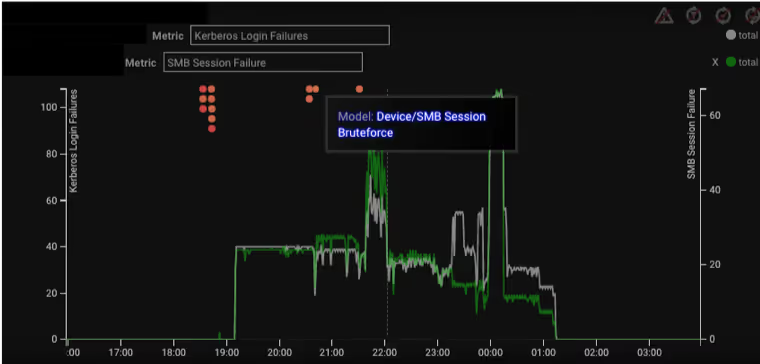
The device was then observed moving laterally across the network by performing brute force activities. In fact, Darktrace detected thousands of Kerberos failed logins, including to administrative accounts, as well as multiple SMB session failures that used a range of common usernames, such as ‘admin’ and ‘exchange’. Below is a graph showing the SMB and Kerberos brute-force activity on the breached device:
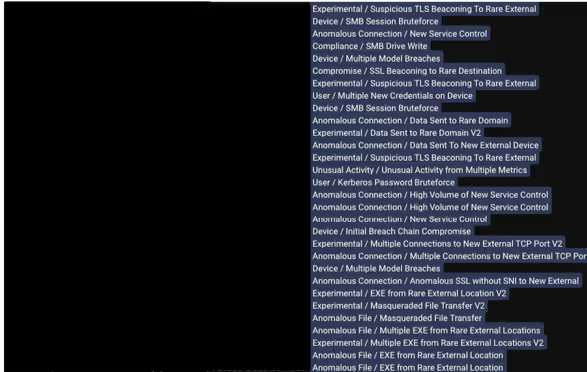
In addition to the brute-forcing activity performed by the credential enumerator module, Darktrace also detected another payload that was potentially functioning as an email spammer. The infected machine started to make a high number of outgoing connections over common email ports. This activity is consistent with Emotet’s typical spreading behavior, which revolves around sending emails to the victim’s hijacked email contacts. Below is an image of Darktrace models breached during the reported Emotet infection:
By forming a comprehensive understanding of normalcy, Darktrace can flag even the most minute anomalies in real time, thwarting subtle threats like Emotet that have already circumvented the network perimeter. To counter such advanced banking trojans, cyber AI defenses like Darktrace have become an organizational necessity.


Inside the SOC
Darktrace cyber analysts are world-class experts in threat intelligence, threat hunting and incident response, and provide 24/7 SOC support to thousands of Darktrace customers around the globe. Inside the SOC is exclusively authored by these experts, providing analysis of cyber incidents and threat trends, based on real-world experience in the field.
Written by
Max Heinemeyer
Global Field CISO

More in this series

No items found.

Blog

/

/

May 28, 2026

From Efficiency to Exposure: How AI Adoption Is Creating Unseen Vulnerabilities on the Factory Floor

AI in manufacturingDefault blog imageDefault blog image

How AI agents impact the manufacturing industry

Security teams and IT personnel across the manufacturing industry are under constant pressure to protect production, maintain uptime, and safeguard critical assets but the rise of AI is bringing huge new opportunities alongside new cyber risks. Across manufacturing, AI is embedded into workflows, decision-making, and increasingly, autonomous AI agents are acting on behalf of employees and systems.  

Agentic systems are powerful because they can act independently, but that same autonomy also creates cyber and operational risk. Agents have extensive permissions and are capable of carrying out complex tasks, making decisions, and interacting with tools or external systems with little to no human intervention.

Unlike traditional AI models that perform predefined tasks, AI agents use advanced techniques to mimic human decision-making processes, dynamically adapting to new challenges, making decision and taking action based on their own judgement. They look like employees operationally but lack judgment, ethics, or fear of consequences like humans do. This means they can be easily manipulated by cybercriminals, and an AI agent embedded across an OT network creates threats that extend well beyond data exposure. For example, at BMW, AI identifies faults in welding processes as they occur. At its Spartanburg plant, AI monitors the weld of 300-400 metal studs onto every SUV frame to detect misplaced or faulty studs and correct them instantly. Corruption of BMW’s AI system could lead to catastrophic quality control errors.

Adopting agentic AI systems across manufacturing raises some concerns across security teams. New data from our State of AI Cybersecurity survey shows that 78% of manufacturing security professionals are worried about employee use of AI agents – their top concern. That’s followed by employee use of generative AI tools like CoPilot and ChatGPT, a worry for 76% of security professionals at manufacturing organizations. As these tools gain more access to business data and processes, and more autonomy within organizations, security teams, who today have minimal visibility of agent activity in their environments, increasingly have sensitive data exposure (a worry for 60%) and accidental policy and regulatory violations (59%) on their minds.

External AI-powered threats are evolving just as quickly

The same capabilities transforming manufacturing are also reshaping cyberattacks.

AI is enabling attackers to automate reconnaissance, refine targeting, and adapt in real time. What once required time and manual effort can now be executed continuously and at scale. Manufacturers are already seeing the impact. According to manufacturing security professionals we surveyed, 76% are already being impacted by AI-powered threats and 90% see AI increasing the success of social engineering attacks.

And the techniques themselves are evolving. Concerns across the manufacturing sector show growing anxiety about the range of AI-powered attack routes, most pressingly of adaptive malware that evolves in real-time – a prospect half (49%) of manufacturing security professionals we surveyed are worried by, a full 9% more than the average across industries. AI adaptive malware is followed by:

  • Automated vulnerability scanning and exploit chaining (48%) which has become even more pressing as Anthropic’s new Mythos AI Model supercharges vulnerability discovery
  • Hyper-personalized phishing campaigns (46%), which remain a mainstay in hackers’ arsenals, and AI has amplified their effectiveness by making phishing emails more convincing and harder to detect.

This is not just an increase in volume, it is a shift toward threats that evolve as they unfold - often faster than static defenses can respond.

Despite rising awareness, many manufacturers are not yet equipped to manage this shift. More than half (51%) say they are not adequately prepared for AI-driven threats, and only 37% have formal policies governing AI deployment.  

Securing AI through visibility, context, and guardrails

Addressing this challenge does not require manufacturers to slow innovation. It requires a different approach to security, one that can operate at the same speed and scale as AI. Three specific priorities are emerging for manufacturers looking to take advantage of the power of AI.

Visibility is foundational.  

Organizations need to understand where AI is being used, what it can access, and how it behaves across both IT and OT environments. Without that, risk cannot be measured or managed. It is no surprise that Darktrace’s research found that 91% of manufacturing security professionals said that they need to understand how AI makes decisions before trusting it. This is even more critical in operational settings where disruption has safety, environmental, financial, and reputational impacts.

Context is what turns visibility into action.  

In environments shaped by AI, normal behavior is constantly shifting. Detecting threats requires a behavioral approach; understanding patterns of life across the organization and identifying subtle deviations in real time – a step change in organizations’ traditional approach to security and risk management.

Guardrails ensure that agency does not become exposure  

As AI systems take on greater responsibility, organizations need clear boundaries around what they can do and when they can act independently. These controls must be embedded into systems themselves, not applied after the fact.  

Securing AI Agents Across Manufacturing IT and OT

The rise of agentic AI is transforming manufacturing - powering next-generation operations while reshaping the security landscape. This is not just an increase in threats, but a shift to autonomous systems, continuously evolving behaviors, and risks moving at machine speed. For organizations trying to grapple with the challenge of enabling AI while managing the risk, visibility, context and guardrails should be foundational.

Darktrace helps manufacturers build secure AI approaches by making those foundations possible. It provides visibility and real-time detection and response to unusual activity across IT and OT environments and allows organizations to understand AI activity from the prompts employees use and the agents they build to how those agents are behaving across the environment. For manufacturers scaling AI, this delivers a foundation for innovation without sacrificing control.

Continue reading
About the author
Oakley Cox
Director of Product

Blog

/

/

May 28, 2026

How to Evaluate AI Vendors: 5 Key categories for AI Adoption

Default blog imageDefault blog image

Understanding the AI buyers’ market

AI adoption has become a central topic of discussion in boardrooms, drawing growing interest from business leaders. Ultimately, organizations hope that an investment in AI technology will have tremendous returns. However, the process of buying an AI solution is not as straight forward as it appears on the surface.  

While business leaders may be eager to improve productivity across their operations, practitioners responsible for evaluating and selecting AI solutions may not always have the visibility or technical understanding needed to make the right decisions for their business. What is typically marketed as a holistic solution to their most critical problems is usually followed by uncertainty when AI tools are finally operationalized in real environments.

This guide is intended to support security leaders who are under growing pressure to adopt AI tools while navigating complex terminology, vendor claims, and increasingly crowded buying cycles. Ultimately, the goal is to help organizations evaluate and adopt AI in a safe, effective, and well-governed way. To support this, we’ve structured the evaluation framework across five key categories:

  1. Governance, safety, and data controls
  1. Data gathering and training
  1. Model and technique choice
  1. Performance and accuracy validation    
  1. Interpretability, adjustability, and transparency    

What buying AI looks like in cybersecurity

While investing in AI can bring immense benefits to your security team, first-time buyers of AI cybersecurity solutions may not know where to start. They will have to determine the type of tool they want, know the options available, and evaluate vendors. Research and understanding are critical to ensure purchases are worth the investment.  

With acceleration in AI adoption, accompanied by the recent boom in agentic AI and autonomous agents, CISOs must look “beneath the hood" of these tools to understand how they work, how they are governed, and to ensure the system is secure and compliant with internal policies.

Challenges in the AI buyers’ marketplace  

The AI security software market is buzzing with hype and flashy promises, which, understandably, needs to be addressed with due diligence. Potential buyers, especially in the cybersecurity space, are hesitant when it comes to allowing AI autonomous capabilities across their workflows, and a lack of vendor transparency can exacerbate those feelings.  

Reinforcing this sentiment, research from this year's Darktrace’s State of AI Cybersecurity report shows where confidence and hesitancy emerge amongst potential buyers. On the one hand, security professionals agree that they have good visibility into the logic and reasoning processes their AI solutions use. However, they lack the explainability and trust to allow AI to take independent remedial action.

  • 89% say they have good visibility into the reasoning behind the outputs generated by AI solutions
  • 92% say they need to understand how a defensive AI tool makes decisions before they can trust it
  • Only 14% say they allow AI to act independently, performing autonomous actions without human approval
  • 74% say they are limiting the autonomy of AI taking action in their SOC until explainability improves

Given the desire for trust and explainability we are seeing from buyers, it's important for them to be equipped with the right questions to ask vendors during an assessment or POV of AI tools in order to demystify marketing hype from real operational outcomes.

Below is a list of categories in which buyers can assess AI vendors or AI Service Providers (AISPs) to help reach safe adoption and maximize their ROI.  

5 categories of AI vendor assessment

Darktrace groups these AI-related questions into 5 categories: governance, data and training, model and technique choice, performance validation, and interpretability and adjustability. By asking questions regarding each of these 5 categories, buyers can gain a deeper understanding of how an AISP’s systems work and whether they suit their business requirements.

Governance, safety, and data controls

Governance of AI systems is critical for all AISPs. Whether their platform is based around a single model, or is a more complex, composite AI solution, strong governance is essential to ensure the system is safe, robust, and reliable.

A simple question you could ask is:

What AI governance policies and frameworks do you follow, and/or certifications do you currently maintain?

For more questions you can ask vendors, download the full guide here.

Darktrace is certified to the ISO/IEC 42001 standard, the world’s first AI Management System (AIMS) standard. ISO/IEC 42001 addresses the unique ethical and technical challenges AI poses by setting out a structured way to manage risks such as transparency, accuracy, and misuse. This includes a commitment to ethical AI development, and effective management and monitoring of AI systems both prior to and continually after release.

Data gathering and training

Accurate, meaningful, and unbiased data gathering is the first important step in producing any AI system. An AI model trained using inaccurate, unbalanced, or poor-quality training data will fail to perform optimally.

To alleviate concerns regarding training data quality, a question you could ask is:

What steps do you take to prevent bias in your AI models and training data?

For more questions, download the full guide here.

AISPs should be able to provide information about the steps taken, workflows followed, and auditing performed to reduce AI bias where appropriate. While it’s sometimes impossible to fully remove bias from an AI model, appropriate actions should be taken to mitigate or reduce bias where relevant.

Model and technique choice

Different AI techniques are optimal for different tasks. For example, research from Gartner suggests that relying on a single “one-size-fits-all" model can lead to data gaps, especially in highly specialized domains.

To achieve more accurate and robust AI solutions, AI leaders should move beyond using just one model or technique, embrace composite AI practices, and adopt a holistic AI system perspective.

A straightforward question you could ask is simply:

What type(s) of AI model(s) do you utilize in your solution?

For more questions, download the full guide here.

While specific detailed information about custom systems used by AISPs is likely proprietary, buyers should expect vendors to be able to provide an overview of the broad techniques used. This will allow you as a buyer to determine if the type of model is appropriate for your use case.

Performance and accuracy validation  

Testing and evaluation of performance is essential for all AI systems. Performance analysis should be performed both before release and continually after release to identify potential data or model drift.  

A question you could ask to understand an AISPs testing workflow is:

How do you audit, test, evaluate, verify, and validate your AI model outputs?

For more questions, download the full guide here.

Testing workflows will likely vary depending on the type of model – measurements relevant to one system may not always be relevant to others. Assessment of systems should also extend beyond these standard accuracy and robustness tests, and should also feature physical performance, such as latency and resource consumption.  

Interpretability, adjustability, and transparency  

AI systems are typically a black box, simply providing an output without an explanation of how that output was attained. Interpretability and transparency are critical to ensure that both SOC teams and end-users trust the outputs of a system to be accurate and meaningful.

A question you could ask is:

How do you promote a trust relationship between human analysts and AI outputs?

For more questions, download the full guide here.

In the context of cybersecurity, trust and interpretability are even more essential. This is particularly relevant for generative AI-based systems (including most AI Agents), where the risk of hallucination can reduce trust in responses.

Cybersecurity systems often need to perform autonomous actions to block incoming threats – an email filtering system may hold potentially dangerous emails; a firewall may block malicious inbound connections. If SOC teams can’t trust these systems to perform accurately, these systems may be limited or disabled, critically reducing their defensive power.

Darktrace as an AI-native cybersecurity vendor

Darktrace has been building and applying AI in cybersecurity for over a decade, developing its capabilities alongside an increasingly complex and fast‑moving threat landscape. This experience has resulted in a mature, multi-layered approach to AI, which continuously learns the normal patterns of each organization to understand behavior, interpret context, and identify meaningful deviations — without relying on predefined rules or known attack signatures. Over time, this has enabled a proven behavioral understanding that helps uncover subtle signals of risk that may otherwise be missed.

With the backing of our ISO/IEC 42001 certification, stakeholders, customers, and partners can be confident that Darktrace is responsibly, ethically, and safely developing its AI systems, and managing the use of AI in day-to-day operations in a compliant and secure manner.  

Explore the principles behind Darktrace’s responsible AI approach, informed by collaboration with global experts in academia and governments, detailing how accountability, explainability, and continuous validation are built into its cybersecurity technology.

How Darktrace secures AI systems

Darktrace now brings these capabilities to monitor and respond to risk generated from AI systems across organizations with Darktrace / SECURE AI. This solution analyzes how prompts, agents, and systems are used within the context of each organization, bringing every AI interaction into a single view. This unique approach helps teams understand intent, assess risk, protect sensitive data, and enforce policy across both human and AI agent activity.

Stay up to date

Sign up for the Secure AI Readiness Program here: This gives you exclusive access to the latest news on the latest AI threats, updates on emerging approaches shaping AI security, and insights into the latest innovations, including Darktrace’s ongoing work in this area.

Ready to talk with a Darktrace expert on securing AI? Register here to receive practical guidance on the AI risks that matter most to your business, paired with clarity on where to focus first across governance, visibility, risk reduction, and long-term readiness.  

Further Reading on AI in cybersecurity

When deciding to invest in an AI solution, it’s important to understand what this means for you and your organization. The questions presented here are only a starting point in understanding an AI solution and whether it is appropriate for your use case.  

Gain deeper knowledge on applications of AI in cybersecurity and Darktrace’s multi-layered AI in the AI Arsenal White Paper.

[related-resource]

Continue reading
About the author
Jamie Bali
Technical Author (AI) Developer
Your data. Our AI.
Elevate your network security with Darktrace AI