Blog
/
/
February 20, 2020

Lessons Learned from a Sodinokibi Ransomware Attack

Gain insights into a targeted Sodinokibi ransomware attack and learn how to better prepare your organization for potential cyber threats.
Inside the SOC
Darktrace cyber analysts are world-class experts in threat intelligence, threat hunting and incident response, and provide 24/7 SOC support to thousands of Darktrace customers around the globe. Inside the SOC is exclusively authored by these experts, providing analysis of cyber incidents and threat trends, based on real-world experience in the field.
Written by
Max Heinemeyer
Global Field CISO
Default blog imageDefault blog imageDefault blog imageDefault blog imageDefault blog imageDefault blog image
20
Feb 2020

Introduction

Last week, Darktrace detected a targeted Sodinokibi ransomware attack during a 4-week trial with a mid-sized company.

This blog post will go through every stage of the attack lifecycle and detail the attacker’s techniques, tools and procedures used, and how Darktrace detected the attack.

The Sodinokibi group is an innovative threat-actor that is sometimes referred to as a ‘double-threat’, due to their ability to run targeted attacks using ransomware while simultaneously exfiltrating their victim’s data. This enables them to threaten to make the victim’s data publicly available if the ransom is not paid.

While Darktrace’s AI was able to identify the attack in real time as it was emerging, unfortunately the security team didn’t have eyes on the technology and was unable to action the alerts — nor was Antigena set in active mode, which would have slowed down and contained the threat instantaneously.

Timeline

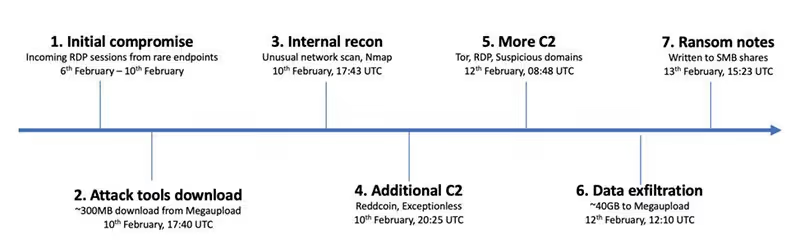
The timeline below provides a rough overview of the major attack phases. Most of the attack took place over the course of a week, with the majority of activity distributed over the last three days.
Technical analysis

Darktrace detected two main devices being hit by the attack: an internet-facing RDP server (‘RDP server’) and a Domain Controller (‘DC’), that also acts as a SMB file server.

In previous attacks, Sodinokibi has used host-level encryption for ransomware activity where the encryption takes place on the compromised host itself — in contrast to network-level encryption where the bulk of the ransomware activity takes place over network protocols such as SMB.

Initial compromise

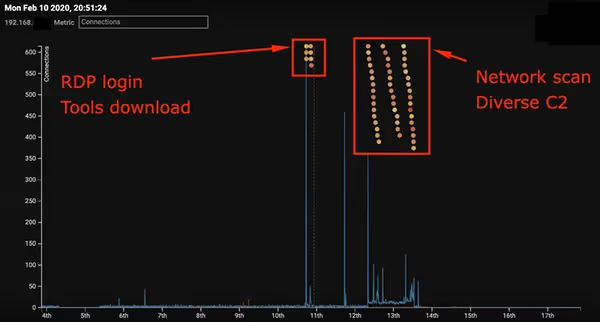
Over several days, the victim’s external-facing RDP server was receiving successful RDP connections from a rare external IP address located in Ukraine.

Shortly before the initial reconnaissance started, Darktrace saw another RDP connection coming into the RDP server with the same RDP account as seen before. This connection lasted for almost an hour.

It is highly likely that the RDP credential used in this attack had been compromised prior to the attack, either via common brute-force methods, credential stuffing attacks, or phishing.

Thanks to Darktrace’s Deep-Packet Inspection, we can clearly see the connection and all related information.

Suspicious RDP connection information:

Time: 2020-02-10 16:57:06 UTC
Source: 46.150.70[.]86 (Ukraine)
Destination: 192.168.X.X
Destination Port: 64347
Protocol: RDP
Cookie: [REDACTED]
Duration: 00h41m40s
Data out: 8.44 MB
Data in: 1.86 MB

Darktrace detects incoming RDP connections from IP addresses that usually do not connect to the organization.

Attack tools download

Approximately 45 minutes after the suspicious RDP connection from Ukraine, the RDP server connected to the popular file sharing platform, Megaupload, and downloaded close to 300MB from there.

Darktrace’s AI recognized that neither this server, nor its automatically detected peer group, nor, in fact, anyone else on the network commonly utilized Megaupload — and therefore instantly detected this as anomalous behavior, and flagged it as unusual.

As well as the full hostname and actual IP used for the download, Megaupload is 100% rare for this organization.

Later on, we will see over 40GB being uploaded to Megaupload. This initial download of 300MB however is likely additional tooling and C2 implants downloaded by the threat-actor into the victim’s environment.

Internal reconnaissance

Only 3 minutes after the download from Megaupload onto the RDP server, Darktrace alerted on the RDP server doing an anomalous network scan:
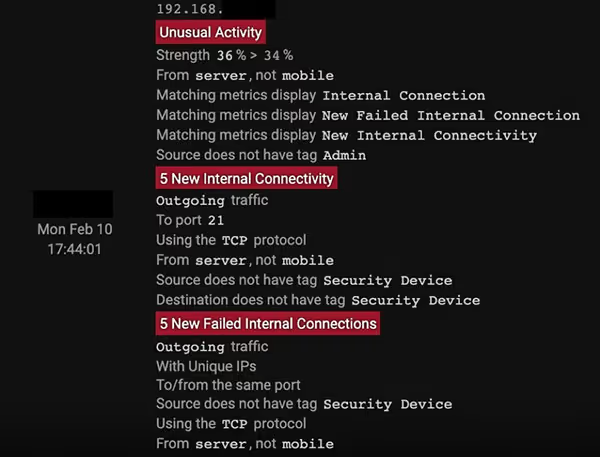
The RDP server scanned 9 other internal devices on the same subnet on 7 unique ports: 21, 80, 139, 445, 3389, 4899, 8080
 . Anybody with some offensive security know-how will recognize most of these ports as default ports one would scan for in a Windows environment for lateral movement. Since this RDP server does not usually conduct network scans, Darktrace again identified this activity as highly anomalous.

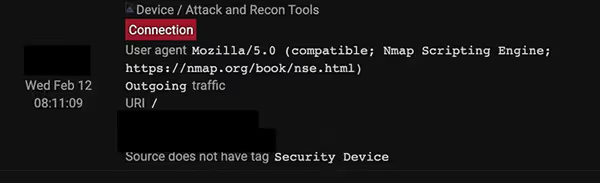
Later on, we see the threat-actor do more network scanning. They become bolder and use more generic scans — one of them showing that they are using Nmap with a default user agent:
Additional Command and Control traffic

While the initial Command and Control traffic was most likely using predominantly RDP, the threat-actor now wanted to establish more persistence and create more resilient channels for C2.

Shortly after concluding the initial network scans (ca. 19:17 on 10th February 2020), the RDP server starts communicating with unusual external services that are unique and unusual for the victim’s environment.
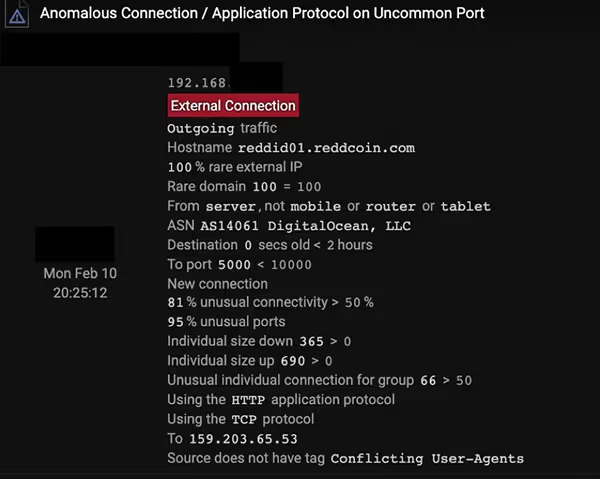
Communications to Reddcoin

Again, nobody else is using Reddcoin on the network. The combination of application protocol and external port is extremely unusual for the network as well.

The communications also went to the Reddcoin API, indicating the installation of a software agent rather than manual communications. This was detected as Reddcoin was not only rare for the network, but also ‘young’ — i.e. this particular external destination had never been seen to be contacted before on the network until 25 minutes before.
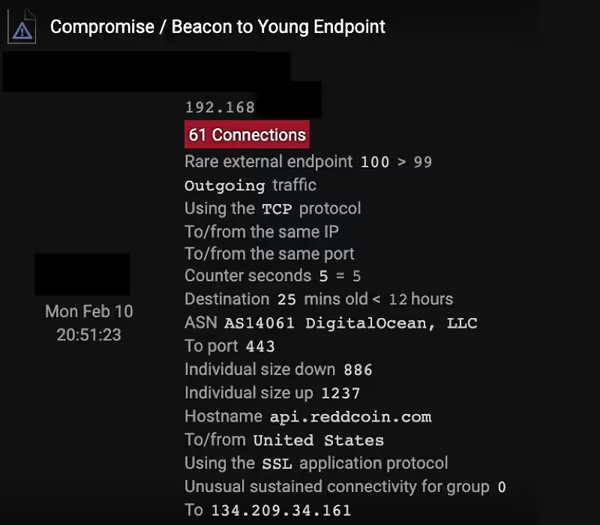
Communications to the Reddcoin API
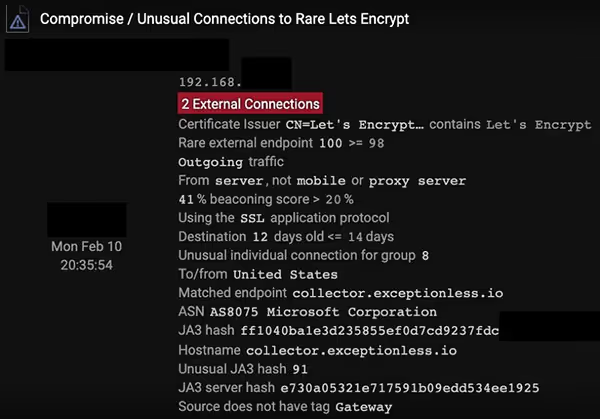
Communications to Exceptionless[.]io

As we can see, the communications to exceptionalness[.]io were done in a beaconing manner, using a Let’s Encrypt certificate, being rare for the network and using an unusual JA3 client hash. All of this indicates the presence of new software on the device, shortly after the threat-actor downloaded their 300MB of tooling.

While most of the above network activity started directly after the threat-actor dropped their tooling on the RDP server, the exact purpose of interfacing with Reddcoin and Exceptionless is unclear. The attacker seems to favor off-the-shelf tooling (Megaupload, Nmap, …) so they might use these services for C2 or telemetry-gathering purposes.

This concluded most of the activity on February 10.

More Command and Control traffic

Why would an attacker do this? Surely using all this C2 at the same time is much noisier than just using 1 or 2 channels?

Another significant burst of activity was observed on February 12 and 13.

The RDP server started making a lot of highly anomalous and rare connections to external destinations. It is inconclusive if all of the below services, IPs, and domains were used for C2 purposes only, but they are linked with high-confidence to the attacker’s activities:

  • HTTP beaconing to vkmuz[.]net
  • Significant amount of Tor usage
  • RDP connections to 198-0-244-153-static.hfc.comcastbusiness[.]net over non-standard RDP port 29348
  • RDP connections to 92.119.160[.]60 using an administrative account (geo-located in Russia)
  • Continued connections to Megaupload
  • Continued SSL beaconing to Exceptionless[.]io
  • Continued connections to api.reddcoin[.]com
  • SSL beaconing to freevpn[.]zone
  • HTTP beaconing to 31.41.116[.]201 to /index.php using a new User Agent
  • Unusual SSL connections to aj1713[.]online
  • Connections to Pastebin
  • SSL beaconing to www.itjx3no[.]com using an unusual JA3 client hash
  • SSL beaconing to safe-proxy[.]com
  • SSL connection to westchange[.]top without prior DNS hostname lookups (likely machine-driven)

What is significant here is the diversity in (potential) C2 channels: Tor, RDP going to dynamic ISP addresses, VPN solutions and possibly custom / customized off-the-shelf implants (the DGA-looking domains and HTTP to IP addresses to /index.php).

Why would an attacker do this? Surely using all this C2 at the same time is much noisier than just using 1 or 2 channels?

One answer might be that the attacker cared much more about short-term resilience than about stealth. As the overall attack in the network took less than 7 days, with a majority of the activity taking place over 2.5 days, this makes sense. Another possibility might be that various individuals were involved in parallel during this attack — maybe one attacker prefers the comfort of RDP sessions for hacking while another is more skilled and uses a particular post-exploitation framework.

The overall modus operandi in this financially-motivated attack is much more smash-and-grab than in the stealthy, espionage-related incidents observed in Advanced Persistent Threat campaigns (APT).

Data exfiltration

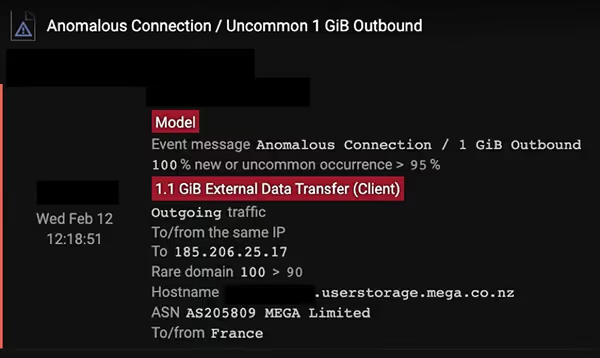
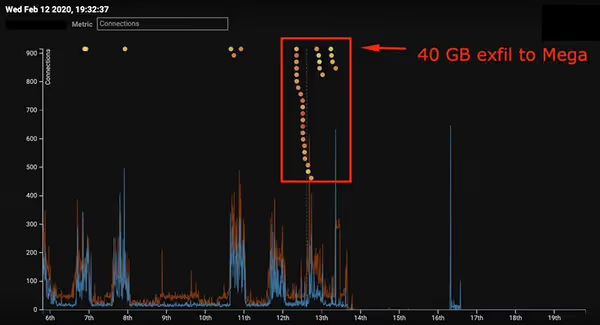
The DC uploaded around 40GB of data to Megaupload over the course of 24 hours.

While all of the above activity was seen on the RDP server (acting as the initial beach-head), the following data exfiltration activity was observed on a Domain Controller (DC) on the same subnet as the RDP server.

The DC uploaded around 40GB of data to Megaupload over the course of 24 hours.

Darktrace detected this data exfiltration while it was in progress — never did the DC (or any similar devices) upload similar amounts of data to the internet. Neither did any client nor server in the victim’s environment use Megaupload:
Ransom notes

Finally, Darktrace observed unusual files being accessed on internal SMB shares on February 13. These files appear to be ransom notes — they follow a similar, randomly-generated naming convention as other victims of the Sodinokibi group have reported:

413x0h8l-readme.txt
4omxa93-readme.txt

Conclusion and observations

The threat-actor seems to be using mostly off-the-shelf tooling which makes attribution harder — while also making detection more difficult.

This attack is representative of many of the current ransomware attacks: financially motivated, fast-acting, and targeted.

The threat-actor seems to be using mostly off-the-shelf tooling (RDP, Nmap, Mega, VPN solutions) which makes attribution harder — while also making detection more difficult. Using this kind of tooling often allows to blend in with regular admin activity — only once anomaly detection is used can this kind of activity be detected.

How can you spot the one anomalous outbound RDP connection amongst the thousands of regular RDP connections leaving your environment? How do you know when the use of Megaupload is malicious — compared to your users’ normal use of it? This is where the power of Darktrace’s self-learning AI comes into play.

Darktrace detected every stage of the visible attack lifecycle without using any threat intelligence or any static signatures.

The graphics below show an overview of detections on both compromised devices. The compromised devices were the highest-scoring assets for the network — even a level 1 analyst with limited previous exposure to Darktrace could detect such an in-progress attack in real time.
RDP Server

Some of the detections on the RDP server include:

  • Compliance / File Storage / Mega — using Megaupload in an unusual way
  • Device / Network Scan — detecting unusual network scans
  • Anomalous Connection / Application Protocol on Uncommon Port — detecting the use of protocols on unusual ports
  • Device / New Failed External Connections — detecting unusual failing C2
  • Compromise / Unusual Connections to Let’s Encrypt — detecting potential C2 over SSL using Let’s Encrypt
  • Compromise / Beacon to Young Endpoint — detecting C2 to new external endpoints for the network
  • Device / Attack and Recon Tools — detecting known offensive security tools like Nmap
  • Compromise / Tor Usage — detecting unusual Tor usage
  • Compromise / SSL Beaconing to Rare Destination — detecting generic SSL C2
  • Compromise / HTTP Beaconing to Rare Destination — detecting generic HTTP C2
  • Device / Long Agent Connection to New Endpoint — detecting unusual services on a device
  • Anomalous Connection / Outbound RDP to Unusual Port — detecting unusual RDP C2
DC

Some of the detections on the DC include:

  • Anomalous Activity / Anomalous External Activity from Critical Device — detecting unusual behaviour on dcs
  • Compliance / File storage / Mega — using Megaupload in an unusual way
  • Anomalous Connection / Data Sent to New External Device — data exfiltration to unusual locations
  • Anomalous Connection / Uncommon 1GB Outbound — large amounts of data leaving to unusual destinations
  • Anomalous Server Activity / Outgoing from Server — likely C2 to unusual endpoint on the internet


Inside the SOC
Darktrace cyber analysts are world-class experts in threat intelligence, threat hunting and incident response, and provide 24/7 SOC support to thousands of Darktrace customers around the globe. Inside the SOC is exclusively authored by these experts, providing analysis of cyber incidents and threat trends, based on real-world experience in the field.
Written by
Max Heinemeyer
Global Field CISO

More in this series

No items found.

Blog

/

/

December 22, 2025

The Year Ahead: AI Cybersecurity Trends to Watch in 2026

2026 cyber threat trendsDefault blog imageDefault blog image

Introduction: 2026 cyber trends

Each year, we ask some of our experts to step back from the day-to-day pace of incidents, vulnerabilities, and headlines to reflect on the forces reshaping the threat landscape. The goal is simple:  to identify and share the trends we believe will matter most in the year ahead, based on the real-world challenges our customers are facing, the technology and issues our R&D teams are exploring, and our observations of how both attackers and defenders are adapting.  

In 2025, we saw generative AI and early agentic systems moving from limited pilots into more widespread adoption across enterprises. Generative AI tools became embedded in SaaS products and enterprise workflows we rely on every day, AI agents gained more access to data and systems, and we saw glimpses of how threat actors can manipulate commercial AI models for attacks. At the same time, expanding cloud and SaaS ecosystems and the increasing use of automation continued to stretch traditional security assumptions.

Looking ahead to 2026, we’re already seeing the security of AI models, agents, and the identities that power them becoming a key point of tension – and opportunity -- for both attackers and defenders. Long-standing challenges and risks such as identity, trust, data integrity, and human decision-making will not disappear, but AI and automation will increase the speed and scale of the cyber risk.  

Here's what a few of our experts believe are the trends that will shape this next phase of cybersecurity, and the realities organizations should prepare for.  

Agentic AI is the next big insider risk

In 2026, organizations may experience their first large-scale security incidents driven by agentic AI behaving in unintended ways—not necessarily due to malicious intent, but because of how easily agents can be influenced. AI agents are designed to be helpful, lack judgment, and operate without understanding context or consequence. This makes them highly efficient—and highly pliable. Unlike human insiders, agentic systems do not need to be socially engineered, coerced, or bribed. They only need to be prompted creatively, misinterpret legitimate prompts, or be vulnerable to indirect prompt injection. Without strong controls around access, scope, and behavior, agents may over-share data, misroute communications, or take actions that introduce real business risk. Securing AI adoption will increasingly depend on treating agents as first-class identities—monitored, constrained, and evaluated based on behavior, not intent.

-- Nicole Carignan, SVP of Security & AI Strategy

Prompt Injection moves from theory to front-page breach

We’ll see the first major story of an indirect prompt injection attack against companies adopting AI either through an accessible chatbot or an agentic system ingesting a hidden prompt. In practice, this may result in unauthorized data exposure or unintended malicious behavior by AI systems, such as over-sharing information, misrouting communications, or acting outside their intended scope. Recent attention on this risk—particularly in the context of AI-powered browsers and additional safety layers being introduced to guide agent behavior—highlights a growing industry awareness of the challenge.  

-- Collin Chapleau, Senior Director of Security & AI Strategy

Humans are even more outpaced, but not broken

When it comes to cyber, people aren’t failing; the system is moving faster than they can. Attackers exploit the gap between human judgment and machine-speed operations. The rise of deepfakes and emotion-driven scams that we’ve seen in the last few years reduce our ability to spot the familiar human cues we’ve been taught to look out for. Fraud now spans social platforms, encrypted chat, and instant payments in minutes. Expecting humans to be the last line of defense is unrealistic.

Defense must assume human fallibility and design accordingly. Automated provenance checks, cryptographic signatures, and dual-channel verification should precede human judgment. Training still matters, but it cannot close the gap alone. In the year ahead, we need to see more of a focus on partnership: systems that absorb risk so humans make decisions in context, not under pressure.

-- Margaret Cunningham, VP of Security & AI Strategy

AI removes the attacker bottleneck—smaller organizations feel the impact

One factor that is currently preventing more companies from breaches is a bottleneck on the attacker side: there’s not enough human hacker capital. The number of human hands on a keyboard is a rate-determining factor in the threat landscape. Further advancements of AI and automation will continue to open that bottleneck. We are already seeing that. The ostrich approach of hoping that one’s own company is too obscure to be noticed by attackers will no longer work as attacker capacity increases.  

-- Max Heinemeyer, Global Field CISO

SaaS platforms become the preferred supply chain target

Attackers have learned a simple lesson: compromising SaaS platforms can have big payouts. As a result, we’ll see more targeting of commercial off-the-shelf SaaS providers, which are often highly trusted and deeply integrated into business environments. Some of these attacks may involve software with unfamiliar brand names, but their downstream impact will be significant. In 2026, expect more breaches where attackers leverage valid credentials, APIs, or misconfigurations to bypass traditional defenses entirely.

-- Nathaniel Jones, VP of Security & AI Strategy

Increased commercialization of generative AI and AI assistants in cyber attacks

One trend we’re watching closely for 2026 is the commercialization of AI-assisted cybercrime. For example, cybercrime prompt playbooks sold on the dark web—essentially copy-and-paste frameworks that show attackers how to misuse or jailbreak AI models. It’s an evolution of what we saw in 2025, where AI lowered the barrier to entry. In 2026, those techniques become productized, scalable, and much easier to reuse.  

-- Toby Lewis, Global Head of Threat Analysis

Conclusion

Taken together, these trends underscore that the core challenges of cybersecurity are not changing dramatically -- identity, trust, data, and human decision-making still sit at the core of most incidents. What is changing quickly is the environment in which these challenges play out. AI and automation are accelerating everything: how quickly attackers can scale, how widely risk is distributed, and how easily unintended behavior can create real impact. And as technology like cloud services and SaaS platforms become even more deeply integrated into businesses, the potential attack surface continues to expand.  

Predictions are not guarantees. But the patterns emerging today suggest that 2026 will be a year where securing AI becomes inseparable from securing the business itself. The organizations that prepare now—by understanding how AI is used, how it behaves, and how it can be misused—will be best positioned to adopt these technologies with confidence in the year ahead.

Learn more about how to secure AI adoption in the enterprise without compromise by registering to join our live launch webinar on February 3, 2026.  

Continue reading
About the author
The Darktrace Community

Blog

/

Email

/

December 18, 2025

Why organizations are moving to label-free, behavioral DLP for outbound email

Man at laptopDefault blog imageDefault blog image

Why outbound email DLP needs reinventing

In 2025, the global average cost of a data breach fell slightly — but remains substantial at USD 4.44 million (IBM Cost of a Data Breach Report 2025). The headline figure hides a painful reality: many of these breaches stem not from sophisticated hacks, but from simple human error: mis-sent emails, accidental forwarding, or replying with the wrong attachment. Because outbound email is a common channel for sensitive data leaving an organization, the risk posed by everyday mistakes is enormous.

In 2025, 53% of data breaches involved customer PII, making it the most commonly compromised asset (IBM Cost of a Data Breach Report 2025). This makes “protection at the moment of send” essential. A single unintended disclosure can trigger compliance violations, regulatory scrutiny, and erosion of customer trust –consequences that are disproportionate to the marginal human errors that cause them.

Traditional DLP has long attempted to mitigate these impacts, but it relies heavily on perfect labelling and rigid pattern-matching. In reality, data loss rarely presents itself as a neat, well-structured pattern waiting to be caught – it looks like everyday communication, just slightly out of context.

How data loss actually happens

Most data loss comes from frustratingly familiar scenarios. A mistyped name in auto-complete sends sensitive data to the wrong “Alex.” A user forwards a document to a personal Gmail account “just this once.” Someone shares an attachment with a new or unknown correspondent without realizing how sensitive it is.

Traditional, content-centric DLP rarely catches these moments. Labels are missing or wrong. Regexes break the moment the data shifts formats. And static rules can’t interpret the context that actually matters – the sender-recipient relationship, the communication history, or whether this behavior is typical for the user.

It’s the everyday mistakes that hurt the most. The classic example: the Friday 5:58 p.m. mis-send, when auto-complete selects Martin, a former contractor, instead of Marta in Finance.

What traditional DLP approaches offer (and where gaps remain)

Most email DLP today follows two patterns, each useful but incomplete.

  • Policy- and label-centric DLP works when labels are correct — but content is often unlabeled or mislabeled, and maintaining classification adds friction. Gaps appear exactly where users move fastest
  • Rule and signature-based approaches catch known patterns but miss nuance: human error, new workflows, and “unknown unknowns” that don’t match a rule

The takeaway: Protection must combine content + behavior + explainability at send time, without depending on perfect labels.

Your technology primer: The three pillars that make outbound DLP effective

1) Label-free (vs. data classification)

Protects all content, not just what’s labeled. Label-free analysis removes classification overhead and closes gaps from missing or incorrect tags. By evaluating content and context at send time, it also catches misdelivery and other payload-free errors.

  • No labeling burden; no regex/rule maintenance
  • Works when tags are missing, wrong, or stale
  • Detects misdirected sends even when labels look right

2) Behavioral (vs. rules, signatures, threat intelligence)

Understands user behavior, not just static patterns. Behavioral analysis learns what’s normal for each person, surfacing human error and subtle exfiltration that rules can’t. It also incorporates account signals and inbound intel, extending across email and Teams.

  • Flags risk without predefined rules or IOCs
  • Catches misdelivery, unusual contacts, personal forwards, odd timing/volume
  • Blends identity and inbound context across channels

3) Proprietary DSLM (vs. generic LLM)

Optimized for precise, fast, explainable on-send decisions. A DSLM understands email/DLP semantics, avoids generative risks, and stays auditable and privacy-controlled, delivering intelligence reliably without slowing mail flow.

  • Low-latency, on-send enforcement
  • Non-generative for predictable, explainable outcomes
  • Governed model with strong privacy and auditability

The Darktrace approach to DLP

Darktrace / EMAIL – DLP stops misdelivery and sensitive data loss at send time using hold/notify/justify/release actions. It blends behavioral insight with content understanding across 35+ PII categories, protecting both labeled and unlabeled data. Every action is paired with clear explainability: AI narratives show exactly why an email was flagged, supporting analysts and helping end-users learn. Deployment aligns cleanly with existing SOC workflows through mail-flow connectors and optional Microsoft Purview label ingestion, without forcing duplicate policy-building.

Deployment is simple: Microsoft 365 routes outbound mail to Darktrace for real-time, inline decisions without regex or rule-heavy setup.

A buyer’s checklist for DLP solutions

When choosing your DLP solution, you want to be sure that it can deliver precise, explainable protection at the moment it matters – on send – without operational drag.  

To finish, we’ve compiled a handy list of questions you can ask before choosing an outbound DLP solution:

  • Can it operate label free when tags are missing or wrong? 
  • Does it truly learn per user behavior (no shortcuts)? 
  • Is there a domain specific model behind the content understanding (not a generic LLM)? 
  • Does it explain decisions to both analysts and end users? 
  • Will it integrate with your label program and SOC workflows rather than duplicate them? 

For a deep dive into Darktrace’s DLP solution, check out the full solution brief.

[related-resource]

Continue reading
About the author
Carlos Gray
Senior Product Marketing Manager, Email
Your data. Our AI.
Elevate your network security with Darktrace AI