Blog
/
/
March 4, 2026

Inside Cloud Compromise: Investigating Attacker Activity with Darktrace / Forensic Acquisition & Investigation

Darktrace / Forensic Acquisition & Investigation automates cloud forensic analysis, enabling rapid investigation of compromised servers via Cloudypots honeypot data. It reveals attacker activity, highlights key events, decodes malicious payloads, and identifies malware campaigns like perfctl, helping defenders accelerate triage and understand cloud-based intrusion techniques.
Inside the SOC
Darktrace cyber analysts are world-class experts in threat intelligence, threat hunting and incident response, and provide 24/7 SOC support to thousands of Darktrace customers around the globe. Inside the SOC is exclusively authored by these experts, providing analysis of cyber incidents and threat trends, based on real-world experience in the field.
Written by
Nathaniel Bill
Malware Research Engineer
Forensic Acquisition and investigationDefault blog imageDefault blog imageDefault blog imageDefault blog imageDefault blog imageDefault blog image
04
Mar 2026

Investigating cloud attacks with Darktrace/ Forensic Acquisition & Investigation

Darktrace / Forensic Acquisition & Investigation™ is the industry’s first truly automated forensic solution purpose-built for the cloud. This blog will demonstrate how an investigation can be carried out against a compromised cloud server in minutes, rather than hours or days.

The compromised server investigated in this case originates from Darktrace’s Cloudypots system, a global honeypot network designed to observe adversary activity in real time across a wide range of cloud services. Whenever an attacker successfully compromises one of these honeypots, a forensic copy of the virtual server's disk is preserved for later analysis. Using Forensic Acquisition & Investigation, analysts can then investigate further and obtain detailed insights into the compromise including complete attacker timelines and root cause analysis.

Forensic Acquisition & Investigation supports importing artifacts from a variety of sources, including EC2 instances, ECS, S3 buckets, and more. The Cloudypots system produces a raw disk image whenever an attack is detected and stores it in an S3 bucket. This allows the image to be directly imported into Forensic Acquisition & Investigation using the S3 bucket import option.

As Forensic Acquisition & Investigation runs cloud-natively, no additional configuration is required to add a specific S3 bucket. Analysts can browse and acquire forensic assets from any bucket that the configured IAM role is permitted to access. Operators can also add additional IAM credentials, including those from other cloud providers, to extend access across multiple cloud accounts and environments.

Figure 1: Forensic Acquisition & Investigation import screen.

Forensic Acquisition & Investigation then retrieves a copy of the file and automatically begins running the analysis pipeline on the artifact. This pipeline performs a full forensic analysis of the disk and builds a timeline of the activity that took place on the compromised asset. By leveraging Forensic Acquisition & Investigation’s cloud-native analysis system, this process condenses hour of manual work into just minutes.
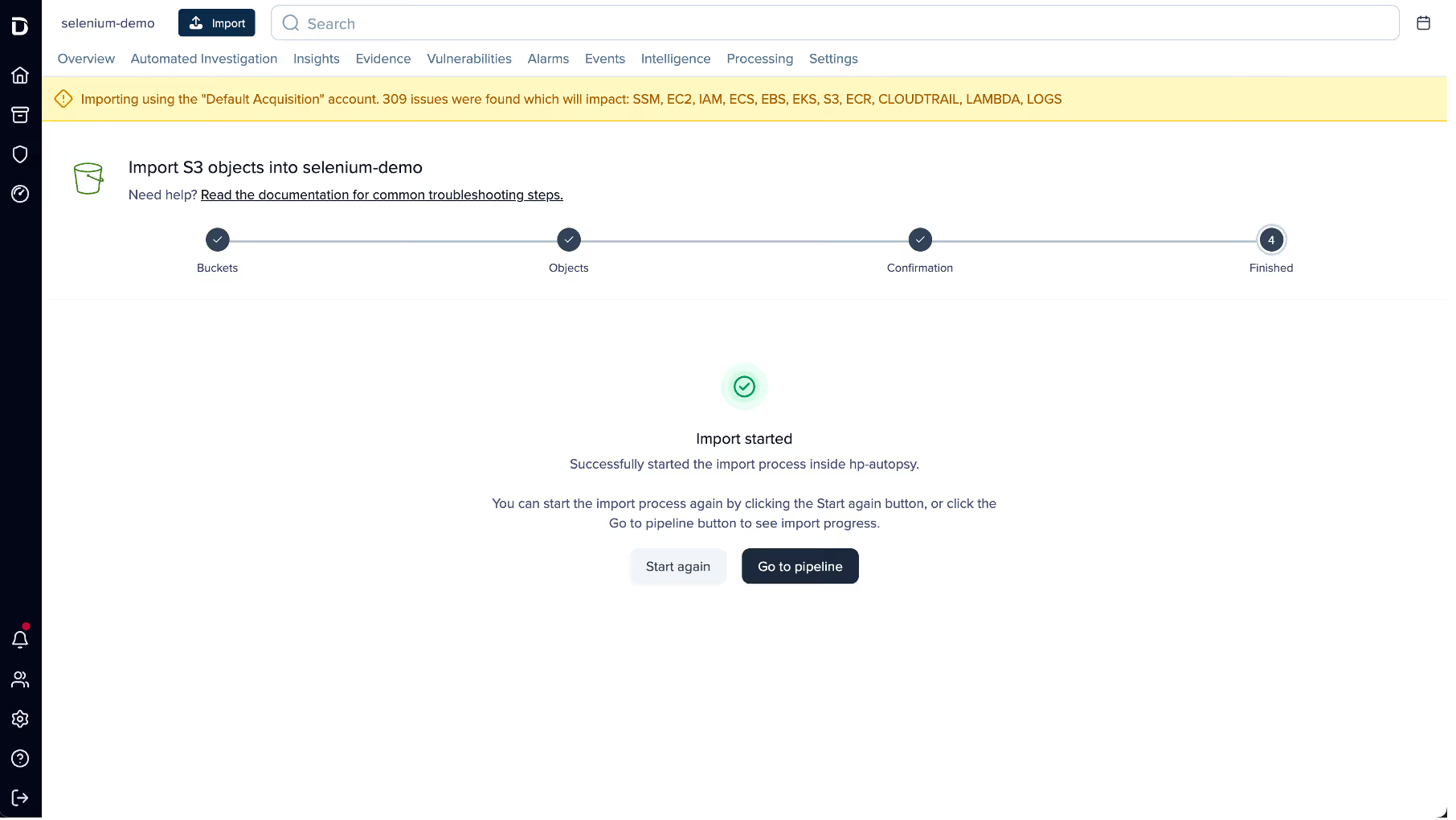
Successful import of a forensic artifact and initiation of the analysis pipeline.
Figure 2: Successful import of a forensic artifact and initiation of the analysis pipeline.

Once processing is complete, the preserved artifact is visible in the Evidence tab, along with a summary of key information obtained during analysis, such as the compromised asset’s hostname, operating system, cloud provider, and key event count.
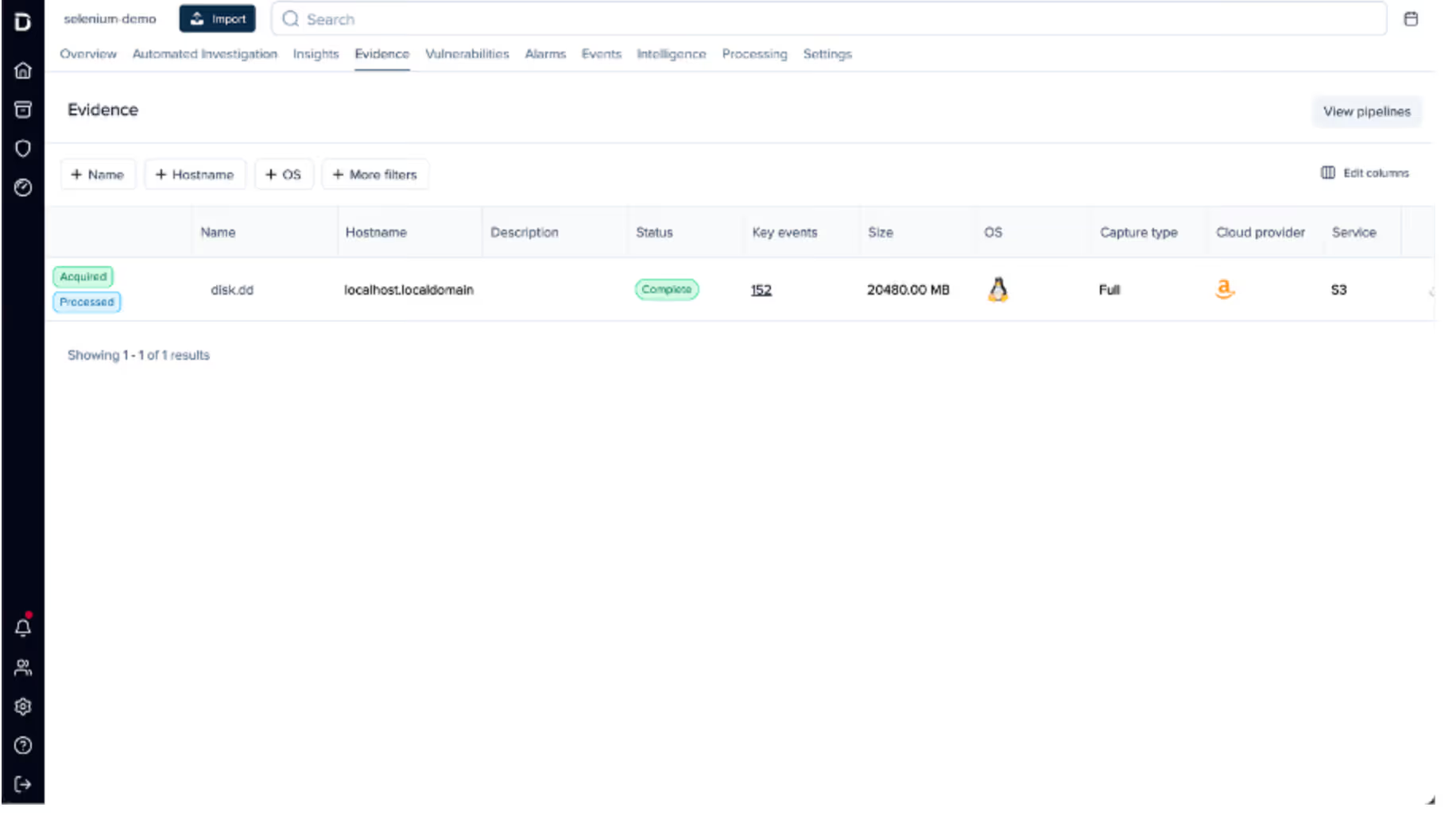
The Evidence overview showing the acquired disk image.
Figure 3: The Evidence overview showing the acquired disk image.

Clicking on the “Key events” field in the listing opens the timeline view, automatically filtered to show system- generated alarms.

The timeline provides a chronological record of every event that occurred on the system, derived from multiple sources, including:

  • Parsed log files such as the systemd journal, audit logs, application specific logs, and others.
  • Parsed history files such as .bash_history, allowing executed commands to be shown on the timeline.
  • File-specific events, such as files being created, accessed, modified, or executables being run, etc.

This approach allows timestamped information and events from multiple sources to be aggregated and parsed into a single, concise view, greatly simplifying the data review process.

Alarms are created for specific timeline events that match either a built-in system rule, curated by Darktrace’s Threat Research team or an operator-defined rule  created at the project level. These alarms help quickly filter out noise and highlight on events of interest, such as the creation of a file containing known malware, access to sensitive files like Amazon Web Service (AWS) credentials, suspicious arguments or commands, and more.
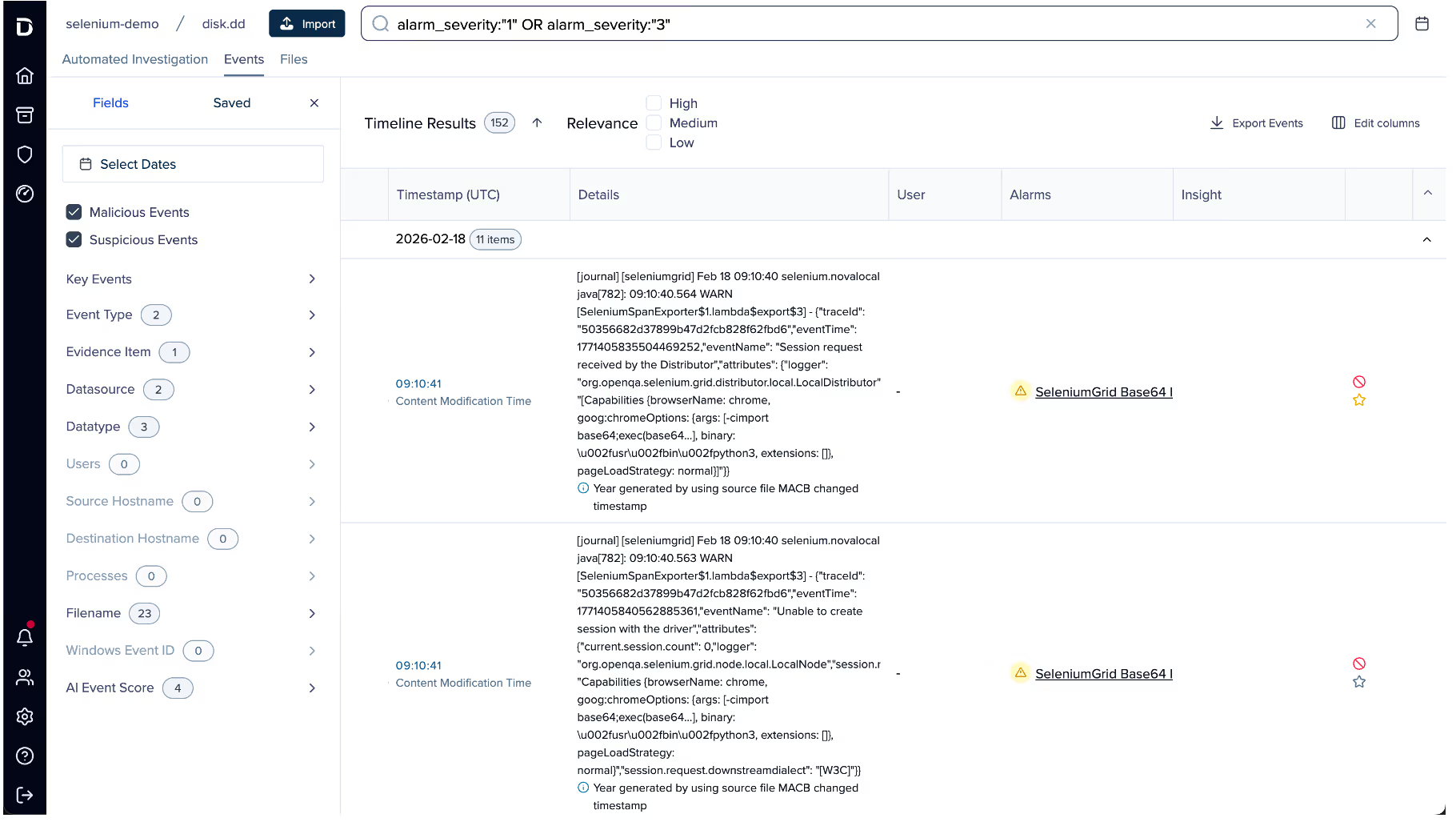
 The timeline view filtered to alarm_severity: “1” OR alarm_severity: “3”, showing only events that matched an alarm rule.
Figure 4: The timeline view filtered to alarm_severity: “1” OR alarm_severity: “3”, showing only events that matched an alarm rule.

In this case, several alarms were generated for suspicious Base64 arguments being passed to Selenium. Examining the event data, it appears the attacker spawned a Selenium Grid session with the following payload:

"request.payload": "[Capabilities {browserName: chrome, goog:chromeOptions: {args: [-cimport base64;exec(base64...], binary: /usr/bin/python3, extensions: []}, pageLoadStrategy: normal}]"

This is a common attack vector for Selenium Grid. The chromeOptions object is intended to specify arguments for how Google Chrome should be launched; however, in this case the attacker has abused the binary field to execute the Python3 binary instead of Chrome. Combined with the option to specify command-line arguments, the attacker can use Python3’s -c option to execute arbitrary Python code, in this instance, decoding and executing a Base64 payload.

Selenium’s logs truncate the Arguments field automatically, so an alternate method is required to retrieve the full payload. To do this, the search bar can be used to find all events that occurred around the same time as this flagged event.

Pivoting off the previous event by filtering the timeline to events within the same window using timestamp: [“2026-02-18T09:09:00Z” TO “2026-02-18T09:12:00Z”].
Figure 5: Pivoting off the previous event by filtering the timeline to events within the same window using timestamp: [“2026-02-18T09:09:00Z” TO “2026-02-18T09:12:00Z”].

Scrolling through the search results, an entry from Java’s systemd journal can be identified. This log contains the full, unaltered payload. GCHQ’s CyberChef can then be used to decode the Base64 data into the attacker’s script, which will ultimately be executed.

Decoding the attacker’s payload in CyberChef.
Figure 6: Decoding the attacker’s payload in CyberChef.

In this instance, the malware was identified as a variant of a campaign that has been previously documented in depth by Darktrace.

Investigating Perfctl Malware

This campaign deploys a malware sample known as ‘perfctl to the compromised host. The script executed by the attacker downloads a Go binary named “promocioni.php” from 200[.]4.115.1. Its functionality is consistent with previously documented perfctl samples, with only minor changes such as updated filenames and a new command-and-control (C2) domain.

Perfctl is a stealthy malware that has several systems designed  to evade detection. The main binary is packed with UPX, with the header intentionally tampered with to prevent unpacking using regular tools. The binary also avoids executing any malicious code if it detects debugging or tracing activity, or if artifacts left by earlier stages are missing.

To further aid its evasive capabilities, perfctl features a usermode rootkit using an LD preload. This causes dynamically linked executables to load perfctl’s rootkit payload before other system modules, allowing it to override functions, such as intercepting calls to list files and hiding output from the returned list. Perfctl uses this to hide its own files, as well as other files like the ld.so.preload file, preventing users from identifying that a rootkit is present in the first place.

This also makes it difficult to dynamically analyze, as even analysts aware of the rootkit will struggle to get around it due to its aggressiveness in hiding its components. A useful trick is to use the busybox-static utilities, which are statically linked and therefore immune to LD preloading.

Perfctl will attempt to use sudo to escalate its permissions to root if the user it was executed as has the required privileges. Failing this, it will attempt to exploit the vulnerability CVE-2021-4034.

Ultimately, perfctl will attempt to establish a C2 link via Tor and spawn an XMRig miner to mine the Monero cryptocurrency. The traffic to the mining pool is encapsulated within Tor to limit network detection of the mining traffic.

Darktrace’s Cloudypots system has observed 1,959 infections of the perfctl campaign across its honeypot network in the past year, making it one of the most aggressive campaigns seen by Darktrace.

Key takeaways

This blog has shown how Darktrace / Forensic Acquisition & Investigation equips defenders in the face of a real-world attacker campaign. By using this solution, organizations can acquire forensic evidence and investigate intrusions across multiple cloud resources and providers, enabling defenders to see the full picture of an intrusion on day one. Forensic Acquisition & Investigation’s patented data-processing system takes advantage of the cloud’s scale to rapidly process large amounts of data, allowing triage to take minutes, not hours.

Darktrace / Forensic Acquisition & Investigation is available as Software-as-a-Service (SaaS) but can also be deployed on-premises as a virtual application or natively in the cloud, providing flexibility between convenience and data sovereignty to suit any use case.

Support for acquiring traditional compute instances like EC2, as well as more exotic and newly targeted platforms such as ECS and Lambda, ensures that attacks taking advantage of Living-off-the-Cloud (LOTC) strategies can be triaged quickly and easily as part of incident response. As attackers continue to develop new techniques, the ability to investigate how they use cloud services to persist and pivot throughout an environment is just as important to triage as a single compromised EC2 instance.

Credit to Nathaniel Bill (Malware Research Engineer)

Inside the SOC
Darktrace cyber analysts are world-class experts in threat intelligence, threat hunting and incident response, and provide 24/7 SOC support to thousands of Darktrace customers around the globe. Inside the SOC is exclusively authored by these experts, providing analysis of cyber incidents and threat trends, based on real-world experience in the field.
Written by
Nathaniel Bill
Malware Research Engineer

More in this series

No items found.

Blog

/

Email

/

March 24, 2026

Darktrace Unites Human Behavior and Threat Detection Across Email, Slack, Teams, and Zoom

Photo of office workers collaborating at a laptopDefault blog imageDefault blog image

The communication attack surface is expanding

Modern attackers no longer focus solely on inboxes, they target people and the productivity systems where work actually happens. Meanwhile, the boundary between internal and external usage of tools is becoming blurrier everyday – turning the entire workplace into the attack surface. In 2025, identity compromise emerged as the single most consistent threat across the global threat landscape, as observed by Darktrace research across our entire customer base. Over 70% of incidents in the US involved SaaS/M365 account compromise and phishing or email-based social engineering, making credential abuse the single most effective initial access vector.

Despite this upward trend, investment in existing security awareness training (SAT) isn’t moving the needle on reducing risk. 84% of organizations still measure success through completion rates1, even though completion of standard training correlates with less than 2% real improvement in risky behavior.2 By prioritizing completion, organizations reward time spent rather than meaningful engagement, yet time in training doesn’t translate to retention or real-world decision-making. This compliance-first approach has left the workforce unprepared for the threats they actually face.

At the same time, attacks have evolved. Highly personalized, AI-generated campaigns now move fluidly across email, Slack, Teams, Zoom, and beyond, blending channels and even targeting systems directly through techniques like prompt injection. This new reality demands a different approach: one that treats people and the tools they use as a single ecosystem, where behavior and detection continuously inform and strengthen each other.

Only an adaptive communication security system can keep pace with the speed, creativity, and cross channel nature of today’s threats. 

Ushering in the adaptive era of workplace security

With this release, Darktrace brings together our new behavior-driven training solution with email detection, cross-channel visibility, and platform-level insights. Powered by Self-Learning AI, it delivers protection across both people and the communication tools they rely on every day, including email, Slack, Teams, and Zoom.

Each component learns from the others – training adapts to real user behavior, detection evolves across channels, and response is continuously refined – creating a powerful feedback loop that strengthens resilience and improves accuracy against today’s AI-driven threats.

Introducing: Unified training and email security for a self-improving email defense

Our brand new product, Darktrace / Adaptive Human Defense, closes the gap between human behavior and email security to continuously strengthen both people and defenses. Each user receives personalized training that adapts to their own inbox activity and skill level, with learning delivered directly within the flow of their day-to-day email interactions.

By learning from each user’s interactions with security training, it adapts security responses, creating a closed-loop system where training reinforces detection and detection informs training. Let’s look at some of the benefits.

  • Reduce successful phishing at the source with contextual Just in Time coaching: Contextual coaching appears directly in real email threads the moment risky behavior is detected, so habits change where mistakes actually happen. Configurable triggers and group policies target the right users, reducing repeated errors and administrative overhead.
  • Adaptive phishing simulations that progress automatically with each user: Embedded simulations vary in their degree of realism, from generic phishing to generative AI-enabled spear phishing. Users progress through the difficulty levels based on their performance to give an accurate picture of their phishing preparedness.  
  • Native email security integration turns human behavior into quantified risk: The native email security integration allows engagement, links clicked, and question success signals to flow back into / EMAIL recipes and models, so detection and response adapt automatically as users learn.  
  • Actionable risk and trend analytics beyond completion rates: Analytics that surface repeat offenders, high-value targets, and measurable exposure, moving beyond completion metrics to give leaders actionable insights tied to real behavior.

Learn more about / Adaptive Human Defense in the product solution brief.

Industry-first cross-channel full-message analysis for email, Slack, Teams, and Zoom

Darktrace now brings full-message analysis to Email, Slack, Teams, Zoom, and even generative AI prompts. The same leading behavioral analysis from EMAIL extends to every message, tracing intent, tone, relationships, and conversation flow across all communication activity for a complete understanding of every user interaction.

By correlating messaging and collaboration activity with email and account environments, cross-channel analysis reveals multi-domain attack paths and follows both users and threats as a single, continuous narrative – delivering better context to improve detection across the entire organization.

  • Eliminate cross-channel blind spots: Detect phishing, malware, account takeovers, and conversational manipulation across email and collaboration platforms, so attackers can’t exploit Slack, Teams, or Zoom as a new entry point. Unified behavioral analysis gives security teams a coherent, single view, for no more fragmented, channel-specific gaps.
  • Spot generative AI prompt injection attacks before they manipulate assistants: Dedicated models surface threats targeting corporate AI assistants – like ShadowLeak and Hashjack – before they can silently manipulate workflows, reducing risk before static filters catch up.

Learn more about Darktrace’s messaging security offering in the product solution brief.

Industry-first DMARC with bi-directional ASM and email security integration

Darktrace transforms domain protection by linking DMARC, attack surface intelligence, and email security into a single, continuously evolving workflow. Instead of treating domain authentication and exposure as separate tasks, this unified approach shows not just where domains are vulnerable, but how attackers are actively exploiting them.

  • Fix authentication weaknesses faster: SPF, DKIM, DMARC configurations, and external exposure data are analyzed together, giving teams clear guidance to correct weaknesses before they can be abused. Deep bidirectional integration with attack surface intelligence reduces impersonation risk at the source.
  • Accelerate email investigations: DMARC context is embedded directly into email workflows, enriching triage with authentication posture, internal/external sender lists, and seamless pivots between email and domain intelligence for faster, more accurate investigations.

Committed to innovation

These updates are part of a broader Darktrace release, which also includes:

Join our Live Launch Event on April 14, 2026.

Join us for an exclusive announcement event where Darktrace, the leader in AI-native cybersecurity, will be announcing our latest innovations, including  a demo of our new product / Adaptive Human Defense, an exclusive conversation with a Darktrace customer, and a deep dive into the Darktrace ActiveAI Security Portal.  

Register here.

References

[1] 84% of organizations still measure security awareness training success through completion rates, a vanity metric with no correlation to behavior change. (Source:  NIST Awareness Effectiveness Study, Forrester 2025)

[2] 'Limited benefit from embedded phishing training. Using randomized controlled trials and statistical modeling, embedded training provides a statistically-significant reduction in average failure rate, but of only 2%.' Ho, G., Mirian, A., Luo, E., Tong, K., Lee, E., Liu, L., Longhurst, C. A., Dameff, C., Savage, S., & Voelker, G. M. (2025). Understanding the Efficacy of Phishing Training in Practice. Proceedings of the 2025 IEEE Symposium on Security and Privacy.

Continue reading
About the author
Carlos Gray
Senior Product Marketing Manager, Email

Blog

/

OT

/

March 25, 2026

Advancing OT Security with Architecture Visibility, Operational Reporting, and Industrial Context

darktrace / ot updatesDefault blog imageDefault blog image

The challenge of operational understanding in complex OT environments

Most industrial organizations today already have some level of asset visibility. The bigger challenge is maintaining a trusted, shared understanding of the environment as it evolves. OT teams still frequently rely on static diagrams, spreadsheets, and manually maintained documentation because these are often the only artifacts trusted by auditors, leadership, and engineering teams. However, these references quickly become outdated as environments change.

At the same time, compliance expectations continue to increase, particularly around IEC-62443 aligned programs. Producing defensible security evidence often requires teams to manually assemble reports across multiple tools while still debating asset inventories and classifications. This creates operational overhead and reduces confidence during audits, risk reviews, and incident response situations.

Advancing operational OT security with Darktrace / OT

Darktrace / OT's latest updates focus on helping industrial organizations close this operational gap by strengthening how OT security platforms support real workflows. This release enhances Operational Overview with architecture visibility, improves how industrial assets are represented, and introduces structured reporting capabilities aligned to governance needs.

Together, these improvements help organizations maintain a more reliable operational picture of their environments while reducing manual effort associated with documentation, reporting, and asset validation.

Native OT architecture visibility inside Operational Overview

Understanding how industrial environments are structured is critical during investigations and risk reviews, yet architecture diagrams are typically maintained outside security platforms and quickly fall out of sync with operational changes. This disconnect makes it harder for OT, IT, and security teams to maintain a shared understanding of their environments when incidents occur.

Darktrace / OT introduces native OT architecture diagrams directly within Operational Overview, allowing teams to maintain a live representation of how OT assets and systems relate to each other inside the same platform used for monitoring and investigations.

These updates help organizations:

  • Maintain a shared architectural understanding across OT, IT, and security teams
  • Improve investigation context by understanding how systems relate operationally
  • Reduce reliance on static diagrams that quickly become outdated

Improving OT governance with operational asset and compliance reporting

Accurate reporting remains a major operational challenge for industrial organizations, particularly when security posture must be demonstrated to auditors, regulators, and leadership. Many OT teams still rely on manual screenshots, spreadsheets, or fragmented exports to show asset inventories and compliance alignment.

Darktrace / OT introduces structured OT asset reporting and IEC-62443-3-3 compliance reporting directly from Operational Overview. These capabilities allow organizations to generate consistent, repeatable outputs based on continuously observed OT environments rather than manually assembled documentation.

These updates help customers:

  • Reduce manual compliance effort through automated IEC-62443 reporting aligned to live OT data
  • Support governance workflows with structured OT asset and architecture reporting
  • Improve audit readiness with consistent reporting aligned to operational security posture

Expanding industrial context through improved asset representation and protocol coverage

Industrial environments rely on diverse technologies spanning manufacturing systems, power and utilities infrastructure, healthcare devices, and Industrial IoT deployments. Maintaining strong visibility across these environments requires both accurate device representation and deeper protocol understanding.

Darktrace / OT strengthens industrial context through expanded ICS and IoMT device classification alongside broader industrial protocol coverage. These improvements help organizations better understand specialized devices and communications across sectors such as manufacturing, energy, healthcare, and Industrial IoT.

These enhancements enable organizations to:

  • Improve visibility into specialized ICS, IoMT, and industrial infrastructure devices
  • Strengthen monitoring across sector-specific industrial communications in manufacturing, utilities, and IIoT environments
  • Increase confidence in detection across complex and evolving industrial technology estates

Supporting practical OT security outcomes for industrial organizations

Darktrace / OT continues our focus on delivering capabilities that help industrial organizations operationalize security rather than simply deploy tools. By improving architecture understanding, strengthening asset representation, and supporting governance reporting, this release helps organizations manage OT security with greater confidence.

As industrial environments continue to evolve, organizations need more than visibility. They need the ability to maintain trusted operational understanding and demonstrate security readiness without increasing operational friction. This release reflects Darktrace’s continued commitment to supporting the priorities that matter most in OT: safety, uptime, and resilience.

Continue reading
About the author
Pallavi Singh
Product Marketing Manager, OT Security & Compliance
Your data. Our AI.
Elevate your network security with Darktrace AI