


Blog
/
Network
/
janvier 28, 2026

The State of Cybersecurity in the Finance Sector: Six Trends to Watch

Financial institutions are facing a threat landscape shaped by identity-led intrusion, pre-disclosure exploitation, data-first ransomware, and growing cloud and AI governance blind spots. This blog explores the key threats and trends redefining cyber risk across the finance sector and what defenders must adapt to next.
Inside the SOC
Darktrace cyber analysts are world-class experts in threat intelligence, threat hunting and incident response, and provide 24/7 SOC support to thousands of Darktrace customers around the globe. Inside the SOC is exclusively authored by these experts, providing analysis of cyber incidents and threat trends, based on real-world experience in the field.
Written by
Nathaniel Jones
SVP, Global Threat Intelligence
financial institutions cybersecurityDefault blog image
28
janv. 2026

The evolving cybersecurity threat landscape in finance

The financial sector, encompassing commercial banks, credit unions, financial services providers, and cryptocurrency platforms, faces an increasingly complex and aggressive cyber threat landscape. The financial sector’s reliance on digital infrastructure and its role in managing high-value transactions make it a prime target for both financially motivated and state-sponsored threat actors.

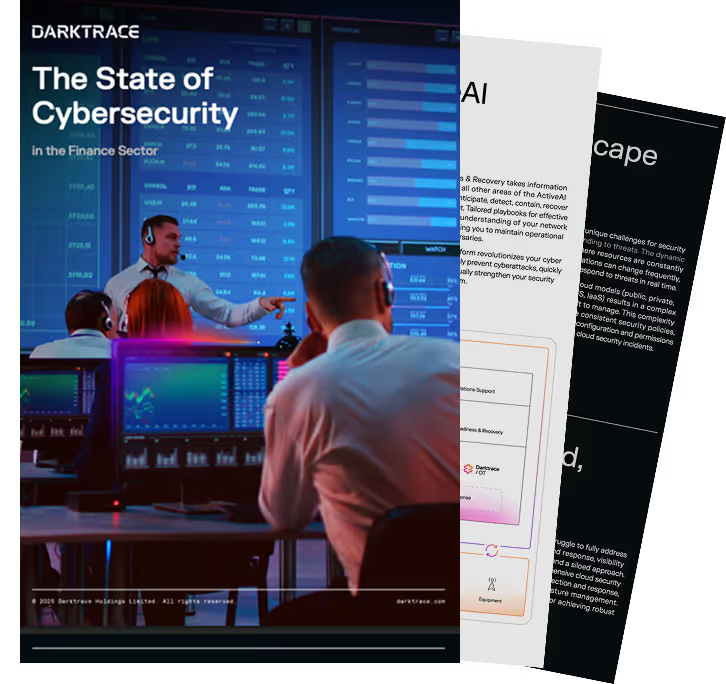
Darktrace’s latest threat research, The State of Cybersecurity in the Finance Sector, draws on a combination of Darktrace telemetry data from real-world customer environments, open-source intelligence, and direct interviews with financial-sector CISOs to provide perspective on how attacks are unfolding and how defenders in the sector need to adapt.  

Six cybersecurity trends in the finance sector for 2026

1. Credential-driven attacks are surging

Phishing continues to be a leading initial access vector for attacks targeting confidentiality. Financial institutions are frequently targeted with phishing emails designed to harvest login credentials. Techniques including Adversary-in-The-Middle (AiTM) to bypass Multi-factor Authentication (MFA) and QR code phishing (“quishing”) are surging and are capable of fooling even trained users. In the first half of 2025, Darktrace observed 2.4 million phishing emails within financial sector customer deployments, with almost 30% targeted towards VIP users.  

2. Data Loss Prevention is an increasing challenge

Compliance issues – particularly data loss prevention -- remain a persistent risk. In October 2025 alone, Darktrace observed over 214,000 emails across financial sector customers that contained unfamiliar attachments and were sent to suspected personal email addresses highlighting clear concerns around data loss prevention. Across the same set of customers within the same time frame, more than 351,000 emails containing unfamiliar attachments were sent to freemail addresses (e.g. gmail, yahoo, icloud), highlighting clear concerns around DLP.  

Confidentiality remains a primary concern for financial institutions as attackers increasingly target sensitive customer data, financial records, and internal communications.  

3. Ransomware is evolving toward data theft and extortion

Ransomware is no longer just about locking systems, it’s about stealing data first and encrypting second. Groups such as Cl0p and RansomHub now prioritize exploiting trusted file-transfer platforms to exfiltrate sensitive data before encryption, maximizing regulatory and reputational fallout for victims.  

Darktrace’s threat research identified routine scanning and malicious activity targeting internet-facing file-transfer systems used heavily by financial institutions. In one notable case involving Fortra GoAnywhere MFT, Darktrace detected malicious exploitation behavior six days before the CVE was publicly disclosed, demonstrating how attackers often operate ahead of patch cycles

This evolution underscores a critical reality: by the time a vulnerability is disclosed publicly, it may already be actively exploited.

4. Attackers are exploiting edge devices, often pre-disclosure.  

VPNs, firewalls, and remote access gateways have become high-value targets, and attackers are increasingly exploiting them before vulnerabilities are publicly disclosed. Darktrace observed pre-CVE exploitation activity affecting edge technologies including Citrix, Palo Alto, and Ivanti, enabling session hijacking, credential harvesting, and privileged lateral movement into core banking systems.  

Once compromised, these edge devices allow adversaries to blend into trusted network traffic, bypassing traditional perimeter defenses. CISOs interviewed for the report repeatedly described VPN infrastructure as a “concentrated focal point” for attackers, especially when patching and segmentation lag behind operational demands.

5. DPRK-linked activity is growing across crypto and fintech.  

State-sponsored activity, particularly from DPRK-linked groups affiliated with Lazarus, continues to intensify across cryptocurrency and fintech organizations. Darktrace identified coordinated campaigns leveraging malicious npm packages, previously undocumented BeaverTail and InvisibleFerret malware, and exploitation of React2Shell (CVE-2025-55182) for credential theft and persistent backdoor access.  

Targeting was observed across the United Kingdom, Spain, Portugal, Sweden, Chile, Nigeria, Kenya, and Qatar, highlighting the global scope of these operations.  

6. Cloud complexity and AI governance gaps are now systemic risks.  

Finally, CISOs consistently pointed to cloud complexity, insider risk from new hires, and ungoverned AI usage exposing sensitive data as systemic challenges. Leaders emphasized difficulty maintaining visibility across multi-cloud environments while managing sensitive data exposure through emerging AI tools.  

Rapid AI adoption without clear guardrails has introduced new confidentiality and compliance risks, turning governance into a board-level concern rather than a purely technical one.

Building cyber resilience in a shifting threat landscape

The financial sector remains a prime target for both financially motivated and state-sponsored adversaries. What this research makes clear is that yesterday’s security assumptions no longer hold. Identity attacks, pre-disclosure exploitation, and data-first ransomware require adaptive, behavior-based defenses that can detect threats as they emerge, often ahead of public disclosure.

As financial institutions continue to digitize, resilience will depend on visibility across identity, edge, cloud, and data, combined with AI-driven defense that learns at machine speed.  

Learn more about the threats facing the finance sector, and what your organization can do to keep up in The State of Cybersecurity in the Finance Sector report here.  

‍

Acknowledgements:

The State of Cybersecurity in the Finance sector report was authored by Calum Hall, Hugh Turnbull, Parvatha Ananthakannan, Tiana Kelly, and Vivek Rajan, with contributions from Emma Foulger, Nicole Wong, Ryan Traill, Tara Gould, and the Darktrace Threat Research and Incident Management teams.

[related-resource]  

State of Finance Sector Threat Report

Access the full Darktrace threat research report to see how financial institutions are being targeted in real-world environments
Inside the SOC
Darktrace cyber analysts are world-class experts in threat intelligence, threat hunting and incident response, and provide 24/7 SOC support to thousands of Darktrace customers around the globe. Inside the SOC is exclusively authored by these experts, providing analysis of cyber incidents and threat trends, based on real-world experience in the field.
Written by
Nathaniel Jones
SVP, Global Threat Intelligence

More in this series

No items found.

Blog

/

AI

/

novembre 26, 2026

Black Friday phishing rises more than 1,200% ahead of holiday shopping weekend

Default blog imageDefault blog image

Black Friday creates conditions in which a fraudulent message can look routine. Shoppers expect promotional emails, unfamiliar sellers compete for attention, and limited-time offers encourage quick decisions. A fake discount or delivery notification can blend into those messages. The deception can continue after payment, through delivery, returns and customer support.

Darktrace’s latest analysis shows an increase in Black Friday phishing, with emails often concentrated into short periods. Between November 1 and 21, average daily volumes were more than 13 times those recorded in October. Among businesses receiving significant volumes, many received most of their Black Friday phishing emails on just a handful of days.

The risks also extend beyond the inbox. AI shopping assistants can help people compare prices and choose sellers, but their recommendations may draw on fabricated reviews or manipulated webpages. For shoppers and retailers, checking who and what to trust now includes the information behind an assistant’s recommendation.

Black Friday phishing volumes and delivery patterns  

The Black Friday phishing total for November 1–21 reached nine times the total recorded throughout October. In the six days to November 21, daily volumes were nearly 3 times those of the previous week. The daily average for Christmas-themed phishing also rose 117% over the period from October through Nov. 21.

Among businesses in the US and Canada, Black Friday phishing volumes in the week beginning November 16 reached nearly 27 times the October weekly average. Among businesses in EMEA, volumes reached nearly 12 times the October weekly average.

Black Friday themes also accounted for a growing share of phishing impersonating the global consumer brands tracked. Among phishing emails impersonating Amazon, Apple, eBay, Netflix, Alibaba and PayPal, nearly 13% were also flagged as likely Black Friday-related during November 16–21, roughly one in eight. That compares with 0.3% in October and 8% across November 1–21.

For businesses experiencing bursts, emails arrived on fewer days than expected, even after accounting for the seasonal rise in activity and weekday patterns. Across businesses receiving significant volume, half received at least 85% of their Black Friday phishing emails on just three days.

Retailers can be impersonated through websites and email infrastructure outside their control. An attacker can copy a brand’s name, imagery and promotional style without gaining access to the retailer’s systems. Being impersonated by attackers does not indicate that a brand’s own systems or services have been compromised.

Seasonal offers make suspicious requests harder to judge

Black Friday can make a risky decision feel reasonable. Someone trying to stretch a limited budget may spend longer searching for a gift, consider a retailer they have never used before or feel pressure to secure a discount before it disappears.  

Legitimate retailers use countdown timers, low stock warnings and delivery deadlines too. Urgency alone is therefore a poor way to distinguish a genuine offer from a scam. Excitement about finding the right gift can encourage a quick decision just as effectively as anxiety about a missing package.

Scams can also reach shoppers after a genuine purchase. Real delays and split orders make fake delivery problems believable. Returns and refunds create further openings, as do offers of help from someone impersonating customer support. A request to confirm an address or resolve a refund can feel like a routine part of the purchase.  

How AI shopping assistants can be manipulated

People are increasingly turning to AI to reduce the effort of finding gifts, comparing prices and choosing sellers. They may see a recommendation without seeing the sources behind it.

An assistant could recommend a seller after finding positive reviews and comparison pages that appear credible, even if those sources are fabricated. When several pages support the same seller, repetition can look like independent confirmation.  

Attackers can also place malicious instructions inside webpages to try to manipulate an AI system's recommendations or actions, a technique known as prompt injection. An attacker could therefore influence a purchase without persuading the shopper directly.  

Practical checks for holiday shoppers

  • Go directly to the source: Check offers, delivery problems and refund requests through the retailer’s official app or a website address you already know. Leave the message and check independently before sharing personal information or paying.
  • Pause before acting: Treat pressure to pay immediately or provide personal information as a reason to stop. Excitement about a bargain and anxiety about a missing gift can both encourage a quick response. Take a ten-minute break before deciding what to do, even if an offer appears to be expiring.
  • Check AI recommendations: Ask the assistant to identify the exact seller, website address, product, total price and return policy, then check those details independently. Treat its recommendation as a lead rather than proof that a seller is trustworthy. If the assistant can make purchases, require it to seek your approval before spending money.

Preparing retailers for peak periods

During Black Friday, retailers must protect payments, orders and customer service while managing higher transaction volumes and access for seasonal staff and suppliers. Teams need to understand how those systems connect so they can contain a compromised account or device without unnecessarily interrupting trading.

Retailers should update e-commerce platforms and plugins, require multi-factor authentication for administrative accounts and review access for temporary staff and suppliers. Staff need a clear way to report suspicious activity, supported by agreed escalation routes and incident response coverage during peak trading.

For businesses using chatbots or AI assistants, preparation should include reviewing what those tools can access and authorize. Customer identity should be verified before sensitive actions, with limits on automated decisions and human review for high-risk or unusual requests involving refunds, order changes or customer information.

Retailers should also monitor unusual purchasing and refund activity alongside fake domains, advertisements and social accounts impersonating their brand. Clear processes for reporting impersonation and requesting takedowns can help teams respond, while reliable support channels give customers a way to check unexpected requests.

Assessing email behavior during peak trading

Attackers can copy a retailer’s branding and write a plausible message, so neither is a reliable basis for deciding whether an email is safe. Email security needs to assess whether the sender’s behavior and request fit the recipient’s usual communications. Identifying and stopping malicious messages as they arrive reduces reliance on employees recognizing and reporting each attack.

Darktrace / EMAIL™ learns how each organization and its people communicate, helping it assess whether a message fits their expected relationships and behavior. By examining behavioral signals alongside message content and links, it helps identify phishing, impersonation and social engineering, including unfamiliar attacks using polished language.

With autonomous response enabled, Darktrace / EMAIL can take action on malicious messages, reducing reliance on someone recognizing and reporting an attack. Connecting email activity with wider account and identity behavior also helps security teams investigate signs of compromise during a busy trading period.

Learn more about Darktrace / EMAIL.

Methodology

Insights derive from anonymized, aggregated live data across customers protected by Darktrace / EMAIL. Darktrace used separate detection models to track phishing emails that:

  • Explicitly mentioned Black Friday.
  • Explicitly mentioned Christmas or Xmas.
  • Impersonated selected US retailers: Walmart, Target, Best Buy, Macy’s, Old Navy and 1-800-Flowers.
  • Impersonated selected global brands: Amazon, Apple, eBay, Netflix, Alibaba and PayPal.

Tracking covered September 1 to November 21, 2026. October provides the baseline for comparisons unless otherwise stated. Identified phishing simulations were excluded from the Black Friday and Christmas figures. Reported volumes are based on detection counts.

Brand impersonation emails did not necessarily mention Black Friday. Emails were counted as both brand impersonation and Black Friday-related when both detection models flagged the same email event.

Burst analysis focused on deployments receiving significant volumes of Black Friday phishing (i.e., at least 20 detections over the tracking period). A deployment was classified as experiencing bursts if its alerts occurred on significantly fewer days than expected and at least half fell on its three busiest days. Expected activity was modeled using daily phishing patterns across other deployments, accounting for the seasonal increase and weekday patterns.

Darktrace, Darktrace / EMAIL and the Darktrace logo are trademarks or registered trademarks of Darktrace Holdings Limited. All other trademarks and brand names referenced are the property of their respective owners and are used for identification purposes only; their use does not imply any affiliation with or endorsement by those owners.

Continue reading
About the author
Nathaniel Jones
SVP, Global Threat Intelligence

Blog

/

AI

/

novembre 20, 2026

Microsoft Perception, Agentic Insiders and the Role of Behavioral Security

Default blog imageDefault blog image

This week at Ignite, Microsoft announced that Microsoft Perception is generally available. It is a significant milestone for the industry, and one we welcome as a Microsoft partner. Microsoft is putting an architectural bet at the center of its security strategy: AI has changed the speed of cyber, and defense must change with it.

At Darktrace, we’ve long held the same view, so it’s encouraging to see a partner of Microsoft’s scale articulate it so clearly and bring it to market.

Security gets a team of agents

Perception is Microsoft’s agentic security system. It orchestrates red, blue, and green team agents through playbooks in a closed loop: red agents simulate attacks, blue agents detect, triage and investigate, and green agents fix and remediate. Rather than adding another assistant to the SOC, it creates coordinated teams of agents that share context. Security teams set the guardrails and approve high-impact actions.

Microsoft frames this as a three-layer cyber stack: signals, sensors and actuators; a context layer; and agents, harness and models on top. Together with partner sources, the foundation produces more than 165 trillion signals per day.  

The announcement also makes a second point that matters just as much. Microsoft is treating AI agents themselves as a new insider-risk category. In its words, “Agents are the new insiders.” They work at machine speed, around the clock, with broad access to data, apps, tools and other agents, and like any insider they can make mistakes, be manipulated or be compromised. New capabilities such as Dynamic Agent Risk (now in preview) and dynamic Conditional Access controls are designed to assess and contain that risk as it changes.

Four truths about security in the agentic era

The announcement is built on four ideas, and together they describe the new reality security teams are defending:

  1. Static security can’t keep up. Microsoft validates what many security practitioners have observed; the window between a vulnerability’s discovery and its exploitation is collapsing from months to minutes. Manual triage can’t answer that pace. Autonomous detection and response is now a requirement, not simply a “nice to have”.
  2. Agents must be treated as insiders. The question for security teams is no longer only “who is this user?” but “what is this agent actually doing?” Identity tells you who an agent is. Policy tells you what it is allowed to do. Neither tells you whether its behavior is normal.
  3. Security is moving from signatures to behavior and context. Dynamic Agent Risk looks across identity, data, endpoint, cloud and network signals and asks whether an agent’s actions are drifting from the intent of its task. That is behavioral thinking, and it is philosophically close to the Adaptive AI approach Darktrace has pioneered.
  4. Machine-speed attacks demand machine-speed response. Humans set the objectives and guardrails. Autonomous systems do the work inside them, both detecting and acting. Microsoft’s design has agents investigate, recommend and, within approved boundaries, act, with security teams setting the limits. At this pace, the gap between knowing something is wrong and doing something about it has to close to seconds.

The opportunity: where control plane meets behavioral context

Perception is an extraordinary control plane for agentic security. The question for security leaders is how to make it even more effective in the environments they actually run.

Real enterprises are heterogeneous. They run AWS and Google Cloud alongside Azure, and OT, IoT and third-party identity alongside Entra. Increasingly they also run AI agents and MCP-connected systems that no single vendor’s telemetry fully covers. Microsoft’s architecture recognizes this, with more than 500 connectors into the wider ecosystem.

That is where Darktrace’s role is distinct. The challenge isn’t signal volume, where Microsoft’s scale is unmatched. It’s deeply understanding what is normal for a specific organization, across every system, identity and agent in it. Together, we deliver two complementary layers:

  • Microsoft brings global intelligence and orchestration. It tells you what is known, what it means and what to do about it.
  • Darktrace brings organization-specific behavioral context. It tells you what is unusual here, right now, across the organizations AI, people and infrastructure, even if it has never been seen before.

The difference shows up in the numbers. A large enterprise generates billions of signals. Darktrace turns them into thousands of incidents, narrows those to hundreds of AI-led investigations, and surfaces as few as 20 that merit a human’s attention. For an agentic SOC, that kind of evaluated, prioritized input makes agents faster, not busier.

As enterprises deploy more agents, the hard problem becomes behavior that is technically permitted but unusual, manipulated or inconsistent with the agent’s purpose. Consider an agent that normally reads Salesforce records during US business hours and suddenly starts enumerating SharePoint and opening unusual outbound connections. Each step may use valid access and approved tools, so identity and policy checks can all pass. Spotting it requires knowing the behavior is abnormal for this agent, in this environment, right now.

That is why one principle in Microsoft’s AI Transparency Initiative matters so much: organizations should be able to see what their AI accesses and does, and independently verify those actions.  

  • Identity and permissions answer “should this agent be allowed to do this?”
  • Behavioral defense answers “even though it is allowed, is what it’s doing normal?”

Deterministic controls around non-deterministic AI are the right foundation, and continuously learned baselines are how organizations can verify those controls are working. ‍

What to look for in an agentic SOC architecture

As organizations adopt platforms like Perception, we’d encourage them to look for three capabilities:

  1. Behavioral context in the control plane. Agents work best with high-confidence signals rather than thousands of raw alerts: here is the behavior that materially deviates from this organization’s learned normal.
  2. ‍Behavioral reasoning on demand. During an investigation, agents should be able to ask what changed around a given identity, device or agent in the last 24 hours, and get a clear answer. ‍
  3. Autonomous, coordinated response across the stack. Response should be as fast as the threat without being reckless: acting immediately when confidence is high, constraining or reversing actions when it isn’t, and keeping a human in the loop when it matters. Within policy and human-approval guardrails, it should target the abnormal behavior rather than the whole business process and span identity, endpoint and the wider environment.

These are the areas where we’re focused, and where we look forward to working with Microsoft and the broader ecosystem.

Response is where speed is won or lost

In the AI era, detection and investigation only matter if action follows quickly. Perception brings agentic orchestration to that problem, with security teams setting the guardrails and approving high-impact steps. Autonomous response from Darktrace takes a complementary approach: it responds on behavioral deviation, in a way that is proportionate and targeted. It can interrupt activity that is abnormal for that specific device, identity or agent while leaving normal business activity running.

The two approaches fit together naturally. Behavioral signals can tell an orchestration layer that something has changed and how confident the system is. Orchestrated playbooks can then coordinate wider containment across identity, endpoint and cloud, within the policies customers define.

The bigger picture

The industry’s architecture is converging on identity, policy, telemetry, behavior, autonomous reasoning and machine-speed response. Microsoft is building formidable pieces of that picture, especially identity, policy, telemetry and orchestration.

Behavior is the layer Darktrace is built to provide: an independent intelligence that continuously learns how humans, machines and AI agents normally act, detects the moment reality departs from intent, and can respond to that deviation in a targeted, proportionate way that keeps normal business running. When attacks move at machine speed, understanding what is abnormal and acting on it quickly have to go together.

Perception brings together what Microsoft knows and orchestrates the response across its stack. Darktrace helps organizations understand what is normal for them and act on what isn’t. Customers building their agentic security strategy will need both.

Congratulations to our partners at Microsoft on this milestone. We look forward to helping customers secure the agentic era together.

Learn more about Darktrace Behavioral Defense.

Continue reading
About the author
Kellie Regan
Director, Product Marketing - Cloud Security
Your data. Our AI.
Elevate your network security with Darktrace AI