Blog
/
Network
/
January 8, 2024

Uncovering CyberCartel Threats in Latin America

Examine the growing threat of cyber cartels in Latin America and learn how to safeguard against their attacks.
Inside the SOC
Darktrace cyber analysts are world-class experts in threat intelligence, threat hunting and incident response, and provide 24/7 SOC support to thousands of Darktrace customers around the globe. Inside the SOC is exclusively authored by these experts, providing analysis of cyber incidents and threat trends, based on real-world experience in the field.
Written by
Alexandra Sentenac
Cyber Analyst
Default blog imageDefault blog imageDefault blog imageDefault blog imageDefault blog imageDefault blog image
08
Jan 2024

Introduction

In September 2023, Darktrace published its first Half-Year Threat Report, highlighting Threat Research, Security Operation Center (SOC), model breach, and Cyber AI Analyst analysis and trends across the Darktrace customer fleet. According to Darktrace’s Threat Report, the most observed threat type to affect Darktrace customers during the first half of 2023 was Malware-as-a-Service (Maas). The report highlighted a growing trend where malware strains, specifically in the MaaS ecosystem, “use cross-functional components from other strains as part of their evolution and customization” [1].  

Darktrace’s Threat Research team assessed this ‘Frankenstein’ approach would very likely increase, as shown by the fact that indicators of compromise (IoCs) are becoming “less and less mutually exclusive between malware strains as compromised infrastructure is used by multiple threat actors through access brokers or the “as-a-Service” market” [1].

Darktrace investigated one such threat during the last months of summer 2023, eventually leading to the discovery of CyberCartel-related activity across a significant number of Darktrace customers, especially in Latin America.

CyberCartel Overview and Darktrace Coverage

During a threat hunt, Darktrace’s Threat Research team discovered the download of a binary with a unique Uniform Resource Identifier (URI) pattern. When examining Darktrace’s customer base, it was discovered that binaries with this same URI pattern had been downloaded by a significant number of customer accounts, especially by customers based in Latin America. Although not identical, the targets and tactics, techniques, and procedures (TTPs) resembled those mentioned in an article regarding a botnet called Fenix [2], particularly active in Latin America.

During the Threat Research team’s investigation, nearly 40 potentially affected customer accounts were identified. Darktrace’s global Threat Research team investigates pervasive threats across Darktrace’s customer base daily. This cross-fleet research is based on Darktrace’s anomaly-based detection capability, Darktrace DETECT™, and revolves around technical analysis and contextualization of detection information.

Amid the investigation, further open-source intelligence (OSINT) research revealed that most indicators observed during Darktrace’s investigations were associated to a Latin American threat group named CyberCartel, with a small number of IoCs being associated with the Fenix botnet. While CyberCartel seems to have been active since 2012 and relies on MaaS offerings from well-known malware families, Fenix botnet was allegedly created at the end of last year and “specifically targets users accessing government services, particularly tax-paying individuals in Mexico and Chile” [2].

Both groups share similar targets and TTPs, as well as objectives: installing malware with information-stealing capabilities. In the case of Fenix infections, the compromised device will be added to a botnet and execute tasks given by the attacker(s); while in the case of CyberCartel, it can lead to various types of second-stage info-stealing and Man-in-the-Browser capabilities, including retrieving system information from the compromised device, capturing screenshots of the active browsing tab, and redirecting the user to fraudulent websites such as fake banking sites. According to a report by Metabase Q [2], both groups possibly share command and control (C2) infrastructure, making accurate attribution and assessment of the confidence level for which group was affecting the customer base extremely difficult. Indeed, one of the C2 IPs (104.156.149[.]33) observed on nearly 20 customer accounts during the investigation had OSINT evidence linking it to both CyberCartel and Fenix, as well as another group known to target Mexico called Manipulated Caiman [3] [4] [5].

CyberCartel and Fenix both appear to target banking and governmental services’ users based in Latin America, especially individuals from Mexico and Chile. Target institutions purportedly include tax administration services and several banks operating in the region. Malvertising and phishing campaigns direct users to pages imitating the target institutions’ webpages and prompt the download of a compressed file advertised in a pop-up window. This file claims enhance the user’s security and privacy while navigating the webpage but instead redirects the user to a compromised website hosting a zip file, which itself contains a URL file containing instructions for retrieval of the first stage payload from a remote server.

pop-up window with malicious file
Figure 1: Example of a pop-up window asking the user to download a compressed file allegedly needed to continue navigating the portal. Connections to the domain srlxlpdfmxntetflx[.]com were observed in one account investigated by Darktrace

During their investigations, the Threat Research team observed connections to 100% rare domains (e.g., situacionfiscal[.]online, consultar-rfc[.]online, facturmx[.]info), many of them containing strings such as “mx”, “rcf” and “factur” in their domain names, prior to the downloads of files with the unique URI pattern identified during the aforementioned threat hunting session.

The reference to “rfc” is likely a reference to the Registro Federal de Contribuyentes, a unique registration number issued by Mexico’s tax collection agency, Servicio de Administración Tributaria (SAT). These domains were observed as being 100% rare for the environment and were connected to a few minutes prior to connections to CyberCartel endpoints. Most of the endpoints were newly registered, with creation dates starting from only a few months earlier in the first half of 2023. Interestingly, some of these domains were very similar to legitimate government websites, likely a tactic employed by threat actors to convince users to trust the domains and to bypass security measures.
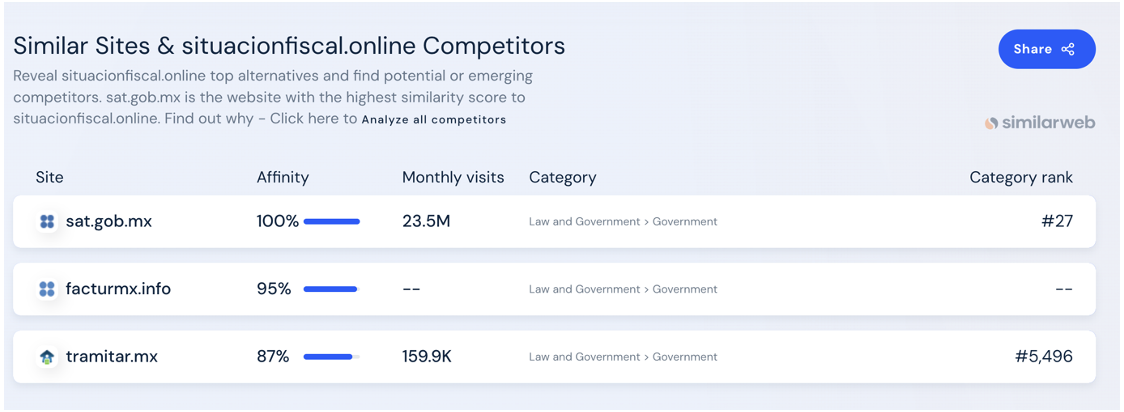
Figure 2: Screenshot from similarweb[.]com showing the degree of affinity between malicious domains situacionfiscal[.]online and facturmx[.]info and the legitimate Mexican government hostname sat[.]gob[.]mx
Figure 3: Screenshot of the likely source infection website facturmx[.]info taken when visited in a sandbox environment

In other customer networks, connections to mail clients were observed, as well as connections to win-rar[.]com, suggesting an interaction with a compressed file. Connections to legitimate government websites were also detected around the same time in some accounts. Shortly after, the infected devices were detected connecting to 100% rare IP addresses over the HTTP protocol using WebDAV user agents such as Microsoft-WebDAV-MiniRedir/10.0.X and DavCInt. Web Distributed Authoring and Versioning, in its full form, is a legitimate extension to the HTTP protocol that allows users to remotely share, copy, move and edit files hosted on a web server. Both CyberCartel and Fenix botnet reportedly abuse this protocol to retrieve the initial payload via a shortcut link. The use (or abuse) of this protocol allows attackers to evade blocklists and streamline payload distribution. In cases investigated by Darktrace, the use of this protocol was not always considered unusual for the breach device, indicating it also was commonly used for its legitimate purposes.

HTTP methods observed included PROPFIND, GET, and OPTIONS, where a higher proportion of PROPFIND requests were observed. PROPFIND is an HTTP method related to the use of WebDAV that retrieves properties in an exactly defined, machine-readable, XML document (GET responses do not have a define format). Properties are pieces of data that describe the state of a resource, i.e., data about data [7]. They are used in distributed authoring environments to provide for efficient discovery and management of resources.  

Figure 4: Device event log showing a connection to facturmx[.]info followed by a WebDAV connection to the 100% rare IP 172.86.68[.]104

In a number of cases, connections to compromised endpoints were followed by the download of one or more executable files with names following the regex pattern /(yes|4496|[A-Za-z]{8})/(((4496|4545)[A-Za-z]{24})|Herramienta_de_Seguridad_SII).(exe|jse), for example 4496UCJlcqwxvkpXKguWNqNWDivM.exe. PROPFIND and GET HTTP requests for dynamic-link library (DLL) files such as urlmon.dll and netutils.dll were also detected. These are legitimate Windows files that are essential to handle network and internet-related tasks in Windows. Irrespective of whether they had malicious or legitimate signatures, Darktrace DETECT was able to recognize that the download of these files was suspicious with rare external endpoints not previously observed on the respective customer networks.

Figure 5: Advanced Search results showing some of the HTTP requests made by the breach device to a CyberCartel endpoint via PROPFIND, GET, or OPTIONS methods for executable and DLL files

Following Darktrace DETECT’s model breaches, these HTTP connections were investigated by Cyber AI Analyst™. AI Analyst provided a summary and further technical details of these connections, as shown in figure 6.
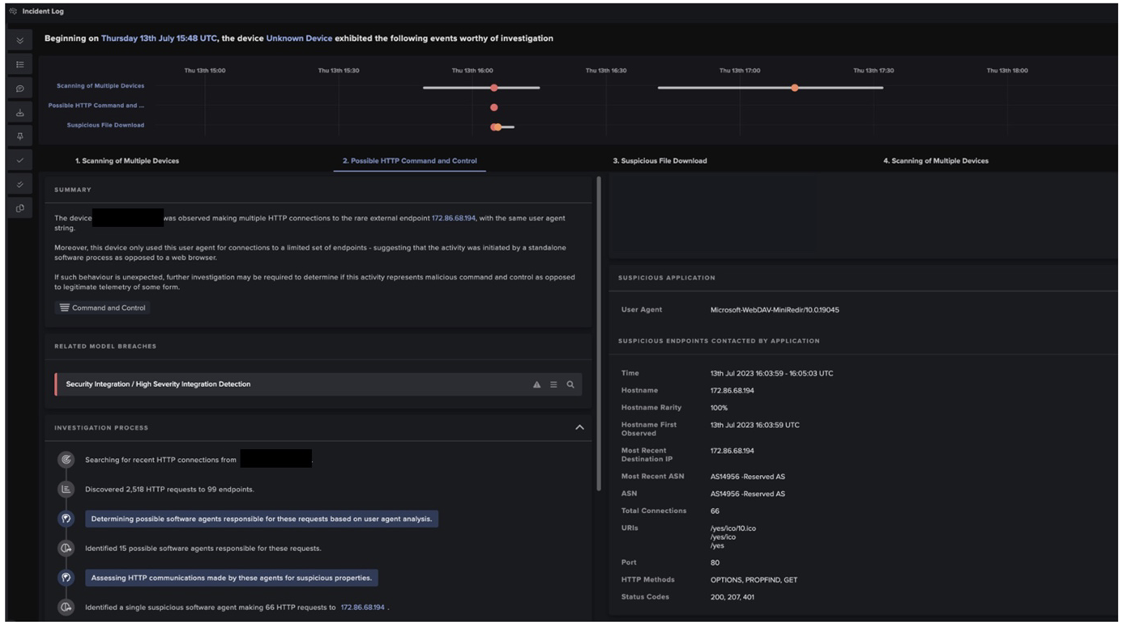
Figure 6: Cyber AI Analyst incident showing a summary of the event, as well as technical details. The AI investigation process is also detailed

AI Analyst searched for all HTTP connections made by the breach device and found more than 2,500 requests to more than a hundred endpoints for one given device. It then looked for the user agents responsible for these connections and found 15 possible software agents responsible for the HTTP requests, and from these identified a single suspicious software agent, Microsoft-WebDAV-Min-Redir. As mentioned previously, this is a legitimate software, but its use by the breach device was considered unusual by Darktrace’s machine learning technology. By performing analysis on thousands of connections to hundreds of endpoints at machine speed, AI Analyst is able to perform the heavy lifting on behalf of human security teams and then collate its findings in a single summary pane, giving end-users the information needed to assess a given activity and quickly start remediation as needed. This allows security teams and administrators to save precious time and provides unparalleled visibility over any potentially malicious activity on their network.

Following the successful identification of CyberCartel activity by DETECT, Darktrace RESPOND™ is then able to contain suspicious behavior, such as by restricting outgoing traffic or enforcing normal patterns of life on affected devices. This would allow customer security teams extra time to analyze potentially malicious behavior, while leaving the rest of the network free to perform business critical operations. Unfortunately, in the cases of CyberCartel compromises detected by Darktrace, RESPOND was not enabled in autonomous response mode meaning preventative actions had to be applied manually by the customer’s security team after the fact.

Figure 7. Device event log showing connections to 100% rare CyberCartel endpoint 172.86.68[.]194 and subsequent suggested RESPOND actions.

Conclusion

Threat actors targeting high-value entities such as government offices and banks is unfortunately all too commonplace.  In the case of Cyber Cartel, governmental organizations and entities, as well as multiple newspapers in the Latin America, have cautioned users against these malicious campaigns, which have occurred over the past few years [8] [9]. However, attackers continuously update their toolsets and infrastructure, quickly rendering these warnings and known-bad security precautions obsolete. In the case of CyberCartel, the abuse of the legitimate WebDAV protocol to retrieve the initial payload is just one example of this. This method of distribution has also been leveraged by in Bumblebee malware loader’s latest campaign [10]. The abuse of the legitimate WebDAV protocol to retrieve the initial CyberCartel payload outlined in this case is one example among many of threat actors adopting new distribution methods used by others to further their ends.

As threat actors continue to search for new ways of remaining undetected, notably by incorporating legitimate processes into their attack flow and utilizing non-exclusive compromised infrastructure, it is more important than ever to have an understanding of normal network operation in order to detect anomalies that are indicative of an ongoing compromise. Darktrace’s suite of products, including DETECT+RESPOND, is well placed to do just that, with machine-speed analysis, detection, and response helping security teams and administrators keep their digital environments safe from malicious actors.

Credit to: Nahisha Nobregas, SOC Analyst

References

[1] https://darktrace.com/blog/darktrace-half-year-threat-report

[2] https://www.metabaseq.com/fenix-botnet/

[3] https://perception-point.io/blog/manipulated-caiman-the-sophisticated-snare-of-mexicos-banking-predators-technical-edition/

[4] https://www.virustotal.com/gui/ip-address/104.156.149.33/community

[5] https://silent4business.com/tendencias/1

[6] https://www.metabaseq.com/cybercartel/

[7] http://www.webdav.org/specs/rfc2518.html#rfc.section.4.1

[8] https://www.csirt.gob.cl/alertas/8ffr23-01415-01/

[9] https://www.gob.mx/sat/acciones-y-programas/sitios-web-falsos

[10] https://www.bleepingcomputer.com/news/security/bumblebee-malware-returns-in-new-attacks-abusing-webdav-folders/

Appendices  

Darktrace DETECT Model Detections

AI Analyst Incidents:

• Possible HTTP Command and Control

• Suspicious File Download

Model Detections:

• Anomalous Connection / New User Agent to IP Without Hostname

• Device / New User Agent and New IP

• Anomalous File / EXE from Rare External Location

• Multiple EXE from Rare External Locations

• Anomalous File / Script from Rare External Location

List of IoCs

IoC - Type - Description + Confidence

f84bb51de50f19ec803b484311053294fbb3b523 - SHA1 hash - Likely CyberCartel Payload IoCs

4eb564b84aac7a5a898af59ee27b1cb00c99a53d - SHA1 hash - Likely CyberCartel payload

8806639a781d0f63549711d3af0f937ffc87585c - SHA1 hash - Likely CyberCartel payload

9d58441d9d31b5c4011b99482afa210b030ecac4 - SHA1 hash - Possible CyberCartel payload

37da048533548c0ad87881e120b8cf2a77528413 - SHA1 hash - Likely CyberCartel payload

2415fcefaf86a83f1174fa50444be7ea830bb4d1 - SHA1 hash - Likely CyberCartel payload

15a94c7e9b356d0ff3bcee0f0ad885b6cf9c1bb7 - SHA1 hash - Likely CyberCartel payload

cdc5da48fca92329927d9dccf3ed513dd28956af - SHA1 hash - Possible CyberCartel payload

693b869bc9ba78d4f8d415eb7016c566ead839f3 - SHA1 hash - Likely CyberCartel payload

04ce764723eaa75e4ee36b3d5cba77a105383dc5 - SHA1 hash - Possible CyberCartel payload

435834167fd5092905ee084038eee54797f4d23e - SHA1 hash - Possible CyberCartel payload

3341b4f46c2f45b87f95168893a7485e35f825fe - SHA1 hash - Likely CyberCartel payload

f6375a1f954f317e16f24c94507d4b04200c63b9 - SHA1 hash - Likely CyberCartel payload

252efff7f54bd19a5c96bbce0bfaeeecadb3752f - SHA1 hash - Likely CyberCartel payload

8080c94e5add2f6ed20e9866a00f67996f0a61ae - SHA1 hash - Likely CyberCartel payload

c5117cedc275c9d403a533617117be7200a2ed77 - SHA1 hash - Possible CyberCartel payload

19dd866abdaf8bc3c518d1c1166fbf279787fc03 - SHA1 hash - Likely CyberCartel payload

548287c0350d6e3d0e5144e20d0f0ce28661f514 - SHA1 hash - Likely CyberCartel payload

f0478e88c8eefc3fd0a8e01eaeb2704a580f88e6 - SHA1 hash - Possible CyberCartel payload

a9809acef61ca173331e41b28d6abddb64c5f192 - SHA1 hash - Likely CyberCartel payload

be96ec94f8f143127962d7bf4131c228474cd6ac - SHA1 hash -Likely CyberCartel payload

44ef336395c41bf0cecae8b43be59170bed6759d - SHA1 hash - Possible CyberCartel payload

facturmx[.]info - Hostname - Likely CyberCartel infection source

consultar-rfc[.]online - Hostname - Possible CyberCartel infection source

srlxlpdfmxntetflx[.]com - Hostname - Likely CyberCartel infection source

facturmx[.]online - Hostname - Possible CyberCartel infection source

rfcconhomoclave[.]mx - Hostname - Possible CyberCartel infection source

situacionfiscal[.]online - Hostname - Likely CyberCartel infection source

descargafactura[.]club - Hostname - Likely CyberCartel infection source

104.156.149[.]33 - IP - Likely CyberCartel C2 endpoint

172.86.68[.]194 - IP - Likely CyberCartel C2 endpoint

139.162.73[.]58 - IP - Likely CyberCartel C2 endpoint

172.105.24[.]190 - IP - Possible CyberCartel C2 endpoint

MITRE ATT&CK Mapping

Tactic - Technique

Command and Control - Ingress Tool Transfer (T1105)

Command and Control - Web Protocols (T1071.001)

Inside the SOC
Darktrace cyber analysts are world-class experts in threat intelligence, threat hunting and incident response, and provide 24/7 SOC support to thousands of Darktrace customers around the globe. Inside the SOC is exclusively authored by these experts, providing analysis of cyber incidents and threat trends, based on real-world experience in the field.
Written by
Alexandra Sentenac
Cyber Analyst

More in this series

No items found.

Blog

/

Network

/

February 3, 2026

Darktrace Malware Analysis: Unpacking SnappyBee

darktace malware analysis snappybeeDefault blog imageDefault blog image

Introduction

The aim of this blog is to be an educational resource, documenting how an analyst can perform malware analysis techniques such as unpacking. This blog will demonstrate the malware analysis process against well-known malware, in this case SnappyBee.

SnappyBee (also known as Deed RAT) is a modular backdoor that has been previously attributed to China-linked cyber espionage group Salt Typhoon, also known as Earth Estries [1] [2]. The malware was first publicly documented by TrendMicro in November 2024 as part of their investigation into long running campaigns targeting various industries and governments by China-linked threat groups.

In these campaigns, SnappyBee is deployed post-compromise, after the attacker has already obtained access to a customer's system, and is used to establish long-term persistence as well as deploying further malware such as Cobalt Strike and the Demodex rootkit.

To decrease the chance of detection, SnappyBee uses a custom packing routine. Packing is a common technique used by malware to obscure its true payload by hiding it and then stealthily loading and executing it at runtime. This hinders analysis and helps the malware evade detection, especially during static analysis by both human analysts and anti-malware services.

This blog is a practical guide on how an analyst can unpack and analyze SnappyBee, while also learning the necessary skills to triage other malware samples from advanced threat groups.

First principles

Packing is not a new technique, and threat actors have generally converged on a standard approach. Packed binaries typically feature two main components: the packed data and an unpacking stub, also called a loader, to unpack and run the data.

Typically, malware developers insert a large blob of unreadable data inside an executable, such as in the .rodata section. This data blob is the true payload of the malware, but it has been put through a process such as encryption, compression, or another form of manipulation to render it unreadable. Sometimes, this data blob is instead shipped in a different file, such as a .dat file, or a fake image. When this happens, the main loader has to read this using a syscall, which can be useful for analysis as syscalls can be easily identified, even in heavily obfuscated binaries.

In the main executable, malware developers will typically include an unpacking stub that takes the data blob, performs one or more operations on it, and then triggers its execution. In most samples, the decoded payload data is loaded into a newly allocated memory region, which will then be marked as executable and executed. In other cases, the decoded data is instead dropped into a new executable on disk and run, but this is less common as it increases the likelihood of detection.

Finding the unpacking routine

The first stage of analysis is uncovering the unpacking routine so it can be reverse engineered. There are several ways to approach this, but it is traditionally first triaged via static analysis on the initial stages available to the analyst.

SnappyBee consists of two components that can be analyzed:

  • A Dynamic-link Library (DLL) that acts as a loader, responsible for unpacking the malicious code
  • A data file shipped alongside the DLL, which contains the encrypted malicious code

Additionally, SnappyBee includes a legitimate signed executable that is vulnerable to DLL side-loading. This means that when the executable is run, it will inadvertently load SnappyBee’s DLL instead of the legitimate one it expects. This allows SnappyBee to appear more legitimate to antivirus solutions.

The first stage of analysis is performing static analysis of the DLL. This can be done by opening the DLL within a disassembler such as IDA Pro. Upon opening the DLL, IDA will display the DllMain function, which is the malware’s initial entry point and the first code executed when the DLL is loaded.

The DllMain function
Figure 1: The DllMain function

First, the function checks if the variable fdwReason is set to 1, and exits if it is not. This variable is set by Windows to indicate why the DLL was loaded. According to Microsoft Developer Network (MSDN), a value of 1 corresponds to DLL_PROCESS_ATTACH, meaning “The DLL is being loaded into the virtual address space of the current process as a result of the process starting up or as a result of a call to LoadLibrary” [3]. Since SnappyBee is known to use DLL sideloading for execution, DLL_PROCESS_ATTACH is the expected value when the legitimate executable loads the malicious DLL.

SnappyBee then uses the GetModule and GetProcAddress to dynamically resolve the address of the VirtualProtect in kernel32 and StartServiceCtrlDispatcherW in advapi32. Resolving these dynamically at runtime prevents them from showing up as a static import for the module, which can help evade detection by anti-malware solutions. Different regions of memory have different permissions to control what they can be used for, with the main ones being read, write, and execute. VirtualProtect is a function that changes the permissions of a given memory region.

SnappyBee then uses VirtualProtect to set the memory region containing the code for the StartServiceCtrlDispatcherW function as writable. It then inserts a jump instruction at the start of this function, redirecting the control flow to one of the SnappyBee DLL’s other functions, and then restores the old permissions.

In practice, this means when the legitimate executable calls StartServiceCtrlDispatcherW, it will immediately hand execution back to SnappyBee. Meanwhile, the call stack now appears more legitimate to outside observers such as antimalware solutions.

The hooked-in function then reads the data file that is shipped with SnappyBee and loads it into a new memory allocation. This pattern of loading the file into memory likely means it is responsible for unpacking the next stage.

The start of the unpacking routine that reads in dbindex.dat.
Figure 2: The start of the unpacking routine that reads in dbindex.dat.

SnappyBee then proceeds to decrypt the memory allocation and execute the code.

The memory decryption routine.
Figure 3: The memory decryption routine.

This section may look complex, however it is fairly straight forward. Firstly, it uses memset to zero out a stack variable, which will be used to store the decryption key. It then uses the first 16 bytes of the data file as a decryption key to initialize the context from.

SnappyBee then calls the mbed_tls_arc4_crypt function, which is a function from the mbedtls library. Documentation for this function can be found online and can be referenced to better understand what each of the arguments mean [4].

The documentation for mbedtls_arc4_crypt.
Figure 4: The documentation for mbedtls_arc4_ crypt.

Comparing the decompilation with the documentation, the arguments SnappyBee passes to the function can be decoded as:

  • The context derived from 16-byte key at the start of the data is passed in as the context in the first parameter
  • The file size minus 16 bytes (to account for the key at the start of the file) is the length of the data to be decrypted
  • A pointer to the file contents in memory, plus 16 bytes to skip the key, is used as the input
  • A pointer to a new memory allocation obtained from VirtualAlloc is used as the output

So, putting it all together, it can be concluded that SnappyBee uses the first 16 bytes as the key to decrypt the data that follows , writing the output into the allocated memory region.

SnappyBee then calls VirtualProtect to set the decrypted memory region as Read + Execute, and subsequently executes the code at the memory pointer. This is clearly where the unpacked code containing the next stage will be placed.

Unpacking the malware

Understanding how the unpacking routine works is the first step. The next step is obtaining the actual code, which cannot be achieved through static analysis alone.

There are two viable methods to retrieve the next stage. The first method is implementing the unpacking routine from scratch in a language like Python and running it against the data file.

This is straightforward in this case, as the unpacking routine in relatively simple and would not require much effort to re-implement. However, many unpacking routines are far more complex, which leads to the second method: allowing the malware to unpack itself by debugging it and then capturing the result. This is the approach many analysts take to unpacking, and the following will document this method to unpack SnappyBee.

As SnappyBee is 32-bit Windows malware, debugging can be performed using x86dbg in a Windows sandbox environment to debug SnappyBee. It is essential this sandbox is configured correctly, because any mistake during debugging could result in executing malicious code, which could have serious consequences.

Before debugging, it is necessary to disable the DYNAMIC_BASE flag on the DLL using a tool such as setdllcharacteristics. This will stop ASLR from randomizing the memory addresses each time the malware runs and ensures that it matches the addresses observed during static analysis.

The first place to set a breakpoint is DllMain, as this is the start of the malicious code and the logical place to pause before proceeding. Using IDA, the functions address can be determined; in this case, it is at offset 10002DB0. This can be used in the Goto (CTRL+G) dialog to jump to the offset and place a breakpoint. Note that the “Run to user code” button may need to be pressed if the DLL has not yet been loaded by x32dbg, as it spawns a small process to load the DLL as DLLs cannot be executed directly.

The program can then run until the breakpoint, at which point the program will pause and code recognizable from static analysis can be observed.

Figure 5: The x32dbg dissassembly listing forDllMain.

In the previous section, this function was noted as responsible for setting up a hook, and in the disassembly listing the hook address can be seen being loaded at offset 10002E1C. It is not necessary to go through the whole hooking process, because only the function that gets hooked in needs to be run. This function will not be naturally invoked as the DLL is being loaded directly rather than via sideloading as it expects. To work around this, the Extended Instruction Pointer (EIP) register can be manipulated to point to the start of the hook function instead, which will cause it to run instead of the DllMain function.

To update EIP, the CRTL+G dialog can again be used to jump to the hook function address (10002B50), and then the EIP register can be set to this address by right clicking the first instruction and selecting “Set EIP here”. This will make the hook function code run next.

Figure 6: The start of the hookedin-in function

Once in this function, there are a few addresses where breakpoints should be set in order to inspect the state of the program at critical points in the unpacking process. These are:

-              10002C93, which allocates the memory for the data file and final code

-              10002D2D, which decrypts the memory

-              10002D81, which runs the unpacked code

Setting these can be done by pressing the dot next to the instruction listing, or via the CTRL+G Goto menu.

At the first breakpoint, the call to VirtualAlloc will be executed. The function returns the memory address of the created memory region, which is stored in the EAX register. In this case, the region was allocated at address 00700000.

Figure 7: The result of the VirtualAlloc call.

It is possible to right click the address and press “Follow in dump” to pin the contents of the memory to the lower pane, which makes it easy to monitor the region as the unpacking process continues.

Figure 8: The allocated memory region shown in x32dbg’s dump.

Single-stepping through the application from this point eventually reaches the call to ReadFile, which loads the file into the memory region.

Figure 9: The allocated memory region after the file is read into it, showing high entropy data.

The program can then be allowed to run until the next breakpoint, which after single-stepping will execute the call to mbedtls_arc4_crypt to decrypt the memory. At this point, the data in the dump will have changed.

Figure 10: The same memory region after the decryption is run, showing lower entropy data.

Right-clicking in the dump and selecting "Disassembly” will disassemble the data. This yields valid shell code, indicating that the unpacking succeeded, whereas corrupt or random data would be expected if the unpacking had failed.

Figure 11: The disassembly view of the allocated memory.

Right-clicking and selecting “Follow in memory map” will show the memory allocation under the memory map view. Right-clicking this then provides an option to dump the entire memory block to file.

Figure 12: Saving the allocated memory region.

This dump can then be opened in IDA, enabling further static analysis of the shellcode. Reviewing the shellcode, it becomes clear that it performs another layer of unpacking.

As the debugger is already running, the sample can be allowed to execute up to the final breakpoint that was set on the call to the unpacked shellcode. Stepping into this call will then allow debugging of the new shellcode.

The simplest way to proceed is to single-step through the code, pausing on each call instruction to consider its purpose. Eventually, a call instruction that points to one of the memory regions that were assigned will be reached, which will contain the next layer of unpacked code. Using the same disassembly technique as before, it can be confirmed that this is more unpacked shellcode.

Figure 13: The unpacked shellcode’s call to RDI, which points to more unpacked shellcode. Note this screenshot depicts the 64-bit variant of SnappyBee instead of 32-bit, however the theory is the same.

Once again, this can be dumped out and analyzed further in IDA. In this case, it is the final payload used by the SnappyBee malware.

Conclusion

Unpacking remains one of the most common anti-analysis techniques and is a feature of most sophisticated malware from threat groups. This technique of in-memory decryption reduces the forensic “surface area” of the malware, helping it to evade detection from anti-malware solutions. This blog walks through one such example and provides practical knowledge on how to unpack malware for deeper analysis.

In addition, this blog has detailed several other techniques used by threat actors to evade analysis, such as DLL sideloading to execute code without arising suspicion, dynamic API resolving to bypass static heuristics, and multiple nested stages to make analysis challenging.

Malware such as SnappyBee demonstrates a continued shift towards highly modular and low-friction malware toolkits that can be reused across many intrusions and campaigns. It remains vital for security teams  to maintain the ability to combat the techniques seen in these toolkits when responding to infections.

While the technical details of these techniques are primarily important to analysts, the outcomes of this work directly affect how a Security Operations Centre (SOC) operates at scale. Without the technical capability to reliably unpack and observe these samples, organizations are forced to respond without the full picture.

The techniques demonstrated here help close that gap. This enables security teams to reduce dwell time by understanding the exact mechanisms of a sample earlier, improve detection quality with behavior-based indicators rather than relying on hash-based detections, and increase confidence in response decisions when determining impact.

Credit to Nathaniel Bill (Malware Research Engineer)
Edited by Ryan Traill (Analyst Content Lead)

Indicators of Compromise (IoCs)

SnappyBee Loader 1 - 25b9fdef3061c7dfea744830774ca0e289dba7c14be85f0d4695d382763b409b

SnappyBee Loader 2 - b2b617e62353a672626c13cc7ad81b27f23f91282aad7a3a0db471d84852a9ac          

SnappyBee Payload - 1a38303fb392ccc5a88d236b4f97ed404a89c1617f34b96ed826e7bb7257e296

References

[1] https://www.trendmicro.com/en_gb/research/24/k/earth-estries.html

[2] https://www.darktrace.com/blog/salty-much-darktraces-view-on-a-recent-salt-typhoon-intrusion

[3] https://learn.microsoft.com/en-us/windows/win32/dlls/dllmain#parameters

[4] https://mbed-tls.readthedocs.io/projects/api/en/v2.28.4/api/file/arc4_8h/#_CPPv418mbedtls_arc4_cryptP20mbedtls_arc4_context6size_tPKhPh

Continue reading
About the author
Nathaniel Bill
Malware Research Engineer

Blog

/

/

February 3, 2026

Introducing Darktrace / SECURE AI: Complete AI Security Across Your Enterprise

Darktrace Secure AIDefault blog imageDefault blog image

Why securing AI can’t wait

AI is entering the enterprise faster than IT and security teams can keep up, appearing in SaaS tools, embedded in core platforms, and spun up by teams eager to move faster.  

As this adoption accelerates, it introduces unpredictable behaviors and expands the attack surface in ways existing security tools can’t see or control, startup or platform, they all lack one trait. These new types of risks command the attention of security teams and boardrooms, touching everything from business integrity to regulatory exposure.

Securing AI demands a fundamentally different approach, one that understands how AI behaves, how it interacts with data and users, and how risk emerges in real time. That shift is at the core of how organizations should be thinking about securing AI across the enterprise.

What is the current state of securing AI?

In Darktrace’s latest State of AI in Cybersecurity Report research across 1,500 cybersecurity professionals shows that the percentage of organizations without an AI adoption policy grew from 55% last year to 63% this year.

More troubling, the percentage of organizations without any plan to create an AI policy nearly tripled from 3% to 8%. Without clear policies, businesses are effectively accelerating blindfolded.

When we analyzed activity across our own customer base, we saw the same patterns playing out in their environments. Last October alone, we saw a 39% month-over-month increase in anomalous data uploads to generative AI services, with the average upload being 75MB. Given the size and frequency of these uploads, it's almost certain that much of this data should never be leaving the enterprise.

Many security teams still lack visibility into how AI is being used across their business; how it’s behaving, what it’s accessing, and most importantly, whether it’s operating safely. This unsanctioned usage quietly expands, creating pockets of AI activity that fall completely outside established security controls. The result is real organizational exposure with almost no visibility, underscoring just how widespread AI use has already become desipite the existence of formal policies.

This challenge doesn’t stop internally. Shadow AI extends into third-party tools, vendor platforms, and partner systems, where AI features are embedded without clear oversight.

Meanwhile, attackers are now learning to exploit AI’s unique characteristics, compounding the risks organizations are already struggling to manage.

The leader in AI cybersecurity now secures AI

Darktrace brings more than a decade of behavioral AI expertise built on an enterprise‑wide platform designed to operate in the complex, ambiguous environments where today’s AI now lives.  

Other cybersecurity technologies try to predict each new attack based on historical attacks. The problem is AI operates like humans do. Every action introduces new information that changes how AI behaves, its unpredictable, and historical attack tactics are now only a small part of the equation, forcing vendors to retrofit unproven acquisitions to secure AI.  

Darktrace is fundamentally different. Our Self‑Learning AI learns what “normal” looks like for your unique business: how your users, systems, applications, and now AI agents behave, how they communicate, and how data flows. This allows us to spot even the smallest shifts when something changes in meaningful ways. Long before AI agents were introduced, our technology was already interpreting nuance, detecting drift, uncovering hidden relationships, and making sense of ambiguous activity across networks, cloud, SaaS, email, OT, identities, and endpoints.

As AI introduces new behaviors, unstructured interactions, invisible pathways, and the rise of Shadow AI, these challenges have only intensified. But this is exactly the environment our platform was built for. Securing AI isn’t a new direction for Darktrace — it’s the natural evolution of the behavioral intelligence we’ve delivered to thousands of organizations worldwide.

Introducing Darktrace / SECURE AI – Complete AI security across your enterprise

We are proud to introduce Darktrace / SECURE AI, the newest product in the Darktrace ActiveAI Security Platform designed to secure AI across the whole enterprise.

This marks the next chapter in our mission to secure organizations from cyber threats and emerging risks. By combining full visibility, intelligent behavioral oversight, and real-time control, Darktrace is enabling enterprises to safely adopt, manage, and build AI within their business. This ensures that AI usage, data access, and behavior remain aligned to security baselines, compliance, and business goals.

Darktrace / SECURE AI can bring every AI interaction into a single view, helping teams understand intent, assess risk, protect sensitive data, and enforce policy across both human and AI Agent activity. Now organizations can embrace AI with confidence, with visibility to ensure it is operating safely, responsibly, and in alignment with their security and compliance needs.  

Because securing AI spans multiple areas and layers of complexity, Darktrace / SECURE AI is built around four foundational use cases that ensure your whole enterprise and every AI use affecting your business, whether owned or through third parties, is protected, they are:

  • Monitoring the prompts driving GenAI agents and assistants
  • Securing business AI agent identities in real time
  • Evaluating AI risks in development and deployment
  • Discovering and controlling Shadow AI

Monitoring the prompts driving GenAI agents and assistants

For AI systems, prompts are one of the most active and sensitive points of interaction—spanning human‑AI exchanges where users express intent and AI‑AI interactions where agents generate internal prompts to reason and coordinate. Because prompt language effectively is behavior, and because it relies on natural language rather than a fixed, finite syntax, the attack surface is open‑ended. This makes prompt‑driven risks far more complex than traditional API‑based vulnerabilities tied to CVEs.

Whether an attacker is probing for weaknesses, an employee inadvertently exposes sensitive data, or agents generate their own sub‑tasks to drive complex workflows, security teams must understand how prompt behavior shapes model behavior—and where that behavior can go wrong. Without that behavioral understanding, organizations face heightened risks of exploitation, drift, and cascading failures within their AI systems.

Darktrace / SECURE AI brings together all prompt activity across enterprise AI systems, including Microsoft Copilot and ChatGPT Enterprise, low‑code environments like Microsoft Copilot Studio, SaaS providers like Salesforce and Microsoft 365, and high‑code platforms such as AWS Bedrock and SageMaker, into a single, unified layer of visibility.  

Beyond visibility, Darktrace applies behavioral analytics to understand whether a prompt is unusual or risky in the context of the user, their peers, and the broader organization. Because AI attacks are far more complex and conversational than traditional exploits against fixed APIs – sharing more in common with email and Teams/Slack interactions, —this behavioral understanding is essential. By treating prompts as behavioral signals, Darktrace can detect conversational attacks, malicious chaining, and subtle prompt‑injection attempts, and where integrations allow, intervene in real time to block unsafe prompts or prevent harmful model actions as they occur.

Securing business AI agent identities in real time

As organizations adopt more AI‑driven workflows, we’re seeing a rapid rise in autonomous and semi‑autonomous agents operating across the business. These agents operate within existing identities, with the capability to access systems, read and write data, and trigger actions across cloud platforms, internal infrastructure, applications, APIs, and third‑party services. Some identities are controlled, like users, others like the ones mentioned, can appear anywhere, with organizations having limited visibility into how they’re configured or how their permissions evolve over time.  

Darktrace / SECURE AI gives organizations a real‑time, identity‑centric understanding of what their AI agents are doing, not just what they were designed to do. It automatically discovers live agent identities operating across SaaS, cloud, network, endpoints, OT, and email, including those running inside third‑party environments.  

The platform maps how each agent is configured, what systems it accesses, and how it communicates, including activity such as MCP usage or interactions with storage services where sensitive data may reside.  

By continuously observing agent behavior across all domains, Darktrace / SECURE AI highlights when unnecessary or risky permissions are granted, when activity patterns deviate, or when agents begin chaining together actions in unintended ways. This real‑time audit trail allows organizations to evaluate whether agent actions align with intended operational parameters and catch anomalous or risky behavior early.    

Evaluating AI risks in development and deployment

In the build phase, new identities are created, entitlements accumulate, components are stitched together across SaaS, cloud, and internal environments, and logic starts taking shape through prompts and configurations.  

It’s a highly dynamic and often fragmented process, and even small missteps here, such as a misconfiguration in a created agent identity, can become major security issues once the system is deployed. This is why evaluating AI risk during development and deployment is critical.

Darktrace / SECURE AI brings clarity and control across this entire lifecycle — from the moment an AI system starts taking shape to the moment it goes live. It allows you to gain visibility into created identities and their access across hyperscalers, low‑code SaaS, and internal labs, supported by AI security posture management that surfaces misconfigurations, over‑entitlement, and anomalous building events. Darktrace/ SECURE AI then connects these development insights directly to prompt oversight, connecting how AI is being built to how it will behave once deployed.  The result is a safer, more predictable AI lifecycle where risks are discovered early, guardrails are applied consistently, and innovations move forward with confidence rather than guesswork.

Discovering and controlling Shadow AI

Shadow AI has now appeared across every corner of the enterprise. It’s not just an employee pasting internal data into an external chatbot; it includes unsanctioned agent builders, hidden MCP servers, rogue model deployments, and AI‑driven workflows running on devices or services no one expected to be using AI.  

Darktrace / SECURE AI brings this frontier into view by continuously analyzing interactions across cloud, networks, endpoints, OT, and SASE environments. It surfaces unapproved AI usage wherever it appears and distinguishes legitimate activity in sanctioned tools from misuse or high‑risk behavior. The system identifies hidden AI components and rogue agents, reveals unauthorized deployments and unexpected connections to external AI systems, and highlights risky data flows that deviate from business norms.

When the behavior warrants a response, Darktrace / SECURE AI enables policy enforcement that guides users back toward sanctioned options while containing unsafe or ungoverned adoption. This closes one of the fastest‑expanding security gaps in modern enterprises and significantly reduces the attack surface created by shadow AI.

Conclusion

What’s needed now along with policies and frameworks for AI adoption is the right tooling to detect threats based on AI behavior across shadow use, prompt risks, identity misuse, and AI development.  

Darktrace is uniquely positioned to secure AI, we’ve spent over a decade building AI that learns your business – understanding subtle behavior across the entire enterprise long before AI agents arrived. With over 10,000 customers relying on Darktrace as the last line of defense to capture threats others cannot, Securing AI isn’t a pivot for us, it's not an acquisition; it’s the natural extension of the behavioral expertise and enterprise‑wide intelligence our platform was built on from the start.  

To learn more about how to secure AI at your organization we curated a readiness program that brings together IT and security leaders navigating this responsibility, providing a forum to prepare for high-impact decisions, explore guardrails, and guide the business amid growing uncertainty and pressure.

Sign up for the Secure AI Readiness Program here: This gives you exclusive access to the latest news on the latest AI threats, updates on emerging approaches shaping AI security, and insights into the latest innovations, including Darktrace’s ongoing work in this area.

Ready to talk with a Darktrace expert on securing AI? Register here to receive practical guidance on the AI risks that matter most to your business, paired with clarity on where to focus first across governance, visibility, risk reduction, and long-term readiness.  

Continue reading
About the author
Brittany Woodsmall
Product Marketing Manager, AI
Your data. Our AI.
Elevate your network security with Darktrace AI