

Blog
/
/
August 6, 2025

How CDR & Automated Forensics Transform Cloud Incident Response

This blog walks through an example of how Darktrace’s CDR and automated cloud forensics capabilities automate cloud detection, and deep forensic investigation in a way that’s fast, scalable, and deeply insightful.
Inside the SOC
Darktrace cyber analysts are world-class experts in threat intelligence, threat hunting and incident response, and provide 24/7 SOC support to thousands of Darktrace customers around the globe. Inside the SOC is exclusively authored by these experts, providing analysis of cyber incidents and threat trends, based on real-world experience in the field.
Written by
Adam Stevens
Senior Director of Product, Cloud | Darktrace
cloud security investigation guy on computer doing workDefault blog imageDefault blog imageDefault blog imageDefault blog imageDefault blog imageDefault blog image
06
Aug 2025

Introduction: Cloud investigations

In cloud security, speed, automation and clarity are everything. However, for many SOC teams, responding to incidents in the cloud is often very difficult especially when attackers move fast, infrastructure is ephemeral, and forensic skills are scarce.

In this blog we will walk through an example that shows exactly how Darktrace Cloud Detection and Response (CDR) and automated cloud forensics together, solve these challenges, automating cloud detection, and deep forensic investigation in a way that’s fast, scalable, and deeply insightful.

The Problem: Cloud incidents are hard to investigate

Security teams often face three major hurdles when investigating cloud detections:

Lack of forensic expertise: Most SOCs and security teams aren’t natively staffed with forensics specialists.

Ephemeral infrastructure: Cloud assets spin up and down quickly, leaving little time to capture evidence.

Lack of existing automation: Gathering forensic-level data often requires manual effort and leaves teams scrambling around during incidents — accessing logs, snapshots, and system states before they disappear. This process is slow and often blocked by permissions, tooling gaps, or lack of visibility.

How Darktrace augments cloud investigations

1. Darktrace’s CDR finds anomalous activity in the cloud

An alert is generated for a large outbound data transfer from an externally facing EC2 instance to a rare external endpoint. It’s anomalous, unexpected, and potentially serious.

2. AI-led investigation stitches together the incident for a SOC analyst to look into

When a security incident unfolds, Darktrace’s Cyber AI Analyst TM is the first to surface it, automatically correlating behaviors, surfacing anomalies, and presenting a cohesive incident summary. It’s fast, detailed, and invaluable.

Once the incident is created, more questions are raised.

  • How were the impacted resources compromised?
  • How did the attack unfold over time – what tools and malware were used?
  • What data was accessed and exfiltrated?

What you’ll see as a SOC analyst: The incident begins in Darktrace’s Threat Visualizer, where a Cyber AI Analyst incident has been generated automatically highlighting large anomalous data transfer to a suspicious external IP. This isn’t just another alert, it’s a high-fidelity signal backed by Darktrace’s Self-Learning AI.
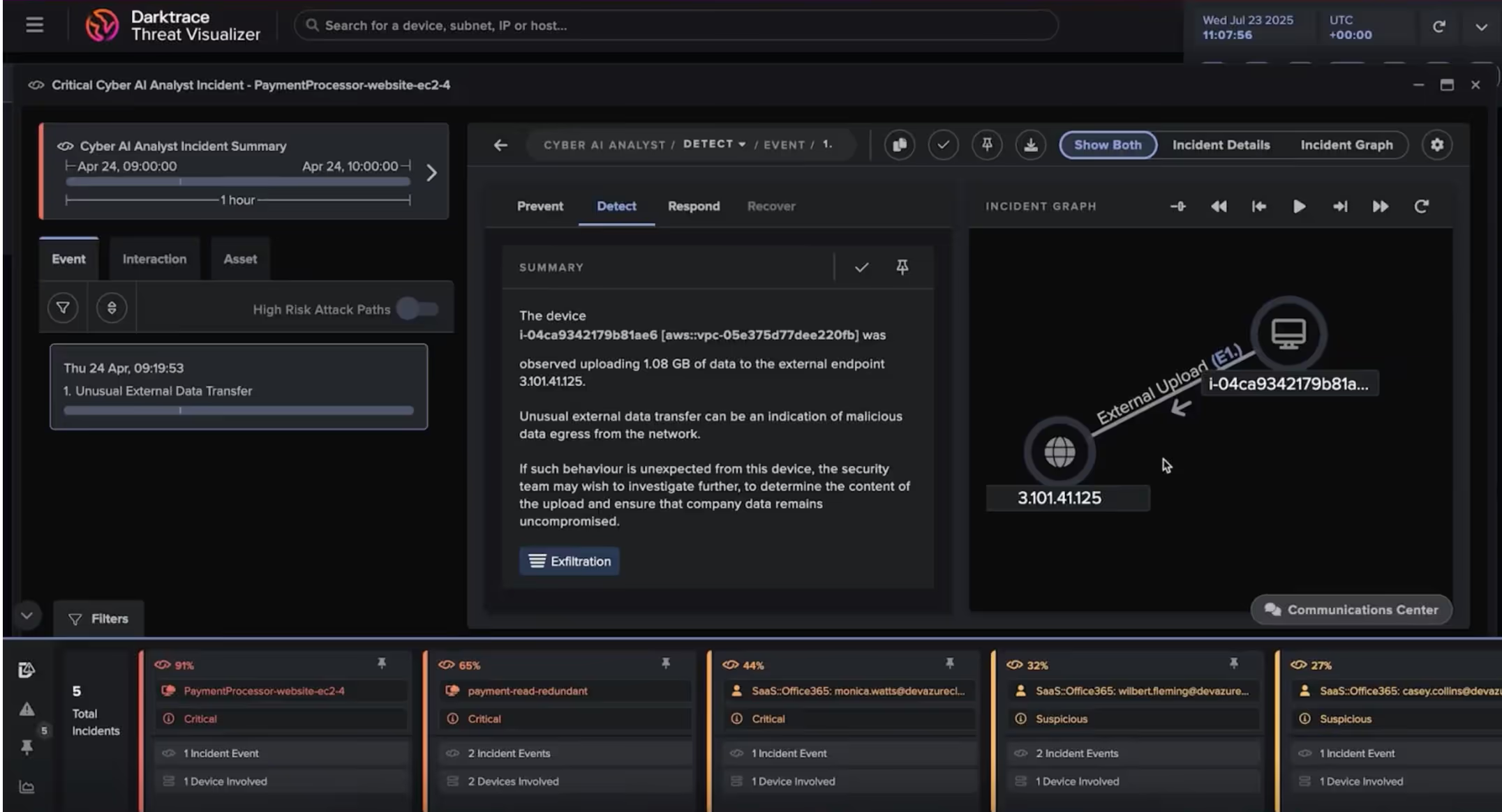
Cyber AI Analyst incident created for anomalous outbound data transfer
Figure 1: Cyber AI Analyst incident created for anomalous outbound data transfer

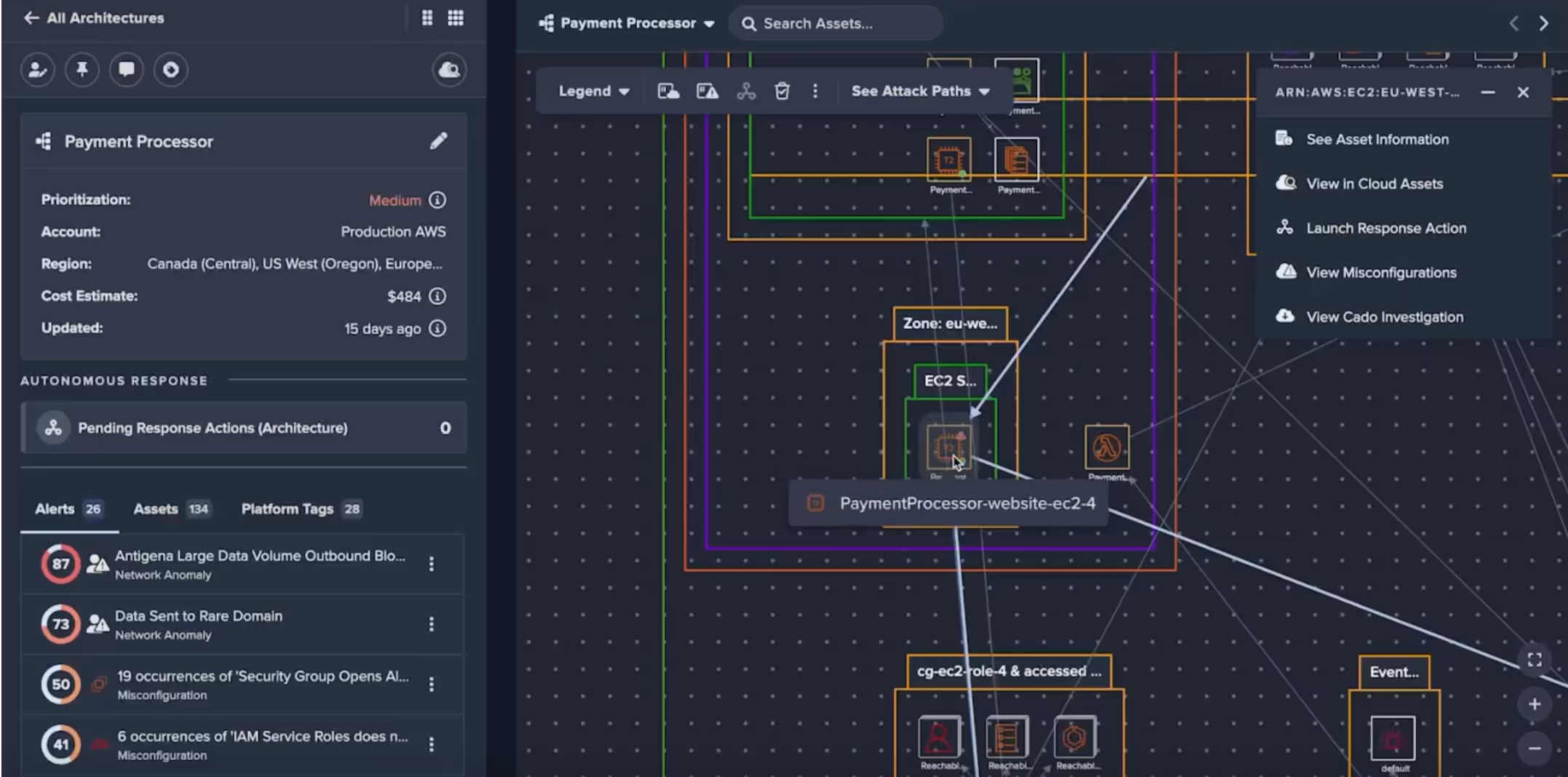
The analyst can then immediately pivot to Darktrace / CLOUD’s architecture view (see below), gaining context on the asset’s environment, ingress/egress points, connected systems, potential attack paths and whether there are any current misconfigurations detected on the asset.
Darktrace / CLOUD architecture view providing critical cloud context
Figure 2: Darktrace / CLOUD architecture view providing critical cloud context

3. Automated forensic capture — No expertise required

Then comes the game-changer, Darktrace’s recent acquisition of Cado enhances its cloud forensics capabilities. From the first alert triggered, Darktrace has already kicked in and automatically processed and analyzed a full volume capture of the EC2. Everything, past and present, is preserved. No need for manual snapshots, CLI commands, or specialist intervention.

Darktrace then provides a clear timeline highlighting the evidence and preserving it. In our example we identify:

  • A brute-force attempt on a file management app, followed by a successful login
  • A reverse shell used to gain unauthorized remote access to the EC2
  • A reverse TCP connection to the same suspicious IP flagged by Darktrace
  • Attacker commands showing how the data was split and prepared for exfiltration
  • A file (a.tar) created from two sensitive archives: product_plans.zip and research_data.zip

All of this is surfaced through the timeline view, ranked by significance using machine learning. The analyst can pivot through time, correlate events, and build a complete picture of the attack — without needing cloud forensics expertise.

Darktrace even gives the ability to:

  • Download and inspect gathered files in full detail, enabling teams to verify exactly what data was accessed or exfiltrated.
  • Interact with the file system as if it were live, allowing investigators to explore directories, uncover hidden artifacts, and understand attacker movement with precision.
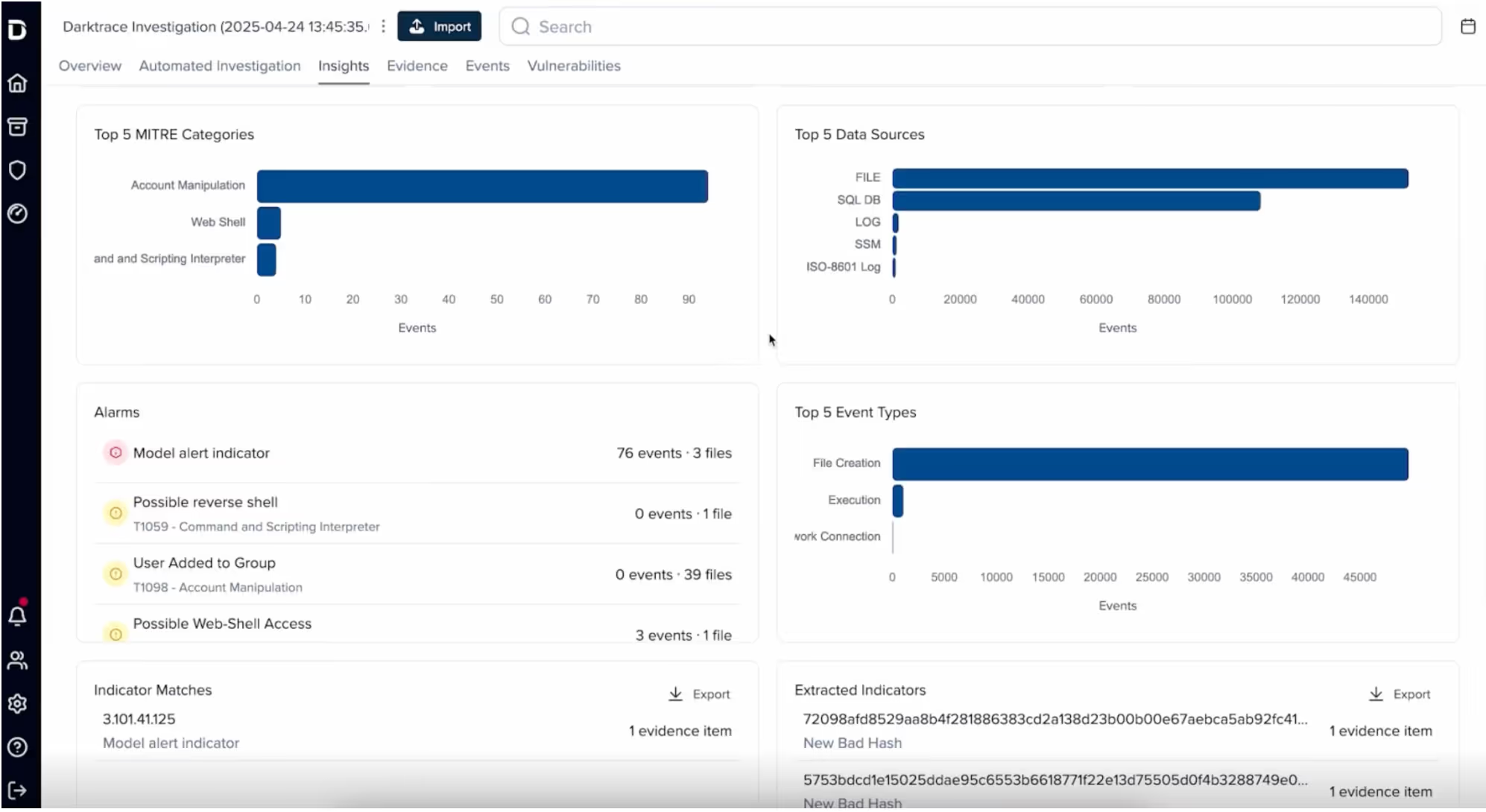
Figure 3 Cado critical forensic investigation automated insights
Figure 3: Cado critical forensic investigation automated insights
Figure 4: Cado forensic file analysis of reverse shell and download option
Figure 5: a.tar created from two sensitive archives: product_plans.zip and research_data.zip
Figure 6: Traverse the full file system of the asset

Why this matters?

This workflow solves the hardest parts of cloud investigation:

  1. Capturing evidence before it disappears
  2. Understanding attacker behavior in detail - automatically
  3. Linking detections to impact with full incident visibility

This kind of insight is invaluable for organizations especially regulated industries, where knowing exactly what data was affected is critical for compliance and reporting. It’s also a powerful tool for detecting insider threats, not just external attackers.

Darktrace / CLOUD and Cado together acts as a force multiplier helping with:

  • Reducing investigation time from hours to minutes
  • Preserving ephemeral evidence automatically
  • Empowering analysts with forensic-level visibility

Cloud threats aren’t slowing down. Your response shouldn’t either. Darktrace / CLOUD + Cado gives your SOC the tools to detect, contain, and investigate cloud incidents — automatically, accurately, and at scale.

[related-resource]

Secure your cloud with confidence

Learn how Darktrace delivers autonomous detection, investigation, and response across multi-cloud and SaaS environments.

Inside the SOC
Darktrace cyber analysts are world-class experts in threat intelligence, threat hunting and incident response, and provide 24/7 SOC support to thousands of Darktrace customers around the globe. Inside the SOC is exclusively authored by these experts, providing analysis of cyber incidents and threat trends, based on real-world experience in the field.
Written by
Adam Stevens
Senior Director of Product, Cloud | Darktrace

More in this series

No items found.

Blog

/

Network

/

February 19, 2026

CVE-2026-1731: How Darktrace Sees the BeyondTrust Exploitation Wave Unfolding

Default blog imageDefault blog image

Note: Darktrace's Threat Research team is publishing now to help defenders. We will continue updating this blog as our investigations unfold.

Background

On February 6, 2026, the Identity & Access Management solution BeyondTrust announced patches for a vulnerability, CVE-2026-1731, which enables unauthenticated remote code execution using specially crafted requests.  This vulnerability affects BeyondTrust Remote Support (RS) and particular older versions of Privileged Remote Access (PRA) [1].

A Proof of Concept (PoC) exploit for this vulnerability was released publicly on February 10, and open-source intelligence (OSINT) reported exploitation attempts within 24 hours [2].

Previous intrusions against Beyond Trust technology have been cited as being affiliated with nation-state attacks, including a 2024 breach targeting the U.S. Treasury Department. This incident led to subsequent emergency directives from  the Cybersecurity and Infrastructure Security Agency (CISA) and later showed attackers had chained previously unknown vulnerabilities to achieve their goals [3].

Additionally, there appears to be infrastructure overlap with React2Shell mass exploitation previously observed by Darktrace, with command-and-control (C2) domain  avg.domaininfo[.]top seen in potential post-exploitation activity for BeyondTrust, as well as in a React2Shell exploitation case involving possible EtherRAT deployment.

Darktrace Detections

Darktrace’s Threat Research team has identified highly anomalous activity across several customers that may relate to exploitation of BeyondTrust since February 10, 2026. Observed activities include:

Outbound connections and DNS requests for endpoints associated with Out-of-Band Application Security Testing; these services are commonly abused by threat actors for exploit validation.  Associated Darktrace models include:

  • Compromise / Possible Tunnelling to Bin Services

Suspicious executable file downloads. Associated Darktrace models include:

  • Anomalous File / EXE from Rare External Location

Outbound beaconing to rare domains. Associated Darktrace models include:

  • Compromise / Agent Beacon (Medium Period)
  • Compromise / Agent Beacon (Long Period)
  • Compromise / Sustained TCP Beaconing Activity To Rare Endpoint
  • Compromise / Beacon to Young Endpoint
  • Anomalous Server Activity / Rare External from Server
  • Compromise / SSL Beaconing to Rare Destination

Unusual cryptocurrency mining activity. Associated Darktrace models include:

  • Compromise / Monero Mining
  • Compromise / High Priority Crypto Currency Mining

And model alerts for:

  • Compromise / Rare Domain Pointing to Internal IP

IT Defenders: As part of best practices, we highly recommend employing an automated containment solution in your environment. For Darktrace customers, please ensure that Autonomous Response is configured correctly. More guidance regarding this activity and suggested actions can be found in the Darktrace Customer Portal.  

Appendices

Potential indicators of post-exploitation behavior:

·      217.76.57[.]78 – IP address - Likely C2 server

·      hXXp://217.76.57[.]78:8009/index.js - URL -  Likely payload

·      b6a15e1f2f3e1f651a5ad4a18ce39d411d385ac7  - SHA1 - Likely payload

·      195.154.119[.]194 – IP address – Likely C2 server

·      hXXp://195.154.119[.]194/index.js - URL – Likely payload

·      avg.domaininfo[.]top – Hostname – Likely C2 server

·      104.234.174[.]5 – IP address - Possible C2 server

·      35da45aeca4701764eb49185b11ef23432f7162a – SHA1 – Possible payload

·      hXXp://134.122.13[.]34:8979/c - URL – Possible payload

·      134.122.13[.]34 – IP address – Possible C2 server

·      28df16894a6732919c650cc5a3de94e434a81d80 - SHA1 - Possible payload

References:

1.        https://nvd.nist.gov/vuln/detail/CVE-2026-1731

2.        https://www.securityweek.com/beyondtrust-vulnerability-targeted-by-hackers-within-24-hours-of-poc-release/

3.        https://www.rapid7.com/blog/post/etr-cve-2026-1731-critical-unauthenticated-remote-code-execution-rce-beyondtrust-remote-support-rs-privileged-remote-access-pra/

Continue reading
About the author
Emma Foulger
Global Threat Research Operations Lead

Blog

/

/

February 18, 2026

How AI is redefining cybersecurity and the role of today’s CIO

Default blog imageDefault blog image

Why AI is essential to modern security

As attackers use automation and AI to outpace traditional tools and people, our approach to cybersecurity must fundamentally change. That’s why one of my first priorities as Withum's CIO was to elevate cybersecurity from a technical function to a business enabler.

What used to be “IT’s problem” is now a boardroom conversation – and for good reason. Protecting our data, our people, and our clients directly impacts revenue, reputation and competitive positioning.  

As CIOs / CISOs, our responsibilities aren’t just keeping systems running, but enabling trust, protecting our organization's reputation, and giving the business confidence to move forward even as the digital world becomes less predictable. To pull that off, we need to know the business inside-out, understand risk, and anticipate what's coming next. That's where AI becomes essential.

Staying ahead when you’re a natural target

With more than 3,100 team members and over 1,000 CPAs (Certified Public Accountant), Withum’s operates in an industry that naturally attracts attention from attackers. Firms like ours handle highly sensitive financial and personal information, which puts us squarely in the crosshairs for sophisticated phishing, ransomware, and cloud-based attacks.

We’ve built our security program around resilience, visibility, and scale. By using Darktrace’s AI-powered platform, we can defend against both known and unknown threats, across email and network, without slowing our teams down.

Our focus is always on what we’re protecting: our clients’ information, our intellectual property, and the reputation of the firm. With Darktrace, we’re not just keeping up with the massive volume of AI-powered attacks coming our way, we’re staying ahead. The platform defends our digital ecosystem around the clock, detecting potential threats across petabytes of data and autonomously investigating and responding to tens of thousands of incidents every year.

Catching what traditional tools miss

Beyond the sheer scale of attacks, Darktrace ActiveAI Security PlatformTM is critical for identifying threats that matter to our business. Today’s attackers don’t use generic techniques. They leverage automation and AI to craft highly targeted attacks – impersonating trusted colleagues, mimicking legitimate websites, and weaving in real-world details that make their messages look completely authentic.

The platform, covering our network, endpoints, inboxes, cloud and more is so effective because it continuously learns what’s normal for our business: how our users typically behave, the business- and industry-specific language we use, how systems communicate, and how cloud resources are accessed. It picks up on minute details that would sail right past traditional tools and even highly trained security professionals.

Freeing up our team to do what matters

On average, Darktrace autonomously investigates 88% of all our security events, using AI to connect the dots across email, network, and cloud activity to figure out what matters. That shift has changed how our team works. Instead of spending hours sorting through alerts, we can focus on proactive efforts that actually strengthen our security posture.

For example, we saved 1,850 hours on investigating security issues over a ten-day period. We’ve reinvested the time saved into strengthening policies, refining controls, and supporting broader business initiatives, rather than spending endless hours manually piecing together alerts.

Real confidence, real results

The impact of our AI-driven approach goes well beyond threat detection. Today, we operate from a position of confidence, knowing that threats are identified early, investigated automatically, and communicated clearly across our organization.

That confidence was tested when we withstood a major ransomware attack by a well-known threat group. Not only were we able to contain the incident, but we were able to trace attacker activity and provided evidence to law enforcement. That was an exhilarating experience! My team did an outstanding job, and moments like that reinforce exactly why we invest in the right technology and the right people.

Internally, this capability has strengthened trust at the executive level. We share security reporting regularly with leadership, translating technical activity into business-relevant insights. That transparency reinforces cybersecurity as a shared responsibility, one that directly supports growth, continuity, and reputation.

Culturally, we’ve embedded security awareness into daily operations through mandatory monthly training, executive communication, and real-world industry examples that keep cybersecurity top of mind for every employee.

The only headlines we want are positive ones: Withum expanding services, Withum growing year over year. Security plays a huge role in making sure that’s the story we get to tell.

What’s next

Looking ahead, we’re expanding our use of Darktrace, including new cloud capabilities that extend AI-driven visibility and investigation into our AWS and Azure environments.

As I continue shaping our security team, I look for people with passion, curiosity, and a genuine drive to solve problems. Those qualities matter just as much as formal credentials in my view. Combined with AI, these attributes help us build a resilient, engaged security function with low turnover and high impact.

For fellow technology leaders, my advice is simple: be forward-thinking and embrace change. We must understand the business, the threat landscape, and how technology enables both. By augmenting human expertise rather than replacing it, AI allows us to move upstream by anticipating risk, advising the business, and fostering stronger collaboration across teams.

Continue reading
About the author
Your data. Our AI.
Elevate your network security with Darktrace AI