

Blog
/
/
September 25, 2025

Introducing the Industry’s First Truly Automated Cloud Forensics Solution

The launch of Darktrace / Forensic Acquisition & Investigation marks a breakthrough moment for cloud security, bringing automated forensic investigations — once reserved for the largest organizations and specialized DFIR teams — to security teams of every size.
Inside the SOC
Darktrace cyber analysts are world-class experts in threat intelligence, threat hunting and incident response, and provide 24/7 SOC support to thousands of Darktrace customers around the globe. Inside the SOC is exclusively authored by these experts, providing analysis of cyber incidents and threat trends, based on real-world experience in the field.
Written by
Paul Bottomley
Director of Product Management | Darktrace
Default blog imageDefault blog imageDefault blog imageDefault blog imageDefault blog imageDefault blog image
25
Sep 2025

Why Cloud Investigations Fail Today

Cloud investigations have become one of the hardest problems in modern cybersecurity. Traditional DFIR tools were built for static, on-prem environments, rather than dynamic and highly scalable cloud environments, containing ephemeral workloads that disappear in minutes. SOC analysts are flooded with cloud security alerts with one-third lacking actionable data to confirm or dismiss a threat[1], while DFIR teams waste 3-5 days requesting access and performing manual collection, or relying on external responders.

These delays leave organizations vulnerable. Research shows that nearly 90% of organizations suffer some level of damage before they can fully investigate and contain a cloud incident [2]. The result is a broken model: alerts are closed without a complete understanding of the threat due to a lack of visibility and control, investigations drag on, and attackers retain the upper hand.

For SOC teams, the challenge is scale and clarity. Analysts are inundated with alerts but lack the forensic depth to quickly distinguish real threats from noise. Manual triage wastes valuable time, creates alert fatigue, and often forces teams to escalate or dismiss incidents without confidence — leaving adversaries with room to maneuver.

For DFIR teams, the challenge is depth and speed. Traditional forensics tools were built for static, on-premises environments and cannot keep pace with ephemeral workloads that vanish in minutes. Investigators are left chasing snapshots, requesting access from cloud teams, or depending on external responders, leading to blind spots and delayed response.

That’s why we built Darktrace / Forensic Acquisition & Investigation, the first automated forensic solution designed specifically for the speed, scale, and complexities of the cloud. It addresses both sets of challenges by combining automated forensic evidence capture, attacker timeline reconstruction, and cross-cloud scale. The solution empowers SOC analysts with instant clarity and DFIR teams with forensic depth, all in minutes, not days. By leveraging the very nature of the cloud, Darktrace makes these advanced capabilities accessible to security teams of all sizes, regardless of expertise or resources.

Introducing Automated Forensics at the Speed and Scale of Cloud

Darktrace / Forensic Acquisition & Investigation transforms cloud investigations by capturing, processing, and analyzing forensic evidence of cloud workloads, instantly, even from time-restricted ephemeral resources. Triggered by a detection from any cloud security tool, the entire process is automated, providing accurate root cause analysis and deep insights into attacker behavior in minutes rather than days or weeks. SOC and DFIR teams no longer have to rely on manual processes, snapshots, or external responders, they can now leverage the scale and elasticity of the cloud to accelerate triage and investigations.

Seamless Integration with Existing Detection Tools

Darktrace / Forensic Acquisition & Investigation does not require customers to replace their detection stack. Instead, it integrates with cloud-native providers, XDR platforms, and SIEM/SOAR tools, automatically initiating forensic capture whenever an alert is raised. This means teams can continue leveraging their existing investments while gaining the forensic depth required to validate alerts, confirm root cause, and accelerate response.

Most importantly, the solution is natively integrated with Darktrace / CLOUD, turning real-time detections of novel attacker behaviors into full forensic investigations instantly. When Darktrace / CLOUD identifies suspicious activity such as lateral movement, privilege escalation, or abnormal usage of compute resources, Darktrace / Forensic Acquisition & Investigation automatically preserves the underlying forensic evidence before it disappears. This seamless workflow unites detection, response, and investigation in a way that eliminates gaps, accelerates triage, and gives teams confidence that every critical cloud alert can be investigated to completion.
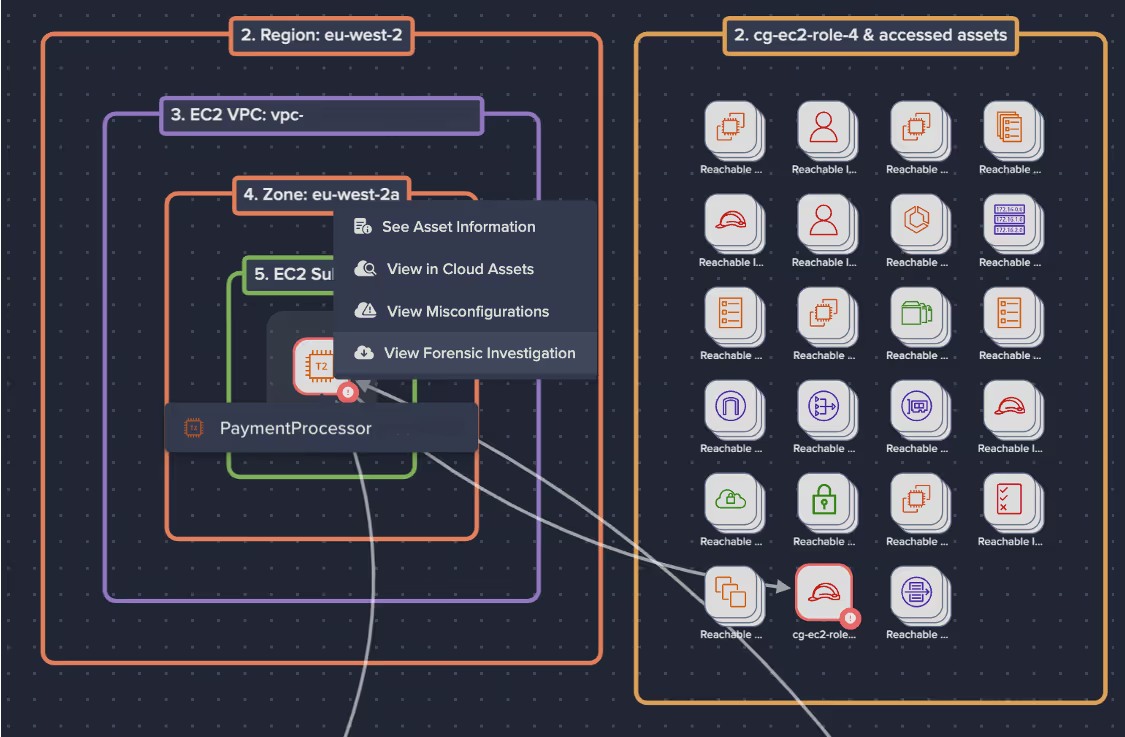
Figure 1: Integration with Darktrace / CLOUD – this example is showing the ability to pivot into the forensic investigation associated with a compromised cloud asset

Automated Evidence Collection Across Hybrid and Multi-Cloud

The solution provides automated forensic acquisition across AWS, Microsoft Azure, GCP, and on-prem environments. It supports both full volume capture, creating a bit-by-bit copy of an entire storage device for the most comprehensive preservation of evidence, and triage collection, which prioritizes speed by gathering only the most essential forensic artifacts such as process data, logs, network connections, and open file contents. This flexibility allows teams to strike the right balance between speed and depth depending on the investigation at hand.
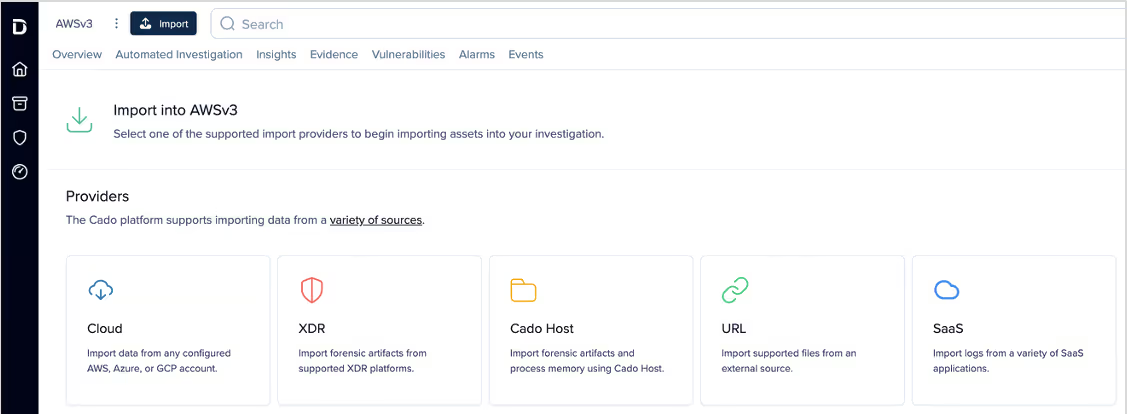
Figure 2: Ability to acquire forensic data from Cloud, SaaS and on-prem environments

Automated Investigations, Root Cause Analysis and Attacker Timelines

Once evidence is collected, Darktrace applies automation to reconstruct attacker activity into a unified timeline. This includes correlating commands, files, lateral movement, and network activity into a single investigative view enriched with custom threat intelligence such as IOCs. Detailed investigation reporting including an investigation summary, an overview of the attacker timeline, and key events. Analysts can pivot into detailed views such as the filesystem view, traversing directories or inspecting file content, or filter and search using faceted options to quickly narrow the scope of an investigation.
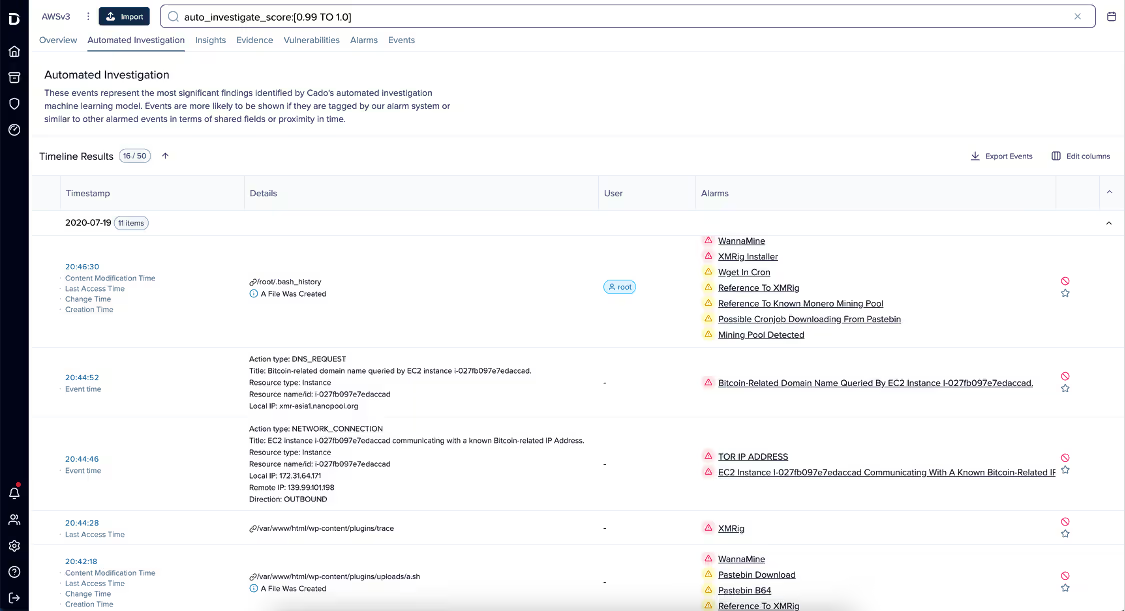
Figure 3: Automated Investigation view surfacing the most significant attacker activity, which is contextualized with Alarm information

Forensics for Containers and Ephemeral Assets

Investigating containers and serverless workloads has historically been one of the hardest challenges for DFIR teams, as these assets often disappear before evidence can be preserved. Darktrace / Forensic Acquisition & Investigation captures forensic evidence across managed Kubernetes cloud services, even from distroless or no-shell containers, AWS ECS and other environments, ensuring that ephemeral activity is no longer a blind spot. For hybrid organizations, this extends to on-premises Kubernetes and OpenShift deployments, bringing consistency across environments.
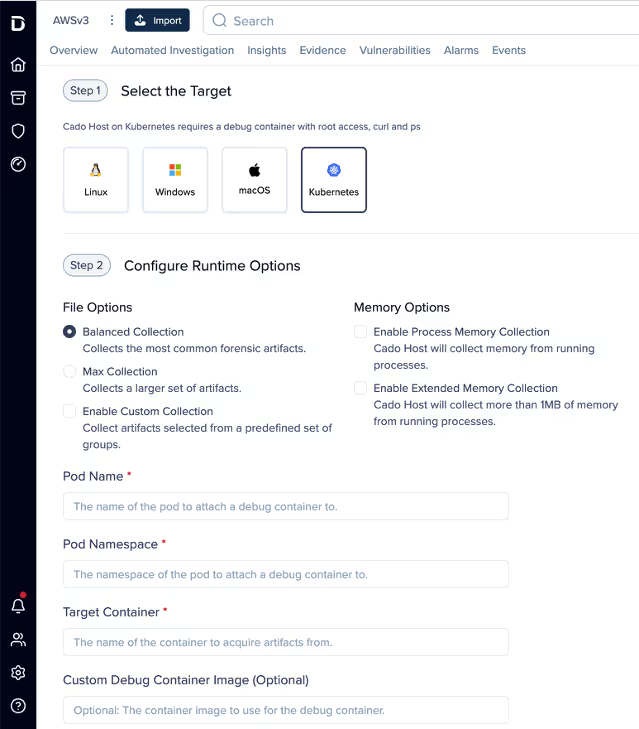
Figure 4: Container investigations – this example is showing the ability to capture containers from managed Kubernetes cloud services

SaaS Log Collection for Modern Investigations

Beyond infrastructure-level data, the solution collects logs from SaaS providers such as Microsoft 365, Entra ID, and Google Workspace. This enables investigations into common attack types like business email compromise (BEC), account takeover (ATO), and insider threats — giving teams visibility into both infrastructure-level and SaaS-driven compromise from a single platform.
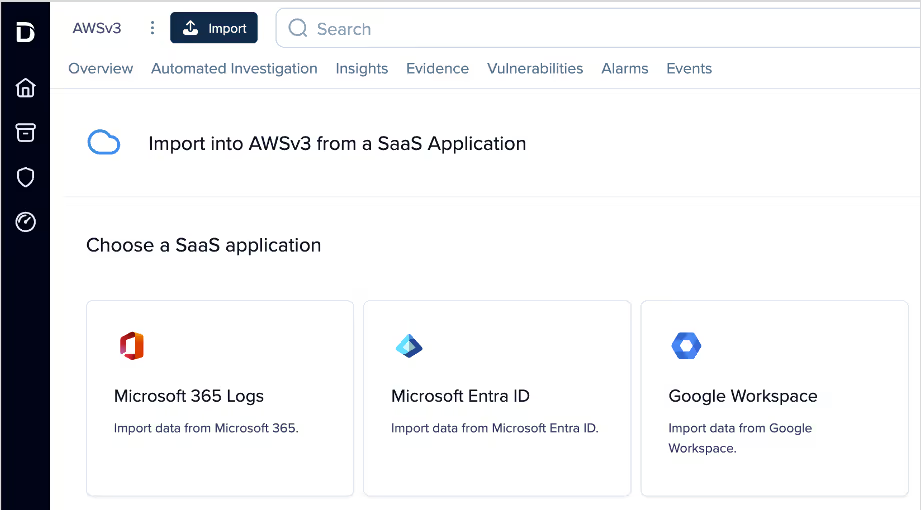
Figure 5: Ability to import logs from SaaS providers including Microsoft 365, Entra ID, and Google Workspace

Proactive Vulnerability and Malware Discovery

Finally, the solution surfaces risk proactively with vulnerability and malware discovery for Linux-based cloud resources. Vulnerabilities are presented in a searchable table and correlated with the attacker timeline, enabling teams to quickly understand not just which packages are exposed, but whether they have been targeted or exploited in the context of an incident.
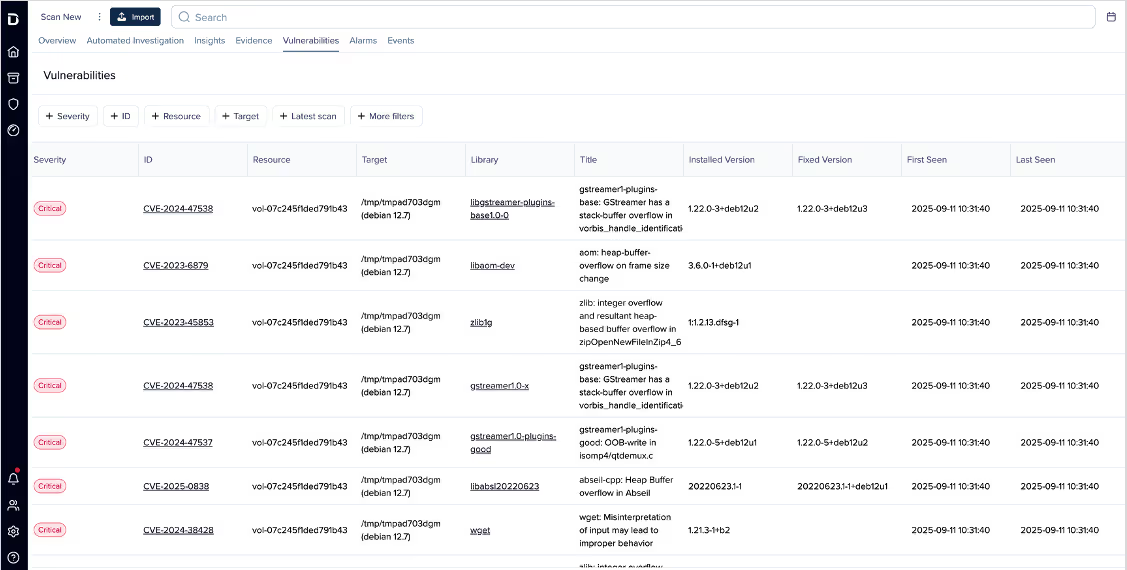
Figure 6: Vulnerability data with pivot points into the attacker timeline

Cloud-Native Scale and Performance

Darktrace / Forensic Acquisition & Investigation uses a cloud-native parallel processing architecture that spins up compute resources on demand, ensuring that investigations run at scale without bottlenecks. Detailed reporting and summaries are automatically generated, giving teams a clear record of the investigation process and supporting compliance, litigation readiness, and executive reporting needs.

Scalable and Flexible Deployment Options

Every organization has different requirements for speed, control, and integration. Darktrace / Forensic Acquisition & Investigation is designed to meet those needs with two flexible deployment models.

  • Self-Hosted Virtual Appliance delivers deep integration and control across hybrid environments, preserving forensic data for compliance and litigation while scaling to the largest enterprise investigations.
  • SaaS-Delivered Deployment provides fast time-to-value out of the box, enabling automated forensic response without requiring deep cloud expertise or heavy setup.

Both models are built to scale across regions and accounts, ensuring organizations of any size can achieve rapid value and adapt the solution to their unique operational and compliance needs. This flexibility makes advanced cloud forensics accessible to every security team — whether they are optimizing for speed, integration depth, or regulatory alignment

Delivering Advanced Cloud Forensics for Every Team

Until now, forensic investigations were slow, manual, and reserved for only the largest organizations with specialized DFIR expertise. Darktrace / Forensic Acquisition & Investigation changes that by leveraging the scale and elasticity of the cloud itself to automate the entire investigation process. From capturing full disk and memory at detection to reconstructing attacker timelines in minutes, the solution turns fragmented workflows into streamlined investigations available to every team.

Whether deployed as a SaaS-delivered service for fast time-to-value or as a self-hosted appliance for deep integration, Darktrace / Forensic Acquisition & Investigation provides the features that matter most: automated evidence capture, cross-cloud investigations, forensic depth for ephemeral assets, and root cause clarity without manual effort.

With Darktrace / Forensic Acquisition & Investigation, what once took days now takes minutes. Now, forensic investigations in the cloud are faster, more scalable, and finally accessible to every security team, no matter their size or expertise.

[related-resource]

Sources: [1], [2] Darktrace Report: Organizations Require a New Approach to Handle Investigations in the Cloud

Additional Resources

Darktrace Innovation Launch: Automated Cloud Forensics

Discover the industry's first truly automated cloud forensics solution in this live broadcast with experts from AWS and Forrester.

Inside the SOC
Darktrace cyber analysts are world-class experts in threat intelligence, threat hunting and incident response, and provide 24/7 SOC support to thousands of Darktrace customers around the globe. Inside the SOC is exclusively authored by these experts, providing analysis of cyber incidents and threat trends, based on real-world experience in the field.
Written by
Paul Bottomley
Director of Product Management | Darktrace

More in this series

No items found.

Blog

/

/

December 22, 2025

The Year Ahead: AI Cybersecurity Trends to Watch in 2026

2026 cyber threat trendsDefault blog imageDefault blog image

Introduction: 2026 cyber trends

Each year, we ask some of our experts to step back from the day-to-day pace of incidents, vulnerabilities, and headlines to reflect on the forces reshaping the threat landscape. The goal is simple:  to identify and share the trends we believe will matter most in the year ahead, based on the real-world challenges our customers are facing, the technology and issues our R&D teams are exploring, and our observations of how both attackers and defenders are adapting.  

In 2025, we saw generative AI and early agentic systems moving from limited pilots into more widespread adoption across enterprises. Generative AI tools became embedded in SaaS products and enterprise workflows we rely on every day, AI agents gained more access to data and systems, and we saw glimpses of how threat actors can manipulate commercial AI models for attacks. At the same time, expanding cloud and SaaS ecosystems and the increasing use of automation continued to stretch traditional security assumptions.

Looking ahead to 2026, we’re already seeing the security of AI models, agents, and the identities that power them becoming a key point of tension – and opportunity -- for both attackers and defenders. Long-standing challenges and risks such as identity, trust, data integrity, and human decision-making will not disappear, but AI and automation will increase the speed and scale of the cyber risk.  

Here's what a few of our experts believe are the trends that will shape this next phase of cybersecurity, and the realities organizations should prepare for.  

Agentic AI is the next big insider risk

In 2026, organizations may experience their first large-scale security incidents driven by agentic AI behaving in unintended ways—not necessarily due to malicious intent, but because of how easily agents can be influenced. AI agents are designed to be helpful, lack judgment, and operate without understanding context or consequence. This makes them highly efficient—and highly pliable. Unlike human insiders, agentic systems do not need to be socially engineered, coerced, or bribed. They only need to be prompted creatively, misinterpret legitimate prompts, or be vulnerable to indirect prompt injection. Without strong controls around access, scope, and behavior, agents may over-share data, misroute communications, or take actions that introduce real business risk. Securing AI adoption will increasingly depend on treating agents as first-class identities—monitored, constrained, and evaluated based on behavior, not intent.

-- Nicole Carignan, SVP of Security & AI Strategy

Prompt Injection moves from theory to front-page breach

We’ll see the first major story of an indirect prompt injection attack against companies adopting AI either through an accessible chatbot or an agentic system ingesting a hidden prompt. In practice, this may result in unauthorized data exposure or unintended malicious behavior by AI systems, such as over-sharing information, misrouting communications, or acting outside their intended scope. Recent attention on this risk—particularly in the context of AI-powered browsers and additional safety layers being introduced to guide agent behavior—highlights a growing industry awareness of the challenge.  

-- Collin Chapleau, Senior Director of Security & AI Strategy

Humans are even more outpaced, but not broken

When it comes to cyber, people aren’t failing; the system is moving faster than they can. Attackers exploit the gap between human judgment and machine-speed operations. The rise of deepfakes and emotion-driven scams that we’ve seen in the last few years reduce our ability to spot the familiar human cues we’ve been taught to look out for. Fraud now spans social platforms, encrypted chat, and instant payments in minutes. Expecting humans to be the last line of defense is unrealistic.

Defense must assume human fallibility and design accordingly. Automated provenance checks, cryptographic signatures, and dual-channel verification should precede human judgment. Training still matters, but it cannot close the gap alone. In the year ahead, we need to see more of a focus on partnership: systems that absorb risk so humans make decisions in context, not under pressure.

-- Margaret Cunningham, VP of Security & AI Strategy

AI removes the attacker bottleneck—smaller organizations feel the impact

One factor that is currently preventing more companies from breaches is a bottleneck on the attacker side: there’s not enough human hacker capital. The number of human hands on a keyboard is a rate-determining factor in the threat landscape. Further advancements of AI and automation will continue to open that bottleneck. We are already seeing that. The ostrich approach of hoping that one’s own company is too obscure to be noticed by attackers will no longer work as attacker capacity increases.  

-- Max Heinemeyer, Global Field CISO

SaaS platforms become the preferred supply chain target

Attackers have learned a simple lesson: compromising SaaS platforms can have big payouts. As a result, we’ll see more targeting of commercial off-the-shelf SaaS providers, which are often highly trusted and deeply integrated into business environments. Some of these attacks may involve software with unfamiliar brand names, but their downstream impact will be significant. In 2026, expect more breaches where attackers leverage valid credentials, APIs, or misconfigurations to bypass traditional defenses entirely.

-- Nathaniel Jones, VP of Security & AI Strategy

Increased commercialization of generative AI and AI assistants in cyber attacks

One trend we’re watching closely for 2026 is the commercialization of AI-assisted cybercrime. For example, cybercrime prompt playbooks sold on the dark web—essentially copy-and-paste frameworks that show attackers how to misuse or jailbreak AI models. It’s an evolution of what we saw in 2025, where AI lowered the barrier to entry. In 2026, those techniques become productized, scalable, and much easier to reuse.  

-- Toby Lewis, Global Head of Threat Analysis

Conclusion

Taken together, these trends underscore that the core challenges of cybersecurity are not changing dramatically -- identity, trust, data, and human decision-making still sit at the core of most incidents. What is changing quickly is the environment in which these challenges play out. AI and automation are accelerating everything: how quickly attackers can scale, how widely risk is distributed, and how easily unintended behavior can create real impact. And as technology like cloud services and SaaS platforms become even more deeply integrated into businesses, the potential attack surface continues to expand.  

Predictions are not guarantees. But the patterns emerging today suggest that 2026 will be a year where securing AI becomes inseparable from securing the business itself. The organizations that prepare now—by understanding how AI is used, how it behaves, and how it can be misused—will be best positioned to adopt these technologies with confidence in the year ahead.

Learn more about how to secure AI adoption in the enterprise without compromise by registering to join our live launch webinar on February 3, 2026.  

Continue reading
About the author
The Darktrace Community

Blog

/

Email

/

December 22, 2025

Why Organizations are Moving to Label-free, Behavioral DLP for Outbound Email

Man at laptopDefault blog imageDefault blog image

Why outbound email DLP needs reinventing

In 2025, the global average cost of a data breach fell slightly — but remains substantial at USD 4.44 million (IBM Cost of a Data Breach Report 2025). The headline figure hides a painful reality: many of these breaches stem not from sophisticated hacks, but from simple human error: mis-sent emails, accidental forwarding, or replying with the wrong attachment. Because outbound email is a common channel for sensitive data leaving an organization, the risk posed by everyday mistakes is enormous.

In 2025, 53% of data breaches involved customer PII, making it the most commonly compromised asset (IBM Cost of a Data Breach Report 2025). This makes “protection at the moment of send” essential. A single unintended disclosure can trigger compliance violations, regulatory scrutiny, and erosion of customer trust –consequences that are disproportionate to the marginal human errors that cause them.

Traditional DLP has long attempted to mitigate these impacts, but it relies heavily on perfect labelling and rigid pattern-matching. In reality, data loss rarely presents itself as a neat, well-structured pattern waiting to be caught – it looks like everyday communication, just slightly out of context.

How data loss actually happens

Most data loss comes from frustratingly familiar scenarios. A mistyped name in auto-complete sends sensitive data to the wrong “Alex.” A user forwards a document to a personal Gmail account “just this once.” Someone shares an attachment with a new or unknown correspondent without realizing how sensitive it is.

Traditional, content-centric DLP rarely catches these moments. Labels are missing or wrong. Regexes break the moment the data shifts formats. And static rules can’t interpret the context that actually matters – the sender-recipient relationship, the communication history, or whether this behavior is typical for the user.

It’s the everyday mistakes that hurt the most. The classic example: the Friday 5:58 p.m. mis-send, when auto-complete selects Martin, a former contractor, instead of Marta in Finance.

What traditional DLP approaches offer (and where gaps remain)

Most email DLP today follows two patterns, each useful but incomplete.

  • Policy- and label-centric DLP works when labels are correct — but content is often unlabeled or mislabeled, and maintaining classification adds friction. Gaps appear exactly where users move fastest
  • Rule and signature-based approaches catch known patterns but miss nuance: human error, new workflows, and “unknown unknowns” that don’t match a rule

The takeaway: Protection must combine content + behavior + explainability at send time, without depending on perfect labels.

Your technology primer: The three pillars that make outbound DLP effective

1) Label-free (vs. data classification)

Protects all content, not just what’s labeled. Label-free analysis removes classification overhead and closes gaps from missing or incorrect tags. By evaluating content and context at send time, it also catches misdelivery and other payload-free errors.

  • No labeling burden; no regex/rule maintenance
  • Works when tags are missing, wrong, or stale
  • Detects misdirected sends even when labels look right

2) Behavioral (vs. rules, signatures, threat intelligence)

Understands user behavior, not just static patterns. Behavioral analysis learns what’s normal for each person, surfacing human error and subtle exfiltration that rules can’t. It also incorporates account signals and inbound intel, extending across email and Teams.

  • Flags risk without predefined rules or IOCs
  • Catches misdelivery, unusual contacts, personal forwards, odd timing/volume
  • Blends identity and inbound context across channels

3) Proprietary DSLM (vs. generic LLM)

Optimized for precise, fast, explainable on-send decisions. A DSLM understands email/DLP semantics, avoids generative risks, and stays auditable and privacy-controlled, delivering intelligence reliably without slowing mail flow.

  • Low-latency, on-send enforcement
  • Non-generative for predictable, explainable outcomes
  • Governed model with strong privacy and auditability

The Darktrace approach to DLP

Darktrace / EMAIL – DLP stops misdelivery and sensitive data loss at send time using hold/notify/justify/release actions. It blends behavioral insight with content understanding across 35+ PII categories, protecting both labeled and unlabeled data. Every action is paired with clear explainability: AI narratives show exactly why an email was flagged, supporting analysts and helping end-users learn. Deployment aligns cleanly with existing SOC workflows through mail-flow connectors and optional Microsoft Purview label ingestion, without forcing duplicate policy-building.

Deployment is simple: Microsoft 365 routes outbound mail to Darktrace for real-time, inline decisions without regex or rule-heavy setup.

A buyer’s checklist for DLP solutions

When choosing your DLP solution, you want to be sure that it can deliver precise, explainable protection at the moment it matters – on send – without operational drag.  

To finish, we’ve compiled a handy list of questions you can ask before choosing an outbound DLP solution:

  • Can it operate label free when tags are missing or wrong? 
  • Does it truly learn per user behavior (no shortcuts)? 
  • Is there a domain specific model behind the content understanding (not a generic LLM)? 
  • Does it explain decisions to both analysts and end users? 
  • Will it integrate with your label program and SOC workflows rather than duplicate them? 

For a deep dive into Darktrace’s DLP solution, check out the full solution brief.

[related-resource]

Continue reading
About the author
Carlos Gray
Senior Product Marketing Manager, Email
Your data. Our AI.
Elevate your network security with Darktrace AI