
Blog
/
Network
/
October 23, 2025

Darktrace Redefines NDR: Industry-First Autonomous Threat Investigation from Network to Endpoint with Agentic AI

Darktrace delivers the next evolution of NDR, extending an industry-first bridge across the network and endpoint gap with Self-Learning AI.
Inside the SOC
Darktrace cyber analysts are world-class experts in threat intelligence, threat hunting and incident response, and provide 24/7 SOC support to thousands of Darktrace customers around the globe. Inside the SOC is exclusively authored by these experts, providing analysis of cyber incidents and threat trends, based on real-world experience in the field.
Written by
Mikey Anderson
Product Marketing Manager, Network Detection & Response
autonomous investigations, endpoint, ndr, network detection and responseDefault blog imageDefault blog imageDefault blog imageDefault blog imageDefault blog imageDefault blog image
23
Oct 2025

Darktrace delivers the next evolution of unified and proactive NDR

Darktrace Network Endpoint eXtended Telemetry (NEXT) is revolutionizing NDR with the industry’s first mixed-telemetry agent using Self-Learning AI.  

The combined context of native network and endpoint process data significantly reduces incident triage and investigation times for threats spanning both domains. Our business-centric approach learns what normal looks like for each endpoint, and now uses process context to extend our ability to identify novel threats that existing EDR/XDR tools often  miss.

Summary of what’s new:

  • Native endpoint process telemetry combined with NDR, bridging the EDR gap
  • Self-Learning AI on the endpoint to stop novel threats missed by EDR
  • Sophisticated Agentic AI to automate SecOps investigations across all major IT domains
  • AI-native, real-time threat detection, investigation, and response (TDIR) for cross-domain activity throughout the enterprise

Why is this an important next step in NDR?

Security analysts are buried under a flood of alerts that lack the context needed to separate genuine threats from noise. The root problem is that most security tools only see one slice of the environment. IT and OT networks, endpoints, and cloud systems are monitored in isolation, with little correlation between them.

As a result, investigations are highly manual. Analysts are forced to pivot between siloed point-products, each providing only a fragment of the incident. This slows response, creates blind spots, and limits the team’s ability to understand and contain threats effectively.

In many cases, the high degree of skill it takes to pivot tools and conduct investigations leads even the most experienced analysts closer to burnout, especially when they are already exhausted by the quantity of alerts. Ultimately, the human personnel managing these systems are using their skills to accommodate for the lack of synergy between tools they are using in their security stack, rather than developing the higher-value expertise needed to anticipate, prevent, and respond to emerging threats.

Many organizations have attempted to overcome this challenge by implementing XDR solutions. But, XDR does not cover NDR related use cases. This is especially true in OT/CPS environments where it is not possible to install an agent on devices.

XDR is an Endpoint-focused tool that cannot see the full picture of threats moving laterally across the network, targeting unmanaged devices, or blending into legitimate traffic. While XDR is still a strong tool in the arsenal, attackers are noticing where the gaps are:

  • A CISA Red Team assessment found that one U.S. critical infrastructure organization suffered prolonged compromise because it overly relied on host‑based EDR and lacked sufficient network-layer defenses.  

Bottom line: Without native network detection and response (NDR), critical incidents slip through undetected.

Not all NDR tools are built the same

When it comes to NDR, the details matter. Here are a few reasons why not all NDR solutions are created equal:

  • Most NDR solutions depend on EDR/XDR integrations to ingest endpoint alerts, which are raised based on activity that is already known to be malicious
  • They can’t investigate beyond what the EDR already flags, lacking process-level context in network investigations
  • Almost no NDR solutions have a native endpoint agent to extend NDR visibility to remote worker devices

This reliance on EDR leaves critical gaps in network coverage, since EDRs themselves don’t provide network-level visibility.

The NEXT evolution of NDR

Darktrace Network Endpoint eXtended Telemetry (NEXT) is revolutionizing NDR with the industry’s first mixed-telemetry agent using Self-Learning AI.  

The combined context of native network and endpoint process data significantly reduces incident triage and investigation times for threats spanning both domains, our business-centric approach with new data also extends our ability to identify novel threats that existing EDR/XDR may miss.

Darktrace / ENDPOINT agents are now able to utilize new Network Endpoint eXtended Telemetry (NEXT) capabilities. This combines full network visibility with native endpoint process data, enabling autonomous investigations that trace threats from initial network activity all the way to the root cause at the endpoint, without manual correlation or tool switching. This bridges the gap between NDR and the endpoint, while adding value to existing EDR investments.
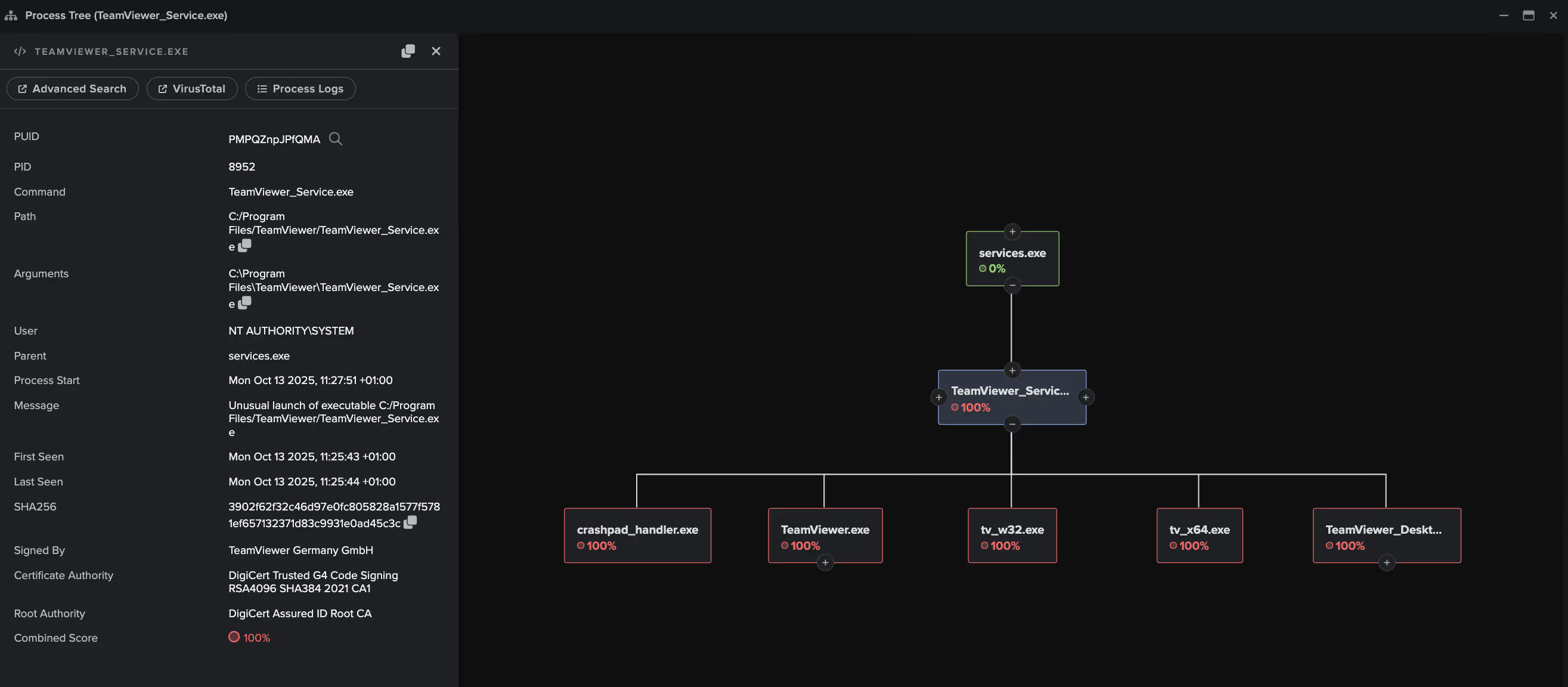
Darktrace natively shows the endpoint process context in relation to network events, complete with parent/child process relationships, adding immediate context to network investigations without needing to pivot to your EDR.
Figure 1: Darktrace natively shows the endpoint process context in relation to network events, complete with parent/child process relationships, adding immediate context to network investigations without needing to pivot to your EDR.

Leveraging this data in investigations

This additional context is then leveraged by Cyber AI Analyst, a sophisticated agentic AI system that autonomously performs end-to-end investigations of all relevant alerts and prioritizes incidents. With the new endpoint process visibility, Cyber AI Analyst now incorporates process context into its decision-making, which improves detection accuracy, filters out benign activity, and enhances incident narratives with process-level insights.

This makes Darktrace the first NDR to natively investigate threats across network and endpoint telemetry with an autonomous, agentic AI analyst. And with our Self-Learning AI, Darktrace continuously evolves by understanding what’s normal for each unique environment, now adding process data to extend visibility and range of detections. This enables Darktrace to detect and contain novel threats, including zero-days, insider threats, and emerging attack techniques, up to 8 days before public disclosure.

This is more than a solution to a visibility problem. It’s a fundamental evolution in how threats are detected, investigated, and stopped. By applying agentic AI, Darktrace empowers security teams to move from reactive alert triage to proactive, autonomous defense, surfacing and blocking threats that others simply can’t see.
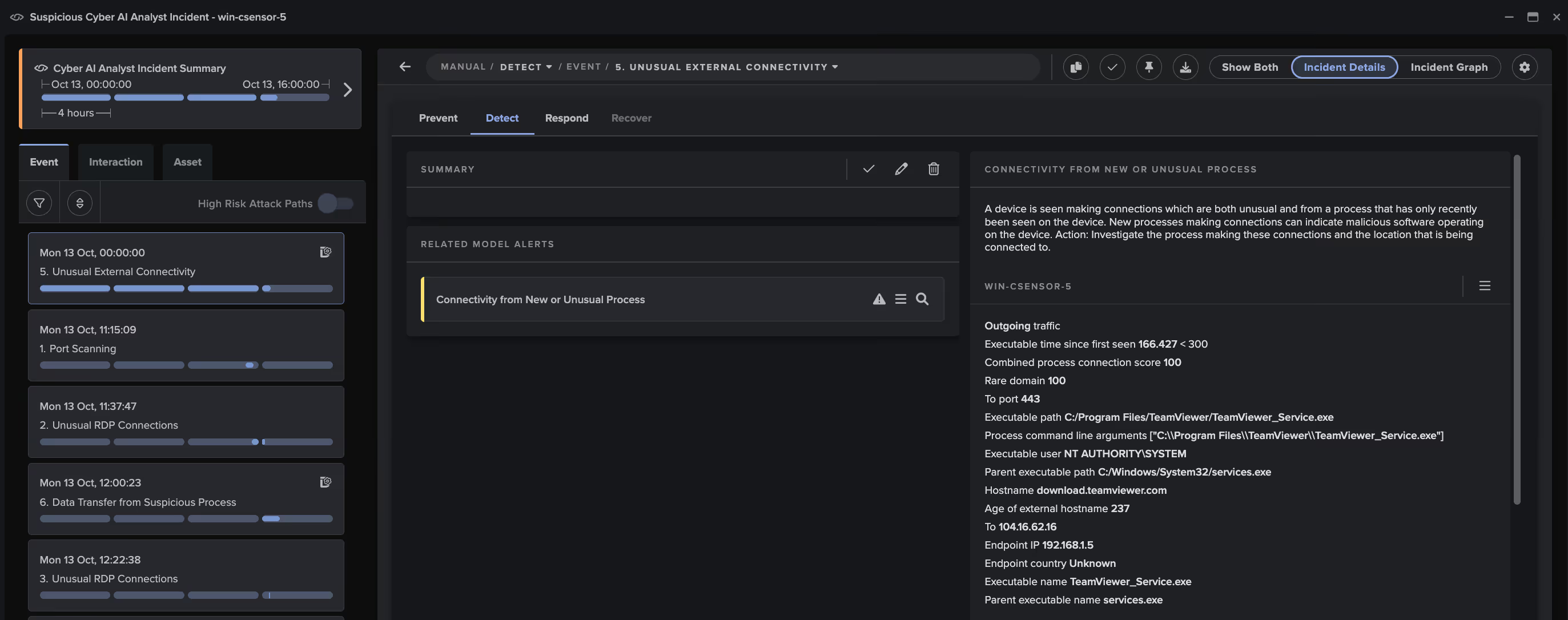
An excerpt from a Darktrace Cyber AI Analyst incident, showing the inclusion of native endpoint process context alongside other network events.
Figure 2: An excerpt from a Darktrace Cyber AI Analyst incident, showing the inclusion of native endpoint process context alongside other network events.

Continued innovation in detection and response

Darktrace also continues to invest in our core NDR capabilities, delivering enhancements and innovations to solve modern network security challenges. In the latest release, Darktrace / NETWORK has been enhanced to increase detection efficacy and performance. This includes increased protocol detection fidelity and new support for custom port mappings, plus expanded visibility into HTTP traffic to support more targeted threat hunting across a wider range of application layer activity. In addition, vSensor performance has been upgraded for tunnel protocols such as Geneve.

We have also released enhancements to Autonomous Response, which is already trusted by thousands of organizations to contain threats at the earliest stages without causing business disruption. This includes enhanced support for highly complex and segmented networks, plus the ability to extend Autonomous Response actions to more areas with additional firewall integration support. This enables faster and more effective response to network threats, and continues Darktrace’s proven ability to contain zero-day threats up to 8 days before public disclosure.

Providing seamless operations with the new Darktrace ActiveAI Security Portal

As part of Darktrace’s commitment to breaking down silos across the cyber defense lifecycle, this release also introduces major platform enhancements that tackle often-overlooked operational gaps specifically around user access, permissions, and integration workflows. With the launch of the new Darktrace ActiveAI Security Portal, organizations can now manage security at scale across diverse environments, making it ideal for large enterprises, MSSPs, and partners overseeing multiple tenants. These updates ensure that visibility, control, and scalability extend beyond detection and response and into how teams manage and interact with the platform itself.

Committed to innovation

These updates are part of the broader Darktrace release, which also included:

1. Major innovations in cloud security with the launch of the industry’s first fully automated cloud forensics solution, reinforcing Darktrace’s leadership in AI-native security.

2. Innovations to our suite of Exposure Management & Attack Surface Management products including:

  • Exploit Prediction Assessment: Continuously validates whether top-priority exposures are actually exploitable in your environment without waiting for patch cycles or formal pen tests.  
  • Deep & Dark Web Monitoring: Extends visibility across millions of sources in the deep and dark web to detect leaked credentials linked to your confirmed domains.
  • Confidence Score: our newly developed AI classification platform will compare newly discovered assets to assets that are known to belong to your organization. The more these newly discovered assets look similar to assets that belong to your organization, the higher the score will be.
  • No-Telemetry Endpoint: Collects installed software data and maps it to known CVEs—without network traffic—providing device-level vulnerability context and operational relevance.
  • Cost-Benefit Analysis for Patching: Calculates ROI by comparing patching effort with potential exploit impact, factoring in headcount time, device count, patch difficulty, and automation availability.

Visit these blogs to learn more about updates:

As attackers exploit gaps between tools, the Darktrace ActiveAI Security Platform delivers unified detection, automated investigation, and autonomous response across cloud, endpoint, email, network, and OT. With full-stack visibility and AI-native workflows, Darktrace empowers security teams to detect, understand, and stop novel threats before they escalate.

Join our Live Launch Event

When? 

December 9, 2025

What will be covered?

Join our live broadcast to experience how Darktrace is eliminating blind spots for detection and response across your complete enterprise with new innovations in Agentic AI across our ActiveAI Security platform. Industry leaders from IDC will join Darktrace customers to discuss challenges in cross-domain security, with a live walkthrough reshaping the future of Network Detection & Response, Endpoint Detection & Response, Email Security, and SecOps in novel threat detection and autonomous investigations.

Inside the SOC
Darktrace cyber analysts are world-class experts in threat intelligence, threat hunting and incident response, and provide 24/7 SOC support to thousands of Darktrace customers around the globe. Inside the SOC is exclusively authored by these experts, providing analysis of cyber incidents and threat trends, based on real-world experience in the field.
Written by
Mikey Anderson
Product Marketing Manager, Network Detection & Response

More in this series

No items found.

Blog

/

/

January 15, 2026

React2Shell Reflections: Cloud Insights, Finance Sector Impacts, and How Threat Actors Moved So Quickly

React2Shell Default blog imageDefault blog image

Introduction

Last month’s disclosure of CVE 2025-55812, known as React2Shell, provided a reminder of how quickly modern threat actors can operationalize newly disclosed vulnerabilities, particularly in cloud-hosted environments.

The vulnerability was discovered on December 3, 2025, with a patch made available on the same day. Within 30 hours of the patch, a publicly available proof-of-concept emerged that could be used to exploit any vulnerable server. This short timeline meant many systems remained unpatched when attackers began actively exploiting the vulnerability.  

Darktrace researchers rapidly deployed a new honeypot to monitor exploitation of CVE 2025-55812 in the wild.

Within two minutes of deployment, Darktrace observed opportunistic attackers exploiting this unauthenticated remote code execution flaw in React Server Components, leveraging a single crafted request to gain control of exposed Next.js servers. Exploitation quickly progressed from reconnaissance to scripted payload delivery, HTTP beaconing, and cryptomining, underscoring how automation and pre‑positioned infrastructure by threat actors now compress the window between disclosure and active exploitation to mere hours.

For cloud‑native organizations, particularly those in the financial sector, where Darktrace observed the greatest impact, React2Shell highlights the growing disconnect between patch availability and attacker timelines, increasing the likelihood that even short delays in remediation can result in real‑world compromise.

Cloud insights

In contrast to traditional enterprise networks built around layered controls, cloud architectures are often intentionally internet-accessible by default. When vulnerabilities emerge in common application frameworks such as React and Next.js, attackers face minimal friction.  No phishing campaign, no credential theft, and no lateral movement are required; only an exposed service and exploitable condition.

The activity Darktrace observed during the React2shell intrusions reflects techniques that are familiar yet highly effective in cloud-based attacks. Attackers quickly pivot from an exposed internet-facing application to abusing the underlying cloud infrastructure, using automated exploitation to deploy secondary payloads at scale and ultimately act on their objectives, whether monetizing access through cryptomining or to burying themselves deeper in the environment for sustained persistence.

Cloud Case Study

In one incident, opportunistic attackers rapidly exploited an internet-facing Azure virtual machine (VM) running a Next.js application, abusing the React/next.js vulnerability to gain remote command execution within hours of the service becoming exposed. The compromise resulted in the staged deployment of a Go-based remote access trojan (RAT), followed by a series of cryptomining payloads such as XMrig.

Initial Access

Initial access appears to have originated from abused virtual private network (VPN) infrastructure, with the source IP (146.70.192[.]180) later identified as being associated with Surfshark

The IP address above is associated with VPN abuse leveraged for initial exploitation via Surfshark infrastructure.
Figure 1: The IP address above is associated with VPN abuse leveraged for initial exploitation via Surfshark infrastructure.

The use of commercial VPN exit nodes reflects a wider trend of opportunistic attackers leveraging low‑cost infrastructure to gain rapid, anonymous access.

Parent process telemetry later confirmed execution originated from the Next.js server, strongly indicating application-layer compromise rather than SSH brute force, misused credentials, or management-plane abuse.

Payload execution

Shortly after successful exploitation, Darktrace identified a suspicious file and subsequent execution. One of the first payloads retrieved was a binary masquerading as “vim”, a naming convention commonly used to evade casual inspection in Linux environments. This directly ties the payload execution to the compromised Next.js application process, reinforcing the hypothesis of exploit-driven access.

Command-and-Control (C2)

Network flow logs revealed outbound connections back to the same external IP involved in the inbound activity. From a defensive perspective, this pattern is significant as web servers typically receive inbound requests, and any persistent outbound callbacks — especially to the same IP — indicate likely post-exploitation control. In this case, a C2 detection model alert was raised approximately 90 minutes after the first indicators, reflecting the time required for sufficient behavioral evidence to confirm beaconing rather than benign application traffic.

Cryptominers deployment and re-exploitation

Following successful command execution within the compromised Next.js workload, the attackers rapidly transitioned to monetization by deploying cryptomining payloads. Microsoft Defender observed a shell command designed to fetch and execute a binary named “x” via either curl or wget, ensuring successful delivery regardless of which tooling was availability on the Azure VM.

The binary was written to /home/wasiluser/dashboard/x and subsequently executed, with open-source intelligence (OSINT) enrichment strongly suggesting it was a cryptominer consistent with XMRig‑style tooling. Later the same day, additional activity revealed the host downloading a static XMRig binary directly from GitHub and placing it in a hidden cache directory (/home/wasiluser/.cache/.sys/).

The use of trusted infrastructure and legitimate open‑source tooling indicates an opportunistic approach focused on reliability and speed. The repeated deployment of cryptominers strongly suggests re‑exploitation of the same vulnerable web application rather than reliance on traditional persistence mechanisms. This behavior is characteristic of cloud‑focused attacks, where publicly exposed workloads can be repeatedly compromised at scale more easily.

Financial sector spotlight

During the mass exploitation of React2Shell, Darktrace observed targeting by likely North Korean affiliated actors focused on financial organizations in the United Kingdom, Sweden, Spain, Portugal, Nigeria, Kenya, Qatar, and Chile.

The targeting of the financial sector is not unexpected, but the emergence of new Democratic People’s Republic of Korea (DPRK) tooling, including a Beavertail variant and EtherRat, a previously undocumented Linux implant, highlights the need for updated rules and signatures for organizations that rely on them.

EtherRAT uses Ethereum smart contracts for C2 resolution, polling every 500 milliseconds and employing five persistence mechanisms. It downloads its own Node.js runtime from nodejs[.]org and queries nine Ethereum RPC endpoints in parallel, selecting the majority response to determine its C2 URL. EtherRAT also overlaps with the Contagious Interview campaign, which has targeted blockchain developers since early 2025.

Read more finance‑sector insights in Darktrace’s white paper, The State of Cyber Security in the Finance Sector.

Threat actor behavior and speed

Darktrace’s honeypot was exploited just two minutes after coming online, demonstrating how automated scanning, pre-positioned infrastructure and staging, and C2 infrastructure traced back to “bulletproof” hosting reflects a mature, well‑resourced operational chain.

For financial organizations, particularly those operating cloud‑native platforms, digital asset services, or internet‑facing APIs, this activity demonstrates how rapidly geopolitical threat actors can weaponize newly disclosed vulnerabilities, turning short patching delays into strategic opportunities for long‑term access and financial gain. This underscores the need for a behavioral-anomaly-led security posture.

Credit to Nathaniel Jones (VP, Security & AI Strategy, Field CISO) and Mark Turner (Specialist Security Researcher)

Edited by Ryan Traill (Analyst Content Lead)

Appendices

Indicators of Compromise (IoCs)

146.70.192[.]180 – IP Address – Endpoint Associated with Surfshark

References

https://www.darktrace.com/resources/the-state-of-cybersecurity-in-the-finance-sector

Continue reading
About the author
Nathaniel Jones
VP, Security & AI Strategy, Field CISO

Blog

/

/

January 13, 2026

Runtime Is Where Cloud Security Really Counts: The Importance of Detection, Forensics and Real-Time Architecture Awareness

runtime, cloud security, cnaapDefault blog imageDefault blog image

Introduction: Shifting focus from prevention to runtime

Cloud security has spent the last decade focused on prevention; tightening configurations, scanning for vulnerabilities, and enforcing best practices through Cloud Native Application Protection Platforms (CNAPP). These capabilities remain essential, but they are not where cloud attacks happen.

Attacks happen at runtime: the dynamic, ephemeral, constantly changing execution layer where applications run, permissions are granted, identities act, and workloads communicate. This is also the layer where defenders traditionally have the least visibility and the least time to respond.

Today’s threat landscape demands a fundamental shift. Reducing cloud risk now requires moving beyond static posture and CNAPP only approaches and embracing realtime behavioral detection across workloads and identities, paired with the ability to automatically preserve forensic evidence. Defenders need a continuous, real-time understanding of what “normal” looks like in their cloud environments, and AI capable of processing massive data streams to surface deviations that signal emerging attacker behavior.

Runtime: The layer where attacks happen

Runtime is the cloud in motion — containers starting and stopping, serverless functions being called, IAM roles being assumed, workloads auto scaling, and data flowing across hundreds of services. It’s also where attackers:

  • Weaponize stolen credentials
  • Escalate privileges
  • Pivot programmatically
  • Deploy malicious compute
  • Manipulate or exfiltrate data

The challenge is complex: runtime evidence is ephemeral. Containers vanish; critical process data disappears in seconds. By the time a human analyst begins investigating, the detail required to understand and respond to the alert, often is already gone. This volatility makes runtime the hardest layer to monitor, and the most important one to secure.

What Darktrace / CLOUD Brings to Runtime Defence

Darktrace / CLOUD is purpose-built for the cloud execution layer. It unifies the capabilities required to detect, contain, and understand attacks as they unfold, not hours or days later. Four elements define its value:

1. Behavioral, real-time detection

The platform learns normal activity across cloud services, identities, workloads, and data flows, then surfaces anomalies that signify real attacker behavior, even when no signature exists.

2. Automated forensic level artifact collection

The moment Darktrace detects a threat, it can automatically capture volatile forensic evidence; disk state, memory, logs, and process context, including from ephemeral resources. This preserves the truth of what happened before workloads terminate and evidence disappears.

3. AI-led investigation

Cyber AI Analyst assembles cloud behaviors into a coherent incident story, correlating identity activity, network flows, and Cloud workload behavior. Analysts no longer need to pivot across dashboards or reconstruct timelines manually.

4. Live architectural awareness

Darktrace continuously maps your cloud environment as it operates; including services, identities, connectivity, and data pathways. This real-time visibility makes anomalies clearer and investigations dramatically faster.

Together, these capabilities form a runtime-first security model.

Why CNAPP alone isn’t enough

CNAPP platforms excel at pre deployment checks all the way down to developer workstations, identifying misconfigurations, concerning permission combinations, vulnerable images, and risky infrastructure choices. But CNAPP’s breadth is also its limitation. CNAPP is about posture. Runtime defense is about behavior.

CNAPP tells you what could go wrong; runtime detection highlights what is going wrong right now.

It cannot preserve ephemeral evidence, correlate active behaviors across domains, or contain unfolding attacks with the precision and speed required during a real incident. Prevention remains essential, but prevention alone cannot stop an attacker who is already operating inside your cloud environment.

Real-world AWS Scenario: Why Runtime Monitoring Wins

A recent incident detected by Darktrace / CLOUD highlights how cloud compromises unfold, and why runtime visibility is non-negotiable. Each step below reflects detections that occur only when monitoring behavior in real time.

1. External Credential Use

Detection: Unusual external source for credential use: An attacker logs into a cloud account from a never-before-seen location, the earliest sign of account takeover.

2. AWS CLI Pivot

Detection: Unusual CLI activity: The attacker switches to programmatic access, issuing commands from a suspicious host to gain automation and stealth.

3. Credential Manipulation

Detection: Rare password reset: They reset or assign new passwords to establish persistence and bypass existing security controls.

4. Cloud Reconnaissance

Detection: Burst of resource discovery: The attacker enumerates buckets, roles, and services to map high value assets and plan next steps.

5. Privilege Escalation

Detection: Anomalous IAM update: Unauthorized policy updates or role changes grant the attacker elevated access or a backdoor.

6. Malicious Compute Deployment

Detection: Unusual EC2/Lambda/ECS creation: The attacker deploys compute resources for mining, lateral movement, or staging further tools.

7. Data Access or Tampering

Detection: Unusual S3 modifications: They alter S3 permissions or objects, often a prelude to data exfiltration or corruption.

Only some of these actions would appear in a posture scan, crucially after the fact.
Every one of these runtime detections is visible only through real-time behavioral monitoring while the attack is in progress.

The future of cloud security Is runtime-first

Cloud defense can no longer revolve solely around prevention. Modern attacks unfold in runtime, across a fast-changing mesh of workloads, services, and — critically — identities. To reduce risk, organizations must be able to detect, understand, and contain malicious activity as it happens, before ephemeral evidence disappears and before attacker's pivot across identity layers.

Darktrace / CLOUD delivers this shift by turning runtime, the most volatile and consequential layer in the cloud, into a fully defensible control point through unified visibility across behavior, workloads, and identities. It does this by providing:

  • Real-time behavior detection across workloads and identity activity
  • Autonomous response actions for rapid containment
  • Automated forensic level artifact preservation the moment events occur
  • AI-driven investigation that separates weak signals from true attacker patterns
  • Live cloud environment insight to understand context and impact instantly

Cloud security must evolve from securing what might go wrong to continuously understanding what is happening; in runtime, across identities, and at the speed attackers operate. Unifying runtime and identity visibility is how defenders regain the advantage.

[related-resource]

Continue reading
About the author
Adam Stevens
Senior Director of Product, Cloud | Darktrace
Your data. Our AI.
Elevate your network security with Darktrace AI