Blog
/
Proactive Security
/
October 23, 2025

Patch Smarter, Not Harder: Now Empowering Security Teams with Business-Aligned Threat Context Agents

This blog introduces new innovations in Darktrace / Proactive Exposure Management that bring precision and clarity to vulnerability prioritization. Learn how No-Telemetry Endpoints provide real device context without network data and how new Cost-Benefit Analysis capabilities quantify patching ROI—helping teams cut noise, act faster, and strengthen proactive risk management.
Inside the SOC
Darktrace cyber analysts are world-class experts in threat intelligence, threat hunting and incident response, and provide 24/7 SOC support to thousands of Darktrace customers around the globe. Inside the SOC is exclusively authored by these experts, providing analysis of cyber incidents and threat trends, based on real-world experience in the field.
Written by
Kelland Goodin
Product Marketing Specialist
Patch Smarter, Not Harder: Now Empowering Security Teams with Business-Aligned Threat Context Agents Default blog imageDefault blog imageDefault blog imageDefault blog imageDefault blog imageDefault blog image
23
Oct 2025

Most risk management programs remain anchored in enumeration: scanning every asset, cataloging every CVE, and drowning in lists that rarely translate into action. Despite expensive scanners, annual pen tests, and countless spreadsheets, prioritization still falters at two critical points.

Context gaps at the device level: It’s hard to know which vulnerabilities actually matter to your business given existing privileges, what software it runs, and what controls already reduce risk.

Business translation: Even when the technical priority is clear, justifying effort and spend in financial terms—especially across many affected devices—can delay action. Especially if it means halting other areas of the business that directly generate revenue.

The result is familiar: alert fatigue, “too many highs,” and remediation that trails behind the threat landscape. Darktrace / Proactive Exposure Management addresses this by pairing precise, endpoint‑level context with clear, financial insight so teams can prioritize confidently and mobilize faster.

A powerful combination: No-Telemetry Endpoint Agent + Cost-Benefit Analysis

Darktrace / Proactive Exposure Management now uniquely combines technical precision with business clarity in a single workflow.  With this release, Darktrace / Proactive Exposure Management delivers a more holistic approach, uniting technical context and financial insight to drive proactive risk reduction. The result is a single solution that helps security teams stay ahead of threats while reducing noise, delays, and complexity.

  • No-Telemetry Endpoint: Collects installed software data and maps it to known CVEs—without network traffic—providing device-level vulnerability context and operational relevance.
  • Cost-Benefit Analysis for Patching: Calculates ROI by comparing patching effort with potential exploit impact, factoring in headcount time, device count, patch difficulty, and automation availability.

Introducing the No-Telemetry Endpoint Agent

Darktrace’s new endpoint agent inventories installed software on devices and maps it to known CVEs without collecting network data so you can prioritize using real device context and available security controls.

By grounding vulnerability findings in the reality of each endpoint, including its software footprint and existing controls, teams can cut through generic severity scores and focus on what matters most. The agent is ideal for remote devices, BYOD-adjacent fleets, or environments standardizing on Darktrace, and is available without additional licensing cost.
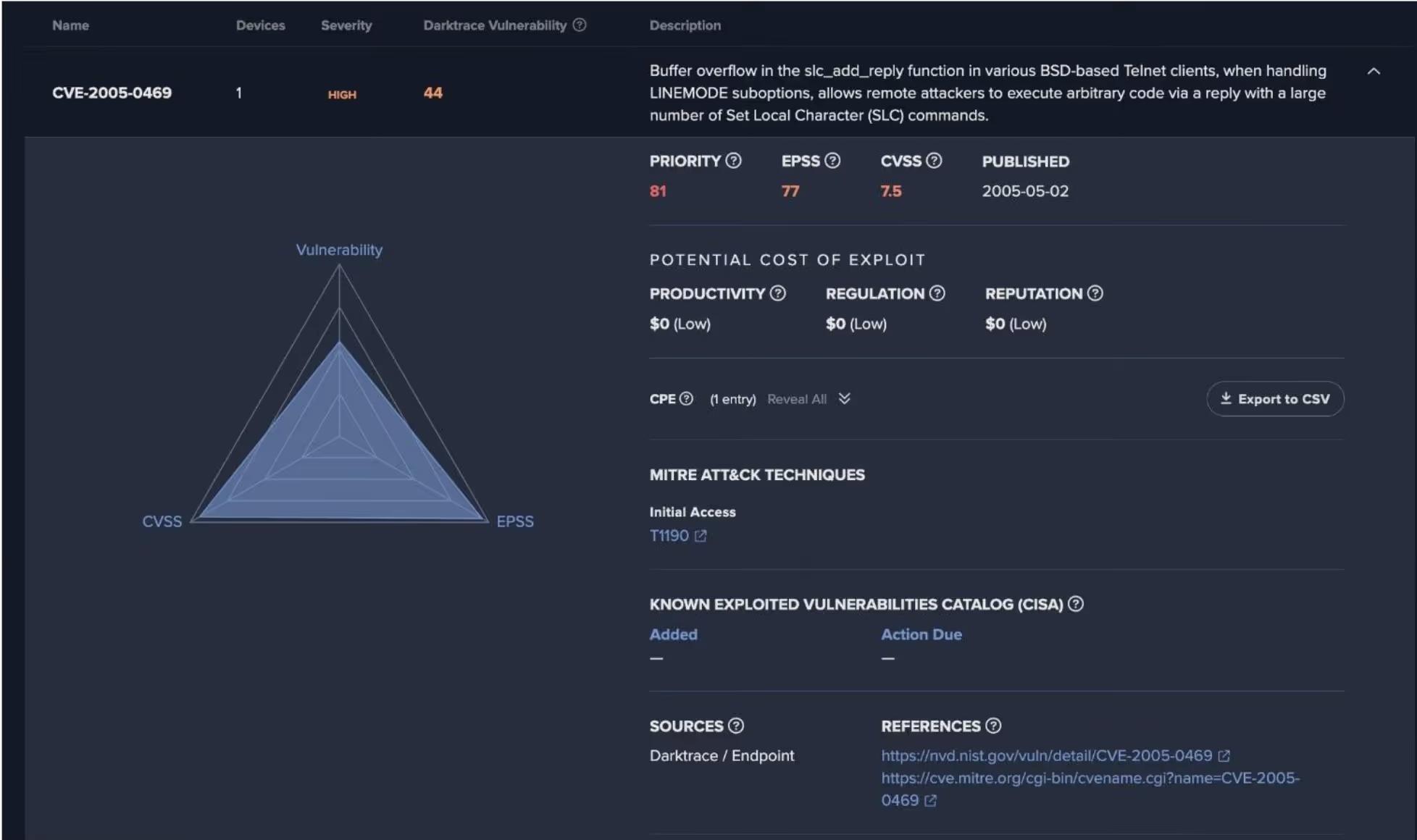
Darktrace / Proactive Exposure Management user interface
Figure 1: Darktrace / Proactive Exposure Management user interface

Built-In Cost-Benefit Analysis for Patching

Security teams often know what needs fixing but stakeholders need to understand why now. Darktrace’s new cost-benefit calculator compares the total cost to patch against the potential cost of exploit, producing an ROI for the patch action that expresses security action in clear financial terms.

Inputs like engineer time, number of affected devices, patch difficulty, and automation availability are factored in automatically. The result is a business-aligned justification for every patching decision—helping teams secure buy-in, accelerate approvals, and move work forward with one-click ticketing, CSV export, or risk acceptance.
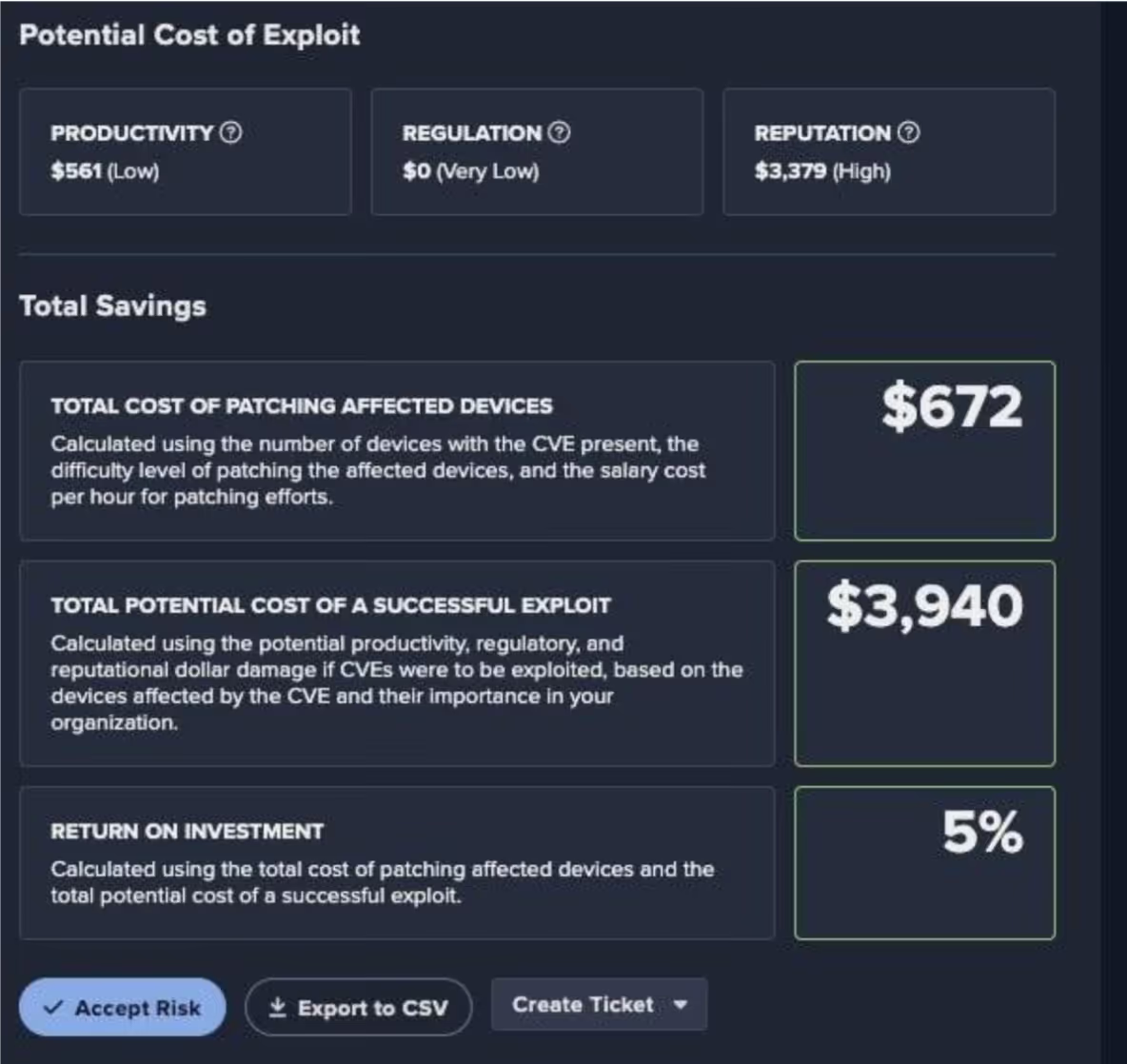
Darktrace / Proactive Exposure Management Cost Benefit Analysis
Figure 2: Darktrace / Proactive Exposure Management Cost Benefit Analysis

A Smarter, Faster Approach to Exposure Management

Together, the no-telemetry endpoint and Cost–Benefit Analysis advance the CTEM motion from theory to practice. You gain higher‑fidelity discovery and validation signals at the device level, paired with business‑ready justification that accelerates mobilization. The result is fewer distractions, clearer priorities, and faster measurable risk reduction. This is not from chasing every alert, but by focusing on what moves the needle now.

  • Smarter Prioritization: Device‑level context trims noise and spotlights the exposures that matter for your business.
  • Faster Decisions: Built‑in ROI turns technical urgency into executive clarity—speeding approvals and action.
  • Practical Execution: Privacy‑conscious endpoint collection and ticketing/export options fit neatly into existing workflows.
  • Better Outcomes: Close the loop faster—discover, prioritize, validate, and mobilize—on the same operating surface.

Committed to innovation

These updates are part of the broader Darktrace release, which also included:

1. Major innovations in cloud security with the launch of the industry’s first fully automated cloud forensics solution, reinforcing Darktrace’s leadership in AI-native security.

2. Darktrace Network Endpoint eXtended Telemetry (NEXT) is revolutionizing NDR with the industry’s first mixed-telemetry agent using Self-Learning AI.

3. Improvements to our OT product, purpose built for industrial infrastructure, Darktrace / OT now brings dedicated OT dashboard, segmentation-aware risk modeling, and expanded visibility into edge assets and automation protocols.


Join our Live Launch Event

When? 

December 9, 2025

What will be covered?

Join our live broadcast to experience how Darktrace is eliminating blind spots for detection and response across your complete enterprise with new innovations in Agentic AI across our ActiveAI Security platform. Industry leaders from IDC will join Darktrace customers to discuss challenges in cross-domain security, with a live walkthrough reshaping the future of Network Detection & Response, Endpoint Detection & Response, Email Security, and SecOps in novel threat detection and autonomous investigations.

Inside the SOC
Darktrace cyber analysts are world-class experts in threat intelligence, threat hunting and incident response, and provide 24/7 SOC support to thousands of Darktrace customers around the globe. Inside the SOC is exclusively authored by these experts, providing analysis of cyber incidents and threat trends, based on real-world experience in the field.
Written by
Kelland Goodin
Product Marketing Specialist

More in this series

No items found.

Blog

/

AI

/

March 2, 2026

What the Darktrace Annual Threat Report 2026 Means for Security Leaders

Image of the Earth from spaceDefault blog imageDefault blog image

The challenge for today’s CISOs

At the broadest level, the defining characteristic of cybersecurity in 2026 is the sheer pace of change shaping the environments we protect. Organizations are operating in ecosystems that are larger, more interconnected, and more automated than ever before – spanning cloud platforms, distributed identities, AI-driven systems, and continuous digital workflows.  

The velocity of this expansion has outstripped the slower, predictable patterns security teams once relied on. What used to be a stable backdrop is now a living, shifting landscape where technology, risk, and business operations evolve simultaneously. From this vantage point, the central challenge for security leaders isn’t reacting to individual threats, but maintaining strategic control and clarity as the entire environment accelerates around them.

Strategic takeaways from the Annual Threat Report

The Darktrace Annual Threat Report 2026 reinforces a reality every CISO feels: the center of gravity isn’t the perimeter, vulnerability management, or malware, but trust abused via identity. For example, our analysis found that nearly 70% of incidents in the Americas region begin with stolen or misused accounts, reflecting the global shift toward identity‑led intrusions.

Mass adoption of AI agents, cloud-native applications, and machine decision-making means CISOs now oversee systems that act on their own. This creates an entirely new responsibility: ensuring those systems remain safe, predictable, and aligned to business intent, even under adversarial pressure.

Attackers increasingly exploit trust boundaries, not firewalls – leveraging cloud entitlements, SaaS identity transitions, supply-chain connectivity, and automation frameworks. The rise of non-human identities intensifies this: credentials, tokens, and agent permissions now form the backbone of operational risk.

Boards are now evaluating CISOs on business continuity, operational recovery, and whether AI systems and cloud workloads can fail safely without cascading or causing catastrophic impact.

In this environment, detection accuracy, autonomous response, and blast radius minimization matter far more than traditional control coverage or policy checklists.

Every organization will face setbacks; resilience is measured by how quickly security teams can rise, respond, and resume momentum. In 2026, success will belong to those that adapt fastest.

Managing business security in the age of AI

CISO accountability in 2026 has expanded far beyond controls and tooling. Whether we asked for it or not, we now own outcomes tied to business resilience, AI trust, cloud assurance, and continuous availability. The role is less about certainty and more about recovering control in an environment that keeps accelerating.

Every major 2026 initiative – AI agents, third-party risk, cloud, or comms protection – connects to a single board-level question: Are we still in control as complexity and automation scale faster than humans?

Attackers are not just getting more sophisticated; they are becoming more automated. AI changes the economics of attack, lowering cost and increasing speed. That asymmetry is what CISOs are being measured against.

CISOs are no longer evaluated on tool coverage, but on the ability to assure outcomes – trust in AI adoption, resilience across cloud and identity, and being able to respond to unknown and unforeseen threats.

Boards are now explicitly asking whether we can defend against AI-driven threats. No one can predict every new behavior – survival depends on detecting malicious deviations from normal fast and responding autonomously.  

Agents introduce decision-making at machine speed. Governance, CI/CD scanning, posture management, red teaming, and runtime detection are no longer differentiators but the baseline.

Cloud security is no longer architectural, it is operational. Identity, control planes, and SaaS exposure now sit firmly with the CISO.

AI-speed threats already reshaping security in 2026

We’re already seeing clear examples of how quickly the threat landscape has shifted in 2026. Darktrace’s work on React2Shell exposed just how unforgiving the new tempo is: a honeypot stood up with an exposed React was hit in under two minutes. There was no recon phase, no gradual probing – just immediate, automated exploitation the moment the code appeared publicly. Exposure now equals compromise unless defenses can detect, interpret, and act at machine speed. Traditional operational rhythms simply don’t map to this reality.

We’re also facing the first wave of AI-authored malware, where LLMs generate code that mutates on demand. This removes the historic friction from the attacker side: no skill barrier, no time cost, no limit on iteration. Malware families can regenerate themselves, shift structure, and evade static controls without a human operator behind the keyboard. This forces CISOs to treat adversarial automation as a core operational risk and ensure that autonomous systems inside the business remain predictable under pressure.

The CVE-2026-1731 BeyondTrust exploitation wave reinforced the same pattern. The gap between disclosure and active, global exploitation compressed into hours. Automated scanning, automated payload deployment, coordinated exploitation campaigns, all spinning up faster than most organizations can push an emergency patch through change control. The vulnerability-to-exploit window has effectively collapsed, making runtime visibility, anomaly detection, and autonomous containment far more consequential than patching speed alone.

These cases aren’t edge scenarios; they represent the emerging norm. Complexity and automation have outpaced human-scale processes, and attackers are weaponizing that asymmetry.  

The real differentiator for CISOs in 2026 is less about knowing everything and more about knowing immediately when something shifts – and having systems that can respond at the same speed.

[related-resource]

Continue reading
About the author
Mike Beck
Global CISO

Blog

/

Network

/

March 2, 2026

CVE-2026-1731: How Darktrace Sees the BeyondTrust Exploitation Wave Unfolding

Default blog imageDefault blog image

Note: Darktrace's Threat Research team is publishing now to help defenders. We will continue updating this blog as our investigations unfold.

Background

On February 6, 2026, the Identity & Access Management solution BeyondTrust announced patches for a vulnerability, CVE-2026-1731, which enables unauthenticated remote code execution using specially crafted requests.  This vulnerability affects BeyondTrust Remote Support (RS) and particular older versions of Privileged Remote Access (PRA) [1].

A Proof of Concept (PoC) exploit for this vulnerability was released publicly on February 10, and open-source intelligence (OSINT) reported exploitation attempts within 24 hours [2].

Previous intrusions against Beyond Trust technology have been cited as being affiliated with nation-state attacks, including a 2024 breach targeting the U.S. Treasury Department. This incident led to subsequent emergency directives from  the Cybersecurity and Infrastructure Security Agency (CISA) and later showed attackers had chained previously unknown vulnerabilities to achieve their goals [3].

Additionally, there appears to be infrastructure overlap with React2Shell mass exploitation previously observed by Darktrace, with command-and-control (C2) domain  avg.domaininfo[.]top seen in potential post-exploitation activity for BeyondTrust, as well as in a React2Shell exploitation case involving possible EtherRAT deployment.

Darktrace Detections

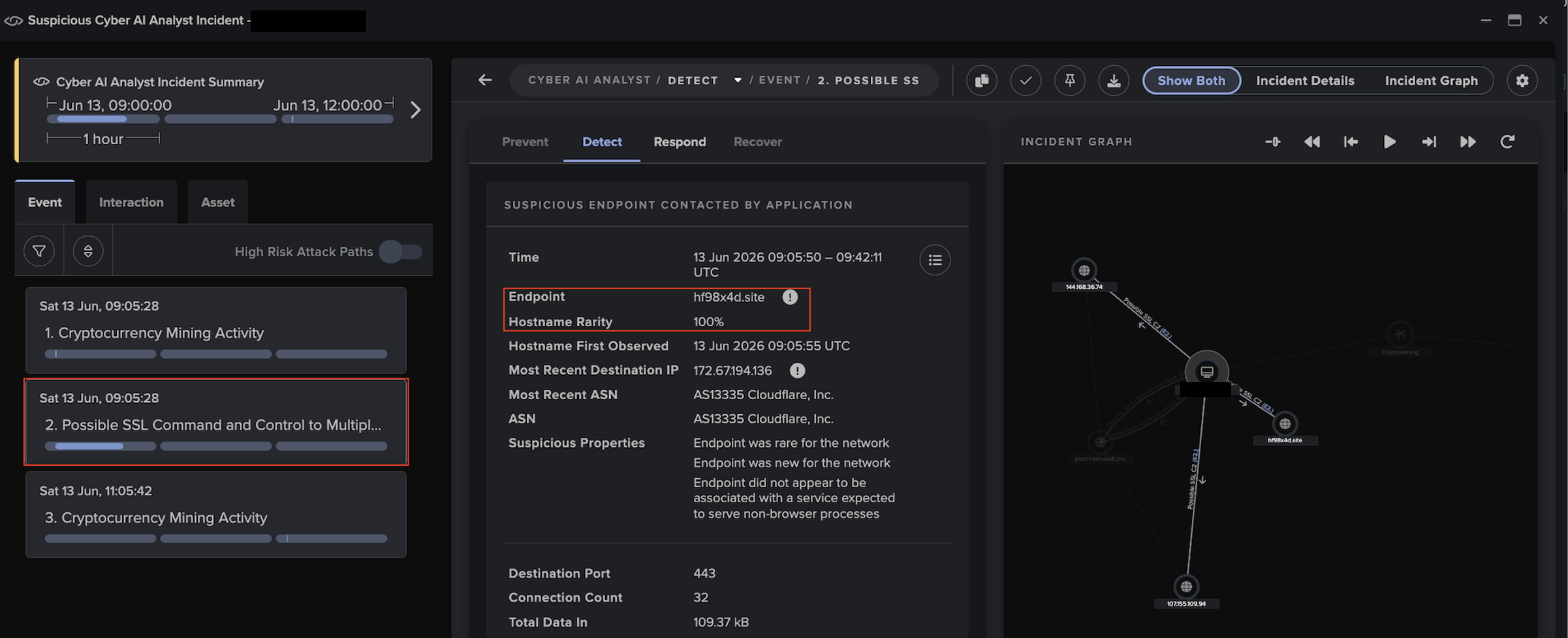
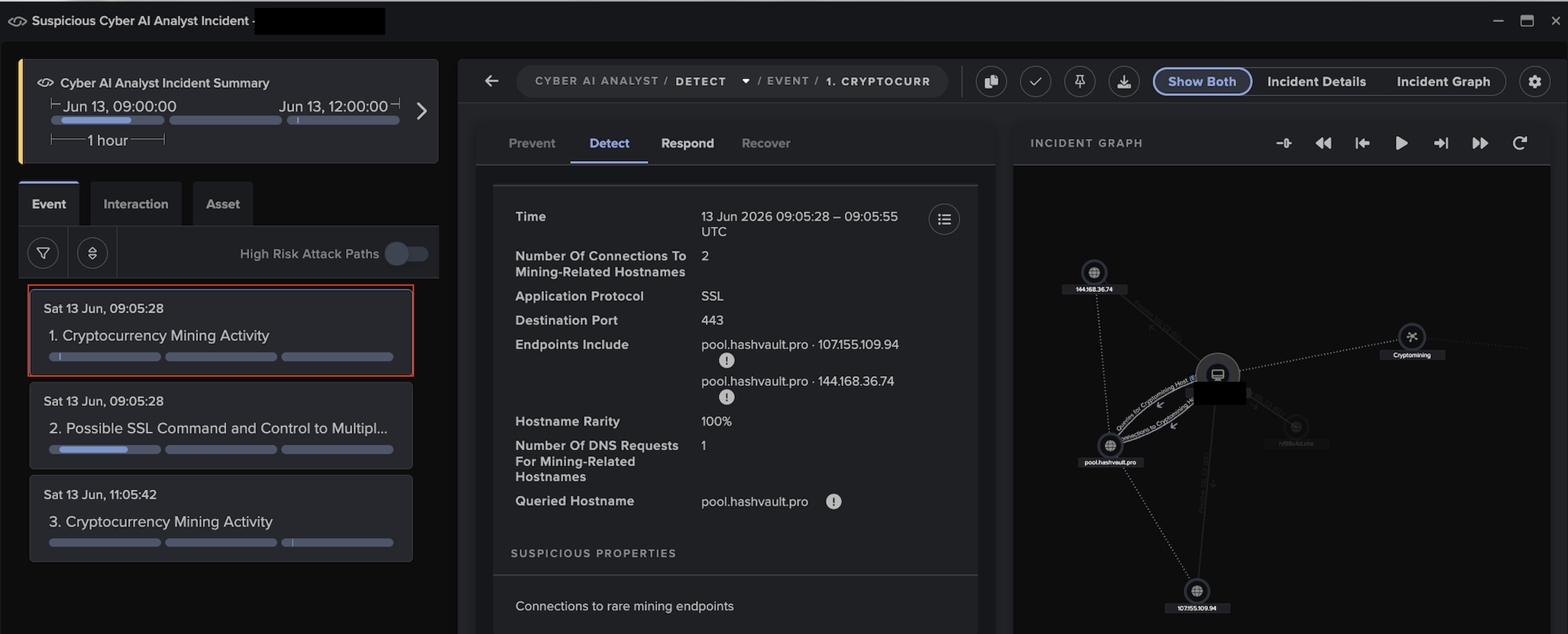
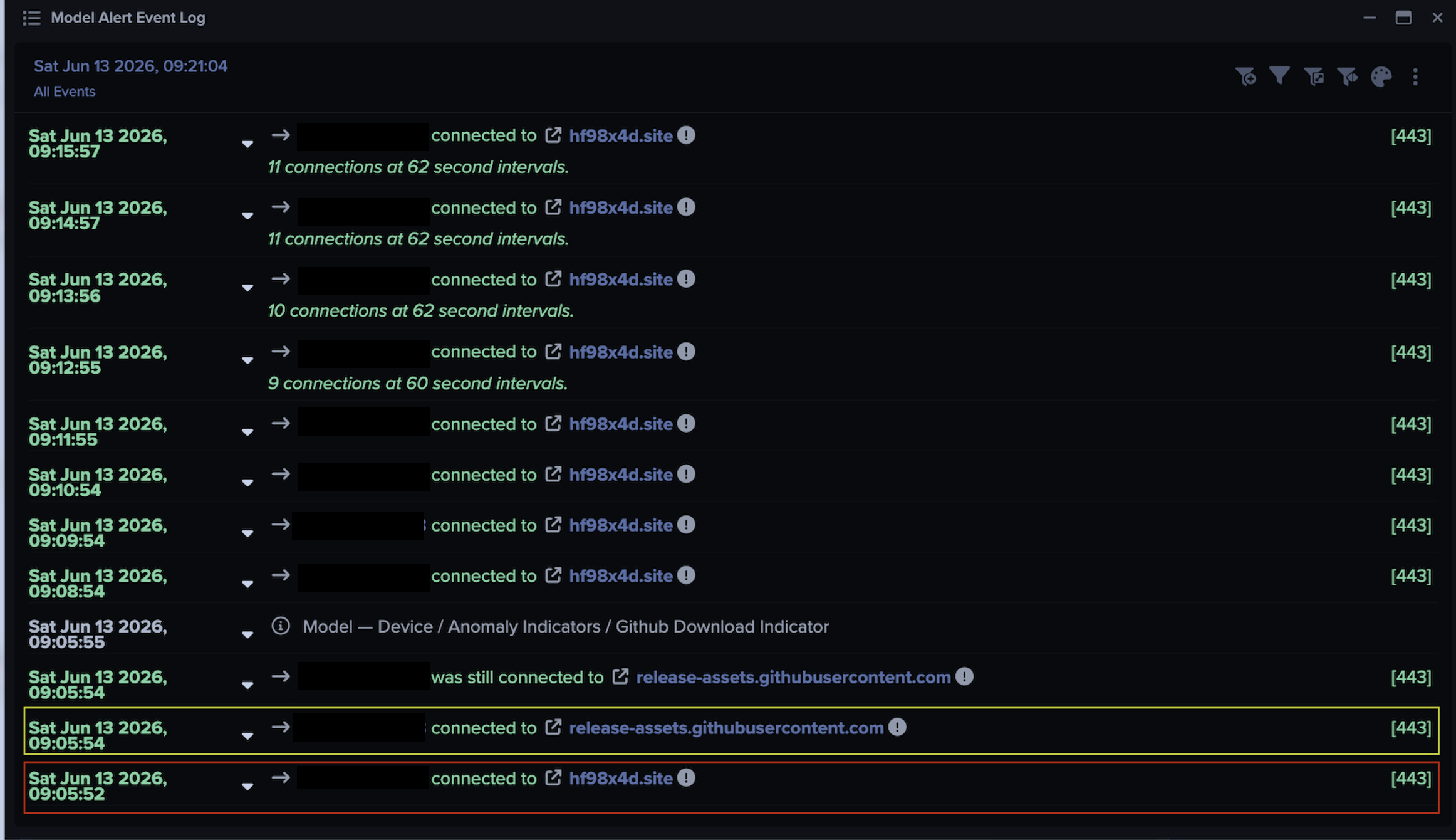
Darktrace’s Threat Research team has identified highly anomalous activity across several customers that may relate to exploitation of BeyondTrust since February 10, 2026. Observed activities include:

Outbound connections and DNS requests for endpoints associated with Out-of-Band Application Security Testing; these services are commonly abused by threat actors for exploit validation.  Associated Darktrace models include:

  • Compromise / Possible Tunnelling to Bin Services

Suspicious executable file downloads. Associated Darktrace models include:

  • Anomalous File / EXE from Rare External Location

Outbound beaconing to rare domains. Associated Darktrace models include:

  • Compromise / Agent Beacon (Medium Period)
  • Compromise / Agent Beacon (Long Period)
  • Compromise / Sustained TCP Beaconing Activity To Rare Endpoint
  • Compromise / Beacon to Young Endpoint
  • Anomalous Server Activity / Rare External from Server
  • Compromise / SSL Beaconing to Rare Destination

Unusual cryptocurrency mining activity. Associated Darktrace models include:

  • Compromise / Monero Mining
  • Compromise / High Priority Crypto Currency Mining

And model alerts for:

  • Compromise / Rare Domain Pointing to Internal IP

IT Defenders: As part of best practices, we highly recommend employing an automated containment solution in your environment. For Darktrace customers, please ensure that Autonomous Response is configured correctly. More guidance regarding this activity and suggested actions can be found in the Darktrace Customer Portal.  

Appendices

Potential indicators of post-exploitation behavior:

·      217.76.57[.]78 – IP address - Likely C2 server

·      hXXp://217.76.57[.]78:8009/index.js - URL -  Likely payload

·      b6a15e1f2f3e1f651a5ad4a18ce39d411d385ac7  - SHA1 - Likely payload

·      195.154.119[.]194 – IP address – Likely C2 server

·      hXXp://195.154.119[.]194/index.js - URL – Likely payload

·      avg.domaininfo[.]top – Hostname – Likely C2 server

·      104.234.174[.]5 – IP address - Possible C2 server

·      35da45aeca4701764eb49185b11ef23432f7162a – SHA1 – Possible payload

·      hXXp://134.122.13[.]34:8979/c - URL – Possible payload

·      134.122.13[.]34 – IP address – Possible C2 server

·      28df16894a6732919c650cc5a3de94e434a81d80 - SHA1 - Possible payload

References:

1.        https://nvd.nist.gov/vuln/detail/CVE-2026-1731

2.        https://www.securityweek.com/beyondtrust-vulnerability-targeted-by-hackers-within-24-hours-of-poc-release/

3.        https://www.rapid7.com/blog/post/etr-cve-2026-1731-critical-unauthenticated-remote-code-execution-rce-beyondtrust-remote-support-rs-privileged-remote-access-pra/

Continue reading
About the author
Emma Foulger
Global Threat Research Operations Lead
Your data. Our AI.
Elevate your network security with Darktrace AI