Blog
/
Proactive Security
/
October 23, 2025

Patch Smarter, Not Harder: Now Empowering Security Teams with Business-Aligned Threat Context Agents

This blog introduces new innovations in Darktrace / Proactive Exposure Management that bring precision and clarity to vulnerability prioritization. Learn how No-Telemetry Endpoints provide real device context without network data and how new Cost-Benefit Analysis capabilities quantify patching ROI—helping teams cut noise, act faster, and strengthen proactive risk management.
Inside the SOC
Darktrace cyber analysts are world-class experts in threat intelligence, threat hunting and incident response, and provide 24/7 SOC support to thousands of Darktrace customers around the globe. Inside the SOC is exclusively authored by these experts, providing analysis of cyber incidents and threat trends, based on real-world experience in the field.
Written by
Kelland Goodin
Product Marketing Specialist
Patch Smarter, Not Harder: Now Empowering Security Teams with Business-Aligned Threat Context Agents Default blog imageDefault blog imageDefault blog imageDefault blog imageDefault blog imageDefault blog image
23
Oct 2025

Most risk management programs remain anchored in enumeration: scanning every asset, cataloging every CVE, and drowning in lists that rarely translate into action. Despite expensive scanners, annual pen tests, and countless spreadsheets, prioritization still falters at two critical points.

Context gaps at the device level: It’s hard to know which vulnerabilities actually matter to your business given existing privileges, what software it runs, and what controls already reduce risk.

Business translation: Even when the technical priority is clear, justifying effort and spend in financial terms—especially across many affected devices—can delay action. Especially if it means halting other areas of the business that directly generate revenue.

The result is familiar: alert fatigue, “too many highs,” and remediation that trails behind the threat landscape. Darktrace / Proactive Exposure Management addresses this by pairing precise, endpoint‑level context with clear, financial insight so teams can prioritize confidently and mobilize faster.

A powerful combination: No-Telemetry Endpoint Agent + Cost-Benefit Analysis

Darktrace / Proactive Exposure Management now uniquely combines technical precision with business clarity in a single workflow.  With this release, Darktrace / Proactive Exposure Management delivers a more holistic approach, uniting technical context and financial insight to drive proactive risk reduction. The result is a single solution that helps security teams stay ahead of threats while reducing noise, delays, and complexity.

  • No-Telemetry Endpoint: Collects installed software data and maps it to known CVEs—without network traffic—providing device-level vulnerability context and operational relevance.
  • Cost-Benefit Analysis for Patching: Calculates ROI by comparing patching effort with potential exploit impact, factoring in headcount time, device count, patch difficulty, and automation availability.

Introducing the No-Telemetry Endpoint Agent

Darktrace’s new endpoint agent inventories installed software on devices and maps it to known CVEs without collecting network data so you can prioritize using real device context and available security controls.

By grounding vulnerability findings in the reality of each endpoint, including its software footprint and existing controls, teams can cut through generic severity scores and focus on what matters most. The agent is ideal for remote devices, BYOD-adjacent fleets, or environments standardizing on Darktrace, and is available without additional licensing cost.
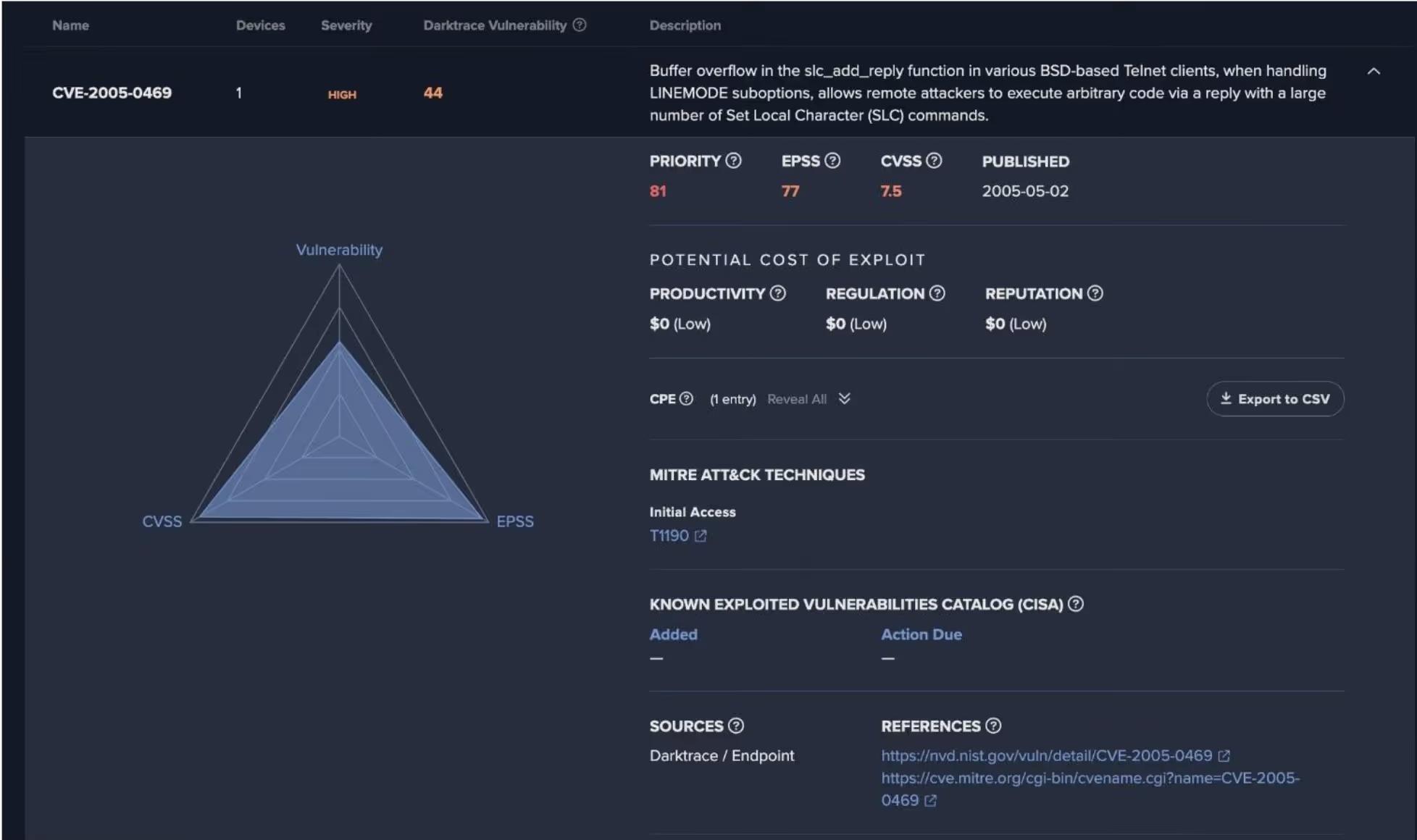
Darktrace / Proactive Exposure Management user interface
Figure 1: Darktrace / Proactive Exposure Management user interface

Built-In Cost-Benefit Analysis for Patching

Security teams often know what needs fixing but stakeholders need to understand why now. Darktrace’s new cost-benefit calculator compares the total cost to patch against the potential cost of exploit, producing an ROI for the patch action that expresses security action in clear financial terms.

Inputs like engineer time, number of affected devices, patch difficulty, and automation availability are factored in automatically. The result is a business-aligned justification for every patching decision—helping teams secure buy-in, accelerate approvals, and move work forward with one-click ticketing, CSV export, or risk acceptance.
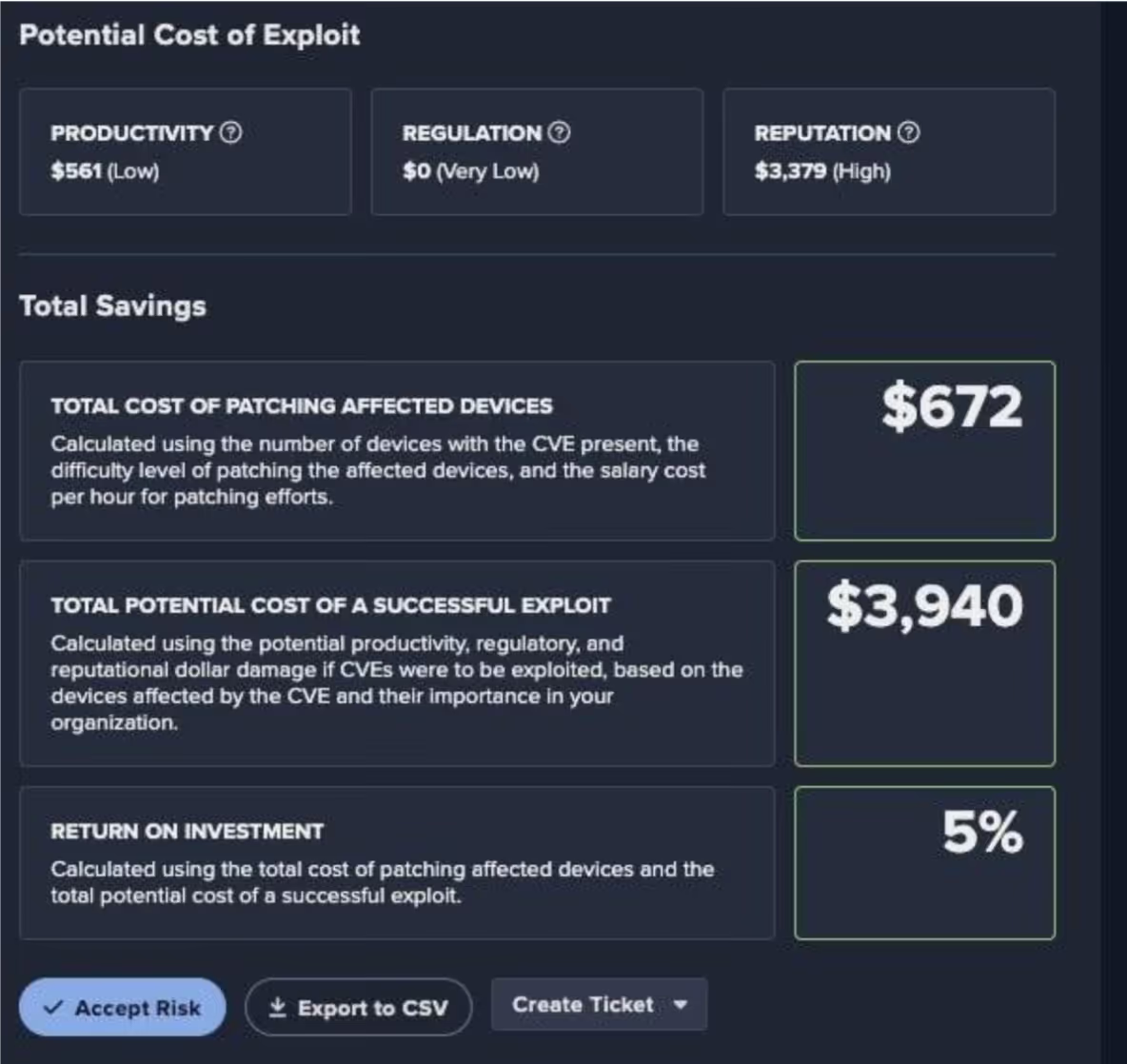
Darktrace / Proactive Exposure Management Cost Benefit Analysis
Figure 2: Darktrace / Proactive Exposure Management Cost Benefit Analysis

A Smarter, Faster Approach to Exposure Management

Together, the no-telemetry endpoint and Cost–Benefit Analysis advance the CTEM motion from theory to practice. You gain higher‑fidelity discovery and validation signals at the device level, paired with business‑ready justification that accelerates mobilization. The result is fewer distractions, clearer priorities, and faster measurable risk reduction. This is not from chasing every alert, but by focusing on what moves the needle now.

  • Smarter Prioritization: Device‑level context trims noise and spotlights the exposures that matter for your business.
  • Faster Decisions: Built‑in ROI turns technical urgency into executive clarity—speeding approvals and action.
  • Practical Execution: Privacy‑conscious endpoint collection and ticketing/export options fit neatly into existing workflows.
  • Better Outcomes: Close the loop faster—discover, prioritize, validate, and mobilize—on the same operating surface.

Committed to innovation

These updates are part of the broader Darktrace release, which also included:

1. Major innovations in cloud security with the launch of the industry’s first fully automated cloud forensics solution, reinforcing Darktrace’s leadership in AI-native security.

2. Darktrace Network Endpoint eXtended Telemetry (NEXT) is revolutionizing NDR with the industry’s first mixed-telemetry agent using Self-Learning AI.

3. Improvements to our OT product, purpose built for industrial infrastructure, Darktrace / OT now brings dedicated OT dashboard, segmentation-aware risk modeling, and expanded visibility into edge assets and automation protocols.


Join our Live Launch Event

When? 

December 9, 2025

What will be covered?

Join our live broadcast to experience how Darktrace is eliminating blind spots for detection and response across your complete enterprise with new innovations in Agentic AI across our ActiveAI Security platform. Industry leaders from IDC will join Darktrace customers to discuss challenges in cross-domain security, with a live walkthrough reshaping the future of Network Detection & Response, Endpoint Detection & Response, Email Security, and SecOps in novel threat detection and autonomous investigations.

Inside the SOC
Darktrace cyber analysts are world-class experts in threat intelligence, threat hunting and incident response, and provide 24/7 SOC support to thousands of Darktrace customers around the globe. Inside the SOC is exclusively authored by these experts, providing analysis of cyber incidents and threat trends, based on real-world experience in the field.
Written by
Kelland Goodin
Product Marketing Specialist

More in this series

No items found.

Blog

/

Network

/

April 27, 2026

How a Compromised eScan Update Enabled Multi‑Stage Malware and Blockchain C2

multi-stage malwareDefault blog imageDefault blog image

The rise of supply chain attacks

In recent years, the abuse of trusted software has become increasingly common, with supply chain compromises emerging as one of the fastest growing vectors for cyber intrusions. As highlighted in Darktrace’s Annual Threat Report 2026, attackers and state-actors continue to find significant value in gaining access to networks through compromised trusted links, third-party tools, or legitimate software. In January 2026, a supply chain compromise affecting MicroWorld Technologies’ eScan antivirus product was reported, with malicious updates distributed to customers through the legitimate update infrastructure. This, in turn, resulted in a multi‑stage loader malware being deployed on compromised devices [1][2].

An overview of eScan exploitation

According to eScan’s official threat advisory, unauthorized access to a regional update server resulted in an “incorrect file placed in the update distribution path” [3]. Customers associated with the affected update servers who downloaded the update during a two-hour window on January 20 were impacted, with affected Windows devices subsequently have experiencing various errors related to update functions and notifications [3].

While eScan did not specify which regional update servers were affected by the malicious update, all impacted Darktrace customer environments were located in the Europe, Middle East, and Africa (EMEA) region.

External research reported that a malicious 32-bit executable file , “Reload.exe”, was first installed on affected devices, which then dropped the 64-bit downloader, “CONSCTLX.exe”. This downloader establishes persistence by creating scheduled tasks such as “CorelDefrag”, which are responsible for executing PowerShell scripts. Subsequently, it evades detection by tampering with the Windows HOSTS file and eScan registry to prevent future remote updates intended for remediation. Additional payloads are then downloaded from its command-and-control (C2) server [1].

Darktrace’s coverage of eScan exploitation

Initial Access and Blockchain as multi-distributed C2 Infrastructure

On January 20, the same day as the aforementioned two‑hour exploit window, Darktrace observed multiple devices across affected networks downloading .dlz package files from eScan update servers, followed by connections to an anomalous endpoint, vhs.delrosal[.]net, which belongs to the attackers’ C2 infrastructure.

The endpoint contained a self‑signed SSL certificate with the string “O=Internet Widgits Pty Ltd, ST=SomeState, C=AU”, a default placeholder commonly used in SSL/TLS certificates for testing and development environments, as well as in malicious C2 infrastructure [4].

Utilizing a multi‑distributed C2 infrastructure, the attackers also leveraged domains linked with the Solana open‑source blockchain for C2 purposes, namely “.sol”. These domains were human‑readable names that act as aliases for cryptocurrency wallet addresses. As browsers do not natively resolve .sol domains, the Solana Naming System (formerly known as Bonfida, an independent contributor within the Solana ecosystem) provides a proxy service, through endpoints such as sol-domain[.]org, to enable browser access.

Darktrace observed devices connecting to blackice.sol-domain[.]org, indicating that attackers were likely using this proxy to reach a .sol domain for C2 activity. Given this behavior, it is likely that the attackers leveraged .sol domains as a dead drop resolver, a C2 technique in which threat actors host information on a public and legitimate service, such as a blockchain. Additional proxy resolver endpoints, such as sns-resolver.bonfida.workers[.]dev, were also observed.

Solana transactions are transparent, allowing all activity to be viewed publicly. When Darktrace analysts examined the transactions associated with blackice[.]sol, they observed that the earliest records dated November 7, 2025, which coincides with the creation date of the known C2 endpoint vhs[.]delrosal[.]net as shown in WHOIS Lookup information [4][5].

WHOIS Look records of the C2 endpoint vhs[.]delrosal[.]net.
Figure 1: WHOIS Look records of the C2 endpoint vhs[.]delrosal[.]net.
 Earliest observed transaction record for blackice[.]sol on public ledgers.
Figure 2: Earliest observed transaction record for blackice[.]sol on public ledgers.

Subsequent instructions found within the transactions contained strings such as “CNAME= vhs[.]delrosal[.]net”, indicating attempts to direct the device toward the malicious endpoint. A more recent transaction recorded on January 28 included strings such as “hxxps://96.9.125[.]243/i;code=302”, suggesting an effort to change C2 endpoints. Darktrace observed multiple alerts triggered for these endpoints across affected devices.

Similar blockchain‑related endpoints, such as “tumama.hns[.]to”, were also observed in C2 activities. The hns[.]to service allows web browsers to access websites registered on Handshake, a decentralized blockchain‑based framework designed to replace centralized authorities and domain registries for top‑level domains. This shift toward decentralized, blockchain‑based infrastructure likely reflects increased efforts by attackers to evade detection.

In outgoing connections to these malicious endpoints across affected networks, Darktrace / NETWORK recognized that the activity was 100% rare and anomalous for both the devices and the wider networks, likely indicative of malicious beaconing, regardless of the underlying trusted infrastructure. In addition to generating multiple model alerts to capture this malicious activity across affected networks, Darktrace’s Cyber AI Analyst was able to compile these separate events into broader incidents that summarized the entire attack chain, allowing customers’ security teams to investigate and remediate more efficiently. Moreover, in customer environments where Darktrace’s Autonomous Response capability was enabled, Darktrace took swift action to contain the attack by blocking beaconing connections to the malicious endpoints, even when those endpoints were associated with seemingly trustworthy services.

Conclusion

Attacks targeting trusted relationships continue to be a popular strategy among threat actors. Activities linked to trusted or widely deployed software are often unintentionally whitelisted by existing security solutions and gateways. Darktrace observed multiple devices becoming impacted within a very short period, likely because tools such as antivirus software are typically mass‑deployed across numerous endpoints. As a result, a single compromised delivery mechanism can greatly expand the attack surface.

Attackers are also becoming increasingly creative in developing resilient C2 infrastructure and exploiting legitimate services to evade detection. Defenders are therefore encouraged to closely monitor anomalous connections and file downloads. Darktrace’s ability to detect unusual activity amidst ever‑changing tactics and indicators of compromise (IoCs) helps organizations maintain a proactive and resilient defense posture against emerging threats.

Credit to Joanna Ng (Associate Principal Cybersecurity Analyst) and Min Kim (Associate Principal Cybersecurity Analyst) and Tara Gould (Malware Researcher Lead)

Edited by Ryan Traill (Content Manager)

Appendices

Darktrace Model Detections

  • Anomalous File::Zip or Gzip from Rare External Location
  • Anomalous Connection / Suspicious Self-Signed SSL
  • Anomalous Connection / Rare External SSL Self-Signed
  • Anomalous Connection / Suspicious Expired SSL
  • Anomalous Server Activity / Anomalous External Activity from Critical Network Device

List of Indicators of Compromise (IoCs)

  • vhs[.]delrosal[.]net – C2 server
  • tumama[.]hns[.]to – C2 server
  • blackice.sol-domain[.]org – C2 server
  • 96.9.125[.]243 – C2 Server

MITRE ATT&CK Mapping

  • T1071.001 - Command and Control: Web Protocols
  • T1588.001 - Resource Development
  • T1102.001 - Web Service: Dead Drop Resolver
  • T1195 – Supple Chain Compromise

References

[1] https://www.morphisec.com/blog/critical-escan-threat-bulletin/

[2] https://www.bleepingcomputer.com/news/security/escan-confirms-update-server-breached-to-push-malicious-update/

[3] hxxps://download1.mwti.net/documents/Advisory/eScan_Security_Advisory_2026[.]pdf

[4] https://www.virustotal.com/gui/domain/delrosal.net

[5] hxxps://explorer.solana[.]com/address/2wFAbYHNw4ewBHBJzmDgDhCXYoFjJnpbdmeWjZvevaVv

Continue reading
About the author
Joanna Ng
Associate Principal Analyst

Blog

/

/

April 17, 2026

Why Behavioral AI Is the Answer to Mythos

mythos behavioral aiDefault blog imageDefault blog image

How AI is breaking the patch-and-prevent security model

The business world was upended last week by the news that Anthropic has developed a powerful new AI model, Claude Mythos, which poses unprecedented risk because of its ability to expose flaws in IT systems.  

Whether it’s Mythos or OpenAI’s GPT-5.4-Cyber, which was just announced on Tuesday, supercharged AI models in the hands of hackers will allow them to carry out attacks at machine speed, much faster than most businesses can stop them.  

This news underscores a stark reality for all leaders: Patching holes alone is not a sufficient control against modern cyberattacks. You must assume that your software is already vulnerable right now. And while LLMs are very good at spotting vulnerabilities, they’re pretty bad at reliably patching them.

Project Glasswing members say it could take months or years for patches to be applied. While that work is done, enterprises must be protected against Zero-Day attacks, or security holes that are still undiscovered.  

Most cybersecurity strategies today are built like a daily multivitamin: broad, preventative, and designed to keep the system generally healthy over time. Patch regularly. Update software. Reduce known vulnerabilities. It’s necessary, disciplined, and foundational. But it’s also built for a world where the risks are well known and defined, cycles are predictable, and exposure unfolds at a manageable pace.

What happens when that model no longer holds?

The AI cyber advantage: Behavioral AI

The vulnerabilities exposed by AI systems like Mythos aren’t the well-understood risks your “multivitamin” was designed to address. They are transient, fast-emerging entry points that exist just long enough to be exploited.

In that environment, prevention alone isn’t enough. You don’t need more vitamins—you need a painkiller. The future of cybersecurity won’t be defined by how well you maintain baseline health. It will be defined by how quickly you respond when something breaks and every second counts.

That’s why behavioral AI gives businesses a durable cyber advantage. Rather than trying to figure out what the attacker looks like, it learns what “normal” looks like across the digital ecosystem of each individual business.  

That’s exactly how behavioral AI works. It understands the self, or what's normal for the organization, and then it can spot deviations in from normal that are actually early-stage attacks.

The Darktrace approach to cybersecurity

At Darktrace, we’ve been defending our 10,000 customers using behavioral AI cybersecurity developed in our AI Research Centre in Cambridge, U.K.

Darktrace was built on the understanding that attacks do not arrive neatly labeled, and that the most damaging threats often emerge before signatures, indicators, or public disclosures can catch up.  

Our AI algorithms learn in real time from your personalized business data to learn what’s normal for every person and every asset, and the flows of data within your organization. By continuously understanding “normal” across your entire digital ecosystem, Darktrace identifies and contains threats emerging from unknown vulnerabilities and compromised supply chain dependencies, autonomously curtailing attacks at machine speed.  

Security for novel threats

Darktrace is built for a world where AI is not just accelerating attacks, but fundamentally reshaping how they originate. What makes our AI so unique is that it's proven time and again to identify cyber threats before public vulnerability disclosures, such as critical Ivanti vulnerabilities in 2025 and SAP NetWeaver exploitations tied to nation-state threat actors.  

As AI reshapes how vulnerabilities are found and exploited, cybersecurity must be anchored in something more durable than a list of known flaws. It requires a real-time understanding of the business itself: what belongs, what does not, and what must be stopped immediately.

What leaders should do right now

The leadership priority must shift accordingly.

First, stop treating unknown vulnerabilities as an edge case. AI‑driven discovery makes them the norm. Security programs built primarily around known flaws, signatures, and threat intelligence will always lag behind an attacker that is operating in real time.

Second, insist on an understanding of what is actually normal across the business. When threats are novel, labels are useless. The earliest and most reliable signal of danger is abnormal behavior—systems, users, or data flows that suddenly depart from what is expected. If you cannot see that deviation as it happens, you are effectively blind during the most critical window.

Finally, assume that the next serious incident will occur before remediation guidance is available. Ask what happens in those first minutes and hours. The organizations that maintain resilience are not the ones waiting for disclosure cycles to catch up—they are the ones that can autonomously identify and contain emerging threats as they unfold.

This is the reality of cybersecurity in an AI‑shaped world. Patching and prevention remain important foundations, but the advantage now belongs to those who can respond instantly when the unpredictable occurs.

Behavioral AI is security designed not just for known threats, but for the ones that AI will discover next.

[related-resource]

Continue reading
About the author
Ed Jennings
President and CEO
Your data. Our AI.
Elevate your network security with Darktrace AI