

Blog
/
/
April 16, 2026

Why Behavioral AI Is the Answer to Mythos

AI is accelerating cyberattacks beyond the pace of patching, exposing a growing gap between vulnerability discovery and remediation. This blog explores why prevention-first security can no longer keep up with AI-driven threats. It also outlines how Darktrace’s behavioral AI enables organizations to detect and contain attacks instantly even when vulnerabilities are unknown or unpatched.
Inside the SOC
Darktrace cyber analysts are world-class experts in threat intelligence, threat hunting and incident response, and provide 24/7 SOC support to thousands of Darktrace customers around the globe. Inside the SOC is exclusively authored by these experts, providing analysis of cyber incidents and threat trends, based on real-world experience in the field.
Written by
Ed Jennings
President and CEO
mythos behavioral aiDefault blog image
16
Apr 2026

How AI is breaking the patch-and-prevent security model

The business world was upended last week by the news that Anthropic has developed a powerful new AI model, Claude Mythos, which poses unprecedented risk because of its ability to expose flaws in IT systems.  

Whether it’s Mythos or OpenAI’s GPT-5.4-Cyber, which was just announced on Tuesday, supercharged AI models in the hands of hackers will allow them to carry out attacks at machine speed, much faster than most businesses can stop them.  

This news underscores a stark reality for all leaders: Patching holes alone is not a sufficient control against modern cyberattacks. You must assume that your software is already vulnerable right now. And while LLMs are very good at spotting vulnerabilities, they’re pretty bad at reliably patching them.

Project Glasswing members say it could take months or years for patches to be applied. While that work is done, enterprises must be protected against Zero-Day attacks, or security holes that are still undiscovered.  

Most cybersecurity strategies today are built like a daily multivitamin: broad, preventative, and designed to keep the system generally healthy over time. Patch regularly. Update software. Reduce known vulnerabilities. It’s necessary, disciplined, and foundational. But it’s also built for a world where the risks are well known and defined, cycles are predictable, and exposure unfolds at a manageable pace.

What happens when that model no longer holds?

The AI cyber advantage: Behavioral AI

The vulnerabilities exposed by AI systems like Mythos aren’t the well-understood risks your “multivitamin” was designed to address. They are transient, fast-emerging entry points that exist just long enough to be exploited.

In that environment, prevention alone isn’t enough. In other words, you don’t need more vitamins, you need a painkiller. The future of cybersecurity won’t be defined by how well you maintain baseline health. It will be defined by how quickly you respond when something breaks and every second counts.

That’s why behavioral AI gives businesses a durable cyber advantage. Rather than trying to figure out what the attacker looks like, it learns what “normal” looks like across the digital ecosystem of each individual business.  

That’s exactly how behavioral AI works. It understands the self, or what's normal for the organization, and then it can spot deviations in from normal that are actually early-stage attacks.

The Darktrace approach to cybersecurity

At Darktrace, we’ve been defending our 10,000 customers using behavioral AI cybersecurity developed in our AI Research Centre in Cambridge, U.K.

Darktrace was built on the understanding that attacks do not arrive neatly labeled, and that the most damaging threats often emerge before signatures, indicators, or public disclosures can catch up.  

Our AI algorithms learn in real time from your personalized business data to learn what’s normal for every person and every asset, and the flows of data within your organization. By continuously understanding “normal” across your entire digital ecosystem, Darktrace identifies and contains threats emerging from unknown vulnerabilities and compromised supply chain dependencies, autonomously curtailing attacks at machine speed.  

Security for novel threats

Darktrace is built for a world where AI is not just accelerating attacks, but fundamentally reshaping how they originate. What makes our AI so unique is that it's proven time and again to identify cyber threats before public vulnerability disclosures, such as critical Ivanti vulnerabilities in 2025 and SAP NetWeaver exploitations tied to nation-state threat actors.  

As AI reshapes how vulnerabilities are found and exploited, cybersecurity must be anchored in something more durable than a list of known flaws. It requires a real-time understanding of the business itself: what belongs, what does not, and what must be stopped immediately.

What leaders should do right now

The leadership priority must shift accordingly.

First, stop treating unknown vulnerabilities as an edge case. AI‑driven discovery makes them the norm. Security programs built primarily around known flaws, signatures, and threat intelligence will always lag behind an attacker that is operating in real time.

Second, insist on an understanding of what is actually normal across the business. When threats are novel, labels are useless. The earliest and most reliable signal of danger is abnormal behavior—systems, users, or data flows that suddenly depart from what is expected. If you cannot see that deviation as it happens, you are effectively blind during the most critical window.

Finally, assume that the next serious incident will occur before remediation guidance is available. Ask what happens in those first minutes and hours. The organizations that maintain resilience are not the ones waiting for disclosure cycles to catch up—they are the ones that can autonomously identify and contain emerging threats as they unfold.

This is the reality of cybersecurity in an AI‑shaped world. Patching and prevention remain important foundations, but the advantage now belongs to those who can respond instantly when the unpredictable occurs.

Behavioral AI is security designed not just for known threats, but for the ones that AI will discover next.

[related-resource]

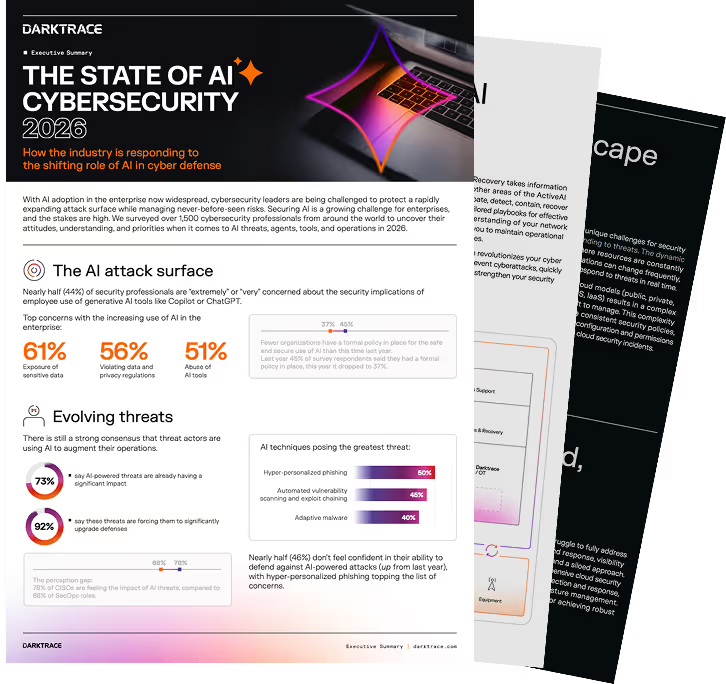
The State of AI Cybersecurity 2026

Darktrace asked over 1,500 security leaders about how they’re navigating rapid technology shifts and challenges AI presents in cybersecurity

Inside the SOC
Darktrace cyber analysts are world-class experts in threat intelligence, threat hunting and incident response, and provide 24/7 SOC support to thousands of Darktrace customers around the globe. Inside the SOC is exclusively authored by these experts, providing analysis of cyber incidents and threat trends, based on real-world experience in the field.
Written by
Ed Jennings
President and CEO

More in this series

No items found.

Blog

/

/

July 1, 2026

5 Ways AI is changing traditional security models according to modern CISOs

Default blog imageDefault blog image

The Reality of Securing AI in Motion

Traditional security tools were built for environments defined by fixed rules and predictable workflows. But AI behavior is non-deterministic. The same prompt can produce different outcomes, and risk often emerges gradually as AI behavior adapts, and permissions drift over time. This creates a constantly shifting environment where security teams are working to define control in a system that resists stability. “In AI security, yesterday's priorities can become tomorrow's blind spots. The landscape shifts that fast,” warned the SVP and Head of Technology and Cybersecurity of a real estate investment trust. Conventional approaches, which rely on establishing and maintaining a steady baseline, struggle to keep up with that level of change.

At the same time, AI adoption is accelerating across organizations, often faster than security teams can implement the controls needed to manage it. “The car is being built while it’s already on the road,” explained the CISO of a global private fund administrator. “The threats we're securing against today won't be the threats we're facing tomorrow. What kept us up three months ago looks nothing like what we're dealing with today.”

As businesses move quickly to unlock value from AI, security teams are left closing gaps in real time, while also facing adversaries who are using AI to make their attacks more scalable, adaptive, and difficult to detect. In this recent roundtable discussion of CISOs and security leaders, five themes emerged around AI cyber risk.  

1. AI agents with human access but no human judgment

In Darktrace’s 2026 State of AI Cybersecurity report, 96% of the surveyed security professionals agree that AI significantly improves the speed and efficiency with which they work. Yet, 92% admitted that they’re concerned with the security implications of the use of AI agents across their workforce.

AI agents now operate with human-level permissions across systems, acting at machine speed, orchestrating actions across platforms, and making decisions without the judgment or caution a person would apply. Unlike human users, they cannot be expected to pause and question whether a given action is appropriate.

Their identities are also difficult to inventory, govern, and audit. As agents become easier to deploy than legacy IT systems ever were, organizations are quickly losing track of what is running, what it has access to, and what it is doing. This creates a growing class of highly privileged, autonomous actors operating without the visibility or oversight that traditional identity and access controls were designed to provide.“While AI adoption is critical to running a modern business, AI alone can’t solve all our cybersecurity challenges,” said a global financial sector CISO. “We still need think critically and use human judgement. Those are two things AI can’t do.”

This lack of human judgment becomes especially risky as new architectures, such as Model Context Protocol (MCP), can expand how agents connect to data, tools, and external systems. By design, MCP enables agents to dynamically discover and interact with new resources, increasing flexibility but also introducing new pathways for unintended access, data exposure, or abuse if not properly governed.

The CISO of a fund administrator highlighted one emerging vector as an example: rogue MCP servers. “Our developers want to move quickly and bring value to the business, but technologies like these can unintentionally expose sensitive data in ways that would never have happened before.”

2. Increased digital complexity and expanded attack surface

AI activity rarely stays contained. A single prompt can trigger a chain of actions across networks, email, cloud infrastructure, SaaS platforms, endpoints, identity systems, and development environments, spanning systems that were never designed to be secured as a single, connected flow. This expands both the scale and complexity of what security teams need to monitor and defend.

Yet no single control has visibility across that entire chain. “You can’t defend effectively what you can’t see,” cautioned the private fund administrator CISO. As AI-driven activity moves fluidly across environments, gaps in coverage become inevitable, creating blind spots that attackers can exploit.

Threat actors are already capitalizing on this lack of visibility. “Threat actors have advanced their use of generative AI to launch more convincing phishing campaigns, automate social engineering, and scale attacks with greater precision down to the individual level,” said the SVP of Technology and Cybersecurity for the real estate investment trust. What was once manual and targeted can now be automated and personalized at scale, making attacks harder to detect and easier to execute.

At the same time, the pace of exploitation is accelerating. As a global CISO operating across 40+ countries described it: “Zero-day vulnerabilities are no longer zero day; it’s minus one day. By the time you get to it and address it, it’s already a problem.” By the time risk is identified, it has often already been realized.

The result is a rapidly expanding and increasingly interconnected attack surface that challenges security teams to maintain visibility, context, and control across AI-driven activity.

3. Shadow AI is already everywhere

76% of organizations now cite shadow AI as a problem, one that is spreading through organizations in ways that are hard to track and even harder to control.

Employees are experimenting with publicly available Gen AI tools. Teams are spinning up low-code automations on their own. SaaS providers are quietly embedding AI into existing products. Developers are plugging AI services directly into workflows, often without pausing to consider what that exposure means.

The result is a lack of visibility into:

  • What AI tools are being used
  • What data those tools can access
  • Where prompts and outputs are going
  • Which AI agents are interacting with enterprise systems

The SVP of Cybersecurity at a real estate investment trust described the shift: “Before, I was worried about someone sending data erroneously to their personal email. Now we have all these agents online that people are utilizing, and we’re looking at those vectors as well.” For security teams, this means operating without a complete view of how AI is being used, what it can access, and where risk may already be emerging.

4. Built-in guardrails are not enough

Organizations often assume that native AI guardrails or provider-level controls are sufficient to manage AI risk. But securing AI requires ongoing visibility, oversight, and governance, not just controls configured at deployment. "It’s a misconception that adopting AI is going to solve all your problems,” warns a global financial services CISO.

Security leaders are increasingly recognizing the limitations of these controls as:

  • Fragmented and difficult to enforce consistently across multiple AI systems, workflows, and environments
  • Ambiguous in terms of accountability due to shared responsibility for AI governance between IT, security, developers, business teams, and third-party providers
  • Limited in end-to-end oversight, leaving gaps that stretch from the initial prompt all the way through to the downstream impact of an agent's actions

Securing AI demands more than simple prompt filtering or static policy enforcement. It requires understanding intent, behavior, and context across both human and AI activity.

The next phase of cybersecurity: securing AI

To safely and responsibly adopt AI at scale, organizations need a new operational model for cybersecurity that’s capable of:

• Understanding AI behavior

• Identifying risk in real time

• Maintaining governance without slowing innovation

The CSO of a $10 billion municipal utility organization described the challenge with precision: “We have to move at the speed of innovation and risk, because both are accelerating faster than ever.”

Embrace AI with confidence with Darktrace / SECURE AI

Darktrace has introduced Darktrace / SECURE AI™, a new product within the Darktrace ActiveAI Security Platform™  ,designed to provide enterprise-wide security for AI by applying industry leading behavioral analysis to how prompts, agents, and AI systems are used.

Darktrace / SECURE AITM delivers real-time visibility and control across Enterprise and SaaS GenAI prompts, AI agent identities, development and production environments, and Shadow AI - detecting even subtle misuse, misconfiguration, and drift that traditional, rule-based controls simply do not understand. By interpreting context and intent across humans and machines, Darktrace enables organizations to adopt AI at scale without introducing unmanaged risk

What makes this possible is Darktrace’s decade-long maturity and expertise in behavioral understanding and AI-native cybersecurity. Achieved with Self-Learning AI that has been proven across more than 10,000 organizations, Darktrace understands what “normal” looks like for a business, across its users, systems, and now AI, so that meaningful deviations can be detected and acted on before they become incidents.

With one CISO describing Darktrace’s Self-Learning AI as “a leap forward compared to other tools” and another as a “force multiplier,” the technology can interpret ambiguous interactions, understand how access accumulates over time, and recognize when behavior, human or machine, begins to drift.

“Strategically, we’re looking to gain more visibility into how AI is operating across the environment and achieve greater control over what AI should be allowed to access and do,” shared the CISO at a private fund administrator.  

“What I’ve seen from Darktrace / SECURE AI is extremely promising. I have tremendous confidence in Darktrace’s vision for where this is headed and its ability to execute on this new solution.”

Continue reading
About the author
The Darktrace Community

Blog

/

Email

/

June 29, 2026

How Darktrace Transformed Cybersecurity at Our Health Center: A CIO’s Perspective

Default blog imageDefault blog image

How Darktrace Transformed Cybersecurity at Our Health Center: A CIO’s Perspective

In my role as CIO, I bring years of experience leading IT for healthcare organizations. I’ve seen firsthand the unique cybersecurity challenges that nonprofit health centers face: limited budgets, small IT teams, and the constant pressure to prioritize patient care over technology investments. Yet, the threat landscape for health is relentless, and the stakes for protecting patient data and ensuring operational continuity have never been higher. It’s a balancing act.

The search for a better solution

Like many nonprofits, organizations I work at start with Microsoft’s security stack. The discounted pricing for nonprofits makes it an obvious choice, and Microsoft Defender provided a solid foundation for endpoint and email security. However, I quickly realized that relying on a single vendor, even one as robust as Microsoft, left gaps in our defenses. Cybersecurity is never one-size-fits-all, which is why my preference was to layer an additional solution on top of our native security to improve our security posture.

Teams needed a solution that could layer seamlessly on top of Microsoft, without adding complexity or draining limited resources. That’s when I found Darktrace. I had heard of their reputation after seeing how other organizations used Darktrace to secure their infrastructure and was impressed by their AI-native, agentless approach and agreed to a proof of value (POV).

Our goal was to elavate Microsoft with an additional layer of intelligence- one that could seamlessly integrate, operate autonomously, and support a small team without increasing overhead. We turned to Darktrace because its AI-native, agentless approach offered a fundamentally different way to detect and respond to threats, learning our environment in real time and filling gaps that traditional tools can miss. With a quick POV, we were able to validate how effectively Darktrace works alongside Microsoft to deliver a more complete and resilient security architecture.

Why Darktrace stood out

From the start, Darktrace differentiated itself in several critical ways:

  • Deep visibility: Unlike other solutions that rely simply on host-based monitoring with endpoint agents, Darktrace operates passively at the network layer and integrates via APIs for email and identity security. This gave full visibility into network traffic that we previously didn’t have, going beyond our existing endpoint-based tools without adding additional maintenance overhead for our small IT team.
  • AI-native from the ground up: Darktrace wasn’t just layering AI on top of an existing product; it was built with AI at its core. Their autonomous detection and response to threats immediately reduced the need for constant human supervision. In a world where cyber-attacks are increasingly sophisticated and subtle, having an AI that learns our environment and adapts in real time is invaluable.
  • Comprehensive coverage: We started with a POV focused on email security, but quickly expanded to full deployment across our entire infrastructure. Darktrace’s products now protect our email, network, and identity layers, providing visibility and defense against lateral movement and abnormal behavior that traditional tools often miss.

Integration and workflow: Smooth and simple

One of the most impressive aspects of Darktrace is how easy it was to integrate into an existing environment. For network security, it was as simple as plugging an appliance into our top-of-rack switch – no downtime, no complex configuration. For email and identity, API integrations meant we could be up and running in hours, not weeks.

This simplicity extended to day-to-day operations. Our IT team received regular security reports, and any time we had questions or needed to adjust policies, Darktrace’s support team was there with white-glove service. Their responsiveness- even in the middle of the night- gave us confidence that we had true partners, not just a vendor.

Real-world impact: Threats stopped, time saved

The results spoke for themselves. During the time with Darktrace, I did not experience any security incidents. The team slept better at night knowing that Darktrace was monitoring for anomalies and proactively blocking suspicious activity, alerting us even before we noticed anything was wrong.

A memorable example was during an Electronic Health Record (EHR) upgrade, when my team forgot to adjust the policy in advance. Darktrace’s autonomous response was so effective that it blocked our upgrade activities- proof that nothing, not even internal changes, could slip by unnoticed. This level of vigilance meant that ransomware, data exfiltration attempts, or insider threats would be detected and contained before causing harm.

While I can’t share specific ROI numbers, the value was clear: we’ve avoided costly breaches, reduced the time spent investigating alerts, and eliminated the performance drag of agent-based tools. With Darktrace layered on top of Microsoft, I’ve hit the right balance of maximum protection with minimal spending. The cost of Darktrace / EMAIL was competitive, especially when factoring in the included Managed Detection and Response (MDR) service, which provides expert human oversight on top of the AI.

Key differentiators over the competition

  • Extending visibility beyond the endpoint: Traditional host-based monitoring solutions, such as EDR, play a critical role in securing individual devices. By adding a network detection and response (NDR) layer, we gained visibility into activity across our wider digital environment, surfacing threats that move laterally, operate between devices, or bypass endpoint controls. Darktrace also stood out for its ability to learn our normal patterns of behavior and identify subtle deviations in real time, not just known indicators of compromise. Because this is delivered through passive, non-disruptive monitoring, we were able to strengthen our defenses without adding complexity or impacting performance.
  • Layered security without complexity: Darktrace elevated our Microsoft foundation without creating conflicts or requiring us to disable existing protections. This layered approach maximized our security posture without adding operational burden.
  • Expert partnership: Beyond technology, Darktrace’s team acted as true partners, guiding us through deployment, providing ongoing support, and helping us interpret findings. This partnership was as valuable as the technology itself.

Advice for other nonprofits

If you’re an IT leader in a nonprofit, my advice is simple: look for solutions that are easy to deploy, intelligent in their response, and cost-effective. Don’t settle for more endpoint based tools that overlap with what you already have. Seek out a layered approach that covers your blind spots – especially at the network and email layers- at a price point that suits your organization.

Most importantly, don’t be afraid to evaluate new solutions. Even if you’re inundated with vendor pitches, you owe it to your organization to explore options that could save you time, money, and sleepless nights.

For organizations I work at, combining Microsoft’s security stack with Darktrace’s AI-native, platform struck the right balance between protection and practicality. We gained enterprise-grade security without sacrificing performance or stretching our budget. In the end, that meant more resources for what matters most: delivering care to our patients. If you’re facing similar challenges, I encourage you to consider how Darktrace could transform your security posture, and give your team the peace of mind they deserve.

For the organization I work in, combining Microsoft with Darktrace delivered a clear step-change in our security posture. Microsoft provided the foundation, while Darktrace’s behavioral intelligence added visibility into the unknown, surfacing emerging threats based on deviations in real-time activity, not just known indicators.

The result was enterprise-grade protection without added overhead, allowing us to stay focused on patient outcomes, not security operations. For organizations facing similar pressures, this layered approach offers a smarter, more efficient path to securing modern environments.

Continue reading
About the author
Mice Chen
Chief Information Security Officer
Your data. Our AI.
Elevate your network security with Darktrace AI