ブログ
/
AI
/
April 16, 2026

ビヘイビアAIがMythosへの答えである理由

AIはパッチ適用が追い付かない速さでサイバー攻撃を加速させており、脆弱性の発見と修復の間のギャップは拡大しています。 このブログでは、なぜ予防第一のセキュリティではもはやAI駆動の脅威に追いつけないのかを解説します。 また、ダークトレースのビヘイビアAIによって、脆弱性が不明または未修正の場合でも、組織は攻撃を即座に検知し封じ込められることを説明します。
Inside the SOC
Darktrace cyber analysts are world-class experts in threat intelligence, threat hunting and incident response, and provide 24/7 SOC support to thousands of Darktrace customers around the globe. Inside the SOC is exclusively authored by these experts, providing analysis of cyber incidents and threat trends, based on real-world experience in the field.
Written by
Ed Jennings
President and CEO
Default blog imageDefault blog imageDefault blog imageDefault blog imageDefault blog imageDefault blog image
16
Apr 2026

パッチ/予防セキュリティモデルをAIが崩壊させる

先週、Anthropicが強力な新しいAIモデル、Claude Mythosを開発したというニュースにより、ビジネス界は大きく揺れ動きました。Claude MythosはITシステムの欠陥を暴露するその能力により、かつてないリスクをもたらすからです。  

Mythosであれ、火曜日に発表されたばかりのOpenAIのGPT-5.4-Cyberであれ、超強力なAIモデルがハッカーの手に渡れば、彼らはほとんどの企業が防御できるよりもはるかに速い、マシンスピードで攻撃を実行できるようになります。このニュースはすべてのリーダーにとって厳しい現実を浮き彫りにしています:つまり穴を塞ぐだけでは、現代のサイバー攻撃に対する十分な対策とはならないのです。現在使用しているソフトウェアはすでに脆弱であると想定しなければなりません。LLMは脆弱性を見つけるのが非常に得意ですが、それを確実に修正するのはかなり苦手です。

Project Glasswing のメンバーによれば、パッチの適用には数ヶ月から数年かかることがあるといいます。その作業が行われている間、まだ発見されていないゼロデイ攻撃やセキュリティホールから企業を保護しなければなりません。

今日のほとんどのサイバーセキュリティ戦略は、私たちが毎日摂取するマルチビタミンのサプリのように構築されています。広範囲で、予防的であり、時間をかけてシステムを全体的に健康に保つことを目的としています。パッチを定期的に適用すること。ソフトウェアを更新すること。既知の脆弱性を減らすこと。それは必要であり、規律であり、基盤です。しかしそれはまた、リスクがよく知られ定義されており、サイクルが予測可能であり、管理可能なペースで露出が進行する世界のために作られたものです。

このモデルがもう成立しないとしたらどうなるでしょうか?

AI によるサイバーアドバンテージ:ビヘイビアAI

MythosのようなAIシステムによって暴かれた脆弱性は、「マルチビタミン」で対応できるようなよく理解されたリスクではありません。それらは一時的な、急速に発生する侵入ポイントであり、エクスプロイトに十分な短い期間だけ存在します。

このような環境において、予防だけでは不十分です。もっとビタミンを摂ればよいのではなく、必要なのは鎮痛剤です。サイバーセキュリティの未来は、ベースラインの状態をどれだけ良好に維持できるかによって決まるのではありません。何かが壊れたときにどれだけ迅速に対応できるかによって決まるのです、そして一秒一秒が重要になります。

ビヘイビアAIが企業に持続可能なサイバー優位性をもたらすことができるのは、そのためです。攻撃者の姿を見極めようとするのではなく、それぞれの企業のデジタルエコシステム全体にとっての「正常」がどのようなものかを学習します。  

それがビヘイビアAIの仕組みです。自己、つまり組織にとっての正常を理解し、実際には攻撃の初期段階かもしれない、正常からの逸脱を見つけることができます。

サイバーセキュリティへのダークトレースのアプローチ

ダークトレースでは、英国ケンブリッジのAI Research Centreで開発されたビヘイビアAIサイバーセキュリティ技術により、10,000社の顧客を守っています。

Darktraceの基盤となる考え方は、攻撃はきちんとラベル付けされて到来するわけではなく、最も重大な脅威はしばしばシグネチャ、インジケータ、公開情報が追いつくよりも前に現れる、という理解です。  

私たちのAIアルゴリズムは、それぞれの組織個別のビジネスデータからリアルタイムで学習し、あらゆる個人およびあらゆるアセットにとって何が通常であるか、および組織内のデータの流れを理解します。組織のデジタルエコシステム全体の「正常」を継続的に理解することにより、Darktraceは未知の脆弱性や侵害されたサプライチェーン依存関係から発生する脅威を特定し、封じ込めます。これにより、攻撃をマシンスピードで自律的に阻止します。  

新手の脅威に対するセキュリティ

Darktraceは、AIが攻撃を加速するだけではなく、その発生の仕方を根本的に変える世界に対応できるよう構築されています。私たちのAIが非常に独特であることは、サイバー脅威を脆弱性の公開以前に何度も特定していることで実証されています。これには2025年に発生したIvantiの重大な脆弱性や、国家が支援する脅威アクターによるSAP NetWeaverのエクスプロイトなどが含まれています。

AIが脆弱性の発見と悪用の方法を変貌させていくなかで、サイバーセキュリティは既知の欠陥のリストよりももっと耐久性のあるものに基づく必要があります。それには組織自体をリアルタイムで理解することが必要になります。つまり何がその組織に相応しく、何が相応しくないか、そして何を直ちに阻止しなければならないかです。

リーダーが今すぐするべきこと

リーダーにとっての優先課題もこの状況に応じてシフトさせなければなりません。

まず、未知の脆弱性をエッジケースとして扱うのをやめることです。AI駆動の脆弱性探索により、これはごく普通のことになります。既知の欠陥、シグネチャ、脅威インテリジェンスを中心に構築されたセキュリティプログラムは、リアルタイムで作戦を展開する攻撃者に常に遅れをとることになります。

次に、組織にとって実際に何が正常なのかについての理解を強く求めることです。脅威が全く新しいものである場合、ラベルは無意味です。最も早期かつ最も信頼できる危険シグナルは、異常な動作です。つまりシステム、ユーザー、データフローが期待されていた動作から突然逸れたときです。逸脱が発生したときにそれを知ることができなければ、最も重大な局面で目を瞑っているのと同じです。

最後に、次の深刻なインシデントは修復の手順が入手可能になる前に起こるだろうということを想定することです。その最初の数分間、数時間の間に何が起こるかを自問してください。レジリエンスを維持する組織は、脆弱性の公開サイクルを待っている組織ではありません。新たな脅威の発生を自律的に特定し進行を封じ込めることができる組織です。

これがAIによって作られる世界でのサイバーセキュリティの現実です。パッチと予防も重要な基盤であることに変わりはありません。しかし、今アドバンテージを持っているのは予測不能な自体の発生に即座に対応できる組織です。

ビヘイビアAIは既知の脅威だけではなく、AIが次に発見する脅威にも対応できるセキュリティです。

[related-resource]

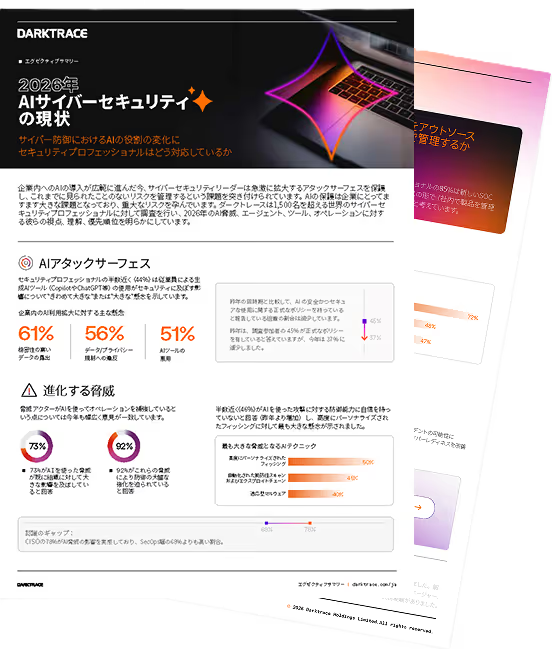
2026年AIサイバーセキュリティの現状

ダークトレースは 1,500 名を超えるセキュリティリーダーを対象に、急激なテクノロジーの変化への対応とサイバーセキュリティにAIがもたらす問題について調査を行いました。レポートをお読みになり最新の動向をご確認ください。

Inside the SOC
Darktrace cyber analysts are world-class experts in threat intelligence, threat hunting and incident response, and provide 24/7 SOC support to thousands of Darktrace customers around the globe. Inside the SOC is exclusively authored by these experts, providing analysis of cyber incidents and threat trends, based on real-world experience in the field.
Written by
Ed Jennings
President and CEO

More in this series

No items found.

Blog

/

Network

/

May 6, 2026

When Trust Becomes the Attack Surface: Supply-Chain Attacks in an Era of Automation and Implicit Trust

Default blog imageDefault blog image

Software supply-chain attacks in 2026

Software supply-chain attacks now represent the primary threat shaping the 2026 security landscape. Rather than relying on exploits at the perimeter, attackers are targeting the connective tissue of modern engineering environments: package managers, CI/CD automation, developer systems, and even the security tools organizations inherently trust.

These incidents are not isolated cases of poisoned code. They reflect a structural shift toward abusing trusted automation and identity at ecosystem scale, where compromise propagates through systems designed for speed, not scrutiny. Ephemeral build runners, regardless of provider, represent high‑trust, low‑visibility execution zones.

The Axios compromise and the cascading Trivy campaign illustrate how quickly this abuse can move once attacker activity enters build and delivery workflows. This blog provides an overview of the latest supply chain and security tool incidents with Darktrace telemetry and defensive actions to improve organizations defensive cyber posture.

1. Why the Axios Compromise Scaled

On 31 March 2026, attackers hijacked the npm account of Axios’s lead maintainer, publishing malicious versions 1.14.1 and 0.30.4 that silently pulled in a malicious dependency, plain‑crypto‑[email protected]. Axios is a popular HTTP client for node.js and  processes 100 million weekly downloads and appears in around 80% of cloud and application environments, making this a high‑leverage breach [1].

The attack chain was simple yet effective:

  • A compromised maintainer account enabled legitimate‑looking malicious releases.
  • The poisoned dependency executed Remote Access Trojans (RATs) across Linux, macOS and Windows systems.
  • The malware beaconed to a remote command-and-control (C2) server every 60 seconds in a loop, awaiting further instructions.
  • The installer self‑cleaned by deleting malicious artifacts.

All of this matters because a single maintainer compromise was enough to project attacker access into thousands of trusted production environments without exploiting a single vulnerability.

A view from Darktrace

Multiple cases linked with the Axios compromise were identified across Darktrace’s customer base in March 2026, across both Darktrace / NETWORK and Darktrace / CLOUD deployments.

In one Darktrace / CLOUD deployment, an Azure Cloud Asset was observed establishing new external HTTP connectivity to the IP 142.11.206[.]73 on port 8000. Darktrace deemed this activity as highly anomalous for the device based on several factors, including the rarity of the endpoint across the network and the unusual combination of protocol and port for this asset. As a result, the triggering the "Anomalous Connection / Application Protocol on Uncommon Port" model was triggered in Darktrace / CLOUD. Detection was driven by environmental context rather than a known indicator at the time. Subsequent reporting later classified the destination as malicious in relation to the Axios supply‑chain compromise, reinforcing the gap that often exists between initial attacker activity and the availability of actionable intelligence. [5]

Additionally, shortly before this C2 connection, the device was observed communicating with various endpoints associated with the NPM package manager, further reinforcing the association with this attack.

Darktrace’s detection of the unusual external connection to 142.11[.]206[.]73 via port 8000.  
Figure 1: Darktrace’s detection of the unusual external connection to 142.11[.]206[.]73 via port 8000.  

Within Axios cases observed within Darktrace / NETWORK customer environments, activity generally focused on the use of newly observed cURL user agents in outbound connections to the C2 URL sfrclak[.]com/6202033, alongside the download of malicious files.

In other cases, Darktrace / NETWORK customers with Microsoft Defender for Endpoint integration received alerts flagging newly observed system executables and process launches associated with C2 communication.

A Security Integration Alert from Microsoft Defender for Endpoint associated with the Axios supply chain attack.
Figure 2: A Security Integration Alert from Microsoft Defender for Endpoint associated with the Axios supply chain attack.

2. Why Trivy bypassed security tooling trust

Between late February and March 22, 2026, the threat group TeamPCP leveraged credentials from a previous incident to insert malicious artifacts across Trivy’s distribution ecosystem, including its CI automation, release binaries, Visual Studio Code extensions, and Docker container images [2].

While public reporting has emphasized GitHub Actions, Darktrace telemetry highlights attacker execution within CI/CD runner environments, including ephemeral build runners. These execution contexts are typically granted broad trust and limited visibility, allowing malicious activity within build automation to blend into expected operational workflows, regardless of provider.

This was a coordinated multi‑phase attack:

  • 75 of 76  of trivy-action tags and all setup‑trivy tags were force‑pushed to deliver a malicious payload.
  • A malicious binary (v0.69.4) was distributed across all major distribution channels.
  • Developer machines were compromised, receiving a persistent backdoor and a self-propagating worm.
  • Secrets were exfiltrated at scale, including SSH keys, Kuberenetes tokens, database passwords, and cloud credentials across Amazon Web Service (AWS), Azure, and Google Cloud Platform (GCP).

Within Darktrace’s customer base, an AWS EC2 instance monitored by Darktrace / CLOUD  appeared to have been impacted by the Trivy attack. On March 19, the device was seen connecting to the attacker-controlled C2 server scan[.]aquasecurtiy[.]org (45.148.10[.]212), triggering the model 'Anomalous Server Activity / Outgoing from Server’ in Darktrace / CLOUD.

Despite this limited historical context, Darktrace assessed this activity as suspicious due to the rarity of the destination endpoint across the wider deployment. This resulted in the triggering of a model alert and the generation of a Cyber AI Analyst incident to further analyze and correlate the attack activity.

TeamPCP’s continued abused of GitHub Actions against security and IT tooling has also been observed more recently in Darktrace’s customer base. On April 22, an AWS asset was seen connecting to the C2 endpoint audit.checkmarx[.]cx (94.154.172[.]43). The timing of this activity suggests a potential link to a malicious Bitwarden package distributed by the threat actor, which was only available for a short timeframe on April 22. [4][3]

Figure 3: A model alert flagging unusual external connectivity from the AWS asset, as seen in Darktrace / CLOUD .

While the Trivy activity originated within build automation, the underlying failure mode mirrors later intrusions observed via management tooling. In both cases, attackers leveraged platforms designed for scale and trust to execute actions that blended into normal operational noise until downstream effects became visible.

Quest KACE: Legacy Risk, Real Impact

The Quest KACE System Management Appliance (SMA) incident reinforces that software risk is not confined to development pipelines alone. High‑trust infrastructure and management platforms are increasingly leveraged by adversaries when left unpatched or exposed to the internet.

Throughout March 2026, attackers exploited CVE 2025-32975 to authentication on outdated, internet-facing KACE appliances, gaining administrative control and pushing remote payloads into enterprise environments. Organizations still running pre-patch versions effectively handed adversaries a turnkey foothold, reaffirming a simple strategic truth: legacy management systems are now part of the supply-chain threat surface, and treating them as “low-risk utilities” is no longer defensible [3].

Within the Darktrace customer base, a potential case was identified in mid-March involving an internet-facing server that exhibited the use of a new user agent alongside unusual file downloads and unexpected external connectivity. Darktrace identified the device downloading file downloads from "216.126.225[.]156/x", "216.126.225[.]156/ct.py" and "216.126.225[.]156/n", using the user agents, "curl/8.5.0" & "Python-urllib/3.9".

The timeframe and IoCs observed point towards likely exploitation of CVE‑2025‑32975. As with earlier incidents, the activity became visible through deviations in expected system behavior rather than through advance knowledge of exploitation or attacker infrastructure. The delay between observed exploitation and its addition to the Known Exploited Vulnerabilities (KEV) catalogue underscores a recurring failure: retrospective validation cannot keep pace with adversaries operating at automation speed.

The strategic pattern: Ecosystem‑scale adversaries

The Axios and Trivy compromises are not anomalies; they are signals of a structural shift in the threat landscape. In this post-trust era, the compromise of a single maintainer, repository token, or CI/CD tag can produce large-scale blast radiuses with downstream victims numbering in the thousands. Attackers are no longer just exploiting vulnerabilities; they are exploiting infrastructure privileges, developer trust relationships, and automated build systems that the industry has generally under secured.

Supply‑chain compromise should now be treated as an assumed breach scenario, not a specialized threat class, particularly across build, integration, and management infrastructure. Organizations must operate under the assumption that compromise will occur within trusted software and automation layers, not solely at the network edge or user endpoint. Defenders should therefore expect compromise to emerge from trusted automation layers before it is labelled, validated, or widely understood.

The future of supply‑chain defense lies in continuous behavioral visibility, autonomous detection across developer and build environments, and real‑time anomaly identification.

As AI increasingly shapes software development and security operations, defenders must assume adversaries will also operate with AI in the loop. The defensive edge will come not from predicting specific compromises, but from continuously interrogating behavior across environments humans can no longer feasibly monitor at scale.

Credit to Nathaniel Jones (VP, Security & AI Strategy, FCISCO), Emma Foulger (Global Threat Research Operations Lead), Justin Torres (Senior Cyber Analyst), Tara Gould (Malware Research Lead)

Edited by Ryan Traill (Content Manager)

Appendices

References:

1)         https://www.infosecurity-magazine.com/news/hackers-hijack-axios-npm-package/

2)         https://thehackernews.com/2026/03/trivy-hack-spreads-infostealer-via.html

3)         https://thehackernews.com/2026/03/hackers-exploit-cve-2025-32975-cvss-100.html

4)         https://www.endorlabs.com/learn/shai-hulud-the-third-coming----inside-the-bitwarden-cli-2026-4-0-supply-chain-attack

5)         https://socket.dev/blog/axios-npm-package-compromised?trk=public_post_comment-text

IoCs

- 142.11.206[.]73 – IP Address – Axios supply chain C2

- sfrclak[.]com – Hostname – Axios supply chain C2

- hxxp://sfrclak[.]com:8000/6202033 - URI – Axios supply chain payload

- 45.148.10[.]212 – IP Address – Trivy supply chain C2

- scan.aquasecurtiy[.]org – Hostname - Trivy supply chain C2

- 94.154.172[.]43 – IP Address - Checkmarx/Bitwarden supply chain C2

- audit.checkmarx[.]cx – Hostname - Checkmarx/Bitwarder supply chain C2

- 216.126.225[.]156 – IP Address – Quest KACE exploitation C2

- 216.126.225[.]156/32 - URI – Possible Quest KACE exploitation payload

- 216.126.225[.]156/ct.py - URI - Possible Quest KACE exploitation payload

- 216.126.225[.]156/n - URI - Possible Quest KACE exploitation payload

- 216.126.225[.]156/x - URI - Possible Quest KACE exploitation payload

- e1ec76a0e1f48901566d53828c34b5dc – MD5 - Possible Quest KACE exploitation payload

- d3beab2e2252a13d5689e9911c2b2b2fc3a41086 – SHA1 - Possible Quest KACE exploitation payload

- ab6677fcbbb1ff4a22cc3e7355e1c36768ba30bbf5cce36f4ec7ae99f850e6c5 – SHA256 - Possible Quest KACE exploitation payload

- 83b7a106a5e810a1781e62b278909396 – MD5 - Possible Quest KACE exploitation payload

- deb4b5841eea43cb8c5777ee33ee09bf294a670d – SHA1 - Possible Quest KACE exploitation payload

- b1b2f1e36dcaa36bc587fda1ddc3cbb8e04c3df5f1e3f1341c9d2ec0b0b0ffaf – SHA256 - Possible Quest KACE exploitation payload

Darktrace Model Detections

Anomalous Connection / Application Protocol on Uncommon Port

Anomalous Server Activity / Outgoing from Server

Anomalous Connection / New User Agent to IP Without Hostname

Anomalous File / EXE from Rare External Location

Anomalous File / Script from Rare External Location

Anomalous Server Activity / New User Agent from Internet Facing System

Anomalous Server Activity / Rare External from Server

Antigena / Network / External Threat / Antigena Suspicious File Block

Antigena / Network / External Threat / Antigena Suspicious File Pattern of Life Block

Device / New User Agent

Device / Internet Facing Device with High Priority Alert

Anomalous File / New User Agent Followed By Numeric File Download

Continue reading
About the author
Nathaniel Jones
VP, Security & AI Strategy, Field CISO

Blog

/

Email

/

May 6, 2026

How email-delivered prompt injection attacks can target enterprise AI – and why it matters

Default blog imageDefault blog image

What are email-delivered prompt injection attacks?

As organizations rapidly adopt AI assistants to improve productivity, a new class of cyber risk is emerging alongside them: email-delivered AI prompt injection. Unlike traditional attacks that target software vulnerabilities or rely on social engineering, this is the act of embedding malicious or manipulative instructions into content that an AI system will process as part of its normal workflow. Because modern AI tools are designed to ingest and reason over large volumes of data, including emails, documents, and chat histories, they can unintentionally treat hidden attacker-controlled text as legitimate input.  

At Darktrace, our analysis has shown an increase of 90% in the number of customer deployments showing signals associated with potential prompt injection attempts since we began monitoring for this type of activity in late 2025. While it is not always possible to definitively attribute each instance, internal scoring systems designed to identify characteristics consistent with prompt injection have recorded a growing number of high-confidence matches. The upward trend suggests that attackers are actively experimenting with these techniques.

Recent examples of prompt injection attacks

Two early examples of this evolving threat are HashJack and ShadowLeak, which illustrate prompt injection in practice.

HashJack is a novel prompt injection technique discovered in November 2025 that exploits AI-powered web browsers and agentic AI browser assistants. By hiding malicious instructions within the URL fragment (after the # symbol) of a legitimate, trusted website, attackers can trick AI web assistants into performing malicious actions – potentially inserting phishing links, fake contact details, or misleading guidance directly into what appears to be a trusted AI-generated output.

ShadowLeak is a prompt injection method to exfiltrate PII identified in September 2025. This was a flaw in ChatGPT (now patched by OpenAI) which worked via an agent connected to email. If attackers sent the target an email containing a hidden prompt, the agent was tricked into leaking sensitive information to the attacker with no user action or visible UI.

What’s the risk of email-delivered prompt injection attacks?

Enterprise AI assistants often have complete visibility across emails, documents, and internal platforms. This means an attacker does not need to compromise credentials or move laterally through an environment. If successful, they can influence the AI to retrieve relevant information seamlessly, without the labor of compromise and privilege escalation.

The first risk is data exfiltration. In a prompt injection scenario, malicious instructions may be embedded within an ordinary email. As in the ShadowLeak attack, when AI processes that content as part of a legitimate task, it may interpret the hidden text as an instruction. This could result in the AI disclosing sensitive data, summarizing confidential communications, or exposing internal context that would otherwise require significant effort to obtain.

The second risk is agentic workflow poisoning. As AI systems take on more active roles, prompt injection can influence how they behave over time. An attacker could embed instructions that persist across interactions, such as causing the AI to include malicious links in responses or redirect users to untrusted resources. In this way, the attacker inserts themselves into the workflow, effectively acting as a man-in-the-middle within the AI system.

Why can’t other solutions catch email-delivered prompt injection attacks?

AI prompt injection challenges many of the assumptions that traditional email security is built on. It does not fit the usual patterns of phishing, where the goal is to trick a user into clicking a link or opening an attachment.  

Most security solutions are designed to detect signals associated with user engagement: suspicious links, unusual attachments, or social engineering cues. Prompt injection avoids these indicators entirely, meaning there are fewer obvious red flags.

In this case, the intention is actually the opposite of user solicitation. The objective is simply for the email to be delivered and remain in the inbox, appearing benign and unremarkable. The malicious element is not something the recipient is expected to engage with, or even notice.

Detection is further complicated by the nature of the prompts themselves. Unlike known malware signatures or consistent phishing patterns, injected prompts can vary widely in structure and wording. This makes simple pattern-matching approaches, such as regex, unreliable. A broad rule set risks generating large numbers of false positives, while a narrow one is unlikely to capture the diversity of possible injections.

How does Darktrace catch these types of attacks?

The Darktrace approach to email security more generally is to look beyond individual indicators and assess context, which also applies here.  

For example, our prompt density score identifies clusters of prompt-like language within an email rather than just single occurrences. Instead of treating the presence of a phrase as a blocking signal, the focus is on whether there is an unusual concentration of these patterns in a way that suggests injection. Additional weighting can be applied where there are signs of obfuscation. For example, text that is hidden from the user – such as white font or font size zero – but still readable by AI systems can indicate an attempt to conceal malicious prompts.

This is combined with broader behavioral signals. The same communication context used to detect other threats remains relevant, such as whether the content is unusual for the recipient or deviates from normal patterns.

Ask your email provider about email-delivered AI prompt injection

Prompt injection targets not just employees, but the AI systems they rely on, so security approaches need to account for both.

Though there are clear indications of emerging activity, it remains to be seen how popular prompt injection will be with attackers going forward. Still, considering the potential impact of this attack type, it’s worth checking if this risk has been considered by your email security provider.

Questions to ask your email security provider

  • What safeguards are in place to prevent emails from influencing AI‑driven workflows over time?
  • How do you assess email content that’s benign for a human reader, but may carry hidden instructions intended for AI systems?
  • If an email contains no links, no attachments, and no social engineering cues, what signals would your platform use to identify malicious intent?

Visit the Darktrace / EMAIL product hub to discover how we detect and respond to advanced communication threats.  

Learn more about securing AI in your enterprise.

Continue reading
About the author
Kiri Addison
Senior Director of Product
あなたのデータ × DarktraceのAI
唯一無二のDarktrace AIで、ネットワークセキュリティを次の次元へ