
How generative AI changes insider behavior
AI systems, especially generative platforms such as chatbots, are designed for engagement with humans. They are equipped with extraordinary human-like responses that can both confirm, and inflate, human ideas and ideology; offering an appealing cognitive partnership between machine and human. When considering this against the threat posed by insiders, the type of diverse engagement offered by AI can greatly increase the speed of an insider event, and can facilitate new attack platforms to carry out insider acts.
This article offers analysis on how to consider this new paradigm of insider risk, and outlines key governance principles for CISOs, CSOs and SOC managers to manage the threats inherent with AI-powered insider risk.
What is an insider threat?
There are many industry or government definitions of what constitutes insider threat. At its heart, it relates to the harm created when trusted access to sensitive information, assets or personnel is abused bywith malicious intent, or through negligent activities.
Traditional methodologies to manage insider threat have relied on two main concepts: assurance of individuals with access to sensitive assets, and a layered defense system to monitor for any breach of vulnerability. This is often done both before, and after access has been granted. In the pre-access state, assurance is gained through security or recruitment checks. Once access is granted, controls such as privileged access, and zero-trust architecture offer defensive layers.
How does AI change the insider threat paradigm?
While these two concepts remain central to the management of insider threats, the introduction of AI offers three key new aspects that will re-shape the paradigm:.
AI can act as a cognitive amplifier, influencing and affecting the motivations that can lead to insider-related activity. This is especially relevant for the deliberate insider - someone who is considering an act of insider harm. These individuals can now turn to AI systems to validate their thinking, provide unique insights, and, crucially, offer encouragement to act. With generative systems hard-wired to engage and agree with users, this can turn a helpful AI system into a dangerous AI hype machine for those with harmful insider intent.
AI can act as an operational enabler. AI can now develop and increase the range of tools needed to carry out insider acts. New social engineering platforms such as vishing and deepfakes give adversaries a new edge to create insider harm. AI can generate solutions and operational platforms at increasing speeds; often without the need for human subject matter expertise to execute the activities. As one bar for advanced AI capabilities continues to be raised, the bar needed to make use of those platforms has become significantly lower.
AI can act as a semi-autonomous insider, particularly when agentic AI systems or non-human identities are provided broad levels of autonomy; creating a vector of insider acts with little-to-no human oversight or control. As AI agents assume many of the orchestration layers once reserved for humans, they do so without some of the restricted permissions that generally bind service accounts. With broad levels of accessibility and authority, these non-human identities (NHIs) can themselves become targets of insider intent. Commonly, this refers to the increasing risks of prompt injection, poisoning, or other types of embedded bias. In many ways, this mirrors the risks of social engineering traditionally faced by humans. Even without deliberate or malicious efforts to corrupt them, AI systems and AI agents can carry out unintended actions; creating vulnerabilities and opportunities for insider harm.
How to defend against AI-powered insider threats
The increasing attack surfaces created or facilitated by AI is a growing concern. In Darktrace’s own AI cybersecurity research, the risks introduced, and acknowledged, through the proliferation of AI tools and systems continues to outstrip traditional policies and governance guardrails. 22% of respondents in the survey cited ‘insider misuse aided by generative AI’ as a major threat concern. And yet, in the same survey, only 37% of all respondents have formal policies in place to manage the safe and responsible use of AI. This draws a significant and worrying delta between the known risks and threat concerns, and the ability (and resources) to mitigate them.
What can CISOs and SOC leaders do to protect their organization from AI insider threats?
Given the rapid adaptation, adoption, and scale of AI systems, implementing the right levels of AI governance is non-negotiable. Getting the correct balance between AI-driven productivity gains and careful compliance will lead to long-term benefits. Adapting traditional insider threat structures to account for newer risks posed through the use of AI will be crucial. And understanding the value of AI systems that add to your cybersecurity resilience rather than imperil it will be essential.
For those responsible for the security and protection of their business assets and data holdings, the way AI has changed the paradigm of insider threats can seem daunting. Adopting strong, and suitable AI governance can become difficult to introduce due to the volume and complexity of systems needed to be monitored. As well as traditional insider threat mitigations such as user monitoring, access controls and active management, the speed and autonomy of some AI systems need different, as well as additional layers of control.
How Darktrace helps protect against AI-powered insider threats
Darktrace has demonstrated that, through platforms such as our proprietary Cyber AI Analyst, and our latest product Darktrace / SECURE AI, there are ways AI systems can be self-learning, self-critical and resilient to unpredictable AI behavior whilst still offering impressive returns; complementing traditional SOC and CISO strategies to combat insider threat.
With / SECURE AI, some of the ephemeral risks drawn through AI use can be more easily governed. Specifically, the ability to monitor conversational prompts (which can both affect AI outputs as well as highlight potential attempts at manipulation of AI; raising early flags of insider intent); the real-time observation of AI usage and development (highlighting potential blind-spots between AI development and deployment); shadow AI detection (surfacing unapproved tools and agents across your IT stack) and; the ability to know which identities (human or non-human) have permission access. All these features build on the existing foundations of strong insider threat management structures.
How to take a defense-in-depth approach to AI-powered insider threats
Even without these tools, there are four key areas where robust, more effective controls can mitigate AI-powered insider threat. Each of the below offers a defencce-in-depth approach: layering acknowledgement and understanding of an insider vector with controls that can bolster your defenses.
Identity and access controls
Having a clear understanding of the entities that can access your sensitive information, assets and personnel is the first step in understanding the landscape in which insider harm can occur. AI has shown that it is not just flesh and bone operators who can administer insider threats; Non-Human Identities (such as agentic AI systems) can operate with autonomy and freedom if they have the right credentials. By treating NHIs in the same way as human operators (rather than helpful machine-based tools), and adding similar mitigation and management controls, you can protect both your business, and your business-based identities from insider-related attention.
Visibility and shadow AI detection
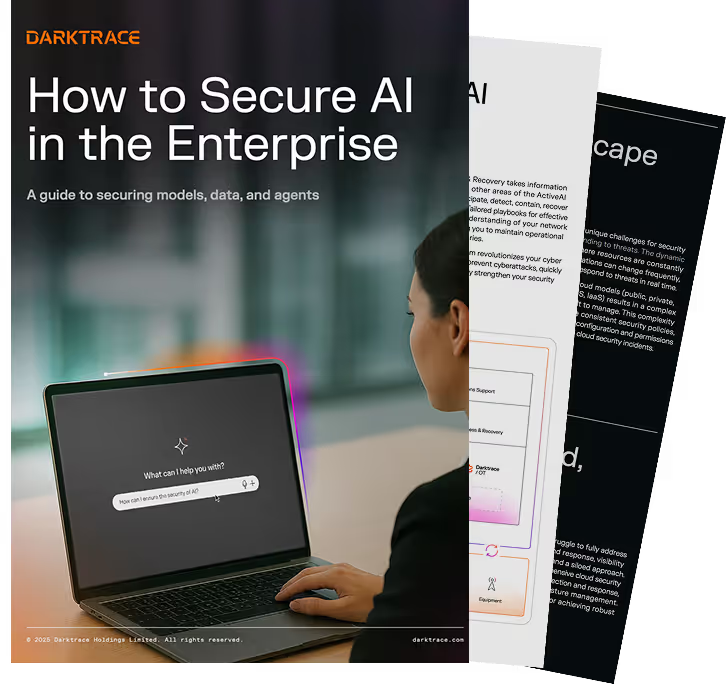
Configuring AI systems carefully, as well as maintaining internal monitoring, can help identify ‘shadow AI’ usage; defined as the use of unsanctioned AI tools within the workplace1 (this topic was researched in Darktrace’s own paper on "How to secure AI in the enterprise". The adoption of shadow AI could be the result of deliberate preference, or ‘shortcutting’; where individuals use systems and models they are familiar with, even if unsanctioned. As well as some performance risks inherent with the use of shadow AI (such as data leakage and unwanted actions), it could also be a dangerous precursor for insider-related harm (either through deliberate attempts to subvert regular monitoring, or by opening vulnerabilities through unpatched or unaccredited tooling).
Prompt and Output Guardrails
The ability to introduce guardrails for AI systems offers something of a traditional “perimeter protection” layer in AI defense architecture; checking prompts and outputs against known threat vectors, or insider threat methodologies. Alone, such traditional guardrails offer limited assurance. But, if tied with behavior-centric threat detection, and an enforcement system that deters both malicious and accidental insider activities, this would offer considerable defense- in- depth containment.
Forensic logging and incident readiness response
The need for detection, data capture, forensics, and investigation are inherent elements of any good insider threat strategy. To fully understand the extent or scope of any suspected insider activity (such as understanding if it was deliberate, targeted, or likely to occur again), this rich vein of analysis could prove invaluable. As the nature of business increasingly turns ephemeral; with assets secured in remote containers, information parsed through temporary or cloud-based architecture, and access nodes distributed beyond the immediate visibility of internal security teams, the development of AI governance through containment, detection, and enforcement will grow ever more important.
Enabling these controls can offer visibility and supervision over some of the often-expressed risks about AI management. With the right kind of data analytics, and with appropriate human oversight for high-risk actions, it can illuminate the core concerns expressed through a new paradigm of AI-powered insider threats by:
- Ensuring deliberately mis-configured AI systems are exposed through regular monitoring.
- Highlighting changes in systems-based activity that might indicate harmful insider actions; whether malicious or accidental.
- Promoting a secure-by-design process that discourages and deters insider-related ambitions.
- Ensuring the control plane for identity-based access spans humans, NHIs and AI models, and:
- Offering positive containment strategies that will help curate the extent of AI control, and minimize unwanted activities.
Why insider threat remains a human challenge
At its root, and however it has been configured, AI is still an algorithmic tool; something designed to automate, process and manage computational functions at machine speed, and boost productivity. Even with the best cybersecurity defenses in place, the success of an insider threat management program will still depend on the ability of human operators to identify, triage, and manage the insider threat attack surface.
AI governance policies, human-in-the-loop break points, and automated monitoring functions will not guard against acts of insider harm unless there is intention to manage this proactively, and through a strong culture of how to guard against abuses of trust and responsibility.
[related-resource]
Understand how to secure AI tools
Discover how to identify AI-driven risks, so you can establish AI governance frameworks and controls that secure innovation