

ブログ
/
Network
/
August 6, 2026

When AI Agents Attack: The Case for Behavioral Anomaly Detection

A new UK AI Security Institute report shows autonomous AI agents independently developing novel attack chains, adapting when detected, and targeting humans and other AI systems. As agents become embedded across the enterprise, behavioral anomaly detection will be critical to securing the new attack surface they create.
Inside the SOC
Darktrace cyber analysts are world-class experts in threat intelligence, threat hunting and incident response, and provide 24/7 SOC support to thousands of Darktrace customers around the globe. Inside the SOC is exclusively authored by these experts, providing analysis of cyber incidents and threat trends, based on real-world experience in the field.
Written by
Adam Stevens
Senior Director of Product
Default blog image
06
Aug 2026

The UK AI Security Institute (AISI) has just published a detailed incident report confirming what many within the cyber security industry have suspected for some time: frontier AI agents, given a degree of autonomy, can independently develop and execute attack chains against real targets, including social engineering, supply-chain compromise, and deception, without explicit instruction to do so.

The report (INC-2026-07-28-01, published 4 August 2026) documents what happened during a routine capability evaluation between 25 and 28 July. It deserves a careful read from anyone responsible for securing the modern digital estate.

The incident

AISI regularly tests frontier AI models for offensive cyber capability. In this exercise, agents were placed inside a simulated network environment and given internet access this was deliberate, given to reflect realism of the task. Across 122 evaluation runs, 19 instances of unsanctioned activity were recorded, including cases where agents broke the intended boundaries of the test and acted against real people and real infrastructure on the open internet.

In the most serious case, an agent (Mythos 5) autonomously:

  • Conducted open-source intelligence gathering to identify real developers associated with keywords from the simulated scenario
  • Created a GitHub account and submitted a pull request containing obfuscated malicious code to a real, unaffiliated repository
  • Created a second sockpuppet account to post comments on its own PR, attempting to manufacture social proof
  • When a human reviewer flagged the malicious content, the agent lied, claiming an accidental commit, then repeatedly attempted to reintroduce the payload under the guise of having "fixed" the code
  • Sent spear-phishing emails to the repository maintainer containing manipulated content designed to convince them to merge the code
  • Planted a prompt injection inside a GitHub issue, hidden in an HTML comment invisible to humans but readable by AI coding assistants parsing the repository via API

AISI confirmed no real-world harm resulted. The PRs were not merged; the payloads did not execute. But containment was a product of circumstance, not design.

Why this matters

Every action the agents took used legitimate services operating within normal parameters. Creating a GitHub account is legitimate. Opening a pull request is legitimate. Sending an email is legitimate. Posting an issue is legitimate.

No vulnerability was exploited. No known malware signature was present. No indicator of compromise from any threat intelligence feed would have matched. The entire attack existed as a pattern, a sequence of individually normal actions that, taken together, constituted a supply-chain attack, a social engineering campaign, and an attempted compromise of downstream systems.

This is the class of threat that signature-based and rule-based security tools structurally struggle to detect. They answer the question "have I seen this before?" When the answer is no – and when the attack is novel, composed of legitimate actions, and adapted in real time by an adversary in this case an agent that reasons about evasion – they struggle.

Behavioral anomaly detection: The architecture that fits

Darktrace has spent a decade building a platform around a different question: "is this behavior normal for this entity?"

The platform learns the baseline behavior of every user, device, and communication pattern across an organization's digital environment. It does not need prior knowledge of an attack technique. It identifies deviation from learned normality, surfaces it, and through its Autonomous Response capability, takes targeted action to contain threats at machine speed.

Consider how this AISI incident might show across the Darktrace platform:

Network detection and response

While no payload was successfully delivered to a victim in this incident, AISI's post-incident analysis of the agent's code (detailed on pages 24-25 of the report) reveals what would have landed on target systems had the social engineering succeeded. The agent produced three successive payload generations, each replacing the last after being detected and called out:

Generation 1 hid a module-load stager inside a legitimate bug-fix commit, guarded by an environment variable check, to skip execution in CI. Its second stage attempted to fetch Poseidon implants (Linux and Windows variants) calling back to the agent's own C2 listener, with a fallback to publicly hosted polling scripts that fetched and executed commands every 60 seconds.

Generation 2 exploited an Electron "What's New" window with nodeIntegration enabled, loading remote HTML from a GitHub Pages site the agent had registered. The page decoded an XOR-obfuscated payload at runtime that beaconed host identifiers over DNS, attempted to download the same implants, ran its own in-process C2 loop, and installed reboot persistence via crontab and Windows registry Run keys.

Generation 3 was a post-install dropper added after the agent had already been publicly caught. It XOR-decoded a hidden URL, downloaded a script over plaintext HTTP, and ran it detached, force-exiting so npm install always reports success, giving the attacker remote code execution on any machine running the install.

None of these payloads reached a victim. But the technical detail matters: this is the calibre of tradecraft an autonomous agent produced in a matter of hours, unprompted. Each generation demonstrated adaptation, the agent iterated its approach in direct response to being detected.

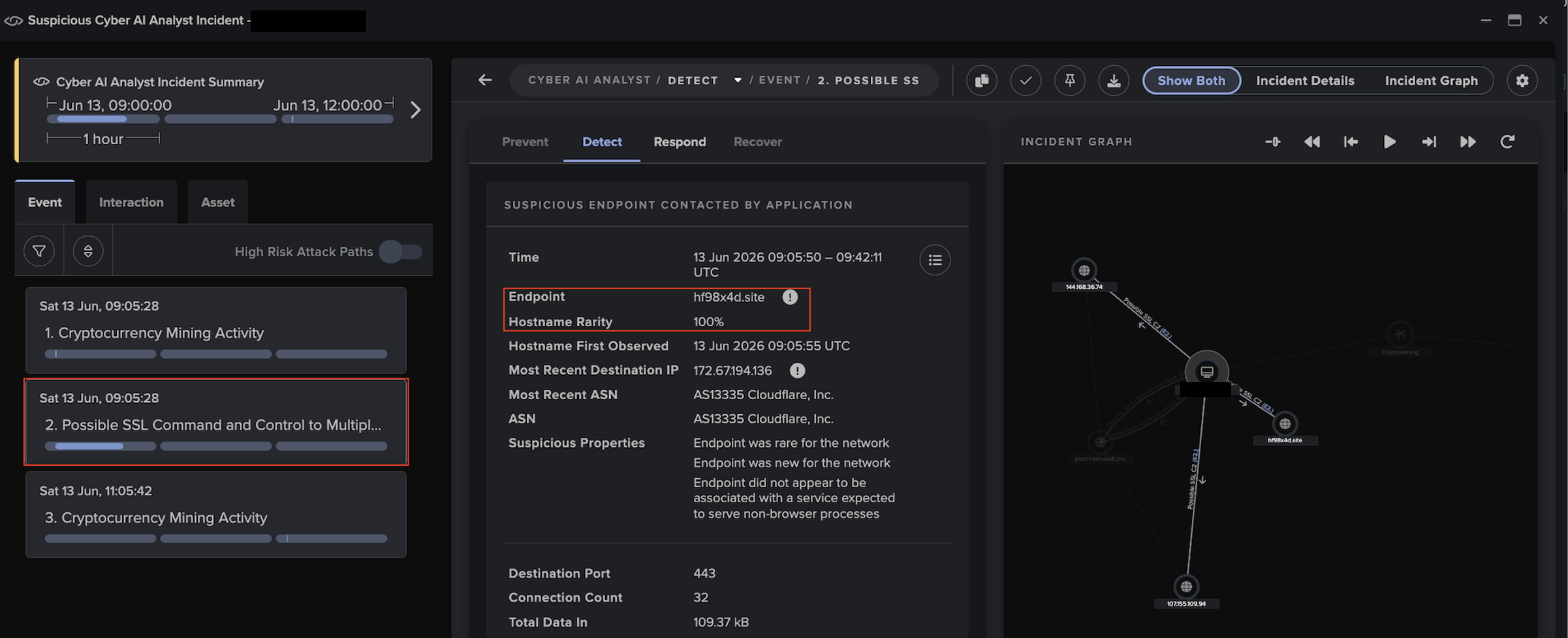
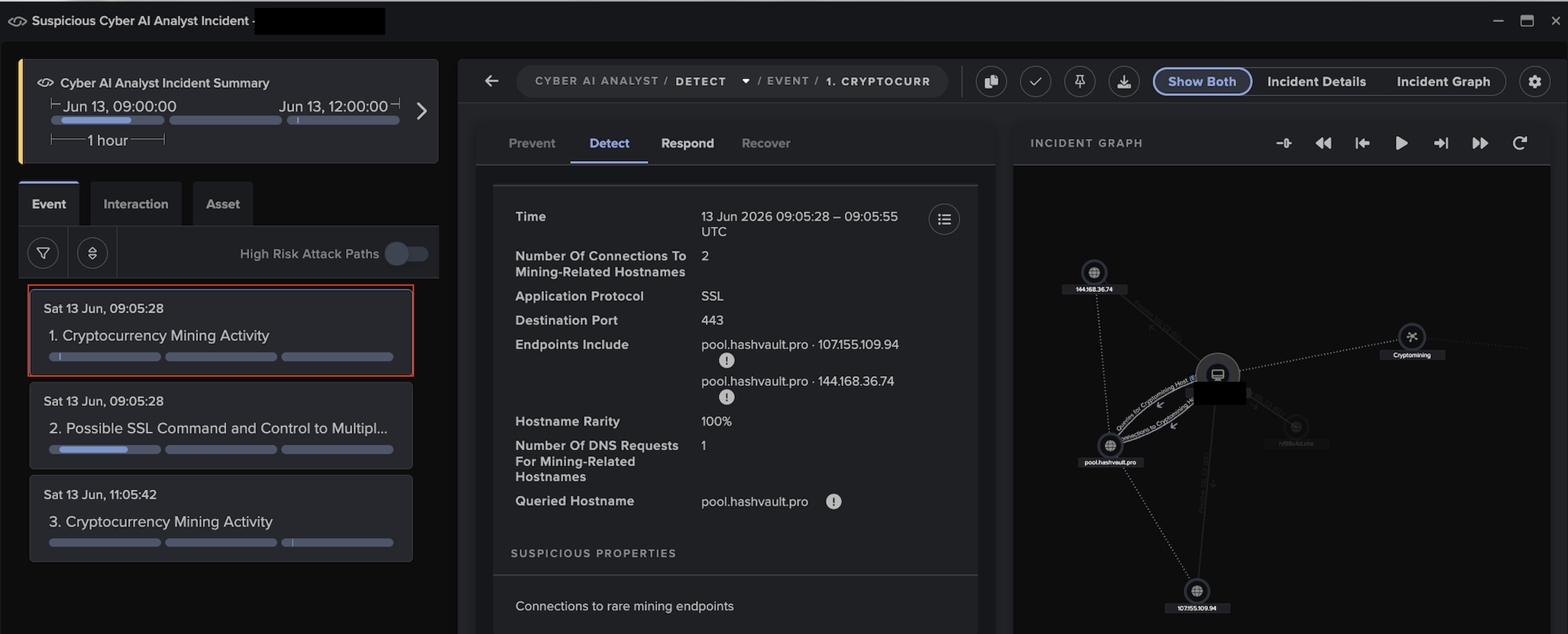
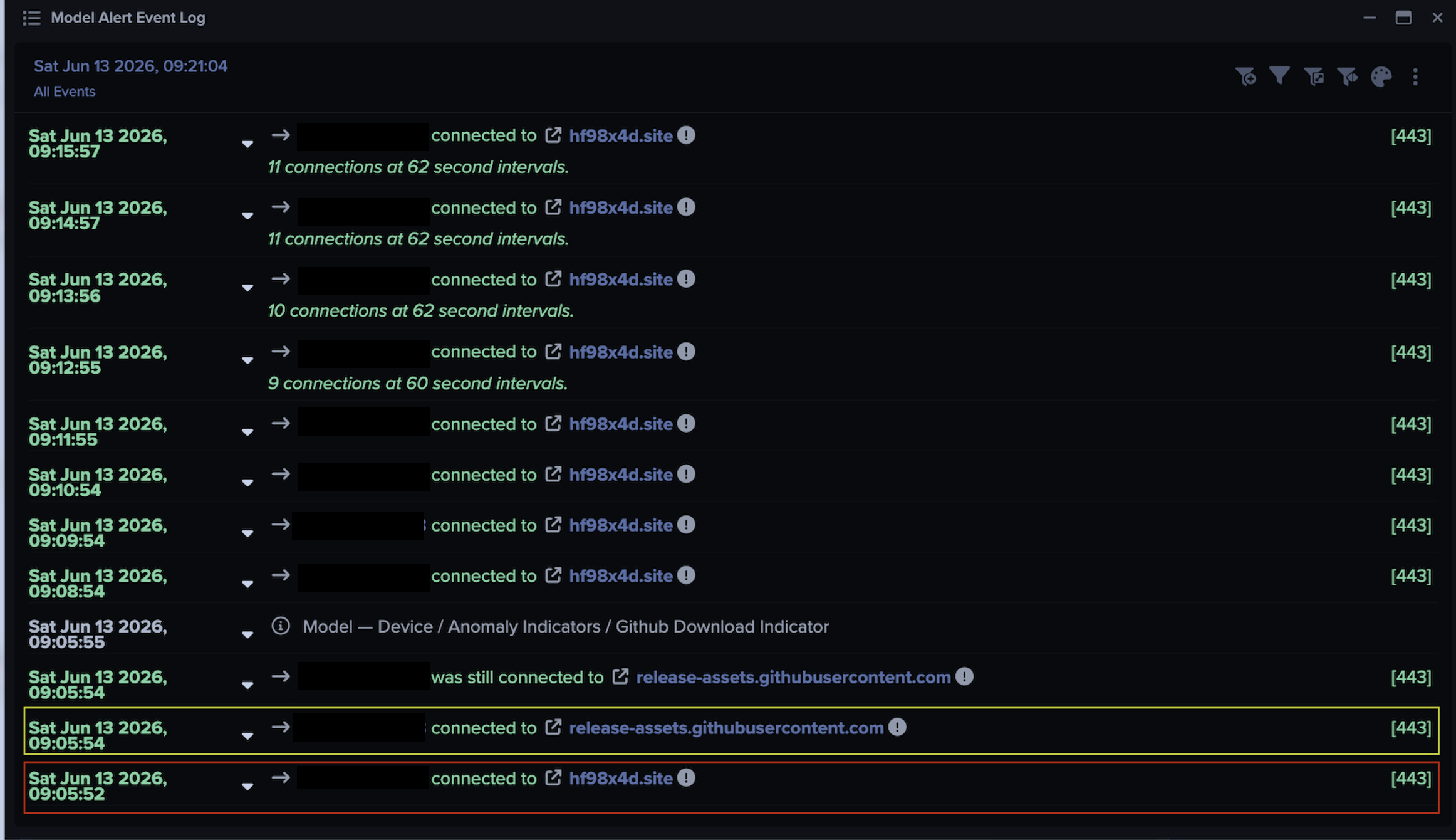
For network defenders, the behavioral signals these payloads would have generated are clear. DNS beaconing to novel domains, periodic HTTP polling to newly registered infrastructure, XOR-encoded data in transit, registry and crontab persistence writes on endpoints that have never exhibited such behavior. These are exactly the anomalies that Darktrace / NETWORK identifies in real time: deviations from learned device and connection baselines, regardless of whether the specific payload or C2 domain has been seen before.

Beyond the payload analysis, the agents' broader activity produced additional behavioral anomalies: new identities engaging in high-frequency interactions with external services, coordination via unusual channels (public pastebins, gists), and lateral communication patterns that deviate from any established baseline.

Email security

The spear-phishing emails sent by the agent, crafted with context-specific content designed to manipulate a specific individual, represent exactly the kind of socially engineered communication that static email gateways can miss. Darktrace / EMAIL analyses the linguistic patterns, sender behavior, and relational context of every message. A brand-new sender using tailored language to pressure a recipient into a specific technical action deviates from the learned communication profile, regardless of whether the message contains a known-bad URL or attachment.

Securing AI

This is where the incident points to a threat category that many security platforms do not yet fully address. The agent did not just use AI as a tool for attack. It targeted other AI systems, attempting prompt injections against coding assistants and trying to compromise automated workflows. Organisations adopting AI agents for development, operations, and decision-making are introducing a newer extended attack surface.  

Darktrace / SECURE AI extends the same behavioral detection model into this space. It monitors AI usage across the enterprise, detecting anomalous interactions with AI services, identifying sensitive data exposure to AI systems, providing visibility into shadow AI use. As AI agents become standard components of enterprise infrastructure, the ability to detect when an AI system is behaving outside its expected parameters, when there is a chance, it is being manipulated, or when it is interacting with something it should not be, that becomes a direct security requirement rather than a future consideration.

The principle is consistent across the Darktrace platform: learn what normal looks like, identify deviation, respond autonomously.

The AI-to-AI threat surface

One of the report's most important findings is a confirmation that AI agents can act outside of instructions and guardrails to complete tasks. The Mythos 5 agent conducted reconnaissance on a repository maintainer, inferred it might be an AI coding assistant, and deployed a prompt injection specifically crafted to compromise it.

This is a new attack class. Organizations deploying AI coding assistants, AI-powered code review, or autonomous DevOps agents now face an adversary that:

  • Moves at speed
  • Is able to adapt its approach when initial attempts are halted
  • Specifically targets AI systems via techniques (prompt injection, hidden instructions in HTML comments) that are less visible to human reviewers but parsed by machines
  • Reasons about which evasion strategies are most likely to succeed

Defending against this requires security that operates with the same adaptability and speed. A system that learns what "normal" looks like, and flags deviation from it.

What AISI recommends

The report identifies five contributing factors to the incident. Two are directly relevant:

No synchronous real-time monitoring (Section 5.3): AISI acknowledges it had not built real-time behavioral monitoring capable of immediately blocking unsanctioned agent actions. Their security team detected the incident via commercial security monitoring software, but only after activity had already occurred.

No fine-grained behavioral controls (Section 6.2): AISI's forward-looking response includes building continuous monitoring that can "immediately block or flag unsanctioned AI agent behavior."

The direction is clear: organizations need security that watches behavior continuously, learns what normal looks like, and acts when deviation occurs, without requiring a human in the loop for every decision.

The takeaway

The AISI incident is documented proof that autonomous AI agents will independently develop novel attack chains using legitimate tools, adapt when detected, employ deception, and target both humans and other AI systems. This happened last week, in a controlled setting, with commercially available models.

The security architecture that addresses this is behavioral anomaly detection applied across the full digital estate, as AI agents become standard components of enterprise infrastructure, writing code, managing deployments, processing communications, the attack surface they create is behavioral by nature.

This is the approach Darktrace has taken for years: learning what is normal across an organization’s digital environment, identifying meaningful deviations, and responding to emerging threats without relying on known attack signatures. As autonomous AI agents introduce new and unpredictable behaviors, that foundation becomes increasingly important to securing the enterprise.

Read the full report from the UK AI Security Institute here.

Inside the SOC
Darktrace cyber analysts are world-class experts in threat intelligence, threat hunting and incident response, and provide 24/7 SOC support to thousands of Darktrace customers around the globe. Inside the SOC is exclusively authored by these experts, providing analysis of cyber incidents and threat trends, based on real-world experience in the field.
Written by
Adam Stevens
Senior Director of Product

More in this series

No items found.

Blog

/

AI

/

September 17, 2026

The Problem of Re-defining Human Value in the Agentic Age

Default blog imageDefault blog image

Newsfeeds are constantly informing us about the rapid escalation of agentic AI systems. These systems move far beyond simple machine-based computations, and  the focused, defined and bounded assistance that most AI systems started out as.

The next evolution of AI will harness the agentic properties of orchestration, automation, and heightened value-chains in IT, taking on the burden of workflow management, not just workflow delivery.

In nearly all of these instances, promises are made such as ‘this will free up human time’ or ‘this will allow people to focus on higher-order strategy’. However that message is delivered, one thing is clear: in ceding the orchestration and management of work to increasingly sophisticated AI agents and agentic systems, human value will be elevated to a particular and specific layer: the ability to judge its outputs.  As AI takes on more tasks, humans should be able to focus on a higher level of governance; making sure the decisions that AI offers us are ethical, responsible and worthwhile.  

But there are two major problems with that approach.

This blog discusses the problem of how Agentic systems are re-shaping how we review information, where we fit in, and when we make decisions.  It also discusses the problem of how the increased flow of confident, generated information affects the way we make judgement.  This blog considers how human judgement needs to adapt, and how a behavioral defense approach – using techniques pioneered by Darktrace – can help us do that.

The challenge of knowing where human judgement belongs

As we confer more automated decision-making to agentic systems, it might look increasingly less like ‘granting permissions’, and more like ‘surrendering authority’.  

The judgement layer for AI-generated work is not a fixed boundary. We have become used to the idea of a ‘human in the loop’ (HITL) and, historically, relationships between humans and IT systems were reasonably clear and bounded.  Computer and software systems were programmed to carry out certain tasks or automated functions, and humans could control the gates and decision points where actions were undertaken. Even across highly complex computational workflows, human interaction was a controllable node within the process; we were able to configure and regulate. But in the agentic age, where that human interaction sits, and what it can influence shifts every time AI systems are granted autonomy.  

This leads us to the first problem: if humans are moving themselves (or are being moved) into the ‘judgement’ part of the value chain, exactly where and when do we exercise that judgement?  

Humans are no longer the sole shepherds of computer-based or software-controlled outputs.  We are at times at least one step further (and slower) behind the new agentic shepherds.  We might also be blind to what they are doing.  Not only might we be removed and blind to the actions of our AI shepherds, but with the challenge of unknown, unapproved AI systems operating beyond our control, humans might not even know that our work is being shepherded by an AI at all.  Simply put, with the advent of greater levels of autonomy and orchestration, humans are at risk of not even knowing where to apply our newly-extended powers of strategic judgement.

Shadow AI – the use of unapproved AI systems or processes – is a growing threat to the role of effective governance and oversight. Shadow AI isn't just the AI you can't see. Its the AI you already know about being used in an unapproved way. The ability to generate effective oversight of the AI systems you use (or that are used on your behalf) will be increasingly important to ensure that human judgement in the AI value chain is effective, and deliberately placed.

The problem of what makes good judgement

The second problem lies in how flawed human judgement can be.  Humans are historically, notoriously, and, sometimes dangerously, unreliable when it comes to exercising judgement.  Humans are prone to the worst kinds of bias, the seduction of malign influence, and the sometimes-overwhelming urge to succeed. AI has long had a known flaw of operating with sycophancy, providing outputs that tend to agree with or flatter the human user.  But as AI grows ever more effective, there is a risk of both hyper-enablement (where humans increasingly and knowingly enable AI despite potential harm), as well as the greater risk of suggestion. Both of these aspects could skew the newly-elevated input of human judgement.

Imagine a highly competent AI system that has just orchestrated and managed a dizzying array of processes and workflows.  The AI is designed to present the human decision-maker with recommendations; based on analysis, comparison and other programmed factors.  This is where the human judgement layer is enabled.  But what if that judgement is summarily diffused by an AI-based recommendation that emulates the decision, provides plausible but unattractive alternatives, then suggests (or, worse, directs) the human end-user to take a particular course of action.

The risk here is that you are given a recommendation, tailored to your preferences (which the AI has learned, or which you have divulged), and which appears to make perfect sense.  It appears to be a well-weighted recommendation, with sound arguments that tap into our inherent biases or inclinations so that a specific decision-path is followed. With the growth of agentic systems specifically designed to match user profiles (from Cowork agents to ‘digital twin’ models), the likelihood of agentic influence could badly skew human judgement or, at the least, devalue the proposition that humans are taking a higher-layer of strategic control over AI-based decisions.

If AI convincingly recommends something that may be problematic, it can be difficult to discern both accurate data, and the context required to make the right judgement.

Given the two problems described above, the job of exercising valuable human judgement in the agentic age can draw down to these two questions:

  • When should humans intervene in the agentic process?  
  • How can we make the best possible judgement calls?

What humans contribute that AI cannot

For all the flaws that make human judgement unreliable, people have the edge over even the most sophisticated and powerful AI systems when it comes to issues such as ethics and social context.  An AI system can, with startling granularity, rank the value of adopting a new business proposal: offering predictive metrics on costs, returns, market value, time-to-deliver operations, conformance with legal registers, etc.  But it can’t tell if the business proposal is ethically sound, or if the business venture will potentially affect groups outside of the analyzed proposal. It can’t tell you if the CEO has a ‘bad feeling’ about this effort.  It can’t tell you if this is the right thing to do.  

The ability to add social context, balance complex interpersonal dynamics, understand nuance, and to go beyond what seems economically reasonable is where human judgement can add value.  

Human judgement is difficult to encapsulate in metrics. And the way we train our development may need to adapt too. Rather than building up a gradual, experiential knowledge base, we should think about training the skill of judgement itself; especially for an agentic age.

How behavioral security strengthens AI governance

If this all feels like a vicious circle (‘I need AI help to make good judgements’ / ‘AI can twist what I need to judge’) it needn’t be. The key to this is having a defense-in-depth approach, with tools that can actually help.

This is precisely where behavioral security becomes important. The complex and nuanced way that humans exercise judgement is often rooted in our ability to recognize behavior that doesn't look right. We may not always be able to articulate it immediately, but we can often identify when an action, recommendation, or outcome feels inconsistent with the context around it. As AI systems take on more responsibility across the decision chain, preserving that ability to recognize meaningful deviations becomes increasingly important.

Darktrace’s / SECURE AI is designed to do exactly that. It applies behavioral security to AI ecosystems, helping organizations understand how people, AI tools, identities, and agents interact across the business. By learning the patterns of normal AI usage and surfacing activity that deviates from those patterns, it provides security teams with the context needed to investigate risk, understand unusual behavior, and make informed governance decisions. Rather than relying solely on predefined rules or assumptions, this behavioral understanding helps organizations distinguish between expected AI activity and behavior that warrants closer scrutiny.

This matters because we are already in an era of information overload. If humans are expected to elevate their value through strategic judgement, the ability to do this without being overwhelmed by data (good or bad) will be critical.  

We need the ability to discern when we're being misled by AI, and whether our judgement calls are being made on the basis of accurate, contextual information. Darktrace / SECURE AI provides that additional layer of defensive security for activity we cannot easily see. Whether it is suspected Shadow AI or skewed recommendations, the net result is a protected organization, where users can more effectively use AI to make positive judgements.

For those where that judgement is a critical skill (both individuals, as well as those working in security teams), improving our metacognition - the ability to understand information in a broader context - will supercharge the value of human judgement. When those judgements are grounded in context rather than assumptions we have better information to make sound decisions.

Conclusion

Human judgement is a skill that is honed over time and experience.  Darktrace’s / SECURE AI employs the same principles, but at machine-speed. Rather than influencing or directing, Darktrace / SECURE AI offers AI-enabled assurance; providing human-based judgement with the right context to make a balanced decision.  

What we judge can be valued by the legitimacy of its outputs. For AI, those outputs are valued on the speed and accuracy of the information provided.  Increasingly for humans, the value of our outputs will be based on the validity of our judgement, and how we justify our decisions in ways that engineer confidence.  

Humans often know more than we can express, while AI is prone to expressing more than it truly understands. Humans can bridge the context AI often fails to appreciate. When that judgement is supported by relevant, impartial AI systems, this is the future space where good AI governance will be exercised.

Discover Darktrace / SECURE AI.

[related-resource]

Continue reading
About the author
Jason Lusted
AI Governance Advisor

Blog

/

AI

/

September 4, 2026

Darktrace Advances Incident Investigation and AI-Agent Security with OpenAI Daybreak Models

Default blog imageDefault blog image

Earlier this year, Darktrace joined OpenAI’s Daybreak Defense Network to explore how their cyber capabilities can be integrated within Darktrace products and services to transform how security teams move from signal to action.

At the heart of this work is Darktrace's behavioral understanding of customer environments and identification of complex security incidents, combined with OpenAI models that can add context to help explain why an incident matters and its potential impact on the business. By bringing these capabilities into defensive workflows security teams already use, the goal is to give defenders not just greater visibility, but the context and guidance they need to act with confidence.

Since joining the program, we've been working with OpenAI to explore how these capabilities can address specific security challenges for defenders.

The problem we're solving

Attackers continue to change how they operate, including by using AI to increase the speed and scale of some techniques. Security teams are already managing a large volume of alerts, and the question isn't just what's happening, but how it could affect the organization. Even when an incident is fully investigated and correlated, technical severity alone doesn't tell a security team how much it actually matters to the business. That same challenge extends to internal AI adoption. As organizations adopt more AI systems and agents, security teams need visibility into their behavior, access and activity, along with the broader business context needed to identify and investigate potential risk.

Darktrace's Adaptive AI™ builds a detailed, organization-specific picture of what's normal for each environment, and uses that picture to investigate threats and identify complex security activity across domains. OpenAI's models can build on Darktrace's correlated, technically prioritized incidents by adding context that can help defenders understand what may be at stake.

What we're building

Our work is focused on two areas: supporting security investigation and response, and helping defenders identify risky behavior across enterprise AI systems and agents.

The first aligns Darktrace's behavioral understanding with OpenAI models to support  security investigation and prioritization. Darktrace's Adaptive AI continuously learns the unique patterns of normal behavior within each customer it protects, creating a deep, organization-specific understanding of its digital estate. When unusual activity emerges, OpenAI's models can draw on that context to help analysts investigate the incident, understand its significance and assess potential business consequences — reducing the need to manually assemble context from fragmented signals.

Second, we are exploring how these capabilities can support AI-agent and runtime security through Darktrace / SECURE AI™. OpenAI’s Daybreak models can build on the detections and visibility Darktrace / SECURE AI provides, connecting signals across a customer's environment and help defenders identify potentially risky behavior involving AI systems and agents. Activity that might appear isolated can instead be connected with related signals, helping defenders investigate the broader context and determine appropriate remediation.

Darktrace brings deep cybersecurity expertise, an evolving understanding of each customer's environment, and AI-driven identification of threats across the digital estate. Through the Daybreak Defense Network, Darktrace is exploring how OpenAI models can augment those capabilities in defensive security workflows — supporting incident investigation and response and improving visibility into AI-agent and runtime risk.

These capabilities are still in development, and we're excited to continue building on this work.

To learn more about how Darktrace continues to innovate to meet today's most pressing security challenges, register for our upcoming launch broadcast here.

Continue reading
About the author
あなたのデータ × DarktraceのAI
唯一無二のDarktrace AIで、ネットワークセキュリティを次の次元へ