
Blog
/
AI
/
May 18, 2026

AI Insider Threats: How Generative AI is Changing Insider Risk

The blog examines how AI has changed the paradigm of understanding, and dealing with, insider threats. It also explores a defense-in-depth approach and discusses what CISOs and SOC leaders can do to protect their organization from AI insider threats.
Inside the SOC
Darktrace cyber analysts are world-class experts in threat intelligence, threat hunting and incident response, and provide 24/7 SOC support to thousands of Darktrace customers around the globe. Inside the SOC is exclusively authored by these experts, providing analysis of cyber incidents and threat trends, based on real-world experience in the field.
Written by
Jason Lusted
AI Governance Advisor
ai insider threatsDefault blog image
18
May 2026

How generative AI changes insider behavior

AI systems, especially generative platforms such as chatbots, are designed for engagement with humans. They are equipped with extraordinary human-like responses that can both confirm, and inflate, human ideas and ideology; offering an appealing cognitive partnership between machine and human.  When considering this against the threat posed by insiders, the type of diverse engagement offered by AI can greatly increase the speed of an insider event, and can facilitate new attack platforms to carry out insider acts.  

This article offers analysis on how to consider this new paradigm of insider risk, and outlines key governance principles for CISOs, CSOs and SOC managers to manage the threats inherent with AI-powered insider risk.

What is an insider threat?

There are many industry or government definitions of what constitutes insider threat. At its heart, it relates to the harm created when trusted access to sensitive information, assets or personnel is abused with malicious intent, or through negligent activities.  

Traditional methodologies to manage insider threat have relied on two main concepts: assurance of individuals with access to sensitive assets, and a layered defense system to monitor for any breach of vulnerability. This is often done both before, and after access has been granted. In the pre-access state, assurance is gained through security or recruitment checks. Once access is granted, controls such as privileged access, and zero-trust architecture offer defensive layers.

How does AI change the insider threat paradigm?

While these two concepts remain central to the management of insider threats, the introduction of AI offers three key new aspects that will re-shape the paradigm.

AI can act as a cognitive amplifier, influencing and affecting the motivations that can lead to insider-related activity. This is especially relevant for the deliberate insider - someone who is considering an act of insider harm. These individuals can now turn to AI systems to validate their thinking, provide unique insights, and, crucially, offer encouragement to act. With generative systems hard-wired to engage and agree with users, this can turn a helpful AI system into a dangerous AI hype machine for those with harmful insider intent.  

AI can act as an operational enabler. AI can now develop and increase the range of tools needed to carry out insider acts. New social engineering platforms such as vishing and deepfakes give adversaries a new edge to create insider harm. AI can generate solutions and operational platforms at increasing speeds; often without the need for human subject matter expertise to execute the activities. As one bar for advanced AI capabilities continues to be raised, the bar needed to make use of those platforms has become significantly lower.

AI can act as a semi-autonomous insider, particularly when agentic AI systems or non-human identities are provided broad levels of autonomy; creating a vector of insider acts with little-to-no human oversight or control. As AI agents assume many of the orchestration layers once reserved for humans, they do so without some of the restricted permissions that generally bind service accounts. With broad levels of accessibility and authority, these non-human identities (NHIs) can themselves become targets of insider intent.  Commonly, this refers to the increasing risks of prompt injection, poisoning, or other types of embedded bias. In many ways, this mirrors the risks of social engineering traditionally faced by humans. Even without deliberate or malicious efforts to corrupt them, AI systems and AI agents can carry out unintended actions; creating vulnerabilities and opportunities for insider harm.

How to defend against AI-powered insider threats

The increasing attack surfaces created or facilitated by AI is a growing concern.  In Darktrace’s own AI cybersecurity research, the risks introduced, and acknowledged, through the proliferation of AI tools and systems continues to outstrip traditional policies and governance guardrails. 22% of respondents in the survey cited ‘insider misuse aided by generative AI’ as a major threat concern.  And yet, in the same survey, only 37% of all respondents have formal policies in place to manage the safe and responsible use of AI.  This draws a significant and worrying delta between the known risks and threat concerns, and the ability (and resources) to mitigate them.

What can CISOs and SOC leaders do to protect their organization from AI insider threats?  

Given the rapid adaptation, adoption, and scale of AI systems, implementing the right levels of AI governance is non-negotiable. Getting the correct balance between AI-driven productivity gains and careful compliance will lead to long-term benefits. Adapting traditional insider threat structures to account for newer risks posed through the use of AI will be crucial. And understanding the value of AI systems that add to your cybersecurity resilience rather than imperil it will be essential.

For those responsible for the security and protection of their business assets and data holdings, the way AI has changed the paradigm of insider threats can seem daunting.  Adopting strong, and suitable AI governance can become difficult to introduce due to the volume and complexity of systems needed to be monitored. As well as traditional insider threat mitigations such as user monitoring, access controls and active management, the speed and autonomy of some AI systems need different, as well as additional layers of control.  

How Darktrace helps protect against AI-powered insider threats

Darktrace has demonstrated that, through platforms such as our proprietary Cyber AI Analyst, and our latest product Darktrace / SECURE AI, there are ways AI systems can be self-learning, self-critical and resilient to unpredictable AI behavior whilst still offering impressive returns; complementing traditional SOC and CISO strategies to combat insider threat.  

With / SECURE AI, some of the ephemeral risks drawn through AI use can be more easily governed.  Specifically, the ability to monitor conversational prompts (which can both affect AI outputs as well as highlight potential attempts at manipulation of AI; raising early flags of insider intent); the real-time observation of AI usage and development (highlighting potential blind-spots between AI development and deployment); shadow AI detection (surfacing unapproved tools and agents across your IT stack) and; the ability to know which identities (human or non-human) have permission access. All these features build on the existing foundations of strong insider threat management structures.  

How to take a defense-in-depth approach to AI-powered insider threats

Even without these tools, there are four key areas where robust, more effective controls can mitigate AI-powered insider threat.  Each of the below offers a defense-in-depth approach: layering acknowledgement and understanding of an insider vector with controls that can bolster your defenses.  

Identity and access controls

Having a clear understanding of the entities that can access your sensitive information, assets and personnel is the first step in understanding the landscape in which insider harm can occur.  AI has shown that it is not just flesh and bone operators who can administer insider threats; Non-Human Identities (such as agentic AI systems) can operate with autonomy and freedom if they have the right credentials. By treating NHIs in the same way as human operators (rather than helpful machine-based tools), and adding similar mitigation and management controls, you can protect both your business, and your business-based identities from insider-related attention.

Visibility and shadow AI detection

Configuring AI systems carefully, as well as maintaining internal monitoring, can help identify ‘shadow AI’ usage; defined as the use of unsanctioned AI tools within the workplace. The adoption of shadow AI could be the result of deliberate preference, or ‘shortcutting’; where individuals use systems and models they are familiar with, even if unsanctioned. As well as some performance risks inherent with the use of shadow AI (such as data leakage and unwanted actions), it could also be a dangerous precursor for insider-related harm (either through deliberate attempts to subvert regular monitoring, or by opening vulnerabilities through unpatched or unaccredited tooling).

Prompt and Output Guardrails

The ability to introduce guardrails for AI systems offers something of a traditional “perimeter protection” layer in AI defense architecture; checking prompts and outputs against known threat vectors, or insider threat methodologies. Alone, such traditional guardrails offer limited assurance.  But, if tied with behavior-centric threat detection, and an enforcement system that deters both malicious and accidental insider activities, this would offer considerable defense-in-depth containment.  

Forensic logging and incident readiness response

The need for detection, data capture, forensics, and investigation are inherent elements of any good insider threat mitigation strategy. To fully understand the extent or scope of any suspected insider activity (such as understanding if it was deliberate, targeted, or likely to occur again), this rich vein of analysis could prove invaluable.  As the nature of business increasingly turns ephemeral; with assets secured in remote containers, information parsed through temporary or cloud-based architecture, and access nodes distributed beyond the immediate visibility of internal security teams, the development of AI governance through containment, detection, and enforcement will grow ever more important.

Enabling these controls can offer visibility and supervision over some of the often-expressed risks about AI management. With the right kind of data analytics, and with appropriate human oversight for high-risk actions, it can illuminate the core concerns expressed through a new paradigm of AI-powered insider threats by:

  • Ensuring deliberately mis-configured AI systems are exposed through regular monitoring.
  • Highlighting changes in systems-based activity that might indicate harmful insider actions; whether malicious or accidental.
  • Promoting a secure-by-design process that discourages and deters insider-related ambitions.
  • Ensuring the control plane for identity-based access spans humans, NHIs and AI models, and:
  • Offering positive containment strategies that will help curate the extent of AI control, and minimize unwanted activities.

Why insider threat remains a human challenge

At its root, and however it has been configured, AI is still an algorithmic tool; something designed to automate, process and manage computational functions at machine speed, and boost productivity.  Even with the best cybersecurity defenses in place, the success of an insider threat management program will still depend on the ability of human operators to identify, triage, and manage the insider threat attack surface.  

AI governance policies, human-in-the-loop break points, and automated monitoring functions will not guard against acts of insider harm unless there is intention to manage this proactively, and through a strong culture of how to guard against abuses of trust and responsibility.

[related-resource]

Understand how to secure AI tools

Discover how to identify AI-driven risks, so you can establish AI governance frameworks and controls that secure innovation

Inside the SOC
Darktrace cyber analysts are world-class experts in threat intelligence, threat hunting and incident response, and provide 24/7 SOC support to thousands of Darktrace customers around the globe. Inside the SOC is exclusively authored by these experts, providing analysis of cyber incidents and threat trends, based on real-world experience in the field.
Written by
Jason Lusted
AI Governance Advisor

More in this series

No items found.

Blog

/

Network

/

June 16, 2026

Hola VPN Abuse: From Proxy Traffic to Malware and Cryptomining

hola vpn malware cryptominingDefault blog imageDefault blog image

Introduction

In enterprise environments, non-compliant software traffic can introduce unexpected exposure by creating unmanaged paths for outbound connectivity. Hola VPN is a notable example because of its peer-to-peer design, which can effectively turn user devices into routing or exit nodes for other parties’ traffic, shifting the risk profile from that of a traditional virtual private network (VPN) to something closer to a distributed proxy.

As a result, the appearance of Hola-related activity, whether from prior installation or unintended background connections, should be treated with caution.  Such activity may provide a foothold for malicious behavior, including lateral movement or command-and-control communication.

This blog explores how Hola-associated activity appeared as part of broader patterns of suspicious behavior observed across the Darktrace customer base.

The campaign

In February and March 2026, Darktrace observed similar anomalous activity across multiple customer environments, with affected devices showing consistent behavioral patterns. These included connections to multiple *.hola[.]org endpoints using Hola-related user agents, suggesting interaction with Hola infrastructure rather than isolated or incidental traffic.

Following these connections, affected customer environments showed downloads of suspicious executable files from rare external endpoints 188.241.219[.]55 and 184.241.218[.]111. Both endpoints have been flagged as potentially malicious by open-source intelligence (OSINT) [1][2].

These downloads were conducted using consistent user agents across impacted customers, specifically ‘Hola svc_js_win32/1.249.408’ and ‘Hola svc_js_win32/1.251.389’, suggesting a possible association with Hola-related activity.

Notably, this pattern aligns with recent reporting that, in some cases, Hola distributed an undeclared executable component, me[.]exe, which was later assessed to be a likely Monero-mining binary introduced via a compromised delivery pipeline [3].

Case Study 1

Darktrace first observed a new device on January 19, 2026, within a customer environment based in the Europe, Middle East, and Africa (EMEA) region. On the same day it appeared on the network, the device communicated with multiple pieces of Hola VPN-linked infrastructure before downloading a binary from a hola[.]org subdomain.

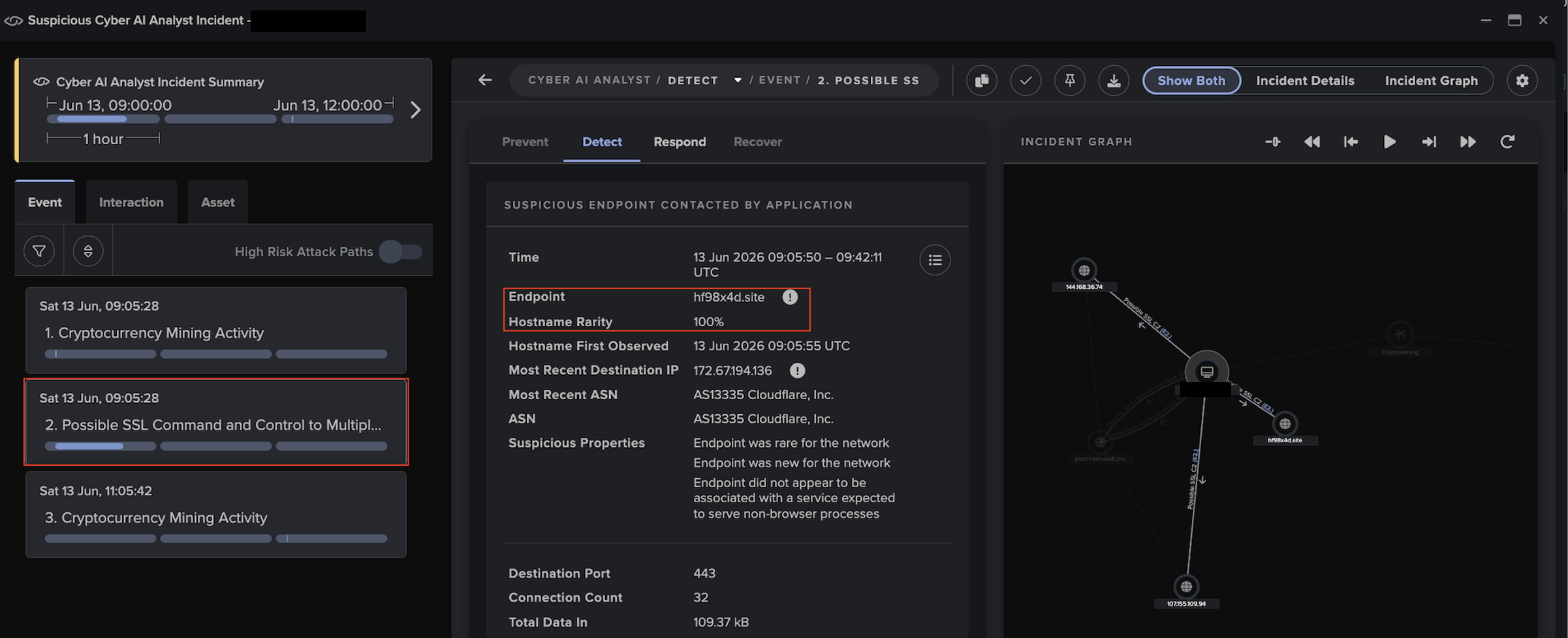
Cyber AI Analyst investigation highlighting Hola VPN service activity potentially associated with subsequent HTTP command-and-control (C2) connections.
Figure 1: Cyber AI Analyst investigation highlighting Hola VPN service activity potentially associated with subsequent HTTP command-and-control (C2) connections.

Subsequent Darktrace telemetry revealed a recurring pattern of activity from the day the device was first observed through to March 4, 2026. During this period, the device repeatedly issued HTTP GET requests to the URI /bwfile?size=1048576, each returning a 200 OK response, indicating successful file retrieval.

This behavior was accompanied by a POST request to /bwfile, followed by an additional GET request for a significantly larger file at /bwfile?size=26214400, suggesting a deliberate and structured file transfer pattern.

Notably, the binary download activity was not tied to a single static host. Instead, it was observed across multiple URLs that changed over time while remaining within the same hola[.]org domain. This pattern suggests the use of rotating or distributed delivery infrastructure rather than a fixed endpoint.

Variation in URLs over time within the same hola[.]org domain, indicating the use of dynamically changing endpoints.
Figure 2: Variation in URLs over time within the same hola[.]org domain, indicating the use of dynamically changing endpoints.

Across these events, the activity was consistently associated with the user agent Hola svc_js_win32/1.249.408, further linking the traffic to Hola-related service components. Amid these persistent and unusual connections, on February 22, Darktrace observed the device connecting to 188.241.219[.]55/proxy-peer-windows-amd64[.]exe, resulting in the download of an executable file.

 File transfer event showing the download of an executable  from the rare external endpoint 188.241.219[.]55.
Figure 3: File transfer event showing the download of an executable  from the rare external endpoint 188.241.219[.]55.

Based on its file hash, the downloaded file was assessed as a likely Trojan downloader [4], with import hash (imphash) values showing similarities to samples linked to Vidar, Rhadamanthys, and Stealc according to OSINT [5]. Overall, this sequence of activity suggests that Hola-related connectivity may have been leveraged as part of a broader malware delivery chain.

Darktrace’s Autonomous Response

Due to the highly unusual activity observed, Darktrace Autonomous Response was triggered by the device’s behavior. However, as the customer deployment was configured in “Human Confirmation” mode, manual approval was required before any action could be taken.

Had the deployment been set to “Fully Autonomous” mode, Darktrace would have automatically:

  1. Blocked connections to the associated ports and external endpoints
  2. Prevented all outgoing network connections from the device
  3. Enforced the device’s established ‘pattern of life’, allowing normal activity to continue while restricting any anomalous behavior
Figure 4: Example of a Darktrace Autonomous Response model highlighting the action that would have been taken, demonstrating how the system identifies anomalous behavior and applies targeted containment measures to restrict suspicious network activity.

Case Study 2

While the first case focused on anomalous activity from a newly observed device, Darktrace also identified cases in which devices had already been communicating with Hola-related endpoints prior to the suspected campaign. This may suggest pre-existing Hola usage within the environment, potentially increasing exposure and creating an avenue for subsequent suspicious activity.

One case involved three devices within a customer network based in the Americas (AMS). In this instance, a different payload was identified: me[.]exe, a potentially malicious cryptocurrency miner also referred to as HolaMonitorService[.]exe [6][7]. The downloads were observed from infrastructure similar to that seen in Case 1, including an IP address within the same 188.241.0.0/16 subnet.

Connections to *.hola[.]org, alongside the use of potential Hola-related user agents consistent with those in Case 1, were also identified, further suggesting a link between the observed activity and Hola-associated infrastructure.

Darktrace observed activity indicative of unusual VPN usage on the first affected device on February 2, followed by telemetry suggesting potential Tor usage. This was later followed by the download of me[.]exe on March 10 from 188.241.218[.]111. Notably, this device was the earliest among the three within the deployment to exhibit the presence of the suspicious executable.

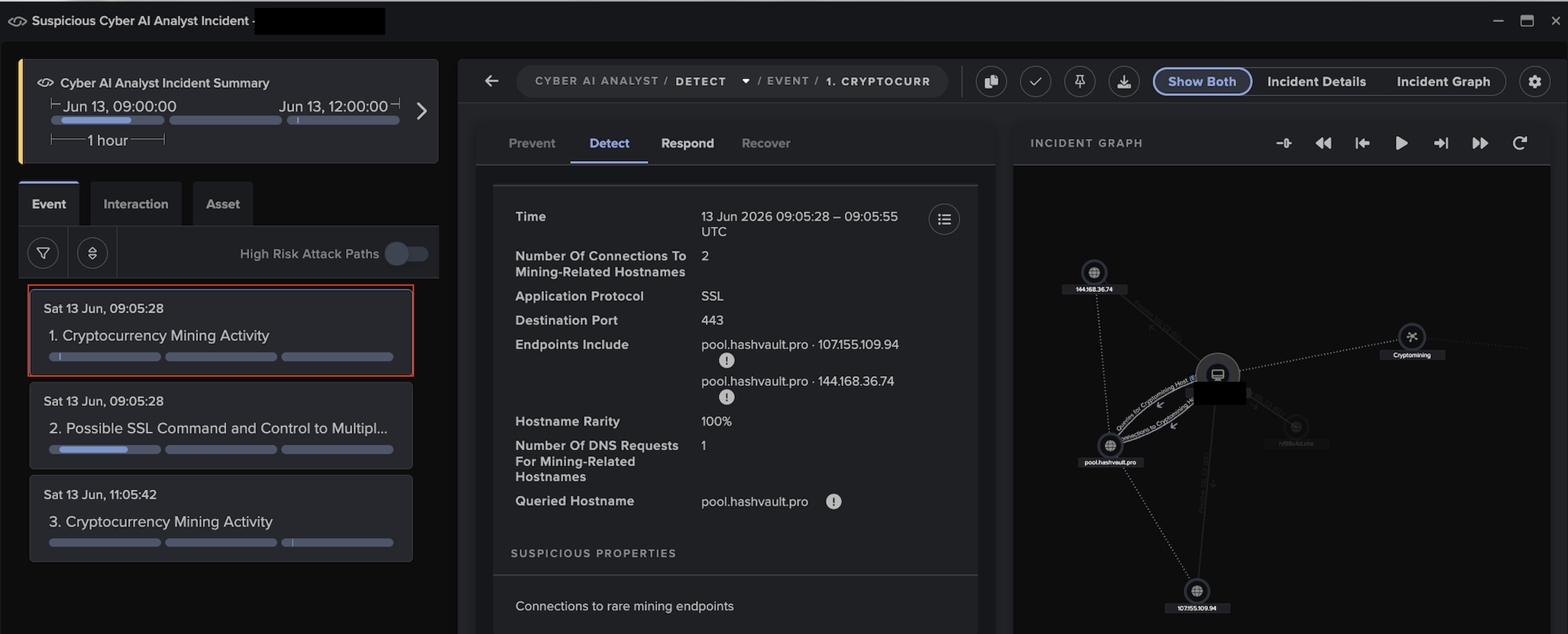
Figure 5: Cyber AI Analyst detection highlighting the download of a suspicious executable from a similar external endpoint in a separate deployment.

On March 5, 2026, the second affected device exhibited a slightly different progression, initiating connections to http-test1[.]hola[.]org using the user agent ‘hola_get’. This activity was followed by the download of me[.]exe from the same endpoint on March 13, consistent with the broader pattern of Hola-related downloads observed across the environment.

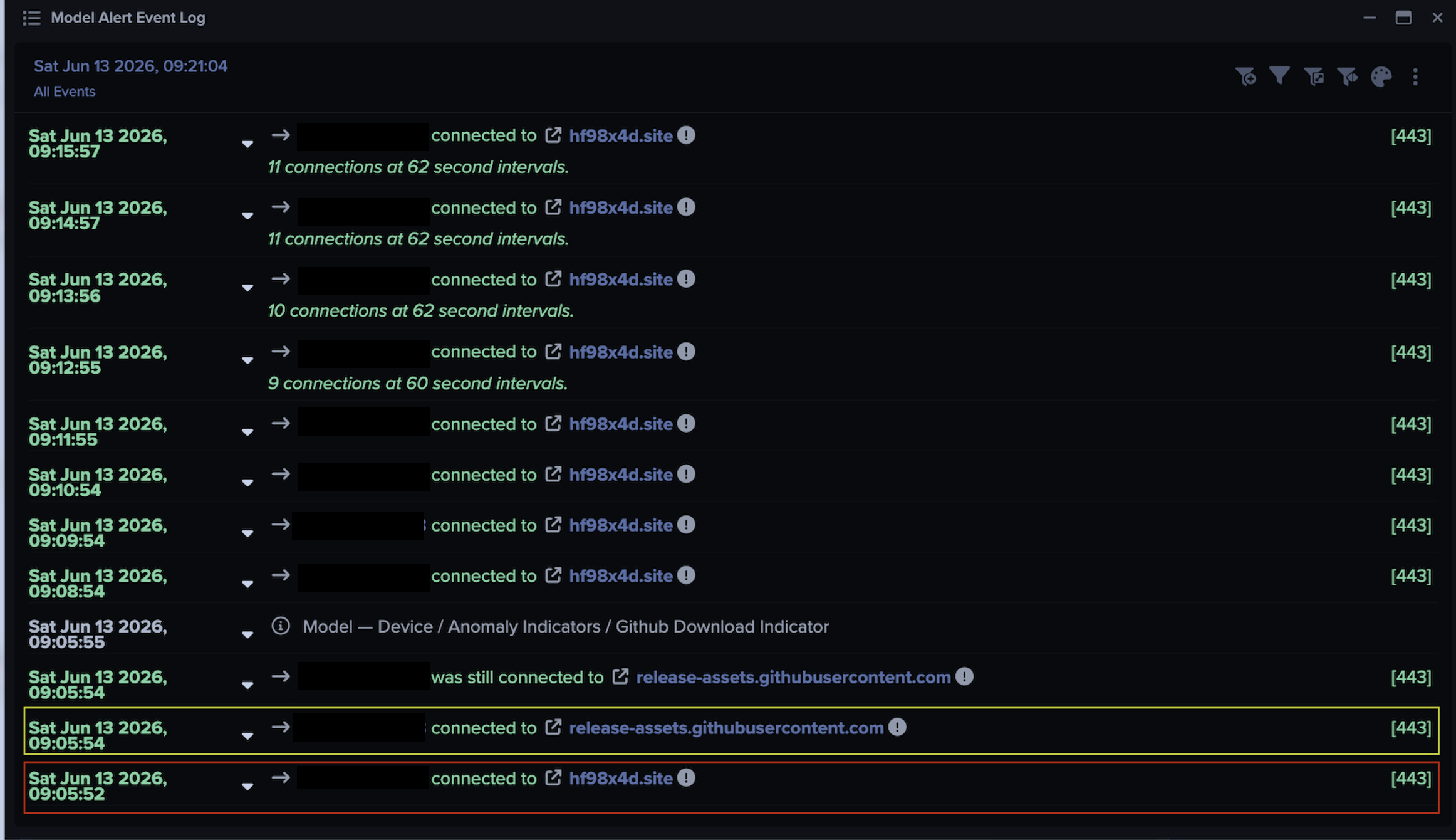
 Example of Hola VPN-related connectivity observed on the network prior to the suspected campaign, indicating pre-existing usage that may have contributed to subsequent activity.
Figure 6: Example of Hola VPN-related connectivity observed on the network prior to the suspected campaign, indicating pre-existing usage that may have contributed to subsequent activity.

The final affected device within this customer’s network demonstrated a more limited but related pattern, also downloading me[.]exe on March 17 using the same ‘hola_get’ user agent.

While the earlier Hola VPN usage observed across the deployment may not have been directly related to the suspected malware campaign, it may nonetheless have contributed to reduced visibility. The presence of pre-existing Hola-related traffic could have obscured malicious activity, making it more difficult to distinguish legitimate usage from attacker-driven behavior and, in turn, hindering the timely identification of the emerging compromise.

Darktrace’s Autonomous Response

For this deployment, the customer had their Autonomous Response capability configured in “Fully Autonomous” mode, allowing Darktrace to take action without human intervention. As a result, the system was able to autonomously disrupt the activity as soon as relevant events were identified through model detections.

Figure 7: Darktrace Autonomous Response actions taken against suspicious activity linked to Hola VPN.

Suspected cryptomining activity

As previously noted, some of the observed executable payloads appear to be linked to cryptomining malware. Across a subset of affected customer environments, this assessment was further supported by subsequent device activity consistent with Monero mining. Affected devices established follow-on connections to multiple external endpoints aligned with known mining infrastructure, indicating post-download execution.

Considering the broader sequence of activity, this pattern may point to a wider form of abuse in which legitimate VPN-related traffic is used to mask or facilitate malicious behavior following compromise.

On several devices, the download of executable files, including a newly observed peer[.]exe, was followed by alerts indicative of cryptocurrency mining activity. Mining-related credentials such as ‘x’ were observed using the Minergate protocol to communicate with endpoints within the 89.125.255.0/24 subnet and 188.241.218[.]111, the same endpoint involved in earlier download activity. Additional credentials appeared to reflect device-specific CPU identifiers, for example ‘12th Gen Intel(R) Core (TM) i5-1235U’.

Observed mining methods included login, submit, and job, consistent with active participation in a pool-based mining workflow rather than passive or incidental contact. The login method indicates that the host authenticated to the mining service as a worker, job reflects the assignment of computational tasks, and submit shows completed work being returned to the pool [8]. This sequence suggests that affected devices were actively contributing processing resources as part of an unauthorized distributed mining operation.

The presence of unauthorized cryptominers can lead to degraded system performance and reduced device stability. Beyond the immediate resource impact, such activity often serves as an indicator of a broader compromise rather than an isolated issue. This may increase the risk of further malware deployment, persistence mechanisms, and lateral movement, particularly in environments where the initial intrusion has not been fully contained.

Conclusion

Across affected environments, detections such as unusual VPN usage, connections to Hola infrastructure, anomalous HTTP activity, suspicious file downloads, and subsequent cryptomining behavior were linked into a single, evolving incident narrative. This aggregation provided a clearer view of attack progression, enabling security teams to understand not just isolated alerts, but the full sequence of compromise from initial contact through to post-exploitation.

Ultimately, these activities show that the risk posed by non-compliant software such as Hola VPN can extend far beyond simple policy violations. What began as traffic to Hola-related infrastructure was, in multiple cases, followed by behavior suggesting deliberate misuse, including suspicious executable downloads using Hola-related user agents and, in some instances, evidence of active cryptomining. These were not isolated anomalies, but elements of a broader pattern in which seemingly benign proxy or VPN-related communications may have created a pathway for malicious delivery and unauthorized resource exploitation.

The significance of this activity lies not only in the downloads or mining, but in what it reveals about an attacker’s ability to blend malicious operations into traffic associated with software that may already have a foothold in the environment. When unapproved software operates within an enterprise, it can reduce visibility, blur the distinction between legitimate and malicious traffic, and create opportunities to extend compromise in ways that are persistent and difficult to detect. Darktrace’s anomaly-based approach enables these behavioral distinctions to be identified, regardless of whether the device is new or long established within the network.

Credit to Min Kim (Associate Principal Analyst), Priya Thapa (Senior Cyber Analyst)
Edited by Ryan Traill (Content Manager)

Appendices

References

[1] https://www.virustotal.com/gui/ip-address/188.241.219.55

[2]  https://www.virustotal.com/gui/ip-address/188.241.218.111

[3] https://www.sophos.com/en-us/blog/you-do-surprise-me-exe-an-unexpected-executable-in-hola-browser

[4] https://www.virustotal.com/gui/file/d275abca286cd75af971d0459fdf1df37c7b19c514abafae5d0b04bf42ccfb45/detection

[5] https://bazaar.abuse.ch/sample/d275abca286cd75af971d0459fdf1df37c7b19c514abafae5d0b04bf42ccfb45/

[6] https://any.run/report/4cdeb5df217764a8b6a20d518b76ccb30cbe623365a13d9dcd40900950f1ed99/de3a756a-3101-4369-8922-52c586c939fb

[7] https://www.virustotal.com/gui/file/e3541caf708c075f0bb22fc68b03acd8457fea7cf0732ea935b1eb016d1c7721/community

[8] https://bitcoinwiki.org/wiki/stratum

Darktrace Model Detections

·      Anomalous File / EXE from Rare External Location

·      Anomalous File / Multiple EXE from Rare External Locations

·      Compromise / Crypto Currency Mining Activity

·      Compromise / High Priority Crypto Currency Mining (EM)

·      Device / New User Agent

·      Anomalous Connection / New User Agent to IP Without Hostname

·      Antigena / Network / Significant Anomaly / Antigena Controlled and Model Alert

·      Antigena / Network / Significant Anomaly / Antigena Alerts Over Time Block

·      Antigena / Network / External Threat / Antigena Tor Block

·      Antigena / Network / External Threat / Antigena File then New Outbound Block

·      Antigena / Network / External Threat / Antigena Suspicious Activity Block

·      Antigena / Network / External Threat / Antigena Suspicious File Pattern of Life Block

·      Antigena / Network / External threat / Antigena Suspicious File Block

Indicators of Compromise (IoCs)

IoC –Type -Description + Confidence

188.241.219[.]55 - IP Address - Malware distribution source

188.241.218[.]111 - IP Address -Malware distribution source

hxxp://188.241.218[.]111:8080/me[.]exe - URI - Malicious payload

hxxp://188.241.219[.]55:9000/proxy-peer-windows-amd64[.]exe - URI - Malicious payload

hxxp://188.241.219[.]55:9000/peer[.]exe - URI - Malicious payload

C8088f3c8bc3542eb1ad78a7cc5306d866c8ac81 - SHA1 - Malicious payload, me[.]exe

b595a6de0f6a18975b29e6f8ebe604956a173478 - SHA1 - Malicious payload, me[.]exe

e9139a2e0839e8b9e5c9787ea936347ae56e5460 - SHA1 - Possible malicious payload

c2e80073e4cafe757d5643bd8fd45f28ad89bff9 - SHA1 - Possible malicious payload

695355eceedcdd337d8fcbd35e6a531cda75b847 - SHA1 - Possible malicious payload

f0b0d8068a1b9ab5d68a8a46842d72b870b292e7 - SHA1 - Possible malicious payload

a21c8b8cabc7670ea45bc175e185a0f9bfcf4733 - SHA1 - Malicious payload, me[.]exe

0353ca44b9f397d8f492db0b2f7a1d00a9e4406a - SHA1 - Possible malicious payload

56824c8a110e35ab303dc27a6c758cd50c36174c - SHA1 - Malicious payload, peer[.]exe

c141fa0fa505fe7f9ad5dd21d9d4d6d411739682 - SHA1 - Malicious payload, peer[.]exe

0417ec988b16f1267065185a6eea98f0bd2e17cd - SHA1 - Possible malicious payload

c54f7eaaeb3e0b528cd2584bdcb3a4b13cc0f8a2 - SHA1 - Malicious payload, peer[.]exe

11c78f15fafd53f8cc5a52b828d7cbf2a99e0b09 - SHA1 - Malicious payload, peer[.]exe

0258bf7dbb0123247db29e8799991140bbdbd9bb - SHA1 - Malicious payload, proxy-peer-windows-amd64[.]exe

b46043a06dd9bbd63e4214d5fbc7fd56e1ff0618 - SHA1 - Possible malicious payload

753afdecd9f5402d004e8e5f768170ae9a468ca5 - SHA1 - Possible malicious payload

8f533c7cb1524b00f7b0311c2ea8603298d6b2ca - SHA1 - Possible malicious payload

3a3bc6a5b4db1a4e961abcb002d26fe9d5e5c349 - SHA1 - Possible malicious payload

897f70eb41d302b045fcb05ed0693675e778ce57 - SHA1 - Possible malicious payload

6ddd5644809606e3dc1e2cc06059c3f5e6176f85 - SHA1 - Malicious payload, proxy-peer-windows-amd64[.]exe

68a94f7cdcaf8853ea99251c1ecc67ae9b32eba8 - SHA1 - Malicious payload, proxy-peer-windows-amd64[.]exe

MITRE ATT&CK Mapping

T1659 -Initial Access, Command and Control -Content Injection

T1588.001 -Resource Development -Malware

T1189 -Initial Access -Drive-by Compromise

T1105 -Command and Control -Ingress Tool Transfer

T1657 -Impact -Financial Theft

T1497.001 -Impact -Compute Hijacking

T1496 -Impact -Resource Hijacking

T1210 -Lateral Movement -Exploitation of Remote Services

T1036.012 -Stealth -Browser Fingerprint

T1071.001 -Command and Control -Web Protocols

Continue reading
About the author
Min Kim
Cyber Security Analyst

Blog

/

AI

/

June 12, 2026

Cybersecurity for the Sports Sector: The Threats Facing a Digitized Industry in 2026

Sports Stadium cybersecurityDefault blog imageDefault blog image

Securing sporting events in 2026

When you walk into a stadium on game day, you are entering a small smart city. Ticketing, turnstiles, payments, public Wi-Fi for tens of thousands of fans, CCTV, lighting, even the HVAC all run on connected systems. The experience for fans has become unmatched, but that dependency has created a much larger attack surface than people may realize.

Our latest threat research backs that up. In the past year, a survey that Darktrace commissioned found that 84% of respondents from professional sports organizations had at least one cyber incident, and 57% were hit more than once. For a sector that relies on the impact of the live moment, those numbers translate directly into operational risk.

Why sports is a target for cyber attacks

Sport is a highly visible target with fixed timelines, so attackers know exactly when disruption will have the most impact. It also holds valuable data, athlete medical records, contracts, sponsorship deals, which carry financial, reputational, and regulatory risk if exposed. At the same time, delivery depends on a wide set of third parties: ticketing providers, broadcasters, cloud services, stadium technology. Any of those connections can become an entry point. Put visibility, timing, data, and dependency together, and you get an environment where even a small foothold can turn into a visible, time-critical incident.

How attackers target email and identity

Email and identity remain the front door. From October 2025 through March 2026, Darktrace / EMAIL™ detected more than 116,000 phishing emails aimed at sports organizations across our customer base, and our sports customers received 19% more phishing emails than organizations in other sectors. The numbers tell the story:

BY THE NUMBERS

  • 21% of phishing emails were aimed at VIPs.
  • 37% used novel social engineering.
  • 84% of malicious emails passed DMARC authentication

A large proportion of these emails passed authentication checks, which means traditional security controls are no longer a reliable barrier. Attackers are not relying on spoofed domains – they're using legitimate infrastructure and trusted platforms. Behavior matters. Once an account is compromised, the behavior shifts quickly. Login patterns change, inbox rules are created to hide responses, and accounts start being used for internal discovery or further phishing. These aren’t high-noise events. They sit in normal workflows, which is why they’re often missed.

Ransomware tells a similar story. In one case inside a sports deployment, attackers had quietly been moving data to an outside server for a full two weeks before they triggered encryption. By the time the ransom note appeared, the outcome was already set. That sequence shows up consistently is access first, movement next, disruption last. If detection starts at encryption, it’s already too late.

Why AI is an emerging blind spot in sports

The increasing adoption of AI is expanding the potential attack surface. 72% of the security professionals we surveyed expect AI to increase their cyber risk over the next year, and yet 35% are already using or planning to use it in stadium operations, the most critical functions to protect. In addition to prompt injection and AI build risks, shadow AI is becoming a more immediate issue. Staff are already putting sensitive data—performance metrics, scouting reports, contracts, health data—into tools with little or no governance. The upside is clear, but so is the exposure—and it is happening before most organizations have any visibility or control. At the same time, attackers are using the same technology to scale phishing and social engineering. The net effect is simple: more exposure, at higher speed.

How can cybersecurity professionals prepare

Across high profile events, Darktrace’s experience shows that effective cyber defense includes preparation, real‑time visibility, and the ability to respond dynamically and decisively when timing, complexity, and public exposure converge.

There are a few strategic implications for cybersecurity teams:

  • Get behavioral visibility across IT and OT, not just corporate systems.
  • Treat identity as your control plane. Most attacks in this sector start with credentials, not malware. MFA with behavioral detection helps solve that challenge.
  • Control third party and AI access the same way you control your own environment.
  • Rehearse response for live conditions, where decisions happen in minutes. Detection and response need to account for non-ideal conditions when engineers are under pressure and time constrained. In sport, timing is what turns small issues into major incidents. The same activity that would be manageable midweek becomes critical during a live event.

Why 2026 raises the cybersecurity stakes for sports

With the 2026 World Cup about to stretch across three countries and dozens of host cities, the attack surface is wide and the schedule is unforgiving.

Geopolitical signaling is raising the threat profile further. Previous international sporting events have demonstrated that nation‑state actors use the cyber domain to signal intent, influence narratives, or retaliate symbolically. In the context of the 2026 World Cup, Russia’s continued exclusion from international sport, the ongoing conflict in Ukraine, US defensive support to Ukraine, and Iran’s likely participation in the tournament introduce additional motivations for state‑aligned and non‑traditional affiliated actors to operate below the threshold of armed conflict. This doesn’t require new techniques—just the right timing and visibility.

In practice, this comes down to preparation: knowing what normal looks like across IT and OT, controlling third-party access, and spotting when behavior shifts.

In sport, disruption does not build slowly—it happens in real time and in public. By that point, the groundwork has already been set, long before the whistle goes.

About this research

Findings are based on Darktrace threat-research telemetry across sports-sector customer deployments (Q4 2025–Q1 2026) and a survey of 875 IT cybersecurity professionals in the US, UK, Australia, and Germany, fielded by Opinion Matters between May 28 and June 3, 2026. Read the full report for complete methodology, incident analysis, and strategic recommendations.

[related-resource]

Continue reading
About the author
Nathaniel Jones
VP, Security & AI Strategy, Field CISO
Your data. Our AI.
Elevate your network security with Darktrace AI