
Vigilance in Action: Monitoring Typosquatting Domains
Cado researchers detected a typosquatting domain mimicking their corporate site, part of a broader campaign targeting tech companies. The malicious domain redirected to the legitimate one, and an accompanying fake X (Twitter) account was created. Cado took swift action, informing staff, blocking emails, and reporting the domain for suspension.
Darktrace cyber analysts are world-class experts in threat intelligence, threat hunting and incident response, and provide 24/7 SOC support to thousands of Darktrace customers around the globe. Inside the SOC is exclusively authored by these experts, providing analysis of cyber incidents and threat trends, based on real-world experience in the field.
Written by
Allan Carchrie
Lead Solutions Engineer
Share
21
Aug 2024
Introduction
In today's digital landscape, cybercriminals are constantly devising new and innovative ways to infiltrate and compromise corporate systems. One such tactic is called typosquatting: the registration of domains that closely resemble a real organization in order to trick users into visiting a fraudulent website. Before any damage could be done, researchers at Cado Security Labs (now part of Darktrace) recently discovered a domain that bore a striking resemblance to the Cado corporate domain during a routine check. In this blog, we will discuss how this domain was identified, and the steps taken following discovery.
Look and you shall find
Monitoring for spoofed domains is a function that helps a threat intel team detect malicious actors preparing their infrastructure for their campaigns. This early detection can prevent potential attacks and protect an organization's reputation and assets from harm.
At Cado Security (now Darktrace), this issue is proactively addressed using a tool called “ dnstwist “ - a powerful domain generation and lookup tool that helps identify domains that could be used as part of phishing attacks. For example, using the corporate domain, cadosecurity.com, dnstwist generated nearly 9,000 permutations of the Cado domain and attempted DNS resolutions of them.
Not if, but when..
During a routine check, Cado discovered that just three days prior, a domain had been registered that contained a character substitution similar to what is seen for typosquatting attacks, highlighting that a potential threat was emerging.
Typosquatting attacks are typically done by deliberately including typos, numbers, or symbols in the domain name that a user might accidentally type or with a quick glance might consider to be legitimate. This might involve adding an extra character, such as "Cadosecurityy.com," or replacing a letter with a similar-looking number or symbol, like "Cado5ecurity.com" or "Cad0security.com" (using a zero instead of the letter 'O'). Another variation of typosquatting is the homoglyph or homograph attack, which uses characters (or glyphs) from other scripts that are very visually similar to register domains that may fool a user. For example, using Cyrillic characters mixed with Latin characters, an attacker might create a domain like "Сadosecurity.com," where the 'C' is replaced with its Cyrillic counterpart, which looks almost identical.
Once this domain was identified, it was quickly discovered that connections to the malicious domain were being redirected to Cado’s legitimate domain. This redirection indicates that the threat actor behind this activity was likely intending to imitate the domain, potentially as part of a future phishing attack.
Upon further investigation, Cado found that this malicious domain was registered through “Apiname” and resolved to IP address 94[.]154[.]35[.]15. Open Source Intelligence analysis revealed that not only was the domain being mimicked, but also several other tech companies' domains have been targeted in a similar fashion. This suggests that it was created as part of a broader campaign to target a large number of brands. Where possible, the affected companies were notified prior to this blog being released.
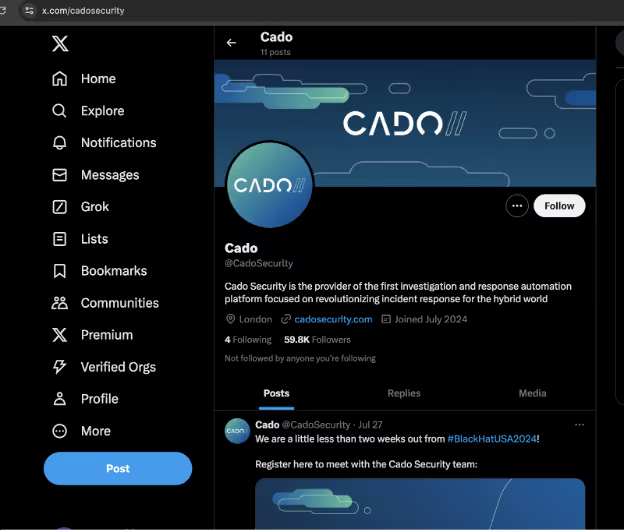
The threat actor also created an X (formerlyTwitter) account as Cado with the typo’d domain mimicking our own X account and in one instance, they had taken it as far as purchasing a Gold Checkmark, adding followers, and following people related to Cado, in order to create a sense of authenticity.

Figure 1: Fake Cado Security account created by threat actor using typo'd username
Figure 2: Fake Cado Security account profile created by threat actor using typo'd username
As seen with the other tech related companies that were also victims of the same domain registration typo activity, Cado found the threat actor had also created X accounts for some of those companies as well.
Actions speak louder than words
When Cado identified that the malicious domain was redirecting to its website, the following proactive actions were taken:
Informed all staff about the current situation and reminded them of the actions they should take. Fostering a security-conscious culture where everyone plays their part in defending against cyber threats is key for a business’ cyber security posture. Ensure your cyber security training is always updated to reflect the latest threats, and that staff are briefed on a routine basis. By investing time and resources into employee cybersecurity education, businesses can significantly reduce the risk of a breach, protect sensitive information, and maintain smooth operations.
Searched for any emails originating from the malicious domain, and implemented alerting and a block for future emails. By doing so, threat actors were unable to send malicious content or phishing attempts to staff inboxes. This step not only protects team members, but also limits the potential damage caused by any malicious emails.
Reported the activity to the DNS registrar who subsequently suspended the domain. By taking this action, not only was the issue addressed at hand, but it also contributed to the overall security of the internet by having a potentially malicious domain taken offline.
Additional typosquatting domains identified
Where possible the organizations included below have all been alerted regarding these fraudulent domains.
URLs
biaizetech[.]com
cadosecurlty[.]com
changeliy[.]com
ciickup[.]com
elliptlc[.]com
miikroad[.]com
ogiivy[.]com
q0nt0[.]com
raiiwayapp[.]com
scrlb3[.]com
sh0rtcut[.]com
slgmaprime[.]com
slnglegrain[.]com
spndesk[.]com
twinmotlon[.]com
tlnulti[.]com
0penraven[.]com
IP addresses
94[.]154[.]35[.]15
The key takeaway
This discovery underscores the importance of staying vigilant and proactive in protecting against such potential threats. It also highlights the need to monitor domain registrations, especially those that closely resemble our own, as well as staying abreast of the latest cybersecurity trends and best practices. By being aware of these potential risks and taking adequate measures to secure our domains, teams can collectively work towards mitigating the impact of such activities on organizations and the broader tech industry.
Darktrace cyber analysts are world-class experts in threat intelligence, threat hunting and incident response, and provide 24/7 SOC support to thousands of Darktrace customers around the globe. Inside the SOC is exclusively authored by these experts, providing analysis of cyber incidents and threat trends, based on real-world experience in the field.
How to Evaluate AI Vendors: 5 Key categories for AI Adoption
Understanding the AI buyers’ market
AI adoption has become a central topic of discussion in boardrooms, drawing growing interest from business leaders. Ultimately, organizations hope that an investment in AI technology will have tremendous returns. However, the process of buying an AI solution is not as straight forward as it appears on the surface.
While business leaders may be eager to improve productivity across their operations, practitioners responsible for evaluating and selecting AI solutions may not always have the visibility or technical understanding needed to make the right decisions for their business. What is typically marketed as a holistic solution to their most critical problems is usually followed by uncertainty when AI tools are finally operationalized in real environments.
This guide is intended to support security leaders who are under growing pressure to adopt AI tools while navigating complex terminology, vendor claims, and increasingly crowded buying cycles. Ultimately, the goal is to help organizations evaluate and adopt AI in a safe, effective, and well-governed way. To support this, we’ve structured the evaluation framework across five key categories:
Governance, safety, and data controls
Data gathering and training
Model and technique choice
Performance and accuracy validation
Interpretability, adjustability, and transparency
What buying AI looks like in cybersecurity
While investing in AI can bring immense benefits to your security team, first-time buyers of AI cybersecurity solutions may not know where to start. They will have to determine the type of tool they want, know the options available, and evaluate vendors. Research and understanding are critical to ensure purchases are worth the investment.
With acceleration in AI adoption, accompanied by the recent boom in agentic AI and autonomous agents, CISOs must look “beneath the hood" of these tools to understand how they work, how they are governed, and to ensure the system is secure and compliant with internal policies.
Challenges in the AI buyers’ marketplace
The AI security software market is buzzing with hype and flashy promises, which, understandably, needs to be addressed with due diligence. Potential buyers, especially in the cybersecurity space, are hesitant when it comes to allowing AI autonomous capabilities across their workflows, and a lack of vendor transparency can exacerbate those feelings.
Reinforcing this sentiment, research from this year's Darktrace’s State of AI Cybersecurity report shows where confidence and hesitancy emerge amongst potential buyers. On the one hand, security professionals agree that they have good visibility into the logic and reasoning processes their AI solutions use. However, they lack the explainability and trust to allow AI to take independent remedial action.
89% say they have good visibility into the reasoning behind the outputs generated by AI solutions
92% say they need to understand how a defensive AI tool makes decisions before they can trust it
Only 14% say they allow AI to act independently, performing autonomous actions without human approval
74% say they are limiting the autonomy of AI taking action in their SOC until explainability improves
Given the desire for trust and explainability we are seeing from buyers, it's important for them to be equipped with the right questions to ask vendors during an assessment or POV of AI tools in order to demystify marketing hype from real operational outcomes.
Below is a list of categories in which buyers can assess AI vendors or AI Service Providers (AISPs) to help reach safe adoption and maximize their ROI.
5 categories of AI vendor assessment
Darktrace groups these AI-related questions into 5 categories: governance, data and training, model and technique choice, performance validation, and interpretability and adjustability. By asking questions regarding each of these 5 categories, buyers can gain a deeper understanding of how an AISP’s systems work and whether they suit their business requirements.
Governance, safety, and data controls
Governance of AI systems is critical for all AISPs. Whether their platform is based around a single model, or is a more complex, composite AI solution, strong governance is essential to ensure the system is safe, robust, and reliable.
A simple question you could ask is:
What AI governance policies and frameworks do you follow, and/or certifications do you currently maintain?
Darktrace is certified to the ISO/IEC 42001 standard, the world’s first AI Management System (AIMS) standard. ISO/IEC 42001 addresses the unique ethical and technical challenges AI poses by setting out a structured way to manage risks such as transparency, accuracy, and misuse. This includes a commitment to ethical AI development, and effective management and monitoring of AI systems both prior to and continually after release.
Data gathering and training
Accurate, meaningful, and unbiased data gathering is the first important step in producing any AI system. An AI model trained using inaccurate, unbalanced, or poor-quality training data will fail to perform optimally.
To alleviate concerns regarding training data quality, a question you could ask is:
What steps do you take to prevent bias in your AI models and training data?
AISPs should be able to provide information about the steps taken, workflows followed, and auditing performed to reduce AI bias where appropriate. While it’s sometimes impossible to fully remove bias from an AI model, appropriate actions should be taken to mitigate or reduce bias where relevant.
Model and technique choice
Different AI techniques are optimal for different tasks. For example, research from Gartner suggests that relying on a single “one-size-fits-all" model can lead to data gaps, especially in highly specialized domains.
To achieve more accurate and robust AI solutions, AI leaders should move beyond using just one model or technique, embrace composite AI practices, and adopt a holistic AI system perspective.
A straightforward question you could ask is simply:
What type(s) of AI model(s) do you utilize in your solution?
While specific detailed information about custom systems used by AISPs is likely proprietary, buyers should expect vendors to be able to provide an overview of the broad techniques used. This will allow you as a buyer to determine if the type of model is appropriate for your use case.
Performance and accuracy validation
Testing and evaluation of performance is essential for all AI systems. Performance analysis should be performed both before release and continually after release to identify potential data or model drift.
A question you could ask to understand an AISPs testing workflow is:
How do you audit, test, evaluate, verify, and validate your AI model outputs?
Testing workflows will likely vary depending on the type of model – measurements relevant to one system may not always be relevant to others. Assessment of systems should also extend beyond these standard accuracy and robustness tests, and should also feature physical performance, such as latency and resource consumption.
Interpretability, adjustability, and transparency
AI systems are typically a black box, simply providing an output without an explanation of how that output was attained. Interpretability and transparency are critical to ensure that both SOC teams and end-users trust the outputs of a system to be accurate and meaningful.
A question you could ask is:
How do you promote a trust relationship between human analysts and AI outputs?
In the context of cybersecurity, trust and interpretability are even more essential. This is particularly relevant for generative AI-based systems (including most AI Agents), where the risk of hallucination can reduce trust in responses.
Cybersecurity systems often need to perform autonomous actions to block incoming threats – an email filtering system may hold potentially dangerous emails; a firewall may block malicious inbound connections. If SOC teams can’t trust these systems to perform accurately, these systems may be limited or disabled, critically reducing their defensive power.
Darktrace as an AI-native cybersecurity vendor
Darktrace has been building and applying AI in cybersecurity for over a decade, developing its capabilities alongside an increasingly complex and fast‑moving threat landscape. This experience has resulted in a mature, multi-layered approach to AI, which continuously learns the normal patterns of each organization to understand behavior, interpret context, and identify meaningful deviations — without relying on predefined rules or known attack signatures. Over time, this has enabled a proven behavioral understanding that helps uncover subtle signals of risk that may otherwise be missed.
With the backing of our ISO/IEC 42001 certification, stakeholders, customers, and partners can be confident that Darktrace is responsibly, ethically, and safely developing its AI systems, and managing the use of AI in day-to-day operations in a compliant and secure manner.
Explore the principles behind Darktrace’s responsible AI approach, informed by collaboration with global experts in academia and governments, detailing how accountability, explainability, and continuous validation are built into its cybersecurity technology.
How Darktrace secures AI systems
Darktrace now brings these capabilities to monitor and respond to risk generated from AI systems across organizations with Darktrace / SECURE AI. This solution analyzes how prompts, agents, and systems are used within the context of each organization, bringing every AI interaction into a single view. This unique approach helps teams understand intent, assess risk, protect sensitive data, and enforce policy across both human and AI agent activity.
Stay up to date
Sign up for the Secure AI Readiness Program here: This gives you exclusive access to the latest news on the latest AI threats, updates on emerging approaches shaping AI security, and insights into the latest innovations, including Darktrace’s ongoing work in this area.
Ready to talk with a Darktrace expert on securing AI? Register here to receive practical guidance on the AI risks that matter most to your business, paired with clarity on where to focus first across governance, visibility, risk reduction, and long-term readiness.
Further Reading on AI in cybersecurity
When deciding to invest in an AI solution, it’s important to understand what this means for you and your organization. The questions presented here are only a starting point in understanding an AI solution and whether it is appropriate for your use case.
Gain deeper knowledge on applications of AI in cybersecurity and Darktrace’s multi-layered AI in the AI Arsenal White Paper.
The CIP-015 Countdown: What Utilities Should Be Doing Before October 2028
CIP-015 what you need to know
The electric sector already knows CIP-015 is coming. The better question is whether utilities are using the time before October 1, 2028 to build an Internal Network Security Monitoring program that is defensible, auditable, and operationally useful.
I have spent most of my OT cybersecurity career around the power sector, from early NERC CIP program work as an asset owner, to consulting with utilities ranging from small municipalities and rural cooperatives to some of the largest power companies in the country, to now working with technology that helps organizations improve visibility and detection across IT and OT. One lesson has been consistent across all of those roles: compliance is not just about having a control in place. It is about being able to prove the control works.
That is where CIP-015 becomes important.
The standard is not simply asking utilities to deploy a tool inside the Electronic Security Perimeter and call the job done. CIP-015 is about improving the probability of detecting anomalous or unauthorized network activity so that organizations can improve response and recovery from an attack. That purpose is directly stated in the standard itself. (NERC)
The real work between now and October 2028 is not just buying technology. It is building an INSM capability that can collect the right data, detect meaningful activity, support evaluation, retain the right evidence, and protect that evidence from unauthorized deletion or modification.
Why CIP-015 exists
CIP-015 exists because perimeter security alone does not solve the internal visibility problem.
For years, many CIP controls have focused heavily on access management, segmentation, patching, logging, training, and other security practices that help reduce the likelihood of unauthorized access. Those controls still matter. But they do not fully answer what happens after an attacker, insider, compromised vendor account, misused credential, or malicious activity is already operating inside a trusted environment.
NERC’s technical rationale explains that Internal Network Security Monitoring focuses on the collection and analysis of network communications inside a “trust zone,” such as an ESP. In other words, CIP-015 is not only about defending the edge. It is about understanding what is happening inside the environment once traffic is already within the trusted zone. (NERC)
That is the internal visibility gap utilities need to close.
Why traditional security monitoring does not fully satisfy CIP-015
One mistake utilities should avoid is assuming that existing security event monitoring automatically solves CIP-015.
Many organizations already have logging programs tied to CIP-007, SIEM use cases, host-level security events, authentication logs, malware alerts, and incident response workflows. Those capabilities remain valuable, but they are not the same as Internal Network Security Monitoring.
Security event monitoring often tells you what happened on or to a system. INSM is intended to help show what is happening between systems, across network communications, devices, connections, and internal traffic patterns. That distinction is especially important in OT environments where adversaries may use legitimate pathways, valid credentials, native protocols, remote access, engineering workstations, or trusted systems to move inside the environment.
CIP-015 pushes utilities toward a different level of visibility: not just “did a system log something,” but “can we see and evaluate anomalous or unauthorized activity occurring inside the ESP?”
What CIP-015 requires
At a high level, CIP-015-1 requires three core capabilities.
First, under Requirement R1, Responsible Entities must implement, using a risk-based rationale, network data feeds to monitor network activity, including connections, devices, and network communications. They must also implement one or more methods to detect anomalous network activity using those feeds, and one or more methods to evaluate detected anomalous activity to determine further actions.
Requirement R2: Retaining INSM data for investigations
Second, under Requirement R2, entities must retain INSM data associated with anomalous network activity at least until the related evaluation and action are complete. The standard also notes that entities are not required to retain INSM data that is not relevant to detected anomalous activity.
Requirement R3: Protecting monitoring data from tampering
Third, under Requirement R3, entities must protect INSM data collected for R1 and retained for R2 from unauthorized deletion or modification.
Those requirements may sound straightforward, but implementation is where the challenge begins.
What should utilities be asking themselves for CIP-015?
Where are we collecting network data inside the ESP, and why are those feeds defensible?
What methods are we using to detect anomalous network activity?
How do we distinguish meaningful anomalous behavior from normal operational change?
Who evaluates detections, and how are decisions documented?
What data is retained, and how is it protected from unauthorized deletion or modification?
Can we produce evidence that proves this process has worked over time?
Those answers matter because auditors will not be looking for marketing claims. They will be looking for evidence.
Why anomaly detection is central to CIP-015 compliance
One of the most important parts of CIP-015 is also one of the easiest to oversimplify: the word anomalous.
NERC’s technical rationale provides useful context. It explains that, as used in CIP-015, “anomalous” refers to unexpected, undesired, unusual, or undetermined network traffic. It also makes clear that the term does not refer to any single proprietary technology commonly marketed as “anomaly detection.”
Understanding static baselines vs true anomaly detection
A static baseline is not the same thing as meaningful anomaly detection. If a platform observes traffic for a limited period of time, assumes that observed behavior is “normal,” and then flags future deviations without deeper context, the result can be noisy, brittle, and operationally frustrating.
In real OT environments, “normal” is not fixed. Maintenance windows, vendor access, failovers, engineering changes, testing activity, backup jobs, and operational shifts can all change behavior. Detection has to keep learning and understand context. Otherwise, the organization may end up with alerts that are technically anomalous but not practically useful.
CIP-015 is not just about producing anomalies. It is about producing meaningful detections that can be evaluated, documented, and acted upon.
What should utilities consider when looking for anomaly detection tools
Some technologies were built around behavioral analysis and anomaly detection long before CIP-015 existed. What practitioners should look for is if the technology behind the phrase can identify meaningful deviations, provide context, reduce noise, and support the evaluation and evidence expectations of the standard.
Utilities should be cautious of vendor positioning that treats “anomaly” as a simple compliance keyword. This is especially important when evaluating tools historically built around signature-based, threat-based, or rule-based detection methods that are now being positioned as anomaly detection because CIP-015 uses the term.
A platform does not solve CIP-015 simply because it can baseline traffic or generate alerts when something changes.
The question is not: Can this tool create alerts?
The question is: Can this tool identify meaningful anomalous activity with enough context, prioritization, and evidence to support evaluation and response?
Why evidence and audit readiness matter for CIP-015
In NERC CIP, the control is only part of the story. Evidence is the part that proves the control existed, worked, and was followed.
That is why CIP-015 readiness should not be treated as a simple deployment project. It should be treated as a compliance operations and evidence program.
What auditors will expect utilities to prove
For R1, examples of evidence include documentation of network data feeds and the risk-based rationale for selecting them, anomalous network detection events, INSM configuration settings, communication baselines or other detection methods, methods used to evaluate anomalous activity, and actions taken in response to detected anomalies.
For R2, evidence may include documentation of the retention process, system configurations, or system-generated reports showing retention timelines sufficient to support evaluation. For R3, evidence may include documentation showing how INSM data is protected from unauthorized deletion or modification.
Common evidence gaps that can create compliance risk
If an entity implements a platform that generates noisy detections, lacks context, does not retain the right data, cannot demonstrate how data is protected, or cannot produce useful audit evidence, the issue may not become obvious until much later. By then, an organization may discover during an audit that it cannot prove what it thought it had implemented.
That is a bad place to be.
CIP evidence gaps can create exposure that goes back over time, not just to the day the audit finding is discovered. This is why utilities need to validate the process early. Do not wait until an audit cycle to find out whether your INSM approach can stand up to scrutiny.
How utilities should prepare for CIP-015 before 2028
October 2028 may sound far away, but in utility planning terms, it is not.
Utilities should already be moving through a structured readiness process.
Assessing internal network visibility across trusted environments
Start with scope. Identify the applicable High and Medium Impact BES Cyber Systems, the relevant ESPs, and the environments where INSM requirements will apply. Then map current visibility. Where do you already have useful network monitoring? Where are you relying mostly on logs, perimeter controls, or assumptions? Where do you have limited east-west visibility inside trusted environments?
Building a defensible network data feed strategy
Next, define the network data feed strategy. CIP-015 requires a risk-based rationale, so the organization should be able to explain why specific feeds were selected and how they support detection of anomalous activity across relevant connections, devices, and communications.
Validating anomaly detection workflows
Then validate the detection method. This is where utilities need to go deeper than vendor claims. Ask how the platform identifies anomalous activity. Ask how it reduces noise. Ask what context is provided for evaluation. Ask how it handles changes in normal operations. Ask what evidence is retained and how that evidence can be produced.
Testing evidence retention and protection processes
After that, build the evaluation workflow. Who reviews detections? How are anomalies classified as benign, abnormal but not suspicious, suspicious, or potentially malicious? When does an event move into CIP-008 incident response? What documentation is created during that process?
Finally, test evidence production. Utilities should be able to show detection records, configuration settings, evaluation notes, response actions, retention records, and data protection controls before an auditor asks for them.
Where Darktrace Fits into CIP-015
This is where technology matters, but only as part of the broader program.
Darktrace was built on self-learning anomaly detection long before CIP-015 created a new compliance driver around anomalous network activity. Its value is rooted in continuous behavioral understanding, multiple analytical techniques, and the ability to identify meaningful deviations across complex IT and OT environments. That matters because CIP-015 requires more than basic alerting. It requires detection that supports evaluation, evidence, and action.
This IT and OT visibility is especially important in power utility environments. High and Medium Impact environments are not made up only of industrial protocols and field devices. Control centers, operational workstations, engineering workstations, servers, remote access systems, domain services, printers, and other enterprise-class assets often sit inside or adjacent to critical operational environments. A useful INSM capability should understand a wide range of communications across both IT and OT, not only traditional industrial protocols like Modbus, DNP3, or IEC 61850.
That distinction matters because “protocol support” can mean very different things. Identifying that a protocol is present is not the same as performing deeper packet analysis that can provide behavioral context, richer protocol understanding, and meaningful detection across the communications actually used inside the environment. For CIP-015, utilities should be asking whether a platform can help evaluate activity across both enterprise and industrial communications, because real power utility environments are rarely “OT-only.”
This is also why utilities should look carefully at how vendors use the word “anomaly.” Some platforms were designed around behavioral understanding and anomaly detection long before CIP-015 created a new compliance driver. Others may now be adopting the language because the standard uses the term. The difference matters. Utilities should ask whether the platform’s detection approach is foundational to the technology, or simply a new label applied to existing signature-based, threat-based, or rule-based methods.
In OT environments, detection quality matters. Utilities do not need more noise. They need visibility into internal communications, confidence in what is normal, context when something changes, and prioritization that helps security and operations teams focus on what matters.
A strong INSM program should help utilities move from raw monitoring to operational confidence. It should support east-west visibility, better anomaly evaluation, defensible evidence retention, protection of monitoring data, and alignment between compliance and security outcomes.
That is the right way to think about CIP-015.
Not as “deploy a tool and move on.”But as “build a capability that can be trusted, operated, and proven.”
CIP-015 is about proving your INSM capability works
The CIP-015 countdown is real, but the countdown itself is not the whole story.
The real story is what utilities do with the time that remains.
Organizations that treat CIP-015 as a checkbox may be able to say they deployed something. But organizations that treat it as an opportunity to close the internal visibility gap will gain something much more valuable: better detection, better response, better evidence, and stronger operational resilience.
The question utilities should be asking now is not whether they can produce more alerts before October 2028.
The question is whether they can prove their INSM capability actually works.