AI Posture Management
AI posture management
Enterprises are rapidly adopting artificial intelligence and Large Language Models (LLMs) to drive innovation, but this expansion creates a vast and complex new attack surface. Traditional security measures for conventional IT infrastructure are insufficient to manage the unique risks associated with AI systems, including data poisoning, model theft, and prompt injection attacks.
AI Security Posture Management (AI-SPM) provides the essential framework for gaining visibility, assessing risk, and enforcing governance across an organization's entire AI ecosystem, enabling secure innovation at scale.
What is AI security posture management?
AI-SPM is a continuous process of discovering, analyzing, and securing AI models and applications, as well as the associated data pipelines that power them. Unlike reactive security approaches that address threats after they emerge, AI-SPM provides proactive oversight of an organization's entire AI landscape, identifying vulnerabilities before they can be exploited.
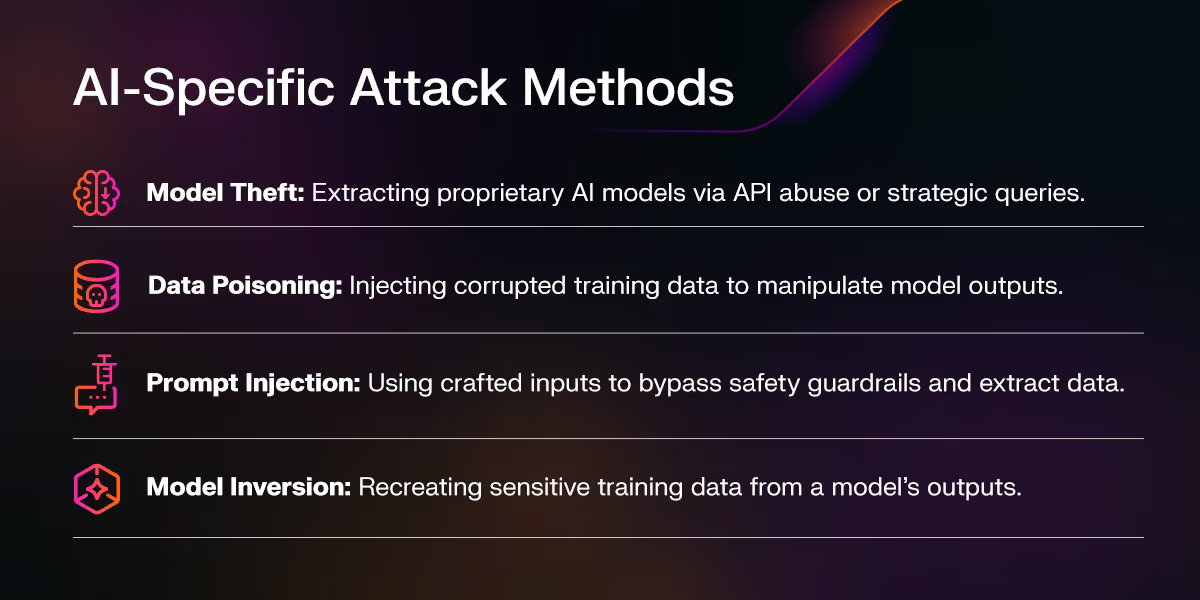
AI-SPM differs from related security disciplines like Cloud Security Posture Management (CSPM) and Data Security Posture Management (DSPM). While CSPM addresses cloud infrastructure misconfigurations and DSPM focuses on data access and classification, AI-SPM deals with AI-specific attack methods, such as:
- Model theft: Adversaries extracting proprietary AI models through API abuse or adversarial queries
- Data poisoning: Adversaries injecting corrupted training data to manipulate model behavior and outputs
- Prompt injection attacks: Exploiting LLM vulnerabilities by crafting inputs that override safety guardrails or extract sensitive information
- Model inversion: Reverse-engineering training data from model outputs to expose confidential information
Why AI-SPM is critical
The rapid integration of AI into business-critical operations has fundamentally altered the threat landscape. Security teams face three interconnected challenges that make AI posture management essential for maintaining organizational resilience.
Protecting against emerging AI-specific threats
Unlike conventional applications where security teams defend against known exploits, AI models can be compromised through mathematical manipulation of their learning processes, making attacks invisible to signature-based detection.
Organizations face emerging attack methods that bypass traditional defenses:
- Membership inference attacks: Determining whether specific data points were used in model training, potentially exposing sensitive customer or proprietary information
- Model extraction attacks: Creating functional replicas of proprietary models through strategic querying, undermining competitive advantages
- Adversarial examples: Crafting inputs that cause models to produce incorrect or manipulated outputs while appearing legitimate to human observers
- Shadow AI exploitation: Unauthorized AI tools and applications operating outside IT oversight, creating unmonitored attack surfaces and compliance gaps
Ensuring data security and governance
AI systems possess immense data gravity. They ingest, process, and learn from datasets containing sensitive business intelligence, customer information, and proprietary knowledge. AI data pipelines create multiple exposure points where inadequate controls can lead to significant breaches, making data security posture management for AI essential.
Without proper governance, AI systems may memorize training data and reveal it in responses, or allow adversaries to reconstruct confidential information through inference attacks.
AI-SPM enforces data governance policies throughout the AI life cycle:
- Training data controls: Implementing restrictions on which datasets can be used for specific AI applications based on sensitivity classification
- Access management: Setting granular permissions that limit who can interact with models and what data they can query
- Output monitoring: Detecting data leakage in model responses to prevent exposure of confidential information
- Compliance enforcement: Ensuring AI systems adhere to data residency and privacy requirements across jurisdictions
Navigating complex regulatory and compliance demands
The regulatory landscape for AI is evolving rapidly, encompassing both mandatory legal frameworks like the EU AI Act and voluntary principles like the NIST artificial intelligence risk management framework. Organizations deploying AI systems must demonstrate that they maintain appropriate oversight, implement necessary safeguards, and can document their AI governance practices.
AI-SPM provides the compliance capabilities organizations need to meet emerging regulatory requirements:
- Asset inventory: Maintaining comprehensive catalogs of AI systems, their purposes, and risk classifications
- Behavior documentation: Recording model decision-making processes and performance metrics for audit trails
- Policy enforcement: Implementing governance controls consistently across the entire AI ecosystem
- Assessment support: Providing the monitoring and documentation infrastructure required for conformity assessments under regulations.
Core components of an AI-SPM strategy
Effective AI security posture management rests on four interconnected components that together create a comprehensive framework for securing AI systems throughout their life cycle.
Discovery and inventory of AI assets
The foundation of any effective AI-SPM program is complete visibility into the organization's AI footprint. Security teams must discover and inventory all AI assets across the enterprise, including production models, development environments, data sources, and third-party AI services integrated into business workflows.
This visibility challenge intensifies in environments where development teams deploy models across multiple cloud platforms, edge devices, and on-premises infrastructure. Each deployment point represents a potential exposure that initial AI-SPM assessments often reveal.
Employees also adopt unauthorized AI tools without formal approval, creating shadow AI that introduces visibility gaps. Comprehensive asset discovery identifies these implementations, documents their data access patterns, and brings them under governance controls.
Risk assessment and prioritization
Once AI assets are identified, AI security posture management tools analyze models and infrastructure for misconfigurations, vulnerabilities, and potential misuse scenarios. This assessment examines multiple risk dimensions:
- Data sensitivity: Evaluating the confidentiality level of information processed by each AI system
- Business impact: Assessing potential consequences of model compromise or manipulation on operations
- Accessibility: Determining how easily adversaries could reach and exploit AI systems
- Control adequacy: Reviewing whether existing security measures sufficiently protect against identified threats
Risk prioritization ensures that security teams focus remediation efforts where they matter most. A customer-facing chatbot trained on public data requires different controls than a proprietary algorithm processing confidential intelligence. AI-SPM frameworks evaluate exploitability alongside business impact, enabling organizations to address critical vulnerabilities first while managing resources efficiently.
Policy enforcement and guardrail implementation
AI-SPM enforces security policies and establishes guardrails that govern AI development, deployment, and operation. These controls operate throughout the AI life cycle, preventing security gaps from emerging as models move from development into production environments.
Policy enforcement mechanisms include:
- Model access controls: Setting granular permissions restricting who can deploy, query, or modify sensitive AI systems
- Data usage restrictions: Defining which datasets are permissible for training specific model types based on sensitivity and compliance requirements
- Rate limiting: Implementing query throttling to prevent model extraction attacks through systematic probing
- Approval workflows: Requiring security review before new models can be deployed to production environments
Continuous monitoring and threat detection
Real-time monitoring of the AI pipeline is essential for identifying attacks in progress and responding before damage occurs. AI-SPM platforms observe AI system behavior in real time, establishing baseline patterns and detecting anomalies that indicate potential security incidents.
Continuous monitoring identifies multiple threat indicators, including:
- Unusual query patterns
- Prompt injection attempts
- Data exfiltration indicators
- Model behavior drift
This ongoing analysis strengthens the overall AI-SPM program, informing policy updates and exposing new attack surfaces.
Secure your AI ecosystem with Darktrace / SECURE AI
As AI becomes integral to business operations, organizations need unified oversight of their AI ecosystem. AI security posture management provides the proactive framework necessary to innovate securely.
Darktrace / SECURE AI is foundational to this approach, providing visibility over how and where AI is used, understanding how it behaves, and intervening when that behavior deviates from what is expected. This allows organizations to embrace AI with confidence, knowing their AI ecosystem is actively monitored and protected.
Learn more about how Darktrace / SECURE AI provides comprehensive visibility and control across your AI landscape.