

Blog
/
Network
/
September 24, 2026

A Chain Reaction: Blockchain-Hosted Infostealer Campaign Targets Windows and macOS

Darktrace detected a blockchain-hosted infostealer campaign targeting Windows and macOS devices, combining ClickFix social engineering with the abuse of legitimate services such as GitHub, blockchain infrastructure, and DGA C2 endpoints to evade disruption and support malware delivery.
Inside the SOC
Darktrace cyber analysts are world-class experts in threat intelligence, threat hunting and incident response, and provide 24/7 SOC support to thousands of Darktrace customers around the globe. Inside the SOC is exclusively authored by these experts, providing analysis of cyber incidents and threat trends, based on real-world experience in the field.
Written by
Nahisha Nobregas
Associate Principal Cyber Analyst & Team Lead
Default blog image
24
Sep 2026

Key Insights

  • Darktrace detected a blockchain-hosted infostealer campaign targeting Windows and macOS devices across multiple customer environments.
  • The campaign combined ClickFix social engineering with trusted services and decentralized blockchain infrastructure to support malware delivery and C2 activity.
  • Compromised devices were observed connecting to rare and unusual external endpoints, including DGA C2 domains, blockchain-related endpoints, and cryptocurrency mining infrastructure.
  • The activity was associated with information-stealing malware strains including Atomic macOS Stealer (AMOS), Lumma, Rhadamanthys, Vidar, and Phexia.
  • Darktrace identified anomalous device behavior, beaconing patterns, rare external connections, cryptomining activity, and suspicious TLS/SSL communications without relying solely on prior knowledge or static indicators of compromise.
  • The campaign highlights how attackers are increasingly using legitimate and decentralized infrastructure to make detection, disruption, and attribution more challenging for defenders.

The Infostealer Ecosystem

The information stealer malware ecosystem continues to grow in value for threat actors across the digital threat landscape. Infostealers are increasingly delivered through Malware-as-a-Service (MaaS) operating models, distributed through affiliate networks, and designed to withstand infrastructure takedowns. This resilience was demonstrated by the recent takedown of Lumma Stealer malicious domains by Microsoft’s Digital Crimes Unit (DCU) [1].

Infostealers are used to gather and exfiltrate sensitive information, including non-human identity (NHI) data, from compromised systems across cloud, Software-as-a-Service (SaaS), Virtual Private Network (VPN), and development environments. They can also support ransomware operations by expanding the credentials and access paths available to threat actors, contributing to the high volume of identity-based attacks observed across the broader threat landscape [2][3].

Darktrace’s Observations of ClickFix and Infostealers

Throughout 2026, Darktrace has observed multiple campaigns using ClickFix social engineering to trick users into carrying out malicious actions and downloading initial payloads, including information stealers. More recently, Darktrace’s Threat Research team identified a specific ClickFix campaign involving a blockchain-hosted infostealer targeting Windows and macOS devices.

Darktrace identified affected customer environments across Europe, the United States, Asia, and the Middle East where blockchain-hosted infostealer malware appears to have been delivered to compromised systems following likely ClickFix-driven initial access. Darktrace investigated the activity and found that decentralized blockchain infrastructure, alongside widely trusted legitimate services, was used to support malware delivery and information theft across Windows and macOS systems.

Following initial access, compromised systems established C2 communication, with C2 configuration and payloads hosted on public blockchain infrastructure. The ultimate objective appears to be credential and cryptocurrency theft through the deployment of information stealers such as Atomic macOS Stealer (AMOS), Lumma, Rhadamanthys, and Vidar [5][6][7].

Darktrace’s Investigation

Affected devices across the Darktrace customer base were observed making outbound connections to rare external endpoints in patterns consistent with beaconing and C2 activity. Darktrace primarily detected devices making repeated connections to algorithmically generated domains (DGA) such as hf98x4d[.]site [8]. In many cases, these domains were linked through open-source intelligence (OSINT) to information-stealing malware families including AMOS and Phexia [5][6][7][8][9].

In multiple cases, devices were also observed connecting to blockchain-related endpoints, such as polygon[.]drpc[.]org, as well as legitimate public services, including GitHub. The use of decentralized blockchain infrastructure and trusted services such as GitHub to facilitate malware distribution and C2 activity can make disruption and attribution significantly more difficult for defenders.

Darktrace also detected a significant proportion of impacted devices making outbound connections to cryptocurrency mining infrastructure associated with the legitimate open-source XMRig mining software and the HashVault mining pool, including pool.hashvault[.]pro and donate[.]ssl[.]xmrig[.]com, which were abused by the attackers, including pool.hashvault[.]pro and donate[.]ssl[.]xmrig[.]com, indicating active cryptomining on compromised systems.

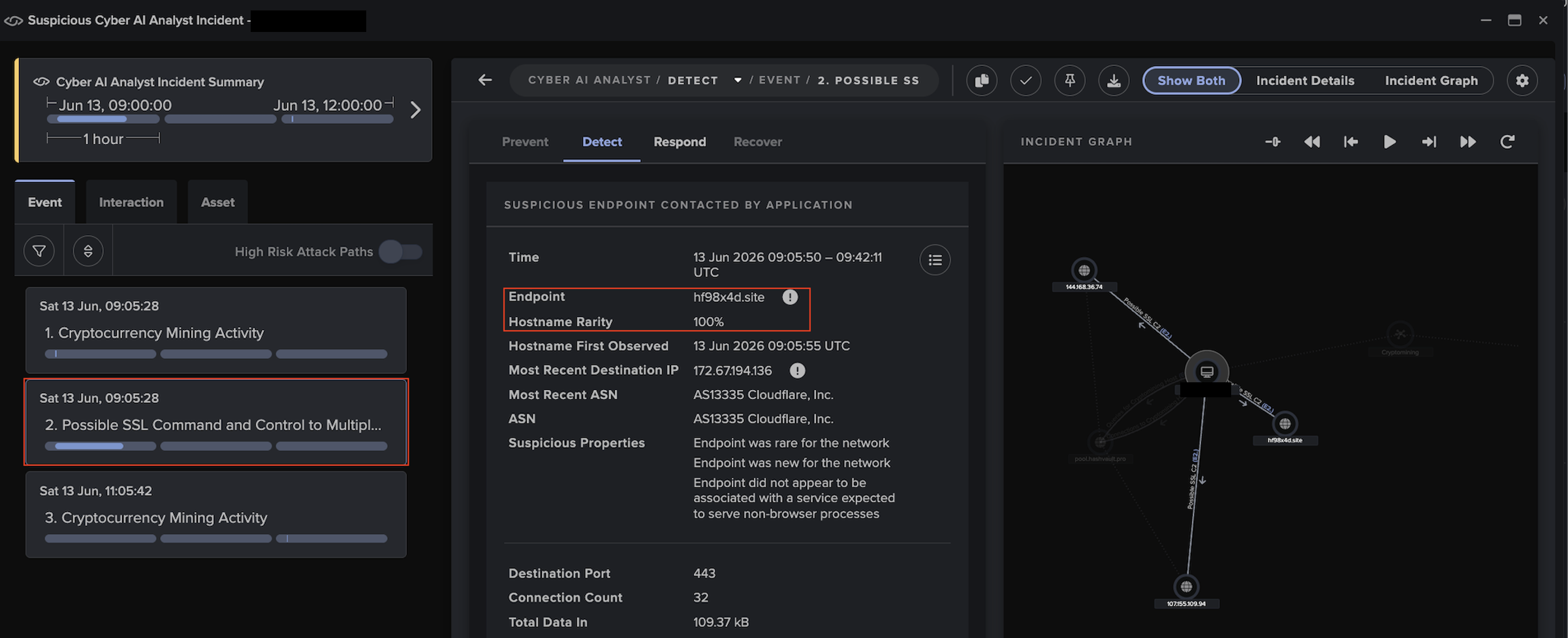
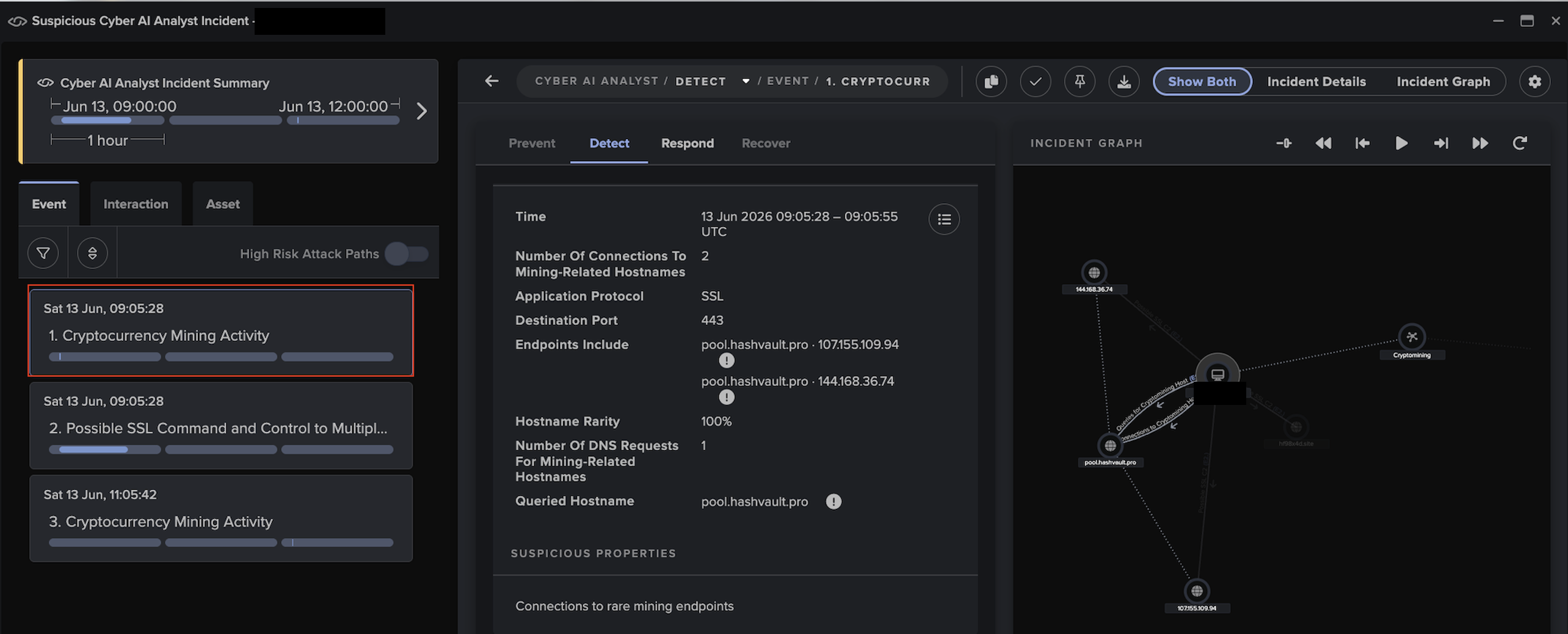
In one case, mining activity was observed before and during connections to the DGA endpoint hf98x4d[.]site. Due to its highly anomalous nature, Darktrace's Real-Time AI Analyst autonomously investigated the activity as it occurred, correlating the two events into a single cryptocurrency mining incident and providing comprehensive visibility into the broader attack.
‍

Figure 1: Real-Time AI Analyst investigation of suspicious SSL and C2 communications with hf98x4d[.]site over port 443.

‍

Figure 2: Real-Time AI Analyst investigation into cryptocurrency mining activity involving pool[.]hashvault[.]pro over SSL on port 443.

‍

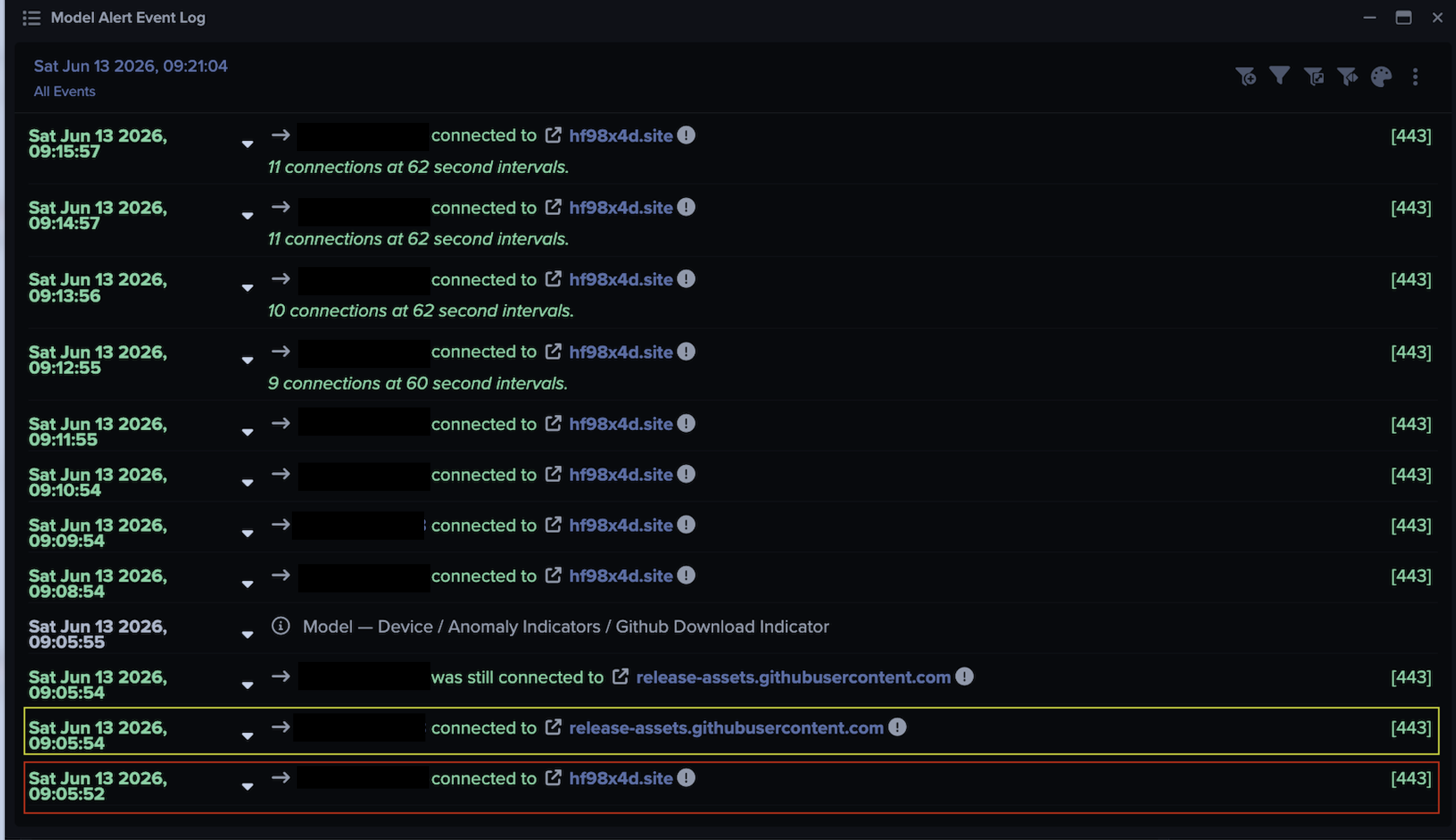
Around the same time, Darktrace identified the same device initiating connections to the GitHub endpoint release-assets[.]githubusercontent[.]com while continuing to make repeated connections to hf98x4d[.]site.
‍

Figure 3: Darktrace's detection of an affected device connecting to a GitHub endpoint between repeated connections to the anomalous external endpoint hf98x4d[.]site.

On the network of another customer, Darktrace observed an affected device making highly unusual outbound connections consistent with beaconing activity. The device initiated multiple connections over port 443 to the external hostname polygon[.]drpc[.]org. According to OSINT, this hostname is a Remote Procedure Call (RPC) endpoint provided by dRPC, a legitimate service enabling decentralized applications (dApps), cryptocurrency wallets, and developer tools to interact with the Polygon blockchain [10].

The same device was later observed making repeated TLS/SSL connections to the previously mentioned DGA C2 domain. In addition, it made outbound connections to the external IP 195.242.214[.]34 over destination port 51820, an endpoint associated with the ProtonVPN service. Collectively, these connections to blockchain-related infrastructure, the DGA C2 domain, and ProtonVPN-associated infrastructure suggested the device had been affected by the campaign.

Conclusion

This campaign demonstrates how attackers can combine ClickFix social engineering with trusted services and decentralized blockchain infrastructure to create a resilient, cross-platform malware delivery chain. By using services such as GitHub alongside blockchain RPC endpoints and rapidly replaceable DGA domains, the activity can blend into legitimate traffic while making infrastructure disruption and attribution more difficult.

For defenders, it’s a reminder that trusted infrastructure does not automatically mean trusted activity. Security teams should look for the behaviors surrounding these connections, including unusual outbound communication, repeated beaconing, unexpected access to blockchain services, suspicious TLS/SSL activity and cryptomining. In this campaign, Darktrace identified and correlated these deviations without depending solely on previously known indicators, providing visibility as affected devices moved between legitimate services, decentralized infrastructure and malicious C2 endpoints

Credit to Nahisha Nobregas (Associate Principal Cyber Analyst), Manoel Kadja (Senior Cyber Analyst)

Edited by Ryan Traill (Content Manager)

Appendices

Darktrace Model Detections

▪ Compromise / Beaconing Activity To External Rare

▪ Compromise / Beacon to Young Endpoint

▪ Compromise / Fast Beaconing to DGA

▪ Compromise / High Volume of Connections with Beacon Score

▪ Compromise / DGA Beacon

▪ Compromise / Slow Beaconing Activity To External Rare

▪ Compromise / Agent Beacon (Long Period)

▪ Compromise / Agent Beacon (Medium Period)

▪ Compromise / Sustained SSL or HTTP Increase

▪ Compromise / Large Number of Suspicious Failed Connections

▪ Compromise / SSL Beaconing to Rare Destination

▪ Compromise / Beacon for 4 Days

▪ Compromise / High Priority Crypto Currency Mining

▪ Compromise / Monero Mining

▪ Device / Long Agent Connection to New Endpoint

▪ Device / New Connections On Suspicious Port

▪ Anomalous Connection / High Volume of Connections to Rare Domain

‍

‍

List of Indicators of Compromise (IoCs)

 
Indicator Description
hf98x4d[.]site C2 Endpoint (Hostname)
sj98xe4[.]xyz C2 Endpoint (Hostname)
citcix6[.]xyz C2 Endpoint (Hostname)
bduwih8[.]pro C2 Endpoint (Hostname)

‍

‍

MITRE ATT&CK Mapping

 
Tactic (ID) Technique
Persistence (T1176) Browser Extensions (T1176.001)
Persistence (T1176) Software Extensions
Command and Control (T1071) Web Protocols (T1071.001)
Command and Control (T1568) Domain Generation Algorithms (T1568.002)
Command and Control (T1071) Application Layer Protocol
Command and Control (T1102) One-Way Communication (T1102.003)
Command and Control (T1571) Non-Standard Port
Command and Control (T1104) Multi-Stage Channels
Command and Control (T1573) Encrypted Channel
Command and Control (T1008) Fallback Channels
Initial Access ICS (T0862) Supply Chain Compromise
Command and Control ICS (T0885) Commonly Used Port
Collection (T1185) Browser Session Hijacking
Impact (T1496) Compute Hijacking (T1496.001)
Impact (T1496) Resource Hijacking
Command and Control (T1071) Publish/Subscribe Protocols (T1071.001)
Lateral Movement (T1210) Exploitation of Remote Services

‍

References:

1.        https://www.microsoft.com/en-us/security/blog/2025/05/21/lumma-stealer-breaking-down-the-delivery-techniques-and-capabilities-of-a-prolific-infostealer/

2.        https://spycloud.com/resource/report/spycloud-annual-identity-exposure-report-2026/

3.        https://www.darktrace.com/blog/why-trust-is-the-new-attack-surface-darktraces-mid-year-threat-update-2026

4.        https://www.darktrace.com/blog/unpacking-clickfix-darktraces-detection-of-a-prolific-social-engineering-tactic

5.        https://abekweng.medium.com/inside-a-blockchain-hosted-malware-campaign-targeting-windows-and-macos-f5bcdeffed66

6.        https://cloud.google.com/blog/topics/threat-intelligence/unc5142-etherhiding-distribute-malware

7.        https://haveibeensquatted.com/blog/from-typosquatting-to-macos-backdoor-clickfix-blockchain-c2

8.        https://www.virustotal.com/gui/domain/hf98x4d.site/community

9.        https://x.com/FABO97662188/status/2074125545026244795

10.  https://www.virustotal.com/gui/url/b0e5c51a411065864119c305fddf218b7c120731f655932cc1c3307ad5b43f94/gti-summary

Inside the SOC
Darktrace cyber analysts are world-class experts in threat intelligence, threat hunting and incident response, and provide 24/7 SOC support to thousands of Darktrace customers around the globe. Inside the SOC is exclusively authored by these experts, providing analysis of cyber incidents and threat trends, based on real-world experience in the field.
Written by
Nahisha Nobregas
Associate Principal Cyber Analyst & Team Lead

More in this series

No items found.

Blog

/

AI

/

November 24, 2026

Black Friday phishing rises more than 1,200% ahead of holiday shopping weekend

Default blog imageDefault blog image

Black Friday creates conditions in which a fraudulent message can look routine. Shoppers expect promotional emails, unfamiliar sellers compete for attention, and limited-time offers encourage quick decisions. A fake discount or delivery notification can blend into those messages. The deception can continue after payment, through delivery, returns and customer support.

Darktrace’s latest analysis shows an increase in Black Friday phishing, with emails often concentrated into short periods. Between November 1 and 21, average daily volumes were more than 13 times those recorded in October. Among businesses receiving significant volumes, many received most of their Black Friday phishing emails on just a handful of days.

The risks also extend beyond the inbox. AI shopping assistants can help people compare prices and choose sellers, but their recommendations may draw on fabricated reviews or manipulated webpages. For shoppers and retailers, checking who and what to trust now includes the information behind an assistant’s recommendation.

Black Friday phishing volumes and delivery patterns  

The Black Friday phishing total for November 1–21 reached nine times the total recorded throughout October. In the six days to November 21, daily volumes were nearly 3 times those of the previous week. The daily average for Christmas-themed phishing also rose 117% over the period from October through Nov. 21.

Among businesses in the US and Canada, Black Friday phishing volumes in the week beginning November 16 reached nearly 27 times the October weekly average. Among businesses in EMEA, volumes reached nearly 12 times the October weekly average.

Black Friday themes also accounted for a growing share of phishing impersonating the global consumer brands tracked. Among phishing emails impersonating Amazon, Apple, eBay, Netflix, Alibaba and PayPal, nearly 13% were also flagged as likely Black Friday-related during November 16–21, roughly one in eight. That compares with 0.3% in October and 8% across November 1–21.

For businesses experiencing bursts, emails arrived on fewer days than expected, even after accounting for the seasonal rise in activity and weekday patterns. Across businesses receiving significant volume, half received at least 85% of their Black Friday phishing emails on just three days.

Retailers can be impersonated through websites and email infrastructure outside their control. An attacker can copy a brand’s name, imagery and promotional style without gaining access to the retailer’s systems. Being impersonated by attackers does not indicate that a brand’s own systems or services have been compromised.

Seasonal offers make suspicious requests harder to judge

Black Friday can make a risky decision feel reasonable. Someone trying to stretch a limited budget may spend longer searching for a gift, consider a retailer they have never used before or feel pressure to secure a discount before it disappears.  

Legitimate retailers use countdown timers, low stock warnings and delivery deadlines too. Urgency alone is therefore a poor way to distinguish a genuine offer from a scam. Excitement about finding the right gift can encourage a quick decision just as effectively as anxiety about a missing package.

Scams can also reach shoppers after a genuine purchase. Real delays and split orders make fake delivery problems believable. Returns and refunds create further openings, as do offers of help from someone impersonating customer support. A request to confirm an address or resolve a refund can feel like a routine part of the purchase.  

How AI shopping assistants can be manipulated

People are increasingly turning to AI to reduce the effort of finding gifts, comparing prices and choosing sellers. They may see a recommendation without seeing the sources behind it.

An assistant could recommend a seller after finding positive reviews and comparison pages that appear credible, even if those sources are fabricated. When several pages support the same seller, repetition can look like independent confirmation.  

Attackers can also place malicious instructions inside webpages to try to manipulate an AI system's recommendations or actions, a technique known as prompt injection. An attacker could therefore influence a purchase without persuading the shopper directly.  

Practical checks for holiday shoppers

  • Go directly to the source: Check offers, delivery problems and refund requests through the retailer’s official app or a website address you already know. Leave the message and check independently before sharing personal information or paying.
  • Pause before acting: Treat pressure to pay immediately or provide personal information as a reason to stop. Excitement about a bargain and anxiety about a missing gift can both encourage a quick response. Take a ten-minute break before deciding what to do, even if an offer appears to be expiring.
  • Check AI recommendations: Ask the assistant to identify the exact seller, website address, product, total price and return policy, then check those details independently. Treat its recommendation as a lead rather than proof that a seller is trustworthy. If the assistant can make purchases, require it to seek your approval before spending money.

Preparing retailers for peak periods

During Black Friday, retailers must protect payments, orders and customer service while managing higher transaction volumes and access for seasonal staff and suppliers. Teams need to understand how those systems connect so they can contain a compromised account or device without unnecessarily interrupting trading.

Retailers should update e-commerce platforms and plugins, require multi-factor authentication for administrative accounts and review access for temporary staff and suppliers. Staff need a clear way to report suspicious activity, supported by agreed escalation routes and incident response coverage during peak trading.

For businesses using chatbots or AI assistants, preparation should include reviewing what those tools can access and authorize. Customer identity should be verified before sensitive actions, with limits on automated decisions and human review for high-risk or unusual requests involving refunds, order changes or customer information.

Retailers should also monitor unusual purchasing and refund activity alongside fake domains, advertisements and social accounts impersonating their brand. Clear processes for reporting impersonation and requesting takedowns can help teams respond, while reliable support channels give customers a way to check unexpected requests.

Assessing email behavior during peak trading

Attackers can copy a retailer’s branding and write a plausible message, so neither is a reliable basis for deciding whether an email is safe. Email security needs to assess whether the sender’s behavior and request fit the recipient’s usual communications. Identifying and stopping malicious messages as they arrive reduces reliance on employees recognizing and reporting each attack.

Darktrace / EMAIL™ learns how each organization and its people communicate, helping it assess whether a message fits their expected relationships and behavior. By examining behavioral signals alongside message content and links, it helps identify phishing, impersonation and social engineering, including unfamiliar attacks using polished language.

With autonomous response enabled, Darktrace / EMAIL can take action on malicious messages, reducing reliance on someone recognizing and reporting an attack. Connecting email activity with wider account and identity behavior also helps security teams investigate signs of compromise during a busy trading period.

Learn more about Darktrace / EMAIL.

Methodology

Insights derive from anonymized, aggregated live data across customers protected by Darktrace / EMAIL. Darktrace used separate detection models to track phishing emails that:

  • Explicitly mentioned Black Friday.
  • Explicitly mentioned Christmas or Xmas.
  • Impersonated selected US retailers: Walmart, Target, Best Buy, Macy’s, Old Navy and 1-800-Flowers.
  • Impersonated selected global brands: Amazon, Apple, eBay, Netflix, Alibaba and PayPal.

Tracking covered September 1 to November 21, 2026. October provides the baseline for comparisons unless otherwise stated. Identified phishing simulations were excluded from the Black Friday and Christmas figures. Reported volumes are based on detection counts.

Brand impersonation emails did not necessarily mention Black Friday. Emails were counted as both brand impersonation and Black Friday-related when both detection models flagged the same email event.

Burst analysis focused on deployments receiving significant volumes of Black Friday phishing (i.e., at least 20 detections over the tracking period). A deployment was classified as experiencing bursts if its alerts occurred on significantly fewer days than expected and at least half fell on its three busiest days. Expected activity was modeled using daily phishing patterns across other deployments, accounting for the seasonal increase and weekday patterns.

Darktrace, Darktrace / EMAIL and the Darktrace logo are trademarks or registered trademarks of Darktrace Holdings Limited. All other trademarks and brand names referenced are the property of their respective owners and are used for identification purposes only; their use does not imply any affiliation with or endorsement by those owners.

Continue reading
About the author
Nathaniel Jones
SVP, Global Threat Intelligence

Blog

/

AI

/

November 19, 2026

Microsoft Perception, Agentic Insiders and the Role of Behavioral Security

Default blog imageDefault blog image

This week at Ignite, Microsoft announced that Microsoft Perception is generally available. It is a significant milestone for the industry, and one we welcome as a Microsoft partner. Microsoft is putting an architectural bet at the center of its security strategy: AI has changed the speed of cyber, and defense must change with it.

At Darktrace, we’ve long held the same view, so it’s encouraging to see a partner of Microsoft’s scale articulate it so clearly and bring it to market.

Security gets a team of agents

Perception is Microsoft’s agentic security system. It orchestrates red, blue, and green team agents through playbooks in a closed loop: red agents simulate attacks, blue agents detect, triage and investigate, and green agents fix and remediate. Rather than adding another assistant to the SOC, it creates coordinated teams of agents that share context. Security teams set the guardrails and approve high-impact actions.

Microsoft frames this as a three-layer cyber stack: signals, sensors and actuators; a context layer; and agents, harness and models on top. Together with partner sources, the foundation produces more than 165 trillion signals per day.  

The announcement also makes a second point that matters just as much. Microsoft is treating AI agents themselves as a new insider-risk category. In its words, “Agents are the new insiders.” They work at machine speed, around the clock, with broad access to data, apps, tools and other agents, and like any insider they can make mistakes, be manipulated or be compromised. New capabilities such as Dynamic Agent Risk (now in preview) and dynamic Conditional Access controls are designed to assess and contain that risk as it changes.

Four truths about security in the agentic era

The announcement is built on four ideas, and together they describe the new reality security teams are defending:

  1. Static security can’t keep up. Microsoft validates what many security practitioners have observed; the window between a vulnerability’s discovery and its exploitation is collapsing from months to minutes. Manual triage can’t answer that pace. Autonomous detection and response is now a requirement, not simply a “nice to have”.
  2. Agents must be treated as insiders. The question for security teams is no longer only “who is this user?” but “what is this agent actually doing?” Identity tells you who an agent is. Policy tells you what it is allowed to do. Neither tells you whether its behavior is normal.
  3. Security is moving from signatures to behavior and context. Dynamic Agent Risk looks across identity, data, endpoint, cloud and network signals and asks whether an agent’s actions are drifting from the intent of its task. That is behavioral thinking, and it is philosophically close to the Adaptive AI approach Darktrace has pioneered.
  4. Machine-speed attacks demand machine-speed response. Humans set the objectives and guardrails. Autonomous systems do the work inside them, both detecting and acting. Microsoft’s design has agents investigate, recommend and, within approved boundaries, act, with security teams setting the limits. At this pace, the gap between knowing something is wrong and doing something about it has to close to seconds.

The opportunity: where control plane meets behavioral context

Perception is an extraordinary control plane for agentic security. The question for security leaders is how to make it even more effective in the environments they actually run.

Real enterprises are heterogeneous. They run AWS and Google Cloud alongside Azure, and OT, IoT and third-party identity alongside Entra. Increasingly they also run AI agents and MCP-connected systems that no single vendor’s telemetry fully covers. Microsoft’s architecture recognizes this, with more than 500 connectors into the wider ecosystem.

That is where Darktrace’s role is distinct. The challenge isn’t signal volume, where Microsoft’s scale is unmatched. It’s deeply understanding what is normal for a specific organization, across every system, identity and agent in it. Together, we deliver two complementary layers:

  • Microsoft brings global intelligence and orchestration. It tells you what is known, what it means and what to do about it.
  • Darktrace brings organization-specific behavioral context. It tells you what is unusual here, right now, across the organizations AI, people and infrastructure, even if it has never been seen before.

The difference shows up in the numbers. A large enterprise generates billions of signals. Darktrace turns them into thousands of incidents, narrows those to hundreds of AI-led investigations, and surfaces as few as 20 that merit a human’s attention. For an agentic SOC, that kind of evaluated, prioritized input makes agents faster, not busier.

As enterprises deploy more agents, the hard problem becomes behavior that is technically permitted but unusual, manipulated or inconsistent with the agent’s purpose. Consider an agent that normally reads Salesforce records during US business hours and suddenly starts enumerating SharePoint and opening unusual outbound connections. Each step may use valid access and approved tools, so identity and policy checks can all pass. Spotting it requires knowing the behavior is abnormal for this agent, in this environment, right now.

That is why one principle in Microsoft’s AI Transparency Initiative matters so much: organizations should be able to see what their AI accesses and does, and independently verify those actions.  

  • Identity and permissions answer “should this agent be allowed to do this?”
  • Behavioral defense answers “even though it is allowed, is what it’s doing normal?”

Deterministic controls around non-deterministic AI are the right foundation, and continuously learned baselines are how organizations can verify those controls are working. ‍

What to look for in an agentic SOC architecture

As organizations adopt platforms like Perception, we’d encourage them to look for three capabilities:

  1. Behavioral context in the control plane. Agents work best with high-confidence signals rather than thousands of raw alerts: here is the behavior that materially deviates from this organization’s learned normal.
  2. ‍Behavioral reasoning on demand. During an investigation, agents should be able to ask what changed around a given identity, device or agent in the last 24 hours, and get a clear answer. ‍
  3. Autonomous, coordinated response across the stack. Response should be as fast as the threat without being reckless: acting immediately when confidence is high, constraining or reversing actions when it isn’t, and keeping a human in the loop when it matters. Within policy and human-approval guardrails, it should target the abnormal behavior rather than the whole business process and span identity, endpoint and the wider environment.

These are the areas where we’re focused, and where we look forward to working with Microsoft and the broader ecosystem.

Response is where speed is won or lost

In the AI era, detection and investigation only matter if action follows quickly. Perception brings agentic orchestration to that problem, with security teams setting the guardrails and approving high-impact steps. Autonomous response from Darktrace takes a complementary approach: it responds on behavioral deviation, in a way that is proportionate and targeted. It can interrupt activity that is abnormal for that specific device, identity or agent while leaving normal business activity running.

The two approaches fit together naturally. Behavioral signals can tell an orchestration layer that something has changed and how confident the system is. Orchestrated playbooks can then coordinate wider containment across identity, endpoint and cloud, within the policies customers define.

The bigger picture

The industry’s architecture is converging on identity, policy, telemetry, behavior, autonomous reasoning and machine-speed response. Microsoft is building formidable pieces of that picture, especially identity, policy, telemetry and orchestration.

Behavior is the layer Darktrace is built to provide: an independent intelligence that continuously learns how humans, machines and AI agents normally act, detects the moment reality departs from intent, and can respond to that deviation in a targeted, proportionate way that keeps normal business running. When attacks move at machine speed, understanding what is abnormal and acting on it quickly have to go together.

Perception brings together what Microsoft knows and orchestrates the response across its stack. Darktrace helps organizations understand what is normal for them and act on what isn’t. Customers building their agentic security strategy will need both.

Congratulations to our partners at Microsoft on this milestone. We look forward to helping customers secure the agentic era together.

Learn more about Darktrace Behavioral Defense.

Continue reading
About the author
Kellie Regan
Director, Product Marketing - Cloud Security
Your data. Our AI.
Elevate your network security with Darktrace AI