
Key Insights
- Darktrace detected a blockchain-hosted infostealer campaign targeting Windows and macOS devices across multiple customer environments.
- The campaign combined ClickFix social engineering with trusted services and decentralized blockchain infrastructure to support malware delivery and C2 activity.
- Compromised devices were observed connecting to rare and unusual external endpoints, including DGA C2 domains, blockchain-related endpoints, and cryptocurrency mining infrastructure.
- The activity was associated with information-stealing malware strains including Atomic macOS Stealer (AMOS), Lumma, Rhadamanthys, Vidar, and Phexia.
- Darktrace identified anomalous device behavior, beaconing patterns, rare external connections, cryptomining activity, and suspicious TLS/SSL communications without relying solely on prior knowledge or static indicators of compromise.
- The campaign highlights how attackers are increasingly using legitimate and decentralized infrastructure to make detection, disruption, and attribution more challenging for defenders.
The Infostealer Ecosystem
The information stealer malware ecosystem continues to grow in value for threat actors across the digital threat landscape. Infostealers are increasingly delivered through Malware-as-a-Service (MaaS) operating models, distributed through affiliate networks, and designed to withstand infrastructure takedowns. This resilience was demonstrated by the recent takedown of Lumma Stealer malicious domains by Microsoft’s Digital Crimes Unit (DCU) [1].
Infostealers are used to gather and exfiltrate sensitive information, including non-human identity (NHI) data, from compromised systems across cloud, Software-as-a-Service (SaaS), Virtual Private Network (VPN), and development environments. They can also support ransomware operations by expanding the credentials and access paths available to threat actors, contributing to the high volume of identity-based attacks observed across the broader threat landscape [2][3].
Darktrace’s Observations of ClickFix and Infostealers
Throughout 2026, Darktrace has observed multiple campaigns using ClickFix social engineering to trick users into carrying out malicious actions and downloading initial payloads, including information stealers. More recently, Darktrace’s Threat Research team identified a specific ClickFix campaign involving a blockchain-hosted infostealer targeting Windows and macOS devices.
Darktrace identified affected customer environments across Europe, the United States, Asia, and the Middle East where blockchain-hosted infostealer malware appears to have been delivered to compromised systems following likely ClickFix-driven initial access. Darktrace investigated the activity and found that decentralized blockchain infrastructure, alongside widely trusted legitimate services, was used to support malware delivery and information theft across Windows and macOS systems.
Following initial access, compromised systems established C2 communication, with C2 configuration and payloads hosted on public blockchain infrastructure. The ultimate objective appears to be credential and cryptocurrency theft through the deployment of information stealers such as Atomic macOS Stealer (AMOS), Lumma, Rhadamanthys, and Vidar [5][6][7].
Darktrace’s Investigation
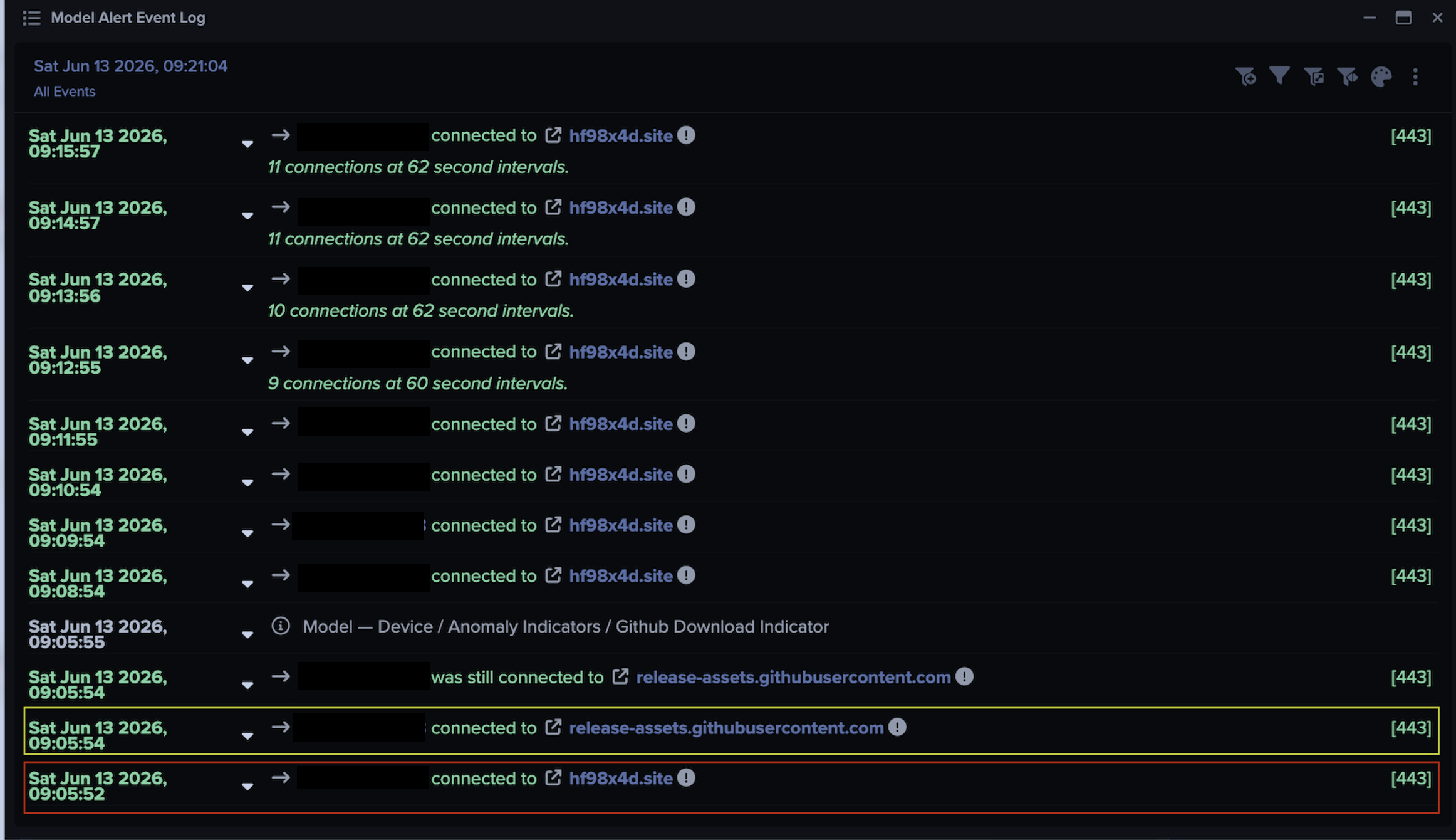
Affected devices across the Darktrace customer base were observed making outbound connections to rare external endpoints in patterns consistent with beaconing and C2 activity. Darktrace primarily detected devices making repeated connections to algorithmically generated domains (DGA) such as hf98x4d[.]site [8]. In many cases, these domains were linked through open-source intelligence (OSINT) to information-stealing malware families including AMOS and Phexia [5][6][7][8][9].
In multiple cases, devices were also observed connecting to blockchain-related endpoints, such as polygon[.]drpc[.]org, as well as legitimate public services, including GitHub. The use of decentralized blockchain infrastructure and trusted services such as GitHub to facilitate malware distribution and C2 activity can make disruption and attribution significantly more difficult for defenders.
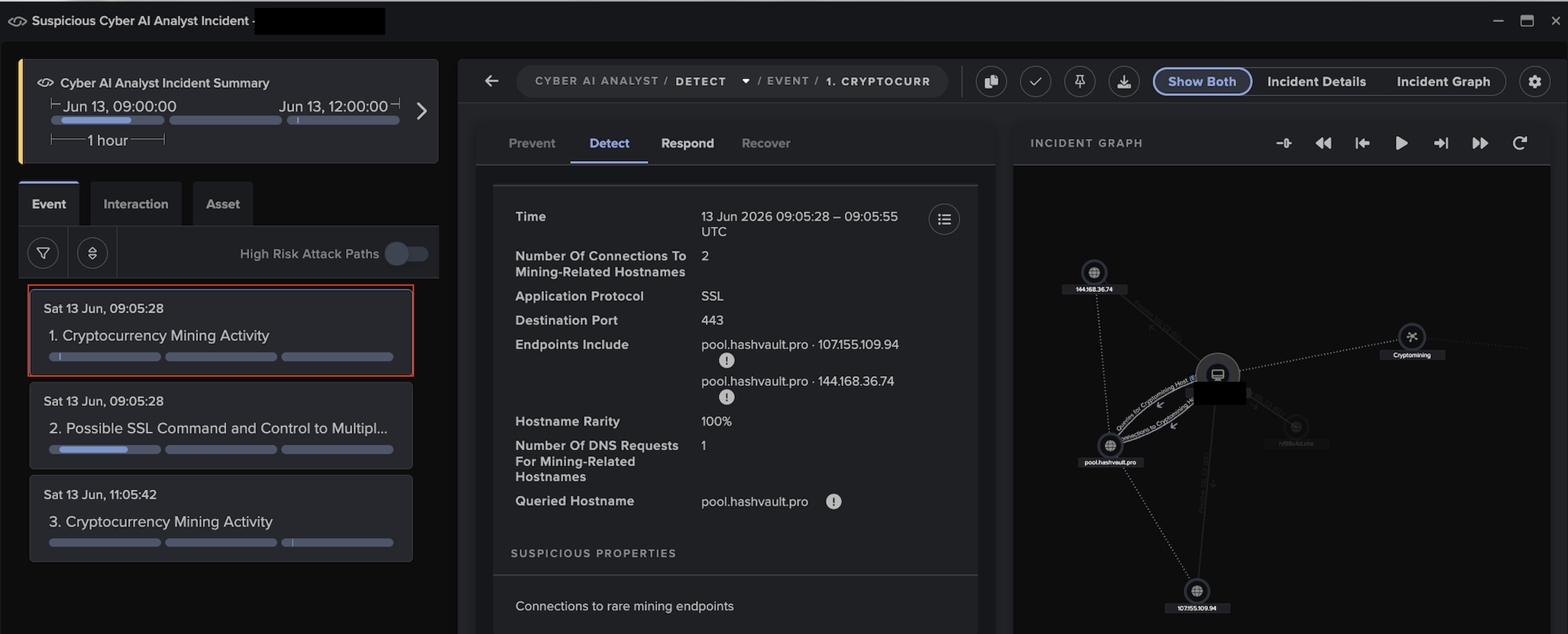
Darktrace also detected a significant proportion of impacted devices making outbound connections to cryptocurrency mining infrastructure associated with the legitimate open-source XMRig mining software and the HashVault mining pool, including pool.hashvault[.]pro and donate[.]ssl[.]xmrig[.]com, which were abused by the attackers, including pool.hashvault[.]pro and donate[.]ssl[.]xmrig[.]com, indicating active cryptomining on compromised systems.
In one case, mining activity was observed before and during connections to the DGA endpoint hf98x4d[.]site. Due to its highly anomalous nature, Darktrace's Real-Time AI Analyst autonomously investigated the activity as it occurred, correlating the two events into a single cryptocurrency mining incident and providing comprehensive visibility into the broader attack.
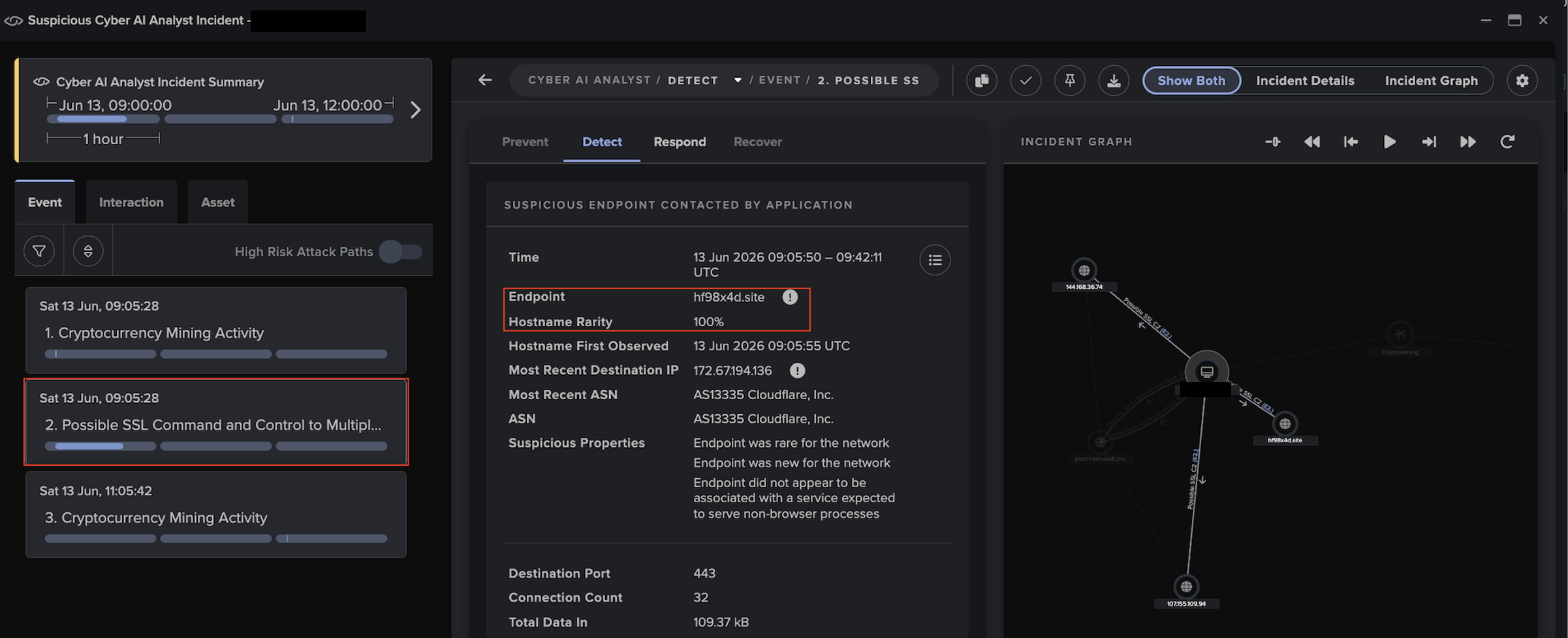
Around the same time, Darktrace identified the same device initiating connections to the GitHub endpoint release-assets[.]githubusercontent[.]com while continuing to make repeated connections to hf98x4d[.]site.
On the network of another customer, Darktrace observed an affected device making highly unusual outbound connections consistent with beaconing activity. The device initiated multiple connections over port 443 to the external hostname polygon[.]drpc[.]org. According to OSINT, this hostname is a Remote Procedure Call (RPC) endpoint provided by dRPC, a legitimate service enabling decentralized applications (dApps), cryptocurrency wallets, and developer tools to interact with the Polygon blockchain [10].
The same device was later observed making repeated TLS/SSL connections to the previously mentioned DGA C2 domain. In addition, it made outbound connections to the external IP 195.242.214[.]34 over destination port 51820, an endpoint associated with the ProtonVPN service. Collectively, these connections to blockchain-related infrastructure, the DGA C2 domain, and ProtonVPN-associated infrastructure suggested the device had been affected by the campaign.
Conclusion
This campaign demonstrates how attackers can combine ClickFix social engineering with trusted services and decentralized blockchain infrastructure to create a resilient, cross-platform malware delivery chain. By using services such as GitHub alongside blockchain RPC endpoints and rapidly replaceable DGA domains, the activity can blend into legitimate traffic while making infrastructure disruption and attribution more difficult.
For defenders, it’s a reminder that trusted infrastructure does not automatically mean trusted activity. Security teams should look for the behaviors surrounding these connections, including unusual outbound communication, repeated beaconing, unexpected access to blockchain services, suspicious TLS/SSL activity and cryptomining. In this campaign, Darktrace identified and correlated these deviations without depending solely on previously known indicators, providing visibility as affected devices moved between legitimate services, decentralized infrastructure and malicious C2 endpoints
Credit to Nahisha Nobregas (Associate Principal Cyber Analyst), Manoel Kadja (Senior Cyber Analyst)
Edited by Ryan Traill (Content Manager)
Appendices
Darktrace Model Detections
▪ Compromise / Beaconing Activity To External Rare
▪ Compromise / Beacon to Young Endpoint
▪ Compromise / Fast Beaconing to DGA
▪ Compromise / High Volume of Connections with Beacon Score
▪ Compromise / DGA Beacon
▪ Compromise / Slow Beaconing Activity To External Rare
▪ Compromise / Agent Beacon (Long Period)
▪ Compromise / Agent Beacon (Medium Period)
▪ Compromise / Sustained SSL or HTTP Increase
▪ Compromise / Large Number of Suspicious Failed Connections
▪ Compromise / SSL Beaconing to Rare Destination
▪ Compromise / Beacon for 4 Days
▪ Compromise / High Priority Crypto Currency Mining
▪ Compromise / Monero Mining
▪ Device / Long Agent Connection to New Endpoint
▪ Device / New Connections On Suspicious Port
▪ Anomalous Connection / High Volume of Connections to Rare Domain
References:
2. https://spycloud.com/resource/report/spycloud-annual-identity-exposure-report-2026/
6. https://cloud.google.com/blog/topics/threat-intelligence/unc5142-etherhiding-distribute-malware
7. https://haveibeensquatted.com/blog/from-typosquatting-to-macos-backdoor-clickfix-blockchain-c2
8. https://www.virustotal.com/gui/domain/hf98x4d.site/community




.jpeg)








.png)