Blog
/
/
March 7, 2024

Defending Against the New Normal in Cybercrime: AI

This blog outlines research & data points on the evolving threat landscape, the impact of malicious AI, and why proactive cyber readiness is essential.
Inside the SOC
Darktrace cyber analysts are world-class experts in threat intelligence, threat hunting and incident response, and provide 24/7 SOC support to thousands of Darktrace customers around the globe. Inside the SOC is exclusively authored by these experts, providing analysis of cyber incidents and threat trends, based on real-world experience in the field.
Written by
Max Heinemeyer
Global Field CISO
Default blog imageDefault blog imageDefault blog imageDefault blog imageDefault blog imageDefault blog image
07
Mar 2024

AI in Cyber Security

Over the last 18 months, discussions about artificial intelligence (AI) – specifically generative AI – ranged from excitement and optimism about its transformative potential to fear and uncertainty about the new risks it introduces.  

New research1 commissioned by Darktrace shows that 89 percent of IT security teams polled globally believe AI-augmented cyber threats will have a significant impact on their organization within the next two years, yet 60 percent believe they are currently unprepared to defend against these attacks. Their concerns include increased volume and sophistication of malware that targets known vulnerabilities and increased exposure of sensitive or proprietary information from using generative AI tools.  

At Darktrace, we monitor trends across our global customer base to understand how the challenges facing security teams are evolving alongside industry advancements in AI. We’ve observed that AI, automation, and cybercrime-as-a-service have increased the speed, sophistication and efficacy of cyber security attacks.  

How AI Impacts Phishing Attempts

Darktrace has observed immediate impacts on phishing, which remains one of the most common forms of attack. In April 2023, Darktrace shared research that found a 135 percent increase in ‘novel social engineering attacks’ in the first two months of 2023, corresponding with the widespread adoption of ChatGPT2. These phishing attacks showed a strong linguistic deviation – semantically and syntactically – compared to other phishing emails, which suggested to us that generative AI is providing an avenue for threat actors to craft sophisticated and targeted attacks at speed and scale. A year later, we’ve seen this trend continue. Darktrace customers received approximately 2,867,000 phishing emails in December 2023 alone, a 14 percent increase on what was observed months prior in September3. Between September and December 2023, phishing attacks that used novel social engineering techniques grew by 35 percent on average across the Darktrace customer base4.  

These observations reinforce trends that others in the industry have shared. For example, Microsoft and OpenAI recently published research on tactics, techniques, and procedures (TTPs) augmented by large language models (LLMs) that they have observed nation-state threat actors using. That includes using LLMs to draft and generate social engineering attacks, inform reconnaissance, assist with vulnerability research and more.  

The Rise of Cybercrime-as-as-a-Service

The increasing cyber challenge facing defenders cannot be attributed to AI alone. The rise of cybercrime as-a-service is also changing the dynamic. Darktrace’s 2023 End of Year Threat Report found that cybercrime-as-a-service continue to dominate the threat landscape, with malware-as-a-Service (MaaS) and ransomware-as-a-Service (RaaS) tools making up most malicious tools in use by attackers. The as-a-Service ecosystem can provide attackers with everything from pre-made malware to templates for phishing emails, payment processing systems and even helplines to enable bad actors to mount attacks with limited technical knowledge.  

These trends make it clear that attackers now have a more widely accessible toolbox that reduces their barriers.

AI Enabling Accidental Insider Threats

However, the new risks facing businesses aren’t from external threat actors alone. Use of generative AI tools within the enterprise introduces a new category of accidental insider threats. Employees using generative AI tools now have easier access to more organizational data than ever before. Even the most well-intentioned employee could unintentionally leak or access restricted, sensitive data via these tools. In the second half of 2023, we observed that approximately half of Darktrace customers had employees accessing generative AI services. As this continues to increase, organizations need policies in place to guide the use cases for generative AI tools as well as strong data governance and the ability to enforce these policies to minimize risk.  

It is inevitable that AI will increase the risks and threats facing an organization, but this is not an unsolvable challenge from a defensive perspective. While advancements in generative AI may be worsening issues like novel social engineering and creating new types of accidental insider threats, AI itself offers a strong defense.  

The Shift to Proactive Cyber Readiness

According to the World Economic Forum’s Global Cybersecurity Outlook 2024, the number of organizations that “maintain minimum viable cyber resilience is down 30 percent compared to 2023”, and “while large organizations have demonstrated gains in cyber resilience, small and medium-sized companies showed significant decline.” The importance of cyber resilience cannot be understated in the face of today’s increasingly as-a-service, automated, and AI-augmented threat landscape.  

Historically, organizations wait for incidents to happen and rely on known attack data for threat detection and response, making it nearly impossible to identify never-before-seen threats. The traditional security stack has also relied heavily on point solutions focused on protecting different pieces of the digital environment, with individual tools for endpoint, email, network, on-premises data centers, SaaS applications, cloud, OT and beyond. These point solutions fail to correlate disparate incidents to form a complete picture of an orchestrated attack. Even with the addition of tools that can stitch together events from across the enterprise, they are in a reactive state that focuses heavily on threat detection and response.  

Organizations need to evolve from a reactive posture to a stance of proactive cyber readiness. To do so, they need an approach that proactively identifies internal and external vulnerabilities, identifies gaps in security policy and process before an attack occurs, breaks down silos to investigate all threats (known and unknown) during an attack, and uplifts the human analyst beyond menial tasks to incident validation and recovery after an attack.  

AI can help break down silos within the SOC and provide a more proactive approach to scale up and augment defenders. It provides richer context when it is fed information from multiple systems, data sets, and tools within the stack and can build an in-depth, real-time behavioural understanding of a business that humans alone cannot.

Lessons From AI in the SOC

At Darktrace, we’ve been applying AI to the challenge of cyber security for more than ten years, and we know that proactive cyber readiness requires the right mix of people, process, and technology.  

When the right AI is applied responsibly to the right cyber security challenge, the impact on both the human security team and the business is profound.

AI can bring machine speed and scale to some of the most time-intensive, error-prone, and psychologically draining components of cyber security, helping humans focus on the value-added work that only they can provide. Incident response and continuous monitoring are two areas where AI has already been proven to effectively augment defenders. For example, a civil engineering company used Darktrace’s AI to uplift its SOC team from the repetitive, manual tasks of analyzing and responding to email incidents. The analysts estimated they were each spending 10 hours per week on email incident analysis. With AI autonomously analyzing and responding to email incidents, the analysts could gain approximately 20 percent of their time back to focus on proactive cyber security measures

An effective human-AI partnership is key to proactive cyber readiness and can directly benefit the work-life of defenders. It can help to reduce burnout, support data-driven decision-making, and reduce the reliance on hard-to-find, specialized talent that has created a skills shortage in cyber security for many years. Most importantly, AI can free up team members to focus on more meaningful tasks, such as compliance initiatives, user education, and sophisticated threat hunting.  

Advancements in AI are happening at a rapid pace. As we’ve already observed, attackers will be watching these developments and looking for ways to use it to their advantage. Luckily, AI has already proved to be an asset for defenders, and embracing a proactive approach to cyber resilience can help organizations increase their readiness for this next phase. Prioritizing cyber security will be an enabler of innovation and progress as AI development continues.  

--

Join Darktrace on 9 April for a virtual event to explore the latest innovations needed to get ahead of the rapidly evolving threat landscape. Register today to hear more about our latest innovations coming to Darktrace’s offerings.

References

[1] The survey was undertaken by AimPoint Group & Dynata on behalf Darktrace between December 2023 & January 2024. The research polled 1773 security professionals in positions across the security team from junior roles to CISOs, across 14 countries – Australia, Brazil, France, Germany, Italy, Japan, Mexico, Netherlands, Singapore, Spain, Sweden, UAE, UK, and USA.

[2] Based on the average change in email attacks between January and February 2023 detected across Darktrace/Email deployments with control of outliers.

[3] Average calculated across Darktrace customers from 31st August to 21st December.

[4] Average calculated across Darktrace customers from 31st August to 21st December. Novel social engineering attacks use linguistic techniques that are different to techniques used in the past, as measured by a combination of semantics, phrasing, text volume, punctuation, and sentence length.


Inside the SOC
Darktrace cyber analysts are world-class experts in threat intelligence, threat hunting and incident response, and provide 24/7 SOC support to thousands of Darktrace customers around the globe. Inside the SOC is exclusively authored by these experts, providing analysis of cyber incidents and threat trends, based on real-world experience in the field.
Written by
Max Heinemeyer
Global Field CISO

More in this series

No items found.

Blog

/

/

March 5, 2026

Inside Cloud Compromise: Investigating Attacker Activity with Darktrace / Forensic Acquisition & Investigation

Forensic Acquisition and investigationDefault blog imageDefault blog image

Investigating cloud attacks with Darktrace/ Forensic Acquisition & Investigation

Darktrace / Forensic Acquisition & Investigation™ is the industry’s first truly automated forensic solution purpose-built for the cloud. This blog will demonstrate how an investigation can be carried out against a compromised cloud server in minutes, rather than hours or days.

The compromised server investigated in this case originates from Darktrace’s Cloudypots system, a global honeypot network designed to observe adversary activity in real time across a wide range of cloud services. Whenever an attacker successfully compromises one of these honeypots, a forensic copy of the virtual server's disk is preserved for later analysis. Using Forensic Acquisition & Investigation, analysts can then investigate further and obtain detailed insights into the compromise including complete attacker timelines and root cause analysis.

Forensic Acquisition & Investigation supports importing artifacts from a variety of sources, including EC2 instances, ECS, S3 buckets, and more. The Cloudypots system produces a raw disk image whenever an attack is detected and stores it in an S3 bucket. This allows the image to be directly imported into Forensic Acquisition & Investigation using the S3 bucket import option.

As Forensic Acquisition & Investigation runs cloud-natively, no additional configuration is required to add a specific S3 bucket. Analysts can browse and acquire forensic assets from any bucket that the configured IAM role is permitted to access. Operators can also add additional IAM credentials, including those from other cloud providers, to extend access across multiple cloud accounts and environments.

Figure 1: Forensic Acquisition & Investigation import screen.

Forensic Acquisition & Investigation then retrieves a copy of the file and automatically begins running the analysis pipeline on the artifact. This pipeline performs a full forensic analysis of the disk and builds a timeline of the activity that took place on the compromised asset. By leveraging Forensic Acquisition & Investigation’s cloud-native analysis system, this process condenses hour of manual work into just minutes.

Successful import of a forensic artifact and initiation of the analysis pipeline.
Figure 2: Successful import of a forensic artifact and initiation of the analysis pipeline.

Once processing is complete, the preserved artifact is visible in the Evidence tab, along with a summary of key information obtained during analysis, such as the compromised asset’s hostname, operating system, cloud provider, and key event count.

The Evidence overview showing the acquired disk image.
Figure 3: The Evidence overview showing the acquired disk image.

Clicking on the “Key events” field in the listing opens the timeline view, automatically filtered to show system- generated alarms.

The timeline provides a chronological record of every event that occurred on the system, derived from multiple sources, including:

  • Parsed log files such as the systemd journal, audit logs, application specific logs, and others.
  • Parsed history files such as .bash_history, allowing executed commands to be shown on the timeline.
  • File-specific events, such as files being created, accessed, modified, or executables being run, etc.

This approach allows timestamped information and events from multiple sources to be aggregated and parsed into a single, concise view, greatly simplifying the data review process.

Alarms are created for specific timeline events that match either a built-in system rule, curated by Darktrace’s Threat Research team or an operator-defined created at the project level. These alarms help quickly filter out noise and highlight on events of interest, such as the creation of a file containing known malware, access to sensitive files like Amazon Web Service (AWS) credentials, suspicious arguments or commands, and more.

 The timeline view filtered to alarm_severity: “1” OR alarm_severity: “3”, showing only events that matched an alarm rule.
Figure 4: The timeline view filtered to alarm_severity: “1” OR alarm_severity: “3”, showing only events that matched an alarm rule.

In this case, several alarms were generated for suspicious Base64 arguments being passed to Selenium. Examining the event data, it appears the attacker spawned a Selenium Grid session with the following payload:

"request.payload": "[Capabilities {browserName: chrome, goog:chromeOptions: {args: [-cimport base64;exec(base64...], binary: /usr/bin/python3, extensions: []}, pageLoadStrategy: normal}]"

This is a common attack vector for Selenium Grid. The chromeOptions object is intended to specify arguments for how Google Chrome should be launched; however, in this case the attacker has abused the binary field to execute the Python3 binary instead of Chrome. Combined with the option to specify command-line arguments, the attacker can use Python3’s -c option to execute arbitrary Python code, in this instance, decoding and executing a Base64 payload.

Selenium’s logs truncate the Arguments field automatically, so an alternate method is required to retrieve the full payload. To do this, the search bar can be used to find all events that occurred around the same time as this flagged event.

Pivoting off the previous event by filtering the timeline to events within the same window using timestamp: [“2026-02-18T09:09:00Z” TO “2026-02-18T09:12:00Z”].
Figure 5: Pivoting off the previous event by filtering the timeline to events within the same window using timestamp: [“2026-02-18T09:09:00Z” TO “2026-02-18T09:12:00Z”].

Scrolling through the search results, an entry from Java’s systemd journal can be identified. This log contains the full, unaltered payload. GCHQ’s CyberChef can then be used to decode the Base64 data into the attacker’s script, which will ultimately be executed.[NJ9]

Decoding the attacker’s payload in CyberChef.
Figure 6: Decoding the attacker’s payload in CyberChef.

In this instance, the malware was identified as a variant of a campaign that has been previously documented in depth by Darktrace.

Investigating Perfectl Malware

This campaign deploys a malware sample known as ‘perfctl to the compromised host. The script executed by the attacker downloads a Go binary named “promocioni.php” from 200[.]4.115.1. Its functionality is consistent with previously documented perfctl samples, with only minor changes such as updated filenames and a new command-and-control (C2) domain.

Perctl is a stealthy malware that has several systems designed  to evade detection. The main binary is packed with UPX, with the header intentionally tampered with to prevent unpacking using regular tools. The binary also avoids executing any malicious code if it detects debugging or tracing activity, or if artifacts left by earlier stages are missing.

To further aid its evasive capabilities, perfctl features a usermode rootkit using an LD preload. This causes dynamically linked executables to load perfctl’s rootkit payload before other system modules, allowing it to override functions, such as intercepting calls to list files and hiding output from the returned list. Perctl uses this to hide its own files, as well as other files like the ld.so.preload file, preventing users from identifying that a rootkit is present in the first place.

This also makes it difficult to dynamically analyze, as even analysts aware of the rootkit will struggle to get around it due to its aggressiveness in hiding its components. A useful trick is to use the busybox-static utilities, which are statically linked and therefore immune to LD preloading.

Perctl will attempt to use sudo to escalate its permissions to root if the user it was executed as has the required privileges. Failing this, it will attempt to exploit the vulnerability CVE-2021-4034.

Ultimately, perfctl will attempt to establish a C2 link via Tor and spawn an XMRig miner to mine the Monero cryptocurrency. The traffic to the mining pool is encapsulated within Tor to limit network detection of the mining traffic.

Darktrace’s Cloudypots system has observed 1,959 infections of the perfectl campaign across its honeypot network in the past year, making it one of the most aggressive campaigns seen by Darktrace.

Key takeaways

This blog has shown how Darktrace / Forensic Acquisition & Investigation equips defenders in the face of a real-world attacker campaign. By using this solution, organizations can acquire forensic evidence and investigate intrusions across multiple cloud resources and providers, enabling defenders to see the full picture of an intrusion on day one. Forensic Acquisition & Investigation’s patented data-processing system takes advantage of the cloud’s scale to rapidly process large amounts of data, allowing triage to take minutes, not hours.

Darktrace / Forensic Acquisition & Investigation is available as Software-as-a-Service (SaaS) but can also be deployed on-premises as a virtual application or natively in the cloud, providing flexibility between convenience and data sovereignty to suit any use case.

Support for acquiring traditional compute instances like EC2, as well as more exotic and newly targeted platforms such as ECS and Lambda, ensures that attacks taking advantage of Living-off-the-Cloud (LOTC) strategies can be triaged quickly and easily as part of incident response. As attackers continue to develop new techniques, the ability to investigate how they use cloud services to persist and pivot throughout an environment is just as important to triage as a single compromised EC2 instance.

Credit to Nathaniel Bill (Malware Research Engineer)

Continue reading
About the author
Nathaniel Bill
Malware Research Engineer

Blog

/

Network

/

February 19, 2026

CVE-2026-1731: How Darktrace Sees the BeyondTrust Exploitation Wave Unfolding

Default blog imageDefault blog image

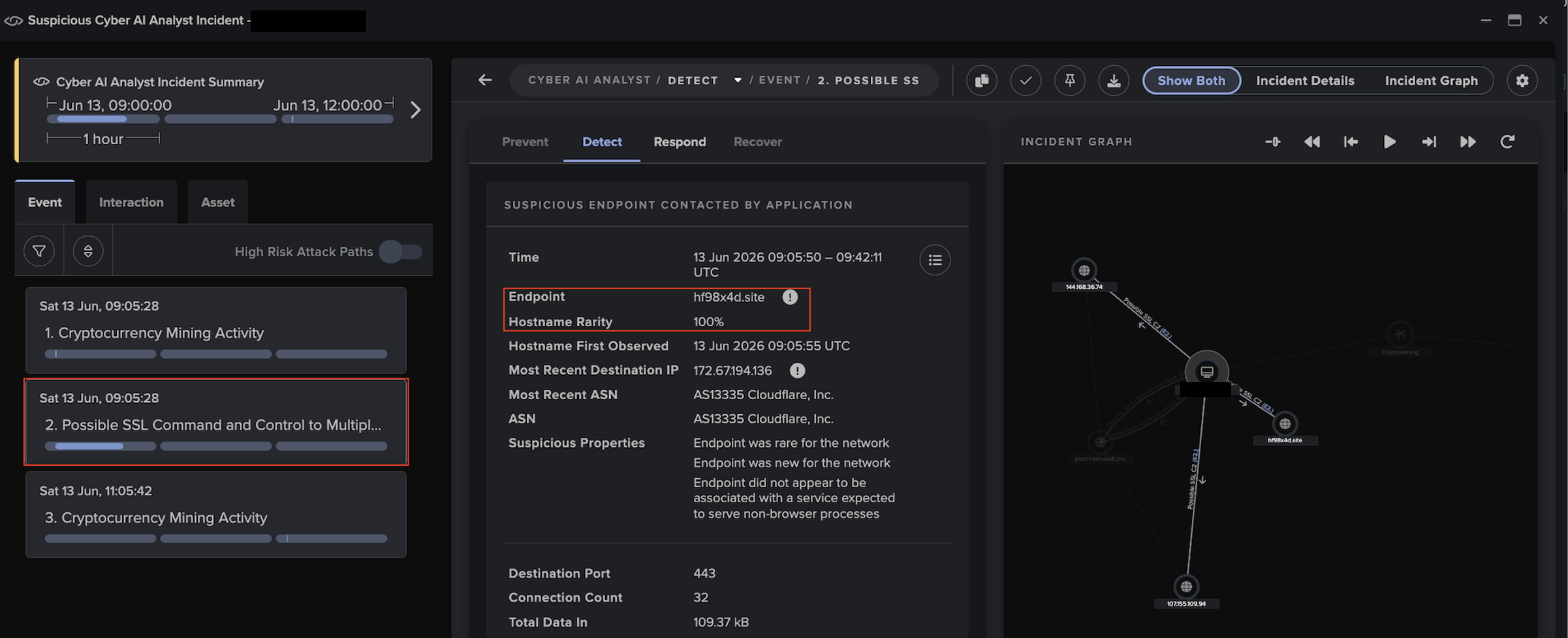
Note: Darktrace's Threat Research team is publishing now to help defenders. We will continue updating this blog as our investigations unfold.

Background

On February 6, 2026, the Identity & Access Management solution BeyondTrust announced patches for a vulnerability, CVE-2026-1731, which enables unauthenticated remote code execution using specially crafted requests.  This vulnerability affects BeyondTrust Remote Support (RS) and particular older versions of Privileged Remote Access (PRA) [1].

A Proof of Concept (PoC) exploit for this vulnerability was released publicly on February 10, and open-source intelligence (OSINT) reported exploitation attempts within 24 hours [2].

Previous intrusions against Beyond Trust technology have been cited as being affiliated with nation-state attacks, including a 2024 breach targeting the U.S. Treasury Department. This incident led to subsequent emergency directives from  the Cybersecurity and Infrastructure Security Agency (CISA) and later showed attackers had chained previously unknown vulnerabilities to achieve their goals [3].

Additionally, there appears to be infrastructure overlap with React2Shell mass exploitation previously observed by Darktrace, with command-and-control (C2) domain  avg.domaininfo[.]top seen in potential post-exploitation activity for BeyondTrust, as well as in a React2Shell exploitation case involving possible EtherRAT deployment.

Darktrace Detections

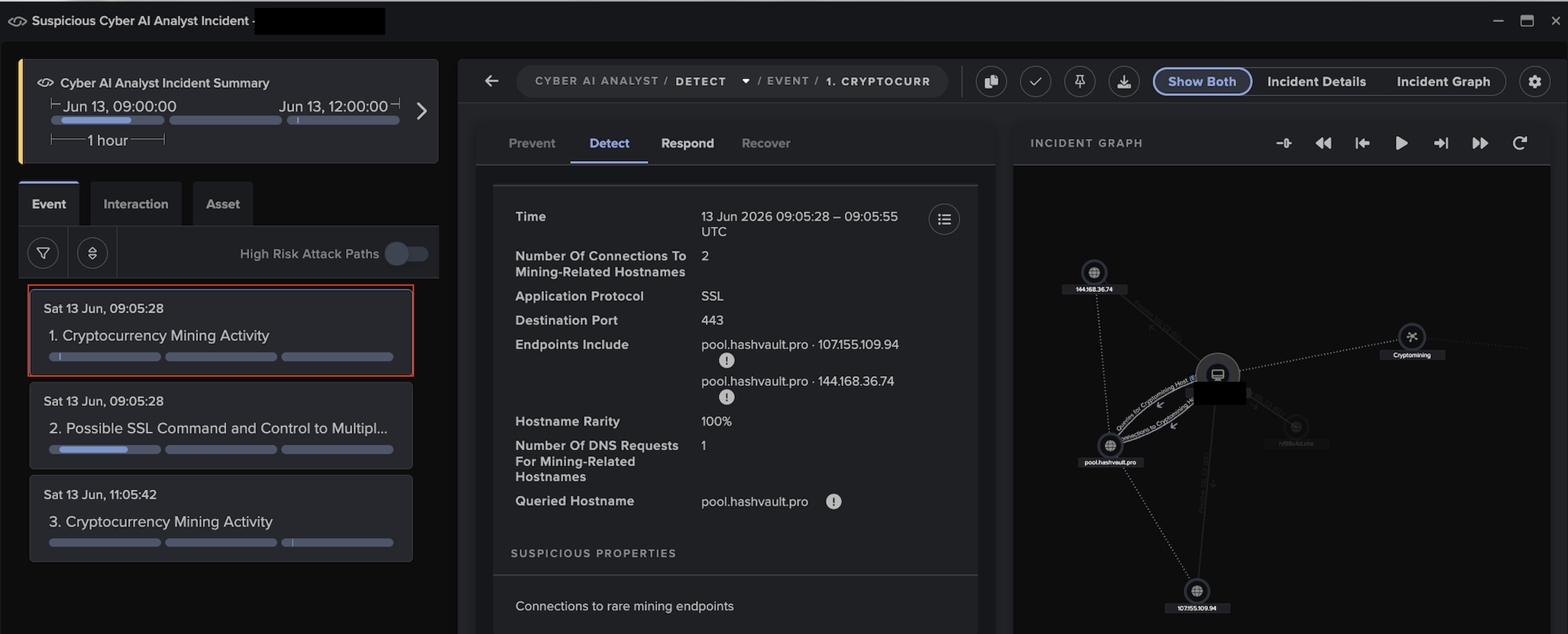
Darktrace’s Threat Research team has identified highly anomalous activity across several customers that may relate to exploitation of BeyondTrust since February 10, 2026. Observed activities include:

Outbound connections and DNS requests for endpoints associated with Out-of-Band Application Security Testing; these services are commonly abused by threat actors for exploit validation.  Associated Darktrace models include:

  • Compromise / Possible Tunnelling to Bin Services

Suspicious executable file downloads. Associated Darktrace models include:

  • Anomalous File / EXE from Rare External Location

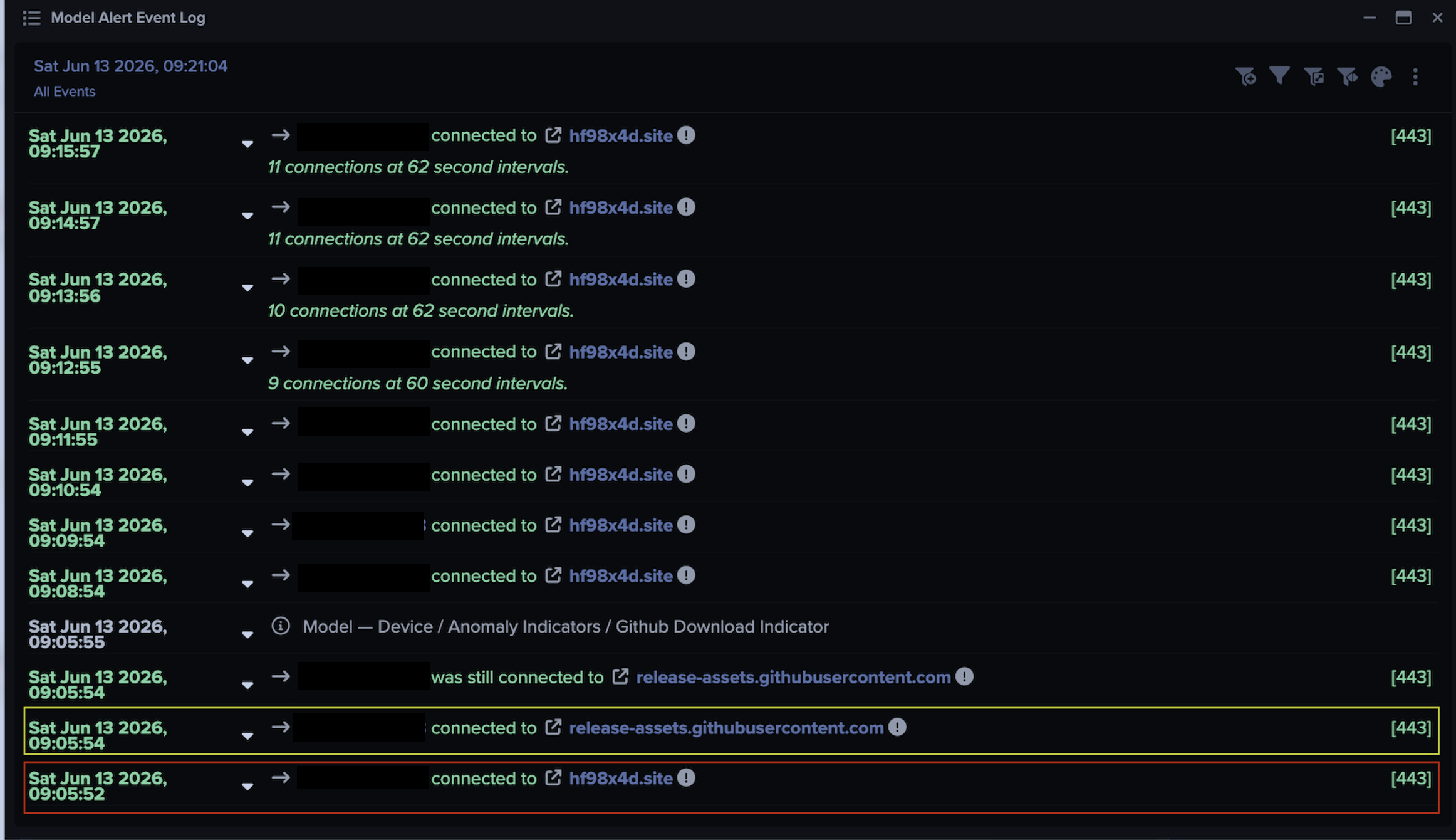
Outbound beaconing to rare domains. Associated Darktrace models include:

  • Compromise / Agent Beacon (Medium Period)
  • Compromise / Agent Beacon (Long Period)
  • Compromise / Sustained TCP Beaconing Activity To Rare Endpoint
  • Compromise / Beacon to Young Endpoint
  • Anomalous Server Activity / Rare External from Server
  • Compromise / SSL Beaconing to Rare Destination

Unusual cryptocurrency mining activity. Associated Darktrace models include:

  • Compromise / Monero Mining
  • Compromise / High Priority Crypto Currency Mining

And model alerts for:

  • Compromise / Rare Domain Pointing to Internal IP

IT Defenders: As part of best practices, we highly recommend employing an automated containment solution in your environment. For Darktrace customers, please ensure that Autonomous Response is configured correctly. More guidance regarding this activity and suggested actions can be found in the Darktrace Customer Portal.  

Appendices

Potential indicators of post-exploitation behavior:

·      217.76.57[.]78 – IP address - Likely C2 server

·      hXXp://217.76.57[.]78:8009/index.js - URL -  Likely payload

·      b6a15e1f2f3e1f651a5ad4a18ce39d411d385ac7  - SHA1 - Likely payload

·      195.154.119[.]194 – IP address – Likely C2 server

·      hXXp://195.154.119[.]194/index.js - URL – Likely payload

·      avg.domaininfo[.]top – Hostname – Likely C2 server

·      104.234.174[.]5 – IP address - Possible C2 server

·      35da45aeca4701764eb49185b11ef23432f7162a – SHA1 – Possible payload

·      hXXp://134.122.13[.]34:8979/c - URL – Possible payload

·      134.122.13[.]34 – IP address – Possible C2 server

·      28df16894a6732919c650cc5a3de94e434a81d80 - SHA1 - Possible payload

References:

1.        https://nvd.nist.gov/vuln/detail/CVE-2026-1731

2.        https://www.securityweek.com/beyondtrust-vulnerability-targeted-by-hackers-within-24-hours-of-poc-release/

3.        https://www.rapid7.com/blog/post/etr-cve-2026-1731-critical-unauthenticated-remote-code-execution-rce-beyondtrust-remote-support-rs-privileged-remote-access-pra/

Continue reading
About the author
Emma Foulger
Global Threat Research Operations Lead
Your data. Our AI.
Elevate your network security with Darktrace AI