
Blog
/
Email
/
November 27, 2025

From Amazon to Louis Vuitton: How Darktrace Detects Black Friday Phishing Attacks

Darktrace detected a surge in Black Friday phishing campaigns exploiting brand impersonation, urgency-driven language, and malicious redirects. Attackers leveraged newly registered domains and social engineering to mimic Amazon, Louis Vuitton, and luxury watch retailers. Learn how layered evasion tactics bypassed security and how Darktrace / EMAIL neutralized these threats.
Inside the SOC
Darktrace cyber analysts are world-class experts in threat intelligence, threat hunting and incident response, and provide 24/7 SOC support to thousands of Darktrace customers around the globe. Inside the SOC is exclusively authored by these experts, providing analysis of cyber incidents and threat trends, based on real-world experience in the field.
Written by
Ryan Traill
Analyst Content Lead
Default blog imageDefault blog imageDefault blog imageDefault blog imageDefault blog imageDefault blog image
27
Nov 2025

Why Black Friday Drives a Surge in Phishing Attacks

In recent years, Black Friday has shifted from a single day of online retail sales and discounts to an extended ‘Black Friday Week’, often preceded by weeks of online hype. During this period, consumers are inundated with promotional emails and marketing campaigns as legitimate retailers compete for attention.

Unsurprisingly, this surge in legitimate communications creates an ideal environment for threat actors to launch targeted phishing campaigns designed to mimic legitimate retail emails. These campaigns often employ social engineering techniques that exploit urgency, exclusivity, and consumer trust in well-known brands, tactics designed to entice recipients into opening emails and clicking on malicious links.

Additionally, given the seasonal nature of Black Friday and the ever-changing habits of consumers, attackers adopt new tactics and register fresh domains each year, rather than reusing domains previously flagged as spam or phishing endpoints. While this may pose a challenge for traditional email security tools, it presents no such difficulty for Darktrace / EMAIL and its anomaly-based approach.

In the days and weeks leading up to ‘Black Friday’, Darktrace observed a spike in sophisticated phishing campaigns targeting consumers, demonstrating how attackers combine phycological manipulation with technical evasion to bypass basic security checks during this high-traffic period. This blog showcases several notable examples of highly convincing phishing emails detected and contained by Darktrace / EMAIL in mid to late November 2025.

Darktrace’s Black Friday Detections

Brand Impersonation: Deal Watchdogs’ Amazon Deals

The impersonation major online retailers has become a common tactic in retail-focused attacks, none more so than Amazon, which ranked as the fourth most impersonated brand in 2024, only behind Microsoft, Apple, Google, and Facebook [1]. Darktrace’s own research found Amazon to be the most mimicked brand, making up 80% of phishing attacks in its analysis of global consumer brands.

When faced with an email that appears to come from a trusted sender like Amazon, recipients are far more likely to engage, increasing the success rate of these phishing campaigns.

In one case observed on November 16, Darktrace detected an email with the subject line “NOW LIVE: Amazon’s Best Early Black Friday Deals on Gadgets Under $60”. The email was sent to a customer by the sender ‘Deal Watchdogs’, in what appeared to be an attempt to masquerade as a legitimate discount-finding platform. No evidence indicated that the company was legitimate. In fact, the threat actor made no attempt to create a convincing name, and the domain appeared to be generated by a domain generation algorithm (DGA), as shown in Figure 2.

Although the email was sent by ‘Deal Watchdogs’, it attempted to impersonate Amazon by featuring realistic branding, including the Amazon logo and a shade of orange similar to that used by them for the ‘CLICK HERE’ button and headline text.

Figure 1: The contents of the email observed by Darktrace, featuring authentic-looking Amazon branding.

Darktrace identified that the email, marked as urgent by the sender, contained a suspicious link to a Google storage endpoint (storage.googleapis[.]com), which had been hidden by the text “CLICK HERE”. If clicked, the link could have led to a credential harvester or served as a delivery vector for a malicious payload hosted on the Google storage platform.

Fortunately, Darktrace immediately identified the suspicious nature of this email and held it before delivery, preventing recipients from ever receiving or interacting with the malicious content.
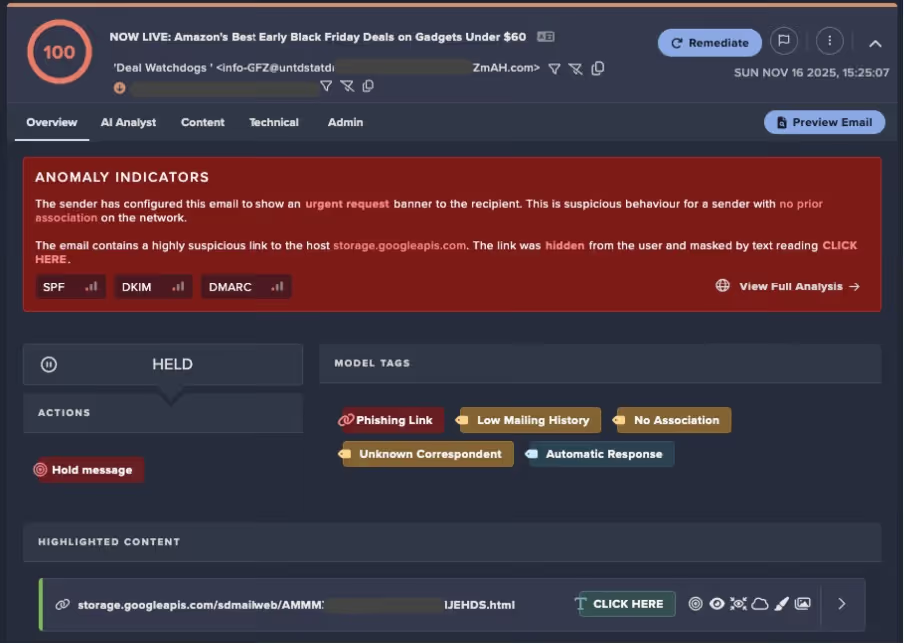
Figure 2: Darktrace / EMAIL’s detection of the malicious phishing email sent to a customer.

Around the same time, Darktrace detected a similar email attempting to spoof Amazon on another customer’s network with the subject line “Our 10 Favorite Deals on Amazon That Started Today”, also sent by ‘Deal Watchdogs,’ suggesting a broader campaign.

Analysis revealed that this email originated from the domain petplatz[.]com, a fake marketing domain previously linked to spam activity according to open-source intelligence (OSINT) [2].

Brand Impersonation: Louis Vuitton

A few days later, on November 20, Darktrace / EMAIL detected a phishing email attempting to impersonate the luxury fashion brand Louis Vuitton. At first glance, the email, sent under the name ‘Louis Vuitton’ and titled “[Black Friday 2025] Discover Your New Favorite Louis Vuitton Bag – Elegance Starts Here”, appeared to be a legitimate Black Friday promotion. However, Darktrace’s analysis uncovered several red flags indicating a elaborate brand impersonation attempt.

The email was not sent by Louis Vuitton but by rskkqxyu@bookaaatop[.]ru, a Russia-based domain never before observed on the customer’s network. Darktrace flagged this as suspicious, noting that .ru domains were highly unusual for this recipient’s environment, further reinforcing the likelihood of malicious intent. Subsequent analysis revealed that the domain had only recently registered and was flagged as malicious by multiple OSINT sources [3].
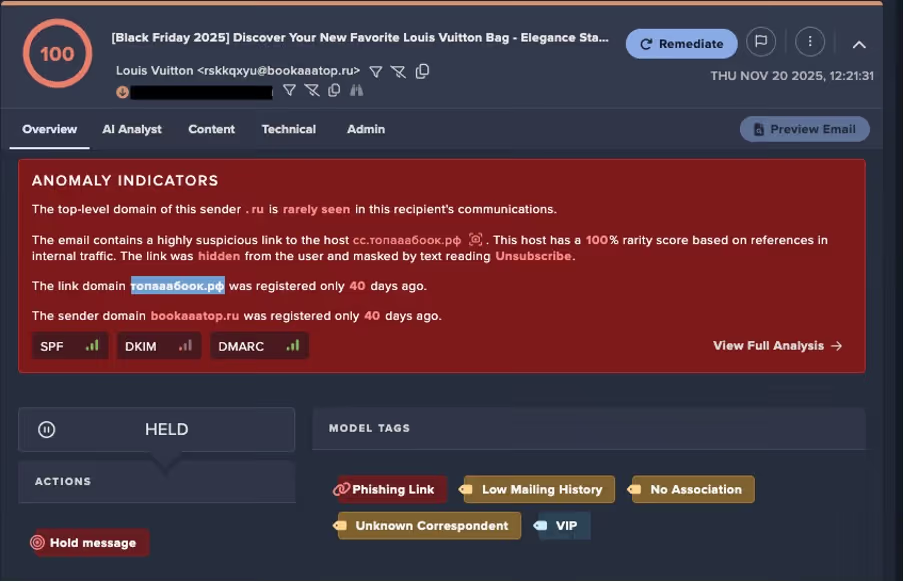
Figure 3: Darktrace / EMAIL’s detection of the malicious email attempting to spoofLouis Vuitton, originating from a suspicious Russia-based domain.

Darktrace further noted that the email contained a highly suspicious link hidden behind the text “View Collection” and “Unsubscribe,” ensuring that any interaction, whether visiting the supposed ‘handbag store’ or attempting to opt out of marketing emails, would direct recipients to the same endpoint. The link resolved to xn--80aaae9btead2a[.]xn--p1ai (топааабоок[.]рф), a domain confirmed as malicious by multiple OSINT sources [4]. At the time of analysis, the domain was inaccessible, likely due to takedown efforts or the short-lived nature of the campaign.

Darktrace / EMAIL blocked this email before it reached customer inboxes, preventing recipients from interacting with the malicious content and averting any disruption.
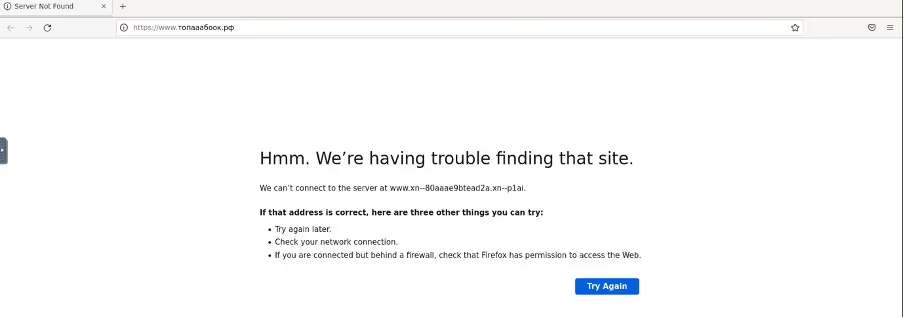
Figure 4: The suspicious domain linked in the Louis Vuitton phishing email, now defunct.

Too good to be true?

Aside from spoofing well-known brands, threat actors frequently lure consumers with “too good to be true” luxury offers, a trend Darktrace observed in multiple cases throughout November.

In one instance, Darktrace identified an email with the subject line “[Black Friday 2025] Luxury Watches Starting at $250.” Emails contained a malicious phishing link, hidden behind text like “Rolex Starting from $250”, “Shop Now”, and “Unsubscribe”.

Figure 5: Example of a phishing email detected by Darktrace, containing malicious links concealed behind seemingly innocuous text.

Similarly to the Louis Vuitton email campaign described above, this malicious link led to a .ru domain (hxxps://x.wwwtopsalebooks[.]ru/.../d65fg4er[.]html), which had been flagged as malicious by multiple sources [5].
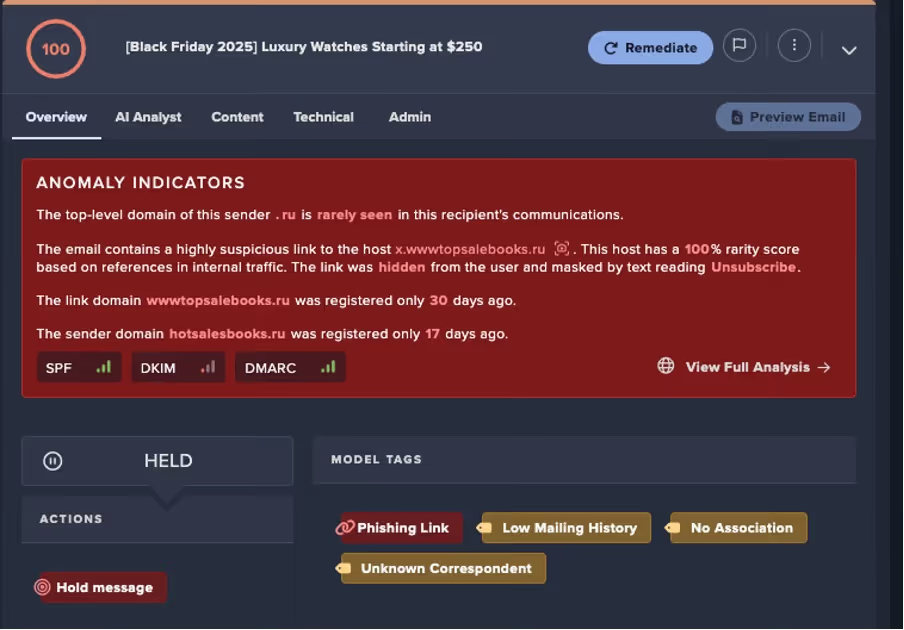
Figure 6: Darktrace / EMAIL’s detection of a malicious email promoting a fake luxury watch store, which was successfully held from recipient inboxes.

If accessed, this domain would redirect users to luxy-rox[.]com, a recently created domain (15 days old at the time of writing) that has also been flagged as malicious by OSINT sources [6]. When visited, the redirect domain displayed a convincing storefront advertising high-end watches at heavily discounted prices.

Figure 7: The fake storefront presented upon visiting the redirectdomain, luxy-rox[.]com.

Although the true intent of this domain could not be confirmed, it was likely a scam site or a credential-harvesting operation, as users were required to create an account to complete a purchase. As of the time or writing, the domain in no longer accessible .

This email illustrates a layered evasion tactic: attackers employed multiple domains, rapid domain registration, and concealed redirects to bypass detection. By leveraging luxury branding and urgency-driven discounts, the campaign sought to exploit seasonal shopping behaviors and entice victims into clicking.

Staying Protected During Seasonal Retail Scams

The investigation into these Black Friday-themed phishing emails highlights a clear trend: attackers are exploiting seasonal shopping events with highly convincing campaigns. Common tactics observed include brand impersonation (Amazon, Louis Vuitton, luxury watch brands), urgency-driven subject lines, and hidden malicious links often hosted on newly registered domains or cloud services.

These campaigns frequently use redirect chains, short-lived infrastructure, and psychological hooks like exclusivity and luxury appeal to bypass user scepticism and security filters. Organizations should remain vigilant during retail-heavy periods, reinforcing user awareness training, link inspection practices, and anomaly-based detection to mitigate these evolving threats.

Credit to Ryan Traill (Analyst Content Lead) and Owen Finn (Cyber Analyst)

Appendices

References

1.        https://keepnetlabs.com/blog/top-5-most-spoofed-brands-in-2024

2.        https://www.virustotal.com/gui/domain/petplatz.com

3.        https://www.virustotal.com/gui/domain/bookaaatop.ru

4.        https://www.virustotal.com/gui/domain/xn--80aaae9btead2a.xn--p1ai

5.        https://www.virustotal.com/gui/url/e2b868a74531cd779d8f4a0e1e610ec7f4efae7c29d8b8ab32c7a6740d770897?nocache=1

6.        https://www.virustotal.com/gui/domain/luxy-rox.com

Indicators of Compromise (IoCs)

IoC – Type – Description + Confidence

petplatz[.]com – Hostname – Spam domain

bookaaatop[.]ru – Hostname – Malicious Domain

xn--80aaae9btead2a[.]xn--p1ai (топааабоок[.]рф) – Hostname - Malicious Domain

hxxps://x.wwwtopsalebooks[.]ru/.../d65fg4er[.]html) – URL – Malicious Domain

luxy-rox[.]com – Hostname -  Malicious Domain

MITRE ATT&CK Mapping  

Tactic – Technique – Sub-Technique  

Initial Access - Phishing – (T1566)  

Inside the SOC
Darktrace cyber analysts are world-class experts in threat intelligence, threat hunting and incident response, and provide 24/7 SOC support to thousands of Darktrace customers around the globe. Inside the SOC is exclusively authored by these experts, providing analysis of cyber incidents and threat trends, based on real-world experience in the field.
Written by
Ryan Traill
Analyst Content Lead

More in this series

No items found.

Blog

/

/

March 5, 2026

Inside Cloud Compromise: Investigating Attacker Activity with Darktrace / Forensic Acquisition & Investigation

Forensic Acquisition and investigationDefault blog imageDefault blog image

Investigating cloud attacks with Darktrace/ Forensic Acquisition & Investigation

Darktrace / Forensic Acquisition & Investigation™ is the industry’s first truly automated forensic solution purpose-built for the cloud. This blog will demonstrate how an investigation can be carried out against a compromised cloud server in minutes, rather than hours or days.

The compromised server investigated in this case originates from Darktrace’s Cloudypots system, a global honeypot network designed to observe adversary activity in real time across a wide range of cloud services. Whenever an attacker successfully compromises one of these honeypots, a forensic copy of the virtual server's disk is preserved for later analysis. Using Forensic Acquisition & Investigation, analysts can then investigate further and obtain detailed insights into the compromise including complete attacker timelines and root cause analysis.

Forensic Acquisition & Investigation supports importing artifacts from a variety of sources, including EC2 instances, ECS, S3 buckets, and more. The Cloudypots system produces a raw disk image whenever an attack is detected and stores it in an S3 bucket. This allows the image to be directly imported into Forensic Acquisition & Investigation using the S3 bucket import option.

As Forensic Acquisition & Investigation runs cloud-natively, no additional configuration is required to add a specific S3 bucket. Analysts can browse and acquire forensic assets from any bucket that the configured IAM role is permitted to access. Operators can also add additional IAM credentials, including those from other cloud providers, to extend access across multiple cloud accounts and environments.

Figure 1: Forensic Acquisition & Investigation import screen.

Forensic Acquisition & Investigation then retrieves a copy of the file and automatically begins running the analysis pipeline on the artifact. This pipeline performs a full forensic analysis of the disk and builds a timeline of the activity that took place on the compromised asset. By leveraging Forensic Acquisition & Investigation’s cloud-native analysis system, this process condenses hour of manual work into just minutes.

Successful import of a forensic artifact and initiation of the analysis pipeline.
Figure 2: Successful import of a forensic artifact and initiation of the analysis pipeline.

Once processing is complete, the preserved artifact is visible in the Evidence tab, along with a summary of key information obtained during analysis, such as the compromised asset’s hostname, operating system, cloud provider, and key event count.

The Evidence overview showing the acquired disk image.
Figure 3: The Evidence overview showing the acquired disk image.

Clicking on the “Key events” field in the listing opens the timeline view, automatically filtered to show system- generated alarms.

The timeline provides a chronological record of every event that occurred on the system, derived from multiple sources, including:

  • Parsed log files such as the systemd journal, audit logs, application specific logs, and others.
  • Parsed history files such as .bash_history, allowing executed commands to be shown on the timeline.
  • File-specific events, such as files being created, accessed, modified, or executables being run, etc.

This approach allows timestamped information and events from multiple sources to be aggregated and parsed into a single, concise view, greatly simplifying the data review process.

Alarms are created for specific timeline events that match either a built-in system rule, curated by Darktrace’s Threat Research team or an operator-defined rule  created at the project level. These alarms help quickly filter out noise and highlight on events of interest, such as the creation of a file containing known malware, access to sensitive files like Amazon Web Service (AWS) credentials, suspicious arguments or commands, and more.

 The timeline view filtered to alarm_severity: “1” OR alarm_severity: “3”, showing only events that matched an alarm rule.
Figure 4: The timeline view filtered to alarm_severity: “1” OR alarm_severity: “3”, showing only events that matched an alarm rule.

In this case, several alarms were generated for suspicious Base64 arguments being passed to Selenium. Examining the event data, it appears the attacker spawned a Selenium Grid session with the following payload:

"request.payload": "[Capabilities {browserName: chrome, goog:chromeOptions: {args: [-cimport base64;exec(base64...], binary: /usr/bin/python3, extensions: []}, pageLoadStrategy: normal}]"

This is a common attack vector for Selenium Grid. The chromeOptions object is intended to specify arguments for how Google Chrome should be launched; however, in this case the attacker has abused the binary field to execute the Python3 binary instead of Chrome. Combined with the option to specify command-line arguments, the attacker can use Python3’s -c option to execute arbitrary Python code, in this instance, decoding and executing a Base64 payload.

Selenium’s logs truncate the Arguments field automatically, so an alternate method is required to retrieve the full payload. To do this, the search bar can be used to find all events that occurred around the same time as this flagged event.

Pivoting off the previous event by filtering the timeline to events within the same window using timestamp: [“2026-02-18T09:09:00Z” TO “2026-02-18T09:12:00Z”].
Figure 5: Pivoting off the previous event by filtering the timeline to events within the same window using timestamp: [“2026-02-18T09:09:00Z” TO “2026-02-18T09:12:00Z”].

Scrolling through the search results, an entry from Java’s systemd journal can be identified. This log contains the full, unaltered payload. GCHQ’s CyberChef can then be used to decode the Base64 data into the attacker’s script, which will ultimately be executed.

Decoding the attacker’s payload in CyberChef.
Figure 6: Decoding the attacker’s payload in CyberChef.

In this instance, the malware was identified as a variant of a campaign that has been previously documented in depth by Darktrace.

Investigating Perfctl Malware

This campaign deploys a malware sample known as ‘perfctl to the compromised host. The script executed by the attacker downloads a Go binary named “promocioni.php” from 200[.]4.115.1. Its functionality is consistent with previously documented perfctl samples, with only minor changes such as updated filenames and a new command-and-control (C2) domain.

Perfctl is a stealthy malware that has several systems designed  to evade detection. The main binary is packed with UPX, with the header intentionally tampered with to prevent unpacking using regular tools. The binary also avoids executing any malicious code if it detects debugging or tracing activity, or if artifacts left by earlier stages are missing.

To further aid its evasive capabilities, perfctl features a usermode rootkit using an LD preload. This causes dynamically linked executables to load perfctl’s rootkit payload before other system modules, allowing it to override functions, such as intercepting calls to list files and hiding output from the returned list. Perfctl uses this to hide its own files, as well as other files like the ld.so.preload file, preventing users from identifying that a rootkit is present in the first place.

This also makes it difficult to dynamically analyze, as even analysts aware of the rootkit will struggle to get around it due to its aggressiveness in hiding its components. A useful trick is to use the busybox-static utilities, which are statically linked and therefore immune to LD preloading.

Perfctl will attempt to use sudo to escalate its permissions to root if the user it was executed as has the required privileges. Failing this, it will attempt to exploit the vulnerability CVE-2021-4034.

Ultimately, perfctl will attempt to establish a C2 link via Tor and spawn an XMRig miner to mine the Monero cryptocurrency. The traffic to the mining pool is encapsulated within Tor to limit network detection of the mining traffic.

Darktrace’s Cloudypots system has observed 1,959 infections of the perfctl campaign across its honeypot network in the past year, making it one of the most aggressive campaigns seen by Darktrace.

Key takeaways

This blog has shown how Darktrace / Forensic Acquisition & Investigation equips defenders in the face of a real-world attacker campaign. By using this solution, organizations can acquire forensic evidence and investigate intrusions across multiple cloud resources and providers, enabling defenders to see the full picture of an intrusion on day one. Forensic Acquisition & Investigation’s patented data-processing system takes advantage of the cloud’s scale to rapidly process large amounts of data, allowing triage to take minutes, not hours.

Darktrace / Forensic Acquisition & Investigation is available as Software-as-a-Service (SaaS) but can also be deployed on-premises as a virtual application or natively in the cloud, providing flexibility between convenience and data sovereignty to suit any use case.

Support for acquiring traditional compute instances like EC2, as well as more exotic and newly targeted platforms such as ECS and Lambda, ensures that attacks taking advantage of Living-off-the-Cloud (LOTC) strategies can be triaged quickly and easily as part of incident response. As attackers continue to develop new techniques, the ability to investigate how they use cloud services to persist and pivot throughout an environment is just as important to triage as a single compromised EC2 instance.

Credit to Nathaniel Bill (Malware Research Engineer)

Continue reading
About the author
Nathaniel Bill
Malware Research Engineer

Blog

/

Network

/

February 19, 2026

CVE-2026-1731: How Darktrace Sees the BeyondTrust Exploitation Wave Unfolding

Default blog imageDefault blog image

Note: Darktrace's Threat Research team is publishing now to help defenders. We will continue updating this blog as our investigations unfold.

Background

On February 6, 2026, the Identity & Access Management solution BeyondTrust announced patches for a vulnerability, CVE-2026-1731, which enables unauthenticated remote code execution using specially crafted requests.  This vulnerability affects BeyondTrust Remote Support (RS) and particular older versions of Privileged Remote Access (PRA) [1].

A Proof of Concept (PoC) exploit for this vulnerability was released publicly on February 10, and open-source intelligence (OSINT) reported exploitation attempts within 24 hours [2].

Previous intrusions against Beyond Trust technology have been cited as being affiliated with nation-state attacks, including a 2024 breach targeting the U.S. Treasury Department. This incident led to subsequent emergency directives from  the Cybersecurity and Infrastructure Security Agency (CISA) and later showed attackers had chained previously unknown vulnerabilities to achieve their goals [3].

Additionally, there appears to be infrastructure overlap with React2Shell mass exploitation previously observed by Darktrace, with command-and-control (C2) domain  avg.domaininfo[.]top seen in potential post-exploitation activity for BeyondTrust, as well as in a React2Shell exploitation case involving possible EtherRAT deployment.

Darktrace Detections

Darktrace’s Threat Research team has identified highly anomalous activity across several customers that may relate to exploitation of BeyondTrust since February 10, 2026. Observed activities include:

Outbound connections and DNS requests for endpoints associated with Out-of-Band Application Security Testing; these services are commonly abused by threat actors for exploit validation.  Associated Darktrace models include:

  • Compromise / Possible Tunnelling to Bin Services

Suspicious executable file downloads. Associated Darktrace models include:

  • Anomalous File / EXE from Rare External Location

Outbound beaconing to rare domains. Associated Darktrace models include:

  • Compromise / Agent Beacon (Medium Period)
  • Compromise / Agent Beacon (Long Period)
  • Compromise / Sustained TCP Beaconing Activity To Rare Endpoint
  • Compromise / Beacon to Young Endpoint
  • Anomalous Server Activity / Rare External from Server
  • Compromise / SSL Beaconing to Rare Destination

Unusual cryptocurrency mining activity. Associated Darktrace models include:

  • Compromise / Monero Mining
  • Compromise / High Priority Crypto Currency Mining

And model alerts for:

  • Compromise / Rare Domain Pointing to Internal IP

IT Defenders: As part of best practices, we highly recommend employing an automated containment solution in your environment. For Darktrace customers, please ensure that Autonomous Response is configured correctly. More guidance regarding this activity and suggested actions can be found in the Darktrace Customer Portal.  

Appendices

Potential indicators of post-exploitation behavior:

·      217.76.57[.]78 – IP address - Likely C2 server

·      hXXp://217.76.57[.]78:8009/index.js - URL -  Likely payload

·      b6a15e1f2f3e1f651a5ad4a18ce39d411d385ac7  - SHA1 - Likely payload

·      195.154.119[.]194 – IP address – Likely C2 server

·      hXXp://195.154.119[.]194/index.js - URL – Likely payload

·      avg.domaininfo[.]top – Hostname – Likely C2 server

·      104.234.174[.]5 – IP address - Possible C2 server

·      35da45aeca4701764eb49185b11ef23432f7162a – SHA1 – Possible payload

·      hXXp://134.122.13[.]34:8979/c - URL – Possible payload

·      134.122.13[.]34 – IP address – Possible C2 server

·      28df16894a6732919c650cc5a3de94e434a81d80 - SHA1 - Possible payload

References:

1.        https://nvd.nist.gov/vuln/detail/CVE-2026-1731

2.        https://www.securityweek.com/beyondtrust-vulnerability-targeted-by-hackers-within-24-hours-of-poc-release/

3.        https://www.rapid7.com/blog/post/etr-cve-2026-1731-critical-unauthenticated-remote-code-execution-rce-beyondtrust-remote-support-rs-privileged-remote-access-pra/

Continue reading
About the author
Emma Foulger
Global Threat Research Operations Lead
Your data. Our AI.
Elevate your network security with Darktrace AI