
Blog
/
AI
/
September 17, 2026

The Problem of Re-defining Human Value in the Agentic Age

As agentic AI systems take on more decision-making, human value is shifting from execution to judgement. This blog explores the challenges of maintaining oversight, resisting AI-driven influence, and making effective decisions in an age of autonomous agents, while examining how behavioral security can help organizations govern AI with confidence.
Inside the SOC
Darktrace cyber analysts are world-class experts in threat intelligence, threat hunting and incident response, and provide 24/7 SOC support to thousands of Darktrace customers around the globe. Inside the SOC is exclusively authored by these experts, providing analysis of cyber incidents and threat trends, based on real-world experience in the field.
Written by
Jason Lusted
AI Governance Advisor
Default blog image
17
Sep 2026

Newsfeeds are constantly informing us about the rapid escalation of agentic AI systems. These systems move far beyond simple machine-based computations, and  the focused, defined and bounded assistance that most AI systems started out as.

The next evolution of AI will harness the agentic properties of orchestration, automation, and heightened value-chains in IT, taking on the burden of workflow management, not just workflow delivery.

In nearly all of these instances, promises are made such as ‘this will free up human time’ or ‘this will allow people to focus on higher-order strategy’. However that message is delivered, one thing is clear: in ceding the orchestration and management of work to increasingly sophisticated AI agents and agentic systems, human value will be elevated to a particular and specific layer: the ability to judge its outputs.  As AI takes on more tasks, humans should be able to focus on a higher level of governance; making sure the decisions that AI offers us are ethical, responsible and worthwhile.  

But there are two major problems with that approach.

This blog discusses the problem of how Agentic systems are re-shaping how we review information, where we fit in, and when we make decisions.  It also discusses the problem of how the increased flow of confident, generated information affects the way we make judgement.  This blog considers how human judgement needs to adapt, and how a behavioral defense approach – using techniques pioneered by Darktrace – can help us do that.

The challenge of knowing where human judgement belongs

As we confer more automated decision-making to agentic systems, it might look increasingly less like ‘granting permissions’, and more like ‘surrendering authority’.  

The judgement layer for AI-generated work is not a fixed boundary. We have become used to the idea of a ‘human in the loop’ (HITL) and, historically, relationships between humans and IT systems were reasonably clear and bounded.  Computer and software systems were programmed to carry out certain tasks or automated functions, and humans could control the gates and decision points where actions were undertaken. Even across highly complex computational workflows, human interaction was a controllable node within the process; we were able to configure and regulate. But in the agentic age, where that human interaction sits, and what it can influence shifts every time AI systems are granted autonomy.  

This leads us to the first problem: if humans are moving themselves (or are being moved) into the ‘judgement’ part of the value chain, exactly where and when do we exercise that judgement?  

Humans are no longer the sole shepherds of computer-based or software-controlled outputs.  We are at times at least one step further (and slower) behind the new agentic shepherds.  We might also be blind to what they are doing.  Not only might we be removed and blind to the actions of our AI shepherds, but with the challenge of unknown, unapproved AI systems operating beyond our control, humans might not even know that our work is being shepherded by an AI at all.  Simply put, with the advent of greater levels of autonomy and orchestration, humans are at risk of not even knowing where to apply our newly-extended powers of strategic judgement.

Shadow AI – the use of unapproved AI systems or processes – is a growing threat to the role of effective governance and oversight. Shadow AI isn't just the AI you can't see. Its the AI you already know about being used in an unapproved way. The ability to generate effective oversight of the AI systems you use (or that are used on your behalf) will be increasingly important to ensure that human judgement in the AI value chain is effective, and deliberately placed.

The problem of what makes good judgement

The second problem lies in how flawed human judgement can be.  Humans are historically, notoriously, and, sometimes dangerously, unreliable when it comes to exercising judgement.  Humans are prone to the worst kinds of bias, the seduction of malign influence, and the sometimes-overwhelming urge to succeed. AI has long had a known flaw of operating with sycophancy, providing outputs that tend to agree with or flatter the human user.  But as AI grows ever more effective, there is a risk of both hyper-enablement (where humans increasingly and knowingly enable AI despite potential harm), as well as the greater risk of suggestion. Both of these aspects could skew the newly-elevated input of human judgement.

Imagine a highly competent AI system that has just orchestrated and managed a dizzying array of processes and workflows.  The AI is designed to present the human decision-maker with recommendations; based on analysis, comparison and other programmed factors.  This is where the human judgement layer is enabled.  But what if that judgement is summarily diffused by an AI-based recommendation that emulates the decision, provides plausible but unattractive alternatives, then suggests (or, worse, directs) the human end-user to take a particular course of action.

The risk here is that you are given a recommendation, tailored to your preferences (which the AI has learned, or which you have divulged), and which appears to make perfect sense.  It appears to be a well-weighted recommendation, with sound arguments that tap into our inherent biases or inclinations so that a specific decision-path is followed. With the growth of agentic systems specifically designed to match user profiles (from Cowork agents to ‘digital twin’ models), the likelihood of agentic influence could badly skew human judgement or, at the least, devalue the proposition that humans are taking a higher-layer of strategic control over AI-based decisions.

If AI convincingly recommends something that may be problematic, it can be difficult to discern both accurate data, and the context required to make the right judgement.

Given the two problems described above, the job of exercising valuable human judgement in the agentic age can draw down to these two questions:

  • When should humans intervene in the agentic process?  
  • How can we make the best possible judgement calls?

What humans contribute that AI cannot

For all the flaws that make human judgement unreliable, people have the edge over even the most sophisticated and powerful AI systems when it comes to issues such as ethics and social context.  An AI system can, with startling granularity, rank the value of adopting a new business proposal: offering predictive metrics on costs, returns, market value, time-to-deliver operations, conformance with legal registers, etc.  But it can’t tell if the business proposal is ethically sound, or if the business venture will potentially affect groups outside of the analyzed proposal. It can’t tell you if the CEO has a ‘bad feeling’ about this effort.  It can’t tell you if this is the right thing to do.  

The ability to add social context, balance complex interpersonal dynamics, understand nuance, and to go beyond what seems economically reasonable is where human judgement can add value.  

Human judgement is difficult to encapsulate in metrics. And the way we train our development may need to adapt too. Rather than building up a gradual, experiential knowledge base, we should think about training the skill of judgement itself; especially for an agentic age.

How behavioral security strengthens AI governance

If this all feels like a vicious circle (‘I need AI help to make good judgements’ / ‘AI can twist what I need to judge’) it needn’t be. The key to this is having a defense-in-depth approach, with tools that can actually help.

This is precisely where behavioral security becomes important. The complex and nuanced way that humans exercise judgement is often rooted in our ability to recognize behavior that doesn't look right. We may not always be able to articulate it immediately, but we can often identify when an action, recommendation, or outcome feels inconsistent with the context around it. As AI systems take on more responsibility across the decision chain, preserving that ability to recognize meaningful deviations becomes increasingly important.

Darktrace’s / SECURE AI is designed to do exactly that. It applies behavioral security to AI ecosystems, helping organizations understand how people, AI tools, identities, and agents interact across the business. By learning the patterns of normal AI usage and surfacing activity that deviates from those patterns, it provides security teams with the context needed to investigate risk, understand unusual behavior, and make informed governance decisions. Rather than relying solely on predefined rules or assumptions, this behavioral understanding helps organizations distinguish between expected AI activity and behavior that warrants closer scrutiny.

This matters because we are already in an era of information overload. If humans are expected to elevate their value through strategic judgement, the ability to do this without being overwhelmed by data (good or bad) will be critical.  

We need the ability to discern when we're being misled by AI, and whether our judgement calls are being made on the basis of accurate, contextual information. Darktrace / SECURE AI provides that additional layer of defensive security for activity we cannot easily see. Whether it is suspected Shadow AI or skewed recommendations, the net result is a protected organization, where users can more effectively use AI to make positive judgements.

For those where that judgement is a critical skill (both individuals, as well as those working in security teams), improving our metacognition - the ability to understand information in a broader context - will supercharge the value of human judgement. When those judgements are grounded in context rather than assumptions we have better information to make sound decisions.

Conclusion

Human judgement is a skill that is honed over time and experience.  Darktrace’s / SECURE AI employs the same principles, but at machine-speed. Rather than influencing or directing, Darktrace / SECURE AI offers AI-enabled assurance; providing human-based judgement with the right context to make a balanced decision.  

What we judge can be valued by the legitimacy of its outputs. For AI, those outputs are valued on the speed and accuracy of the information provided.  Increasingly for humans, the value of our outputs will be based on the validity of our judgement, and how we justify our decisions in ways that engineer confidence.  

Humans often know more than we can express, while AI is prone to expressing more than it truly understands. Humans can bridge the context AI often fails to appreciate. When that judgement is supported by relevant, impartial AI systems, this is the future space where good AI governance will be exercised.

‍

Discover Darktrace / SECURE AI.

[related-resource]

Secure Your AI Adoption

Practical guidance for securing LLM deployments, AI-integrated workflows, and agent-based systems, including controls to manage AI risk.
Inside the SOC
Darktrace cyber analysts are world-class experts in threat intelligence, threat hunting and incident response, and provide 24/7 SOC support to thousands of Darktrace customers around the globe. Inside the SOC is exclusively authored by these experts, providing analysis of cyber incidents and threat trends, based on real-world experience in the field.
Written by
Jason Lusted
AI Governance Advisor

More in this series

No items found.

Blog

/

Network

/

November 17, 2026

GTA VI Cyber Threats: Fake downloads, ransomware and account hijacking

Default blog imageDefault blog image

Key findings

  • Darktrace detected GTA VI-themed suspicious activity across organizations in multiple sectors ahead of the game’s release, showing how malicious gaming content can reach corporate environments outside the gaming industry.
  • Twelve Darktrace customer environments connected to gta6demo[.]asia, a domain that public threat research has associated with a fake GTA VI demo used to distribute the Vidar infostealer. Seven of the twelve communicated with infrastructure associated with AS56322 ServerAstra Kft as part of this connectivity.
  • Darktrace investigated ransomware activity at two European games companies. One incident involved DireWolf ransomware alongside reported data exfiltration. A separate Qilin incident included Active Directory reconnaissance, new administrative credentials, possible lateral movement and substantial cloud-storage transfers before ransomware deployment.
  • Another incident on a gaming organization involved a SaaS account hijack in which a compromised account authenticated from unusual IP addresses, created a new privileged account and subsequently sent a high volume of suspected malicious email. An administrative account later authenticated from rare endpoints.‍
  • Darktrace's new report highlights how threat actors continue to weaponize launch hype to breach corporate networks and target gaming infrastructure following the guilty plea of hacker Arion Kurtaj. These findings demonstrate that global enterprises remain actively exposed to franchise-related social engineering and exploitation attempts.

‍

GTA VI gives criminals an audience

Grand Theft Auto VI arrives on November 19 with the kind of attention few entertainment releases command [1]. Before launch, that interest is already being exploited by sites offering supposed demos and downloads.

During September and October 2026, Darktrace detected devices across multiple customer environments connecting to GTA VI-themed sites associated with suspicious activity. The organizations involved were spread across EMEA and the Americas and included Manufacturing, Finance, and Public administration and defense sectors.

Darktrace has also investigated multiple incidents affecting gaming organizations including ransomware and a SaaS account hijack. Those investigations show a separate side of the threat: attackers operating inside corporate infrastructure and accounts, sometimes well before the eventual impact becomes apparent.

Following a fake GTA VI download

On October 7, 2026, Darktrace detected a device making suspicious DNS requests for gta6-play[.]ru, an unofficial Russian-language GTA VI site that had also been flagged as likely malicious in open-source intelligence (OSINT).

‍

Figure 1: A screenshot of the suspicious endpoint gta6-play[.]ru .

‍

Figure 2: A screenshot of a “Download Studio” endpoint led to on gta6-play[.]ru.

‍

The site advertised a GTA VI download. The site led to a separate “Download Studio” page offering a Windows executable. Analysis found the file was packaged using InstallMate, a commercial installation framework, with an embedded .tsuarch section containing a compressed tiz3 archive.


Further examination identified functionality designed to inspect the environment in which the installer was running. This included checking registry entries for installed software and disk devices, enumerating network adapters, inspecting MAC addresses, and searching for running processes and window titles.


The installer also searched for processes associated with virtualization, debugging, and network analysis, including VMware and VirtualBox components, alongside debugging and monitoring utilities such as OllyDbg, WinDbg, Process Hacker, Process Monitor, Wireshark and Fiddler.

The presence of those checks did not prove that the executable was malicious. The installer contained functionality capable of extracting embedded files, but the investigation did not establish that it was being used to deploy a malicious payload. No definitive malicious payload or command-and-control infrastructure was identified. The software appeared to be InstallRex, which is classified by several security vendors as a potentially unwanted program.

That is still a useful finding; A user looking for GTA VI content could move from an unofficial gaming site to an executable that inspected the local environment, including checking for software commonly used by security researchers.

A second GTA VI lure appeared across twelve organizations

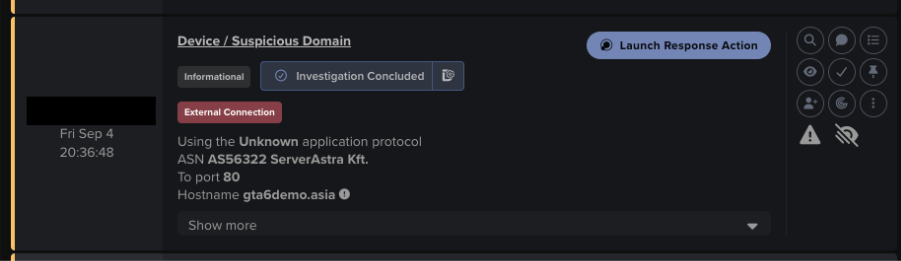
During September 2026, Darktrace alerted on HTTP connections to gta6demo[.]asia across twelve customer environments. Seven of the twelve communicated with infrastructure associated with AS56322 ServerAstra Kft as part of this connectivity.

‍

Figure 3: An example model alert generated due to a suspicious connection to gta6demo[.]asia.

‍

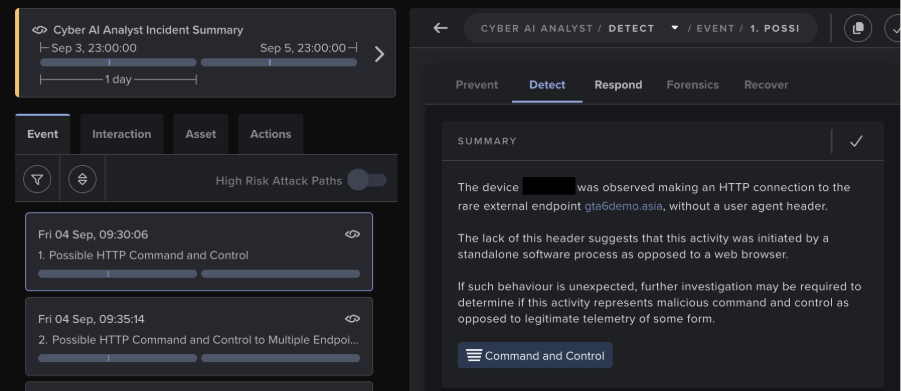
In a case affecting a UK-based customer, Darktrace’s Real-Time AI Analyst further investigated connections to gta6demo[.]asia and generated an incident due to the highly suspicious nature of the behavior.

‍

Figure 4: A Real-Time AI Analyst incident highlighting the suspicious activity for further investigation

‍

Public threat research has associated gta6demo[.]asia with a campaign advertising a fake GTA VI demo. Users clicking "Play Now" were reportedly directed towards an executable containing the Vidar infostealer [2].

There is a practical difference between this activity and an attack against a games company. The users encountering GTA VI-themed infrastructure can work anywhere. Darktrace saw the activity across several sectors outside Gaming, including Finance, Manufacturing, and Public administration and defense.

A major game release can therefore create security exposure well beyond its publisher. A search for a demo or unofficial download on a corporate device is enough to bring gaming-themed infrastructure into an enterprise environment.

Ransomware operators inside the gaming industry

The attacks Darktrace observed against Gaming companies themselves show different patterns.

In August 2026, Darktrace threat research identified possible malicious activity at a European game developer. Ransomware was ultimately deployed and data was exfiltrated, with the DireWolf ransomware group claiming responsibility.

Darktrace observed suspicious file downloads and beaconing from several devices to rare endpoints alongside Monero cryptocurrency mining, Active Directory and network reconnaissance, unusual administrative RDP connections, activity associated with data staging and HTTP-based exfiltration.

Much of the intrusion was therefore visible before ransomware appeared; the environment was already showing evidence of ingress tooling, external command-and-control communications (C2), reconnaissance, unusual administrative access and data movement.

A separate investigation in December 2025 provides a closer view of this pre-ransomware activity. A European games company was targeted by Qilin ransomware with Darktrace observing scanning and LDAP searches involving userAccountControl, which can expose information useful for identifying accounts and Service Principal Names within Active Directory.

New administrative credentials then appeared on a Domain Controller and the Domain Controller also generated scanning, anomalous RPC, SMB, and SSH activity, and NetShareEnum activity through srvsvc. Elsewhere in the environment, long Remote Desktop sessions and SMB enumeration appeared consistent with lateral movement.

Several devices also transferred data to cloud storage services including WebDrive and Amazon Web Services (AWS). In some cases, large downloads preceded subsequent uploads. Darktrace observed the transfer pattern, although the available telemetry does not establish that every transfer represented attacker-controlled exfiltration.

The activity preceding the Qilin deployment included Active Directory reconnaissance, privileged credential use, network and share enumeration, unusual remote access and significant data movement. Each appeared before ransomware became the defining feature of the incident.

SaaS hijacking shifts the attacker evidence

A separate investigation in May 2026 involved the hijacking of a SaaS account at a Gaming organization.

The compromised account authenticated from several IP addresses that were unusual for the organization. It then performed suspicious SaaS group administration, including creating a new privileged account. The account subsequently sent a high volume of emails assessed as likely malicious spam and potentially intended to compromise additional users.

The following day, an administrative SaaS account authenticated from rare endpoints, raising the possibility that further privileged access had been obtained.

The activity presented a different detection problem from the ransomware cases. Authentication from rare infrastructure, administrative changes, creation of a privileged account and subsequent email activity provided the strongest indications that a legitimate identity had been compromised.

For a Gaming company using hosted platforms for development, communication and business operations, a compromised account with the right permissions can provide considerable access without requiring the attacker to reproduce a conventional network intrusion.

Detecting the intrusion before impact

The ransomware investigations show why encryption should not be the first point at which an incident comes into focus. Darktrace observed LDAP and Active Directory-related reconnaissance, new privileged credentials, unusual Domain Controller activity, remote sessions, network enumeration and abnormal data movement before ransomware deployment.

The SaaS case produced different evidence: authentication from rare infrastructure, unexpected administrative changes and activity performed through a compromised account. GTA VI-themed activity required another approach again, following users through unofficial sites and redirects and examining the software offered for download.

GTA VI has put gaming back into the headlines ahead of its November release. The security activity around it is already visible beyond the games industry, while ransomware and account-compromise investigations show attackers operating inside gaming companies through very different routes.

For defenders, those routes leave evidence before the incident reaches its most damaging stage. The practical work is in recognizing those changes early enough to investigate them.

Credit to Gemma Stubberfield (Cyber Analyst), Ahmed Gardezi (Senior Cyber Analyst), Tara Gould (Malware Research Lead), Nathaniel Jones (SVP, Global Threat Intelligence)

References:

1.        https://www.rockstargames.com/VI

2.     https://www.malwarebytes.com/blog/threat-intel/2026/08/fake-gta-6-extended-look-and-demo-sites-deliver-an-infostealer

‍

‍

Continue reading
About the author
Gemma Stubberfield
Cyber Analyst

Blog

/

AI

/

November 17, 2026

How Microsoft and Darktrace Secure the AI-Powered Enterprise

Default blog imageDefault blog image

When legitimate activity creates business risk

AI is making information more accessible and enabling autonomous agents to act across enterprise systems. But legitimate access can still result in sensitive-data exposure, unintended actions, or activity that deviates from business expectations.

Microsoft's evolving security strategy recognizes this shift, emphasizing continuous risk assessment, stronger identity protection, and security that adapts as AI systems operate. For enterprises, the challenge is increasingly about recognizing when trusted activity introduces risk, even when existing controls are functioning as intended.

Where global intelligence meets deep business context

Microsoft brings global threat intelligence and comprehensive security capabilities, helping organizations protect identities, data, applications, and infrastructure. Its integrated approach connects security signals, governance, detection, and response across increasingly complex environments.

Darktrace complements these strengths with deep, organization-specific behavioral understanding. Powered by Adaptive AI, Darktrace continuously learns the patterns and relationships unique to each business, developing a Unique Behavioral Profile for each organization that helps distinguish meaningful threats from legitimate activity. By connecting identity, activity, context, and intent, it adds another dimension to security intelligence.

Together, Microsoft and Darktrace combine global intelligence with deeper knowledge of how each customer operates. Through supported integrations, this behavioral context enriches existing Microsoft security workflows, enabling more informed investigations and precise response.

This complementary approach extends across three interconnected areas of enterprise security- AI, People and Infrastructure. From understanding how AI and agents operate to protecting trusted communications and the infrastructure businesses depend on, Darktrace strengthens Microsoft's security capabilities with behavioral insight specific to each organization.

Understanding AI beyond permissions and policies

As AI moves into business-critical operations, security teams need to understand more than which applications and agents are approved. They need visibility into how AI is used, what information it accesses, and whether its actions remain aligned with business intent.

Microsoft provides extensive AI development, governance, and security capabilities. Darktrace / SECURE AI complements these with behavioral analysis across Shadow AI, prompts, agent identities and actions, and development risk. Policy Manager helps evaluate activity against organizational AI policies, while the announced integration with Microsoft Agent 365 is designed to enrich agent risk assessments with organization-specific behavioral signals. Together, these capabilities help organizations scale AI adoption with greater confidence.

Recognizing risk within trusted relationships

Sophisticated threats increasingly exploit established business relationships, familiar communications, and legitimate accounts. A message from a trusted supplier or an action taken through an authorized identity may appear routine until considered against the organization's normal behavior.

Darktrace / EMAIL complements Microsoft's native email, identity, and data protection capabilities by understanding how people and organizations communicate. This enables more precise detection of targeted phishing, business email compromise, account takeover, and data loss, supported by proportionate response. Integrations such as Unified Quarantine within Microsoft Defender for Office 365 bring this additional protection into existing security workflows.

Seeing the bigger picture behind an attack across domains

Threats rarely unfold within a single security domain. Suspicious identity activity, unexpected cloud connections, and unusual network behavior may appear unrelated until the relationships between them reveal a developing attack.

Darktrace / HYBRID NETWORK complements Microsoft's security capabilities with organization-specific behavioral detection across network, cloud, identity, and operational technology. Real-Time AI Analyst, including Cyber AI Analyst, connects related activity into investigated incidents that can be delivered into Microsoft Sentinel, helping security teams accelerate investigations and support targeted containment across the hybrid enterprise.

Turning security intelligence into business confidence

As AI becomes more deeply integrated into business operations, organizations need security that understands not only what technology can access, but how it behaves within their unique environment.

Microsoft and Darktrace bring complementary strengths to that challenge. By connecting global threat intelligence and integrated security capabilities with deep behavioral understanding, the partnership helps organizations recognize emerging risks, respond with greater precision, and strengthen their existing security investments.

The opportunity is to turn security intelligence into meaningful business context, enabling organizations to innovate and operate AI with confidence.

Darktrace named a 2026 Microsoft Partner of the Year Finalist for ISV Innovation

Darktrace has been named a finalist for the 2026 Microsoft Partner of the Year Award in the ISV Innovation category.  

This recognition reflects our collaboration with Microsoft to bring business context to enterprise security. By connecting Microsoft's global threat intelligence and integrated security capabilities with Darktrace's deep behavioral understanding, we help organizations recognize emerging risks and respond with greater precision across AI, People and Infrastructure.

Thank you to Microsoft, our customers, and our teams for their continued collaboration.

Meet Darktrace at Microsoft Ignite and the Microsoft Frontier Tour

Explore how Darktrace and Microsoft are bringing behavioral security to AI, people, and infrastructure.

Join Darktrace at Microsoft Ignite in San Francisco, November 17–19, or connect with our experts as we join the Microsoft Frontier Tour across 21 cities worldwide.

Meet Darktrace at Microsoft Ignite

Connect with Darktrace at the Microsoft Frontier Tour

[related-resource]

Continue reading
About the author
Your data. Our AI.
Elevate your network security with Darktrace AI