
Blog
/
Email
/
December 18, 2025

Why Organizations are Moving to Label-free, Behavioral DLP for Outbound Email

Modern data loss doesn’t always look like a regex match. It can look like everyday communication slightly out of context. Here’s how a domain specific language model paired with behavioral learning protects labeled and unlabeled data without slowing business down.
Inside the SOC
Darktrace cyber analysts are world-class experts in threat intelligence, threat hunting and incident response, and provide 24/7 SOC support to thousands of Darktrace customers around the globe. Inside the SOC is exclusively authored by these experts, providing analysis of cyber incidents and threat trends, based on real-world experience in the field.
Written by
Carlos Gray
Senior Product Marketing Manager, Email
Man at laptopDefault blog imageDefault blog imageDefault blog imageDefault blog imageDefault blog imageDefault blog image
18
Dec 2025

Why outbound email DLP needs reinventing

In 2025, the global average cost of a data breach fell slightly — but remains substantial at USD 4.44 million (IBM Cost of a Data Breach Report 2025). The headline figure hides a painful reality: many of these breaches stem not from sophisticated hacks, but from simple human error: mis-sent emails, accidental forwarding, or replying with the wrong attachment. Because outbound email is a common channel for sensitive data leaving an organization, the risk posed by everyday mistakes is enormous.

In 2025, 53% of data breaches involved customer PII, making it the most commonly compromised asset (IBM Cost of a Data Breach Report 2025). This makes “protection at the moment of send” essential. A single unintended disclosure can trigger compliance violations, regulatory scrutiny, and erosion of customer trust –consequences that are disproportionate to the marginal human errors that cause them.

Traditional DLP has long attempted to mitigate these impacts, but it relies heavily on perfect labelling and rigid pattern-matching. In reality, data loss rarely presents itself as a neat, well-structured pattern waiting to be caught – it looks like everyday communication, just slightly out of context.

How data loss actually happens

Most data loss comes from frustratingly familiar scenarios. A mistyped name in auto-complete sends sensitive data to the wrong “Alex.” A user forwards a document to a personal Gmail account “just this once.” Someone shares an attachment with a new or unknown correspondent without realizing how sensitive it is.

Traditional, content-centric DLP rarely catches these moments. Labels are missing or wrong. Regexes break the moment the data shifts formats. And static rules can’t interpret the context that actually matters – the sender-recipient relationship, the communication history, or whether this behavior is typical for the user.

It’s the everyday mistakes that hurt the most. The classic example: the Friday 5:58 p.m. mis-send, when auto-complete selects Martin, a former contractor, instead of Marta in Finance.

What traditional DLP approaches offer (and where gaps remain)

Most email DLP today follows two patterns, each useful but incomplete.

  • Policy- and label-centric DLP works when labels are correct — but content is often unlabeled or mislabeled, and maintaining classification adds friction. Gaps appear exactly where users move fastest
  • Rule and signature-based approaches catch known patterns but miss nuance: human error, new workflows, and “unknown unknowns” that don’t match a rule

The takeaway: Protection must combine content + behavior + explainability at send time, without depending on perfect labels.

Your technology primer: The three pillars that make outbound DLP effective

1) Label-free (vs. data classification)

Protects all content, not just what’s labeled. Label-free analysis removes classification overhead and closes gaps from missing or incorrect tags. By evaluating content and context at send time, it also catches misdelivery and other payload-free errors.

  • No labeling burden; no regex/rule maintenance
  • Works when tags are missing, wrong, or stale
  • Detects misdirected sends even when labels look right

2) Behavioral (vs. rules, signatures, threat intelligence)

Understands user behavior, not just static patterns. Behavioral analysis learns what’s normal for each person, surfacing human error and subtle exfiltration that rules can’t. It also incorporates account signals and inbound intel, extending across email and Teams.

  • Flags risk without predefined rules or IOCs
  • Catches misdelivery, unusual contacts, personal forwards, odd timing/volume
  • Blends identity and inbound context across channels

3) Proprietary DSLM (vs. generic LLM)

Optimized for precise, fast, explainable on-send decisions. A DSLM understands email/DLP semantics, avoids generative risks, and stays auditable and privacy-controlled, delivering intelligence reliably without slowing mail flow.

  • Low-latency, on-send enforcement
  • Non-generative for predictable, explainable outcomes
  • Governed model with strong privacy and auditability

The Darktrace approach to DLP

Darktrace / EMAIL – DLP stops misdelivery and sensitive data loss at send time using hold/notify/justify/release actions. It blends behavioral insight with content understanding across 35+ PII categories, protecting both labeled and unlabeled data. Every action is paired with clear explainability: AI narratives show exactly why an email was flagged, supporting analysts and helping end-users learn. Deployment aligns cleanly with existing SOC workflows through mail-flow connectors and optional Microsoft Purview label ingestion, without forcing duplicate policy-building.

Deployment is simple: Microsoft 365 routes outbound mail to Darktrace for real-time, inline decisions without regex or rule-heavy setup.

A buyer’s checklist for DLP solutions

When choosing your DLP solution, you want to be sure that it can deliver precise, explainable protection at the moment it matters – on send – without operational drag.  

To finish, we’ve compiled a handy list of questions you can ask before choosing an outbound DLP solution:

  • Can it operate label free when tags are missing or wrong? 
  • Does it truly learn per user behavior (no shortcuts)? 
  • Is there a domain specific model behind the content understanding (not a generic LLM)? 
  • Does it explain decisions to both analysts and end users? 
  • Will it integrate with your label program and SOC workflows rather than duplicate them? 

For a deep dive into Darktrace’s DLP solution, check out the full solution brief.

[related-resource]

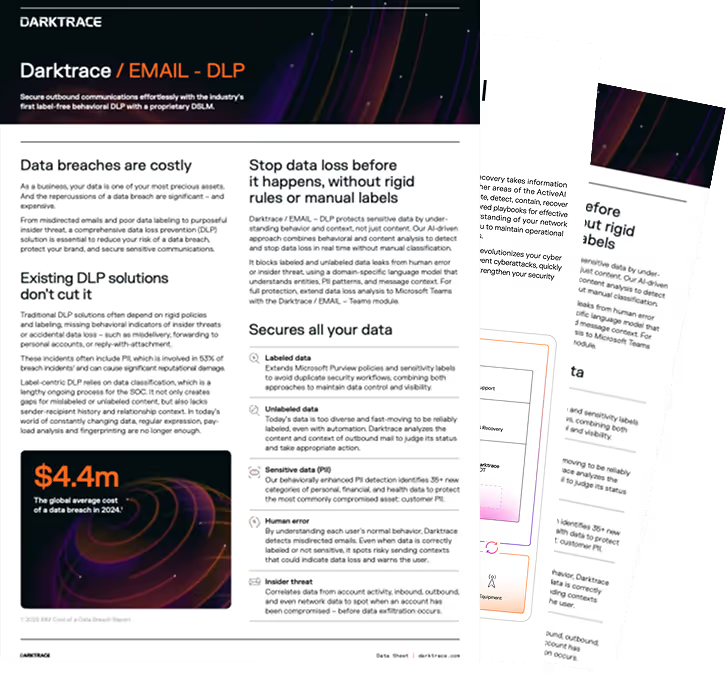
Darktrace / EMAIL - DLP Solution Brief

Secure outbound communications effortlessly with the industry’s first label-free behavioral DLP with a proprietary DSLM.

Inside the SOC
Darktrace cyber analysts are world-class experts in threat intelligence, threat hunting and incident response, and provide 24/7 SOC support to thousands of Darktrace customers around the globe. Inside the SOC is exclusively authored by these experts, providing analysis of cyber incidents and threat trends, based on real-world experience in the field.
Written by
Carlos Gray
Senior Product Marketing Manager, Email

More in this series

No items found.

Blog

/

/

March 5, 2026

Inside Cloud Compromise: Investigating Attacker Activity with Darktrace / Forensic Acquisition & Investigation

Forensic Acquisition and investigationDefault blog imageDefault blog image

Investigating cloud attacks with Darktrace/ Forensic Acquisition & Investigation

Darktrace / Forensic Acquisition & Investigation™ is the industry’s first truly automated forensic solution purpose-built for the cloud. This blog will demonstrate how an investigation can be carried out against a compromised cloud server in minutes, rather than hours or days.

The compromised server investigated in this case originates from Darktrace’s Cloudypots system, a global honeypot network designed to observe adversary activity in real time across a wide range of cloud services. Whenever an attacker successfully compromises one of these honeypots, a forensic copy of the virtual server's disk is preserved for later analysis. Using Forensic Acquisition & Investigation, analysts can then investigate further and obtain detailed insights into the compromise including complete attacker timelines and root cause analysis.

Forensic Acquisition & Investigation supports importing artifacts from a variety of sources, including EC2 instances, ECS, S3 buckets, and more. The Cloudypots system produces a raw disk image whenever an attack is detected and stores it in an S3 bucket. This allows the image to be directly imported into Forensic Acquisition & Investigation using the S3 bucket import option.

As Forensic Acquisition & Investigation runs cloud-natively, no additional configuration is required to add a specific S3 bucket. Analysts can browse and acquire forensic assets from any bucket that the configured IAM role is permitted to access. Operators can also add additional IAM credentials, including those from other cloud providers, to extend access across multiple cloud accounts and environments.

Figure 1: Forensic Acquisition & Investigation import screen.

Forensic Acquisition & Investigation then retrieves a copy of the file and automatically begins running the analysis pipeline on the artifact. This pipeline performs a full forensic analysis of the disk and builds a timeline of the activity that took place on the compromised asset. By leveraging Forensic Acquisition & Investigation’s cloud-native analysis system, this process condenses hour of manual work into just minutes.

Successful import of a forensic artifact and initiation of the analysis pipeline.
Figure 2: Successful import of a forensic artifact and initiation of the analysis pipeline.

Once processing is complete, the preserved artifact is visible in the Evidence tab, along with a summary of key information obtained during analysis, such as the compromised asset’s hostname, operating system, cloud provider, and key event count.

The Evidence overview showing the acquired disk image.
Figure 3: The Evidence overview showing the acquired disk image.

Clicking on the “Key events” field in the listing opens the timeline view, automatically filtered to show system- generated alarms.

The timeline provides a chronological record of every event that occurred on the system, derived from multiple sources, including:

  • Parsed log files such as the systemd journal, audit logs, application specific logs, and others.
  • Parsed history files such as .bash_history, allowing executed commands to be shown on the timeline.
  • File-specific events, such as files being created, accessed, modified, or executables being run, etc.

This approach allows timestamped information and events from multiple sources to be aggregated and parsed into a single, concise view, greatly simplifying the data review process.

Alarms are created for specific timeline events that match either a built-in system rule, curated by Darktrace’s Threat Research team or an operator-defined rule  created at the project level. These alarms help quickly filter out noise and highlight on events of interest, such as the creation of a file containing known malware, access to sensitive files like Amazon Web Service (AWS) credentials, suspicious arguments or commands, and more.

 The timeline view filtered to alarm_severity: “1” OR alarm_severity: “3”, showing only events that matched an alarm rule.
Figure 4: The timeline view filtered to alarm_severity: “1” OR alarm_severity: “3”, showing only events that matched an alarm rule.

In this case, several alarms were generated for suspicious Base64 arguments being passed to Selenium. Examining the event data, it appears the attacker spawned a Selenium Grid session with the following payload:

"request.payload": "[Capabilities {browserName: chrome, goog:chromeOptions: {args: [-cimport base64;exec(base64...], binary: /usr/bin/python3, extensions: []}, pageLoadStrategy: normal}]"

This is a common attack vector for Selenium Grid. The chromeOptions object is intended to specify arguments for how Google Chrome should be launched; however, in this case the attacker has abused the binary field to execute the Python3 binary instead of Chrome. Combined with the option to specify command-line arguments, the attacker can use Python3’s -c option to execute arbitrary Python code, in this instance, decoding and executing a Base64 payload.

Selenium’s logs truncate the Arguments field automatically, so an alternate method is required to retrieve the full payload. To do this, the search bar can be used to find all events that occurred around the same time as this flagged event.

Pivoting off the previous event by filtering the timeline to events within the same window using timestamp: [“2026-02-18T09:09:00Z” TO “2026-02-18T09:12:00Z”].
Figure 5: Pivoting off the previous event by filtering the timeline to events within the same window using timestamp: [“2026-02-18T09:09:00Z” TO “2026-02-18T09:12:00Z”].

Scrolling through the search results, an entry from Java’s systemd journal can be identified. This log contains the full, unaltered payload. GCHQ’s CyberChef can then be used to decode the Base64 data into the attacker’s script, which will ultimately be executed.

Decoding the attacker’s payload in CyberChef.
Figure 6: Decoding the attacker’s payload in CyberChef.

In this instance, the malware was identified as a variant of a campaign that has been previously documented in depth by Darktrace.

Investigating Perfctl Malware

This campaign deploys a malware sample known as ‘perfctl to the compromised host. The script executed by the attacker downloads a Go binary named “promocioni.php” from 200[.]4.115.1. Its functionality is consistent with previously documented perfctl samples, with only minor changes such as updated filenames and a new command-and-control (C2) domain.

Perfctl is a stealthy malware that has several systems designed  to evade detection. The main binary is packed with UPX, with the header intentionally tampered with to prevent unpacking using regular tools. The binary also avoids executing any malicious code if it detects debugging or tracing activity, or if artifacts left by earlier stages are missing.

To further aid its evasive capabilities, perfctl features a usermode rootkit using an LD preload. This causes dynamically linked executables to load perfctl’s rootkit payload before other system modules, allowing it to override functions, such as intercepting calls to list files and hiding output from the returned list. Perfctl uses this to hide its own files, as well as other files like the ld.so.preload file, preventing users from identifying that a rootkit is present in the first place.

This also makes it difficult to dynamically analyze, as even analysts aware of the rootkit will struggle to get around it due to its aggressiveness in hiding its components. A useful trick is to use the busybox-static utilities, which are statically linked and therefore immune to LD preloading.

Perfctl will attempt to use sudo to escalate its permissions to root if the user it was executed as has the required privileges. Failing this, it will attempt to exploit the vulnerability CVE-2021-4034.

Ultimately, perfctl will attempt to establish a C2 link via Tor and spawn an XMRig miner to mine the Monero cryptocurrency. The traffic to the mining pool is encapsulated within Tor to limit network detection of the mining traffic.

Darktrace’s Cloudypots system has observed 1,959 infections of the perfctl campaign across its honeypot network in the past year, making it one of the most aggressive campaigns seen by Darktrace.

Key takeaways

This blog has shown how Darktrace / Forensic Acquisition & Investigation equips defenders in the face of a real-world attacker campaign. By using this solution, organizations can acquire forensic evidence and investigate intrusions across multiple cloud resources and providers, enabling defenders to see the full picture of an intrusion on day one. Forensic Acquisition & Investigation’s patented data-processing system takes advantage of the cloud’s scale to rapidly process large amounts of data, allowing triage to take minutes, not hours.

Darktrace / Forensic Acquisition & Investigation is available as Software-as-a-Service (SaaS) but can also be deployed on-premises as a virtual application or natively in the cloud, providing flexibility between convenience and data sovereignty to suit any use case.

Support for acquiring traditional compute instances like EC2, as well as more exotic and newly targeted platforms such as ECS and Lambda, ensures that attacks taking advantage of Living-off-the-Cloud (LOTC) strategies can be triaged quickly and easily as part of incident response. As attackers continue to develop new techniques, the ability to investigate how they use cloud services to persist and pivot throughout an environment is just as important to triage as a single compromised EC2 instance.

Credit to Nathaniel Bill (Malware Research Engineer)

Continue reading
About the author
Nathaniel Bill
Malware Research Engineer

Blog

/

Network

/

February 19, 2026

CVE-2026-1731: How Darktrace Sees the BeyondTrust Exploitation Wave Unfolding

Default blog imageDefault blog image

Note: Darktrace's Threat Research team is publishing now to help defenders. We will continue updating this blog as our investigations unfold.

Background

On February 6, 2026, the Identity & Access Management solution BeyondTrust announced patches for a vulnerability, CVE-2026-1731, which enables unauthenticated remote code execution using specially crafted requests.  This vulnerability affects BeyondTrust Remote Support (RS) and particular older versions of Privileged Remote Access (PRA) [1].

A Proof of Concept (PoC) exploit for this vulnerability was released publicly on February 10, and open-source intelligence (OSINT) reported exploitation attempts within 24 hours [2].

Previous intrusions against Beyond Trust technology have been cited as being affiliated with nation-state attacks, including a 2024 breach targeting the U.S. Treasury Department. This incident led to subsequent emergency directives from  the Cybersecurity and Infrastructure Security Agency (CISA) and later showed attackers had chained previously unknown vulnerabilities to achieve their goals [3].

Additionally, there appears to be infrastructure overlap with React2Shell mass exploitation previously observed by Darktrace, with command-and-control (C2) domain  avg.domaininfo[.]top seen in potential post-exploitation activity for BeyondTrust, as well as in a React2Shell exploitation case involving possible EtherRAT deployment.

Darktrace Detections

Darktrace’s Threat Research team has identified highly anomalous activity across several customers that may relate to exploitation of BeyondTrust since February 10, 2026. Observed activities include:

Outbound connections and DNS requests for endpoints associated with Out-of-Band Application Security Testing; these services are commonly abused by threat actors for exploit validation.  Associated Darktrace models include:

  • Compromise / Possible Tunnelling to Bin Services

Suspicious executable file downloads. Associated Darktrace models include:

  • Anomalous File / EXE from Rare External Location

Outbound beaconing to rare domains. Associated Darktrace models include:

  • Compromise / Agent Beacon (Medium Period)
  • Compromise / Agent Beacon (Long Period)
  • Compromise / Sustained TCP Beaconing Activity To Rare Endpoint
  • Compromise / Beacon to Young Endpoint
  • Anomalous Server Activity / Rare External from Server
  • Compromise / SSL Beaconing to Rare Destination

Unusual cryptocurrency mining activity. Associated Darktrace models include:

  • Compromise / Monero Mining
  • Compromise / High Priority Crypto Currency Mining

And model alerts for:

  • Compromise / Rare Domain Pointing to Internal IP

IT Defenders: As part of best practices, we highly recommend employing an automated containment solution in your environment. For Darktrace customers, please ensure that Autonomous Response is configured correctly. More guidance regarding this activity and suggested actions can be found in the Darktrace Customer Portal.  

Appendices

Potential indicators of post-exploitation behavior:

·      217.76.57[.]78 – IP address - Likely C2 server

·      hXXp://217.76.57[.]78:8009/index.js - URL -  Likely payload

·      b6a15e1f2f3e1f651a5ad4a18ce39d411d385ac7  - SHA1 - Likely payload

·      195.154.119[.]194 – IP address – Likely C2 server

·      hXXp://195.154.119[.]194/index.js - URL – Likely payload

·      avg.domaininfo[.]top – Hostname – Likely C2 server

·      104.234.174[.]5 – IP address - Possible C2 server

·      35da45aeca4701764eb49185b11ef23432f7162a – SHA1 – Possible payload

·      hXXp://134.122.13[.]34:8979/c - URL – Possible payload

·      134.122.13[.]34 – IP address – Possible C2 server

·      28df16894a6732919c650cc5a3de94e434a81d80 - SHA1 - Possible payload

References:

1.        https://nvd.nist.gov/vuln/detail/CVE-2026-1731

2.        https://www.securityweek.com/beyondtrust-vulnerability-targeted-by-hackers-within-24-hours-of-poc-release/

3.        https://www.rapid7.com/blog/post/etr-cve-2026-1731-critical-unauthenticated-remote-code-execution-rce-beyondtrust-remote-support-rs-privileged-remote-access-pra/

Continue reading
About the author
Emma Foulger
Global Threat Research Operations Lead
Your data. Our AI.
Elevate your network security with Darktrace AI