

.avif)

Why outbound email DLP needs reinventing
In 2025, the global average cost of a data breach fell slightly — but remains substantial at USD 4.44 million (IBM Cost of a Data Breach Report 2025). The headline figure hides a painful reality: many of these breaches stem not from sophisticated hacks, but from simple human error: mis-sent emails, accidental forwarding, or replying with the wrong attachment. Because outbound email is a common channel for sensitive data leaving an organization, the risk posed by everyday mistakes is enormous.
In 2025, 53% of data breaches involved customer PII, making it the most commonly compromised asset (IBM Cost of a Data Breach Report 2025). This makes “protection at the moment of send” essential. A single unintended disclosure can trigger compliance violations, regulatory scrutiny, and erosion of customer trust –consequences that are disproportionate to the marginal human errors that cause them.
Traditional DLP has long attempted to mitigate these impacts, but it relies heavily on perfect labelling and rigid pattern-matching. In reality, data loss rarely presents itself as a neat, well-structured pattern waiting to be caught – it looks like everyday communication, just slightly out of context.
How data loss actually happens
Most data loss comes from frustratingly familiar scenarios. A mistyped name in auto-complete sends sensitive data to the wrong “Alex.” A user forwards a document to a personal Gmail account “just this once.” Someone shares an attachment with a new or unknown correspondent without realizing how sensitive it is.
Traditional, content-centric DLP rarely catches these moments. Labels are missing or wrong. Regexes break the moment the data shifts formats. And static rules can’t interpret the context that actually matters – the sender-recipient relationship, the communication history, or whether this behavior is typical for the user.
It’s the everyday mistakes that hurt the most. The classic example: the Friday 5:58 p.m. mis-send, when auto-complete selects Martin, a former contractor, instead of Marta in Finance.
What traditional DLP approaches offer (and where gaps remain)
Most email DLP today follows two patterns, each useful but incomplete.
- Policy- and label-centric DLP works when labels are correct — but content is often unlabeled or mislabeled, and maintaining classification adds friction. Gaps appear exactly where users move fastest
- Rule and signature-based approaches catch known patterns but miss nuance: human error, new workflows, and “unknown unknowns” that don’t match a rule
The takeaway: Protection must combine content + behavior + explainability at send time, without depending on perfect labels.
Your technology primer: The three pillars that make outbound DLP effective
1) Label-free (vs. data classification)
Protects all content, not just what’s labeled. Label-free analysis removes classification overhead and closes gaps from missing or incorrect tags. By evaluating content and context at send time, it also catches misdelivery and other payload-free errors.
- No labeling burden; no regex/rule maintenance
- Works when tags are missing, wrong, or stale
- Detects misdirected sends even when labels look right
2) Behavioral (vs. rules, signatures, threat intelligence)
Understands user behavior, not just static patterns. Behavioral analysis learns what’s normal for each person, surfacing human error and subtle exfiltration that rules can’t. It also incorporates account signals and inbound intel, extending across email and Teams.
- Flags risk without predefined rules or IOCs
- Catches misdelivery, unusual contacts, personal forwards, odd timing/volume
- Blends identity and inbound context across channels
3) Proprietary DSLM (vs. generic LLM)
Optimized for precise, fast, explainable on-send decisions. A DSLM understands email/DLP semantics, avoids generative risks, and stays auditable and privacy-controlled, delivering intelligence reliably without slowing mail flow.
- Low-latency, on-send enforcement
- Non-generative for predictable, explainable outcomes
- Governed model with strong privacy and auditability
The Darktrace approach to DLP
Darktrace / EMAIL – DLP stops misdelivery and sensitive data loss at send time using hold/notify/justify/release actions. It blends behavioral insight with content understanding across 35+ PII categories, protecting both labeled and unlabeled data. Every action is paired with clear explainability: AI narratives show exactly why an email was flagged, supporting analysts and helping end-users learn. Deployment aligns cleanly with existing SOC workflows through mail-flow connectors and optional Microsoft Purview label ingestion, without forcing duplicate policy-building.
Deployment is simple: Microsoft 365 routes outbound mail to Darktrace for real-time, inline decisions without regex or rule-heavy setup.
A buyer’s checklist for DLP solutions
When choosing your DLP solution, you want to be sure that it can deliver precise, explainable protection at the moment it matters – on send – without operational drag.
To finish, we’ve compiled a handy list of questions you can ask before choosing an outbound DLP solution:
- Can it operate label free when tags are missing or wrong?
- Does it truly learn per user behavior (no shortcuts)?
- Is there a domain specific model behind the content understanding (not a generic LLM)?
- Does it explain decisions to both analysts and end users?
- Will it integrate with your label program and SOC workflows rather than duplicate them?
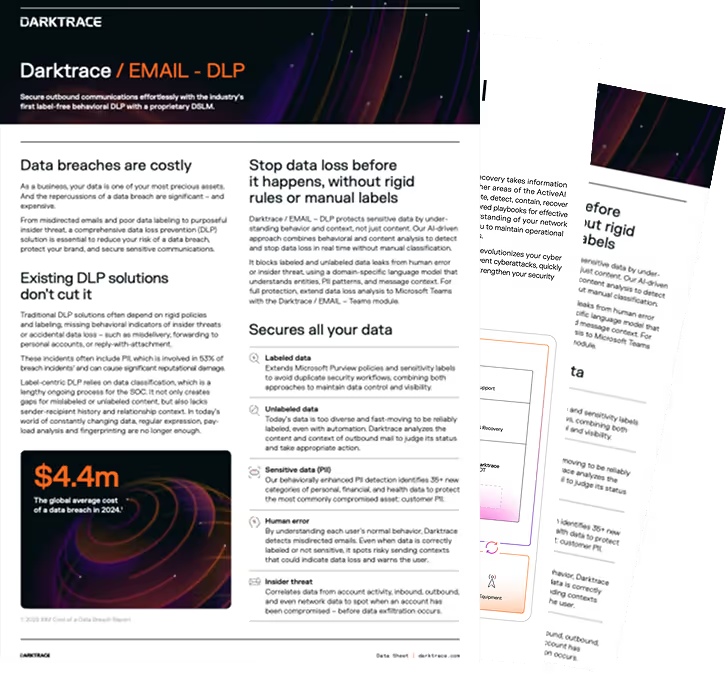
For a deep dive into Darktrace’s DLP solution, check out the full solution brief.
[related-resource]
Darktrace / EMAIL - DLP Solution Brief
Secure outbound communications effortlessly with the industry’s first label-free behavioral DLP with a proprietary DSLM.




.avif)







.png)