
Blog
/
Email
/
September 30, 2025

Out of Character: Detecting Vendor Compromise and Trusted Relationship Abuse with Darktrace

Phishing emails from compromised vendors are increasingly difficult to distinguish from genuine correspondence. They challenge workers, security teams and traditional email SEGs alike. Anomaly detection can be a game-changer in spotting the subtle signs of these meticulous attacks.
No items found.
Inside the SOC
Darktrace cyber analysts are world-class experts in threat intelligence, threat hunting and incident response, and provide 24/7 SOC support to thousands of Darktrace customers around the globe. Inside the SOC is exclusively authored by these experts, providing analysis of cyber incidents and threat trends, based on real-world experience in the field.
No items found.
vendor email compromiseDefault blog imageDefault blog imageDefault blog imageDefault blog imageDefault blog imageDefault blog image
30
Sep 2025

What is Vendor Email Compromise?

Vendor Email Compromise (VEC) refers to an attack where actors breach a third-party provider to exploit their access, relationships, or systems for malicious purposes. The initially compromised entities are often the target’s existing partners, though this can extend to any organization or individual the target is likely to trust.

It sits at the intersection of supply chain attacks and business email compromise (BEC), blending technical exploitation with trust-based deception. Attackers often infiltrate existing conversations, leveraging AI to mimic tone and avoid common spelling and grammar pitfalls. Malicious content is typically hosted on otherwise reputable file sharing platforms, meaning any shared links initially seem harmless.

While techniques to achieve initial access may have evolved, the goals remain familiar. Threat actors harvest credentials, launch subsequent phishing campaigns, attempt to redirect invoice payments for financial gain, and exfiltrate sensitive corporate data.

Why traditional defenses fall short

These subtle and sophisticated email attacks pose unique challenges for defenders. Few busy people would treat an ongoing conversation with a trusted contact with the same level of suspicion as an email from the CEO requesting ‘URGENT ASSISTANCE!’ Unfortunately, many traditional secure email gateways (SEGs) struggle with this too. Detecting an out-of-character email, when it does not obviously appear out of character, is a complex challenge. It’s hardly surprising, then, that 83% of organizations have experienced a security incident involving third-party vendors [1].  

This article explores how Darktrace detected four different vendor compromise campaigns for a single customer, within a two-week period in 2025.  Darktrace / EMAIL successfully identified the subtle indicators that these seemingly benign emails from trusted senders were, in fact, malicious. Due to the configuration of Darktrace / EMAIL in this customer’s environment, it was unable to take action against the malicious emails. However, if fully enabled to take Autonomous Response, it would have held all offending emails identified.

How does Darktrace detect vendor compromise?

The answer lies at the core of how Darktrace operates: anomaly detection. Rather than relying on known malicious rules or signatures, Darktrace learns what ‘normal’ looks like for an environment, then looks for anomalies across a wide range of metrics. Despite the resourcefulness of the threat actors involved in this case, Darktrace identified many anomalies across these campaigns.

Different campaigns, common traits

A wide variety of approaches was observed. Individuals, shared mailboxes and external contractors were all targeted. Two emails originated from compromised current vendors, while two came from unknown compromised organizations - one in an associated industry. The sender organizations were either familiar or, at the very least, professional in appearance, with no unusual alphanumeric strings or suspicious top-level domains (TLDs). Subject line, such as “New Approved Statement From [REDACTED]” and “[REDACTED] - Proposal Document” appeared unremarkable and were not designed to provoke heightened emotions like typical social engineering or BEC attempts.

All emails had been given a Microsoft Spam Confidence Level of 1, indicating Microsoft did not consider them to be spam or malicious [2]. They also passed authentication checks (including SPF, and in some cases DKIM and DMARC), meaning they appeared to originate from an authentic source for the sender domain and had not been tampered with in transit.  

All observed phishing emails contained a link hosted on a legitimate and commonly used file-sharing site. These sites were often convincingly themed, frequently featuring the name of a trusted vendor either on the page or within the URL, to appear authentic and avoid raising suspicion. However, these links served only as the initial step in a more complex, multi-stage phishing process.
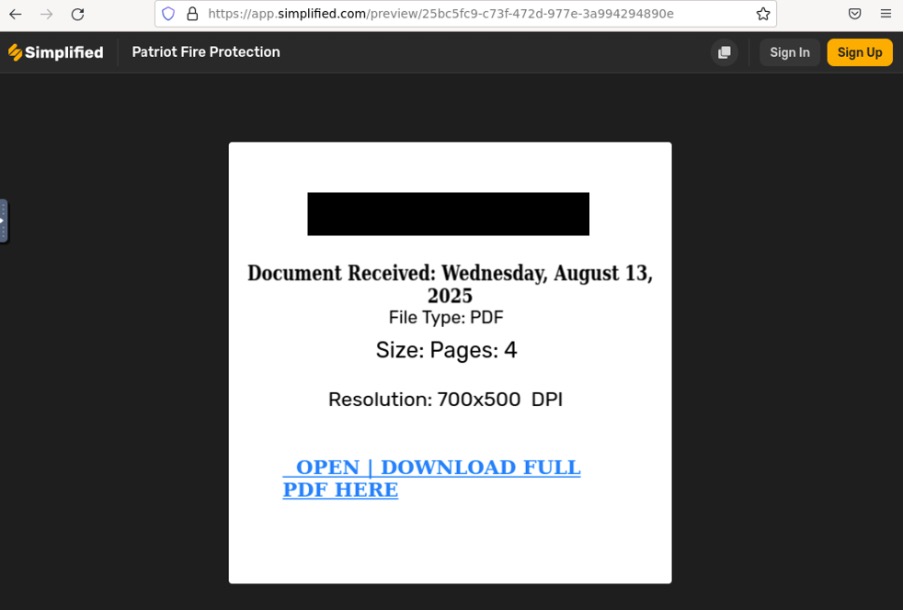
A legitimate file sharing site used in phishing emails to host a secondary malicious link.
Figure 1: A legitimate file sharing site used in phishing emails to host a secondary malicious link.
Another example of a legitimate file sharing endpoint sent in a phishing email and used to host a malicious link.
Figure 2: Another example of a legitimate file sharing endpoint sent in a phishing email and used to host a malicious link.

If followed, the recipient would be redirected, sometimes via CAPTCHA, to fake Microsoft login pages designed to capturing credentials, namely http://pub-ac94c05b39aa4f75ad1df88d384932b8.r2[.]dev/offline[.]html and https://s3.us-east-1.amazonaws[.]com/s3cure0line-0365cql0.19db86c3-b2b9-44cc-b339-36da233a3be2ml0qin/s3cccql0.19db86c3-b2b9-44cc-b339-36da233a3be2%26l0qn[.]html#.

The latter made use of homoglyphs to deceive the user, with a link referencing ‘s3cure0line’, rather than ‘secureonline’. Post-incident investigation using open-source intelligence (OSINT) confirmed that the domains were linked to malicious phishing endpoints [3] [4].
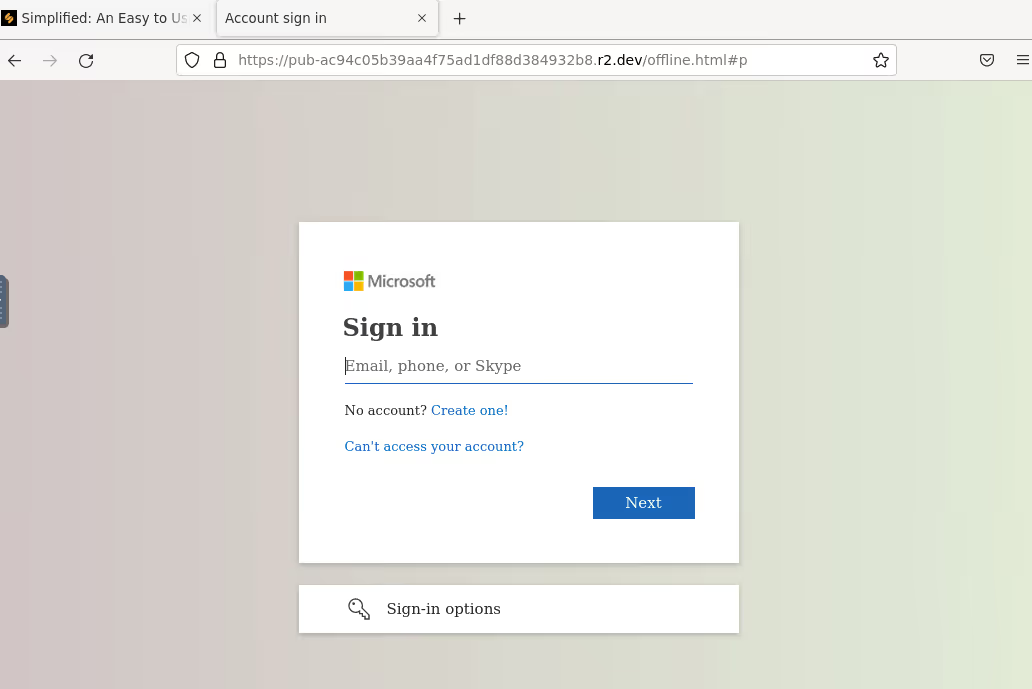
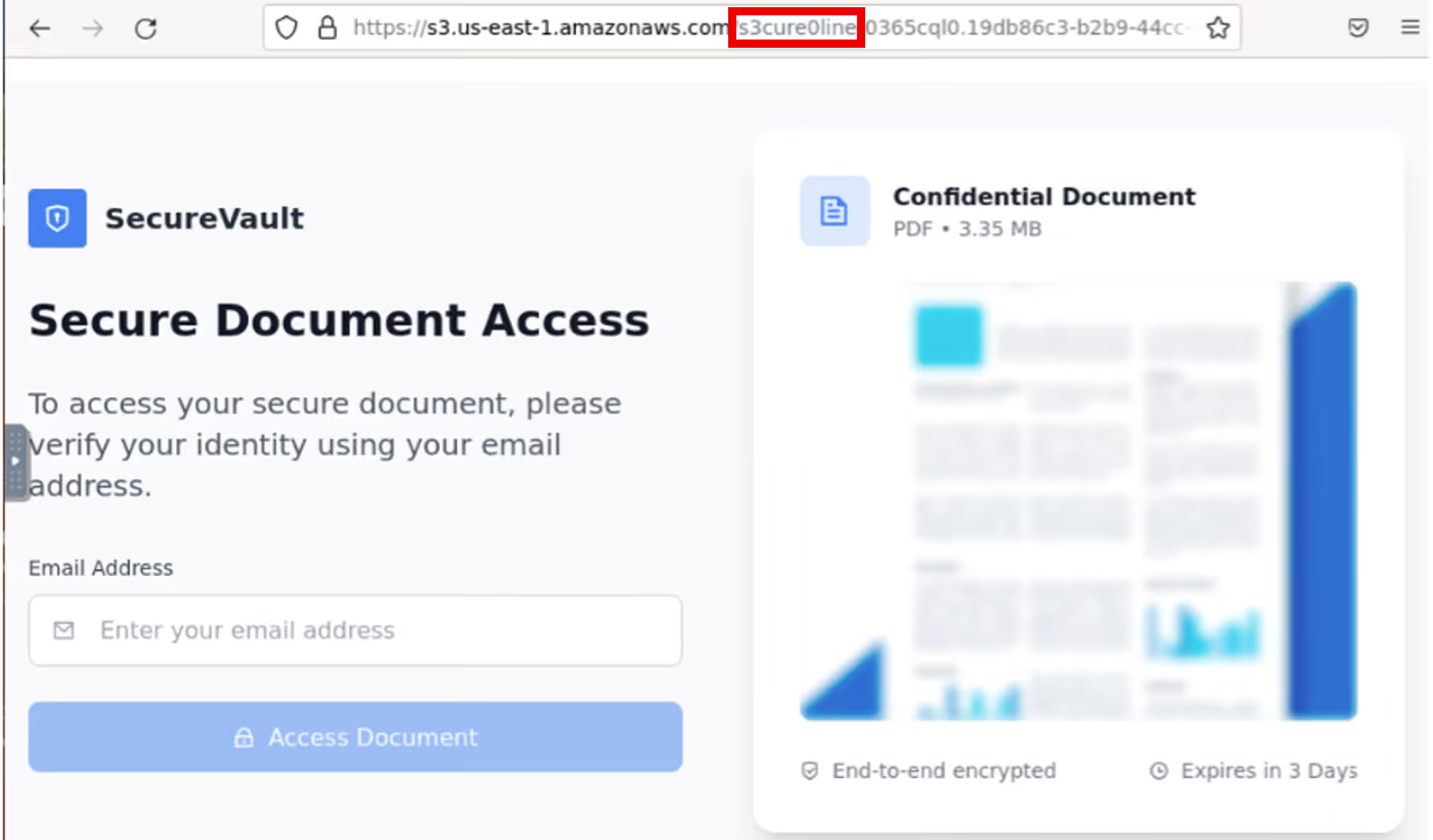
Fake Microsoft login page designed to harvest credentials.
Figure 3: Fake Microsoft login page designed to harvest credentials.
Phishing kit with likely AI-generated image, designed to harvest user credentials. The URL uses ‘s3cure0line’ instead of ‘secureonline’, a subtle misspelling intended to deceive users.
Figure 4: Phishing kit with likely AI-generated image, designed to harvest user credentials. The URL uses ‘s3cure0line’ instead of ‘secureonline’, a subtle misspelling intended to deceive users.

Darktrace Anomaly Detection

Some senders were unknown to the network, with no previous outbound or inbound emails. Some had sent the email to multiple undisclosed recipients using BCC, an unusual behavior for a new sender.  

Where the sender organization was an existing vendor, Darktrace recognized out-of-character behavior, in this case it was the first time a link to a particular file-sharing site had been shared. Often the links themselves exhibited anomalies, either being unusually prominent or hidden altogether - masked by text or a clickable image.

Crucially, Darktrace / EMAIL is able to identify malicious links at the time of processing the emails, without needing to visit the URLs or analyze the destination endpoints, meaning even the most convincing phishing pages cannot evade detection – meaning even the most convincing phishing emails cannot evade detection. This sets it apart from many competitors who rely on crawling the endpoints present in emails. This, among other things, risks disruption to user experience, such as unsubscribing them from emails, for instance.

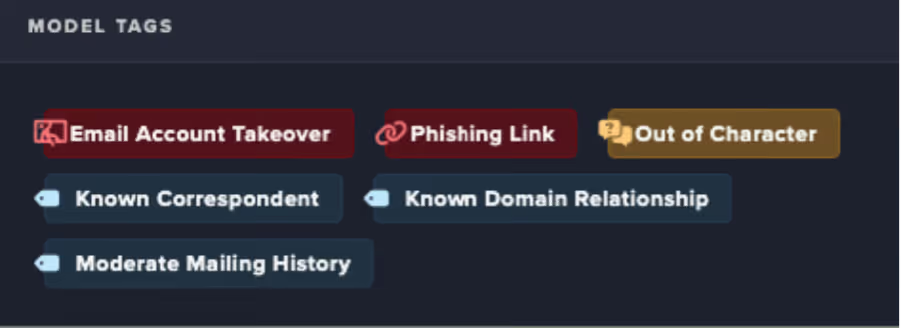
Darktrace was also able to determine that the malicious emails originated from a compromised mailbox, using a series of behavioral and contextual metrics to make the identification. Upon analysis of the emails, Darktrace autonomously assigned several contextual tags to highlight their concerning elements, indicating that the messages contained phishing links, were likely sent from a compromised account, and originated from a known correspondent exhibiting out-of-character behavior.
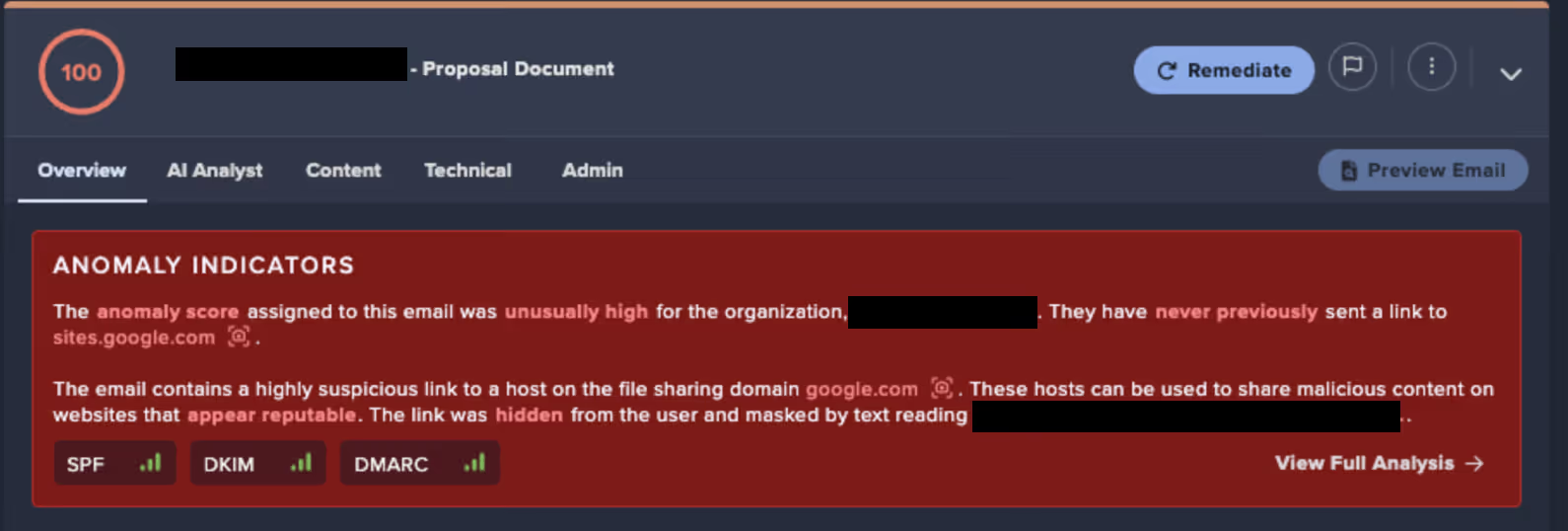
A summary of the anomalous email, confirming that it contained a highly suspicious link.
Figure 5: Tags assigned to offending emails by Darktrace / EMAIL.

Figure 6: A summary of the anomalous email, confirming that it contained a highly suspicious link.

Out-of-character behavior caught in real-time

In another customer environment around the same time Darktrace / EMAIL detected multiple emails with carefully crafted, contextually appropriate subject lines sent from an established correspondent being sent to 30 different recipients. In many cases, the attacker hijacked existing threads and inserted their malicious emails into an ongoing conversation in an effort to blend in and avoid detection. As in the previous, the attacker leveraged a well-known service, this time ClickFunnels, to host a document containing another malicious link. Once again, they were assigned a Microsoft Spam Confidence Level of 1, indicating that they were not considered malicious.
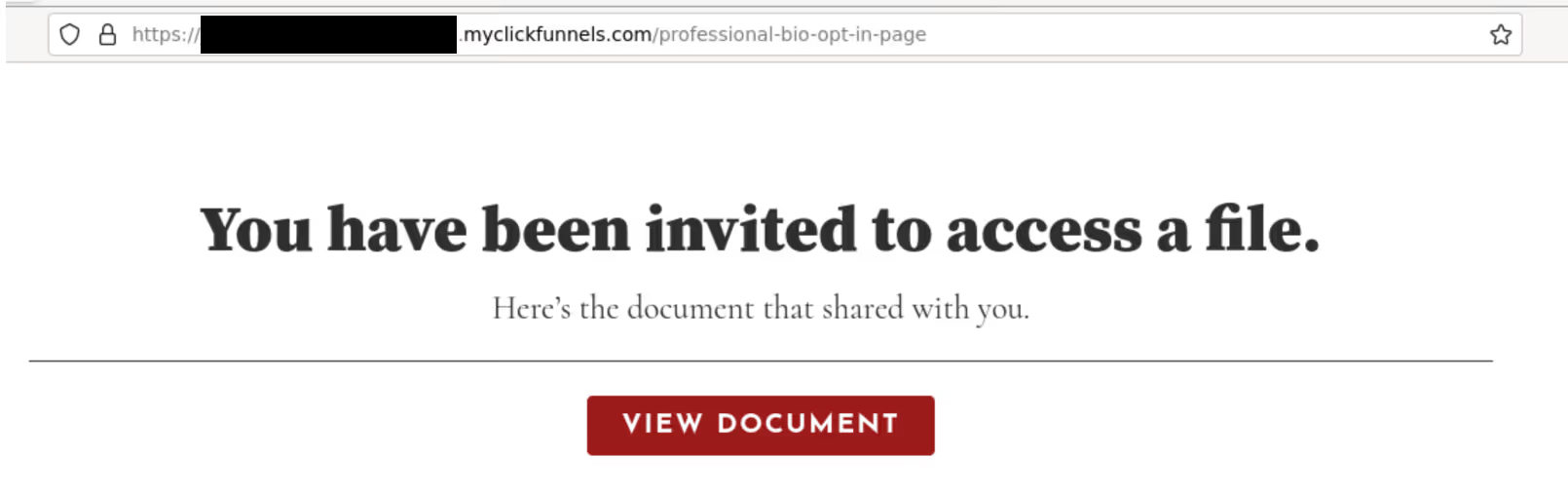
The legitimate ClickFunnels page used to host a malicious phishing link.
Figure 7: The legitimate ClickFunnels page used to host a malicious phishing link.

This time, however, the customer had Darktrace / EMAIL fully enabled to take Autonomous Response against suspicious emails. As a result, when Darktrace detected the out-of-character behavior, specifically, the sharing of a link to a previously unused file-sharing domain, and identified the likely malicious intent of the message, it held the email, preventing it from reaching recipients’ inboxes and effectively shutting down the attack.
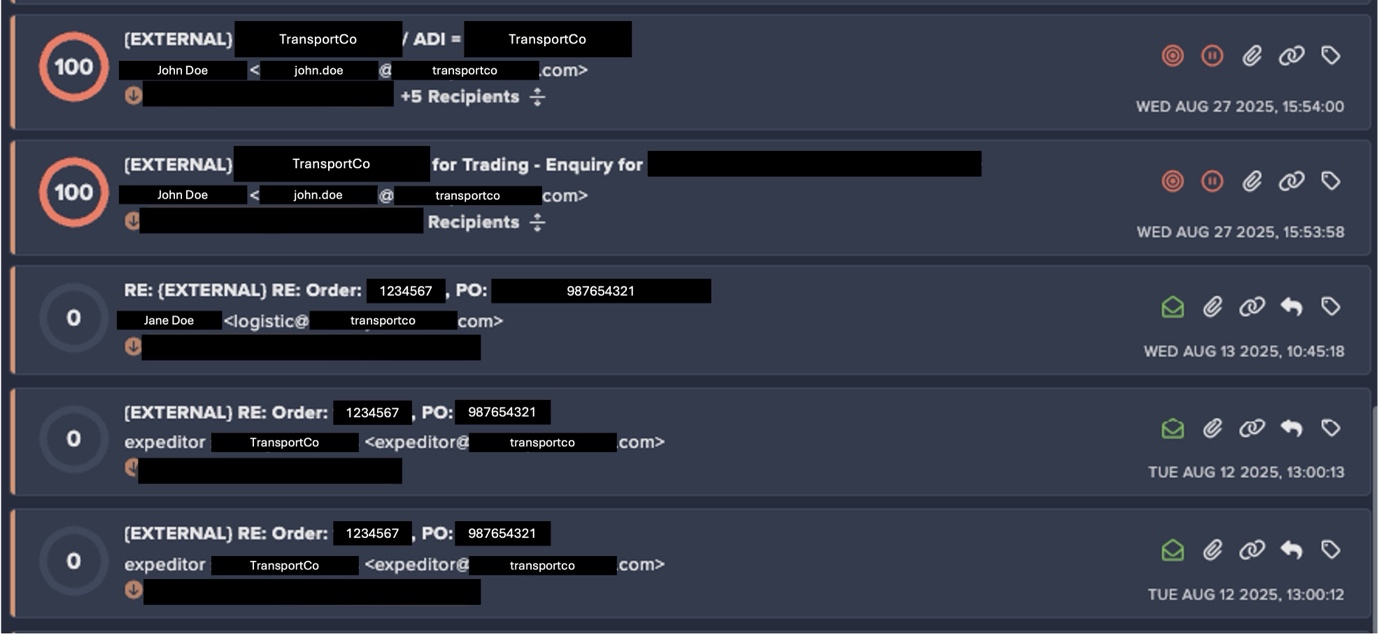
Figure 8: Darktrace / EMAIL’s detection of malicious emails inserted into an existing thread.*

*To preserve anonymity, all real customer names, email addresses, and other identifying details have been redacted and replaced with fictitious placeholders.

Legitimate messages in the conversation were assigned an Anomaly Score of 0, while the newly inserted malicious emails identified and were flagged with the maximum score of 100.

Key takeaways for defenders

Phishing remains big business, and as the landscape evolves, today’s campaigns often look very different from earlier versions. As with network-based attacks, threat actors are increasingly leveraging legitimate tools and exploiting trusted relationships to carry out their malicious goals, often staying under the radar of security teams and traditional email defenses.

As attackers continue to exploit trusted relationships between organizations and their third-party associates, security teams must remain vigilant to unexpected or suspicious email activity. Protecting the digital estate requires an email solution capable of identifying malicious characteristics, even when they originate from otherwise trusted senders.

Credit to Jennifer Beckett (Cyber Analyst), Patrick Anjos (Senior Cyber Analyst), Ryan Traill (Analyst Content Lead), Kiri Addison (Director of Product)

Appendices

IoC - Type - Description + Confidence  

- http://pub-ac94c05b39aa4f75ad1df88d384932b8.r2[.]dev/offline[.]html#p – fake Microsoft login page

- https://s3.us-east-1.amazonaws[.]com/s3cure0line-0365cql0.19db86c3-b2b9-44cc-b339-36da233a3be2ml0qin/s3cccql0.19db86c3-b2b9-44cc-b339-36da233a3be2%26l0qn[.]html# - link to domain used in homoglyph attack

MITRE ATT&CK Mapping  

Tactic – Technique – Sub-Technique  

Initial Access - Phishing – (T1566)  

References

1.     https://gitnux.org/third-party-risk-statistics/

2.     https://learn.microsoft.com/en-us/defender-office-365/anti-spam-spam-confidence-level-scl-about

3.     https://www.virustotal.com/gui/url/5df9aae8f78445a590f674d7b64c69630c1473c294ce5337d73732c03ab7fca2/detection

4.     https://www.virustotal.com/gui/url/695d0d173d1bd4755eb79952704e3f2f2b87d1a08e2ec660b98a4cc65f6b2577/details

The content provided in this blog is published by Darktrace for general informational purposes only and reflects our understanding of cybersecurity topics, trends, incidents, and developments at the time of publication. While we strive to ensure accuracy and relevance, the information is provided “as is” without any representations or warranties, express or implied. Darktrace makes no guarantees regarding the completeness, accuracy, reliability, or timeliness of any information presented and expressly disclaims all warranties.

Nothing in this blog constitutes legal, technical, or professional advice, and readers should consult qualified professionals before acting on any information contained herein. Any references to third-party organizations, technologies, threat actors, or incidents are for informational purposes only and do not imply affiliation, endorsement, or recommendation.

Darktrace, its affiliates, employees, or agents shall not be held liable for any loss, damage, or harm arising from the use of or reliance on the information in this blog.

The cybersecurity landscape evolves rapidly, and blog content may become outdated or superseded. We reserve the right to update, modify, or remove any content

The Darktrace / EMAIL Solution Brief

Learn more about how Darktrace / EMAIL stops block novel threats up to 13 days earlier than other tools
No items found.
Inside the SOC
Darktrace cyber analysts are world-class experts in threat intelligence, threat hunting and incident response, and provide 24/7 SOC support to thousands of Darktrace customers around the globe. Inside the SOC is exclusively authored by these experts, providing analysis of cyber incidents and threat trends, based on real-world experience in the field.
No items found.

More in this series

No items found.

Blog

/

Email

/

December 2, 2025

From Amazon to Louis Vuitton: How Darktrace Detects Black Friday Phishing Attacks

Default blog imageDefault blog image

Why Black Friday Drives a Surge in Phishing Attacks

In recent years, Black Friday has shifted from a single day of online retail sales and discounts to an extended ‘Black Friday Week’, often preceded by weeks of online hype. During this period, consumers are inundated with promotional emails and marketing campaigns as legitimate retailers compete for attention.

Unsurprisingly, this surge in legitimate communications creates an ideal environment for threat actors to launch targeted phishing campaigns designed to mimic legitimate retail emails. These campaigns often employ social engineering techniques that exploit urgency, exclusivity, and consumer trust in well-known brands, tactics designed to entice recipients into opening emails and clicking on malicious links.

Additionally, given the seasonal nature of Black Friday and the ever-changing habits of consumers, attackers adopt new tactics and register fresh domains each year, rather than reusing domains previously flagged as spam or phishing endpoints. While this may pose a challenge for traditional email security tools, it presents no such difficulty for Darktrace / EMAIL and its anomaly-based approach.

In the days and weeks leading up to ‘Black Friday’, Darktrace observed a spike in sophisticated phishing campaigns targeting consumers, demonstrating how attackers combine phycological manipulation with technical evasion to bypass basic security checks during this high-traffic period. This blog showcases several notable examples of highly convincing phishing emails detected and contained by Darktrace / EMAIL in mid to late November 2025.

Darktrace’s Black Friday Detections

Brand Impersonation: Deal Watchdogs’ Amazon Deals

The impersonation major online retailers has become a common tactic in retail-focused attacks, none more so than Amazon, which ranked as the fourth most impersonated brand in 2024, only behind Microsoft, Apple, Google, and Facebook [1]. Darktrace’s own research found Amazon to be the most mimicked brand, making up 80% of phishing attacks in its analysis of global consumer brands.

When faced with an email that appears to come from a trusted sender like Amazon, recipients are far more likely to engage, increasing the success rate of these phishing campaigns.

In one case observed on November 16, Darktrace detected an email with the subject line “NOW LIVE: Amazon’s Best Early Black Friday Deals on Gadgets Under $60”. The email was sent to a customer by the sender ‘Deal Watchdogs’, in what appeared to be an attempt to masquerade as a legitimate discount-finding platform. No evidence indicated that the company was legitimate. In fact, the threat actor made no attempt to create a convincing name, and the domain appeared to be generated by a domain generation algorithm (DGA), as shown in Figure 2.

Although the email was sent by ‘Deal Watchdogs’, it attempted to impersonate Amazon by featuring realistic branding, including the Amazon logo and a shade of orange similar to that used by them for the ‘CLICK HERE’ button and headline text.

Figure 1: The contents of the email observed by Darktrace, featuring authentic-looking Amazon branding.

Darktrace identified that the email, marked as urgent by the sender, contained a suspicious link to a Google storage endpoint (storage.googleapis[.]com), which had been hidden by the text “CLICK HERE”. If clicked, the link could have led to a credential harvester or served as a delivery vector for a malicious payload hosted on the Google storage platform.

Fortunately, Darktrace immediately identified the suspicious nature of this email and held it before delivery, preventing recipients from ever receiving or interacting with the malicious content.

Figure 2: Darktrace / EMAIL’s detection of the malicious phishing email sent to a customer.

Around the same time, Darktrace detected a similar email attempting to spoof Amazon on another customer’s network with the subject line “Our 10 Favorite Deals on Amazon That Started Today”, also sent by ‘Deal Watchdogs,’ suggesting a broader campaign.

Analysis revealed that this email originated from the domain petplatz[.]com, a fake marketing domain previously linked to spam activity according to open-source intelligence (OSINT) [2].

Brand Impersonation: Louis Vuitton

A few days later, on November 20, Darktrace / EMAIL detected a phishing email attempting to impersonate the luxury fashion brand Louis Vuitton. At first glance, the email, sent under the name ‘Louis Vuitton’ and titled “[Black Friday 2025] Discover Your New Favorite Louis Vuitton Bag – Elegance Starts Here”, appeared to be a legitimate Black Friday promotion. However, Darktrace’s analysis uncovered several red flags indicating a elaborate brand impersonation attempt.

The email was not sent by Louis Vuitton but by rskkqxyu@bookaaatop[.]ru, a Russia-based domain never before observed on the customer’s network. Darktrace flagged this as suspicious, noting that .ru domains were highly unusual for this recipient’s environment, further reinforcing the likelihood of malicious intent. Subsequent analysis revealed that the domain had only recently registered and was flagged as malicious by multiple OSINT sources [3].

Figure 3: Darktrace / EMAIL’s detection of the malicious email attempting to spoofLouis Vuitton, originating from a suspicious Russia-based domain.

Darktrace further noted that the email contained a highly suspicious link hidden behind the text “View Collection” and “Unsubscribe,” ensuring that any interaction, whether visiting the supposed ‘handbag store’ or attempting to opt out of marketing emails, would direct recipients to the same endpoint. The link resolved to xn--80aaae9btead2a[.]xn--p1ai (топааабоок[.]рф), a domain confirmed as malicious by multiple OSINT sources [4]. At the time of analysis, the domain was inaccessible, likely due to takedown efforts or the short-lived nature of the campaign.

Darktrace / EMAIL blocked this email before it reached customer inboxes, preventing recipients from interacting with the malicious content and averting any disruption.

Figure 4: The suspicious domain linked in the Louis Vuitton phishing email, now defunct.

Too good to be true?

Aside from spoofing well-known brands, threat actors frequently lure consumers with “too good to be true” luxury offers, a trend Darktrace observed in multiple cases throughout November.

In one instance, Darktrace identified an email with the subject line “[Black Friday 2025] Luxury Watches Starting at $250.” Emails contained a malicious phishing link, hidden behind text like “Rolex Starting from $250”, “Shop Now”, and “Unsubscribe”.

Figure 5: Example of a phishing email detected by Darktrace, containing malicious links concealed behind seemingly innocuous text.

Similarly to the Louis Vuitton email campaign described above, this malicious link led to a .ru domain (hxxps://x.wwwtopsalebooks[.]ru/.../d65fg4er[.]html), which had been flagged as malicious by multiple sources [5].

Figure 6: Darktrace / EMAIL’s detection of a malicious email promoting a fake luxury watch store, which was successfully held from recipient inboxes.

If accessed, this domain would redirect users to luxy-rox[.]com, a recently created domain (15 days old at the time of writing) that has also been flagged as malicious by OSINT sources [6]. When visited, the redirect domain displayed a convincing storefront advertising high-end watches at heavily discounted prices.

Figure 7: The fake storefront presented upon visiting the redirectdomain, luxy-rox[.]com.

Although the true intent of this domain could not be confirmed, it was likely a scam site or a credential-harvesting operation, as users were required to create an account to complete a purchase. As of the time or writing, the domain in no longer accessible .

This email illustrates a layered evasion tactic: attackers employed multiple domains, rapid domain registration, and concealed redirects to bypass detection. By leveraging luxury branding and urgency-driven discounts, the campaign sought to exploit seasonal shopping behaviors and entice victims into clicking.

Staying Protected During Seasonal Retail Scams

The investigation into these Black Friday-themed phishing emails highlights a clear trend: attackers are exploiting seasonal shopping events with highly convincing campaigns. Common tactics observed include brand impersonation (Amazon, Louis Vuitton, luxury watch brands), urgency-driven subject lines, and hidden malicious links often hosted on newly registered domains or cloud services.

These campaigns frequently use redirect chains, short-lived infrastructure, and psychological hooks like exclusivity and luxury appeal to bypass user scepticism and security filters. Organizations should remain vigilant during retail-heavy periods, reinforcing user awareness training, link inspection practices, and anomaly-based detection to mitigate these evolving threats.

Credit to Ryan Traill (Analyst Content Lead) and Owen Finn (Cyber Analyst)

Appendices

References

1.        https://keepnetlabs.com/blog/top-5-most-spoofed-brands-in-2024

2.        https://www.virustotal.com/gui/domain/petplatz.com

3.        https://www.virustotal.com/gui/domain/bookaaatop.ru

4.        https://www.virustotal.com/gui/domain/xn--80aaae9btead2a.xn--p1ai

5.        https://www.virustotal.com/gui/url/e2b868a74531cd779d8f4a0e1e610ec7f4efae7c29d8b8ab32c7a6740d770897?nocache=1

6.        https://www.virustotal.com/gui/domain/luxy-rox.com

Indicators of Compromise (IoCs)

IoC – Type – Description + Confidence

petplatz[.]com – Hostname – Spam domain

bookaaatop[.]ru – Hostname – Malicious Domain

xn--80aaae9btead2a[.]xn--p1ai (топааабоок[.]рф) – Hostname - Malicious Domain

hxxps://x.wwwtopsalebooks[.]ru/.../d65fg4er[.]html) – URL – Malicious Domain

luxy-rox[.]com – Hostname -  Malicious Domain

MITRE ATT&CK Mapping  

Tactic – Technique – Sub-Technique  

Initial Access - Phishing – (T1566)  

Continue reading
About the author
Ryan Traill
Analyst Content Lead

Blog

/

Network

/

November 27, 2025

CastleLoader & CastleRAT: Behind TAG150’s Modular Malware Delivery System

CastleLoader & CastleRAT: Behind TAG150’s Modular Malware Delivery SystemDefault blog imageDefault blog image

What is TAG-150?

TAG-150, a relatively new Malware-as-a-Service (MaaS) operator, has been active since March 2025, demonstrating rapid development and an expansive, evolving infrastructure designed to support its malicious operations. The group employs two custom malware families, CastleLoader and CastleRAT, to compromise target systems, with a primary focus on the United States [1]. TAG-150’s infrastructure included numerous victim-facing components, such as IP addresses and domains functioning as command-and-control (C2) servers associated with malware families like SecTopRAT and WarmCookie, in addition to CastleLoader and CastleRAT [2].

As of May 2025, CastleLoader alone had infected a reported 469 devices, underscoring the scale and sophistication of TAG-150’s campaign [1].

What are CastleLoader and CastleRAT?

CastleLoader is a loader malware, primarily designed to download and install additional malware, enabling chain infections across compromised systems [3]. TAG-150 employs a technique known as ClickFix, which uses deceptive domains that mimic document verification systems or browser update notifications to trick victims into executing malicious scripts. Furthermore, CastleLoader leverages fake GitHub repositories that impersonate legitimate tools as a distribution method, luring unsuspecting users into downloading and installing malware on their devices [4].

CastleRAT, meanwhile, is a remote access trojan (RAT) that serves as one of the primary payloads delivered by CastleLoader. Once deployed, CastleRAT grants attackers extensive control over the compromised system, enabling capabilities such as keylogging, screen capturing, and remote shell access.

TAG-150 leverages CastleLoader as its initial delivery mechanism, with CastleRAT acting as the main payload. This two-stage attack strategy enhances the resilience and effectiveness of their operations by separating the initial infection vector from the final payload deployment.

How are they deployed?

Castleloader uses code-obfuscation methods such as dead-code insertion and packing to hinder both static and dynamic analysis. After the payload is unpacked, it connects to its command-and-control server to retrieve and running additional, targeted components.

Its modular architecture enables it to function both as a delivery mechanism and a staging utility, allowing threat actors to decouple the initial infection from payload deployment. CastleLoader typically delivers its payloads as Portable Executables (PEs) containing embedded shellcode. This shellcode activates the loader’s core module, which then connects to the C2 server to retrieve and execute the next-stage malware.[6]

Following this, attackers deploy the ClickFix technique, impersonating legitimate software distribution platforms like Google Meet or browser update notifications. These deceptive sites trick victims into copying and executing PowerShell commands, thereby initiating the infection kill chain. [1]

When a user clicks on a spoofed Cloudflare “Verification Stepprompt, a background request is sent to a PHP script on the distribution domain (e.g., /s.php?an=0). The server’s response is then automatically copied to the user’s clipboard using the ‘unsecuredCopyToClipboard()’ function. [7].

The Python-based variant of CastleRAT, known as “PyNightShade,” has been engineered with stealth in mind, showing minimal detection across antivirus platforms [2]. As illustrated in Figure 1, PyNightShade communicates with the geolocation API service ip-api[.]com, demonstrating both request and response behavior

Packet Capture (PCAP) of PyNightShade, the Python-based variant of CastleRAT, communicating with the geolocation API service ip-api[.]com.
Figure 1: Packet Capture (PCAP) of PyNightShade, the Python-based variant of CastleRAT, communicating with the geolocation API service ip-api[.]com.

Darktrace Coverage

In mid-2025, Darktrace observed a range of anomalous activities across its customer base that appeared linked to CastleLoader, including the example below from a US based organization.

The activity began on June 26, when a device on the customer’s network was observed connecting to the IP address 173.44.141[.]89, a previously unseen IP for this network along with the use of multiple user agents, which was also rare for the user.  It was later determined that the IP address was a known indicator of compromise (IoC) associated with TAG-150’s CastleRAT and CastleLoader operations [2][5].

Figure 2: Darktrace’s detection of a device making unusual connections to the malicious endpoint 173.44.141[.]89.

The device was observed downloading two scripts from this endpoint, namely ‘/service/download/data_5x.bin’ and ‘/service/download/data_6x.bin’, which have both been linked to CastleLoader infections by open-source intelligence (OSINT) [8]. The archives contains embedded shellcode, which enables attackers to execute arbitrary code directly in memory, bypassing disk writes and making detection by endpoint detection and response (EDR) tools significantly more difficult [2].

 Darktrace’s detection of two scripts from the malicious endpoint.
Figure 3: Darktrace’s detection of two scripts from the malicious endpoint.

In addition to this, the affected device exhibited a high volume of internal connections to a broad range of endpoints, indicating potential scanning activity. Such behavior is often associated with reconnaissance efforts aimed at mapping internal infrastructure.

Darktrace / NETWORK correlated these behaviors and generated an Enhanced Monitoring model, a high-fidelity security model designed to detect activity consistent with the early stages of an attack. These high-priority models are continuously monitored and triaged by Darktrace’s Security Operations Center (SOC) as part of the Managed Threat Detection and Managed Detection & Response services, ensuring that subscribed customers are promptly alerted to emerging threats.

Darktrace detected an unusual ZIP file download alongside the anomalous script, followed by internal connectivity. This activity was correlated under an Enhanced Monitoring model.
Figure 4: Darktrace detected an unusual ZIP file download alongside the anomalous script, followed by internal connectivity. This activity was correlated under an Enhanced Monitoring model.

Darktrace Autonomous Response

Fortunately, Darktrace’s Autonomous Response capability was fully configured, enabling it to take immediate action against the offending device by blocking any further connections external to the malicious endpoint, 173.44.141[.]89. Additionally, Darktrace enforced a ‘group pattern of life’ on the device, restricting its behavior to match other devices in its peer group, ensuring it could not deviate from expected activity, while also blocking connections over 443, shutting down any unwanted internal scanning.

Figure 5: Actions performed by Darktrace’s Autonomous Response to contain the ongoing attack.

Conclusion

The rise of the MaaS ecosystem, coupled with attackers’ growing ability to customize tools and techniques for specific targets, is making intrusion prevention increasingly challenging for security teams. Many threat actors now leverage modular toolkits, dynamic infrastructure, and tailored payloads to evade static defenses and exploit even minor visibility gaps. In this instance, Darktrace demonstrated its capability to counter these evolving tactics by identifying early-stage attack chain behaviors such as network scanning and the initial infection attempt. Autonomous Response then blocked the CastleLoader IP delivering the malicious ZIP payload, halting the attack before escalation and protecting the organization from a potentially damaging multi-stage compromise

Credit to Ahmed Gardezi (Cyber Analyst) Tyler Rhea (Senior Cyber Analyst)
Edited by Ryan Traill (Analyst Content Lead)

Appendices

Darktrace Model Detections

  • Anomalous Connection / Unusual Internal Connections
  • Anomalous File / Zip or Gzip from Rare External Location
  • Anomalous File / Script from Rare External Location
  • Initial Attack Chain Activity (Enhanced Monitoring Model)

MITRE ATT&CK Mapping

  • T15588.001 - Resource Development – Malware
  • TG1599 – Defence Evasion – Network Boundary Bridging
  • T1046 – Discovery – Network Service Scanning
  • T1189 – Initial Access

List of IoCs
IoC - Type - Description + Confidence

  • 173.44.141[.]89 – IP – CastleLoader C2 Infrastructure
  • 173.44.141[.]89/service/download/data_5x.bin – URI – CastleLoader Script
  • 173.44.141[.]89/service/download/data_6x.bin – URI  - CastleLoader Script
  • wsc.zip – ZIP file – Possible Payload

References

[1] - https://blog.polyswarm.io/castleloader

[2] - https://www.recordedfuture.com/research/from-castleloader-to-castlerat-tag-150-advances-operations

[3] - https://www.pcrisk.com/removal-guides/34160-castleloader-malware

[4] - https://www.scworld.com/brief/malware-loader-castleloader-targets-devices-via-fake-github-clickfix-phishing

[5] https://www.virustotal.com/gui/ip-address/173.44.141.89/community

[6] https://thehackernews.com/2025/07/castleloader-malware-infects-469.html

[7] https://www.cryptika.com/new-castleloader-attack-using-cloudflare-themed-clickfix-technique-to-infect-windows-computers/

[8] https://www.cryptika.com/castlebot-malware-as-a-service-deploys-range-of-payloads-linked-to-ransomware-attacks/

Continue reading
About the author
Your data. Our AI.
Elevate your network security with Darktrace AI