
Blog
/
OT
/
September 4, 2025

Rethinking Signature-Based Detection for Power Utility Cybersecurity

Signature-based detection has been a mainstay of IT security for decades, but the unique realities of operational technology (OT) environments make it a poor return on investment for power utilities. While signatures can still provide value for commodity IT malware, they fail against insider misuse, zero-day exploits, and custom-built malware designed for grid operations. Historical evidence shows signatures rarely generalize across different utilities, and overreliance creates strategic blind spots. To effectively defend critical energy infrastructure, utilities should prioritize behavioral analytics, anomaly detection, and intelligence sharing across the community.
Inside the SOC
Darktrace cyber analysts are world-class experts in threat intelligence, threat hunting and incident response, and provide 24/7 SOC support to thousands of Darktrace customers around the globe. Inside the SOC is exclusively authored by these experts, providing analysis of cyber incidents and threat trends, based on real-world experience in the field.
Written by
Daniel Simonds
Director of Operational Technology
power utility cybersecurityDefault blog imageDefault blog imageDefault blog imageDefault blog imageDefault blog imageDefault blog image
04
Sep 2025

Lessons learned from OT cyber attacks

Over the past decade, some of the most disruptive attacks on power utilities have shown the limits of signature-based detection and reshaped how defenders think about OT security. Each incident reinforced that signatures are too narrow and reactive to serve as the foundation of defense.

2015: BlackEnergy 3 in Ukraine

According to CISA, on December 23, 2015, Ukrainian power companies experienced unscheduled power outages affecting a large number of customers — public reports indicate that the BlackEnergy malware was discovered on the companies’ computer networks.

2016: Industroyer/CrashOverride

CISA describes CrashOverride malwareas an “extensible platform” reported to have been used against critical infrastructure in Ukraine in 2016. It was capable of targeting industrial control systems using protocols such as IEC‑101, IEC‑104, and IEC‑61850, and fundamentally abused legitimate control system functionality to deliver destructive effects. CISA emphasizes that “traditional methods of detection may not be sufficient to detect infections prior to the malware execution” and recommends behavioral analysis techniques to identify precursor activity to CrashOverride.

2017: TRITON Malware

The U.S. Department of the Treasury reports that the Triton malware, also known as TRISIS or HatMan, was “designed specifically to target and manipulate industrial safety systems” in a petrochemical facility in the Middle East. The malware was engineered to control Safety Instrumented System (SIS) controllers responsible for emergency shutdown procedures. During the attack, several SIS controllers entered a failed‑safe state, which prevented the malware from fully executing.

The broader lessons

These events revealed three enduring truths:

  • Signatures have diminishing returns: BlackEnergy showed that while signatures can eventually identify adapted IT malware, they arrive too late to prevent OT disruption.
  • Behavioral monitoring is essential: CrashOverride demonstrated that adversaries abuse legitimate industrial protocols, making behavioral and anomaly detection more effective than traditional signature methods.
  • Critical safety systems are now targets: TRITON revealed that attackers are willing to compromise safety instrumented systems, elevating risks from operational disruption to potential physical harm.

The natural progression for utilities is clear. Static, file-based defenses are too fragile for the realities of OT.  

These incidents showed that behavioral analytics and anomaly detection are far more effective at identifying suspicious activity across industrial systems, regardless of whether the malicious code has ever been seen before.

Strategic risks of overreliance on signatures

  • False sense of security: Believing signatures will block advanced threats can delay investment in more effective detection methods.
  • Resource drain: Constantly updating, tuning, and maintaining signature libraries consumes valuable staff resources without proportional benefit.
  • Adversary advantage: Nation-state and advanced actors understand the reactive nature of signature defenses and design attacks to circumvent them from the start.

Recommended Alternatives (with real-world OT examples)
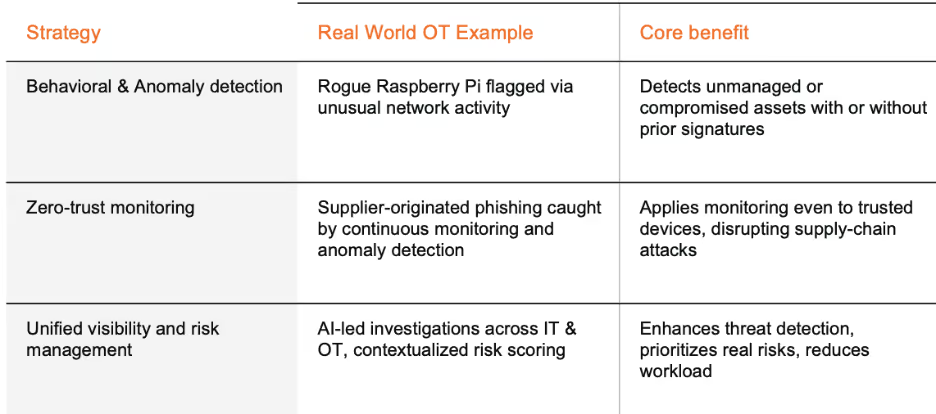
 Alternative strategies for detecting cyber attacks in OT
Figure 1: Alternative strategies for detecting cyber attacks in OT

Behavioral and anomaly detection

Rather than relying on signatures, focusing on behavior enables detection of threats that have never been seen before—even trusted-looking devices.

Real-world insight:

In one OT setting, a vendor inadvertently left a Raspberry Pi on a customer’s ICS network. After deployment, Darktrace’s system flagged elastic anomalies in its HTTPS and DNS communication despite the absence of any known indicators of compromise. The alerting included sustained SSL increases, agent‑beacon activity, and DNS connections to unusual endpoints, revealing a possible supply‑chain or insider risk invisible to static tools.  

Darktrace’s AI-driven threat detection aligns with the zero-trust principle of assuming the risk of a breach. By leveraging AI that learns an organization’s specific patterns of life, Darktrace provides a tailored security approach ideal for organizations with complex supply chains.

Threat intelligence sharing & building toward zero-trust philosophy

Frameworks such as MITRE ATT&CK for ICS provide a common language to map activity against known adversary tactics, helping teams prioritize detections and response strategies. Similarly, information-sharing communities like E-ISAC and regional ISACs give utilities visibility into the latest tactics, techniques, and procedures (TTPs) observed across the sector. This level of intel can help shift the focus away from chasing individual signatures and toward building resilience against how adversaries actually operate.

Real-world insight:

Darktrace’s AI embodies zero‑trust by assuming breach potential and continually evaluating all device behavior, even those deemed trusted. This approach allowed the detection of an anomalous SharePoint phishing attempt coming from a trusted supplier, intercepted by spotting subtle patterns rather than predefined rules. If a cloud account is compromised, unauthorized access to sensitive information could lead to extortion and lateral movement into mission-critical systems for more damaging attacks on critical-national infrastructure.

This reinforces the need to monitor behavioral deviations across the supply chain, not just known bad artifacts.

Defense-in-Depth with OT context & unified visibility

OT environments demand visibility that spans IT, OT, and IoT layers, supported by risk-based prioritization.

Real-world insight:

Darktrace / OT offers unified AI‑led investigations that break down silos between IT and OT. Smaller teams can see unusual outbound traffic or beaconing from unknown OT devices, swiftly investigate across domains, and get clear visibility into device behavior, even when they lack specialized OT security expertise.  

Moreover, by integrating contextual risk scoring, considering real-world exploitability, device criticality, firewall misconfiguration, and legacy hardware exposure, utilities can focus on the vulnerabilities that genuinely threaten uptime and safety, rather than being overwhelmed by CVE noise.  

Regulatory alignment and positive direction

Industry regulations are beginning to reflect this evolution in strategy. NERC CIP-015 requires internal network monitoring that detects anomalies, and the standard references anomalies 15 times. In contrast, signature-based detection is not mentioned once.

This regulatory direction shows that compliance bodies understand the limitations of static defenses and are encouraging utilities to invest in anomaly-based monitoring and analytics. Utilities that adopt these approaches will not only be strengthening their resilience but also positioning themselves for regulatory compliance and operational success.

Conclusion

Signature-based detection retains utility for common IT malware, but it cannot serve as the backbone of security for power utilities. History has shown that major OT attacks are rarely stopped by signatures, since each campaign targets specific systems with customized tools. The most dangerous adversaries, from insiders to nation-states, actively design their operations to avoid detection by signature-based tools.

A more effective strategy prioritizes behavioral analytics, anomaly detection, and community-driven intelligence sharing. These approaches not only catch known threats, but also uncover the subtle anomalies and novel attack techniques that characterize tomorrow’s incidents.

Inside the SOC
Darktrace cyber analysts are world-class experts in threat intelligence, threat hunting and incident response, and provide 24/7 SOC support to thousands of Darktrace customers around the globe. Inside the SOC is exclusively authored by these experts, providing analysis of cyber incidents and threat trends, based on real-world experience in the field.
Written by
Daniel Simonds
Director of Operational Technology

More in this series

No items found.

Blog

/

/

March 5, 2026

Inside Cloud Compromise: Investigating Attacker Activity with Darktrace / Forensic Acquisition & Investigation

Forensic Acquisition and investigationDefault blog imageDefault blog image

Investigating cloud attacks with Darktrace/ Forensic Acquisition & Investigation

Darktrace / Forensic Acquisition & Investigation™ is the industry’s first truly automated forensic solution purpose-built for the cloud. This blog will demonstrate how an investigation can be carried out against a compromised cloud server in minutes, rather than hours or days.

The compromised server investigated in this case originates from Darktrace’s Cloudypots system, a global honeypot network designed to observe adversary activity in real time across a wide range of cloud services. Whenever an attacker successfully compromises one of these honeypots, a forensic copy of the virtual server's disk is preserved for later analysis. Using Forensic Acquisition & Investigation, analysts can then investigate further and obtain detailed insights into the compromise including complete attacker timelines and root cause analysis.

Forensic Acquisition & Investigation supports importing artifacts from a variety of sources, including EC2 instances, ECS, S3 buckets, and more. The Cloudypots system produces a raw disk image whenever an attack is detected and stores it in an S3 bucket. This allows the image to be directly imported into Forensic Acquisition & Investigation using the S3 bucket import option.

As Forensic Acquisition & Investigation runs cloud-natively, no additional configuration is required to add a specific S3 bucket. Analysts can browse and acquire forensic assets from any bucket that the configured IAM role is permitted to access. Operators can also add additional IAM credentials, including those from other cloud providers, to extend access across multiple cloud accounts and environments.

Figure 1: Forensic Acquisition & Investigation import screen.

Forensic Acquisition & Investigation then retrieves a copy of the file and automatically begins running the analysis pipeline on the artifact. This pipeline performs a full forensic analysis of the disk and builds a timeline of the activity that took place on the compromised asset. By leveraging Forensic Acquisition & Investigation’s cloud-native analysis system, this process condenses hour of manual work into just minutes.

Successful import of a forensic artifact and initiation of the analysis pipeline.
Figure 2: Successful import of a forensic artifact and initiation of the analysis pipeline.

Once processing is complete, the preserved artifact is visible in the Evidence tab, along with a summary of key information obtained during analysis, such as the compromised asset’s hostname, operating system, cloud provider, and key event count.

The Evidence overview showing the acquired disk image.
Figure 3: The Evidence overview showing the acquired disk image.

Clicking on the “Key events” field in the listing opens the timeline view, automatically filtered to show system- generated alarms.

The timeline provides a chronological record of every event that occurred on the system, derived from multiple sources, including:

  • Parsed log files such as the systemd journal, audit logs, application specific logs, and others.
  • Parsed history files such as .bash_history, allowing executed commands to be shown on the timeline.
  • File-specific events, such as files being created, accessed, modified, or executables being run, etc.

This approach allows timestamped information and events from multiple sources to be aggregated and parsed into a single, concise view, greatly simplifying the data review process.

Alarms are created for specific timeline events that match either a built-in system rule, curated by Darktrace’s Threat Research team or an operator-defined rule  created at the project level. These alarms help quickly filter out noise and highlight on events of interest, such as the creation of a file containing known malware, access to sensitive files like Amazon Web Service (AWS) credentials, suspicious arguments or commands, and more.

 The timeline view filtered to alarm_severity: “1” OR alarm_severity: “3”, showing only events that matched an alarm rule.
Figure 4: The timeline view filtered to alarm_severity: “1” OR alarm_severity: “3”, showing only events that matched an alarm rule.

In this case, several alarms were generated for suspicious Base64 arguments being passed to Selenium. Examining the event data, it appears the attacker spawned a Selenium Grid session with the following payload:

"request.payload": "[Capabilities {browserName: chrome, goog:chromeOptions: {args: [-cimport base64;exec(base64...], binary: /usr/bin/python3, extensions: []}, pageLoadStrategy: normal}]"

This is a common attack vector for Selenium Grid. The chromeOptions object is intended to specify arguments for how Google Chrome should be launched; however, in this case the attacker has abused the binary field to execute the Python3 binary instead of Chrome. Combined with the option to specify command-line arguments, the attacker can use Python3’s -c option to execute arbitrary Python code, in this instance, decoding and executing a Base64 payload.

Selenium’s logs truncate the Arguments field automatically, so an alternate method is required to retrieve the full payload. To do this, the search bar can be used to find all events that occurred around the same time as this flagged event.

Pivoting off the previous event by filtering the timeline to events within the same window using timestamp: [“2026-02-18T09:09:00Z” TO “2026-02-18T09:12:00Z”].
Figure 5: Pivoting off the previous event by filtering the timeline to events within the same window using timestamp: [“2026-02-18T09:09:00Z” TO “2026-02-18T09:12:00Z”].

Scrolling through the search results, an entry from Java’s systemd journal can be identified. This log contains the full, unaltered payload. GCHQ’s CyberChef can then be used to decode the Base64 data into the attacker’s script, which will ultimately be executed.

Decoding the attacker’s payload in CyberChef.
Figure 6: Decoding the attacker’s payload in CyberChef.

In this instance, the malware was identified as a variant of a campaign that has been previously documented in depth by Darktrace.

Investigating Perfctl Malware

This campaign deploys a malware sample known as ‘perfctl to the compromised host. The script executed by the attacker downloads a Go binary named “promocioni.php” from 200[.]4.115.1. Its functionality is consistent with previously documented perfctl samples, with only minor changes such as updated filenames and a new command-and-control (C2) domain.

Perfctl is a stealthy malware that has several systems designed  to evade detection. The main binary is packed with UPX, with the header intentionally tampered with to prevent unpacking using regular tools. The binary also avoids executing any malicious code if it detects debugging or tracing activity, or if artifacts left by earlier stages are missing.

To further aid its evasive capabilities, perfctl features a usermode rootkit using an LD preload. This causes dynamically linked executables to load perfctl’s rootkit payload before other system modules, allowing it to override functions, such as intercepting calls to list files and hiding output from the returned list. Perfctl uses this to hide its own files, as well as other files like the ld.so.preload file, preventing users from identifying that a rootkit is present in the first place.

This also makes it difficult to dynamically analyze, as even analysts aware of the rootkit will struggle to get around it due to its aggressiveness in hiding its components. A useful trick is to use the busybox-static utilities, which are statically linked and therefore immune to LD preloading.

Perfctl will attempt to use sudo to escalate its permissions to root if the user it was executed as has the required privileges. Failing this, it will attempt to exploit the vulnerability CVE-2021-4034.

Ultimately, perfctl will attempt to establish a C2 link via Tor and spawn an XMRig miner to mine the Monero cryptocurrency. The traffic to the mining pool is encapsulated within Tor to limit network detection of the mining traffic.

Darktrace’s Cloudypots system has observed 1,959 infections of the perfctl campaign across its honeypot network in the past year, making it one of the most aggressive campaigns seen by Darktrace.

Key takeaways

This blog has shown how Darktrace / Forensic Acquisition & Investigation equips defenders in the face of a real-world attacker campaign. By using this solution, organizations can acquire forensic evidence and investigate intrusions across multiple cloud resources and providers, enabling defenders to see the full picture of an intrusion on day one. Forensic Acquisition & Investigation’s patented data-processing system takes advantage of the cloud’s scale to rapidly process large amounts of data, allowing triage to take minutes, not hours.

Darktrace / Forensic Acquisition & Investigation is available as Software-as-a-Service (SaaS) but can also be deployed on-premises as a virtual application or natively in the cloud, providing flexibility between convenience and data sovereignty to suit any use case.

Support for acquiring traditional compute instances like EC2, as well as more exotic and newly targeted platforms such as ECS and Lambda, ensures that attacks taking advantage of Living-off-the-Cloud (LOTC) strategies can be triaged quickly and easily as part of incident response. As attackers continue to develop new techniques, the ability to investigate how they use cloud services to persist and pivot throughout an environment is just as important to triage as a single compromised EC2 instance.

Credit to Nathaniel Bill (Malware Research Engineer)

Continue reading
About the author
Nathaniel Bill
Malware Research Engineer

Blog

/

Network

/

February 19, 2026

CVE-2026-1731: How Darktrace Sees the BeyondTrust Exploitation Wave Unfolding

Default blog imageDefault blog image

Note: Darktrace's Threat Research team is publishing now to help defenders. We will continue updating this blog as our investigations unfold.

Background

On February 6, 2026, the Identity & Access Management solution BeyondTrust announced patches for a vulnerability, CVE-2026-1731, which enables unauthenticated remote code execution using specially crafted requests.  This vulnerability affects BeyondTrust Remote Support (RS) and particular older versions of Privileged Remote Access (PRA) [1].

A Proof of Concept (PoC) exploit for this vulnerability was released publicly on February 10, and open-source intelligence (OSINT) reported exploitation attempts within 24 hours [2].

Previous intrusions against Beyond Trust technology have been cited as being affiliated with nation-state attacks, including a 2024 breach targeting the U.S. Treasury Department. This incident led to subsequent emergency directives from  the Cybersecurity and Infrastructure Security Agency (CISA) and later showed attackers had chained previously unknown vulnerabilities to achieve their goals [3].

Additionally, there appears to be infrastructure overlap with React2Shell mass exploitation previously observed by Darktrace, with command-and-control (C2) domain  avg.domaininfo[.]top seen in potential post-exploitation activity for BeyondTrust, as well as in a React2Shell exploitation case involving possible EtherRAT deployment.

Darktrace Detections

Darktrace’s Threat Research team has identified highly anomalous activity across several customers that may relate to exploitation of BeyondTrust since February 10, 2026. Observed activities include:

Outbound connections and DNS requests for endpoints associated with Out-of-Band Application Security Testing; these services are commonly abused by threat actors for exploit validation.  Associated Darktrace models include:

  • Compromise / Possible Tunnelling to Bin Services

Suspicious executable file downloads. Associated Darktrace models include:

  • Anomalous File / EXE from Rare External Location

Outbound beaconing to rare domains. Associated Darktrace models include:

  • Compromise / Agent Beacon (Medium Period)
  • Compromise / Agent Beacon (Long Period)
  • Compromise / Sustained TCP Beaconing Activity To Rare Endpoint
  • Compromise / Beacon to Young Endpoint
  • Anomalous Server Activity / Rare External from Server
  • Compromise / SSL Beaconing to Rare Destination

Unusual cryptocurrency mining activity. Associated Darktrace models include:

  • Compromise / Monero Mining
  • Compromise / High Priority Crypto Currency Mining

And model alerts for:

  • Compromise / Rare Domain Pointing to Internal IP

IT Defenders: As part of best practices, we highly recommend employing an automated containment solution in your environment. For Darktrace customers, please ensure that Autonomous Response is configured correctly. More guidance regarding this activity and suggested actions can be found in the Darktrace Customer Portal.  

Appendices

Potential indicators of post-exploitation behavior:

·      217.76.57[.]78 – IP address - Likely C2 server

·      hXXp://217.76.57[.]78:8009/index.js - URL -  Likely payload

·      b6a15e1f2f3e1f651a5ad4a18ce39d411d385ac7  - SHA1 - Likely payload

·      195.154.119[.]194 – IP address – Likely C2 server

·      hXXp://195.154.119[.]194/index.js - URL – Likely payload

·      avg.domaininfo[.]top – Hostname – Likely C2 server

·      104.234.174[.]5 – IP address - Possible C2 server

·      35da45aeca4701764eb49185b11ef23432f7162a – SHA1 – Possible payload

·      hXXp://134.122.13[.]34:8979/c - URL – Possible payload

·      134.122.13[.]34 – IP address – Possible C2 server

·      28df16894a6732919c650cc5a3de94e434a81d80 - SHA1 - Possible payload

References:

1.        https://nvd.nist.gov/vuln/detail/CVE-2026-1731

2.        https://www.securityweek.com/beyondtrust-vulnerability-targeted-by-hackers-within-24-hours-of-poc-release/

3.        https://www.rapid7.com/blog/post/etr-cve-2026-1731-critical-unauthenticated-remote-code-execution-rce-beyondtrust-remote-support-rs-privileged-remote-access-pra/

Continue reading
About the author
Emma Foulger
Global Threat Research Operations Lead
Your data. Our AI.
Elevate your network security with Darktrace AI