ブログ
/
AI
/
June 11, 2026

スポーツ産業のサイバーセキュリティ: デジタル化した2026年のスポーツ産業が直面する脅威

スポーツ組織の84%が過去12か月間にサイバーインシデントを経験しています。 なぜスポーツがこのように大きな標的となったかを説明するデータと当社の分析を紹介します。
Inside the SOC
Darktrace cyber analysts are world-class experts in threat intelligence, threat hunting and incident response, and provide 24/7 SOC support to thousands of Darktrace customers around the globe. Inside the SOC is exclusively authored by these experts, providing analysis of cyber incidents and threat trends, based on real-world experience in the field.
Written by
Nathaniel Jones
VP, Security & AI Strategy, Field CISO
Default blog image
11
Jun 2026

2026年のスポーツイベントを保護する

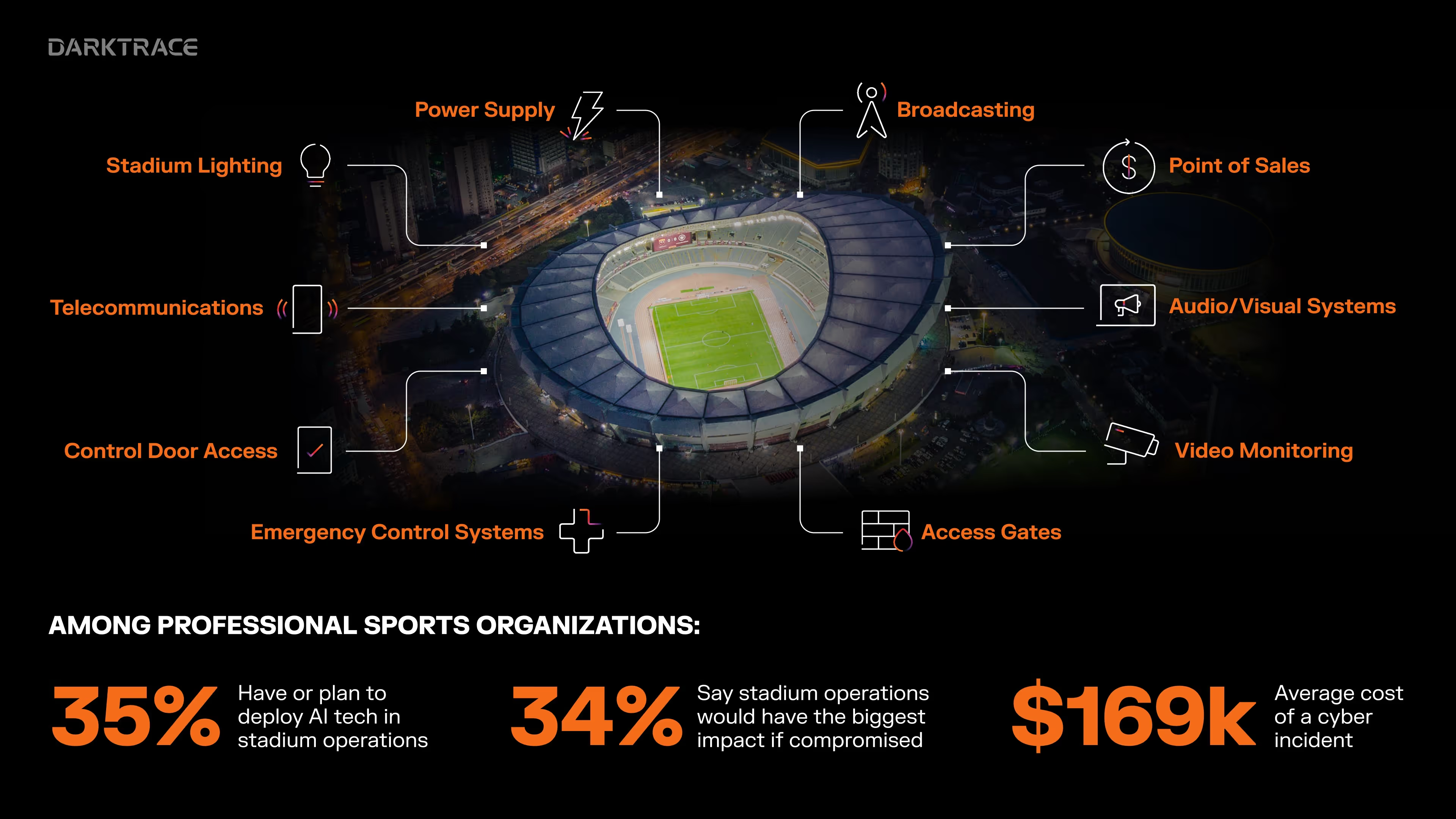
試合開催日にスタジアムに足を踏み入れるとき、あなたは小さなスマートシティを訪れています。チケット販売、回転ゲート、決済システム、何万ものファンが利用する公共Wi-Fi、CCTV、照明、そしてHVACまでもがすべて、相互に接続されたシステム上で稼働しています。ファンの体験はこれまでになく向上しましたが、この接続への依存は人々が想像するよりもはるかに大きなアタックサーフェスを作り出しています。

私たちの最新の調査結果はそれを裏付けています。ダークトレースが委託して実施した調査によれば、調査対象のプロスポーツ組織の84%は過去1年間に少なくとも1回のサイバーインシデントを経験しており、57%は複数回遭遇していました。試合が行われるライブ時間にすべてがかかっている業界にとって、これらの数字は直接的に運営上のリスクを意味します。

なぜスポーツがサイバー攻撃の標的になるのか

スポーツは非常に目立つターゲットであり、スケジュールが決まっているため、攻撃者は障害が最も影響を与える時期を正確に知っています。また、貴重なデータであるアスリートの医療記録、契約書、スポンサー契約書などが保管されており、これらが漏洩すれば財務上、評判上、規制上のリスクを伴います。同時に、イベントの開催もチケット発行、放送局、クラウドサービス、スタジアム関連テクノロジーなど、多くの第三者に依存しています。それらのシステムとの接続はいずれも侵入点になる可能性があります。注目度、スケジュール、データ、依存関係、これらが組み合わされることにより、小さな足がかりから、影響の大きな、時間的余裕の許されないインシデントに発展する環境が生まれます。

攻撃者はどのようにEメールとアイデンティティを標的にするか

Eメールとアイデンティティは主要な侵入経路です。2025年10月から2026年3月にかけて、Darktrace / EMAIL™は当社の顧客ベースにおいてスポーツ組織を狙った11万6,000通以上のフィッシングEメールを検知しました。また、スポーツ業界の顧客は他の業界の組織よりも19%多くのフィッシングEメールを受け取っています。数字がこれを物語っています:

数値が示すもの

  • フィッシングEメールの21%はVIPを標的
  • 37%は新手のソーシャルエンジニアリングを使用
  • 悪意あるEメールの84%がDMARC認証を通過

これらのEメールの大部分は認証チェックを通過しており、従来のセキュリティ対策がもはや信頼できる防壁ではないことを意味しています。攻撃者はなりすましドメインに頼っているのではなく、正規のインフラストラクチャと信頼されたプラットフォームを利用しています。ここで、動作が大きな意味を持ちます。アカウントが侵害されると、動作は急速に変化します。ログインパターンが変わり、返信を隠すための受信トレイルールが作成され、アカウントが内部偵察やさらなるフィッシングに使用され始めます。これらは大きな騒音を伴う出来事ではありません。それらは通常のワークフローに紛れ込み、多くのケースで見落とされています。

ランサムウェアも同じような経緯で発生しています。あるスポーツ関連の顧客内では、攻撃者は暗号化を開始する前の2週間もの間、静かにデータを外部サーバーに移動していました。身代金要求文が出現するときには、すでにお膳立てができていたというわけです。一貫して見られるシーケンスとして、まずアクセスがあり、次に移動があり、そして最後に障害が発生しています。暗号化の時点で検知されても、既に手遅れです。

AIがスポーツ組織の新たなブラインドスポットとなる理由

AI導入の増加は潜在的アタックサーフェスを拡大させています。当社が調査を行ったセキュリティプロフェッショナルの72%は、今後1年間でAIがリスク増大につながると予想しています。しかし35%はスタジアムの運営という保護すべき最も重要な機能に既にAIを使用しているか、使用を計画しているのです。プロンプトインジェクションやAI構築リスクに加えて、シャドーAIがより切迫したリスクとなりつつあります。スタッフはすでに、パフォーマンス指標、スカウティングレポート、契約、健康データなどの機密データを、ほとんどまたはまったく管理されていないツールに入力しています。AIのもたらす利点は明らかですが、リスクも同様に明白であり、しかもそれはほとんどの組織が何の可視性やコントロールも持たないうちに発生しています。その一方で、攻撃者は同じAI技術を使ってフィッシングやソーシャルエンジニアリングを拡大しています。その結果はシンプルです-より大きな露出リスクが、より速いスピードで発生しているのです。

サイバーセキュリティプロフェッショナルはどう備えるべきか

大規模なイベントにおいて、効果的なサイバー防御には準備、リアルタイムの可視性が重要です。限られたタイミング、複雑さ、一般の注目、そしてこれらが重なるなかで、動的かつ決定的に対応する能力が必要であることを、ダークトレースの経験は物語っています。

サイバーセキュリティチームにとって戦略的に重要ないくつかの項目があります:

  • コーポレートシステムだけでなく、ITおよびOT全体の動作の可視性を確保すること。
  • アイデンティティをコントロールプレーンとして扱うこと。 この分野でのほとんどの攻撃は、マルウェアではなく認証情報から始まります。ビヘイビア検知を用いた多要素認証(MFA)は、その課題の解決に役立ちます。
  • 自社の環境を管理するのと同じように第三者とAIのアクセスも制御すること。
  • 数分で意思決定を行う、ライブ条件で対応を訓練すること。 検知と対応は、エンジニアにプレッシャーがかかり、時間が制約される非理想的な条件を考慮する必要があります。スポーツにおいて小さな問題を重大インシデントに発展させるのは、このタイミング条件です。平日であれば問題なく対応できる事象も、イベント開催中は重大な事態になりかねません。

2026年、スポーツにおいてサイバーセキュリティのリスクが拡大する理由

FIFAワールドカップ2026は3か国と数十の開催都市にまたがるため、アタックサーフェスは広範であり、スケジュールも厳しいものとなります。

地政学的なシグナリングは脅威プロファイルをさらに深刻化させています。これまでの国際スポーツイベントでは、国家を背後に持つ脅威アクターがサイバー領域を利用してその意思を示し、ナラティブに影響を及ぼし、象徴的な報復を行うことが実証されています。2026年ワールドカップの文脈において、国際スポーツからのロシアの継続的な排除、ウクライナでの現在の紛争、米国のウクライナへの防衛支援、そしてイランの大会参加の可能性は、国家に関係したアクター、そして非伝統的なアフィリエイト達が武力攻撃未満のサイバー攻撃を展開するさらなる動機を与えています。それには新しい技術は必要ありません — ただ適切なタイミングと注目度があればよいのです。

実務においては、結局準備に行きつくことになります。ITとOT全体で正常な状態がどのようなものかを把握し、第三者のアクセスを管理し、動作の変化を識別することです。

スポーツにおいて、障害は徐々に蓄積するのではなく、リアルタイムに、衆人環視の下で発生します。試合開始のホイッスルが鳴るずっと前に、その段取りはすでに完了しているのです。

調査について

調査結果は、スポーツセクターの顧客におけるDarktraceの脅威調査テレメトリー(2025年第4四半期~2026年第1四半期)および2026年5月28日から6月3日にOpinion Mattersが実施した米国、英国、オーストラリア、ドイツの875人のITサイバーセキュリティ専門家を対象とした調査に基づいています。調査手法の詳細、インシデント分析、および戦略的推奨事項については、レポート全文をお読みください。

[related-resource]

世界のスポーツにおけるサイバーセキュリティ

本レポートでは、ますますデジタル化が進むスポーツ産業における脅威、兆候、および戦略的影響を探ります。なぜスポーツがサイバー攻撃の大きな標的となっっているのか、2026年のスポーツ産業が直面する脅威について、データと当社の分析を紹介します。

Inside the SOC
Darktrace cyber analysts are world-class experts in threat intelligence, threat hunting and incident response, and provide 24/7 SOC support to thousands of Darktrace customers around the globe. Inside the SOC is exclusively authored by these experts, providing analysis of cyber incidents and threat trends, based on real-world experience in the field.
Written by
Nathaniel Jones
VP, Security & AI Strategy, Field CISO

More in this series

No items found.

Blog

/

AI

/

June 30, 2026

5 Ways AI is changing traditional security models according to modern CISOs

Default blog imageDefault blog image

The Reality of Securing AI in Motion

Traditional security tools were built for environments defined by fixed rules and predictable workflows. But AI behavior is non-deterministic. The same prompt can produce different outcomes, and risk often emerges gradually as AI behavior adapts, and permissions drift over time. This creates a constantly shifting environment where security teams are working to define control in a system that resists stability. “In AI security, yesterday's priorities can become tomorrow's blind spots. The landscape shifts that fast,” warned the SVP and Head of Technology and Cybersecurity of a real estate investment trust. Conventional approaches, which rely on establishing and maintaining a steady baseline, struggle to keep up with that level of change.

At the same time, AI adoption is accelerating across organizations, often faster than security teams can implement the controls needed to manage it. “The car is being built while it’s already on the road,” explained the CISO of a global private fund administrator. “The threats we're securing against today won't be the threats we're facing tomorrow. What kept us up three months ago looks nothing like what we're dealing with today.”

As businesses move quickly to unlock value from AI, security teams are left closing gaps in real time, while also facing adversaries who are using AI to make their attacks more scalable, adaptive, and difficult to detect. In this recent roundtable discussion of CISOs and security leaders, five themes emerged around AI cyber risk.  

1. AI agents with human access but no human judgment

In Darktrace’s 2026 State of AI Cybersecurity report, 96% of the surveyed security professionals agree that AI significantly improves the speed and efficiency with which they work. Yet, 92% admitted that they’re concerned with the security implications of the use of AI agents across their workforce.

AI agents now operate with human-level permissions across systems, acting at machine speed, orchestrating actions across platforms, and making decisions without the judgment or caution a person would apply. Unlike human users, they cannot be expected to pause and question whether a given action is appropriate.

Their identities are also difficult to inventory, govern, and audit. As agents become easier to deploy than legacy IT systems ever were, organizations are quickly losing track of what is running, what it has access to, and what it is doing. This creates a growing class of highly privileged, autonomous actors operating without the visibility or oversight that traditional identity and access controls were designed to provide.“While AI adoption is critical to running a modern business, AI alone can’t solve all our cybersecurity challenges,” said a global financial sector CISO. “We still need think critically and use human judgement. Those are two things AI can’t do.”

This lack of human judgment becomes especially risky as new architectures, such as Model Context Protocol (MCP), can expand how agents connect to data, tools, and external systems. By design, MCP enables agents to dynamically discover and interact with new resources, increasing flexibility but also introducing new pathways for unintended access, data exposure, or abuse if not properly governed.

The CISO of a fund administrator highlighted one emerging vector as an example: rogue MCP servers. “Our developers want to move quickly and bring value to the business, but technologies like these can unintentionally expose sensitive data in ways that would never have happened before.”

2. Increased digital complexity and expanded attack surface

AI activity rarely stays contained. A single prompt can trigger a chain of actions across networks, email, cloud infrastructure, SaaS platforms, endpoints, identity systems, and development environments, spanning systems that were never designed to be secured as a single, connected flow. This expands both the scale and complexity of what security teams need to monitor and defend.

Yet no single control has visibility across that entire chain. “You can’t defend effectively what you can’t see,” cautioned the private fund administrator CISO. As AI-driven activity moves fluidly across environments, gaps in coverage become inevitable, creating blind spots that attackers can exploit.

Threat actors are already capitalizing on this lack of visibility. “Threat actors have advanced their use of generative AI to launch more convincing phishing campaigns, automate social engineering, and scale attacks with greater precision down to the individual level,” said the SVP of Technology and Cybersecurity for the real estate investment trust. What was once manual and targeted can now be automated and personalized at scale, making attacks harder to detect and easier to execute.

At the same time, the pace of exploitation is accelerating. As a global CISO operating across 40+ countries described it: “Zero-day vulnerabilities are no longer zero day; it’s minus one day. By the time you get to it and address it, it’s already a problem.” By the time risk is identified, it has often already been realized.

The result is a rapidly expanding and increasingly interconnected attack surface that challenges security teams to maintain visibility, context, and control across AI-driven activity.

3. Shadow AI is already everywhere

76% of organizations now cite shadow AI as a problem, one that is spreading through organizations in ways that are hard to track and even harder to control.

Employees are experimenting with publicly available Gen AI tools. Teams are spinning up low-code automations on their own. SaaS providers are quietly embedding AI into existing products. Developers are plugging AI services directly into workflows, often without pausing to consider what that exposure means.

The result is a lack of visibility into:

  • What AI tools are being used
  • What data those tools can access
  • Where prompts and outputs are going
  • Which AI agents are interacting with enterprise systems

The SVP of Cybersecurity at a real estate investment trust described the shift: “Before, I was worried about someone sending data erroneously to their personal email. Now we have all these agents online that people are utilizing, and we’re looking at those vectors as well.” For security teams, this means operating without a complete view of how AI is being used, what it can access, and where risk may already be emerging.

4. Built-in guardrails are not enough

Organizations often assume that native AI guardrails or provider-level controls are sufficient to manage AI risk. But securing AI requires ongoing visibility, oversight, and governance, not just controls configured at deployment. "It’s a misconception that adopting AI is going to solve all your problems,” warns a global financial services CISO.

Security leaders are increasingly recognizing the limitations of these controls as:

  • Fragmented and difficult to enforce consistently across multiple AI systems, workflows, and environments
  • Ambiguous in terms of accountability due to shared responsibility for AI governance between IT, security, developers, business teams, and third-party providers
  • Limited in end-to-end oversight, leaving gaps that stretch from the initial prompt all the way through to the downstream impact of an agent's actions

Securing AI demands more than simple prompt filtering or static policy enforcement. It requires understanding intent, behavior, and context across both human and AI activity.

The next phase of cybersecurity: securing AI

To safely and responsibly adopt AI at scale, organizations need a new operational model for cybersecurity that’s capable of:

• Understanding AI behavior

• Identifying risk in real time

• Maintaining governance without slowing innovation

The CSO of a $10 billion municipal utility organization described the challenge with precision: “We have to move at the speed of innovation and risk, because both are accelerating faster than ever.”

Embrace AI with confidence with Darktrace / SECURE AI

Darktrace has introduced Darktrace / SECURE AI™, a new product within the Darktrace ActiveAI Security Platform™  ,designed to provide enterprise-wide security for AI by applying industry leading behavioral analysis to how prompts, agents, and AI systems are used.

Darktrace / SECURE AITM delivers real-time visibility and control across Enterprise and SaaS GenAI prompts, AI agent identities, development and production environments, and Shadow AI - detecting even subtle misuse, misconfiguration, and drift that traditional, rule-based controls simply do not understand. By interpreting context and intent across humans and machines, Darktrace enables organizations to adopt AI at scale without introducing unmanaged risk

What makes this possible is Darktrace’s decade-long maturity and expertise in behavioral understanding and AI-native cybersecurity. Achieved with Self-Learning AI that has been proven across more than 10,000 organizations, Darktrace understands what “normal” looks like for a business, across its users, systems, and now AI, so that meaningful deviations can be detected and acted on before they become incidents.

With one CISO describing Darktrace’s Self-Learning AI as “a leap forward compared to other tools” and another as a “force multiplier,” the technology can interpret ambiguous interactions, understand how access accumulates over time, and recognize when behavior, human or machine, begins to drift.

“Strategically, we’re looking to gain more visibility into how AI is operating across the environment and achieve greater control over what AI should be allowed to access and do,” shared the CISO at a private fund administrator.  

“What I’ve seen from Darktrace / SECURE AI is extremely promising. I have tremendous confidence in Darktrace’s vision for where this is headed and its ability to execute on this new solution.”

Continue reading
About the author
The Darktrace Community

Blog

/

Email

/

June 29, 2026

How Darktrace Transformed Cybersecurity at Our Health Center: A CIO’s Perspective

Default blog imageDefault blog image

How Darktrace Transformed Cybersecurity at Our Health Center: A CIO’s Perspective

In my role as CIO, I bring years of experience leading IT for healthcare organizations. I’ve seen firsthand the unique cybersecurity challenges that nonprofit health centers face: limited budgets, small IT teams, and the constant pressure to prioritize patient care over technology investments. Yet, the threat landscape for health is relentless, and the stakes for protecting patient data and ensuring operational continuity have never been higher. It’s a balancing act.

The search for a better solution

Like many nonprofits, organizations I work at start with Microsoft’s security stack. The discounted pricing for nonprofits makes it an obvious choice, and Microsoft Defender provided a solid foundation for endpoint and email security. However, I quickly realized that relying on a single vendor, even one as robust as Microsoft, left gaps in our defenses. Cybersecurity is never one-size-fits-all, which is why my preference was to layer an additional solution on top of our native security to improve our security posture.

Teams needed a solution that could layer seamlessly on top of Microsoft, without adding complexity or draining limited resources. That’s when I found Darktrace. I had heard of their reputation after seeing how other organizations used Darktrace to secure their infrastructure and was impressed by their AI-native, agentless approach and agreed to a proof of value (POV).

Our goal was to elavate Microsoft with an additional layer of intelligence- one that could seamlessly integrate, operate autonomously, and support a small team without increasing overhead. We turned to Darktrace because its AI-native, agentless approach offered a fundamentally different way to detect and respond to threats, learning our environment in real time and filling gaps that traditional tools can miss. With a quick POV, we were able to validate how effectively Darktrace works alongside Microsoft to deliver a more complete and resilient security architecture.

Why Darktrace stood out

From the start, Darktrace differentiated itself in several critical ways:

  • Deep visibility: Unlike other solutions that rely simply on host-based monitoring with endpoint agents, Darktrace operates passively at the network layer and integrates via APIs for email and identity security. This gave full visibility into network traffic that we previously didn’t have, going beyond our existing endpoint-based tools without adding additional maintenance overhead for our small IT team.
  • AI-native from the ground up: Darktrace wasn’t just layering AI on top of an existing product; it was built with AI at its core. Their autonomous detection and response to threats immediately reduced the need for constant human supervision. In a world where cyber-attacks are increasingly sophisticated and subtle, having an AI that learns our environment and adapts in real time is invaluable.
  • Comprehensive coverage: We started with a POV focused on email security, but quickly expanded to full deployment across our entire infrastructure. Darktrace’s products now protect our email, network, and identity layers, providing visibility and defense against lateral movement and abnormal behavior that traditional tools often miss.

Integration and workflow: Smooth and simple

One of the most impressive aspects of Darktrace is how easy it was to integrate into an existing environment. For network security, it was as simple as plugging an appliance into our top-of-rack switch – no downtime, no complex configuration. For email and identity, API integrations meant we could be up and running in hours, not weeks.

This simplicity extended to day-to-day operations. Our IT team received regular security reports, and any time we had questions or needed to adjust policies, Darktrace’s support team was there with white-glove service. Their responsiveness- even in the middle of the night- gave us confidence that we had true partners, not just a vendor.

Real-world impact: Threats stopped, time saved

The results spoke for themselves. During the time with Darktrace, I did not experience any security incidents. The team slept better at night knowing that Darktrace was monitoring for anomalies and proactively blocking suspicious activity, alerting us even before we noticed anything was wrong.

A memorable example was during an Electronic Health Record (EHR) upgrade, when my team forgot to adjust the policy in advance. Darktrace’s autonomous response was so effective that it blocked our upgrade activities- proof that nothing, not even internal changes, could slip by unnoticed. This level of vigilance meant that ransomware, data exfiltration attempts, or insider threats would be detected and contained before causing harm.

While I can’t share specific ROI numbers, the value was clear: we’ve avoided costly breaches, reduced the time spent investigating alerts, and eliminated the performance drag of agent-based tools. With Darktrace layered on top of Microsoft, I’ve hit the right balance of maximum protection with minimal spending. The cost of Darktrace / EMAIL was competitive, especially when factoring in the included Managed Detection and Response (MDR) service, which provides expert human oversight on top of the AI.

Key differentiators over the competition

  • Extending visibility beyond the endpoint: Traditional host-based monitoring solutions, such as EDR, play a critical role in securing individual devices. By adding a network detection and response (NDR) layer, we gained visibility into activity across our wider digital environment, surfacing threats that move laterally, operate between devices, or bypass endpoint controls. Darktrace also stood out for its ability to learn our normal patterns of behavior and identify subtle deviations in real time, not just known indicators of compromise. Because this is delivered through passive, non-disruptive monitoring, we were able to strengthen our defenses without adding complexity or impacting performance.
  • Layered security without complexity: Darktrace elevated our Microsoft foundation without creating conflicts or requiring us to disable existing protections. This layered approach maximized our security posture without adding operational burden.
  • Expert partnership: Beyond technology, Darktrace’s team acted as true partners, guiding us through deployment, providing ongoing support, and helping us interpret findings. This partnership was as valuable as the technology itself.

Advice for other nonprofits

If you’re an IT leader in a nonprofit, my advice is simple: look for solutions that are easy to deploy, intelligent in their response, and cost-effective. Don’t settle for more endpoint based tools that overlap with what you already have. Seek out a layered approach that covers your blind spots – especially at the network and email layers- at a price point that suits your organization.

Most importantly, don’t be afraid to evaluate new solutions. Even if you’re inundated with vendor pitches, you owe it to your organization to explore options that could save you time, money, and sleepless nights.

For organizations I work at, combining Microsoft’s security stack with Darktrace’s AI-native, platform struck the right balance between protection and practicality. We gained enterprise-grade security without sacrificing performance or stretching our budget. In the end, that meant more resources for what matters most: delivering care to our patients. If you’re facing similar challenges, I encourage you to consider how Darktrace could transform your security posture, and give your team the peace of mind they deserve.

For the organization I work in, combining Microsoft with Darktrace delivered a clear step-change in our security posture. Microsoft provided the foundation, while Darktrace’s behavioral intelligence added visibility into the unknown, surfacing emerging threats based on deviations in real-time activity, not just known indicators.

The result was enterprise-grade protection without added overhead, allowing us to stay focused on patient outcomes, not security operations. For organizations facing similar pressures, this layered approach offers a smarter, more efficient path to securing modern environments.

Continue reading
About the author
Mice Chen
Chief Information Security Officer
あなたのデータ × DarktraceのAI
唯一無二のDarktrace AIで、ネットワークセキュリティを次の次元へ