
ブログ
/
AI
/
August 19, 2026

When AI Becomes the Lure: A Fake Gemini Installer Delivers Vidar

With the growing prevalence of generative AI, attackers are increasingly exploiting interest in AI tools to distribute malware. Darktrace recently investigated an incident in which a malicious executable masquerading as a Google Gemini installer resulted in a Vidar information stealer infection.
Inside the SOC
Darktrace cyber analysts are world-class experts in threat intelligence, threat hunting and incident response, and provide 24/7 SOC support to thousands of Darktrace customers around the globe. Inside the SOC is exclusively authored by these experts, providing analysis of cyber incidents and threat trends, based on real-world experience in the field.
Written by
Rushanth Ramanathan
Cyber Analyst
Default blog image
19
Aug 2026

Key takeaways

‍

  • Darktrace observed a customer download a fake Google Gemini installer hosted on Google Colab, resulting in the execution of the Vidar information stealer.
  • Darktrace identified the compromise through behavioral indicators, including suspicious process activity, anomalous network communications, and indicators of credential theft, before autonomously containing the threat.
  • The incident highlights how threat actors are increasingly exploiting trusted platforms and a growing interest in AI tools to distribute malware through seemingly legitimate software acquisition workflows.

‍

The Growing Abuse of Generative AI

As organizations are increasingly adopting generative AI tools into their daily workflows, attackers are adapting their distribution methods accordingly too. As part of their day-to-day work, users are now searching for AI assistants, programming tools, browser extensions, desktop applications, and productivity integrations.

Recent reports have highlighted campaigns that use fake AI software and AI-related installers to distribute malware and steal credentials [1]. Researchers have documented campaigns that exploit fake AI-themed websites and services to distribute information stealers and backdoors [2]. Security researchers have also observed attackers disguising malware as legitimate installers for AI software to increase the likelihood of victim interaction and execution [3].

In July 2026, Darktrace observed one such case within a customer environment in the Europe, Middle East and Africa (EMEA) region, where attackers used a fake generative AI installer to deliver the prolific information stealer Vidar. This incident highlights how threat actors are exploiting interest in AI services to distribute established malware using increasingly convincing social engineering techniques.

How a Fake Gemini Installer Delivered Vidar

Initial Access: From Search Result to Malware Download

Unlike many malware campaigns that begin with a phishing email, this activity appears to have originated from a user searching for and downloading software.

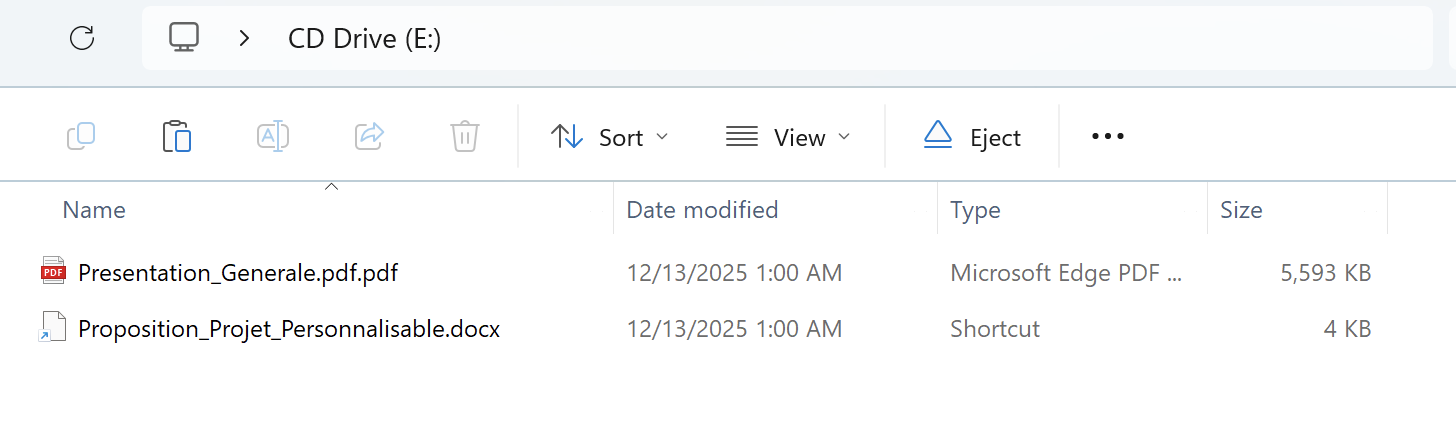
Darktrace first observed unusual activity on the customer network after a suspicious executable file was launched from a user’s Download folder. Further investigation revealed that the file purported to be a Google Gemini installer and was named “Download_Google_Gemini_For_Windows.exe”.

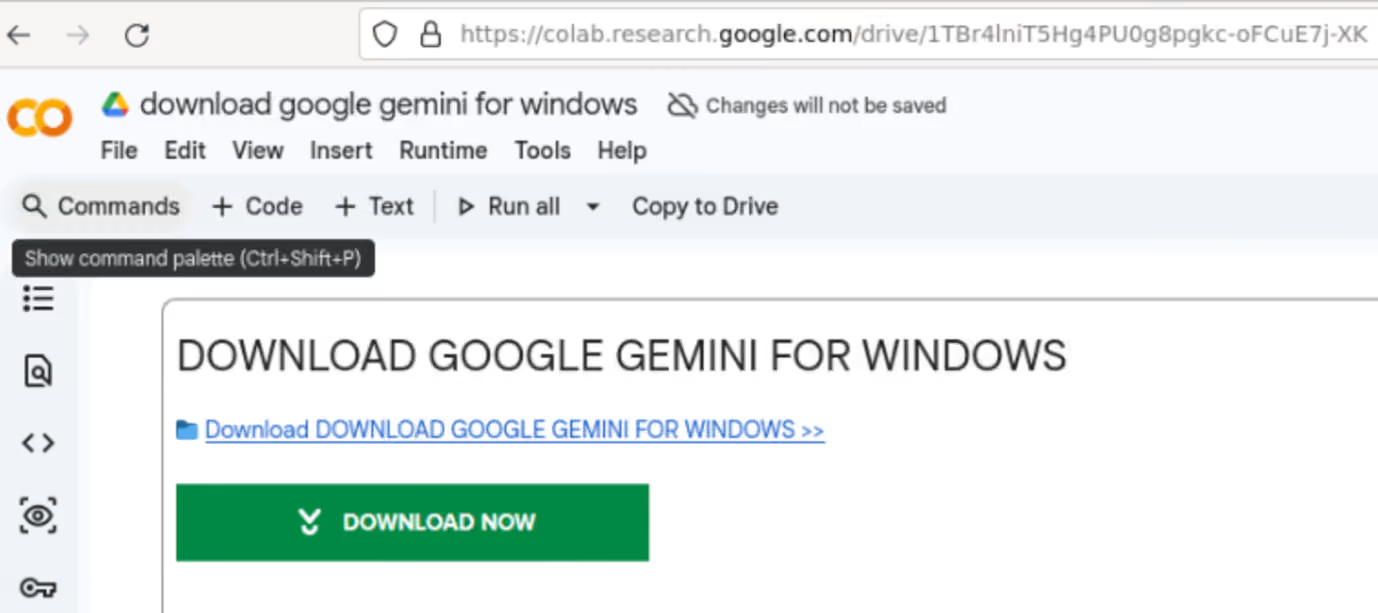
During the initial analysis, it was noted that the top search result for the suspicious filename associated pointed to a file hosted on Google Colab, a cloud-based Jupyter notebook platform, commonly used by developers, researchers, and data scientists to run code and machine learning workloads through a web browser. By leveraging another trusted Google platform, the attacker increased the likelihood that users would perceive the download as legitimate, making the lure more convincing to those searching for Gemini-related software.
‍

Figure 1: The Google Colab page containing a download prompt for the fake Google Gemini installer.

Further investigation of the Google Colab page revealed that the download prompt redirected users to a secondary site, hxxps://micronsoftwares[.]com, which posed as a "Windows Software Hub" download page and offered the fake Gemini installer for download.

‍

Figure 2: The secondary website posing as a "Windows Software Hub" download page, which likely hosted the fake Gemini installer.

While the investigation did not uncover any HTTP or file-download telemetry data that conclusively identified the download source, SSL communication sessions with Google Colab were detected immediately before the suspicious file was executed. The timing of these connections suggests that the user interacted with the Colab resource before being redirected to the secondary site from which the executable was downloaded.

‍

The user was not simply tricked into opening an email attachment; instead, the attacker embedded malicious content into a process many users would consider entirely legitimate: searching for and downloading software associated with a trusted platform.

‍

Weaponizing Trusted Platforms

At the time of review (July 15, 2026), Darktrace's Threat Research team confirmed that the Google Colab page was still active and prompting users to download a ZIP archive containing the binary file.

‍

The archive also appeared to contain a README file instructing users to run the binary file with administrator privileges and add it to their antivirus software’s exception lists. These instructions suggest that the campaign relied heavily on social engineering, convincing users to take actions that would facilitate malware execution and potentially bypass security checks.

The use of a legitimate platform also complicates the user’s decision-making. Downloads associated with a trusted service are often perceived as less suspicious than those hosted on unfamiliar domains. When combined with the branding of a widely used AI tool, the lure becomes even more convincing.

Malware Analysis

Darktrace’s Threat Research team identified the executable file as the information-stealing malware Vidar. Analysis revealed that the binary file was a newer Go-compiled variant that communicated with Telegram-based infrastructure. Darktrace’s researchers also identified dtm[.]kijangturbo88[.]top as a command-and-control (C2) endpoint associated with the activity. While the malware itself was not novel, the lure and delivery mechanism was.

For a deeper look at the information stealer, see Darktrace’s 2023 analysis of Vidar.
‍

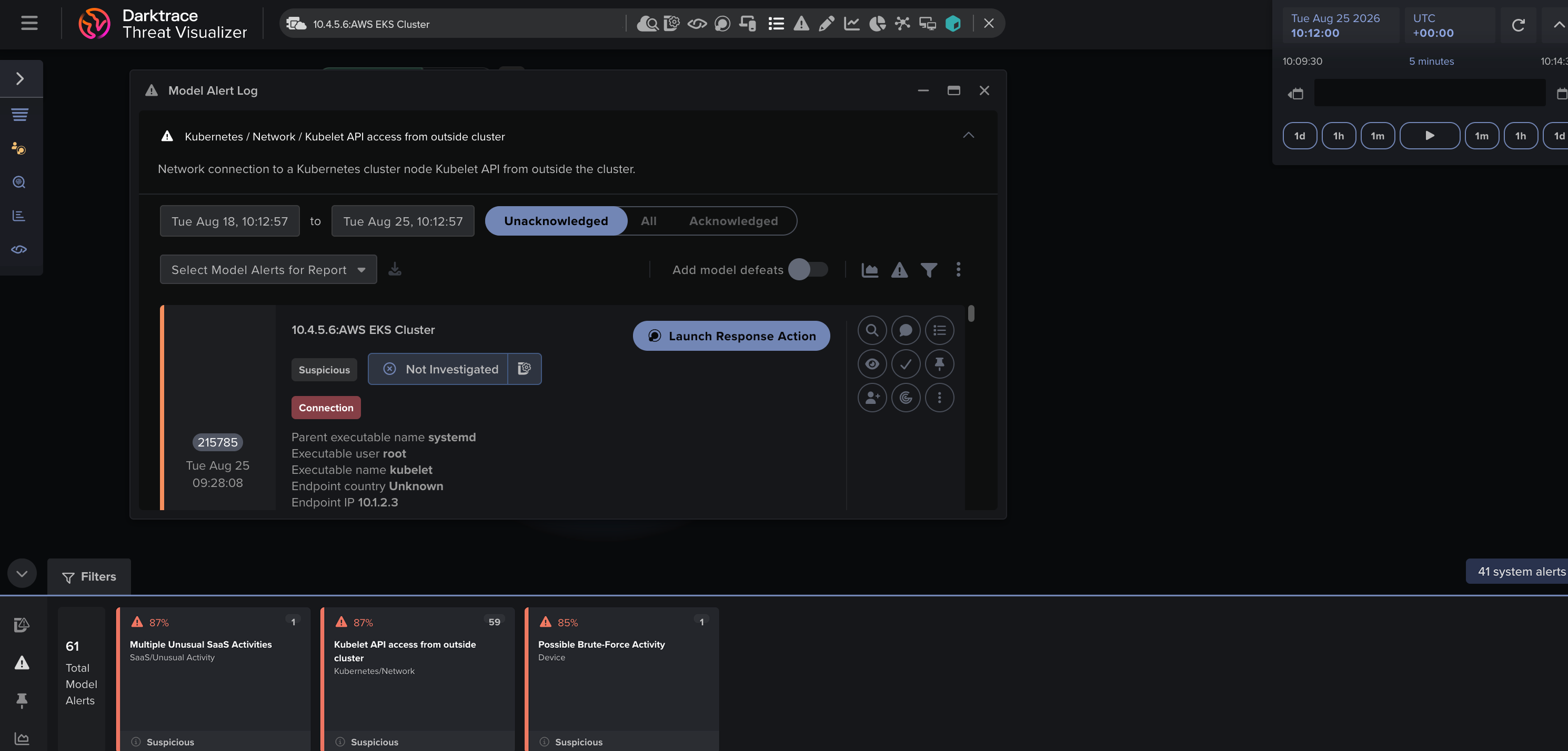
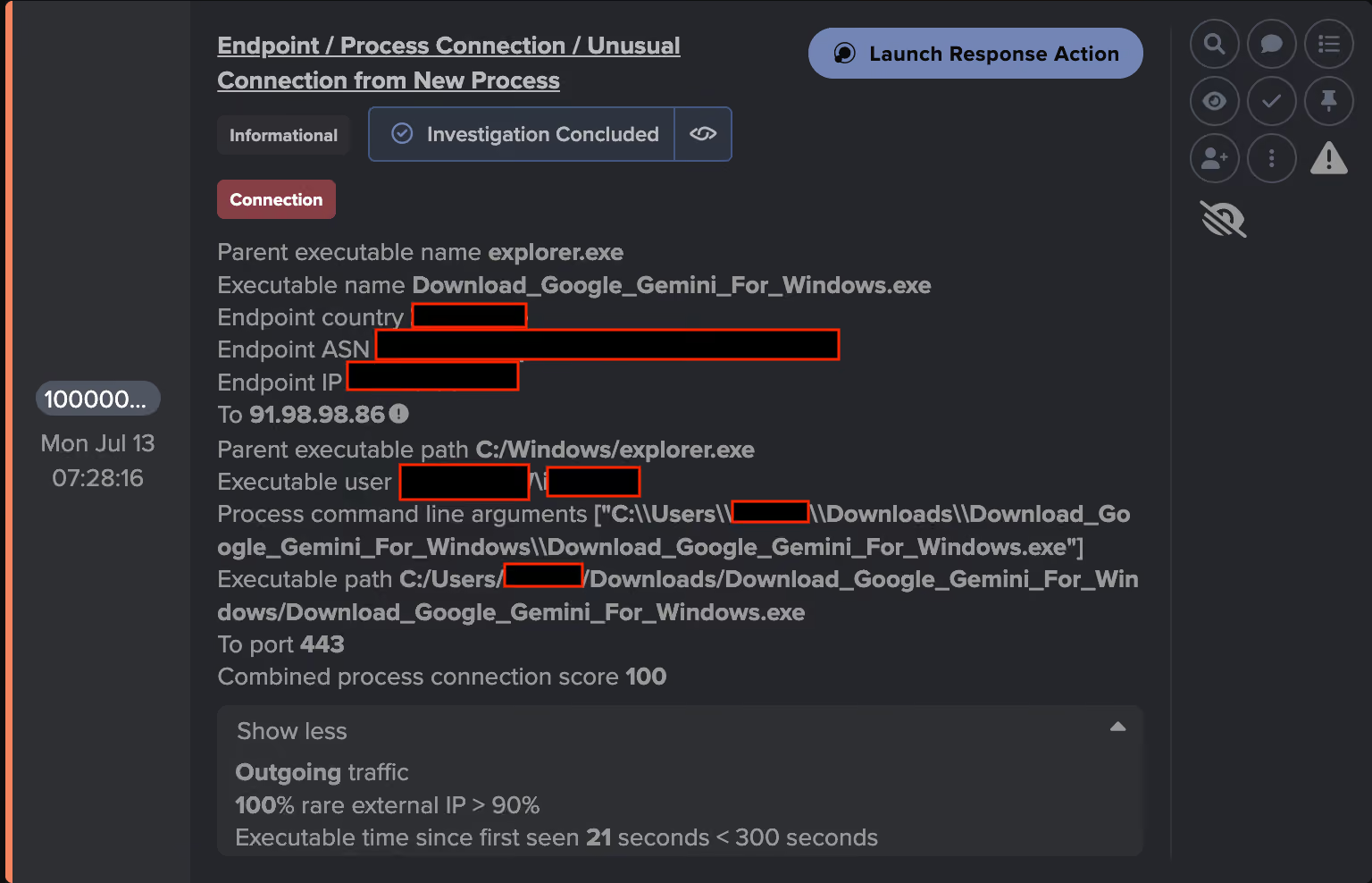
Figure 3: Darktrace’s detection of the unusual outbound connection associated with the fake Gemini installer.

Shortly after execution, the process established communications with the external IP address 91.98.98[.]86 via port 443, directly linking the executable to suspicious network activity observed on the device. Subsequent open-source intelligence (OSINT) analysis of the revealed multiple malicious associations [5].

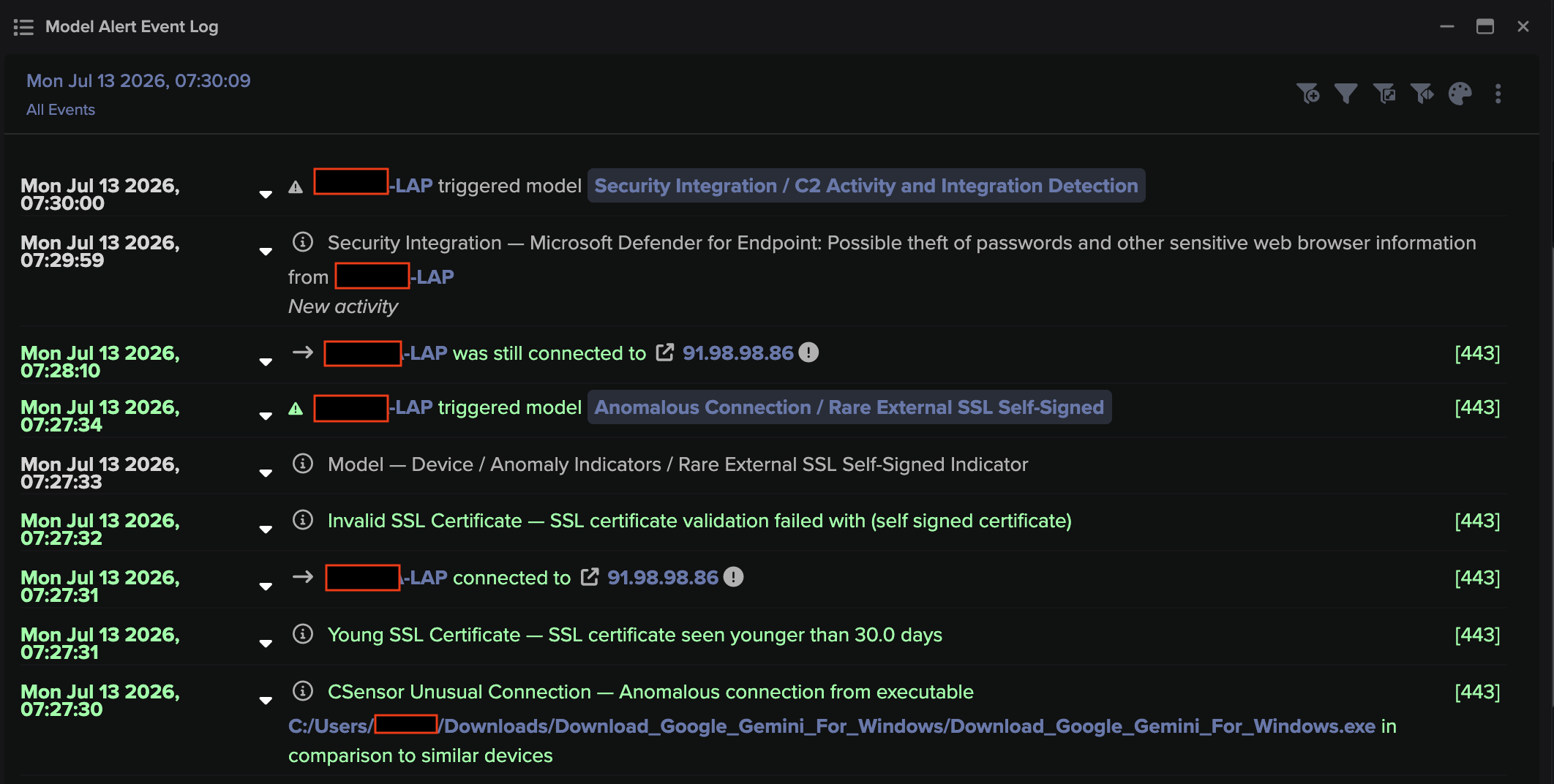
Additional Darktrace detections included unusual SSL activity from the affected device. Analysis of related SSL telemetry identified 91.98.111[.]49 as additional infrastructure associated  with the activity [6].

Subsequent alerts from the customer's Microsoft Defender for Endpoint integration later confirmed activity consistent with the theft of browser credentials and other sensitive data from the affected endpoint.

Taken together, these detections provided a clear picture of the attack, from the execution of a suspicious file and unusual network connections to indicators of C2 activity and credential theft.
‍

Figure 4: Darktrace’s detection of anomalous activity following the execution of the fake Gemini installer, seen in the Model Alert Event Log.

Darktrace's Autonomous Response

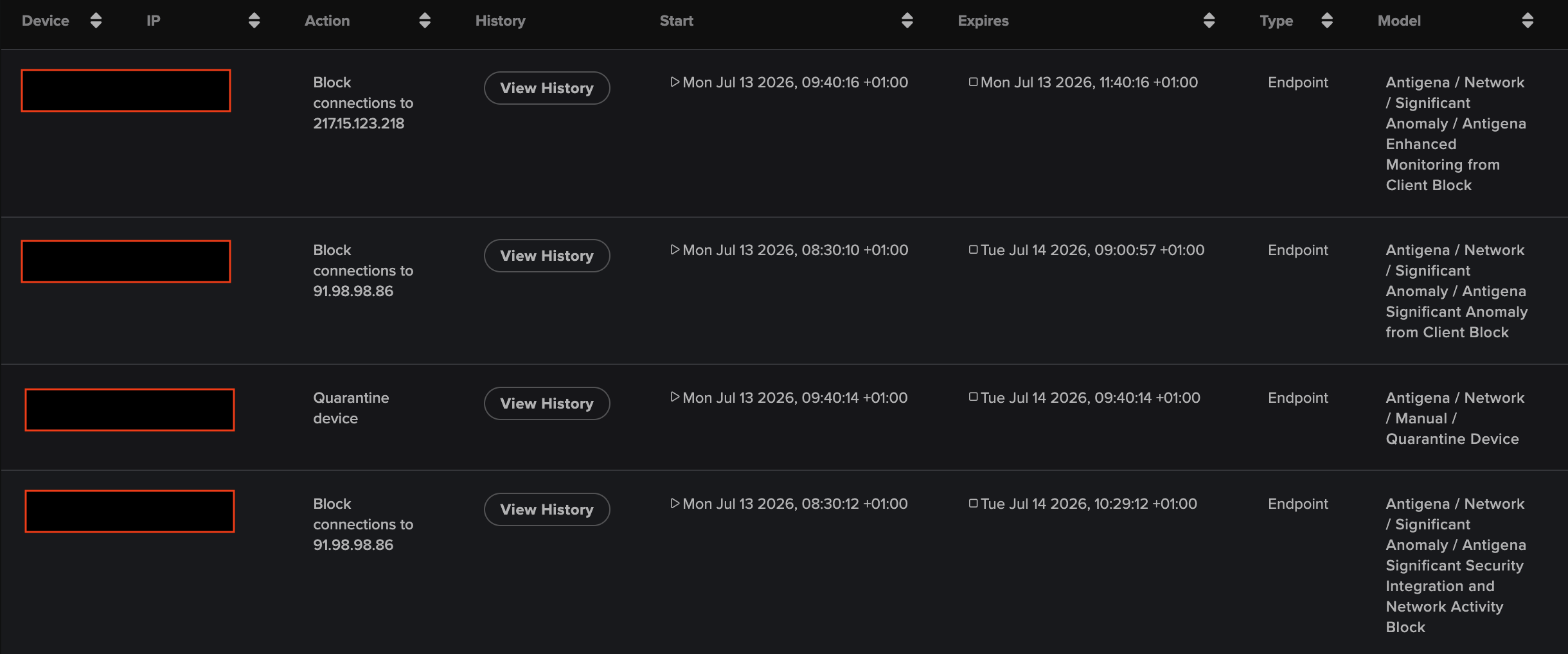
Following the detection, Darktrace’s Autonomous Response took immediate containment action, including blocking communication with suspicious external infrastructure, including 91.98.98[.]86, and quarantining the compromised device.

Despite the apparent legitimacy of the activity, with the installer hosted on a trusted platform and resembling a routine software download, Darktrace was able to detect and contain the attack because the device's behavior deviated from its normal pattern.
‍

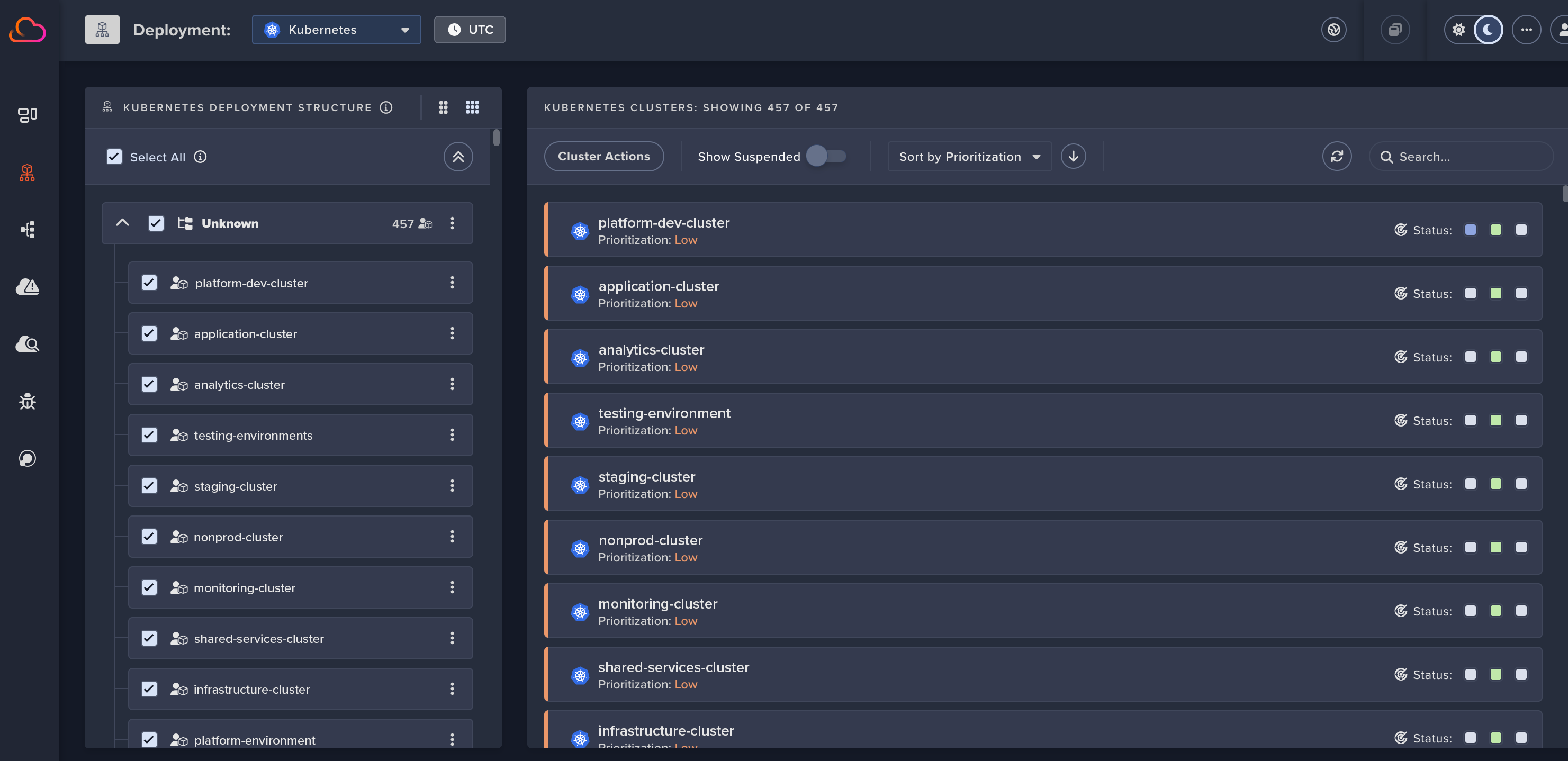
Figure 5: Automated containment actions implemented by Darktrace's Autonomous Response following the detection of activity associated with the fake Gemini installer.

Conclusion

This investigation highlights how threat actors continue to adapt established malware delivery techniques to emerging technology trends. While the malware itself was not new, the distribution method was. By disguising Vidar as a Google Gemini installer and hosting the malicious content on a trusted platform, the attack aligned its lure with a growing behavioral trend: users actively searching for AI tools and services as part of their day-to-day work.

Although fake installers are not a new phenomenon, the rapid rise of generative AI has created new opportunities for threat actors. Rather than relying solely on traditional delivery methods, attackers can now target users who are actively searching for AI applications. As AI adoption continues to accelerate across enterprise environments, organizations should remain alert to campaigns that exploit this interest through fake applications, malicious websites, manipulated search results, the misuse of trusted platforms, and AI-themed social engineering.

Credit to Rushanth Ramanathan (Cyber Analyst) Joanna Ng (Detection Engineer)

Edited by Ryan Traill (Content Manager)

Appendices

Darktrace Model Detections

  • Security Integration / C2 Activity and Integration Detection
  • Endpoint / New Suspicious Executable Launched
  • Endpoint / Process Connection / Unusual Connection from New Process
  • Anomalous Connection / Rare External SSL Self-Signed
  • Security Integration / High Severity Integration Detection
  • Antigena / Network / Significant Anomaly /  Antigena Significant Security Integration and Network Activity Block

•Antigena / Network / Significant Anomaly /  Antigena Significant Anomaly from Client Block

‍

List of Indicators of Compromise (IoCs)

‍

IoC Type Description
Download_Google_Gemini_For_Windows.exe File Fake Gemini-themed installer observed during the investigation.
GoogleAppInstaller.exe File Related executable identified through endpoint telemetry.
91.98.98[.]86 IP Address External destination contacted by the malicious executable.
91.98.111[.]49 IP Address Related infrastructure identified through SSL certificate pivoting.
dtm[.]kijangturbo88[.]top Domain Command-and-control endpoint identified during malware analysis.
1e13c2c9eac72daf63fd00a9946878949e159ae6ec51b54ec64f942d79d61913 SHA256 Malware sample associated with the fake Gemini installer.

MITRE ATT@CK Mapping

‍


MITRE ATT&CK Mapping Tactic Technique
Initial Access T1204 User Execution
Execution T1204.002 User Execution: Malicious File
Defence Evasion T1036 Masquerading
Credential Access T1555 Credentials from Password Stores
Credential Access T1555.003 Credentials from Web Browsers
Command and Control T1071 Application Layer Protocol
Exfiltration T1041 Exfiltration Over C2 Channel
Inside the SOC
Darktrace cyber analysts are world-class experts in threat intelligence, threat hunting and incident response, and provide 24/7 SOC support to thousands of Darktrace customers around the globe. Inside the SOC is exclusively authored by these experts, providing analysis of cyber incidents and threat trends, based on real-world experience in the field.
Written by
Rushanth Ramanathan
Cyber Analyst

More in this series

No items found.

Blog

/

AI

/

September 30, 2026

AI-Assisted Attacks Still Leave a Behavioral Trace  

Default blog imageDefault blog image

Key Insights

  • Darktrace identified behavioral indicators associated with two campaigns linked to AI-assisted threat activity, highlighting the growing role of AI in modern cyber-attacks.
  • Observed activity involved suspicious WebDAV file transfers, disguised executable downloads, beaconing to rare infrastructure, unusual process execution, and communications with C2 infrastructure linked to active intrusion campaigns.

Introduction

Just as organizations are incorporating AI into their operations to take advantage of its benefits, threat actors are doing the same, creating new challenges for defenders.

Much of the discussion around AI risk has focused on the expanding attack surface created by AI systems within organizations. These systems are often granted privileged access and heightened permissions to carry out their duties, introducing new security risks and unintended consequences.

At the same time, threat actors are learning to leverage AI to enable malicious activities such as vulnerability discovery, exploit creation, and progressing through the Cyber Kill Chain more quickly. By accelerating development, adaptation, and scaling, AI enables attackers to operate more efficiently while making some capabilities more accessible to less skilled operators.

Whether AI is the target or the enabler, the resulting activity still manifests through networks, identities, endpoints and cloud services. Those interactions create observable signals that defenders can investigate, regardless of how the attack was developed.

AI as part of the attacker’s workflow

Darktrace has previously documented how threat actors are increasingly incorporating AI into offensive operations [1]. Two recent investigations from open-source intelligence (OSINT) illustrate this. In both cases, researchers identified the role of AI within malicious operations. Separately, Darktrace detected activity in customer environments that aligned with the infrastructure and techniques reported in those campaigns. These perspectives provide a view of both attacker workflow and operational consequences.

Although AI played different roles in each campaign, it did not remove the need for the attackers to interact with their targets. Payloads still had to be delivered, processes executed, and command-and-control (C2) connections established, creating behavioral anomalies that Darktrace was able to identify.

‍

Case 1: A Mexican government impersonation campaign with LLM-assisted malware development

Rapid7 reported on a malware delivery operation that used generative AI to assist development, testing, documentation and refinement of attacker infrastructure. Between May and June 2026, Darktrace similarly observed two chains of suspicious activity across customer environments in the Americas that exhibited clear similarities in behavior.

In both cases Darktrace observed:

  • WebDAV communication with onedrive[.]cv·138.124.123[.]87, retrieving a file from the path /Downloads/CURP/
  • Transfer of a masqueraded .scr executable
  • Subsequent communication with google.services[.]ug·77.110.127[.]205 over unusual high ports
  • Additional Darktrace detections correlating the unusual behavior seen spanning payload delivery and C2 communication
  • Darktrace’s Autonomous Response capability alerted across multiple stages of the attack

The infrastructure and behavior observed by Darktrace closely aligned with a campaign reported by Rapid7, in which a WebDAV malware delivery environment was exposed. Rapid7 assessed that threat actors had used generative AI to support the development, testing, documentation and refinement of the operation. The observed activity also aligned with reporting on a campaign in which impersonation of Mexico’s government Unique Population Registry Code (CURP) identity-record service led to delivery of PureRAT, a .NET-based information stealer and remote access trojan (RAT) [2]. The infrastructure overlap and consistent behavioural sequence provides strong alignment and offers a view of how an AI-assisted development pipeline ultimately manifested inside target environments.

Case 2: A suspected China-linked intrusion campaign with AI-assisted automation

In July 2026, Hunt.io published research into a suspected China-based intrusion operation targeting government and financial services organizations [3]. Material recovered from exposed attacker infrastructure by Hunt.io indicated that Claude Code and DeepSeek-v4-pro were being used as active components of the attacker’s workflow. According to the research, the models supported activities including attack reasoning, script generation, execution, exploit adaptation, and phishing-page development.

The investigation identified 192.229.115[.]229 and 192.229.115[.]230 as infrastructure associated with suspected TencShell operations and a possible second C2 framework known as Gshell [3].

Darktrace identified likely related activity within a financial services customer environment involving a newly observed laptop running the Windows 11 Pro operating system. Over a six-day period in July, the device made repeated outbound connections to 192.229.115[.]229 over port 8083.

Darktrace recognized the destination was highly rare for the environment, and the connectivity exhibited beaconing characteristics. During the same timeframe, Darktrace also identified suspicious process behavior associated with process chains involving svchost.exe and cmd.exe. The device repeatedly communicated with infrastructure identified in the Hunt.io research while exhibiting beaconing characteristics and suspicious process activity, strengthening the assessment that the activity likely was associated with the same operation.

Unlike many previous examples of AI-assisted cybercrime, the Hunt.io investigation provided rare visibility into how large language models were being incorporated directly into operational workflows rather than being used solely for content generation. Darktrace, meanwhile, observed how activity associated with that operation ultimately manifested inside a target environment, providing a complementary view of its operational impact.

Operational consequences of AI-assisted attacks

These investigations provide two complementary perspectives on AI-assisted cyber operations. OSINT research revealed how AI was incorporated into attacker workflows, while Darktrace observed the resulting activity within customer environments.

Although AI played different roles in each campaign, it did not remove the need for attackers to interact with their targets, deliver payloads, execute processes, and communicate with C2, all of which generated observable signals.

In these cases, Darktrace identified suspicious file delivery, unusual process behavior, beaconing activity, and communication with rare external infrastructure that aligned with campaigns later linked to AI-assisted operations. While AI may influence how attacks are developed, adapted, and scaled, it does not make them operationally invisible.

For defenders, the broader lesson extends beyond these specific campaigns. As AI becomes increasingly embedded within both enterprise operations and attacker workflows, understanding what a model was asked to do is often less important than understanding the actions it ultimately took and the consequences those actions produced. Whether the actor is human, AI-assisted, or increasingly autonomous, activity still manifests through identities, endpoints, applications, cloud services and network infrastructure.

Credit to Angel Arribas Lopez (Associate Principal Cyber Analyst), Emma Foulger (Global Threat Research Operations Lead), Nathaniel Jones, SVP Global Threat Intelligence
Edited by Ryan Traill (Content Manager)

‍

Appendices

Darktrace Model Detections

Case 1

Anomalous File / Masqueraded File Transfer from New External Endpoint

Anomalous File / Script from Rare External Location

Anomalous File / EXE from Rare External Location

Anomalous File / Script and EXE from Rare External

Anomalous Connection / Multiple Failed Connections to Rare Endpoint

Anomalous Connection / Rare External SSL Self-Signed

Compromise / New or Repeated to Unusual SSL Port

Compromise / Large Number of Suspicious Failed Connections

Device / Initial Attack Chain Activity

Antigena / Network / External Threat::Antigena Suspicious File Block

Antigena / Network / Significant Anomaly::Antigena Enhanced Monitoring from Client Block

Antigena / Network / Significant Anomaly::Antigena Controlled and Model Alert

Antigena / Network / External Threat::Antigena File then New Outbound Block

Antigena / Network / Significant Anomaly::Antigena Significant Anomaly from Client Block

Antigena / Network / Significant Anomaly::Antigena Alerts Over Time Block

Case 2

Anomalous Connection / Multiple Failed Connections to Rare Endpoint

Compromise / High Volume of Connections with Beacon Score

Compromise / Large Number of Suspicious Failed Connections

‍

Indicators of Compromise (IoCs)

‍

Case 1

                                                                                                                                                                                                                                                 
IoCTypeDescription + Confidence
onedrive[.]cvHostnameLikely C2 server
138.124.123[.]87IP AddressPossible C2 server
hXXp://onedrive[.]cv/Downloads/CURP/ReportFinal.%E2%80%AE%E1%BA%9D%D4%81%EF%BD%90.scrURIPossible payload
google.services[.]ugHostnameLikely C2 server
77.110.127[.]205IP AddressLikely C2 server
google.services[.]ug:57666Hostname + PortLikely C2 communication
google.services[.]ug:57888Hostname + PortLikely C2 communication
google.services[.]ug:56001Hostname + PortLikely C2 communication

‍

Case 2

IoC Type Description + Confidence
192.229.115[.]229 IP Address Likely C2 communication
Continue reading
About the author
Angel Arribas Lopez
Associate Principal Cyber Analyst

Blog

/

Network

/

September 30, 2026

A Chain Reaction: Blockchain-Hosted Infostealer Campaign Targets Windows and macOS

Default blog imageDefault blog image

Key Insights

  • Darktrace detected a blockchain-hosted infostealer campaign targeting Windows and macOS devices across multiple customer environments.
  • The campaign combined ClickFix social engineering with trusted services and decentralized blockchain infrastructure to support malware delivery and C2 activity.
  • Compromised devices were observed connecting to rare and unusual external endpoints, including DGA C2 domains, blockchain-related endpoints, and cryptocurrency mining infrastructure.
  • The activity was associated with information-stealing malware strains including Atomic macOS Stealer (AMOS), Lumma, Rhadamanthys, Vidar, and Phexia.
  • Darktrace identified anomalous device behavior, beaconing patterns, rare external connections, cryptomining activity, and suspicious TLS/SSL communications without relying solely on prior knowledge or static indicators of compromise.
  • The campaign highlights how attackers are increasingly using legitimate and decentralized infrastructure to make detection, disruption, and attribution more challenging for defenders.

The Infostealer Ecosystem

The information stealer malware ecosystem continues to grow in value for threat actors across the digital threat landscape. Infostealers are increasingly delivered through Malware-as-a-Service (MaaS) operating models, distributed through affiliate networks, and designed to withstand infrastructure takedowns. This resilience was demonstrated by the recent takedown of Lumma Stealer malicious domains by Microsoft’s Digital Crimes Unit (DCU) [1].

Infostealers are used to gather and exfiltrate sensitive information, including non-human identity (NHI) data, from compromised systems across cloud, Software-as-a-Service (SaaS), Virtual Private Network (VPN), and development environments. They can also support ransomware operations by expanding the credentials and access paths available to threat actors, contributing to the high volume of identity-based attacks observed across the broader threat landscape [2][3].

Darktrace’s Observations of ClickFix and Infostealers

Throughout 2026, Darktrace has observed multiple campaigns using ClickFix social engineering to trick users into carrying out malicious actions and downloading initial payloads, including information stealers. More recently, Darktrace’s Threat Research team identified a specific ClickFix campaign involving a blockchain-hosted infostealer targeting Windows and macOS devices.

Darktrace identified affected customer environments across Europe, the United States, Asia, and the Middle East where blockchain-hosted infostealer malware appears to have been delivered to compromised systems following likely ClickFix-driven initial access. Darktrace investigated the activity and found that decentralized blockchain infrastructure, alongside widely trusted legitimate services, was used to support malware delivery and information theft across Windows and macOS systems.

Following initial access, compromised systems established C2 communication, with C2 configuration and payloads hosted on public blockchain infrastructure. The ultimate objective appears to be credential and cryptocurrency theft through the deployment of information stealers such as Atomic macOS Stealer (AMOS), Lumma, Rhadamanthys, and Vidar [5][6][7].

Darktrace’s Investigation

Affected devices across the Darktrace customer base were observed making outbound connections to rare external endpoints in patterns consistent with beaconing and C2 activity. Darktrace primarily detected devices making repeated connections to algorithmically generated domains (DGA) such as hf98x4d[.]site [8]. In many cases, these domains were linked through open-source intelligence (OSINT) to information-stealing malware families including AMOS and Phexia [5][6][7][8][9].

In multiple cases, devices were also observed connecting to blockchain-related endpoints, such as polygon[.]drpc[.]org, as well as legitimate public services, including GitHub. The use of decentralized blockchain infrastructure and trusted services such as GitHub to facilitate malware distribution and C2 activity can make disruption and attribution significantly more difficult for defenders.

Darktrace also detected a significant proportion of impacted devices making outbound connections to cryptocurrency mining infrastructure associated with the legitimate open-source XMRig mining software and the HashVault mining pool, including pool.hashvault[.]pro and donate[.]ssl[.]xmrig[.]com, which were abused by the attackers, indicating, including pool.hashvault[.]pro and donate[.]ssl[.]xmrig[.]com, indicating active cryptomining on compromised systems.

In one case, mining activity was observed before and during connections to the DGA endpoint hf98x4d[.]site. Due to its highly anomalous nature, Darktrace's Real-Time AI Analyst autonomously investigated the activity as it occurred, correlating the two events into a single cryptocurrency mining incident and providing comprehensive visibility into the broader attack.

‍

Figure 1: Real-Time AI Analyst investigation of suspicious SSL and C2 communications with hf98x4d[.]site over port 443.

‍

Figure 2: Real-Time AI Analyst investigation into cryptocurrency mining activity involving pool[.]hashvault[.]pro over SSL on port 443.

‍

Around the same time, Darktrace identified the same device initiating connections to the GitHub endpoint release-assets[.]githubusercontent[.]com while continuing to make repeated connections to hf98x4d[.]site.

‍

Figure 3: Darktrace's detection of an affected device connecting to a GitHub endpoint between repeated connections to the anomalous external endpoint hf98x4d[.]site.

On the network of another customer, Darktrace observed an affected device making highly unusual outbound connections consistent with beaconing activity. The device initiated multiple connections over port 443 to the external hostname polygon[.]drpc[.]org. According to OSINT, this hostname is a Remote Procedure Call (RPC) endpoint provided by dRPC, a legitimate service enabling decentralized applications (dApps), cryptocurrency wallets, and developer tools to interact with the Polygon blockchain [10].

The same device was later observed making repeated TLS/SSL connections to the previously mentioned DGA C2 domain. In addition, it made outbound connections to the external IP 195.242.214[.]34 over destination port 51820, an endpoint associated with the ProtonVPN service. Collectively, these connections to blockchain-related infrastructure, the DGA C2 domain, and ProtonVPN-associated infrastructure suggested the device had been affected by the campaign.

Conclusion

This campaign demonstrates how attackers can combine ClickFix social engineering with trusted services and decentralized blockchain infrastructure to create a resilient, cross-platform malware delivery chain. By using services such as GitHub alongside blockchain RPC endpoints and rapidly replaceable DGA domains, the activity can blend into legitimate traffic while making infrastructure disruption and attribution more difficult.

For defenders, it’s a reminder that trusted infrastructure does not automatically mean trusted activity. Security teams should look for the behaviors surrounding these connections, including unusual outbound communication, repeated beaconing, unexpected access to blockchain services, suspicious TLS/SSL activity and cryptomining. In this campaign, Darktrace identified and correlated these deviations without depending solely on previously known indicators, providing visibility as affected devices moved between legitimate services, decentralized infrastructure and malicious C2 endpoints

Credit to Nahisha Nobregas (Associate Principal Cyber Analyst), Manoel Kadja (Senior Cyber Analyst)

Edited by Ryan Traill (Content Manager)

Appendices

Darktrace Model Detections

▪ Compromise / Beaconing Activity To External Rare

▪ Compromise / Beacon to Young Endpoint

▪ Compromise / Fast Beaconing to DGA

▪ Compromise / High Volume of Connections with Beacon Score

▪ Compromise / DGA Beacon

▪ Compromise / Slow Beaconing Activity To External Rare

▪ Compromise / Agent Beacon (Long Period)

▪ Compromise / Agent Beacon (Medium Period)

▪ Compromise / Sustained SSL or HTTP Increase

▪ Compromise / Large Number of Suspicious Failed Connections

▪ Compromise / SSL Beaconing to Rare Destination

▪ Compromise / Beacon for 4 Days

▪ Compromise / High Priority Crypto Currency Mining

▪ Compromise / Monero Mining

▪ Device / Long Agent Connection to New Endpoint

▪ Device / New Connections On Suspicious Port

▪ Anomalous Connection / High Volume of Connections to Rare Domain

‍

‍

List of Indicators of Compromise (IoCs)

 
Indicator Description
hf98x4d[.]site C2 Endpoint (Hostname)
sj98xe4[.]xyz C2 Endpoint (Hostname)
citcix6[.]xyz C2 Endpoint (Hostname)
bduwih8[.]pro C2 Endpoint (Hostname)

‍

‍

MITRE ATT&CK Mapping

 
Tactic (ID) Technique
Persistence (T1176) Browser Extensions (T1176.001)
Persistence (T1176) Software Extensions
Command and Control (T1071) Web Protocols (T1071.001)
Command and Control (T1568) Domain Generation Algorithms (T1568.002)
Command and Control (T1071) Application Layer Protocol
Command and Control (T1102) One-Way Communication (T1102.003)
Command and Control (T1571) Non-Standard Port
Command and Control (T1104) Multi-Stage Channels
Command and Control (T1573) Encrypted Channel
Command and Control (T1008) Fallback Channels
Initial Access ICS (T0862) Supply Chain Compromise
Command and Control ICS (T0885) Commonly Used Port
Collection (T1185) Browser Session Hijacking
Impact (T1496) Compute Hijacking (T1496.001)
Impact (T1496) Resource Hijacking
Command and Control (T1071) Publish/Subscribe Protocols (T1071.001)
Lateral Movement (T1210) Exploitation of Remote Services

‍

References:

1.        https://www.microsoft.com/en-us/security/blog/2025/05/21/lumma-stealer-breaking-down-the-delivery-techniques-and-capabilities-of-a-prolific-infostealer/

2.        https://spycloud.com/resource/report/spycloud-annual-identity-exposure-report-2026/

3.        https://www.darktrace.com/blog/why-trust-is-the-new-attack-surface-darktraces-mid-year-threat-update-2026

4.        https://www.darktrace.com/blog/unpacking-clickfix-darktraces-detection-of-a-prolific-social-engineering-tactic

5.        https://abekweng.medium.com/inside-a-blockchain-hosted-malware-campaign-targeting-windows-and-macos-f5bcdeffed66

6.        https://cloud.google.com/blog/topics/threat-intelligence/unc5142-etherhiding-distribute-malware

7.        https://haveibeensquatted.com/blog/from-typosquatting-to-macos-backdoor-clickfix-blockchain-c2

8.        https://www.virustotal.com/gui/domain/hf98x4d.site/community

9.        https://x.com/FABO97662188/status/2074125545026244795

10.  https://www.virustotal.com/gui/url/b0e5c51a411065864119c305fddf218b7c120731f655932cc1c3307ad5b43f94/gti-summary

Continue reading
About the author
Nahisha Nobregas
SOC Analyst
あなたのデータ × DarktraceのAI
唯一無二のDarktrace AIで、ネットワークセキュリティを次の次元へ