Blog
/
/
May 28, 2019

[Part 2] Top Cyber Hygiene Issues Leading to a Breach

Spotting cyber hygiene issues caused by a lapse of attention requires AI tools that alert critical changes to network activity. Read part two here!
Inside the SOC
Darktrace cyber analysts are world-class experts in threat intelligence, threat hunting and incident response, and provide 24/7 SOC support to thousands of Darktrace customers around the globe. Inside the SOC is exclusively authored by these experts, providing analysis of cyber incidents and threat trends, based on real-world experience in the field.
Written by
Max Heinemeyer
Global Field CISO
Default blog imageDefault blog imageDefault blog imageDefault blog imageDefault blog imageDefault blog image
28
May 2019

Read the first part: Part one — A perimeter in ruins

Earlier this month, I discussed some of the most critical challenges that today’s institutions face in their efforts to reinforce the network perimeter. Eliminating common attack vectors, from unauthorized uploads in the cloud to outdated protocol usage on-premise, is an essential step toward a more secure digital future.

Ultimately, however, I concluded that even flawless cyber hygiene at the perimeter will never be a panacea for all possible cyber-threats, since defenders cannot possibly address vulnerabilities about which they aren’t yet aware. Building strong borders is vital, clearly, but as attackers continue to launch novel attacks, even 50-foot walls are imperiled by 50-foot ladders.

Of course, such concerns become merely academic when your walls aren’t placed correctly, or watched attentively, or expanded when the digital estate grows. For countless employees and organizations alike, the allure of convenience has weakened the perimeter in all of these ways and more, rendering the work of cyber-criminals exponentially easier. Yet given the complexity of the modern enterprise, discovering exactly where users have cut corners is often difficult for human security teams alone. Spotting cyber hygiene issues caused by a lack of due diligence — like the five detailed below — therefore requires AI tools that alert on critical changes to network activity in real time.

Issue #6: Not keeping an inventory of hardware on the network

As all manner of non-traditional IT makes its way into workplaces around the world, keeping an inventory of these seamlessly integrated devices often proves an arduous undertaking, one that many organizations shirk altogether. Between app-controlled thermostats and smart refrigerators, connected cameras and Bluetooth sensors, few security teams possess a rigorous list of the hardware under their care.

Yet attaining 100% network visibility is a prerequisite to any viable security posture. Attackers are increasingly targeting poorly secured IoT devices to bypass the perimeter at its weakest points, before moving laterally to compromise more sensitive databases and machines. By analyzing all traffic from the entire enterprise, Darktrace detects when new devices come online and alert on any unusual activity from them with its AI models, some of which are:

  • Device / New Device with Attack Tools
  • Unusual Activity / Anomalous SMB Read & Write from New Device
  • Unusual Activity / Sustained Unusual Activity from New Device
  • Unusual Activity / Unusual Activity from New Device

Issue #7: Using corporate devices for private use

While the divide between corporate and private networks is a primary facet of cyber hygiene, few employees are immune to the temptation and convenience of using company devices for personal use. Whether it’s torrenting movies, visiting social media websites, or checking personal email accounts during the workday, these activities all expose carefully guarded corporate environments to ones that are far less secure. At the same time, many organizations lack visibility over their own online traffic, preventing their security teams from catching such risky behavior until it’s already too late.

Employees have also been known to violate internal compliance policies by downloading unauthorized software for private purposes, which introduces serious security risks and opens the door for supply chain attacks. Darktrace has detected a plethora of threats related to such downloads across our customer base, including outdated software, network scanners, BitTorrent clients, and crypto-mining programs. Such compliance issues trigger a number of Darktrace’s behavioral models, for example:

  • Anomalous File / EXE from Rare External Location
  • Anomalous File / Incoming RAR File
  • Compliance / BitTorrent
  • Compliance / Crypto Currency Mining Activity

To bypass compliance policies and access resources blocked by network administrators, employees often turn to VPNs as well as onion routing services like Tor, which facilitate anonymous communication. These services are equivalent to inhibiting security controls on the offending device; consequently, companies must have the ability to detect and terminate them whenever they are used on the network. Because Darktrace provides 100% visibility across the digital infrastructure, it can flag private VPN and Tor sessions with the following example models:

  • Anomalous Connection / New Outbound VPN
  • Compliance / Privacy VPN
  • Compliance / Tor Usage

Darktrace detected one such case earlier this year wherein a corporate device connected to a third-party VPN. Although this activity is not inherently risky or threatening in all situations, Darktrace’s understanding of the company’s network revealed that the device was the only one using the VPN — strongly suggesting a compliance violation. Moreover, when the device was not using the VPN service, it was seen making a large amount of HTTP post requests to another rare destination and displaying other signs of infection. It turned out that the device was infected with the elusive Ursnif trojan.
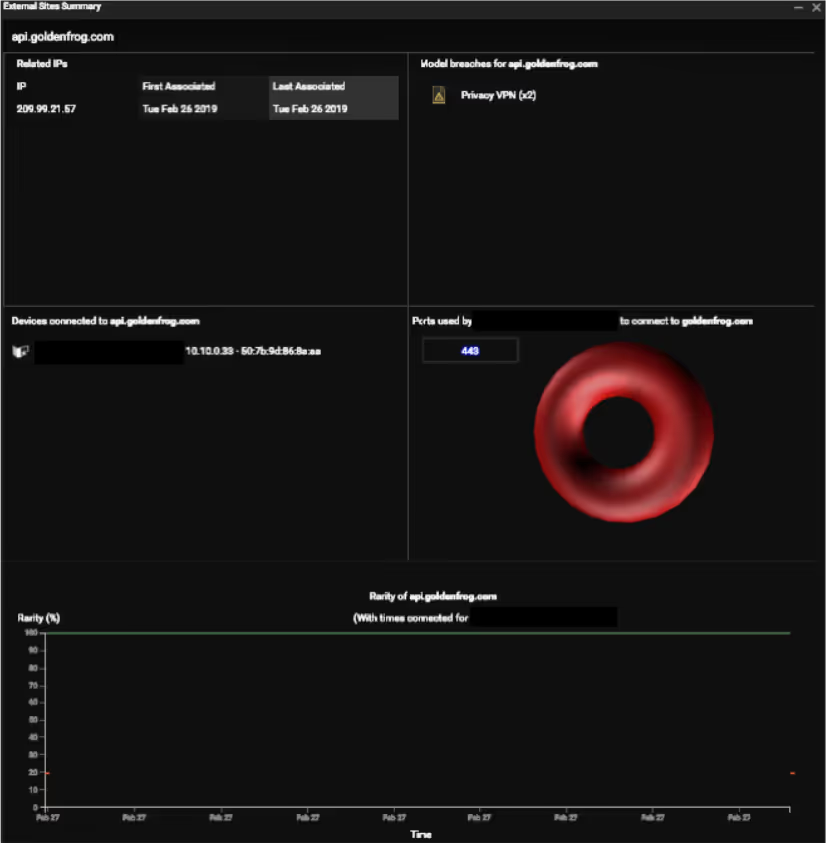
Figure 1: Darktrace’s external site summary showing that only one device in the network connected to the VPN.

Issue #8: Lack of strong access management

Ensuring that only rightful users have access to private company resources is a foundational component of cyber security. Yet as these users and their privileges continuously evolve, maintaining strong access management can be time-consuming and difficult.

Out of all the users in the network, the accounts to which the most attention should be paid are those with administrator or root privileges. While it is common to keep a tight control on high-privilege accounts, there are still organizations that find it hard to manage the access control well, making their devices more vulnerable to both malware and insider threats. In fact, even well-intentioned insiders can jeopardize the organization in the absence of strong access management, such as employees who download unauthorized software without understanding its associated risks.

Darktrace has a list of models to detect the unusual usage of credentials, including:

  • User / New Admin Credentials on Client
  • User / Overactive User Credential
  • SaaS / Unusual SaaS Administration

Issue #9: TFTP Usage

Trivial File Transfer Protocol (TFTP) is an application layer protocol commonly employed to transfer files between devices. Due to its relatively simplistic design and easy implementation, TFTP was very popular in the past. In the context of today’s sophisticated cyber-threats, however, TFTP has become highly insecure. Among the protocol’s numerous weaknesses from a cyber hygiene perspective is its lack of authentication mechanisms, a flaw which allows essentially anyone to read and write resources on the exposed device.

Darktrace’s Compliance / External TFTP model enables network administrators to detect any incoming TFTP connections from external IP addresses that don’t normally connect to the network. Crucially, Darktrace AI’s understanding what constitutes “normal” versus “abnormal” for each particular network serves to differentiate the most serious threats, as TFTP connections from a rare IP address are much more likely to be malicious than similar connections between known IP addresses on the network.

TFTP is just one example of insecure protocol usage – Darktrace monitors for the abnormal usage of various other attack-prone protocols as well. Another example is Telnet.

Issue #10: Unencrypted data transferred between internal and external devices

While encrypting communication can be a hassle, cleartext messages are liable to be intercepted or even altered by malicious actors — with potentially devastating ramifications. Indeed, Darktrace’s Compliance / FTP / Unusual Outbound FTP model has frequently flagged credentials being sent via unencrypted channels, which attackers could have used to access privileged resources within the company’s network.

In the first few months of 2019, Darktrace detected an unusual connection made to an external device on port 1414 using the IBM WebSphere MQ Protocol. When potentially sensitive information was transmitted in cleartext, Darktrace AI alerted the customer in real time.
Figure 2: Packet capture showing that potential sensitive information was captured

Sacrificing convenience for security in these most egregious cases remains the foundation of robust cyber hygiene, whether that means not torrenting Shrek 2 on a work laptop or taking inventory of the smart juicer in the office kitchen. Of course, just as no perimeter defenses are formidable enough to keep motivated attackers at bay, so too is there no level of due diligence sufficient to close off all possible attack vectors or ensure that all employees are compliant with internal policies. With cyber AI defenses like Darktrace, security teams have an extra set of eyes watching out for poor cyber hygiene practices across the entire digital infrastructure, empowering them to grow those infrastructures with confidence.


Inside the SOC
Darktrace cyber analysts are world-class experts in threat intelligence, threat hunting and incident response, and provide 24/7 SOC support to thousands of Darktrace customers around the globe. Inside the SOC is exclusively authored by these experts, providing analysis of cyber incidents and threat trends, based on real-world experience in the field.
Written by
Max Heinemeyer
Global Field CISO

More in this series

No items found.

Blog

/

Email

/

March 24, 2026

Darktrace Unites Human Behavior and Threat Detection Across Email, Slack, Teams, and Zoom

Photo of office workers collaborating at a laptopDefault blog imageDefault blog image

The communication attack surface is expanding

Modern attackers no longer focus solely on inboxes, they target people and the productivity systems where work actually happens. Meanwhile, the boundary between internal and external usage of tools is becoming blurrier everyday – turning the entire workplace into the attack surface. In 2025, identity compromise emerged as the single most consistent threat across the global threat landscape, as observed by Darktrace research across our entire customer base. Over 70% of incidents in the US involved SaaS/M365 account compromise and phishing or email-based social engineering, making credential abuse the single most effective initial access vector.

Despite this upward trend, investment in existing security awareness training (SAT) isn’t moving the needle on reducing risk. 84% of organizations still measure success through completion rates1, even though completion of standard training correlates with less than 2% real improvement in risky behavior.2 By prioritizing completion, organizations reward time spent rather than meaningful engagement, yet time in training doesn’t translate to retention or real-world decision-making. This compliance-first approach has left the workforce unprepared for the threats they actually face.

At the same time, attacks have evolved. Highly personalized, AI-generated campaigns now move fluidly across email, Slack, Teams, Zoom, and beyond, blending channels and even targeting systems directly through techniques like prompt injection. This new reality demands a different approach: one that treats people and the tools they use as a single ecosystem, where behavior and detection continuously inform and strengthen each other.

Only an adaptive communication security system can keep pace with the speed, creativity, and cross channel nature of today’s threats. 

Ushering in the adaptive era of workplace security

With this release, Darktrace brings together our new behavior-driven training solution with email detection, cross-channel visibility, and platform-level insights. Powered by Self-Learning AI, it delivers protection across both people and the communication tools they rely on every day, including email, Slack, Teams, and Zoom.

Each component learns from the others – training adapts to real user behavior, detection evolves across channels, and response is continuously refined – creating a powerful feedback loop that strengthens resilience and improves accuracy against today’s AI-driven threats.

Introducing: Unified training and email security for a self-improving email defense

Our brand new product, Darktrace / Adaptive Human Defense, closes the gap between human behavior and email security to continuously strengthen both people and defenses. Each user receives personalized training that adapts to their own inbox activity and skill level, with learning delivered directly within the flow of their day-to-day email interactions.

By learning from each user’s interactions with security training, it adapts security responses, creating a closed-loop system where training reinforces detection and detection informs training. Let’s look at some of the benefits.

  • Reduce successful phishing at the source with contextual Just in Time coaching: Contextual coaching appears directly in real email threads the moment risky behavior is detected, so habits change where mistakes actually happen. Configurable triggers and group policies target the right users, reducing repeated errors and administrative overhead.
  • Adaptive phishing simulations that progress automatically with each user: Embedded simulations vary in their degree of realism, from generic phishing to generative AI-enabled spear phishing. Users progress through the difficulty levels based on their performance to give an accurate picture of their phishing preparedness.  
  • Native email security integration turns human behavior into quantified risk: The native email security integration allows engagement, links clicked, and question success signals to flow back into / EMAIL recipes and models, so detection and response adapt automatically as users learn.  
  • Actionable risk and trend analytics beyond completion rates: Analytics that surface repeat offenders, high-value targets, and measurable exposure, moving beyond completion metrics to give leaders actionable insights tied to real behavior.

Learn more about / Adaptive Human Defense in the product solution brief.

Industry-first cross-channel full-message analysis for email, Slack, Teams, and Zoom

Darktrace now brings full-message analysis to Email, Slack, Teams, Zoom, and even generative AI prompts. The same leading behavioral analysis from EMAIL extends to every message, tracing intent, tone, relationships, and conversation flow across all communication activity for a complete understanding of every user interaction.

By correlating messaging and collaboration activity with email and account environments, cross-channel analysis reveals multi-domain attack paths and follows both users and threats as a single, continuous narrative – delivering better context to improve detection across the entire organization.

  • Eliminate cross-channel blind spots: Detect phishing, malware, account takeovers, and conversational manipulation across email and collaboration platforms, so attackers can’t exploit Slack, Teams, or Zoom as a new entry point. Unified behavioral analysis gives security teams a coherent, single view, for no more fragmented, channel-specific gaps.
  • Spot generative AI prompt injection attacks before they manipulate assistants: Dedicated models surface threats targeting corporate AI assistants – like ShadowLeak and Hashjack – before they can silently manipulate workflows, reducing risk before static filters catch up.

Learn more about Darktrace’s messaging security offering in the product solution brief.

Industry-first DMARC with bi-directional ASM and email security integration

Darktrace transforms domain protection by linking DMARC, attack surface intelligence, and email security into a single, continuously evolving workflow. Instead of treating domain authentication and exposure as separate tasks, this unified approach shows not just where domains are vulnerable, but how attackers are actively exploiting them.

  • Fix authentication weaknesses faster: SPF, DKIM, DMARC configurations, and external exposure data are analyzed together, giving teams clear guidance to correct weaknesses before they can be abused. Deep bidirectional integration with attack surface intelligence reduces impersonation risk at the source.
  • Accelerate email investigations: DMARC context is embedded directly into email workflows, enriching triage with authentication posture, internal/external sender lists, and seamless pivots between email and domain intelligence for faster, more accurate investigations.

Committed to innovation

These updates are part of a broader Darktrace release, which also includes:

Join our Live Launch Event on April 14, 2026.

Join us for an exclusive announcement event where Darktrace, the leader in AI-native cybersecurity, will be announcing our latest innovations, including  a demo of our new product / Adaptive Human Defense, an exclusive conversation with a Darktrace customer, and a deep dive into the Darktrace ActiveAI Security Portal.  

Register here.

References

[1] 84% of organizations still measure security awareness training success through completion rates, a vanity metric with no correlation to behavior change. (Source:  NIST Awareness Effectiveness Study, Forrester 2025)

[2] 'Limited benefit from embedded phishing training. Using randomized controlled trials and statistical modeling, embedded training provides a statistically-significant reduction in average failure rate, but of only 2%.' Ho, G., Mirian, A., Luo, E., Tong, K., Lee, E., Liu, L., Longhurst, C. A., Dameff, C., Savage, S., & Voelker, G. M. (2025). Understanding the Efficacy of Phishing Training in Practice. Proceedings of the 2025 IEEE Symposium on Security and Privacy.

Continue reading
About the author
Carlos Gray
Senior Product Marketing Manager, Email

Blog

/

OT

/

March 24, 2026

Advancing OT Security with Architecture Visibility, Operational Reporting, and Industrial Context

darktrace / ot updatesDefault blog imageDefault blog image

The challenge of operational understanding in complex OT environments

Most industrial organizations today already have some level of asset visibility. The bigger challenge is maintaining a trusted, shared understanding of the environment as it evolves. OT teams still frequently rely on static diagrams, spreadsheets, and manually maintained documentation because these are often the only artifacts trusted by auditors, leadership, and engineering teams. However, these references quickly become outdated as environments change.

At the same time, compliance expectations continue to increase, particularly around IEC-62443 aligned programs. Producing defensible security evidence often requires teams to manually assemble reports across multiple tools while still debating asset inventories and classifications. This creates operational overhead and reduces confidence during audits, risk reviews, and incident response situations.

Advancing operational OT security with Darktrace / OT 7.1

Darktrace / OT's latest updates focus on helping industrial organizations close this operational gap by strengthening how OT security platforms support real workflows. This release enhances Operational Overview with architecture visibility, improves how industrial assets are represented, and introduces structured reporting capabilities aligned to governance needs.

Together, these improvements help organizations maintain a more reliable operational picture of their environments while reducing manual effort associated with documentation, reporting, and asset validation.

Darktrace OT updates 2026

Native OT architecture visibility inside Operational Overview

Understanding how industrial environments are structured is critical during investigations and risk reviews, yet architecture diagrams are typically maintained outside security platforms and quickly fall out of sync with operational changes. This disconnect makes it harder for OT, IT, and security teams to maintain a shared understanding of their environments when incidents occur.

Darktrace / OT introduces native OT architecture diagrams directly within Operational Overview, allowing teams to maintain a live representation of how OT assets and systems relate to each other inside the same platform used for monitoring and investigations.

These updates help organizations:

  • Maintain a shared architectural understanding across OT, IT, and security teams
  • Improve investigation context by understanding how systems relate operationally
  • Reduce reliance on static diagrams that quickly become outdated

Improving OT governance with operational asset and compliance reporting

Accurate reporting remains a major operational challenge for industrial organizations, particularly when security posture must be demonstrated to auditors, regulators, and leadership. Many OT teams still rely on manual screenshots, spreadsheets, or fragmented exports to show asset inventories and compliance alignment.

Darktrace / OT introduces structured OT asset reporting and IEC-62443-3-3 compliance reporting directly from Operational Overview. These capabilities allow organizations to generate consistent, repeatable outputs based on continuously observed OT environments rather than manually assembled documentation.

These updates help customers:

  • Reduce manual compliance effort through automated IEC-62443 reporting aligned to live OT data
  • Support governance workflows with structured OT asset and architecture reporting
  • Improve audit readiness with consistent reporting aligned to operational security posture

Expanding industrial context through improved asset representation and protocol coverage

Industrial environments rely on diverse technologies spanning manufacturing systems, power and utilities infrastructure, healthcare devices, and Industrial IoT deployments. Maintaining strong visibility across these environments requires both accurate device representation and deeper protocol understanding.

Darktrace / OT strengthens industrial context through expanded ICS and IoMT device classification alongside broader industrial protocol coverage. These improvements help organizations better understand specialized devices and communications across sectors such as manufacturing, energy, healthcare, and Industrial IoT.

These enhancements enable organizations to:

  • Improve visibility into specialized ICS, IoMT, and industrial infrastructure devices
  • Strengthen monitoring across sector-specific industrial communications in manufacturing, utilities, and IIoT environments
  • Increase confidence in detection across complex and evolving industrial technology estates

Supporting practical OT security outcomes for industrial organizations

Darktrace / OT continues our focus on delivering capabilities that help industrial organizations operationalize security rather than simply deploy tools. By improving architecture understanding, strengthening asset representation, and supporting governance reporting, this release helps organizations manage OT security with greater confidence.

As industrial environments continue to evolve, organizations need more than visibility. They need the ability to maintain trusted operational understanding and demonstrate security readiness without increasing operational friction. This release reflects Darktrace’s continued commitment to supporting the priorities that matter most in OT: safety, uptime, and resilience.

Continue reading
About the author
Pallavi Singh
Product Marketing Manager, OT Security & Compliance
Your data. Our AI.
Elevate your network security with Darktrace AI