Blog
/
Network
/
July 24, 2025

Untangling the web: Darktrace’s investigation of Scattered Spider’s evolving tactics

Learn about a recent Scattered Spider attack observed by Darktrace, comparing tactics with those seen in previous attacks. Widespread use of LOTL techniques alongside continued changes in TTPs such as their recent use of Ransomware-as-a-Service (RaaS) platforms can make it challenging for security teams to harden defenses.
Inside the SOC
Darktrace cyber analysts are world-class experts in threat intelligence, threat hunting and incident response, and provide 24/7 SOC support to thousands of Darktrace customers around the globe. Inside the SOC is exclusively authored by these experts, providing analysis of cyber incidents and threat trends, based on real-world experience in the field.
Written by
Emma Foulger
Global Threat Research Operations Lead
man on computer doing work scattered spider cybersecurityDefault blog imageDefault blog imageDefault blog imageDefault blog imageDefault blog imageDefault blog image
24
Jul 2025

What is Scattered Spider?

Scattered Spider is a native English-speaking group, also referred to, or closely associated with, aliases such as UNC3944, Octo Tempest and Storm-0875. They are primarily financially motivated with a clear emphasis on leveraging social engineering, SIM swapping attacks, exploiting legitimate tooling as well as using Living-Off-the-Land (LOTL) techniques [1][2].

In recent years, Scattered Spider has been observed employing a shift in tactics, leveraging Ransomware-as-a-Service (RaaS) platforms in their attacks. This adoption reflects a shift toward more scalable attacks with a lower barrier to entry, allowing the group to carry out sophisticated ransomware attacks without the need to develop it themselves.

While RaaS offerings have been available for purchase on the Dark Web for several years, they have continued to grow in popularity, providing threat actors a way to cause significant impact to critical infrastructure and organizations without requiring highly technical capabilities [12].

This blog focuses on the group’s recent changes in tactics, techniques, and procedures (TTPs) reported by open-source intelligence (OSINT) and how TTPs in a recent Scattered Spider attack observed by Darktrace compare.

How has Scattered Spider been reported to operate?

First observed in 2022, Scattered Spider is known to target various industries globally including telecommunications, technology, financial services, and commercial facilities.

Overview of key TTPs

Scattered Spider has been known to utilize the following methods which cover multiple stages of the Cyber Kill Chain including initial access, lateral movement, evasion, persistence, and action on objective:

Social engineering [1]:

Impersonating staff via phone calls, SMS and Telegram messages; obtaining employee credentials (MITRE techniques T1598,T1656), multi-factor authentication (MFA) codes such as one-time passwords, or convincing employees to run commercial remote access tools enabling initial access (MITRE techniques T1204,T1219,T1566)

  • Phishing using specially crafted domains containing the victim name e.g. victimname-sso[.]com
  • MFA fatigue: sending repeated requests for MFA approval with the intention that the victim will eventually accept (MITRE technique T1621)

SIM swapping [1][3]:

  • Includes hijacking phone numbers to intercept 2FA codes
  • This involves the actor migrating the victim's mobile number to a new SIM card without legitimate authorization

Reconnaissance, lateral movement & command-and-control (C2) communication via use of legitimate tools:

  • Examples include Mimikatz, Ngrok, TeamViewer, and Pulseway [1]. A more recently reported example is Teleport [3].

Financial theft through their access to victim networks: Extortion via ransomware, data theft (MITRE technique T1657) [1]

Bring Your Own Vulnerable Driver (BYOVD) techniques [4]:

  • Exploiting vulnerable drivers to evade detection from Endpoint Detection and Response (EDR) security products (MITRE technique T1068) frequently used against Windows devices.

LOTL techniques

LOTL techniques are also closely associated with Scattered Spider actors once they have gained initial access; historically this has allowed them to evade detection until impact starts to be felt. It also means that specific TTPs may vary from case-to-case, making it harder for security teams to prepare and harden defences against the group.

Prominent Scattered Spider attacks over the years

While attribution is sometimes unconfirmed, Scattered Spider have been linked with a number of highly publicized attacks since 2022.

Smishing attacks on Twilio: In August 2022 the group conducted multiple social engineering-based attacks. One example was an SMS phishing (smishing) attack against the cloud communication platform Twilio, which led to the compromise of employee accounts, allowing actors to access internal systems and ultimately target Twilio customers [5][6].

Phishing and social engineering against MailChimp: Another case involved a phishing and social engineering attack against MailChimp. After gaining access to internal systems through compromised employee accounts the group conducted further attacks specifically targeting MailChimp users within cryptocurrency and finance industries [5][7].

Social engineering against Riot Games: In January 2023, the group was linked with an attack on video game developer Riot Games where social engineering was once again used to access internal systems. This time, the attackers exfiltrated game source code before sending a ransom note [8][9].

Attack on Caesars & MGM: In September 2023, Scattered Spider was linked with attacked on Caesars Entertainment and MGM Resorts International, two of the largest casino and gambling companies in the United States. It was reported that the group gathered nearly six terabytes of stolen data from the hotels and casinos, including sensitive information of guests, and made use of the RaaS strain BlackCat [10].

Ransomware against Marks & Spencer: More recently, in April 2025, the group has also been linked to the alleged ransomware incident against the UK-based retailer Marks & Spencer (M&S) making use of the DragonForce RaaS [11].

How a recent attack observed by Darktrace compares

In May 2025, Darktrace observed a Scattered Spider attack affecting one of its customers. While initial access in this attack fell outside of Darktrace’s visibility, information from the affected customer suggests similar social engineering techniques involving abuse of the customer’s helpdesk and voice phishing (vishing) were used for reconnaissance.

Initial access

It is believed the threat actor took advantage of the customer’s third-party Software-as-a-Service (SaaS) applications, such as Salesforce during the attack.

Such applications are a prime target for data exfiltration due to the sensitive data they hold; customer, personnel, and business data can all prove useful in enabling further access into target networks.

Techniques used by Scattered Spider following initial access to a victim network tend to vary more widely and so details are sparser within OSINT. However, Darktrace is able to provide some additional insight into what techniques were used in this specific case, based on observed activity and subsequent investigation by its Threat Research team.

Lateral movement

Following initial access to the customer’s network, the threat actor was able to pivot into the customer’s Virtual Desktop Infrastructure (VDI) environment.

Darktrace observed the threat actor spinning up new virtual machines and activating cloud inventory management tools to enable discovery of targets for lateral movement.

In some cases, these virtual machines were not monitored or managed by the customer’s security tools, allowing the threat actor to make use of additional tooling such as AnyDesk which may otherwise have been blocked.

Tooling in further stages of the attack sometimes overlapped with previous OSINT reporting on Scattered Spider, with anomalous use of Ngrok and Teleport observed by Darktrace, likely representing C2 communication. Additional tooling was also seen being used on the virtual machines, such as Pastebin.

 Cyber AI Analyst’s detection of C2 beaconing to a teleport endpoint with hostname CUSTOMERNAME.teleport[.]sh, likely in an attempt to conceal the traffic.
Figure 1: Cyber AI Analyst’s detection of C2 beaconing to a teleport endpoint with hostname CUSTOMERNAME.teleport[.]sh, likely in an attempt to conceal the traffic.

Leveraging LOTL techniques

Alongside use of third-party tools that may have been unexpected on the network, various LOTL techniques were observed during the incident; this primarily involved the abuse of standard network protocols such as:

  • SAMR requests to alter Active Directory account details
  • Lateral movement over RDP and SSH
  • Data collection over LDAP and SSH

Coordinated exfiltration activity linked through AI-driven analysis

Multiple methods of exfiltration were observed following internal data collection. This included SSH transfers to IPs associated with Vultr, alongside significant uploads to an Amazon S3 bucket.

While connections to this endpoint were not deemed unusual for the network at this stage due to the volume of traffic seen, Darktrace’s Cyber AI Analyst was still able to identify the suspiciousness of this behavior and launched an investigation into the activity.

Cyber AI Analyst successfully correlated seemingly unrelated internal download and external upload activity across multiple devices into a single, broader incident for the customer’s security team to review.

Cyber AI Analyst Incident summary showing a clear outline of the observed activity, including affected devices and the anomalous behaviors detected.
Figure 2: Cyber AI Analyst Incident summary showing a clear outline of the observed activity, including affected devices and the anomalous behaviors detected.
Figure 3: Cyber AI Analyst’s detection of internal data downloads and subsequent external uploads to an Amazon S3 bucket.

Exfiltration and response

Unfortunately, as Darktrace was not configured in Autonomous Response mode at the time, the attack was able to proceed without interruption, ultimately escalating to the point of data exfiltration.

Despite this, Darktrace was still able to recommend several Autonomous Response actions, aimed at containing the attack by blocking the internal data-gathering activity and the subsequent data exfiltration connections.

These actions required manual approval by the customer’s security team and as shown in Figure 3, at least one of the recommended actions was subsequently approved.

Had Darktrace been enabled in Autonomous Response mode, these measures would have been applied immediately, effectively halting the data exfiltration attempts.
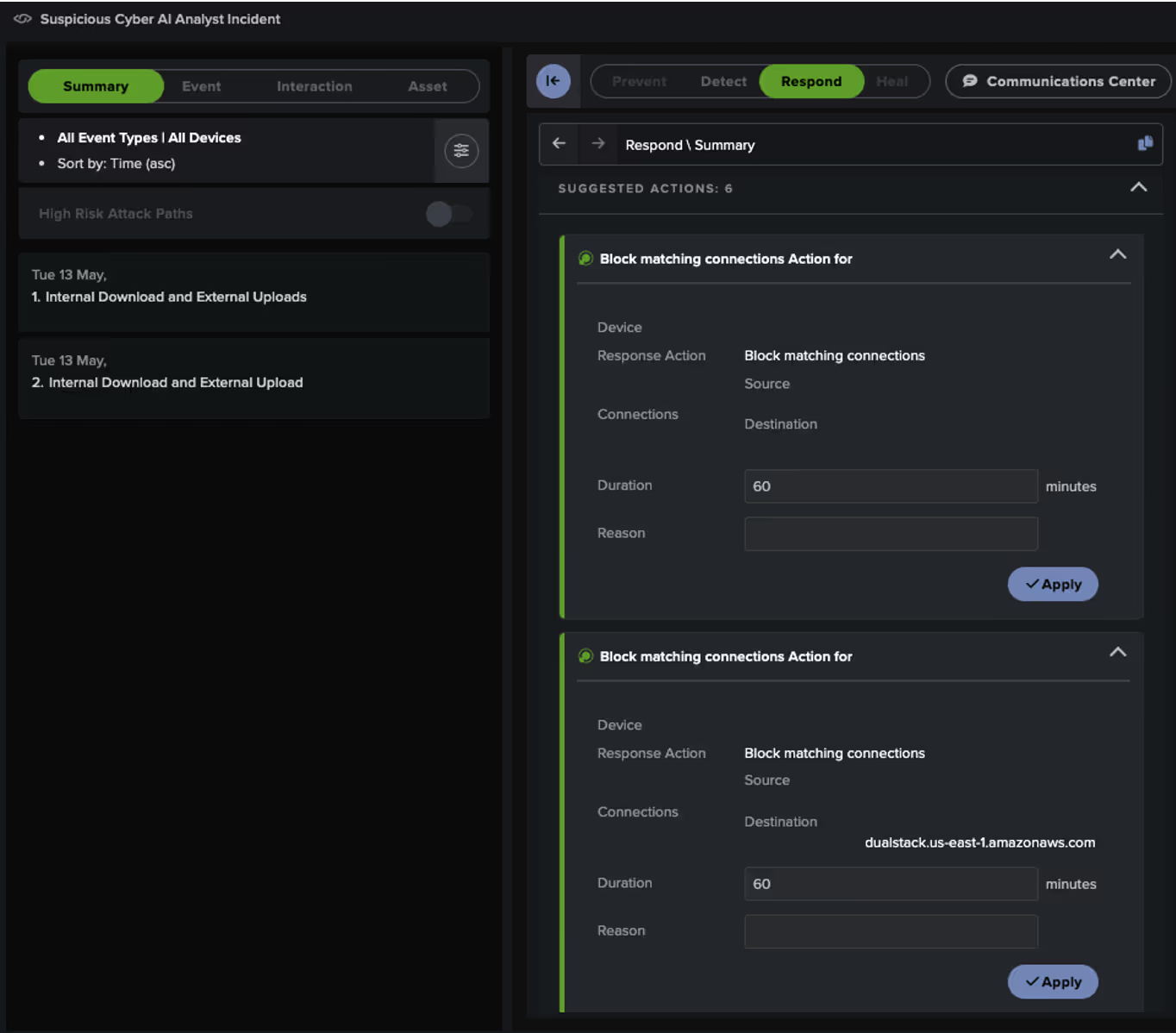
Further recommendations for Autonomous Response actions in Darktrace‘s Incident Interface, with surgical response targeting both the internal data collection and subsequent exfiltration.
Figure 4: Further recommendations for Autonomous Response actions in Darktrace‘s Incident Interface, with surgical response targeting both the internal data collection and subsequent exfiltration.

Scattered Spider’s use of RaaS

In this recent Scattered Spider incident observed by Darktrace, exfiltration appears to have been the primary impact. While no signs of ransomware deployment were observed here, it is possible that this was the threat actors’ original intent, consistent with other recent Scattered Spider attacks involving RaaS platforms like DragonForce.

DragonForce emerged towards the end of 2023, operating by offering their platform and capabilities on a wide scale. They also launched a program which offered their affiliates 80% of the eventual ransom, along with tools for further automation and attack management [13].

The rise of RaaS and attacker customization is fragmenting TTPs and indicators, making it harder for security teams to anticipate and defend against each unique intrusion.

While DragonForce appears to be the latest RaaS used by Scattered Spider, it is not the first, showcasing the ongoing evolution of tactics used the group.

In addition, the BlackCat RaaS strain was reportedly used by Scattered Spider for their attacks against Caesars Entertainment and MGM Resorts International [10].

In 2024 the group was also seen making use of additional RaaS strains; RansomHub and Qilin [15].

What security teams and CISOs can do to defend against Scattered Spider

The ongoing changes in tactics used by Scattered Spider, reliance on LOTL techniques, and continued adoption of evolving RaaS providers like DragonForce make it harder for organizations and their security teams to prepare their defenses against such attacks.

CISOs and security teams should implement best practices such as MFA, Single Sign-On (SSO), notifications for suspicious logins, forward logging, ethical phishing tests.

Also, given Scattered Spider’s heavy focus on social engineering, and at times using their native English fluency to their advantage, it is critical to IT and help desk teams are reminded they are possible targets.

Beyond social engineering, the threat actor is also adept at taking advantage of third-party SaaS applications in use by victims to harvest common SaaS data, such as PII and configuration data, that enable the threat actor to take on multiple identities across different domains.

With Darktrace’s Self-Learning AI, anomaly-based detection, and Autonomous Response inhibitors, businesses can halt malicious activities in real-time, whether attackers are using known TTPs or entirely new ones. Offerings such as Darktrace /Attack Surface Management enable security teams to proactively identify signs of malicious activity before it can cause an impact, while more generally Darktrace’s ActiveAI Security Platform can provide a comprehensive view of an organization’s digital estate across multiple domains.

Credit to Justin Torres (Senior Cyber Analyst), Emma Foulger (Global Threat Research Operations Lead), Zaki Al-Dhamari (Cyber Analyst), Nathaniel Jones (VP, Security & AI Strategy, FCISO), and Ryan Traill (Analyst Content Lead)

---------------------

The information provided in this blog post is for general informational purposes only and is provided "as is" without any representations or warranties, express or implied. While Darktrace makes reasonable efforts to ensure the accuracy and timeliness of the content related to cybersecurity threats such as Scattered Spider, we make no warranties or guarantees regarding the completeness, reliability, or suitability of the information for any purpose.

This blog post does not constitute professional cybersecurity advice, and should not be relied upon as such. Readers should seek guidance from qualified cybersecurity professionals or legal counsel before making any decisions or taking any actions based on the content herein.

No warranty of any kind, whether express or implied, including, but not limited to, warranties of performance, merchantability, fitness for a particular purpose, or non-infringement, is given with respect to the contents of this post.

Darktrace expressly disclaims any liability for any loss or damage arising from reliance on the information contained in this blog.

Appendices

References

[1] https://www.cisa.gov/news-events/cybersecurity-advisories/aa23-320a

[2] https://attack.mitre.org/groups/G1015/

[3] https://www.rapid7.com/blog/post/scattered-spider-rapid7-insights-observations-and-recommendations/

[4] https://www.crowdstrike.com/en-us/blog/scattered-spider-attempts-to-avoid-detection-with-bring-your-own-vulnerable-driver-tactic/

[5] https://krebsonsecurity.com/2024/06/alleged-boss-of-scattered-spider-hacking-group-arrested/?web_view=true

[6] https://www.cxtoday.com/crm/uk-teenager-accused-of-hacking-twilio-lastpass-mailchimp-arrested/

[7] https://mailchimp.com/newsroom/august-2022-security-incident/

[8] https://techcrunch.com/2023/02/02/0ktapus-hackers-are-back-and-targeting-tech-and-gaming-companies-says-leaked-report/

[9] https://www.pcmag.com/news/hackers-behind-riot-games-breach-stole-league-of-legends-source-code

[10] https://www.bbrown.com/us/insight/a-look-back-at-the-mgm-and-caesars-incident/

[11] https://cyberresilience.com/threatonomics/scattered-spider-uk-retail-attacks/

[12] https://www.crowdstrike.com/en-us/cybersecurity-101/ransomware/ransomware-as-a-service-raas/

[13] https://www.group-ib.com/blog/dragonforce-ransomware/
[14] https://blackpointcyber.com/wp-content/uploads/2024/11/DragonForce.pdf
[15] https://x.com/MsftSecIntel/status/1812932749314978191?lang=en

Select MITRE tactics associated with Scattered Spider

Tactic – Technique – Technique Name

Reconnaissance - T1598 -   Phishing for Information

Initial Access - T1566 – Phishing

Execution - T1204 - User Execution

Privilege Escalation - T1068 - Exploitation for Privilege Escalation

Defense Evasion - T1656 - Impersonation

Credential Access - T1621 - Multi-Factor Authentication Request Generation

Lateral Movement - T1021 - Remote Services

Command and Control - T1102 - Web Service

Command and Control - T1219 - Remote Access Tools

Command and Control - T1572 - Protocol Tunneling

Exfiltration - T1567 - Exfiltration Over Web Service

Impact - T1657 - Financial Theft

Select MITRE tactics associated with DragonForce

Tactic – Technique – Technique Name

Initial Access, Defense Evasion, Persistence, Privilege Escalation - T1078 - Valid Accounts

Initial Access, Persistence - T1133 - External Remote Services

Initial Access - T1190 - Exploit Public-Facing Application

Initial Access - T1566 – Phishing

Execution - T1047 - Windows Management Instrumentation

Privilege Escalation - T1068 - Exploitation for Privilege Escalation

Lateral Movement - T1021 - Remote Services

Impact - T1486 - Data Encrypted for Impact

Impact - T1657 - Financial Theft

Select Darktrace models

Compliance / Internet Facing RDP Server

Compliance / Incoming Remote Access Tool

Compliance / Remote Management Tool on Server

Anomalous File / Internet Facing System File Download

Anomalous Server Activity/ New User Agent from Internet Facing System

Anomalous Connection / Callback on Web Facing Device

Device / Internet Facing System with High Priority Alert

Anomalous Connection / Unusual Admin RDP

Anomalous Connection / High Priority DRSGetNCChanges

Anomalous Connection / Unusual Internal SSH

Anomalous Connection / Active Remote Desktop Tunnel

Compliance / Pastebin

Anomalous Connection / Possible Tunnelling to Rare Endpoint

Compromise / Beaconing Activity to External Rare

Device / Long Agent Connection to New Endpoint

Compromise / SSH to Rare External AWS

Compliance / SSH to Rare External Destination

Anomalous Server Activity / Outgoing from Server

Anomalous Connection / Large Volume of LDAP Download

Unusual Activity / Internal Data Transfer on New Device

Anomalous Connection / Download and Upload

Unusual Activity / Enhanced Unusual External Data Transfer

Compromise / Ransomware/Suspicious SMB Activity

Inside the SOC
Darktrace cyber analysts are world-class experts in threat intelligence, threat hunting and incident response, and provide 24/7 SOC support to thousands of Darktrace customers around the globe. Inside the SOC is exclusively authored by these experts, providing analysis of cyber incidents and threat trends, based on real-world experience in the field.
Written by
Emma Foulger
Global Threat Research Operations Lead

More in this series

No items found.

Blog

/

Network

/

March 26, 2026

Phantom Footprints: Tracking GhostSocks Malware

Default blog imageDefault blog image

Why are attackers using residential proxies?

In today's threat landscape, blending in to normal activity is the key to success for attackers and the growing reliance on residential proxies shows a significant shift in how threat actors are attempting to bypass IP detection tools.

The increasing dependency on residential proxies has exposed how prevalent proxy services are and how reliant a diverse range of threat actors are on them. From cybercriminal groups to state‑sponsored actors, the need to bypass IP detection tools is fundamental to the success of these groups. One malware that has quietly become notorious for its ability to avoid anomaly detection is GhostSocks, a malware that turns compromised devices into residential proxies.

What is GhostSocks?

Originally marketed on the Russian underground forum xss[.]is as a Malware‑as‑a‑Service (MaaS), GhostSocks enables threat actors to turn compromised devices into residential proxies, leveraging the victim's internet bandwidth to route malicious traffic through it.

How does Ghostsocks malware work? 

The malware offers the threat actor a “clean” IP address, making it look like it is coming from a household user. This enables the bypassing of geographic restrictions and IP detection tools, a perfect tool for avoiding anomaly detection. It wasn’t until 2024, when a partnership was announced with the infamous information stealer Lumma Stealer, that GhostSocks surged into widespread adoption and alluded to who may be the author of the proxy malware.

Written in GoLang, GhostSocks utilizes the SOCKS5 proxy protocol, creating a SOCKS5 connection on infected devices. It uses a relay‑based C2 implementation, where an intermediary server sits in between the real command-and-control (C2) server and the infected device.

How does Ghostsocks malware evade detection?

To further increase evasion, the Ghostsocks malware wraps its SOCKS5 tunnels in TLS encryption, allowing its malicious traffic to blend into normal network traffic.

Early variants of GhostSocks do not implement a persistence mechanism; however, later versions achieve persistence via registry run keys, ensuring sustained proxy operational time [1].

While proxying is its primary purpose, GhostSocks also incorporates backdoor functionality, enabling malicious actors to run arbitrary commands and download and deploy additional malicious payloads. This was evident with the well‑known ransomware group Black Basta, which reportedly used GhostSocks as a way of maintaining long‑term access to victims’ networks [1].

Darktrace’s detection of GhostSocks Malware

Darktrace observed a steady increase in GhostSocks activity across its customer base from late 2025, with its Threat Research team identifying multiple incidents involving the malware. In one notable case from December 2025, Darktrace detected GhostSocks operating alongside Lumma Stealer, reinforcing that the partnership between Lumma and GhostSocks remains active despite recent attempts to disrupt Lumma’s infrastructure.

Darktrace’s first detection of GhostSocks‑related activity came when a device on the network of a customer in the education sector began making connections to an endpoint with a suspicious self‑signed certificate that had never been seen on the network before.

The endpoint in question, 159.89.46[.]92 with the hostname retreaw[.]click, has been flagged by multiple open‑source intelligence (OSINT) sources as being associated with Lumma Stealer’s C2 infrastructure [2], indicating its likely role in the delivery of malicious payloads.

Darktrace’s detection of suspicious SSL connections to retreaw[.]click, indicating an attempted link to Lumma C2 infrastructure.
Figure 1: Darktrace’s detection of suspicious SSL connections to retreaw[.]click, indicating an attempted link to Lumma C2 infrastructure.

Less than two minutes later, Darktrace observed the same device downloading the executable (.exe) file “Renewable.exe” from the IP 86.54.24[.]29, which Darktrace recognized as 100% rare for this network.

Darktrace’s detection of a device downloading the unusual executable file “Renewable.exe”.
Figure 2: Darktrace’s detection of a device downloading the unusual executable file “Renewable.exe”.

Both the file MD5 hash and the executable itself have been identified by multiple OSINT vendors as being associated with the GhostSocks malware [3], with the executable likely the backdoor component of the GhostSocks malware, facilitating the distribution of additional malicious payloads [4].

Following this detection, Darktrace’s Autonomous Response capability recommended a blocking action for the device in an early attempt to stop the malicious file download. In this instance, Darktrace was configured in Human Confirmation Mode, meaning the customer’s security team was required to manually apply any mitigative response actions. Had Autonomous Response been fully enabled at the time of the attack, the connections to 86.54.24[.]29 would have been blocked, rendering the malware ineffective at reaching its C2 infrastructure and halting any further malicious communication.

 Darktrace’s Autonomous Response capability suggesting blocking the suspicious connections to the unusual endpoint from which the malicious executable was downloaded.
Figure 3: Darktrace’s Autonomous Response capability suggesting blocking the suspicious connections to the unusual endpoint from which the malicious executable was downloaded.

As the attack was able to progress, two days later the device was detected downloading additional payloads from the endpoint www.lbfs[.]site (23.106.58[.]48), including “Setup.exe”, “,.exe”, and “/vp6c63yoz.exe”.

Darktrace’s detection of a malicious payload being downloaded from the endpoint www.lbfs[.]site.
Figure 4: Darktrace’s detection of a malicious payload being downloaded from the endpoint www.lbfs[.]site.

Once again, Darktrace recognized the anomalous nature of these downloads and suggested that a “group pattern of life” be enforced on the offending device in an attempt to contain the activity. By enforcing a pattern of life on a device, Darktrace restricts its activity to connections and behaviors similar to those performed by peer devices within the same group, while still allowing it to carry out its expected activity, effectively preventing deviations indicative of compromise while minimizing disruption. As mentioned earlier, these mitigative actions required manual implementation, so the activity was able to continue. Darktrace proceeded to suggest further actions to contain subsequent malicious downloads, including an attempt to block all outbound traffic to stop the attack from progressing.

An overview of download activity and the Autonomous Response actions recommended by Darktrace to block the downloads.
Figure 5: An overview of download activity and the Autonomous Response actions recommended by Darktrace to block the downloads.

Around the same time, a third executable download was detected, this time from the hostname hxxp[://]d2ihv8ymzp14lr.cloudfront.net/2021-08-19/udppump[.]exe, along with the file “udppump.exe”.While GhostSocks may have been present only to facilitate the delivery of additional payloads, there is no indication that these CloudFront endpoints or files are functionally linked to GhostSocks. Rather, the evidence points to broader malicious file‑download activity.

Shortly after the multiple executable files had been downloaded, Darktrace observed the device initiating a series of repeated successful connections to several rare external endpoints, behavior consistent with early-stage C2 beaconing activity.

Cyber AI Analyst’s investigation

Darktrace’s detection of additional malicious file downloads from malicious CloudFront endpoints.
Figure 7: Darktrace’s detection of additional malicious file downloads from malicious CloudFront endpoints.

Throughout the course of this attack, Darktrace’s Cyber AI Analyst carried out its own autonomous investigation, piecing together seemingly separate events into one wider incident encompassing the first suspicious downloads beginning on December 4, the unusual connectivity to many suspicious IPs that followed, and the successful beaconing activity observed two days later. By analyzing these events in real-time and viewing them as part of the bigger picture, Cyber AI Analyst was able to construct an in‑depth breakdown of the attack to aid the customer’s investigation and remediation efforts.

Cyber AI Analyst investigation detailing the sequence of events on the compromised device, highlighting its extensive connectivity to rare endpoints, the related malicious file‑download activity, and finally the emergence of C2 beaconing behavior.
Figure 8: Cyber AI Analyst investigation detailing the sequence of events on the compromised device, highlighting its extensive connectivity to rare endpoints, the related malicious file‑download activity, and finally the emergence of C2 beaconing behavior.

Conclusion

The versatility offered by GhostSocks is far from new, but its ability to convert compromised devices into residential proxy nodes, while enabling long‑term, covert network access—illustrates how threat actors continue to maximise the value of their victims’ infrastructure. Its growing popularity, coupled with its ongoing partnership with Lumma, demonstrates that infrastructure takedowns alone are insufficient; as long as threat actors remain committed to maintaining anonymity and can rapidly rebuild their ecosystems, related malware activity is likely to persist in some form.

Credit to Isabel Evans (Cyber Analyst), Gernice Lee (Associate Principal Analyst & Regional Consultancy Lead – APJ)
Edited by Ryan Traill (Content Manager)

Appendices

References

1.    https://bloo.io/research/malware/ghostsocks

2.    https://www.virustotal.com/gui/domain/retreaw.click/community

3.    https://synthient.com/blog/ghostsocks-from-initial-access-to-residential-proxy

4.    https://www.joesandbox.com/analysis/1810568/0/html

5. https://www.virustotal.com/gui/url/fab6525bf6e77249b74736cb74501a9491109dc7950688b3ae898354eb920413

Darktrace Model Detections

Real-time Detection Models

Anomalous Connection / Suspicious Self-Signed SSL

Anomalous Connection / Rare External SSL Self-Signed

Anomalous File / EXE from Rare External Location

Anomalous File / Multiple EXE from Rare External Locations

Compromise / Possible Fast Flux C2 Activity

Compromise / Large Number of Suspicious Successful Connections

Compromise / Large Number of Suspicious Failed Connections

Compromise / Sustained SSL or HTTP Increase

Autonomous Response Models

Antigena / Network / Significant Anomaly / Antigena Significant Anomaly from Client Block

Antigena / Network / External Threat / Antigena Suspicious File Block

Antigena / Network / Significant Anomaly / Antigena Controlled and Model Alert

Antigena / Network / External Threat / Antigena File then New Outbound Block

Antigena / Network / Significant Anomaly / Antigena Alerts Over Time Block

Antigena / Network / External Threat / Antigena Suspicious Activity Block

MITRE ATT&CK Mapping

Tactic – Technique – Sub-Technique

Resource Development – T1588 - Malware

Initial Access - T1189 - Drive-by Compromise

Persistence – T1112 – Modify Registry

Command and Control – T1071 – Application Layer Protocol

Command and Control – T1095 – Non-application Layer Protocol

Command and Control – T1071 – Web Protocols

Command and Control – T1571 – Non-Standard Port

Command and Control – T1102 – One-Way Communication

List of Indicators of Compromise (IoCs)

86.54.24[.]29 - IP - Likely GhostSocks C2

http[://]86.54.24[.]29/Renewable[.]exe - Hostname - GhostSocks Distribution Endpoint

http[://]d2ihv8ymzp14lr.cloudfront[.]net/2021-08-19/udppump[.]exe - CDN - Payload Distribution Endpoint

www.lbfs[.]site - Hostname - Likely C2 Endpoint

retreaw[.]click - Hostname - Lumma C2 Endpoint

alltipi[.]com - Hostname - Possible C2 Endpoint

w2.bruggebogeyed[.]site - Hostname - Possible C2 Endpoint

9b90c62299d4bed2e0752e2e1fc777ac50308534 - SHA1 file hash – Likely GhostSocks payload

3d9d7a7905e46a3e39a45405cb010c1baa735f9e - SHA1 file hash - Likely follow-up payload

10f928e00a1ed0181992a1e4771673566a02f4e3 - SHA1 file hash - Likely follow-up payload

Continue reading
About the author
Gernice Lee
Associate Principal Analyst & Regional Consultancy Lead

Blog

/

Email

/

March 24, 2026

Darktrace Unites Human Behavior and Threat Detection Across Email, Slack, Teams, and Zoom

Photo of office workers collaborating at a laptopDefault blog imageDefault blog image

The communication attack surface is expanding

Modern attackers no longer focus solely on inboxes, they target people and the productivity systems where work actually happens. Meanwhile, the boundary between internal and external usage of tools is becoming blurrier everyday – turning the entire workplace into the attack surface. In 2025, identity compromise emerged as the single most consistent threat across the global threat landscape, as observed by Darktrace research across our entire customer base. Over 70% of incidents in the US involved SaaS/M365 account compromise and phishing or email-based social engineering, making credential abuse the single most effective initial access vector.

Despite this upward trend, investment in existing security awareness training (SAT) isn’t moving the needle on reducing risk. 84% of organizations still measure success through completion rates1, even though completion of standard training correlates with less than 2% real improvement in risky behavior.2 By prioritizing completion, organizations reward time spent rather than meaningful engagement, yet time in training doesn’t translate to retention or real-world decision-making. This compliance-first approach has left the workforce unprepared for the threats they actually face.

At the same time, attacks have evolved. Highly personalized, AI-generated campaigns now move fluidly across email, Slack, Teams, Zoom, and beyond, blending channels and even targeting systems directly through techniques like prompt injection. This new reality demands a different approach: one that treats people and the tools they use as a single ecosystem, where behavior and detection continuously inform and strengthen each other.

Only an adaptive communication security system can keep pace with the speed, creativity, and cross channel nature of today’s threats. 

Ushering in the adaptive era of workplace security

With this release, Darktrace brings together our new behavior-driven training solution with email detection, cross-channel visibility, and platform-level insights. Powered by Self-Learning AI, it delivers protection across both people and the communication tools they rely on every day, including email, Slack, Teams, and Zoom.

Each component learns from the others – training adapts to real user behavior, detection evolves across channels, and response is continuously refined – creating a powerful feedback loop that strengthens resilience and improves accuracy against today’s AI-driven threats.

Introducing: Unified training and email security for a self-improving email defense

Our brand new product, Darktrace / Adaptive Human Defense, closes the gap between human behavior and email security to continuously strengthen both people and defenses. Each user receives personalized training that adapts to their own inbox activity and skill level, with learning delivered directly within the flow of their day-to-day email interactions.

By learning from each user’s interactions with security training, it adapts security responses, creating a closed-loop system where training reinforces detection and detection informs training. Let’s look at some of the benefits.

  • Reduce successful phishing at the source with contextual Just in Time coaching: Contextual coaching appears directly in real email threads the moment risky behavior is detected, so habits change where mistakes actually happen. Configurable triggers and group policies target the right users, reducing repeated errors and administrative overhead.
  • Adaptive phishing simulations that progress automatically with each user: Embedded simulations vary in their degree of realism, from generic phishing to generative AI-enabled spear phishing. Users progress through the difficulty levels based on their performance to give an accurate picture of their phishing preparedness.  
  • Native email security integration turns human behavior into quantified risk: The native email security integration allows engagement, links clicked, and question success signals to flow back into / EMAIL recipes and models, so detection and response adapt automatically as users learn.  
  • Actionable risk and trend analytics beyond completion rates: Analytics that surface repeat offenders, high-value targets, and measurable exposure, moving beyond completion metrics to give leaders actionable insights tied to real behavior.

Learn more about / Adaptive Human Defense in the product solution brief.

Industry-first cross-channel full-message analysis for email, Slack, Teams, and Zoom

Darktrace now brings full-message analysis to Email, Slack, Teams, Zoom, and even generative AI prompts. The same leading behavioral analysis from EMAIL extends to every message, tracing intent, tone, relationships, and conversation flow across all communication activity for a complete understanding of every user interaction.

By correlating messaging and collaboration activity with email and account environments, cross-channel analysis reveals multi-domain attack paths and follows both users and threats as a single, continuous narrative – delivering better context to improve detection across the entire organization.

  • Eliminate cross-channel blind spots: Detect phishing, malware, account takeovers, and conversational manipulation across email and collaboration platforms, so attackers can’t exploit Slack, Teams, or Zoom as a new entry point. Unified behavioral analysis gives security teams a coherent, single view, for no more fragmented, channel-specific gaps.
  • Spot generative AI prompt injection attacks before they manipulate assistants: Dedicated models surface threats targeting corporate AI assistants – like ShadowLeak and Hashjack – before they can silently manipulate workflows, reducing risk before static filters catch up.

Learn more about Darktrace’s messaging security offering in the product solution brief.

Industry-first DMARC with bi-directional ASM and email security integration

Darktrace transforms domain protection by linking DMARC, attack surface intelligence, and email security into a single, continuously evolving workflow. Instead of treating domain authentication and exposure as separate tasks, this unified approach shows not just where domains are vulnerable, but how attackers are actively exploiting them.

  • Fix authentication weaknesses faster: SPF, DKIM, DMARC configurations, and external exposure data are analyzed together, giving teams clear guidance to correct weaknesses before they can be abused. Deep bidirectional integration with attack surface intelligence reduces impersonation risk at the source.
  • Accelerate email investigations: DMARC context is embedded directly into email workflows, enriching triage with authentication posture, internal/external sender lists, and seamless pivots between email and domain intelligence for faster, more accurate investigations.

Committed to innovation

These updates are part of a broader Darktrace release, which also includes:

Join our Live Launch Event on April 14, 2026.

Join us for an exclusive announcement event where Darktrace, the leader in AI-native cybersecurity, will be announcing our latest innovations, including  a demo of our new product / Adaptive Human Defense, an exclusive conversation with a Darktrace customer, and a deep dive into the Darktrace ActiveAI Security Portal.  

Register here.

References

[1] 84% of organizations still measure security awareness training success through completion rates, a vanity metric with no correlation to behavior change. (Source:  NIST Awareness Effectiveness Study, Forrester 2025)

[2] 'Limited benefit from embedded phishing training. Using randomized controlled trials and statistical modeling, embedded training provides a statistically-significant reduction in average failure rate, but of only 2%.' Ho, G., Mirian, A., Luo, E., Tong, K., Lee, E., Liu, L., Longhurst, C. A., Dameff, C., Savage, S., & Voelker, G. M. (2025). Understanding the Efficacy of Phishing Training in Practice. Proceedings of the 2025 IEEE Symposium on Security and Privacy.

Continue reading
About the author
Carlos Gray
Senior Product Marketing Manager, Email
Your data. Our AI.
Elevate your network security with Darktrace AI