

%201%20(1).avif)

AI is moving faster than the controls built to secure it
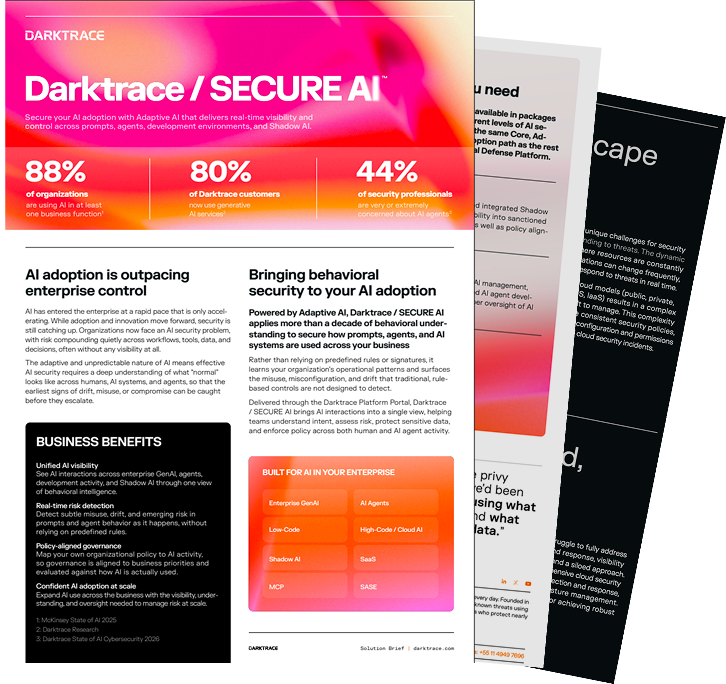
Over 80% of Darktrace’s customers now use generative AI services, and the average organization interacted with five different AI provides in August 20261. That level of adoption reflects how quickly AI has become embedded in day-to-day business operations. But as adoption accelerates, so do the opportunities for new forms of exposure that often operate outside traditional security controls. Prompts can expose sensitive information, an over-permissioned agent can turn a routine task into a serious security concern, and an employee using an unsanctioned AI tool to get work done can quietly introduce risk long before the security team is aware of its existence.
Securing AI isn’t a nice-to-have. It's an urgent, board-level requirement for any business that wants AI adoption to be an advantage rather than a liability.
Why traditional security controls fall short
The challenge isn’t a lack of AI security tools, it’s that most security solutions weren’t built for the way AI behaves.
AI systems are adaptive and, by nature, unpredictable. A prompt can be entirely benign in one context and a serious risk in another. An agent's permissions can look reasonable in isolation and dangerous the moment they're combined with what that agent is actually doing. Rule-based controls, built to catch known signatures and static policy violations, simply aren't designed to catch this kind of subtlety. They might be able to tell you what happened, but they can’t tell you if it mattered.
Effective AI security requires something different: a deep understanding of what normal looks like across every human, system, and agent in an environment, so the earliest signs of drift, misuse, or compromise stand out as they emerge.
Behavioral understanding is our foundation
Darktrace isn’t reinventing itself to secure AI. We’re extending what we already do. For over a decade, Darktrace has been built on a single premise – that every organization has its own unique, evolving way of operating, shaped by how its systems, users, and devices behave. Understanding that is the only reliable way to catch what rules and signatures miss. Our Adaptive AI™ continuously learns the distinct behaviors, relationships, and operational patterns of every enterprise it protects, building a Unique Behavioral Profile that no other vendor can replicate. It's how we've spent years interpreting ambiguity, uncovering subtle intent, and spotting drift before it becomes dangerous across networks, cloud, identities, email, OT, and endpoints. AI is a new domain, but behavioral security isn't a new discipline for us.
Introducing Darktrace / SECURE AI
Darktrace / SECURE AI helps organizations embrace AI innovation without losing control of how it is used. Delivered through the Darktrace Behavioral Defense Platform™, it provides visibility into AI activity across employees, agents, and AI systems, helping security teams understand how AI is being used throughout their business.
Darktrace then applies behavioral understanding to that activity, adding the context needed to distinguish routine usage from genuine risk. By understanding the relationships between users, agents, systems, and data, / SECURE AI helps organizations move beyond simply observing AI usage to understanding risk, governing behavior against policy, and enabling AI adoption with confidence. The result is greater oversight, stronger governance, and the ability to confidently accelerate AI innovation without creating unmanaged risk.
Securing your AI ecosystem
AI risk doesn't originate from a single source, and effective AI security can't focus on just one layer of the problem. Organizations need visibility, understanding, and governance across the entire AI ecosystem, from the prompts users submit and the agents they create, to the development environments where AI is built and the unsanctioned tools operating outside approved channels. Here's how Darktrace / SECURE AI helps organizations secure each of these areas.
Shadow AI management
Darktrace / SECURE AI helps security teams discover unsanctioned AI services and track usage trends over time using Darktrace telemetry and supported SASE integrations such as Microsoft Entra Global Secure Access. It also extends visibility to Model Context Protocol (MCP) usage, helping teams understand where AI tools and agents are connecting to external services. Through Darktrace platform integrations, organizations can block unsanctioned AI usage or quarantine affected devices when needed, helping them reduce exposure and guide users toward approved options.
AI prompt analysis
Prompts reveal what users are asking AI to do, what information they are sharing, and the outcomes they are trying to produce. Darktrace / SECURE AI provides visibility into prompts, sessions, and responses across supported platforms, including Microsoft Copilot, Copilot Studio, ChatGPT Enterprise, Claude, Salesforce, and AWS Bedrock2. Behavioral analysis detects activity such as attempted jailbreaks, sensitive data exposure, and potential indirect prompt injection, while risk scoring helps analysts prioritize the sessions that need attention. Policy Manager maps organizational AI policies against prompt activity and surfaces potential violations, helping teams govern AI use with direct evidence instead of relying on fragmented logs or inferred intent.
AI agent identities and actions
AI agents have their own permissions, roles, relationships, and access to systems and data. Darktrace / SECURE AI brings agent identities together with the users interacting with them, giving security teams visibility into access, sessions, and connections across supported environments. A real-time audit trail helps teams continuously evaluate whether an agent’s activity remains aligned with its intended purpose, so they can identify excessive access or behavioral drift before it becomes a security issue.
AI agent development risk management
Many AI risks are introduced during development, when agents are created, permissions are assigned, and connections to data sources are established. Darktrace / SECURE AI provides visibility across both low-code and high-code environments. In platforms such as AWS Bedrock, teams can examine AI architecture and the agent identities involved in development and deployment. In low-code environments, such as Copilot Studio, they can observe agents as they are created, monitor whether behavior stays aligned with their intended purpose, and connect prompt activity during development with behavior in production. This helps organizations address misconfigurations and excessive permissions before they reach production.
The promise of AI, secured
The question isn't whether to adopt AI, it's whether security teams can enable secure adoption that allows every business to benefit from AI’s potential.
Darktrace / SECURE AI is built to solve this problem – extending a decade of behavioral understanding to the newest, fastest-moving part of the enterprise, using the same principles which already protect people and hybrid infrastructure.
Darktrace / SECURE AI is generally available now. Discover the product, or get a demo today.
[related-resource]
[1] Based on aggregated Darktrace product telemetry across a fleet of ~8,200 observed deployments, measuring generative AI service usage across accounts monitored in August 2026. The 80%+ figure reflects the share of monitored accounts with any generative AI service usage during the same period.
[2] Microsoft, Copilot, ChatGPT, Claude, Salesforce, and Amazon Bedrock are trademarks of their respective owners.
Discover / SECURE AI
See how Darktrace / SECURE AI inspects prompts, sessions, and responses in real time to help organizations adopt AI securely.