
ブログ
/
Network
/
February 3, 2026

Darktrace Malware Analysis: Unpacking SnappyBee

his blog details how to unpack malware like SnappyBee, a modular backdoor linked to Salt Typhoon, revealing its custom packing, DLL sideloading, dynamic API resolution, and multi‑stage in‑memory decryption. It provides analysts with a step‑by‑step guide to extract hidden payloads and understand advanced evasion techniques by sophisticated malware strains.
Inside the SOC
Darktrace cyber analysts are world-class experts in threat intelligence, threat hunting and incident response, and provide 24/7 SOC support to thousands of Darktrace customers around the globe. Inside the SOC is exclusively authored by these experts, providing analysis of cyber incidents and threat trends, based on real-world experience in the field.
Written by
Nathaniel Bill
Malware Research Engineer
Default blog imageDefault blog imageDefault blog imageDefault blog imageDefault blog imageDefault blog image
03
Feb 2026

Introduction

The aim of this blog is to be an educational resource, documenting how an analyst can perform malware analysis techniques such as unpacking. This blog will demonstrate the malware analysis process against well-known malware, in this case SnappyBee.

SnappyBee (also known as Deed RAT) is a modular backdoor that has been previously attributed to China-linked cyber espionage group Salt Typhoon, also known as Earth Estries [1] [2]. The malware was first publicly documented by TrendMicro in November 2024 as part of their investigation into long running campaigns targeting various industries and governments by China-linked threat groups.

In these campaigns, SnappyBee is deployed post-compromise, after the attacker has already obtained access to a customer's system, and is used to establish long-term persistence as well as deploying further malware such as Cobalt Strike and the Demodex rootkit.

To decrease the chance of detection, SnappyBee uses a custom packing routine. Packing is a common technique used by malware to obscure its true payload by hiding it and then stealthily loading and executing it at runtime. This hinders analysis and helps the malware evade detection, especially during static analysis by both human analysts and anti-malware services.

This blog is a practical guide on how an analyst can unpack and analyze SnappyBee, while also learning the necessary skills to triage other malware samples from advanced threat groups.

First principles

Packing is not a new technique, and threat actors have generally converged on a standard approach. Packed binaries typically feature two main components: the packed data and an unpacking stub, also called a loader, to unpack and run the data.

Typically, malware developers insert a large blob of unreadable data inside an executable, such as in the .rodata section. This data blob is the true payload of the malware, but it has been put through a process such as encryption, compression, or another form of manipulation to render it unreadable. Sometimes, this data blob is instead shipped in a different file, such as a .dat file, or a fake image. When this happens, the main loader has to read this using a syscall, which can be useful for analysis as syscalls can be easily identified, even in heavily obfuscated binaries.

In the main executable, malware developers will typically include an unpacking stub that takes the data blob, performs one or more operations on it, and then triggers its execution. In most samples, the decoded payload data is loaded into a newly allocated memory region, which will then be marked as executable and executed. In other cases, the decoded data is instead dropped into a new executable on disk and run, but this is less common as it increases the likelihood of detection.

Finding the unpacking routine

The first stage of analysis is uncovering the unpacking routine so it can be reverse engineered. There are several ways to approach this, but it is traditionally first triaged via static analysis on the initial stages available to the analyst.

SnappyBee consists of two components that can be analyzed:

  • A Dynamic-link Library (DLL) that acts as a loader, responsible for unpacking the malicious code
  • A data file shipped alongside the DLL, which contains the encrypted malicious code

Additionally, SnappyBee includes a legitimate signed executable that is vulnerable to DLL side-loading. This means that when the executable is run, it will inadvertently load SnappyBee’s DLL instead of the legitimate one it expects. This allows SnappyBee to appear more legitimate to antivirus solutions.

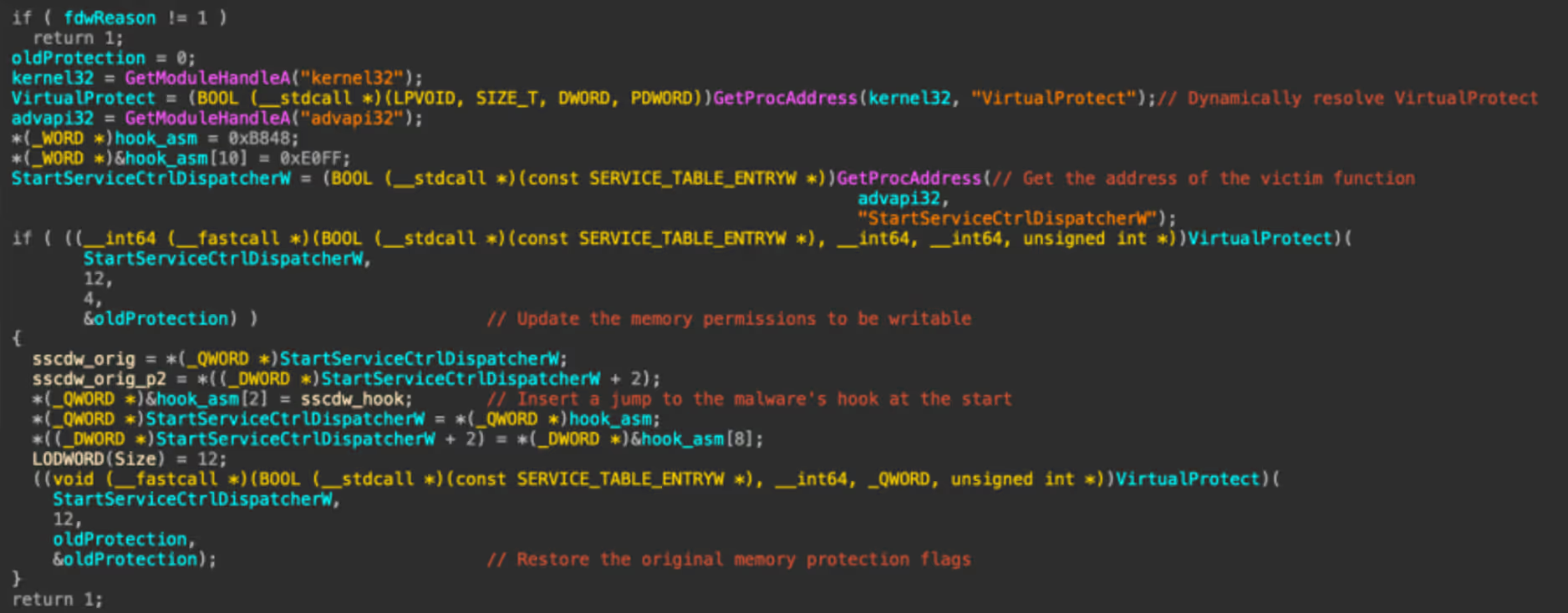
The first stage of analysis is performing static analysis of the DLL. This can be done by opening the DLL within a disassembler such as IDA Pro. Upon opening the DLL, IDA will display the DllMain function, which is the malware’s initial entry point and the first code executed when the DLL is loaded.
The DllMain function
Figure 1: The DllMain function

First, the function checks if the variable fdwReason is set to 1, and exits if it is not. This variable is set by Windows to indicate why the DLL was loaded. According to Microsoft Developer Network (MSDN), a value of 1 corresponds to DLL_PROCESS_ATTACH, meaning “The DLL is being loaded into the virtual address space of the current process as a result of the process starting up or as a result of a call to LoadLibrary” [3]. Since SnappyBee is known to use DLL sideloading for execution, DLL_PROCESS_ATTACH is the expected value when the legitimate executable loads the malicious DLL.

SnappyBee then uses the GetModule and GetProcAddress to dynamically resolve the address of the VirtualProtect in kernel32 and StartServiceCtrlDispatcherW in advapi32. Resolving these dynamically at runtime prevents them from showing up as a static import for the module, which can help evade detection by anti-malware solutions. Different regions of memory have different permissions to control what they can be used for, with the main ones being read, write, and execute. VirtualProtect is a function that changes the permissions of a given memory region.

SnappyBee then uses VirtualProtect to set the memory region containing the code for the StartServiceCtrlDispatcherW function as writable. It then inserts a jump instruction at the start of this function, redirecting the control flow to one of the SnappyBee DLL’s other functions, and then restores the old permissions.

In practice, this means when the legitimate executable calls StartServiceCtrlDispatcherW, it will immediately hand execution back to SnappyBee. Meanwhile, the call stack now appears more legitimate to outside observers such as antimalware solutions.

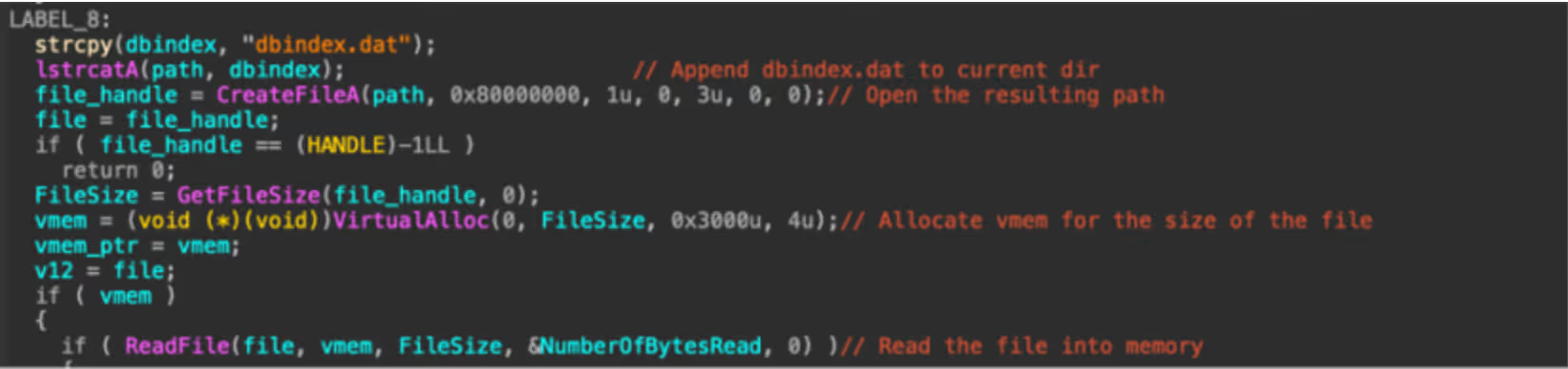
The hooked-in function then reads the data file that is shipped with SnappyBee and loads it into a new memory allocation. This pattern of loading the file into memory likely means it is responsible for unpacking the next stage.
The start of the unpacking routine that reads in dbindex.dat.
Figure 2: The start of the unpacking routine that reads in dbindex.dat.

SnappyBee then proceeds to decrypt the memory allocation and execute the code.

The memory decryption routine.
Figure 3: The memory decryption routine.

This section may look complex, however it is fairly straight forward. Firstly, it uses memset to zero out a stack variable, which will be used to store the decryption key. It then uses the first 16 bytes of the data file as a decryption key to initialize the context from.

SnappyBee then calls the mbed_tls_arc4_crypt function, which is a function from the mbedtls library. Documentation for this function can be found online and can be referenced to better understand what each of the arguments mean [4].
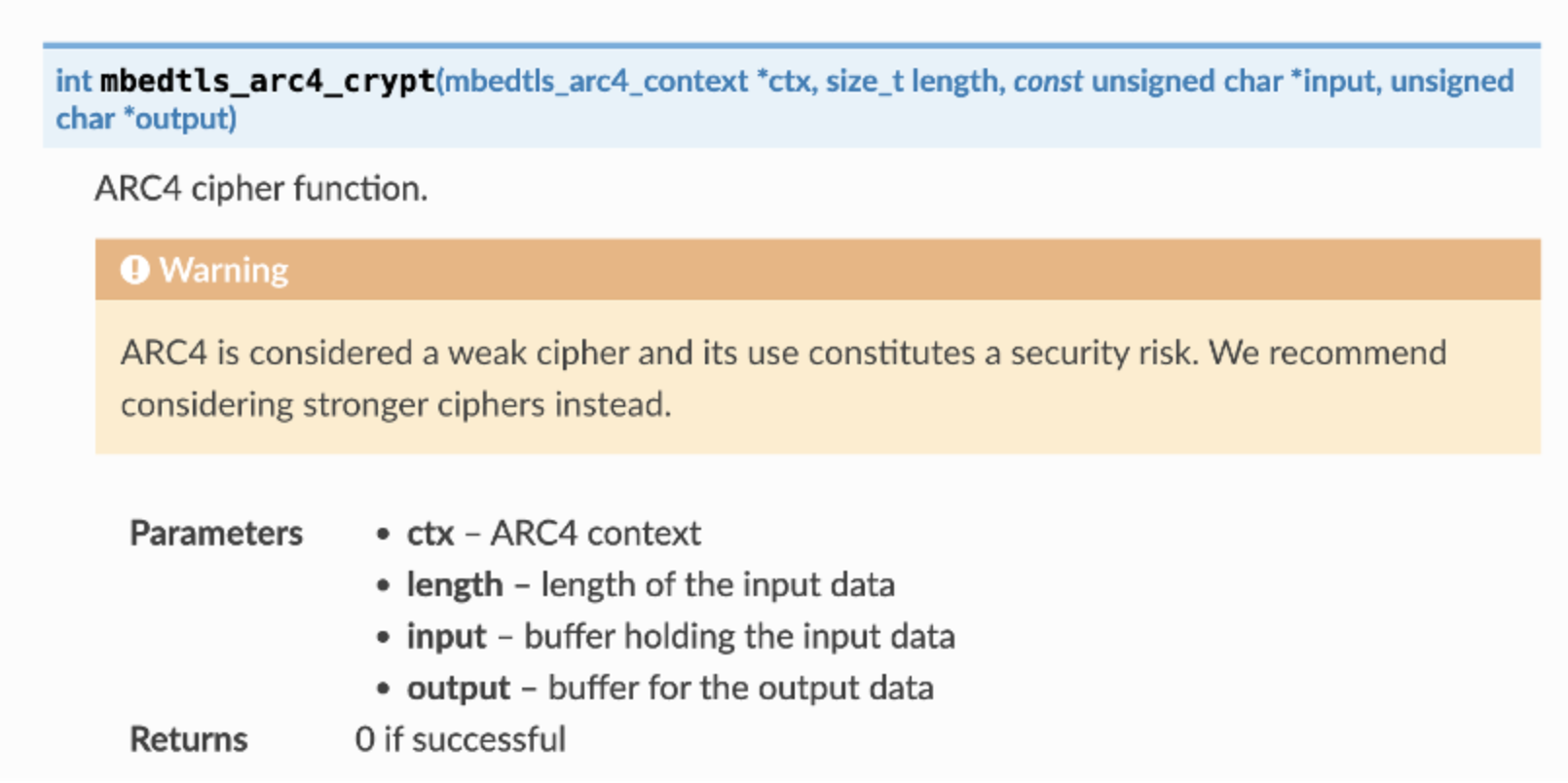
The documentation for mbedtls_arc4_crypt.
Figure 4: The documentation for mbedtls_arc4_ crypt.

Comparing the decompilation with the documentation, the arguments SnappyBee passes to the function can be decoded as:

  • The context derived from 16-byte key at the start of the data is passed in as the context in the first parameter
  • The file size minus 16 bytes (to account for the key at the start of the file) is the length of the data to be decrypted
  • A pointer to the file contents in memory, plus 16 bytes to skip the key, is used as the input
  • A pointer to a new memory allocation obtained from VirtualAlloc is used as the output

So, putting it all together, it can be concluded that SnappyBee uses the first 16 bytes as the key to decrypt the data that follows , writing the output into the allocated memory region.

SnappyBee then calls VirtualProtect to set the decrypted memory region as Read + Execute, and subsequently executes the code at the memory pointer. This is clearly where the unpacked code containing the next stage will be placed.

Unpacking the malware

Understanding how the unpacking routine works is the first step. The next step is obtaining the actual code, which cannot be achieved through static analysis alone.

There are two viable methods to retrieve the next stage. The first method is implementing the unpacking routine from scratch in a language like Python and running it against the data file.

This is straightforward in this case, as the unpacking routine in relatively simple and would not require much effort to re-implement. However, many unpacking routines are far more complex, which leads to the second method: allowing the malware to unpack itself by debugging it and then capturing the result. This is the approach many analysts take to unpacking, and the following will document this method to unpack SnappyBee.

As SnappyBee is 32-bit Windows malware, debugging can be performed using x86dbg in a Windows sandbox environment to debug SnappyBee. It is essential this sandbox is configured correctly, because any mistake during debugging could result in executing malicious code, which could have serious consequences.

Before debugging, it is necessary to disable the DYNAMIC_BASE flag on the DLL using a tool such as setdllcharacteristics. This will stop ASLR from randomizing the memory addresses each time the malware runs and ensures that it matches the addresses observed during static analysis.

The first place to set a breakpoint is DllMain, as this is the start of the malicious code and the logical place to pause before proceeding. Using IDA, the functions address can be determined; in this case, it is at offset 10002DB0. This can be used in the Goto (CTRL+G) dialog to jump to the offset and place a breakpoint. Note that the “Run to user code” button may need to be pressed if the DLL has not yet been loaded by x32dbg, as it spawns a small process to load the DLL as DLLs cannot be executed directly.

The program can then run until the breakpoint, at which point the program will pause and code recognizable from static analysis can be observed.
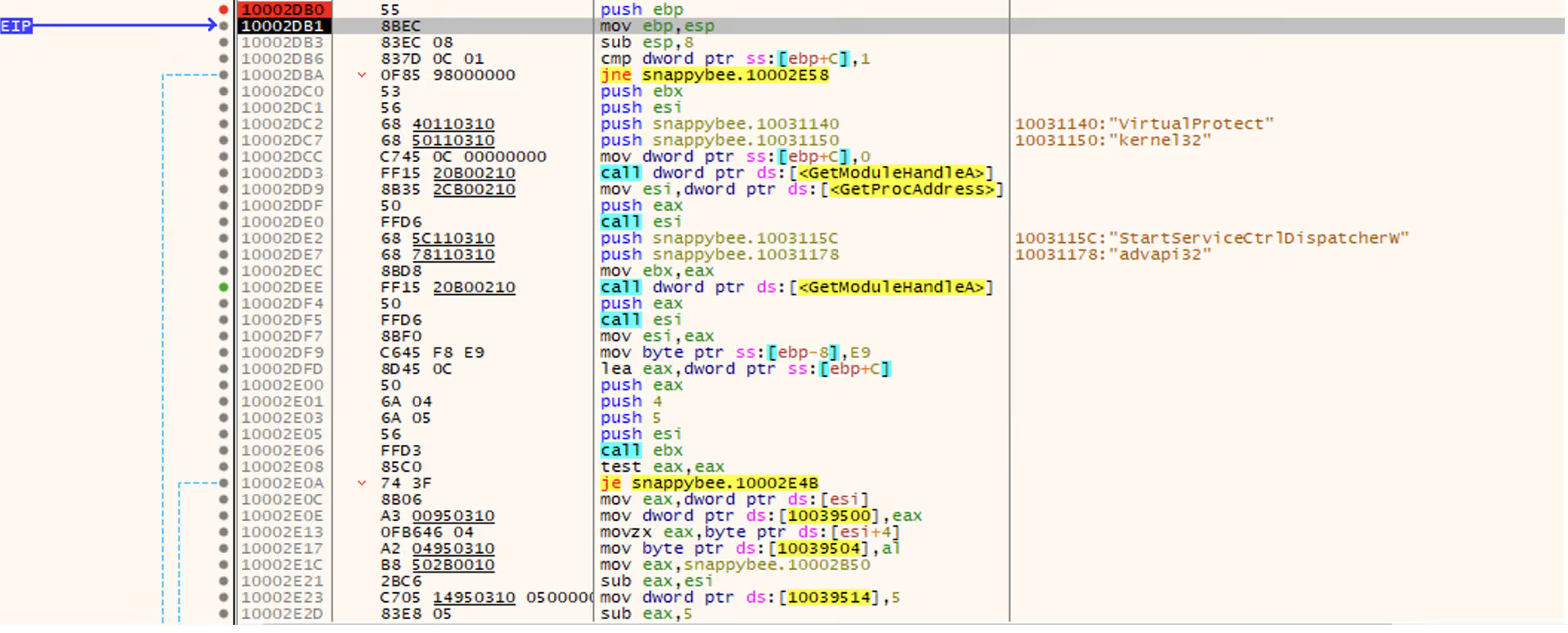
Figure 5: The x32dbg dissassembly listing forDllMain.

In the previous section, this function was noted as responsible for setting up a hook, and in the disassembly listing the hook address can be seen being loaded at offset 10002E1C. It is not necessary to go through the whole hooking process, because only the function that gets hooked in needs to be run. This function will not be naturally invoked as the DLL is being loaded directly rather than via sideloading as it expects. To work around this, the Extended Instruction Pointer (EIP) register can be manipulated to point to the start of the hook function instead, which will cause it to run instead of the DllMain function.

To update EIP, the CRTL+G dialog can again be used to jump to the hook function address (10002B50), and then the EIP register can be set to this address by right clicking the first instruction and selecting “Set EIP here”. This will make the hook function code run next.
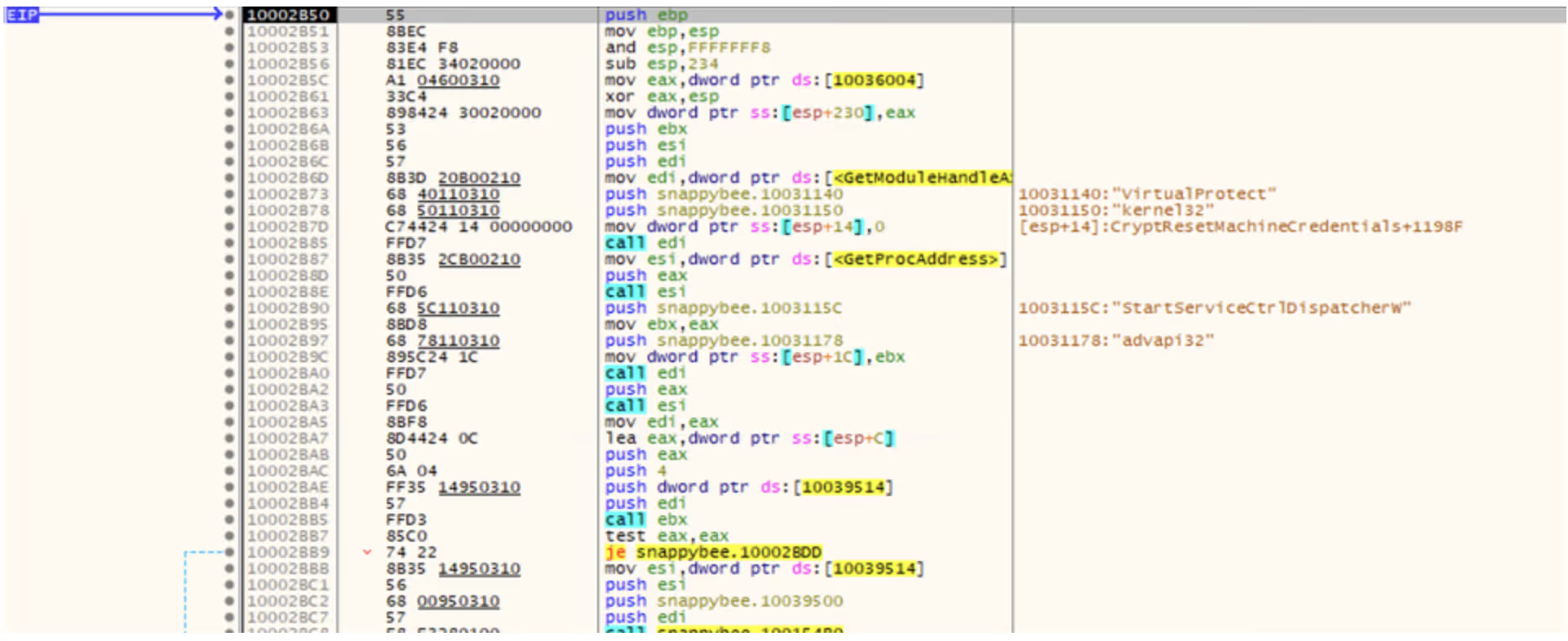
Figure 6: The start of the hookedin-in function

Once in this function, there are a few addresses where breakpoints should be set in order to inspect the state of the program at critical points in the unpacking process. These are:

-              10002C93, which allocates the memory for the data file and final code

-              10002D2D, which decrypts the memory

-              10002D81, which runs the unpacked code

Setting these can be done by pressing the dot next to the instruction listing, or via the CTRL+G Goto menu.

At the first breakpoint, the call to VirtualAlloc will be executed. The function returns the memory address of the created memory region, which is stored in the EAX register. In this case, the region was allocated at address 00700000.

Figure 7: The result of the VirtualAlloc call.

It is possible to right click the address and press “Follow in dump” to pin the contents of the memory to the lower pane, which makes it easy to monitor the region as the unpacking process continues.
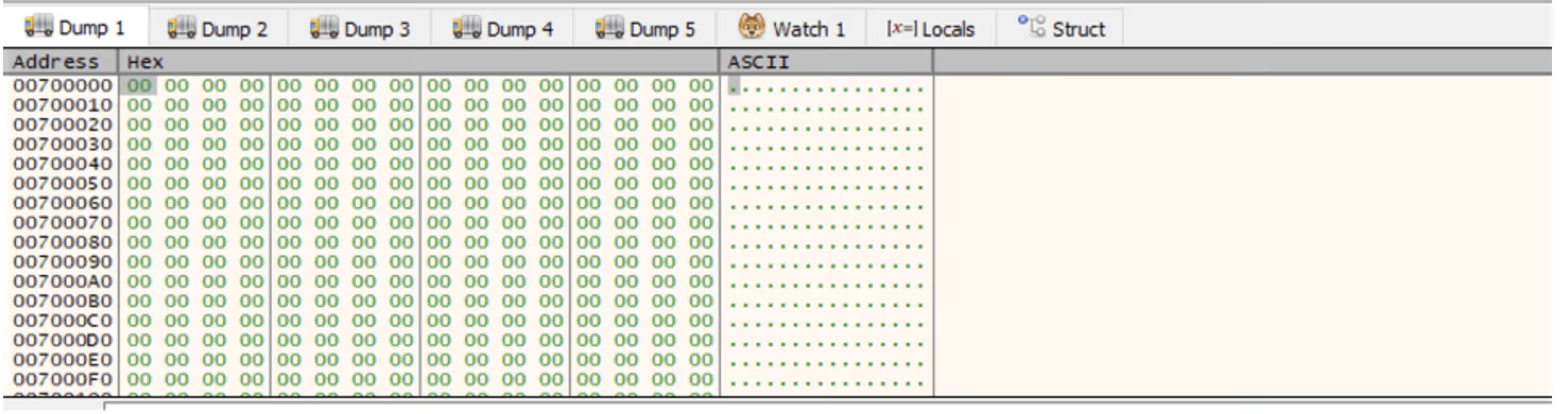
Figure 8: The allocated memory region shown in x32dbg’s dump.

Single-stepping through the application from this point eventually reaches the call to ReadFile, which loads the file into the memory region.

Figure 9: The allocated memory region after the file is read into it, showing high entropy data.

The program can then be allowed to run until the next breakpoint, which after single-stepping will execute the call to mbedtls_arc4_crypt to decrypt the memory. At this point, the data in the dump will have changed.
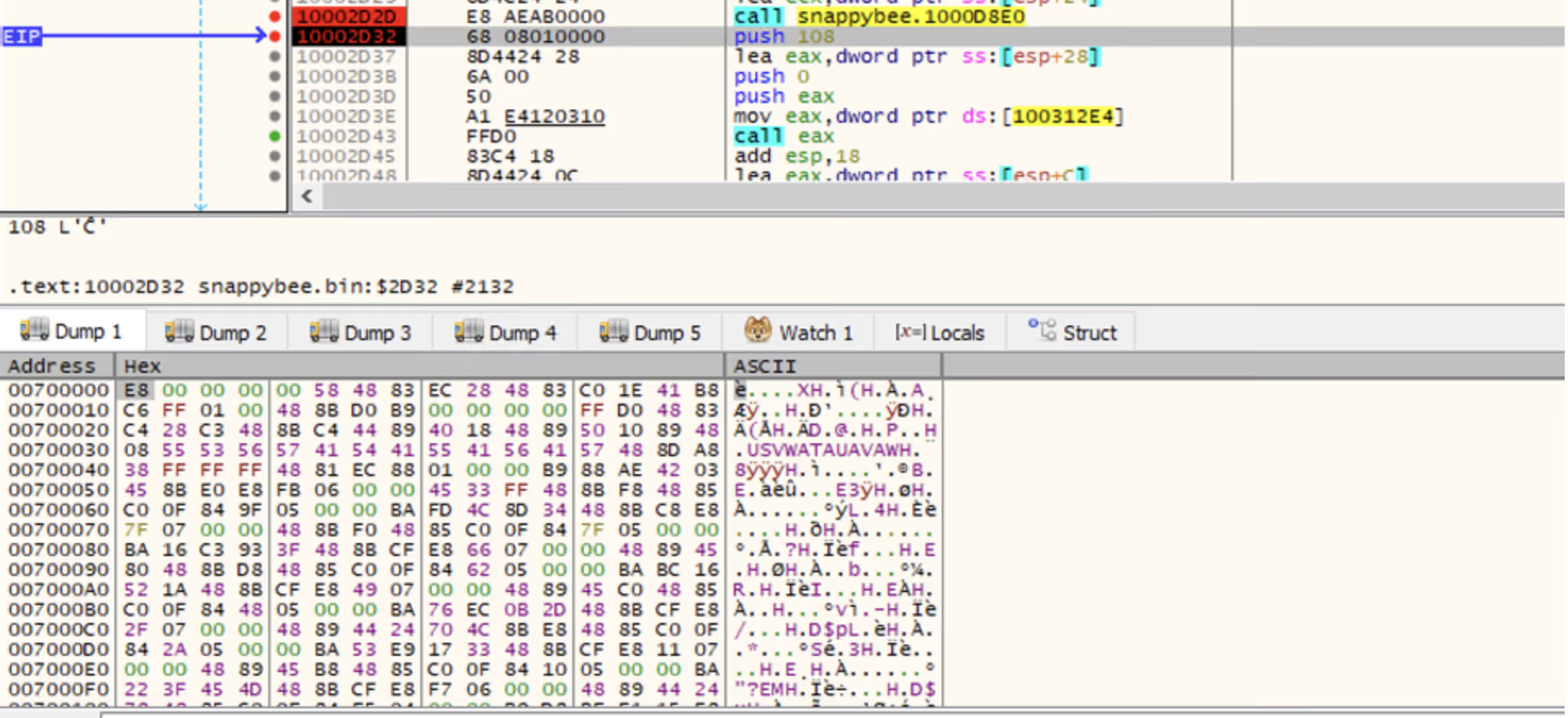
Figure 10: The same memory region after the decryption is run, showing lower entropy data.

Right-clicking in the dump and selecting "Disassembly” will disassemble the data. This yields valid shell code, indicating that the unpacking succeeded, whereas corrupt or random data would be expected if the unpacking had failed.
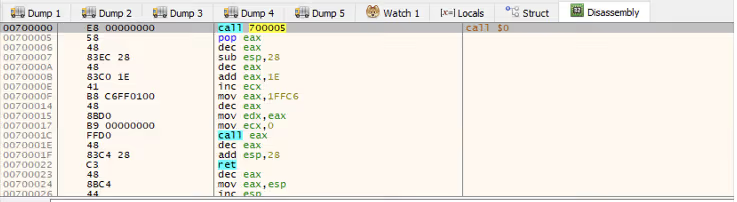
Figure 11: The disassembly view of the allocated memory.

Right-clicking and selecting “Follow in memory map” will show the memory allocation under the memory map view. Right-clicking this then provides an option to dump the entire memory block to file.

Figure 12: Saving the allocated memory region.

This dump can then be opened in IDA, enabling further static analysis of the shellcode. Reviewing the shellcode, it becomes clear that it performs another layer of unpacking.

As the debugger is already running, the sample can be allowed to execute up to the final breakpoint that was set on the call to the unpacked shellcode. Stepping into this call will then allow debugging of the new shellcode.

The simplest way to proceed is to single-step through the code, pausing on each call instruction to consider its purpose. Eventually, a call instruction that points to one of the memory regions that were assigned will be reached, which will contain the next layer of unpacked code. Using the same disassembly technique as before, it can be confirmed that this is more unpacked shellcode.
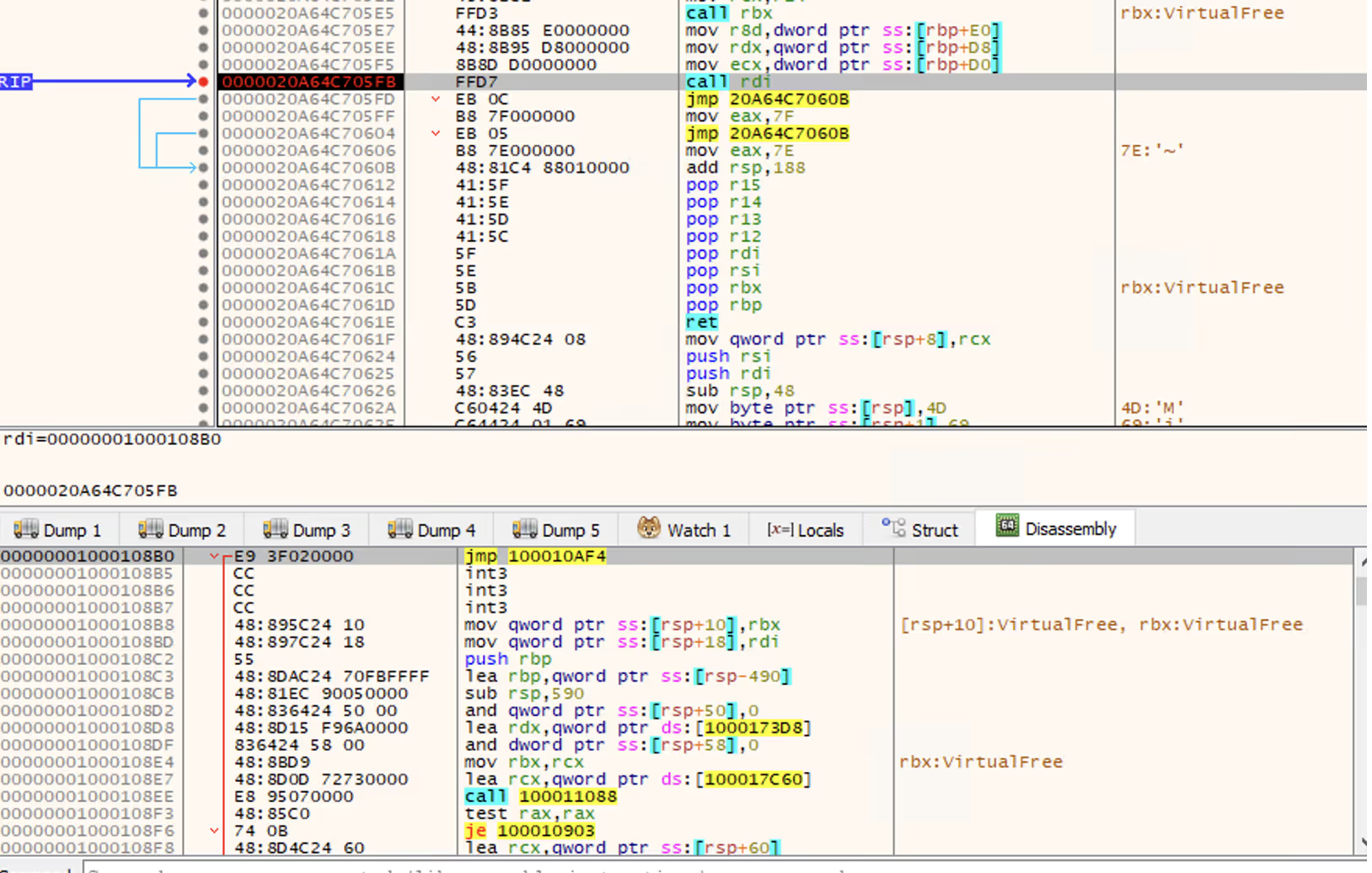
Figure 13: The unpacked shellcode’s call to RDI, which points to more unpacked shellcode. Note this screenshot depicts the 64-bit variant of SnappyBee instead of 32-bit, however the theory is the same.

Once again, this can be dumped out and analyzed further in IDA. In this case, it is the final payload used by the SnappyBee malware.

Conclusion

Unpacking remains one of the most common anti-analysis techniques and is a feature of most sophisticated malware from threat groups. This technique of in-memory decryption reduces the forensic “surface area” of the malware, helping it to evade detection from anti-malware solutions. This blog walks through one such example and provides practical knowledge on how to unpack malware for deeper analysis.

In addition, this blog has detailed several other techniques used by threat actors to evade analysis, such as DLL sideloading to execute code without arising suspicion, dynamic API resolving to bypass static heuristics, and multiple nested stages to make analysis challenging.

Malware such as SnappyBee demonstrates a continued shift towards highly modular and low-friction malware toolkits that can be reused across many intrusions and campaigns. It remains vital for security teams  to maintain the ability to combat the techniques seen in these toolkits when responding to infections.

While the technical details of these techniques are primarily important to analysts, the outcomes of this work directly affect how a Security Operations Centre (SOC) operates at scale. Without the technical capability to reliably unpack and observe these samples, organizations are forced to respond without the full picture.

The techniques demonstrated here help close that gap. This enables security teams to reduce dwell time by understanding the exact mechanisms of a sample earlier, improve detection quality with behavior-based indicators rather than relying on hash-based detections, and increase confidence in response decisions when determining impact.

Credit to Nathaniel Bill (Malware Research Engineer)
Edited by Ryan Traill (Analyst Content Lead)

Indicators of Compromise (IoCs)

SnappyBee Loader 1 - 25b9fdef3061c7dfea744830774ca0e289dba7c14be85f0d4695d382763b409b

SnappyBee Loader 2 - b2b617e62353a672626c13cc7ad81b27f23f91282aad7a3a0db471d84852a9ac          

SnappyBee Payload - 1a38303fb392ccc5a88d236b4f97ed404a89c1617f34b96ed826e7bb7257e296

References

[1] https://www.trendmicro.com/en_gb/research/24/k/earth-estries.html

[2] https://www.darktrace.com/blog/salty-much-darktraces-view-on-a-recent-salt-typhoon-intrusion

[3] https://learn.microsoft.com/en-us/windows/win32/dlls/dllmain#parameters

[4] https://mbed-tls.readthedocs.io/projects/api/en/v2.28.4/api/file/arc4_8h/#_CPPv418mbedtls_arc4_cryptP20mbedtls_arc4_context6size_tPKhPh

Inside the SOC
Darktrace cyber analysts are world-class experts in threat intelligence, threat hunting and incident response, and provide 24/7 SOC support to thousands of Darktrace customers around the globe. Inside the SOC is exclusively authored by these experts, providing analysis of cyber incidents and threat trends, based on real-world experience in the field.
Written by
Nathaniel Bill
Malware Research Engineer

More in this series

No items found.

Blog

/

Network

/

March 17, 2026

When Reality Diverges from the Playbook: Darktrace Identifies Encryption in a World Leaks Ransomware Attack

Default blog imageDefault blog image

As-a-Service Cybercrime Models

As-a-Service cybercrime models reduce the barrier to entry for cyber criminals as they no longer need expertise in every domain. Threat actors can increasingly outsource or supplement missing skills through the broader cybercrime-as-a-service ecosystem, and thus these models continue to grow in popularity within the cybercriminal underground. This has led to multiple templates in this sphere, such as Phishing-as-a-Service, Botnet-as-a-Service, DDoS-as-a-Service, and notably Ransomware-as-a-Service (RaaS) [1].

What is Extortion-as-a-Service?

Extortion-as-a-Service (EaaS) businesses function as a formalized way for cyber threat actors to offer extortion services to others for a fee or profit share and represents an evolution of extortion operations from the double-extortion ransomware model. Advancing from the RaaS model, extortion has become a distinct profit stream, separate from the encryption payload. This separation of functions, data theft, negotiation, and publicity, sets the stage for EaaS [1].

The EaaS model reflects a broader trend in cybercriminal activity, in which threat actors increasingly prioritize data theft and public exposure over traditional ransomware encryption. This shift reduces operational complexity while increasing pressure on victims through reputational damage. This approach has become increasingly popular among threat actors as, unlike encryption-based attacks, these operations are more difficult to detect and remediate [2]. It reflects a trend of ‘hack-and-leak’ operations that prioritize stealth, speed, and reputational damage over traditional encryption-based ransomware attacks [3].

World leaks overview

World Leaks emerged in early 2024 as a direct rebrand of the Hunters International ransomware group, which was notorious for encrypting victims’ data and demanding payment for decryption keys. In mid-2025, Hunters International shifted to an extortion-only model due to law enforcement scrutiny and reduced profitability, rebranding itself as World Leaks.

World Leaks functions as an affiliate-based EaaS operation which provides proprietary Storage Software exfiltration tooling to affiliates while maintaining a four-platform infrastructure consisting of a main data leak site hosted on the Dark Web where victim data is published, a victim negotiation portal with live chat, an affiliate management panel, and an insider journalist platform granting media outlets 24-hour advance access to stolen data before public release [4]. Since its emergence, World Leaks has published data stolen from dozens of organizations globally on its data leak site, serving both as a pressure tactic and a means for building reputation among cyber criminals.

World Leaks (known associations include Hive Ransomware, Secp0 Ransomware, and UNC6148) have been known to target the industrial (manufacturing) sector, along with healthcare organizations, technology firms and more generally, industries with valuable intellectual property [4]. Victims targeted have spanned multiple countries, with most located in the US, as well as Canada and several countries across Europe [5].

World Leaks’ Tactics, Techniques, and Procedures (TTPs) [3][4]

World Leaks’ typical attack pattern involves the exploitation of credentials with inadequate access controls, e.g. lacking multi-factor authentication (MFA), moving through reconnaissance, lateral movement and data exfiltration, notably without an encryption element.

Initial Access:

Initial access is typically gained through the exploitation of compromised virtual private network (VPN) credentials lacking MFA through valid accounts, as well as phishing campaigns. The targeting of internet-facing VPN infrastructure, RDP, and public-facing applications also represent common attack vectors in World Leaks incidents.

Lateral Movement:

SMB, RDP, and SSH are used for lateral movement via remote services. Notably, the group is also known to use PsExec and Rclone as part of their lateral movement activities.

Persistence:

Registry key modifications, scheduled tasks creation, account manipulation.

Exfiltration:

Data exfiltration is carried out through custom storage software tooling via TOR connections. Cloud storage services used for exfiltration particularly include MEGA. World Leaks also carry out direct data transfer through established command-and-control (C2) infrastructure.

Unlike Hunters International, which combined encryption with extortion, World Leaks claims to have abandoned the use of encryption. Some reports note that operations since January 2025 represent a pivot toward eliminating encryption entirely, instead relying on custom exfiltration tooling with SOCKSv5 proxy and TOR-based communications [4]. However, in early 2026, Darktrace detected an incident that directly contradicted this claim: World Leaks carried out an attack that involved both the exfiltration and encryption of customer data.

Darktrace’s Coverage of World Leaks Ransomware

Organizations today face a growing challenge: keeping pace with increasingly fast-moving threats. This incident highlights a common problem, when time-limited mitigations expire or human security teams cannot respond quickly enough, attackers are often able to regain the upper hand. A recent Darktrace detection of World Leaks ransomware provides a clear example of this challenge in practice.

In January 2026, Darktrace identified the presence of ransomware and data encryption linked to World Leaks within the network of an organization within the healthcare sector. Although Darktrace’s Autonomous Response capability was active in the customer’s environment and initially blocking suspicious connectivity, buying time for the customer to remediate, the attack continued once these mitigative actions expired. Darktrace continued to apply Autonomous Response actions as the attack progressed, working to inhibit the attackers at each stage of the intrusion.

Investigations carried out by Darktrace revealed that threat actors likely gained initial access via a Fortigate appliance in mid-October, indicating a three-month dwell time, before employing living-off-the-land (LOTL) techniques for lateral movement. C2 communications were established using Cloudflare Tunnel (formerly Argo Tunnel). As part of the Actions on Objectives attack phase, a significant volume of data was exfiltrated to the MEGA cloud storage platform, followed by the encryption of customer data.

Attack timeline

Initial access/ Lateral movement

Darktrace analysts identified the likely patient-zero device within the network as a Fortigate appliance. In October 2025, this device was seen conducting brute-force activity using the compromised ‘administrator’ credential to gain a foothold deeper within the customer’s environment. Masquerading as a privileged user, the threat actor then went on to launch activity on remote devices via PsExec, a common administrative tool that allows users to execute processes on remote systems without manually installing client software, providing significant power to attackers when abused. Around the time, Darktrace detected an unknown device on the network attempting to authenticate via NTLM. As this device had not previously been seen on the network, it likely belonged to the attacker.

Reconnaissance

As part of the reconnaissance phase of the attack, port and network scanning was carried out in an attempt to identify open UDP and TCP ports within the network.

Lateral movement/C2

Around one month after entering the customer’s network, the World Leaks threat actors began tunnelling activity using Cloudflare Tunnel. Darktrace detected connections to several hostnames including: region2.v2.argotunnel[.]com; h2.cftunnel[.]com; region1.v2.argotunnel[.]com. This tunnelling activity continued until January of 2026, when encryption occurred. Cloudflare tunnels are known to be abused by attackers as they enable the use of temporary infrastructure to scale operations, allowing rapid deployment and teardown. Furthermore, leveraging of Cloudflare’s infrastructure to create these rate-limited tunnels (used to relay traffic from an attacker-controlled server to a local machine) makes such malicious activity harder to detect by both defenders and traditional security measures, particularly those that rely on static blocklists [6].

Further lateral movement was carried out using common remote management tools such as Windows Remote Management (WinRM) RDP, allowing the World Leaks threat actors to access local devices within the victim organization’s network.

As this attack progressed, Darktrace detected multiple files being written over SMB. These files included Windows\Temp\chromeremotedesktophost.msi, which was written from the patient-zero device to another internal device as part of lateral movement efforts. Following this transfer, and prior to subsequent data exfiltration activity, a network server was observed connecting to the hostname remotedesktop-pa[.]googleapis[.]com, an API endpoint required for Chrome Remote Desktop, indicating that Chrome RDP was used by the threat actor in this stage of the attack.

Other files written over SMB included the script programdata\syc\OpenSSHUtils.psm1 (which can be used legitimately to configure OpenSSH) and the executable programdata\syc\ssh‑sk‑helper.exe (a legitimate OpenSSH component used to support security keys). These files were written from the suspected patient‑zero device to an internal domain controller using the ‘administrator’ credential.

Thereafter, SSH connections to external IP address 51.15.109[.]222 were observed, providing another channel between the malicious actors and victim machines. Darktrace recognized that the use of SSH by the devices seen connecting to this IP address was highly anomalous, indicating that this suspicious activity formed part of the attack.

Writes of the script programdata\syc\OpenSSHUtils.psm1 were also observed into January, highlighting the continuation of the attack that had begun three months earlier.

On December 19 and 20, Darktrace detected a DNS server within the customer’s network making anomalous outgoing connections to an external IP address not previously seen in the environment: 193.161.193[.]99. This IP address has been reported by open-source-intelligence (OSINT) as being associated with C2 infrastructure, having been linked to several remote access trojans (RATs) and botnets in the past.

This activity a shift towards the infrastructure-as-a-service (IaaS) model, underscoring the growing trend around As-a-Service Cybercrime models and the increasing the industrialization of botnets. The presence of extensive digital botnets, often leased to other criminal organizations, means the group gaining initial access is not necessarily the same group conducting ransomware deployment or data theft; botnets now act as shared underlying infrastructure enabling multiple forms of cybercriminal activity [7].

Furthermore, connections to this IP address (193.161.193[.]99) were made over port 1194, which is associated with OpenVPN, suggesting that World Leaks may have leveraged it to obfuscate C2 communication with attacker-controlled infrastructure.

Darktrace’s detection of the IP address 193.161.193[.]99, noting that it was first seen within the customer’s network on December 19, 2025.
Figure 1: Darktrace’s detection of the IP address 193.161.193[.]99, noting that it was first seen within the customer’s network on December 19, 2025.

Data exfiltration

In November, Darktrace detected the threat actors carrying out one of their Attack on Objective tactics: data exfiltration. Multiple local devices within the compromised network began transferring data to Backblaze and MEGA domains, both of which provide cloud storage services; 80+GB of data was transferred to MEGA in late December 2025. Endpoints associated with this activity included: backblazeb2[.]com and gfs302n520[.]userstorage[.]mega[.]co[.]nz, as well as related user agents such as AS40401 BACKBLAZE) and MegaClient/10.3.0/64.

Notably, Darktrace researchers identified two known World Leaks TTPs in this attack: the use of MEGA, a known tool abused by the group, and Rclone, a command-line tool used to manage files on cloud storage, which was observed in the user agent of the MEGA data-transfer connections: rclone/v1.69.0 [4].

Cyber AI Analyst Incident highlighting data upload activity to backblaze[.]com endpoints.
Figure 2: Cyber AI Analyst Incident highlighting data upload activity to backblaze[.]com endpoints.\

Ransomware deployment & encryption

The encryption stage of this attack was confirmed by the presence of a ransom note found on the network in a file with a seemingly randomized nine-character string preceding README.txt, attributing the incident to World Leaks, along with an extension with the same nine characters appended to encrypted files. Darktrace also observed SMB writes of files named world.exe and task.bat, with the compromised ‘localadmin’ credential used during the SMB logins. It is likely that these files served as the vector for the ransomware payload.

 Packet Capture (PCAP) of the ransom note claiming that the attack was carried out by World Leaks.
Figure 3: Packet Capture (PCAP) of the ransom note claiming that the attack was carried out by World Leaks.

Conclusion

Though traditional ransomware relies on encryption, recent trends show that cyber threat actors no longer need to rely on noisy encryption tools and can eliminate much of the risk and technical complexity associated with encrypting systems. This is the model reportedly preferred by World Leaks after their rebrand from Hunters International.

In addition to reducing noise around these attacks, extortion‑only operations may be favored by threat actors over encryption‑focused ones for several reasons, including the fact that traditional security tools may struggle to detect data theft compared to encryption, that attackers leave less evidence behind when encryption is avoided, and that the long‑term impacts of stolen data on organizations can be greater than the loss of systems caused by encryption processes, which can be restored [8]. This is supported by analysis of data leak sites suggesting that almost 1,500 incidents in 2025 relied on data theft alone. Attackers can simply steal victim data and attempt to extort a ransom by threatening to publish it, without needing to deploy ransomware at all [9]. Furthermore, although World Leaks aims to function as an affiliate‑based EaaS operation, security teams should remain aware that their affiliates may have different criminal objectives.

Contrary to reports that World Leaks’ typical attack style has an extortion‑only objective, Darktrace detected an incident in which a World Leaks attack did end with the encryption of customer data. This highlights the need for adaptive defenses and reinforces the importance of network defenders staying proactive in the face of attacks, particularly as they may progress in ways that are unexpected compared to previous trends associated with a given threat actor.

Credit to Tiana Kelly (Senior Cyber Analyst and Analyst Manager) and Emily Megan Lim (Senior Cyber Analyst)

Edited by Ryan Traill (Content Manager)

Appendices

IoCs

  • world.exe – Executable File – Possible Ransomware Payload
  • task.bat – Script File – Possible Ransomware Payload
  • ‘^[A-Z][a-z]{3}[A-Z][a-z][A-Z]{3}[.]README[.]txt' – Ransom Note
  • [.]^[A-Z][a-z]{3}[A-Z][a-z][A-Z]{3} – Ransomware file extension

·       51.15.109[.]222 – IP Address - Possible C2 Infrastructure

·       193.161.193[.]99 – IP Address – Probable C2 Infrastructure

Darktrace Model Detections (Enhanced Monitoring models denoted with an asterisk)

·      Device / Attack and Recon Tools

·      Device / Suspicious SMB Scanning Activity

·      Device / Anomalous NTLM Brute Force

·      Compliance / Connection to Tunnelling Service

·      Device / Suspicious New User Agents

·      Device / New or Unusual Remote Command Execution

·      Compliance / SMB Drive Write

·      Anomalous Connection / Uncommon 1 GiB Outbound

·      Compromise / Ransomware / Ransom or Offensive Words Written to SMB

·      Device / Multiple Lateral Movement Model Alerts*

·      Device / SMB Lateral Movement

·      Unusual Activity / Sustained Anomalous SMB Activity

·      Device / Large Number of Model Alerts

·      Compromise / Ransomware / SMB Reads then Writes with Additional Extensions

·      Compromise / Ransomware / Suspicious SMB Activity*

·      Anomalous File / Internal / Additional Extension Appended to SMB File

·      Unusual Activity / SMB Access Failures

·      Unusual Activity / Enhanced Unusual External Data Transfer*

·      Device / Suspicious File Writes to Multiple Hidden SMB Shares

·      Anomalous Server Activity / Rare External from Server

·      Unusual Activity / Unusual Mega Data Transfer*

·      Device / Possible SMB/NTLM Brute Force

·      Anomalous Connection / Unusual Admin RDP Session

·      Anomalous Connection / Active Remote Desktop Tunnel

·      Anomalous Connection / Data Sent to Rare Domain

·      Anomalous Connection / New or Uncommon Service Control

·      Anomalous Connection / New or Uncommon Service Enumeration

·      Anomalous Connection / Rare WinRM Outgoing

·      Anomalous Connection / SMB Enumeration

·      Anomalous Connection / Unusual Admin RDP Session

·      Anomalous Connection / Unusual Incoming Long Remote Desktop Session

·      Anomalous Connection / Upload via Remote Desktop

·      Anomalous File / Internal / Executable Uploaded to DC

·      Anomalous File / Internal / Unusual SMB Script Write

·      Compliance / SSH to Rare External Destination

·      Device / Anomalous Github Download

·      Device / Anonymous NTLM Logins

·      Device / Network Scan

·      Device / New or Uncommon WMI Activity

·      Device / New User Agent To Internal Server

·      Device / Possible Brute-Force Activity

·      Device / RDP Scan

·      Device / SMB Session Brute Force (Admin)

·      Device / SMB Session Brute Force (Non-Admin)

·      Device / Suspicious Network Scan Activity

·      Unusual Activity / Successful Admin Brute-Force Activity

·      Unusual Activity / Unusual External Data to New Endpoint

·      Unusual Activity / Unusual External Data Transfer

·      Unusual Activity / Unusual File Storage Data Transfer

·      User / New Admin Credentials on Server

Cyber AI Analyst Incidents

·      Scanning of Multiple Devices

·      Large Volume of SMB Login Failures to Multiple Devices

·      Suspicious Chain of Administrative Connections

·      SMB Write of Suspicious File

·      Suspicious DCE-RPC Activity

·      Unusual External Data Transfer

·      Unusual External Data Transfer to Multiple Related Endpoints

·      Unusual External Data Transfer to Endpoints

MITRE ATT&CK Mapping

·      Initial Access – T1190 – Exploit Public-Facing Application

·      Defense Evasion, Initial Access, Persistence, Privilege Escalation – T1078 – Valid Accounts

·      Resource Development – T1588.001 – Obtain Capabilities: Malware

·      Reconnaissance – T1590.005 – Gather Victim Network Information: IP Addresses

·      Reconnaissance – T1592.004 – Gather Victim Host Information: Client Configurations

·      Reconnaissance – T1595.001 – Active Scanning: Scanning IP Blocks

·      Reconnaissance – T1595.002 – Active Scanning: Vulnerability Scanning

·      Reconnaissance – T1595.003 – Active Scanning: Wordlist Scanning

·      Discovery – T1018 – Remote System Discovery

·      Discovery – T1046 – Network Service Discovery

·      Discovery – T1083 – File and Directory Discovery

·      Discovery – T1135 – Network Share Discovery

·      Command and Control – T1219 – Remote Access Tools

·      Command and Control – T1219.002 – Remote Access Tools: Remote Desktop Software

·      Command and Control – T1571 – Non-Standard Port

·      Command and Control – T1572 – Protocol Tunneling

·      Command and Control – T1573.001 – Encrypted Channel: Symmetric Cryptography

·      Credential Access – T1110 – Brute Force

·      Credential Access – T1110.001 – Brute Force: Password Guessing

·      Defense Evasion – T1006 – Direct Volume Access

·      Defense Evasion – T1564.005 – Hide Artifacts: Hidden File System

·      Defense Evasion – T1564.012 – Hide Artifacts: File/Path Exclusions

·      Execution – T1047 – Windows Management Instrumentation

·      Execution – T1569.002 – System Services: Service Execution

·      Lateral Movement – T1021 – Remote Services

·      Lateral Movement – T1021.001 – Remote Services: Remote Desktop Protocol

·      Lateral Movement – T1021.002 – Remote Services: SMB/Windows Admin Shares

·      Lateral Movement – T1021.006 – Remote Services: Windows Remote Management

·      Lateral Movement – T1080 – Taint Shared Content

·      Lateral Movement – T1210 – Exploitation of Remote Services

·      Lateral Movement – T1570 – Lateral Tool Transfer

·      Collection – T1039 – Data from Network Shared Drive

·      Collection – T1074 – Data Staged

·      Exfiltration – T1041 – Exfiltration Over C2 Channel

·      Exfiltration – T1048 – Exfiltration Over Alternative Protocol

·      Exfiltration – T1567.002 – Exfiltration Over Web Service: Exfiltration to Cloud Storage

References

[1] https://www.levelblue.com/blogs/levelblue-blog/extortion-as-a-service-the-latest-threat-actor-criminal-ecosystem/

[2] https://blackpointcyber.com/wp-content/uploads/2025/12/World-Leaks.pdf

[3] https://blackpointcyber.com/threat-profile/world-leaks-ransomware/

[4] https://www.halcyon.ai/threat-group/worldleaks

[5] https://www.moxfive.com/resources/moxfive-threat-actor-spotlight-world-leaks

[6] https://thehackernews.com/2024/08/cybercriminals-abusing-cloudflare.html

[7] https://www.trendmicro.com/vinfo/tw/security/news/threat-landscape/the-industrialization-of-botnets-automation-and-scale-as-a-new-threat-infrastructure

[8] https://www.morphisec.com/blog/ransomware-without-encryption-why-pure-exfiltration-attacks-are-surging-and-why-theyre-so-hard-to-catch/

[9] https://sed-cms.broadcom.com/sites/default/files/2026-01/RWN-2026-WP100_1.pdf

Continue reading
About the author
Tiana Kelly
Deputy Team Lead, London & Cyber Analyst

Blog

/

Network

/

March 11, 2026

NetSupport RAT: How Legitimate Tools Can Be as Damaging as Malware

Default blog imageDefault blog image

What is NetSupport Manager?

NetSupport Manager is a legitimate IT tool used by system administrators for remote support, monitoring, and management. In use since 1989, NetSupport Manager enables users to remotely access and navigate systems across different platforms and operating systems [1].

What is NetSupport RAT?

Although NetSupport Manager is a legitimate tool that can be used by IT and security professionals, there has been a rising number of cases in which it is abused to gain unauthorized access to victim systems. This misuse has become so prevalent that, in recent years, security researchers have begun referring to NetSupport as a Remote Access Trojan (RAT), a term typically used for malware that enables a threat actor to remotely access or control an infected device [2][3][4].

NetSupport RAT activity summary

The initial stages of NetSupport RAT infection may vary depending on the source of the initial compromise. Using tactics such as the social engineering tactic ClickFix, threat actors attempt to trick users into inadvertently executing malicious PowerShell commands under the guise of resolving a non-existent issue or completing a fake CAPTCHA verification [5]. Other attack vectors such as phishing emails, fake browser updates, malicious websites, search engine optimization (SEO) poisoning, malvertising and drive-by downloads are also employed to direct users to fraudulent pages and fake reCAPTCHA verification checks, ultimately inducing them to execute malicious PowerShell commands [5][6][7]. This leads to the successful installation of NetSupport Manager on the compromised device, which is often placed in non-standard directories such as AppData, ProgramData, or Downloads [3][8].

Once installed, the adversary is able to gain remote access to the affected machine, monitor user activity, exfiltrate data, communicate with the command-and-control (C2) server, and maintain persistence [5]. External research has also highlighted that post-exploitation of NetSupport RAT has involved the additional download of malicious payloads [2][5].

Attack flow diagram highlighting key events across each phase of the attack phase
Figure 1: Attack flow diagram highlighting key events across each phase of the attack phase [2][5].

Darktrace coverage

In November of 2025, suspicious behavior indicative of the malicious abuse of NetSupport Manager was observed on multiple customers across Europe, the Middle East, and Africa (EMEA) and the Americas (AMS).

While open-source intelligence (OSINT) has reported that, in a recent campaign, a threat actor impersonated government entities to trick users in organizations in the Information Technology, Government and Financial Services sectors in Central Asia into downloading NetSupport Manager [8], approximately a third of Darktrace’s affected customers in November were based in the US while the rest were based in EMEA. This contrast underscores how widely NetSupport Manager is leveraged by threat actors and highlights its accessibility as an initial access tool.  

The Darktrace customers affected were in sectors including Information and Communication, Manufacturing and Arts, entertainment and recreation.

The ClickFix social engineering tactic typically used to distribute the NetSupport RAT is known to target multiple industries, including Technology, Manufacturing and Energy sectors [9]. It also reflects activity observed in the campaign targeting Central Asia, where the Information Technology sector was among those affected [8].

The prevalence of affected Education customers highlights NetSupport’s marketing focus on the Education sector [10]. This suggests that threat actors are also aware of this marketing strategy and have exploited the trust it creates to deploy NetSupport Manager and gain access to their targets’ systems. While the execution of the PowerShell commands that led to the installation of NetSupport Manager falls outside of Darktrace's purview in cases identified, Darktrace was still able to identify a pattern of devices making connections to multiple rare external domains and IP addresses associated with the NetSupport RAT, using a wide range of ports over the HTTP protocol. A full list of associated domains and IP addresses is provided in the Appendices of this blog.

Although OSINT identifies multiple malicious domains and IP addresses as used as C2 servers, signature-based detections of NetSupport RAT indicators of compromise (IoCs) may miss broader activity, as new malicious websites linked to the RAT continue to appear.

Darktrace’s anomaly‑based approach allows it to establish a normal ‘pattern of life’ for each device on a network and identify when behavior deviates from this baseline, enabling the detection of unusual activity even when it does not match known IoCs or tactics, techniques and procedures (TTPs).

In one customer environment in late 2025, Darktrace / NETWORK detected a device initiating new connections to the rare external endpoint, thetavaluemetrics[.]com (74.91.125[.]57), along with the use of a previously unseen user agent, which it recognized as highly unusual for the network.

Darktrace’s detection of HTTP POST requests to a suspicious URI and new user agent usage.
Figure 2: Darktrace’s detection of HTTP POST requests to a suspicious URI and new user agent usage.

Darktrace identified that user agent present in connections to this endpoint was the ‘NetSupport Manager/1.3’, initially suggesting legitimate NetSupport Manager activity. Subsequent investigation, however, revealed that the endpoint was in fact a malicious NetSupportRAT C2 endpoint [12]. Shortly after, Darktrace detected the same device performing HTTP POST requests to the URI fakeurl[.]htm. This pattern of activity is consistent with OSINT reporting that details communication between compromised devices and NetSupport Connectivity Gateways functioning as C2 servers [11].

Conclusion

As seen not only with NetSupport Manager but with any legitimate or open‑source software used by IT and security professionals, the legitimacy of a tool does not prevent it from being abused by threat actors. Open‑source software, especially tools with free or trial versions such as NetSupport Manager, remains readily accessible for malicious use, including network compromise. In an age where remote work is still prevalent, validating any anomalous use of software and remote management tools is essential to reducing opportunities for unauthorized access.

Darktrace’s anomaly‑based detection enables security teams to identify malicious use of legitimate tools, even when clear signatures or indicators of compromise are absent, helping to prevent further impact on a network.


Credit to George Kim (Analyst Consulting Lead – AMS), Anna Gilbertson (Senior Cyber Analyst)

Edited by Ryan Traill (Analyst Content Lead)

Appendices

Darktrace Model Alerts

·       Compromise / Suspicious HTTP and Anomalous Activity

·       Compromise / New User Agent and POST

·       Device / New User Agent

·       Anomalous Connection / New User Agent to IP Without Hostname

·       Anomalous Connection / Posting HTTP to IP Without Hostname

·       Anomalous Connection / Multiple Failed Connections to Rare Endpoint

·       Anomalous Connection / Application Protocol on Uncommon Port

·       Anomalous Connection / Multiple HTTP POSTs to Rare Hostname

·       Compromise / Beaconing Activity To External Rare

·       Compromise / HTTP Beaconing to Rare Destination

·       Compromise / Agent Beacon (Medium Period)

·       Compromise / Agent Beacon (Long Period)

·       Compromise / Quick and Regular Windows HTTP Beaconing

·       Compromise / Sustained TCP Beaconing Activity To Rare Endpoint

·       Compromise / POST and Beacon to Rare External

Indicators of Compromise (IoCs)

Indicator           Type     Description

/fakeurl.htm URI            NetSupportRAT C2 URI

thetavaluemetrics[.]com        Connection hostname              NetSupportRAT C2 Endpoint

westford-systems[.]icu            Connection hostname              NetSupportRAT C2 Endpoint

holonisz[.]com                Connection hostname              NetSupportRAT C2 Endpoint

heaveydutyl[.]com      Connection hostname              NetSupportRAT C2 Endpoint

nsgatetest1[.]digital   Connection hostname              NetSupportRAT C2 Endpoint

finalnovel[.]com            Connection hostname              NetSupportRAT C2 Endpoint

217.91.235[.]17              IP             NetSupportRAT C2 Endpoint

45.94.47[.]224                 IP             NetSupportRAT C2 Endpoint

74.91.125[.]57                 IP             NetSupportRAT C2 Endpoint

88.214.27[.]48                 IP             NetSupportRAT C2 Endpoint

104.21.40[.]75                 IP             NetSupportRAT C2 Endpoint

38.146.28[.]242              IP             NetSupportRAT C2 Endpoint

185.39.19[.]233              IP             NetSupportRAT C2 Endpoint

45.88.79[.]237                 IP             NetSupportRAT C2 Endpoint

141.98.11[.]224              IP             NetSupportRAT C2 Endpoint

88.214.27[.]166              IP             NetSupportRAT C2 Endpoint

107.158.128[.]84          IP             NetSupportRAT C2 Endpoint

87.120.93[.]98                 IP             Rhadamanthys C2 Endpoint

References

  1. https://mspalliance.com/netsupport-debuts-netsupport-24-7/
  2. https://blogs.vmware.com/security/2023/11/netsupport-rat-the-rat-king-returns.html
  3. https://redcanary.com/threat-detection-report/threats/netsupport-manager/
  4. https://www.elastic.co/guide/en/security/8.19/netsupport-manager-execution-from-an-unusual-path.html
  5. https://rewterz.com/threat-advisory/netsupport-rat-delivered-through-spoofed-verification-pages-active-iocs
  6. https://thehackernews.com/2025/11/new-evalusion-clickfix-campaign.html
  7. https://corelight.com/blog/detecting-netsupport-manager-abuse
  8. https://thehackernews.com/2025/11/bloody-wolf-expands-java-based.html
  9. https://unit42.paloaltonetworks.com/preventing-clickfix-attack-vector
  10. https://www.netsupportsoftware.com/education-solutions
  11. https://www.esentire.com/blog/unpacking-netsupport-rat-loaders-delivered-via-clickfix
  12. https://threatfox.abuse.ch/browse/malware/win.netsupportmanager_rat/
  13. https://www.virustotal.com/gui/url/5fe6936a69c786c9ded9f31ed1242c601cd64e1d90cecd8a7bb03182c47906c2

Continue reading
About the author
George Kim
Analyst Consulting Lead – AMS
あなたのデータ × DarktraceのAI
唯一無二のDarktrace AIで、ネットワークセキュリティを次の次元へ