Blog
/
Network
/
July 24, 2025

Untangling the web: Darktrace’s investigation of Scattered Spider’s evolving tactics

Learn about a recent Scattered Spider attack observed by Darktrace, comparing tactics with those seen in previous attacks. Widespread use of LOTL techniques alongside continued changes in TTPs such as their recent use of Ransomware-as-a-Service (RaaS) platforms can make it challenging for security teams to harden defenses.
Inside the SOC
Darktrace cyber analysts are world-class experts in threat intelligence, threat hunting and incident response, and provide 24/7 SOC support to thousands of Darktrace customers around the globe. Inside the SOC is exclusively authored by these experts, providing analysis of cyber incidents and threat trends, based on real-world experience in the field.
Written by
Emma Foulger
Global Threat Research Operations Lead
man on computer doing work scattered spider cybersecurityDefault blog imageDefault blog imageDefault blog imageDefault blog imageDefault blog imageDefault blog image
24
Jul 2025

What is Scattered Spider?

Scattered Spider is a native English-speaking group, also referred to, or closely associated with, aliases such as UNC3944, Octo Tempest and Storm-0875. They are primarily financially motivated with a clear emphasis on leveraging social engineering, SIM swapping attacks, exploiting legitimate tooling as well as using Living-Off-the-Land (LOTL) techniques [1][2].

In recent years, Scattered Spider has been observed employing a shift in tactics, leveraging Ransomware-as-a-Service (RaaS) platforms in their attacks. This adoption reflects a shift toward more scalable attacks with a lower barrier to entry, allowing the group to carry out sophisticated ransomware attacks without the need to develop it themselves.

While RaaS offerings have been available for purchase on the Dark Web for several years, they have continued to grow in popularity, providing threat actors a way to cause significant impact to critical infrastructure and organizations without requiring highly technical capabilities [12].

This blog focuses on the group’s recent changes in tactics, techniques, and procedures (TTPs) reported by open-source intelligence (OSINT) and how TTPs in a recent Scattered Spider attack observed by Darktrace compare.

How has Scattered Spider been reported to operate?

First observed in 2022, Scattered Spider is known to target various industries globally including telecommunications, technology, financial services, and commercial facilities.

Overview of key TTPs

Scattered Spider has been known to utilize the following methods which cover multiple stages of the Cyber Kill Chain including initial access, lateral movement, evasion, persistence, and action on objective:

Social engineering [1]:

Impersonating staff via phone calls, SMS and Telegram messages; obtaining employee credentials (MITRE techniques T1598,T1656), multi-factor authentication (MFA) codes such as one-time passwords, or convincing employees to run commercial remote access tools enabling initial access (MITRE techniques T1204,T1219,T1566)

  • Phishing using specially crafted domains containing the victim name e.g. victimname-sso[.]com
  • MFA fatigue: sending repeated requests for MFA approval with the intention that the victim will eventually accept (MITRE technique T1621)

SIM swapping [1][3]:

  • Includes hijacking phone numbers to intercept 2FA codes
  • This involves the actor migrating the victim's mobile number to a new SIM card without legitimate authorization

Reconnaissance, lateral movement & command-and-control (C2) communication via use of legitimate tools:

  • Examples include Mimikatz, Ngrok, TeamViewer, and Pulseway [1]. A more recently reported example is Teleport [3].

Financial theft through their access to victim networks: Extortion via ransomware, data theft (MITRE technique T1657) [1]

Bring Your Own Vulnerable Driver (BYOVD) techniques [4]:

  • Exploiting vulnerable drivers to evade detection from Endpoint Detection and Response (EDR) security products (MITRE technique T1068) frequently used against Windows devices.

LOTL techniques

LOTL techniques are also closely associated with Scattered Spider actors once they have gained initial access; historically this has allowed them to evade detection until impact starts to be felt. It also means that specific TTPs may vary from case-to-case, making it harder for security teams to prepare and harden defences against the group.

Prominent Scattered Spider attacks over the years

While attribution is sometimes unconfirmed, Scattered Spider have been linked with a number of highly publicized attacks since 2022.

Smishing attacks on Twilio: In August 2022 the group conducted multiple social engineering-based attacks. One example was an SMS phishing (smishing) attack against the cloud communication platform Twilio, which led to the compromise of employee accounts, allowing actors to access internal systems and ultimately target Twilio customers [5][6].

Phishing and social engineering against MailChimp: Another case involved a phishing and social engineering attack against MailChimp. After gaining access to internal systems through compromised employee accounts the group conducted further attacks specifically targeting MailChimp users within cryptocurrency and finance industries [5][7].

Social engineering against Riot Games: In January 2023, the group was linked with an attack on video game developer Riot Games where social engineering was once again used to access internal systems. This time, the attackers exfiltrated game source code before sending a ransom note [8][9].

Attack on Caesars & MGM: In September 2023, Scattered Spider was linked with attacked on Caesars Entertainment and MGM Resorts International, two of the largest casino and gambling companies in the United States. It was reported that the group gathered nearly six terabytes of stolen data from the hotels and casinos, including sensitive information of guests, and made use of the RaaS strain BlackCat [10].

Ransomware against Marks & Spencer: More recently, in April 2025, the group has also been linked to the alleged ransomware incident against the UK-based retailer Marks & Spencer (M&S) making use of the DragonForce RaaS [11].

How a recent attack observed by Darktrace compares

In May 2025, Darktrace observed a Scattered Spider attack affecting one of its customers. While initial access in this attack fell outside of Darktrace’s visibility, information from the affected customer suggests similar social engineering techniques involving abuse of the customer’s helpdesk and voice phishing (vishing) were used for reconnaissance.

Initial access

It is believed the threat actor took advantage of the customer’s third-party Software-as-a-Service (SaaS) applications, such as Salesforce during the attack.

Such applications are a prime target for data exfiltration due to the sensitive data they hold; customer, personnel, and business data can all prove useful in enabling further access into target networks.

Techniques used by Scattered Spider following initial access to a victim network tend to vary more widely and so details are sparser within OSINT. However, Darktrace is able to provide some additional insight into what techniques were used in this specific case, based on observed activity and subsequent investigation by its Threat Research team.

Lateral movement

Following initial access to the customer’s network, the threat actor was able to pivot into the customer’s Virtual Desktop Infrastructure (VDI) environment.

Darktrace observed the threat actor spinning up new virtual machines and activating cloud inventory management tools to enable discovery of targets for lateral movement.

In some cases, these virtual machines were not monitored or managed by the customer’s security tools, allowing the threat actor to make use of additional tooling such as AnyDesk which may otherwise have been blocked.

Tooling in further stages of the attack sometimes overlapped with previous OSINT reporting on Scattered Spider, with anomalous use of Ngrok and Teleport observed by Darktrace, likely representing C2 communication. Additional tooling was also seen being used on the virtual machines, such as Pastebin.

 Cyber AI Analyst’s detection of C2 beaconing to a teleport endpoint with hostname CUSTOMERNAME.teleport[.]sh, likely in an attempt to conceal the traffic.
Figure 1: Cyber AI Analyst’s detection of C2 beaconing to a teleport endpoint with hostname CUSTOMERNAME.teleport[.]sh, likely in an attempt to conceal the traffic.

Leveraging LOTL techniques

Alongside use of third-party tools that may have been unexpected on the network, various LOTL techniques were observed during the incident; this primarily involved the abuse of standard network protocols such as:

  • SAMR requests to alter Active Directory account details
  • Lateral movement over RDP and SSH
  • Data collection over LDAP and SSH

Coordinated exfiltration activity linked through AI-driven analysis

Multiple methods of exfiltration were observed following internal data collection. This included SSH transfers to IPs associated with Vultr, alongside significant uploads to an Amazon S3 bucket.

While connections to this endpoint were not deemed unusual for the network at this stage due to the volume of traffic seen, Darktrace’s Cyber AI Analyst was still able to identify the suspiciousness of this behavior and launched an investigation into the activity.

Cyber AI Analyst successfully correlated seemingly unrelated internal download and external upload activity across multiple devices into a single, broader incident for the customer’s security team to review.

Cyber AI Analyst Incident summary showing a clear outline of the observed activity, including affected devices and the anomalous behaviors detected.
Figure 2: Cyber AI Analyst Incident summary showing a clear outline of the observed activity, including affected devices and the anomalous behaviors detected.
Figure 3: Cyber AI Analyst’s detection of internal data downloads and subsequent external uploads to an Amazon S3 bucket.

Exfiltration and response

Unfortunately, as Darktrace was not configured in Autonomous Response mode at the time, the attack was able to proceed without interruption, ultimately escalating to the point of data exfiltration.

Despite this, Darktrace was still able to recommend several Autonomous Response actions, aimed at containing the attack by blocking the internal data-gathering activity and the subsequent data exfiltration connections.

These actions required manual approval by the customer’s security team and as shown in Figure 3, at least one of the recommended actions was subsequently approved.

Had Darktrace been enabled in Autonomous Response mode, these measures would have been applied immediately, effectively halting the data exfiltration attempts.
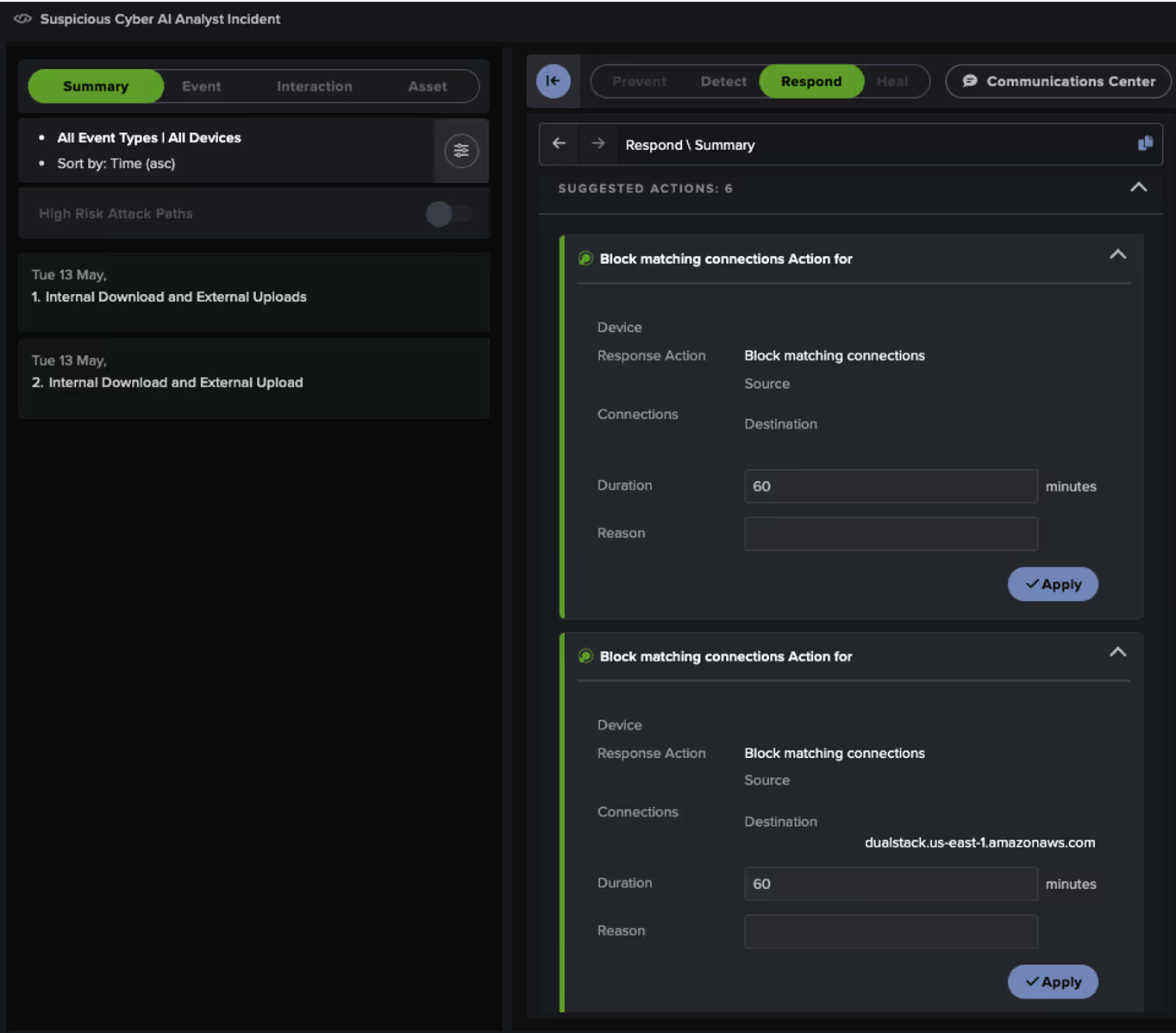
Further recommendations for Autonomous Response actions in Darktrace‘s Incident Interface, with surgical response targeting both the internal data collection and subsequent exfiltration.
Figure 4: Further recommendations for Autonomous Response actions in Darktrace‘s Incident Interface, with surgical response targeting both the internal data collection and subsequent exfiltration.

Scattered Spider’s use of RaaS

In this recent Scattered Spider incident observed by Darktrace, exfiltration appears to have been the primary impact. While no signs of ransomware deployment were observed here, it is possible that this was the threat actors’ original intent, consistent with other recent Scattered Spider attacks involving RaaS platforms like DragonForce.

DragonForce emerged towards the end of 2023, operating by offering their platform and capabilities on a wide scale. They also launched a program which offered their affiliates 80% of the eventual ransom, along with tools for further automation and attack management [13].

The rise of RaaS and attacker customization is fragmenting TTPs and indicators, making it harder for security teams to anticipate and defend against each unique intrusion.

While DragonForce appears to be the latest RaaS used by Scattered Spider, it is not the first, showcasing the ongoing evolution of tactics used the group.

In addition, the BlackCat RaaS strain was reportedly used by Scattered Spider for their attacks against Caesars Entertainment and MGM Resorts International [10].

In 2024 the group was also seen making use of additional RaaS strains; RansomHub and Qilin [15].

What security teams and CISOs can do to defend against Scattered Spider

The ongoing changes in tactics used by Scattered Spider, reliance on LOTL techniques, and continued adoption of evolving RaaS providers like DragonForce make it harder for organizations and their security teams to prepare their defenses against such attacks.

CISOs and security teams should implement best practices such as MFA, Single Sign-On (SSO), notifications for suspicious logins, forward logging, ethical phishing tests.

Also, given Scattered Spider’s heavy focus on social engineering, and at times using their native English fluency to their advantage, it is critical to IT and help desk teams are reminded they are possible targets.

Beyond social engineering, the threat actor is also adept at taking advantage of third-party SaaS applications in use by victims to harvest common SaaS data, such as PII and configuration data, that enable the threat actor to take on multiple identities across different domains.

With Darktrace’s Self-Learning AI, anomaly-based detection, and Autonomous Response inhibitors, businesses can halt malicious activities in real-time, whether attackers are using known TTPs or entirely new ones. Offerings such as Darktrace /Attack Surface Management enable security teams to proactively identify signs of malicious activity before it can cause an impact, while more generally Darktrace’s ActiveAI Security Platform can provide a comprehensive view of an organization’s digital estate across multiple domains.

Credit to Justin Torres (Senior Cyber Analyst), Emma Foulger (Global Threat Research Operations Lead), Zaki Al-Dhamari (Cyber Analyst), Nathaniel Jones (VP, Security & AI Strategy, FCISO), and Ryan Traill (Analyst Content Lead)

---------------------

The information provided in this blog post is for general informational purposes only and is provided "as is" without any representations or warranties, express or implied. While Darktrace makes reasonable efforts to ensure the accuracy and timeliness of the content related to cybersecurity threats such as Scattered Spider, we make no warranties or guarantees regarding the completeness, reliability, or suitability of the information for any purpose.

This blog post does not constitute professional cybersecurity advice, and should not be relied upon as such. Readers should seek guidance from qualified cybersecurity professionals or legal counsel before making any decisions or taking any actions based on the content herein.

No warranty of any kind, whether express or implied, including, but not limited to, warranties of performance, merchantability, fitness for a particular purpose, or non-infringement, is given with respect to the contents of this post.

Darktrace expressly disclaims any liability for any loss or damage arising from reliance on the information contained in this blog.

Appendices

References

[1] https://www.cisa.gov/news-events/cybersecurity-advisories/aa23-320a

[2] https://attack.mitre.org/groups/G1015/

[3] https://www.rapid7.com/blog/post/scattered-spider-rapid7-insights-observations-and-recommendations/

[4] https://www.crowdstrike.com/en-us/blog/scattered-spider-attempts-to-avoid-detection-with-bring-your-own-vulnerable-driver-tactic/

[5] https://krebsonsecurity.com/2024/06/alleged-boss-of-scattered-spider-hacking-group-arrested/?web_view=true

[6] https://www.cxtoday.com/crm/uk-teenager-accused-of-hacking-twilio-lastpass-mailchimp-arrested/

[7] https://mailchimp.com/newsroom/august-2022-security-incident/

[8] https://techcrunch.com/2023/02/02/0ktapus-hackers-are-back-and-targeting-tech-and-gaming-companies-says-leaked-report/

[9] https://www.pcmag.com/news/hackers-behind-riot-games-breach-stole-league-of-legends-source-code

[10] https://www.bbrown.com/us/insight/a-look-back-at-the-mgm-and-caesars-incident/

[11] https://cyberresilience.com/threatonomics/scattered-spider-uk-retail-attacks/

[12] https://www.crowdstrike.com/en-us/cybersecurity-101/ransomware/ransomware-as-a-service-raas/

[13] https://www.group-ib.com/blog/dragonforce-ransomware/
[14] https://blackpointcyber.com/wp-content/uploads/2024/11/DragonForce.pdf
[15] https://x.com/MsftSecIntel/status/1812932749314978191?lang=en

Select MITRE tactics associated with Scattered Spider

Tactic – Technique – Technique Name

Reconnaissance - T1598 -   Phishing for Information

Initial Access - T1566 – Phishing

Execution - T1204 - User Execution

Privilege Escalation - T1068 - Exploitation for Privilege Escalation

Defense Evasion - T1656 - Impersonation

Credential Access - T1621 - Multi-Factor Authentication Request Generation

Lateral Movement - T1021 - Remote Services

Command and Control - T1102 - Web Service

Command and Control - T1219 - Remote Access Tools

Command and Control - T1572 - Protocol Tunneling

Exfiltration - T1567 - Exfiltration Over Web Service

Impact - T1657 - Financial Theft

Select MITRE tactics associated with DragonForce

Tactic – Technique – Technique Name

Initial Access, Defense Evasion, Persistence, Privilege Escalation - T1078 - Valid Accounts

Initial Access, Persistence - T1133 - External Remote Services

Initial Access - T1190 - Exploit Public-Facing Application

Initial Access - T1566 – Phishing

Execution - T1047 - Windows Management Instrumentation

Privilege Escalation - T1068 - Exploitation for Privilege Escalation

Lateral Movement - T1021 - Remote Services

Impact - T1486 - Data Encrypted for Impact

Impact - T1657 - Financial Theft

Select Darktrace models

Compliance / Internet Facing RDP Server

Compliance / Incoming Remote Access Tool

Compliance / Remote Management Tool on Server

Anomalous File / Internet Facing System File Download

Anomalous Server Activity/ New User Agent from Internet Facing System

Anomalous Connection / Callback on Web Facing Device

Device / Internet Facing System with High Priority Alert

Anomalous Connection / Unusual Admin RDP

Anomalous Connection / High Priority DRSGetNCChanges

Anomalous Connection / Unusual Internal SSH

Anomalous Connection / Active Remote Desktop Tunnel

Compliance / Pastebin

Anomalous Connection / Possible Tunnelling to Rare Endpoint

Compromise / Beaconing Activity to External Rare

Device / Long Agent Connection to New Endpoint

Compromise / SSH to Rare External AWS

Compliance / SSH to Rare External Destination

Anomalous Server Activity / Outgoing from Server

Anomalous Connection / Large Volume of LDAP Download

Unusual Activity / Internal Data Transfer on New Device

Anomalous Connection / Download and Upload

Unusual Activity / Enhanced Unusual External Data Transfer

Compromise / Ransomware/Suspicious SMB Activity

Inside the SOC
Darktrace cyber analysts are world-class experts in threat intelligence, threat hunting and incident response, and provide 24/7 SOC support to thousands of Darktrace customers around the globe. Inside the SOC is exclusively authored by these experts, providing analysis of cyber incidents and threat trends, based on real-world experience in the field.
Written by
Emma Foulger
Global Threat Research Operations Lead

More in this series

No items found.

Blog

/

AI

/

December 23, 2025

How to Secure AI in the Enterprise: A Practical Framework for Models, Data, and Agents

How to secure AI in the enterprise: A practical framework for models, data, and agents Default blog imageDefault blog image

Introduction: Why securing AI is now a security priority

AI adoption is at the forefront of the digital movement in businesses, outpacing the rate at which IT and security professionals can set up governance models and security parameters. Adopting Generative AI chatbots, autonomous agents, and AI-enabled SaaS tools promises efficiency and speed but also introduces new forms of risk that traditional security controls were never designed to manage. For many organizations, the first challenge is not whether AI should be secured, but what “securing AI” actually means in practice. Is it about protecting models? Governing data? Monitoring outputs? Or controlling how AI agents behave once deployed?  

While demand for adoption increases, securing AI use in the enterprise is still an abstract concept to many and operationalizing its use goes far beyond just having visibility. Practitioners need to also consider how AI is sourced, built, deployed, used, and governed across the enterprise.

The goal for security teams: Implement a clear, lifecycle-based AI security framework. This blog will demonstrate the variety of AI use cases that should be considered when developing this framework and how to frame this conversation to non-technical audiences.  

What does “securing AI” actually mean?

Securing AI is often framed as an extension of existing security disciplines. In practice, this assumption can cause confusion.

Traditional security functions are built around relatively stable boundaries. Application security focuses on code and logic. Cloud security governs infrastructure and identity. Data security protects sensitive information at rest and in motion. Identity security controls who can access systems and services. Each function has clear ownership, established tooling, and well-understood failure modes.

AI does not fit neatly into any of these categories. An AI system is simultaneously:

  • An application that executes logic
  • A data processor that ingests and generates sensitive information
  • A decision-making layer that influences or automates actions
  • A dynamic system that changes behavior over time

As a result, the security risks introduced by AI cuts across multiple domains at once. A single AI interaction can involve identity misuse, data exposure, application logic abuse, and supply chain risk all within the same workflow. This is where the traditional lines between security functions begin to blur.

For example, a malicious prompt submitted by an authorized user is not a classic identity breach, yet it can trigger data leakage or unauthorized actions. An AI agent calling an external service may appear as legitimate application behavior, even as it violates data sovereignty or compliance requirements. AI-generated code may pass standard development checks while introducing subtle vulnerabilities or compromised dependencies.

In each case, no single security team “owns” the risk outright.

This is why securing AI cannot be reduced to model safety, governance policies, or perimeter controls alone. It requires a shared security lens that spans development, operations, data handling, and user interaction. Securing AI means understanding not just whether systems are accessed securely, but whether they are being used, trained, and allowed to act in ways that align with business intent and risk tolerance.

At its core, securing AI is about restoring clarity in environments where accountability can quickly blur. It is about knowing where AI exists, how it behaves, what it is allowed to do, and how its decisions affect the wider enterprise. Without this clarity, AI becomes a force multiplier for both productivity and risk.

The five categories of AI risk in the enterprise

A practical way to approach AI security is to organize risk around how AI is used and where it operates. The framework below defines five categories of AI risk, each aligned to a distinct layer of the enterprise AI ecosystem  

How to Secure AI in the Enterprise:

  • Defending against misuse and emergent behaviors
  • Monitoring and controlling AI in operation
  • Protecting AI development and infrastructure
  • Securing the AI supply chain
  • Strengthening readiness and oversight

Together, these categories provide a structured lens for understanding how AI risk manifests and where security teams should focus their efforts.

1. Defending against misuse and emergent AI behaviors

Generative AI systems and agents can be manipulated in ways that bypass traditional controls. Even when access is authorized, AI can be misused, repurposed, or influenced through carefully crafted prompts and interactions.

Key risks include:

  • Malicious prompt injection designed to coerce unwanted actions
  • Unauthorized or unintended use cases that bypass guardrails
  • Exposure of sensitive data through prompt histories
  • Hallucinated or malicious outputs that influence human behavior

Unlike traditional applications, AI systems can produce harmful outcomes without being explicitly compromised. Securing this layer requires monitoring intent, not just access. Security teams need visibility into how AI systems are being prompted, how outputs are consumed, and whether usage aligns with approved business purposes

2. Monitoring and controlling AI in operation

Once deployed, AI agents operate at machine speed and scale. They can initiate actions, exchange data, and interact with other systems with little human oversight. This makes runtime visibility critical.

Operational AI risks include:

  • Agents using permissions in unintended ways
  • Uncontrolled outbound connections to external services or agents
  • Loss of forensic visibility into ephemeral AI components
  • Non-compliant data transmission across jurisdictions

Securing AI in operation requires real-time monitoring of agent behavior, centralized control points such as AI gateways, and the ability to capture agent state for investigation. Without these capabilities, security teams may be blind to how AI systems behave once live, particularly in cloud-native or regulated environments.

3. Protecting AI development and infrastructure

Many AI risks are introduced long before deployment. Development pipelines, infrastructure configurations, and architectural decisions all influence the security posture of AI systems.

Common risks include:

  • Misconfigured permissions and guardrails
  • Insecure or overly complex agent architectures
  • Infrastructure-as-Code introducing silent misconfigurations
  • Vulnerabilities in AI-generated code and dependencies

AI-generated code adds a new dimension of risk, as hallucinated packages or insecure logic may be harder to detect and debug than human-written code. Securing AI development means applying security controls early, including static analysis, architectural review, and continuous configuration monitoring throughout the build process.

4. Securing the AI supply chain

AI supply chains are often opaque. Models, datasets, dependencies, and services may come from third parties with varying levels of transparency and assurance.

Key supply chain risks include:

  • Shadow AI tools used outside approved controls
  • External AI agents granted internal access
  • Suppliers applying AI to enterprise data without disclosure
  • Compromised models, training data, or dependencies

Securing the AI supply chain requires discovering where AI is used, validating the provenance and licensing of models and data, and assessing how suppliers process and protect enterprise information. Without this visibility, organizations risk data leakage, regulatory exposure, and downstream compromise through trusted integrations.

5. Strengthening readiness and oversight

Even with strong technical controls, AI security fails without governance, testing, and trained teams. AI introduces new incident scenarios that many security teams are not yet prepared to handle.

Oversight risks include:

  • Lack of meaningful AI risk reporting
  • Untested AI systems in production
  • Security teams untrained in AI-specific threats

Organizations need AI-aware reporting, red and purple team exercises that include AI systems, and ongoing training to build operational readiness. These capabilities ensure AI risks are understood, tested, and continuously improved, rather than discovered during a live incident.

Reframing AI security for the boardroom

AI security is not just a technical issue. It is a trust, accountability, and resilience issue. Boards want assurance that AI-driven decisions are reliable, explainable, and protected from tampering.

Effective communication with leadership focuses on:

  • Trust: confidence in data integrity, model behavior, and outputs
  • Accountability: clear ownership across teams and suppliers
  • Resilience: the ability to operate, audit, and adapt under attack or regulation

Mapping AI security efforts to recognized frameworks such as ISO/IEC 42001 and the NIST AI Risk Management Framework helps demonstrate maturity and aligns AI security with broader governance objectives.

Conclusion: Securing AI is a lifecycle challenge

The same characteristics that make AI transformative also make it difficult to secure. AI systems blur traditional boundaries between software, users, and decision-making, expanding the attack surface in subtle but significant ways.

Securing AI requires restoring clarity. Knowing where AI exists, how it behaves, who controls it, and how it is governed. A framework-based approach allows organizations to innovate with AI while maintaining trust, accountability, and control.

The journey to secure AI is ongoing, but it begins with understanding the risks across the full AI lifecycle and building security practices that evolve alongside the technology.

Continue reading
About the author
Brittany Woodsmall
Product Marketing Manager, AI & Attack Surface

Blog

/

AI

/

December 22, 2025

The Year Ahead: AI Cybersecurity Trends to Watch in 2026

2026 cyber threat trendsDefault blog imageDefault blog image

Introduction: 2026 cyber trends

Each year, we ask some of our experts to step back from the day-to-day pace of incidents, vulnerabilities, and headlines to reflect on the forces reshaping the threat landscape. The goal is simple:  to identify and share the trends we believe will matter most in the year ahead, based on the real-world challenges our customers are facing, the technology and issues our R&D teams are exploring, and our observations of how both attackers and defenders are adapting.  

In 2025, we saw generative AI and early agentic systems moving from limited pilots into more widespread adoption across enterprises. Generative AI tools became embedded in SaaS products and enterprise workflows we rely on every day, AI agents gained more access to data and systems, and we saw glimpses of how threat actors can manipulate commercial AI models for attacks. At the same time, expanding cloud and SaaS ecosystems and the increasing use of automation continued to stretch traditional security assumptions.

Looking ahead to 2026, we’re already seeing the security of AI models, agents, and the identities that power them becoming a key point of tension – and opportunity -- for both attackers and defenders. Long-standing challenges and risks such as identity, trust, data integrity, and human decision-making will not disappear, but AI and automation will increase the speed and scale of the cyber risk.  

Here's what a few of our experts believe are the trends that will shape this next phase of cybersecurity, and the realities organizations should prepare for.  

Agentic AI is the next big insider risk

In 2026, organizations may experience their first large-scale security incidents driven by agentic AI behaving in unintended ways—not necessarily due to malicious intent, but because of how easily agents can be influenced. AI agents are designed to be helpful, lack judgment, and operate without understanding context or consequence. This makes them highly efficient—and highly pliable. Unlike human insiders, agentic systems do not need to be socially engineered, coerced, or bribed. They only need to be prompted creatively, misinterpret legitimate prompts, or be vulnerable to indirect prompt injection. Without strong controls around access, scope, and behavior, agents may over-share data, misroute communications, or take actions that introduce real business risk. Securing AI adoption will increasingly depend on treating agents as first-class identities—monitored, constrained, and evaluated based on behavior, not intent.

-- Nicole Carignan, SVP of Security & AI Strategy

Prompt Injection moves from theory to front-page breach

We’ll see the first major story of an indirect prompt injection attack against companies adopting AI either through an accessible chatbot or an agentic system ingesting a hidden prompt. In practice, this may result in unauthorized data exposure or unintended malicious behavior by AI systems, such as over-sharing information, misrouting communications, or acting outside their intended scope. Recent attention on this risk—particularly in the context of AI-powered browsers and additional safety layers being introduced to guide agent behavior—highlights a growing industry awareness of the challenge.  

-- Collin Chapleau, Senior Director of Security & AI Strategy

Humans are even more outpaced, but not broken

When it comes to cyber, people aren’t failing; the system is moving faster than they can. Attackers exploit the gap between human judgment and machine-speed operations. The rise of deepfakes and emotion-driven scams that we’ve seen in the last few years reduce our ability to spot the familiar human cues we’ve been taught to look out for. Fraud now spans social platforms, encrypted chat, and instant payments in minutes. Expecting humans to be the last line of defense is unrealistic.

Defense must assume human fallibility and design accordingly. Automated provenance checks, cryptographic signatures, and dual-channel verification should precede human judgment. Training still matters, but it cannot close the gap alone. In the year ahead, we need to see more of a focus on partnership: systems that absorb risk so humans make decisions in context, not under pressure.

-- Margaret Cunningham, VP of Security & AI Strategy

AI removes the attacker bottleneck—smaller organizations feel the impact

One factor that is currently preventing more companies from breaches is a bottleneck on the attacker side: there’s not enough human hacker capital. The number of human hands on a keyboard is a rate-determining factor in the threat landscape. Further advancements of AI and automation will continue to open that bottleneck. We are already seeing that. The ostrich approach of hoping that one’s own company is too obscure to be noticed by attackers will no longer work as attacker capacity increases.  

-- Max Heinemeyer, Global Field CISO

SaaS platforms become the preferred supply chain target

Attackers have learned a simple lesson: compromising SaaS platforms can have big payouts. As a result, we’ll see more targeting of commercial off-the-shelf SaaS providers, which are often highly trusted and deeply integrated into business environments. Some of these attacks may involve software with unfamiliar brand names, but their downstream impact will be significant. In 2026, expect more breaches where attackers leverage valid credentials, APIs, or misconfigurations to bypass traditional defenses entirely.

-- Nathaniel Jones, VP of Security & AI Strategy

Increased commercialization of generative AI and AI assistants in cyber attacks

One trend we’re watching closely for 2026 is the commercialization of AI-assisted cybercrime. For example, cybercrime prompt playbooks sold on the dark web—essentially copy-and-paste frameworks that show attackers how to misuse or jailbreak AI models. It’s an evolution of what we saw in 2025, where AI lowered the barrier to entry. In 2026, those techniques become productized, scalable, and much easier to reuse.  

-- Toby Lewis, Global Head of Threat Analysis

Conclusion

Taken together, these trends underscore that the core challenges of cybersecurity are not changing dramatically -- identity, trust, data, and human decision-making still sit at the core of most incidents. What is changing quickly is the environment in which these challenges play out. AI and automation are accelerating everything: how quickly attackers can scale, how widely risk is distributed, and how easily unintended behavior can create real impact. And as technology like cloud services and SaaS platforms become even more deeply integrated into businesses, the potential attack surface continues to expand.  

Predictions are not guarantees. But the patterns emerging today suggest that 2026 will be a year where securing AI becomes inseparable from securing the business itself. The organizations that prepare now—by understanding how AI is used, how it behaves, and how it can be misused—will be best positioned to adopt these technologies with confidence in the year ahead.

Learn more about how to secure AI adoption in the enterprise without compromise by registering to join our live launch webinar on February 3, 2026.  

Continue reading
About the author
The Darktrace Community
Your data. Our AI.
Elevate your network security with Darktrace AI