Data security for AI
Definition Data security for AI
Enterprise AI adoption has changed the data security equation. Models, agents, and pipelines now process and transmit sensitive information in ways traditional controls weren't built to secure.
The data feeding those systems, including training sets, prompts, embeddings, and model outputs, has become one of the highest-value, least-governed targets in the environment — and the new attack surface security teams are responsible for safeguarding.
Blocking AI outright isn't realistic. Yet, ungoverned use exposes regulated, proprietary, and customer data to leakage, unintended training reuse, and adversarial misuse in ways that are difficult to reverse once they happen.
Securing AI starts with seeing it clearly.
What is AI data security?
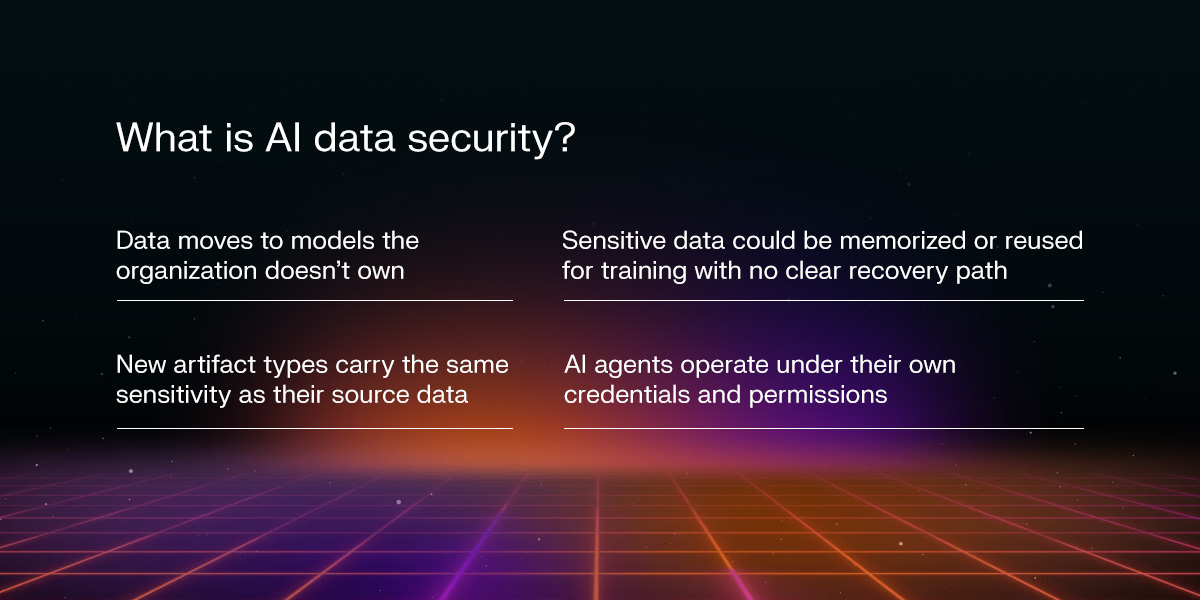
AI data security is the set of controls, policies, and detection capabilities that protect data as it moves into, through, and out of AI systems. Four realities set it apart from traditional data security:
- Data moves to models the organization doesn't own: SaaS LLMs, copilots, and embedded AI features sit entirely beyond the traditional data perimeter.
- Sensitive data could be memorized or reused for training with no clear recovery path: Once information enters a model, context could remain and resurface in unrelated outputs.
- New artifact types carry the same sensitivity as their source data: Prompts, embeddings, vector stores, and model outputs all require equivalent classification.
- AI agents operate under their own credentials and permissions: This trait expands the identity attack surface in ways identity access management wasn't designed to address.
Key data security risks introduced by AI
According to Darktrace research, 78% of CISOs say AI-powered cyber-threats are having a significant impact on their organization, reinforcing the need to map the risk landscape.
Sensitive data exposure to external models
Employees submit proprietary code, contracts, customer PII, and other sensitive data to public AI platforms, often without organizational visibility into what's being shared or with whom.
Once data enters a third-party model, recovery isn't guaranteed. It may be logged, retained, used for future training, or regenerated later through model inversion, with no way to unsubmit it.
Practitioner preference is shifting toward tools operating under enterprise data processing agreements or private, on-premises deployments, both of which keep data under organizational control.
Shadow AI and ungoverned data flows
Unsanctioned shadow AI spans the full stack, from browser plug-ins and personal accounts on approved SaaS platforms to embedded AI features inside already-approved apps and AI-native browsers. As a result, your perimeters are no longer where they used to be.
These flows create audit gaps and invisible data trails that make compliance challenging to demonstrate under privacy frameworks like GDPR, HIPAA, and CCPA. Volume isn't the only issue, however. Approved apps can turn AI-powered overnight without formal review, and static “allow” lists can't keep pace with a landscape that shifts that fast.
Prompt injection and model manipulation
Direct prompt injection manipulates a model through user-controlled input, while indirect injection relies on external content, such as emails or documents, to trigger unintended behavior.
Overly permissive agent tooling compounds the risk — an injected agent with broad access can exfiltrate data, bypass policy, or trigger downstream actions across connected systems.
Data poisoning in training pipelines is equally damaging. Adversaries compromise training data at the source to corrupt model behavior at deployment, a pattern the OWASP Top 10 for LLM Applications actively tracks to keep security professionals informed. Poisoned training data can introduce backdoors, biases, or behavioral changes that are difficult to detect post-deployment and harder to remediate without a full retrain.
Vector store compromise
Fine-tuning datasets, Retrieval-Augmented Generation (RAG) pipelines, and embeddings inherit the classification sensitivity of their source data, yet access controls on vector stores are frequently weaker than those applied to the source systems.
Improperly scoped vector stores can surface underlying records at retrieval time, bypassing protections on the original source entirely.
AI agent identity and permission sprawl
Autonomous agents operate through their own credentials, API keys, and integrations, often scoped for maximum functionality at deployment rather than least privilege. A single compromised or manipulated agent can reach data and systems that no human session would be granted in one interaction, exponentially expanding the potential blast radius. This kind of unchecked sprawl is part of the reason that 92% of security professionals surveyed have concerns about the security implications of AI deployment across their workforce.
AI-powered offensive activity against data

Research also reveals that 87% of survey respondents feel AI-driven malware attacks are increasing and growing more sophisticated. Adding to the challenge is that such attacks can be carried out at a speed that manual methods can't match. Adversaries use generative tooling to produce highly targeted phishing campaigns, deepfake-driven social engineering, and automated reconnaissance against data stores. Doing so results in a compressed attack timeline — targeted campaigns that once required significant time and effort can now be built and launched in minutes.
How to implement strong data security for AI
How to implement strong data security for AI
AI data risk can't be eliminated, but strong data security for AI can help mitigate it with the right blueprint.
Establish visibility into AI usage and data flows
Robust AI and data security protocols start with understanding use and data flow. Without this visibility layer, classification and policy downstream operate without ground truth, as teams can't govern what they can't see.
Begin with a comprehensive inventory of sanctioned and unsanctioned AI tools across SaaS, browsers, endpoints, and cloud. You'll need to update this regularly, since embedded AI features can evolve without any formal review cycle. From there, map data-to-model flows. Which datasets, moved by which users or agents, land in which models, and how often? Use the results as a baseline for enforcement policy development.
Classify and tag data before it reaches a model
Classification without enforcement is just documentation. Labels need to connect to runtime controls, not sit in a spreadsheet.
Apply or refresh data classification so regulated, proprietary, and customer data is labeled at the source, before it enters an AI pipeline. Those labels can drive runtime policy decisions, like what can be sent to which model class, what redaction applies, and what retention terms govern it.
Set acceptable-use and vendor-selection policies
Strict vendor controls separate the best AI tools for enterprise teams with secure data from those that undermine governance. As a result, look for technology that supports a stronger posture — no external training on customer data, encryption in transit and at rest, configurable retention, granular logging, and single sign-on with least-privilege access.
It's also best practice to define a clear acceptable-use policy for AI tools and align controls to the NIST AI Risk Management Framework and AI TRiSM, both of which provide structured ways to govern AI risk at the enterprise level.
Apply zero trust to models, agents, and pipelines
Agent credentials deserve the same scrutiny as privileged human identities, and arguably more, since agents can act autonomously and at scale.
Treat AI systems as first-class identities, not entities trusted by virtue of being internal or sanctioned. Apply zero trust principles to model endpoints, agent credentials, vector stores, and training pipelines. Also consider security approaches that scope permissions tightly, segment networks around AI workloads, and require continuous verification over one-time approval.
Detect and respond to AI-driven anomalies
Signature-based controls weren't built for prompt-driven data movement or agent activity, and they have no reference pattern for what normal looks like inside an agentic workflow.
Behavioral AI, sometimes called defensive AI, learns an organization's operational baseline, including its AI system interactions, then relies on continuous anomaly detection to surface deviations like unusual data egress or agent behavior outside learned parameters. That pairs with automated threat detection to close gaps that signature-based tools often leave behind.
Keep humans in the loop on autonomous response
Human-in-the-loop design isn't a limitation on defensive AI. Regulatory, legal, and operational contexts require accountability, and configurable autonomy should be the goal, not a ceiling. Only 14% of security professionals allow AI to take independent remediation actions today, while 70% require human approval before any action is taken.
Where AI takes or recommends response actions, such as containing a session or isolating a compromised agent, teams need auditability, configurable autonomy levels, and clear escalation paths.
Learn more about securing prompts, agents, and shadow AI
Multilayered data security for AI results in a coordinated program built on visibility, classification, policy, zero trust, behavioral detection, and human-in-the-loop response.
The enterprises getting this right adopt AI deliberately, govern it with intention, and pair it with defensive AI capable of keeping pace with adversaries rather than only recognizing familiar attack patterns.
If you're ready to see what that looks like in practice, learn more about Darktrace's approach to securing AI or explore real-world applications on the blog.