What is a remote access trojan?
The differences between RATs and other malware
While RATs are a form of malware, they have key distinctions:
- RATs versus viruses: Unlike viruses, RATs typically don't self-replicate, and they rely on adversaries for distribution. Viruses often insert their code into other files or programs and spread through those to infect as many as possible.
- RATs versus worms: Worms are designed for independence, so they can spread to other systems without user assistance. Like viruses, worms also generally self-replicate.
- RATs versus spyware: Spyware's primary purpose is to capture user information without consent. While a RAT can be used for those activities, remote access offers far more capabilities than spyware.
Several high-profile RAT attacks exemplify the damaging power of this malware. Examples include:
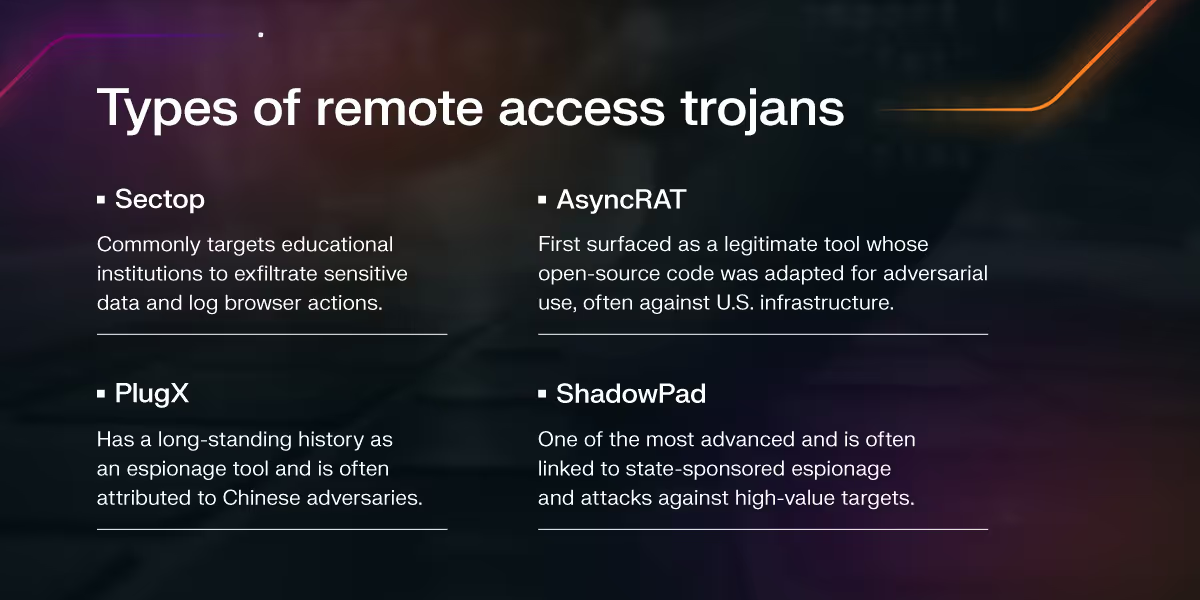
- Sectop: This RAT commonly targets educational institutions to exfiltrate sensitive data and log browser actions.
- AsyncRAT: This RAT first surfaced as a legitimate tool whose open-source code was adapted for adversarial use, often against U.S. infrastructure.
- PlugX: This RAT has a long-standing history as an espionage tool and is often attributed to Chinese adversaries.
- ShadowPad: This RAT is one of the most advanced and is often linked to state-sponsored espionage and attacks against high-value targets.
- Triton RAT: A Python-based remote access trojan that uses Telegram for command and control. Darktrace's Triton RAT investigation identified malicious capabilities including keylogging, credential theft, and the extraction of Roblox security cookies.
Actionable tips for preventing RATs
When considering how to stop a remote access trojan, ensure your strategy includes multiple layers of security for better protection and defense. The following tips can help you design a customized approach based on your needs.
1. Invest in user education and access control measures
In the modern distributed work environment, users access company resources from various devices and locations. Not all have the same stringent security as company-controlled assets, which means an expanded attack surface. Yet, deploying an agent on every device is impractical and unsustainable.
Design your strategy with a careful balance between access control and operational efficiency. Enforce options like zero trust architecture, identity access management, and the principle of least privilege to help oversee digital identities and control their resource access.
Building a culture of cybersecurity in your workforce is equally important, especially as attacks evolve. Invest in regular training to test and improve awareness, transforming every user into a proactive line of defense.
2. Implement secure remote access solutions
Secure remote access solutions provide another layer of protection against RAT infections.
Go beyond a traditional virtual private network (VPN) and look for those offering advanced features, like split tunneling and kill switches. Reinforce VPNs with secure gateways that provide granular control and context-aware access based on user ID, location, and device health.
Cloud-native businesses should consider customized Secure Access Service Edge (SASE) solutions to integrate multiple security functions into a single platform. Identity-driven access control coupled with dynamic adaptation capabilities will help keep pace with an evolving threat landscape.
3. Leverage behavioral analysis tools to detect anomalies
RATs often use legitimate tools and processes to blend in with normal system activity, evading detection by traditional signature-based cybersecurity tools.
Behavioral analysis solutions effectively address this issue with powerful anomaly detection that can indicate a RAT. These tools transcend the limited capabilities of signature-based security and proactively identify subtle patterns like:
- Unusual network traffic
- Unauthorized access to sensitive data or privileged accounts
- User behavior that's inconsistent with established baselines
- Suspicious process executions
- Living off the land techniques
Maximize your investment by seeking options that provide advanced features like machine learning capabilities, real-time threat detection, and configurable security alerts. Ensure the tools you select integrate with your other security solutions, like SOARs, to avoid security gaps.
4. Secure your network as the first line of defense
Just as a perimeter fence provides a physical property barrier, your network is the boundary between your infrastructure and the outside world — ideal as the first control point.
Proactively securing your network starts with comprehensive visibility into traffic and practical measures for controlling it.
Consider network segmentation to isolate crucial assets and guard against lateral movement with rigid access control. Enhance your protection with firewalls configured with well-developed security policies and protocols.
Investing in network detection and response (NDR) solutions gives your organization an extra layer of security against network-based threats like RATs. These advanced tools combine threat intelligence with proactive threat hunting, real-time detection, and automated investigation to help eliminate alert fatigue and false positives. Plus, NDR seamlessly integrates with SASE to strengthen your overall security posture in the distributed environment.